
Lecture 2 Peter the Greats Reforms monuments to
- Slides: 37
Lecture 2: Peter the Great’s Reforms, monuments to Peter the Great, after Peter I
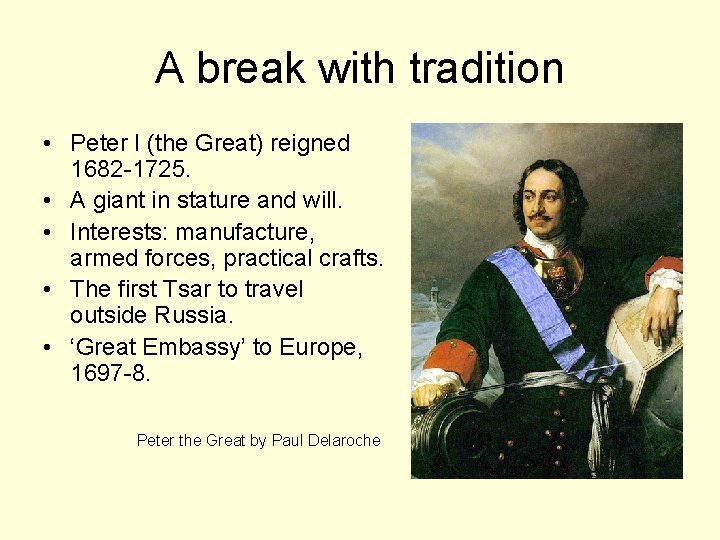
A break with tradition • Peter I (the Great) reigned 1682 -1725. • A giant in stature and will. • Interests: manufacture, armed forces, practical crafts. • The first Tsar to travel outside Russia. • ‘Great Embassy’ to Europe, 1697 -8. Peter the Great by Paul Delaroche
A military state • 1698 – brutal suppression of the Streltsy revolt. • Wars with Sweden, Turkey and campaigns in the Middle East. • Creation of a Russian navy. • Many reforms driven by the need to power the military machine.
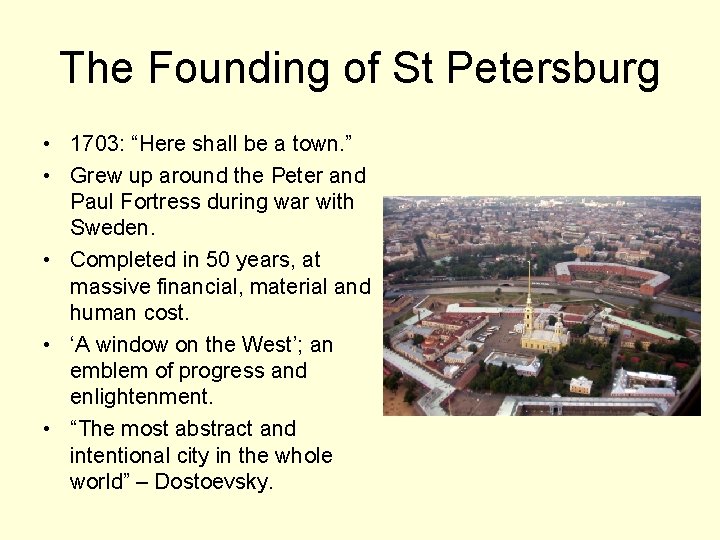
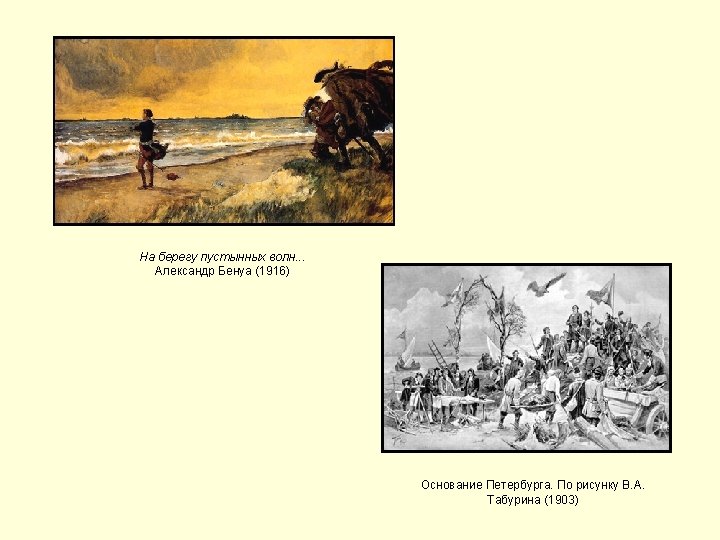
The Founding of St Petersburg • 1703: “Here shall be a town. ” • Grew up around the Peter and Paul Fortress during war with Sweden. • Completed in 50 years, at massive financial, material and human cost. • ‘A window on the West’; an emblem of progress and enlightenment. • “The most abstract and intentional city in the whole world” – Dostoevsky.
Westernisation • 1700: imposition of Western dress on Russian gentry – shaving of beards, frock coats instead of kaftans. • A symbol of Peter’s will and of the tone of his reforms. • Stark division between gentry and peasantry. • Resistance: Peter was called ‘the Antichrist’ by some (‘Old Believers’). • Peter adopts title of imperator (Emperor), 1721.
The Table of Ranks • Peter systematised the principle of gentry service to the State. • Compulsory education (often abroad), followed by army, navy or civil service. • Table of Ranks instituted in 1722. 14 ranks, equivalent across the army, navy and civil service • This stimulated a great preoccupation with social rank and promotion (which is depicted – often satirised - in works of Russian literature)
Cultural revolution • Subordination of Church to State: creation of the Holy Synod, 1721. Subordination of Russian Orthodox Church: in this respect Peter has been compared to Bolsheviks after 1917 • Development of the education system. • Founding of the Russian Academy of Sciences. • Adoption of the Julian calendar in 1700. • Simplification of the Cyrillic alphabet. • Publication of the first newspaper, Vedomosti (News) and secular books. • Women encouraged to ‘come out’ into society.
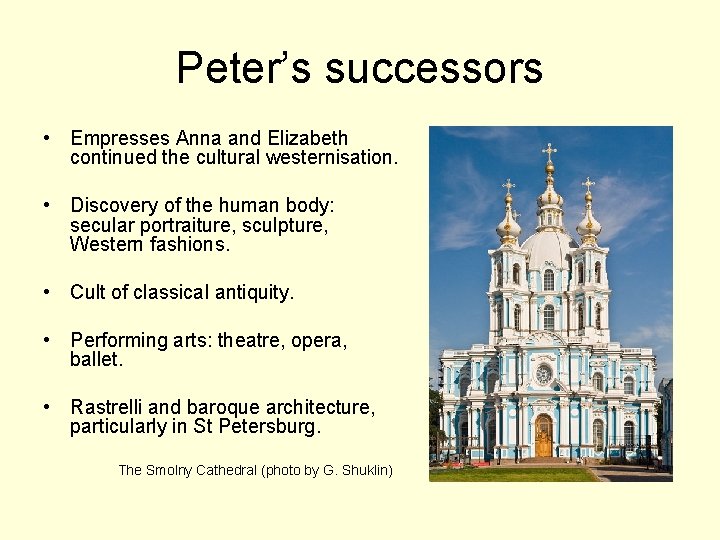
Peter’s successors • Empresses Anna and Elizabeth continued the cultural westernisation. • Discovery of the human body: secular portraiture, sculpture, Western fashions. • Cult of classical antiquity. • Performing arts: theatre, opera, ballet. • Rastrelli and baroque architecture, particularly in St Petersburg. The Smolny Cathedral (photo by G. Shuklin)
Imperial expansion According to Aleksandr Solzhenitsyn imperial expansion harmed Russia rather than helped it. Solzhenitsyn believed that Russia should limit itself, consolidate and utilise the assets which it already possessed rather than expand ‘over-stretch’ itself. He saw ‘empire’ as a ‘burden’.
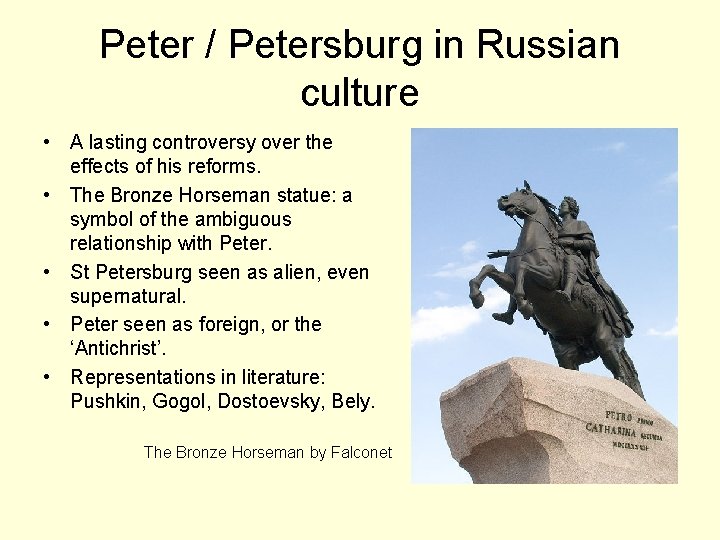
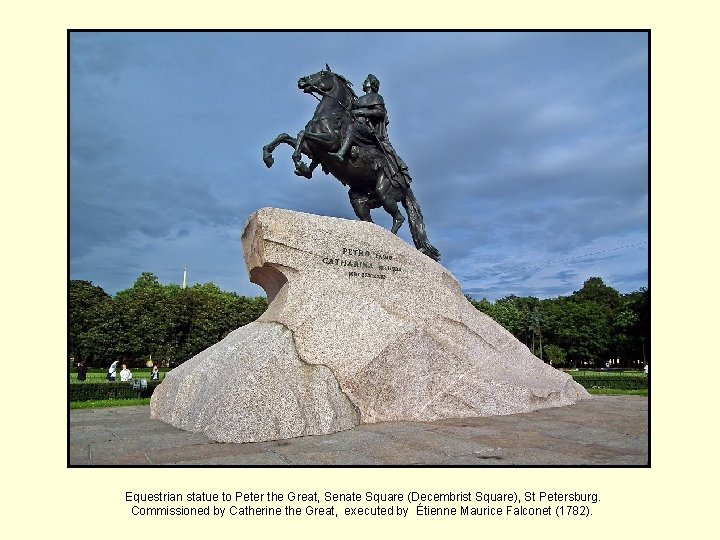
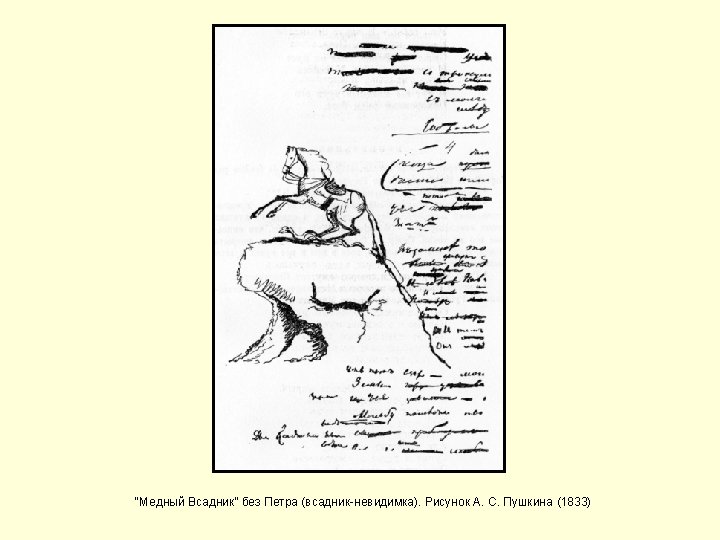
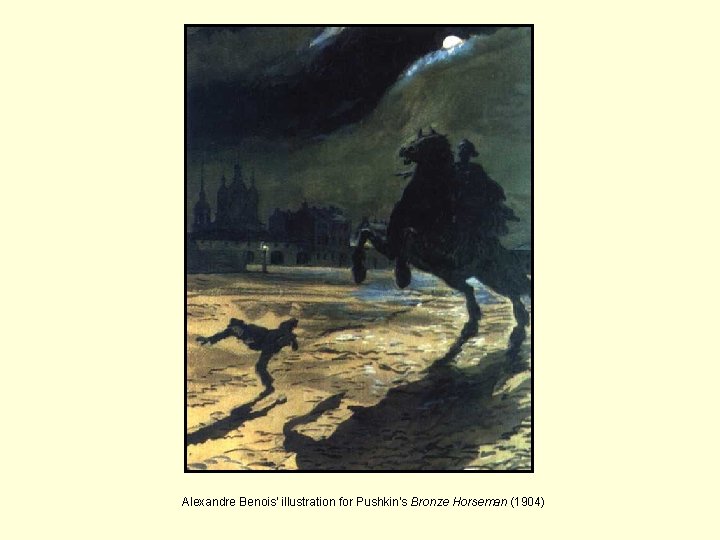
Peter / Petersburg in Russian culture • A lasting controversy over the effects of his reforms. • The Bronze Horseman statue: a symbol of the ambiguous relationship with Peter. • St Petersburg seen as alien, even supernatural. • Peter seen as foreign, or the ‘Antichrist’. • Representations in literature: Pushkin, Gogol, Dostoevsky, Bely. The Bronze Horseman by Falconet
Peter the Great: A focus for ongoing debate Controversial means to achieve desirable ends. The Slavophiles of the 19 th century didn’t even view these ends as desirable or good for Russia. They idealised pre-Petrine Russia.
Openness to isolation and back again This pattern was common to Russia and Japan: Extraordinary openness and eagerness to imitate foreign ways Under Nicholas I (19 th c. ) and Stalin (20 th c. ): Isolation and fearfulness of ‘the foreigner’, who might ‘infect’ and ‘contaminate’ the population with ‘foreign’ ideas and lifestyles.
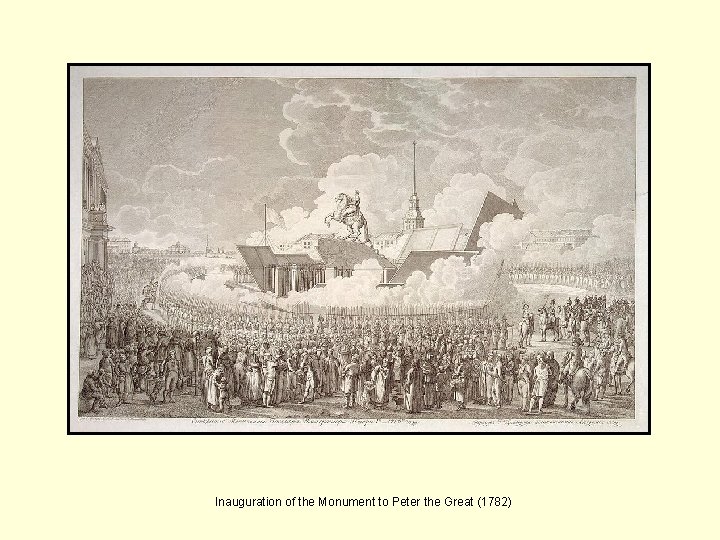
Equestrian statue to Peter the Great, Senate Square (Decembrist Square), St Petersburg. Commissioned by Catherine the Great, executed by Étienne Maurice Falconet (1782).
Alexandre Benois' illustration for Pushkin’s Bronze Horseman (1904)
Inauguration of the Monument to Peter the Great (1782)
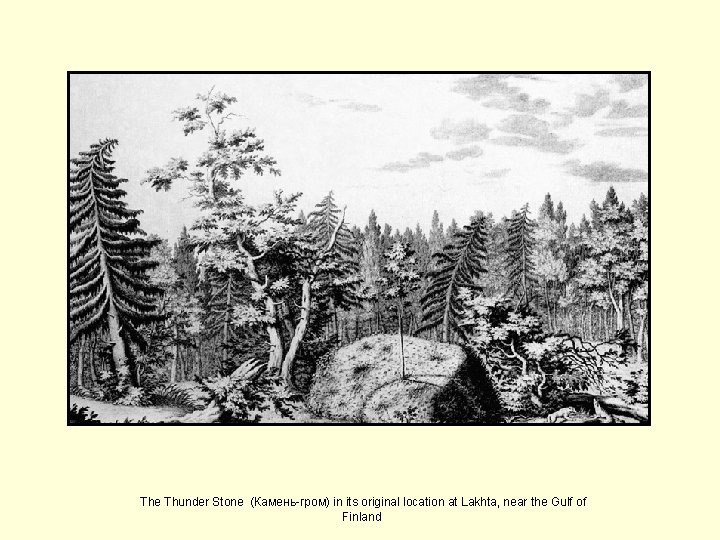
The Thunder Stone (Камень-гром) in its original location at Lakhta, near the Gulf of Finland
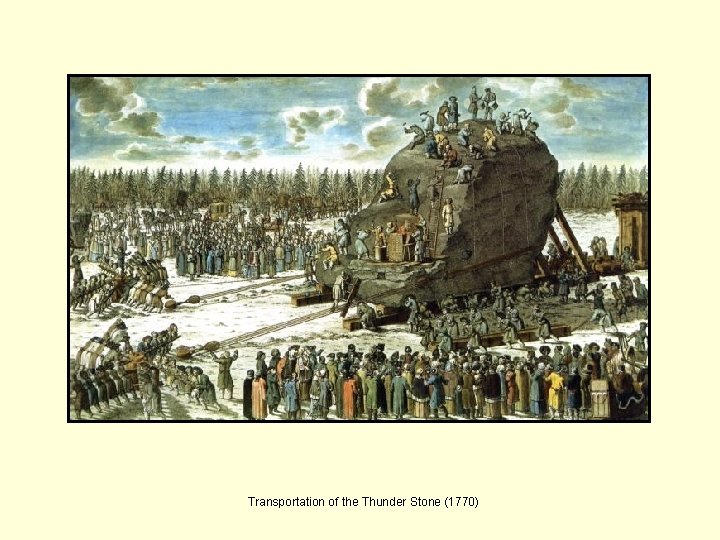
Transportation of the Thunder Stone (1770)
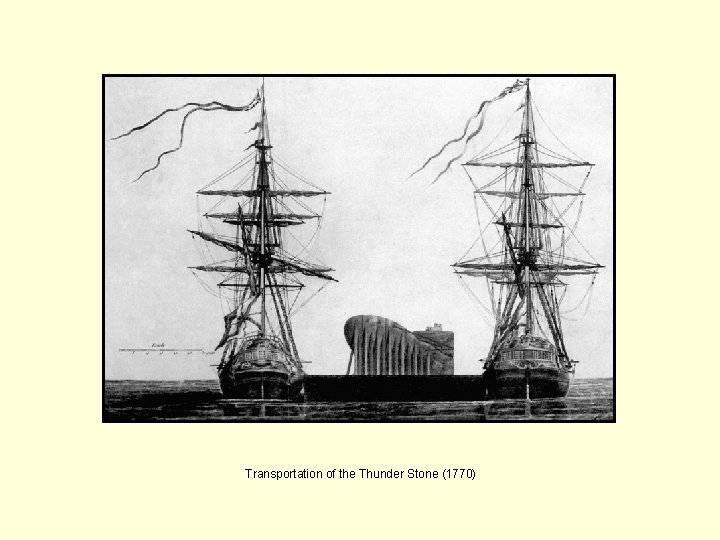
Transportation of the Thunder Stone (1770)
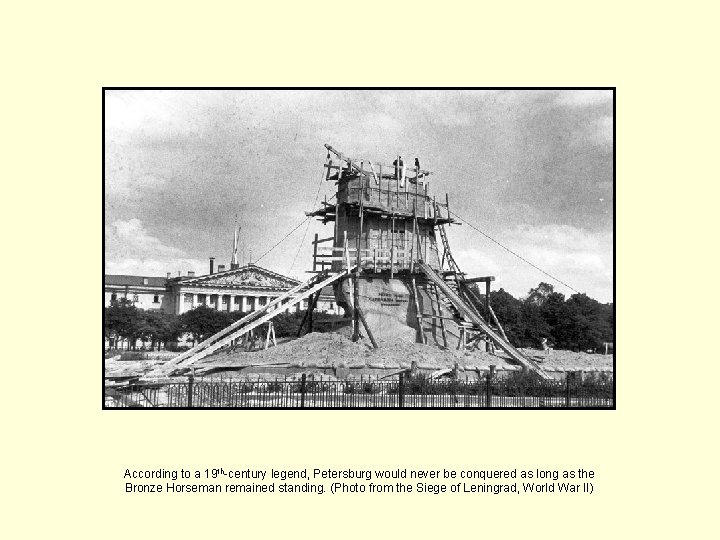
According to a 19 th-century legend, Petersburg would never be conquered as long as the Bronze Horseman remained standing. (Photo from the Siege of Leningrad, World War II)
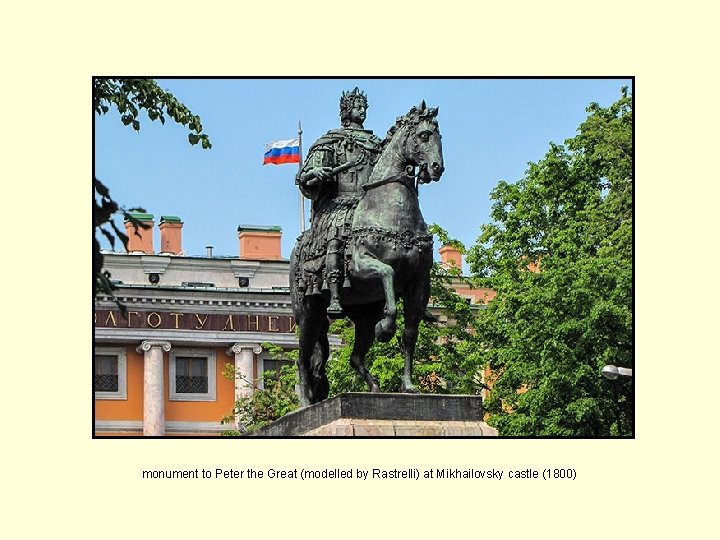
monument to Peter the Great (modelled by Rastrelli) at Mikhailovsky castle (1800)
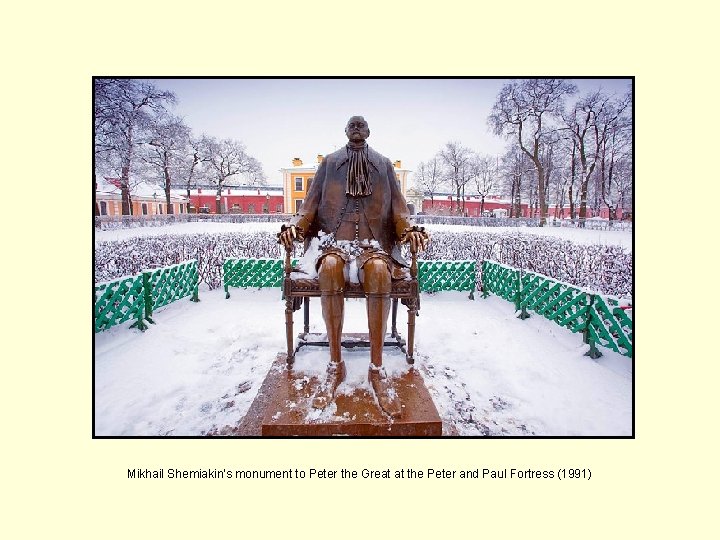
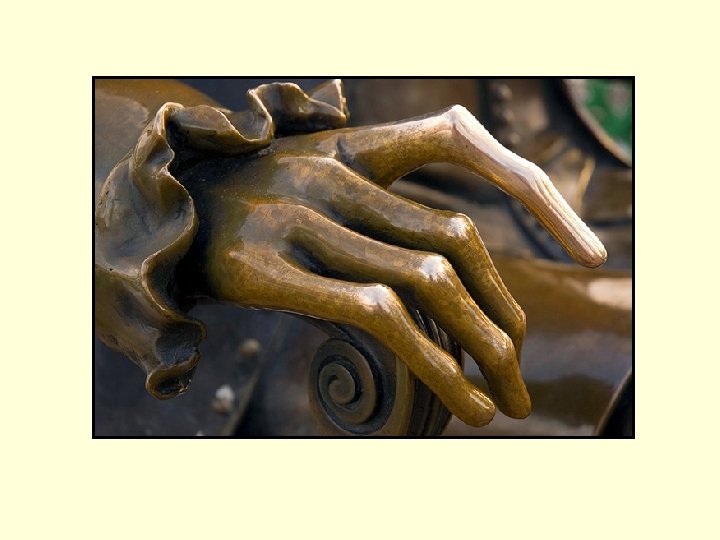
Mikhail Shemiakin’s monument to Peter the Great at the Peter and Paul Fortress (1991)
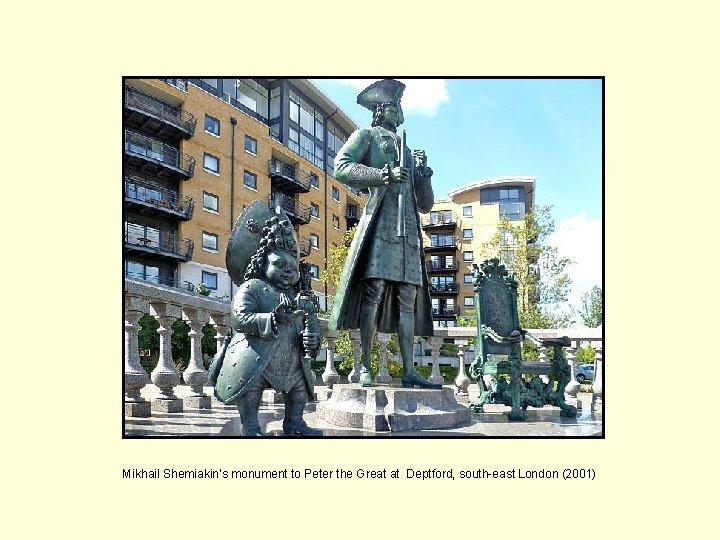
Mikhail Shemiakin’s monument to Peter the Great at Deptford, south-east London (2001)
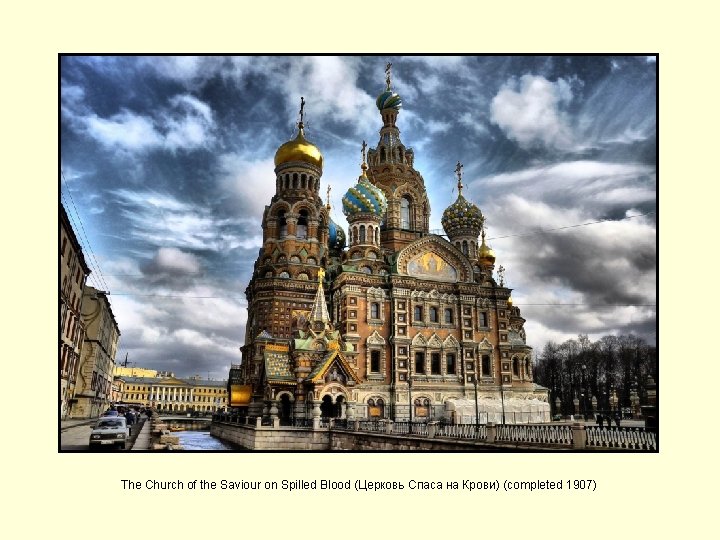
The Church of the Saviour on Spilled Blood (Церковь Спаса на Крови) (completed 1907)
After Peter I
The liberation of the nobility • Peter III: ‘Manifesto of Dvorianstvo Liberty’ 1762. • Voluntary service only. • Freedom to travel abroad and take service with foreign powers. • Creation of a large, privileged leisure class. • Many nobles returned to their provincial estates.
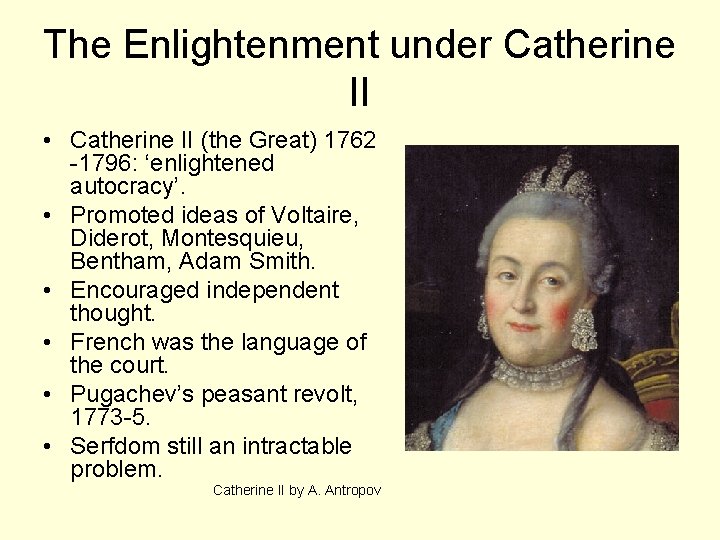
The Enlightenment under Catherine II • Catherine II (the Great) 1762 -1796: ‘enlightened autocracy’. • Promoted ideas of Voltaire, Diderot, Montesquieu, Bentham, Adam Smith. • Encouraged independent thought. • French was the language of the court. • Pugachev’s peasant revolt, 1773 -5. • Serfdom still an intractable problem. Catherine II by A. Antropov
Skilful rule: Example • Relatively tolerant of Islamic population of Russian Empire • Divided Muslims into four administrative regions • The administrative structures which Catherine put in place to control Muslims were re-applied by Soviet authorities in 20 th century.
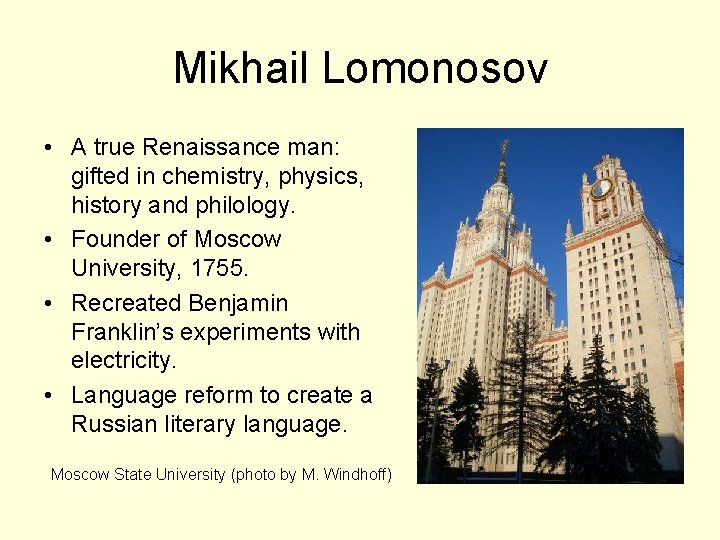
Mikhail Lomonosov • A true Renaissance man: gifted in chemistry, physics, history and philology. • Founder of Moscow University, 1755. • Recreated Benjamin Franklin’s experiments with electricity. • Language reform to create a Russian literary language. Moscow State University (photo by M. Windhoff)
Reactions to the French Revolution • Catherine horrified by the French Revolution of 1789. • Diplomatic relations with France severed. • Francophilia turns to Francophobia. • Re-emergence of Russian national identity. • Too late to stop the spread of French liberal ideas.
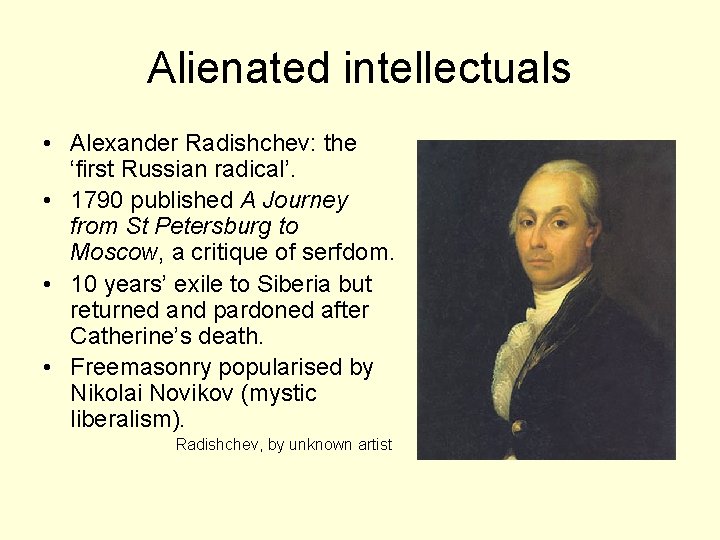
Alienated intellectuals • Alexander Radishchev: the ‘first Russian radical’. • 1790 published A Journey from St Petersburg to Moscow, a critique of serfdom. • 10 years’ exile to Siberia but returned and pardoned after Catherine’s death. • Freemasonry popularised by Nikolai Novikov (mystic liberalism). Radishchev, by unknown artist
The Napoleonic Wars • • • Tsar Alexander I ascends to the throne, 1801. Russia defeated at Austerlitz, 1805. Napoleon invades Russia, June 1812. ‘Pyrrhic’ victory of Battle of Borodino, Sept. 1812. ‘Sacrifice’ of burning Moscow. Russian Commander: Kutuzov (portrayed in Tolstoy’s novel ‘War & Peace’) • A war between foreign conventions and Russian principles. • Recognition of the peasant soldiers’ moral worth and patriotism. • ‘The last occasion when educated Russians shared a common view of their society and its needs’ (Kochan and Abraham).
Alexander I’s reign • Years before Napoleon’s invasion were marked by liberal reforming rule and spirit of hope • 1812 victory over Napoleon gave huge boost to Russians’ sense of pride and selfworth • After that Alexander veered away from reform and to simply maintaining status quo. Nobility & people very disappointed.
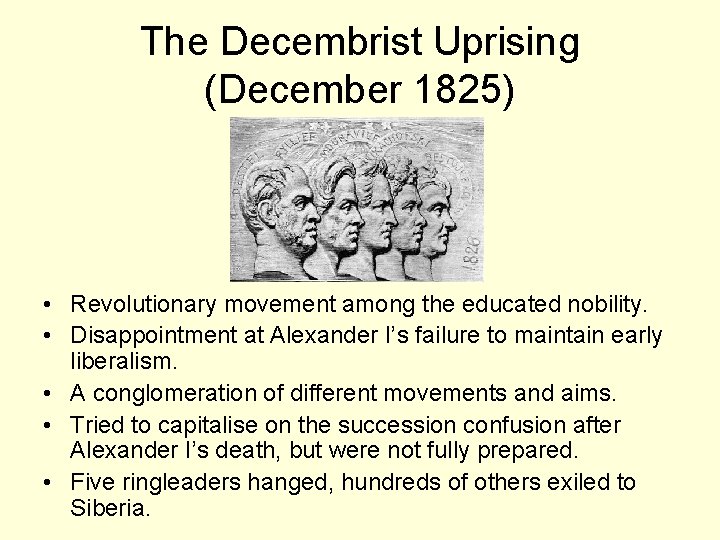
The Decembrist Uprising (December 1825) • Revolutionary movement among the educated nobility. • Disappointment at Alexander I’s failure to maintain early liberalism. • A conglomeration of different movements and aims. • Tried to capitalise on the succession confusion after Alexander I’s death, but were not fully prepared. • Five ringleaders hanged, hundreds of others exiled to Siberia.
The Decembrist legacy • Wanted a better society for all – an important development in Russian political dissent. • ‘Martyr’ figures for future opponents of the regime. • Exiled Decembrists had huge impact on Siberian development. • Decembrist wives inspired female radicals. • Encouraged reaction of Nicholas I. • Pushkin a prominent Decembrist sympathiser: translated their ethos into his literary works.