
Lecture 2 Performance MIPS ISA Todays topics Performance
- Slides: 22
Lecture 2: Performance, MIPS ISA • Today’s topics: § Performance equations § MIPS instructions • Reminder: canvas and class webpage: http: //www. cs. utah. edu/~rajeev/cs 3810/ • Reminder: sign up for the mailing list csece 3810 • See info on TA office hours on class webpage • From your classmate, Jeremy: www. Ute. Swap. com 1
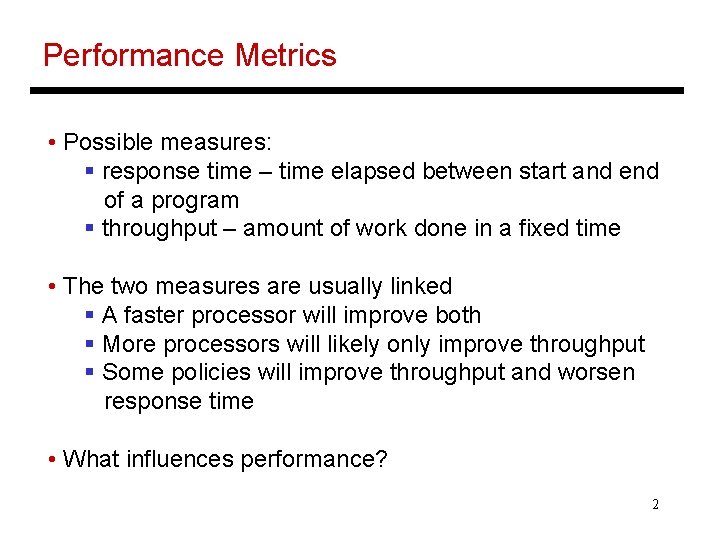
Performance Metrics • Possible measures: § response time – time elapsed between start and end of a program § throughput – amount of work done in a fixed time • The two measures are usually linked § A faster processor will improve both § More processors will likely only improve throughput § Some policies will improve throughput and worsen response time • What influences performance? 2
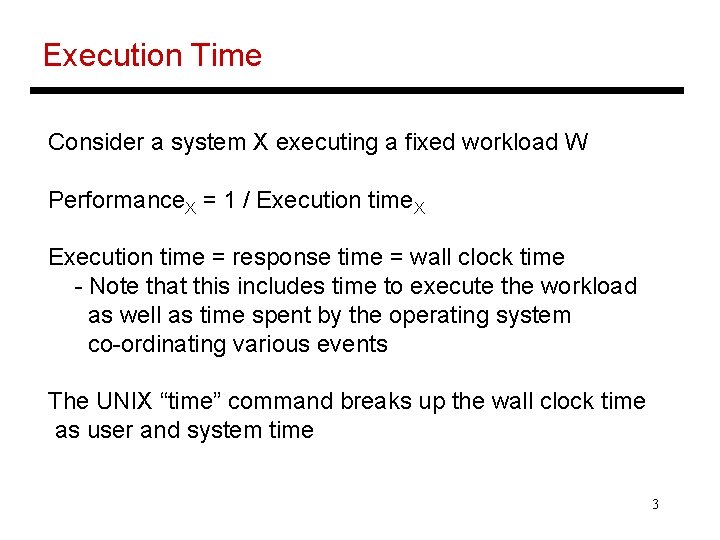
Execution Time Consider a system X executing a fixed workload W Performance. X = 1 / Execution time. X Execution time = response time = wall clock time - Note that this includes time to execute the workload as well as time spent by the operating system co-ordinating various events The UNIX “time” command breaks up the wall clock time as user and system time 3
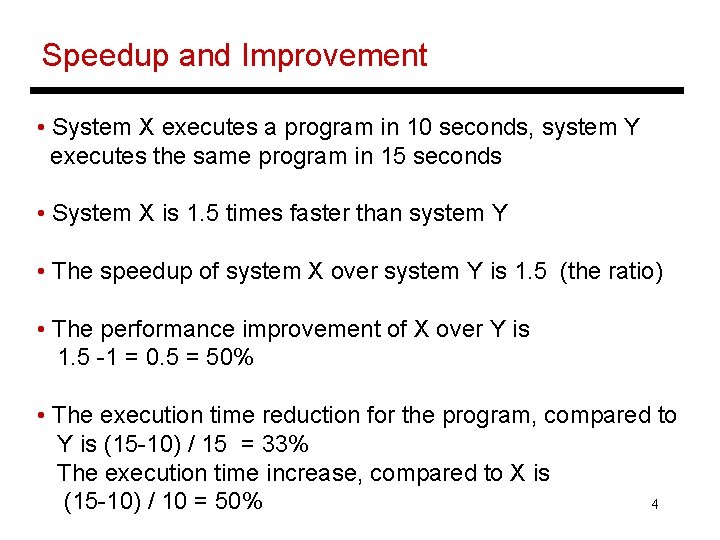
Speedup and Improvement • System X executes a program in 10 seconds, system Y executes the same program in 15 seconds • System X is 1. 5 times faster than system Y • The speedup of system X over system Y is 1. 5 (the ratio) • The performance improvement of X over Y is 1. 5 -1 = 0. 5 = 50% • The execution time reduction for the program, compared to Y is (15 -10) / 15 = 33% The execution time increase, compared to X is 4 (15 -10) / 10 = 50%
A Primer on Clocks and Cycles 5
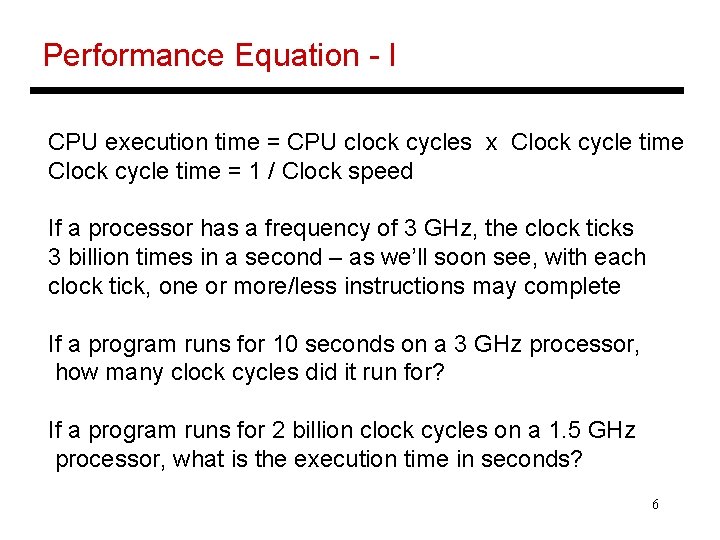
Performance Equation - I CPU execution time = CPU clock cycles x Clock cycle time = 1 / Clock speed If a processor has a frequency of 3 GHz, the clock ticks 3 billion times in a second – as we’ll soon see, with each clock tick, one or more/less instructions may complete If a program runs for 10 seconds on a 3 GHz processor, how many clock cycles did it run for? If a program runs for 2 billion clock cycles on a 1. 5 GHz processor, what is the execution time in seconds? 6
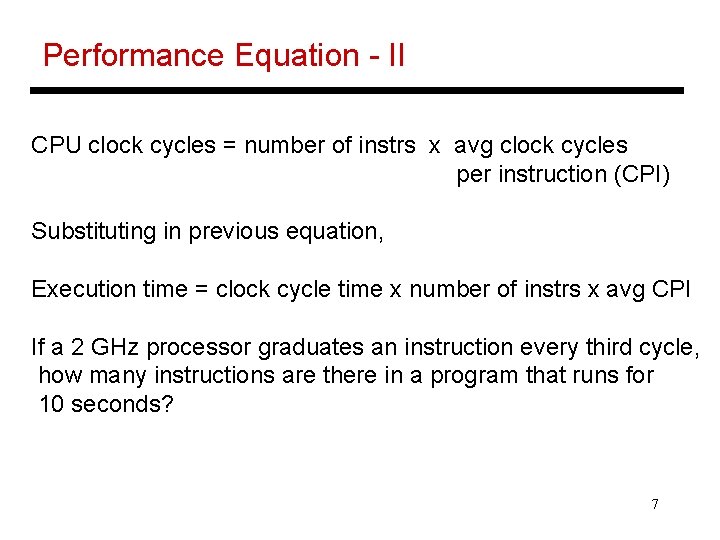
Performance Equation - II CPU clock cycles = number of instrs x avg clock cycles per instruction (CPI) Substituting in previous equation, Execution time = clock cycle time x number of instrs x avg CPI If a 2 GHz processor graduates an instruction every third cycle, how many instructions are there in a program that runs for 10 seconds? 7
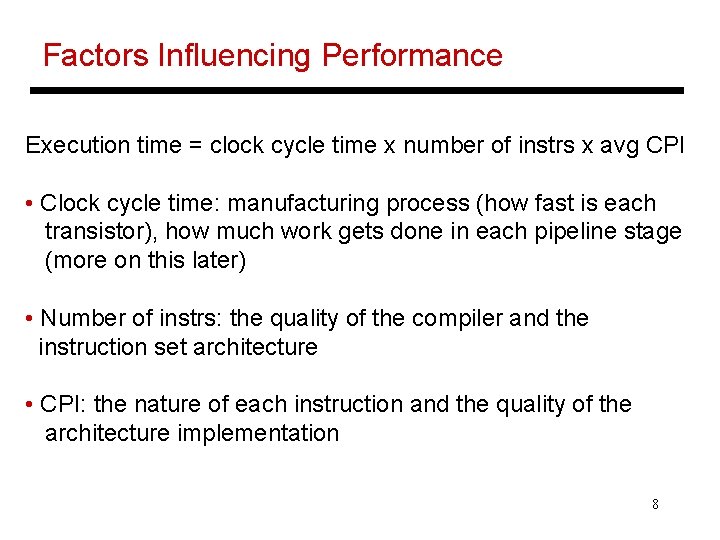
Factors Influencing Performance Execution time = clock cycle time x number of instrs x avg CPI • Clock cycle time: manufacturing process (how fast is each transistor), how much work gets done in each pipeline stage (more on this later) • Number of instrs: the quality of the compiler and the instruction set architecture • CPI: the nature of each instruction and the quality of the architecture implementation 8
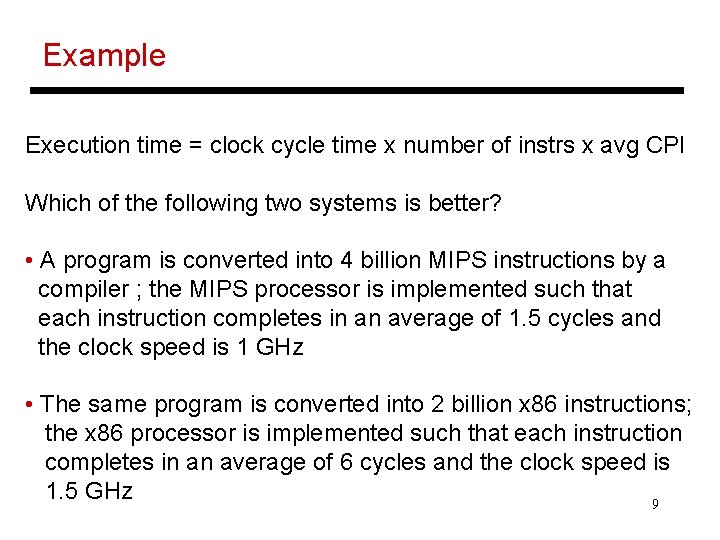
Example Execution time = clock cycle time x number of instrs x avg CPI Which of the following two systems is better? • A program is converted into 4 billion MIPS instructions by a compiler ; the MIPS processor is implemented such that each instruction completes in an average of 1. 5 cycles and the clock speed is 1 GHz • The same program is converted into 2 billion x 86 instructions; the x 86 processor is implemented such that each instruction completes in an average of 6 cycles and the clock speed is 1. 5 GHz 9
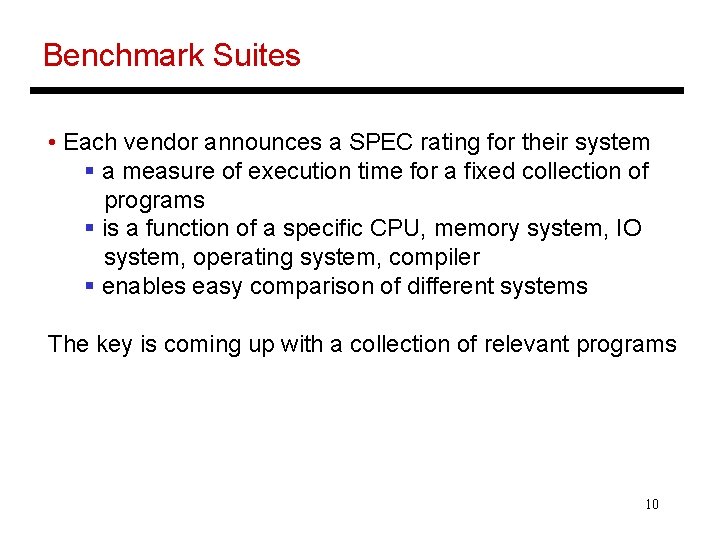
Benchmark Suites • Each vendor announces a SPEC rating for their system § a measure of execution time for a fixed collection of programs § is a function of a specific CPU, memory system, IO system, operating system, compiler § enables easy comparison of different systems The key is coming up with a collection of relevant programs 10
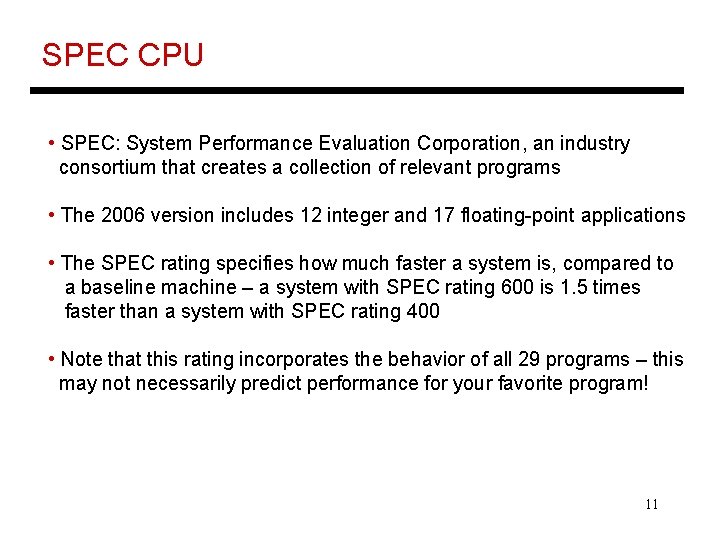
SPEC CPU • SPEC: System Performance Evaluation Corporation, an industry consortium that creates a collection of relevant programs • The 2006 version includes 12 integer and 17 floating-point applications • The SPEC rating specifies how much faster a system is, compared to a baseline machine – a system with SPEC rating 600 is 1. 5 times faster than a system with SPEC rating 400 • Note that this rating incorporates the behavior of all 29 programs – this may not necessarily predict performance for your favorite program! 11
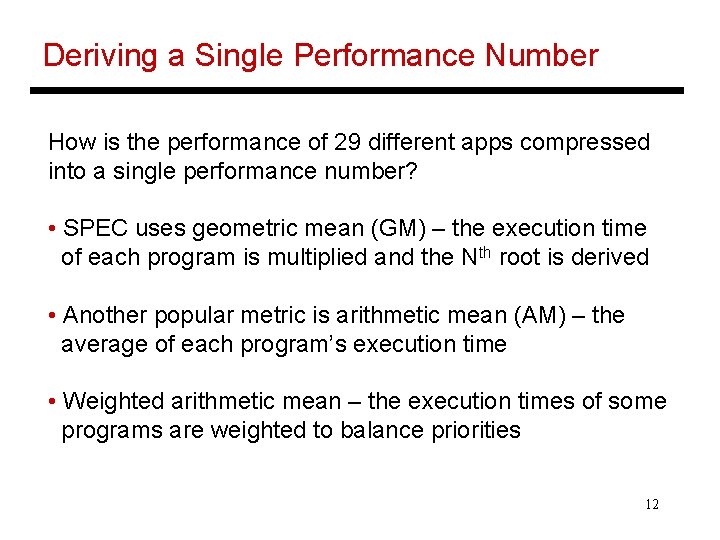
Deriving a Single Performance Number How is the performance of 29 different apps compressed into a single performance number? • SPEC uses geometric mean (GM) – the execution time of each program is multiplied and the Nth root is derived • Another popular metric is arithmetic mean (AM) – the average of each program’s execution time • Weighted arithmetic mean – the execution times of some programs are weighted to balance priorities 12
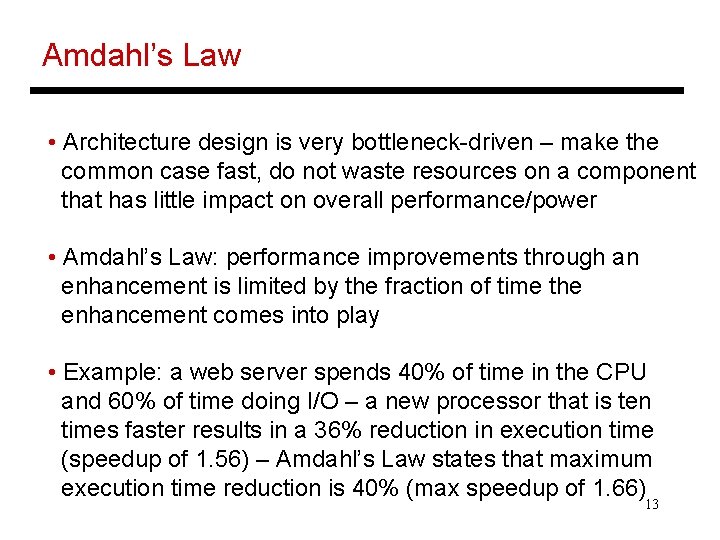
Amdahl’s Law • Architecture design is very bottleneck-driven – make the common case fast, do not waste resources on a component that has little impact on overall performance/power • Amdahl’s Law: performance improvements through an enhancement is limited by the fraction of time the enhancement comes into play • Example: a web server spends 40% of time in the CPU and 60% of time doing I/O – a new processor that is ten times faster results in a 36% reduction in execution time (speedup of 1. 56) – Amdahl’s Law states that maximum execution time reduction is 40% (max speedup of 1. 66) 13
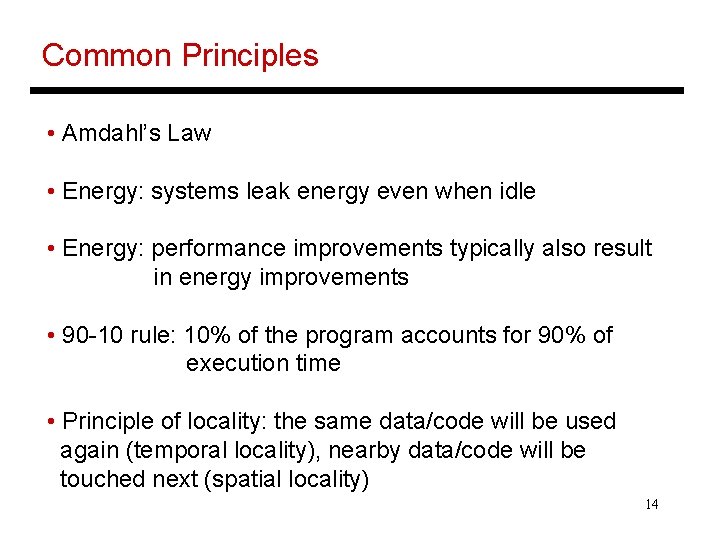
Common Principles • Amdahl’s Law • Energy: systems leak energy even when idle • Energy: performance improvements typically also result in energy improvements • 90 -10 rule: 10% of the program accounts for 90% of execution time • Principle of locality: the same data/code will be used again (temporal locality), nearby data/code will be touched next (spatial locality) 14
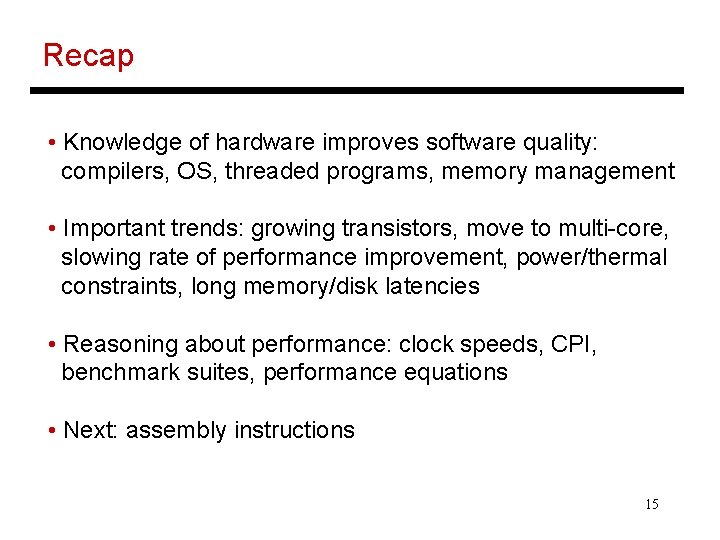
Recap • Knowledge of hardware improves software quality: compilers, OS, threaded programs, memory management • Important trends: growing transistors, move to multi-core, slowing rate of performance improvement, power/thermal constraints, long memory/disk latencies • Reasoning about performance: clock speeds, CPI, benchmark suites, performance equations • Next: assembly instructions 15
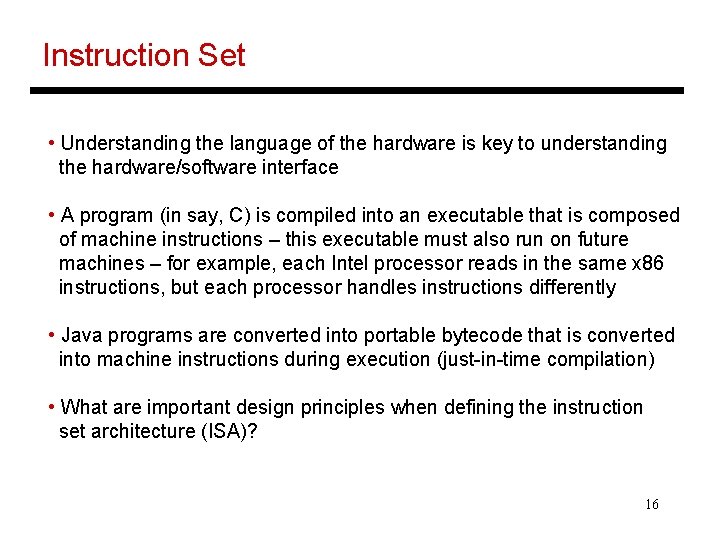
Instruction Set • Understanding the language of the hardware is key to understanding the hardware/software interface • A program (in say, C) is compiled into an executable that is composed of machine instructions – this executable must also run on future machines – for example, each Intel processor reads in the same x 86 instructions, but each processor handles instructions differently • Java programs are converted into portable bytecode that is converted into machine instructions during execution (just-in-time compilation) • What are important design principles when defining the instruction set architecture (ISA)? 16
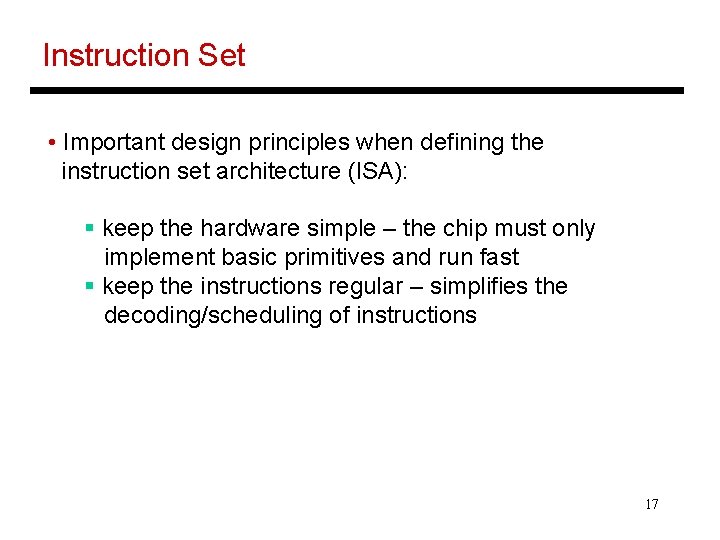
Instruction Set • Important design principles when defining the instruction set architecture (ISA): § keep the hardware simple – the chip must only implement basic primitives and run fast § keep the instructions regular – simplifies the decoding/scheduling of instructions 17
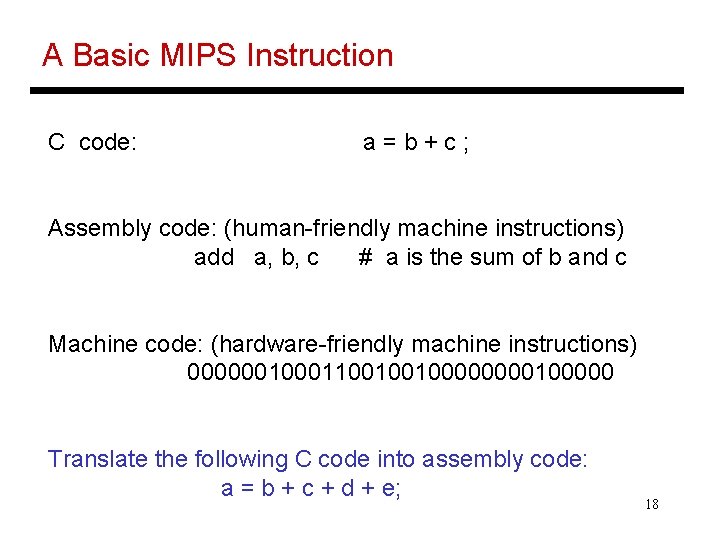
A Basic MIPS Instruction C code: a=b+c; Assembly code: (human-friendly machine instructions) add a, b, c # a is the sum of b and c Machine code: (hardware-friendly machine instructions) 000000110010010000100000 Translate the following C code into assembly code: a = b + c + d + e; 18
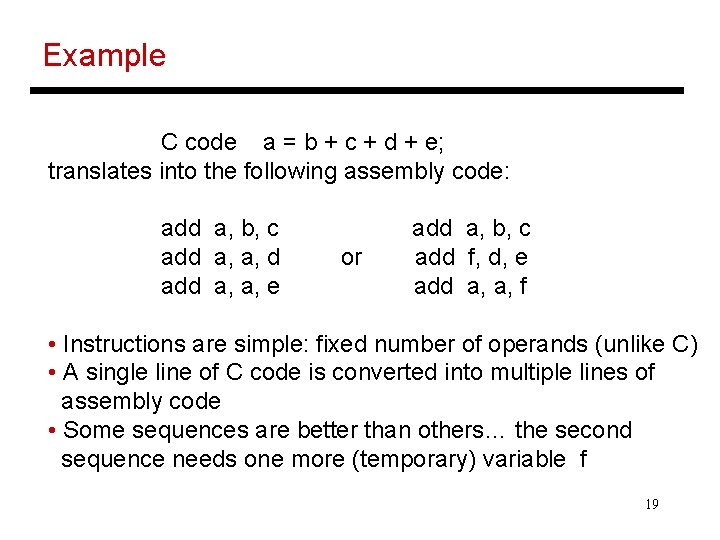
Example C code a = b + c + d + e; translates into the following assembly code: add a, b, c add a, a, d add a, a, e or add a, b, c add f, d, e add a, a, f • Instructions are simple: fixed number of operands (unlike C) • A single line of C code is converted into multiple lines of assembly code • Some sequences are better than others… the second sequence needs one more (temporary) variable f 19
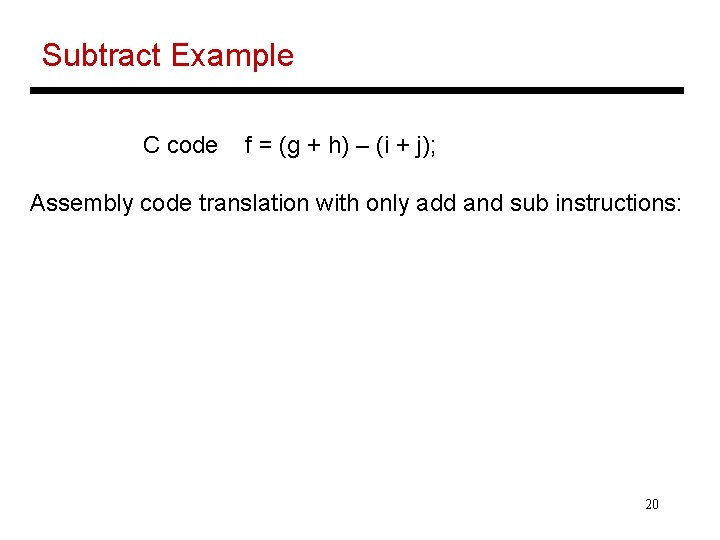
Subtract Example C code f = (g + h) – (i + j); Assembly code translation with only add and sub instructions: 20
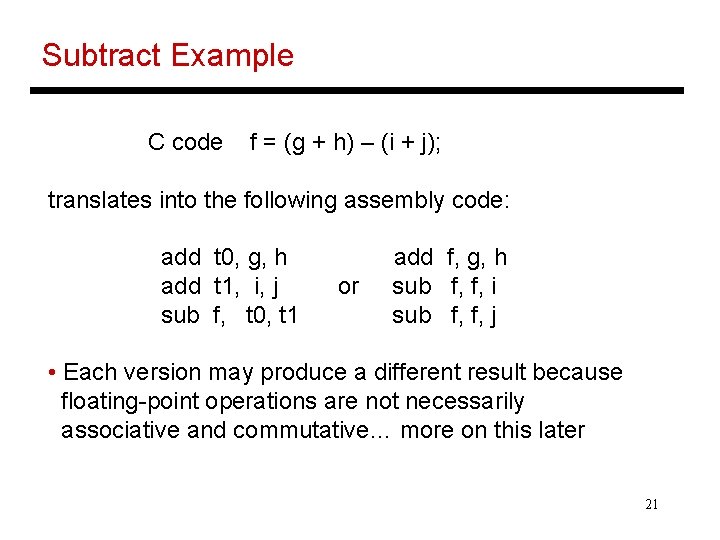
Subtract Example C code f = (g + h) – (i + j); translates into the following assembly code: add t 0, g, h add t 1, i, j sub f, t 0, t 1 or add f, g, h sub f, f, i sub f, f, j • Each version may produce a different result because floating-point operations are not necessarily associative and commutative… more on this later 21
Title • Bullet 22