
Lecture 2 Overview of the Engineering Design Process

- Slides: 26
Lecture 2 Overview of the (Engineering) Design Process
Lecture layout ¤Good vs. bad design (baddesigns. com) ¤User-centered Design (UCD) process n Individual steps 2
Engineering Design Engineering design is the process of devising a system, component, or process to meet desired needs. It is a decision making process (often iterative), in which the basic sciences, mathematics, and engineering sciences are applied to convert resources optimally to meet a stated objective. -ABET 3
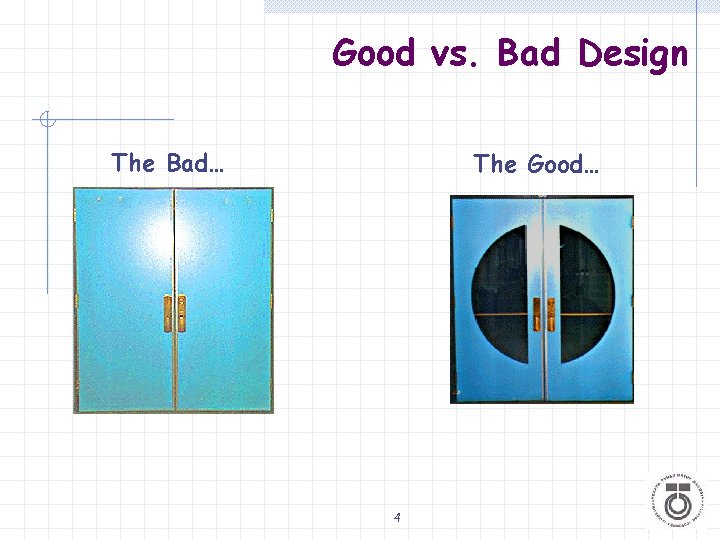
Good vs. Bad Design The Bad… The Good… 4
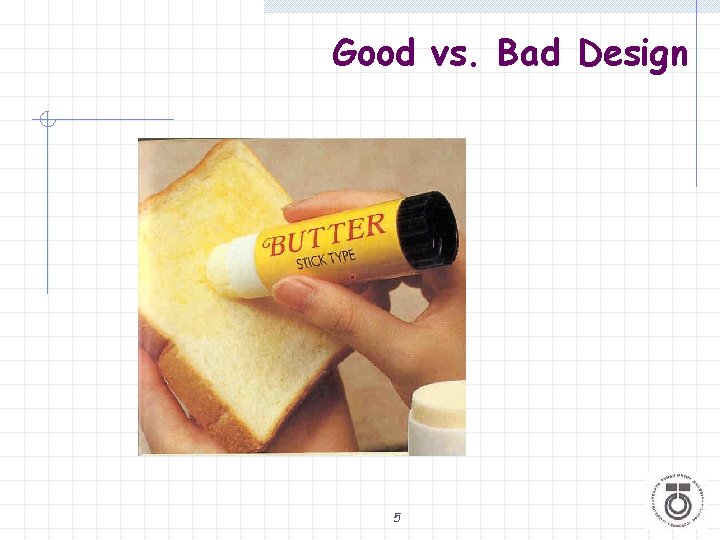
Good vs. Bad Design 5
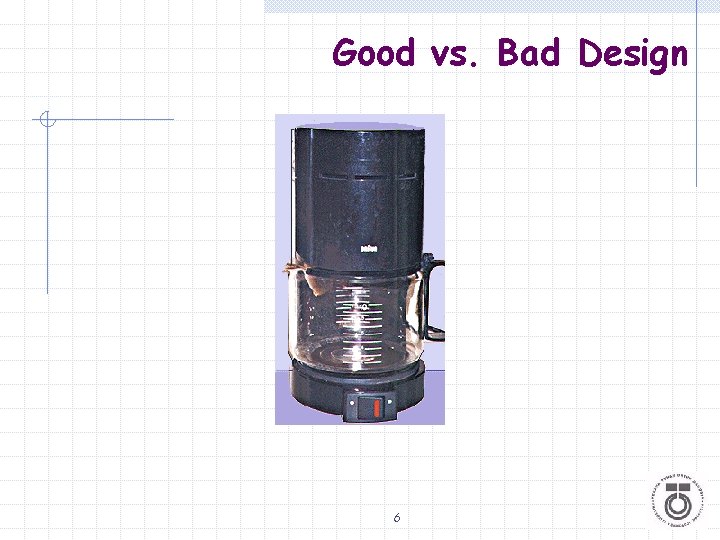
Good vs. Bad Design 6
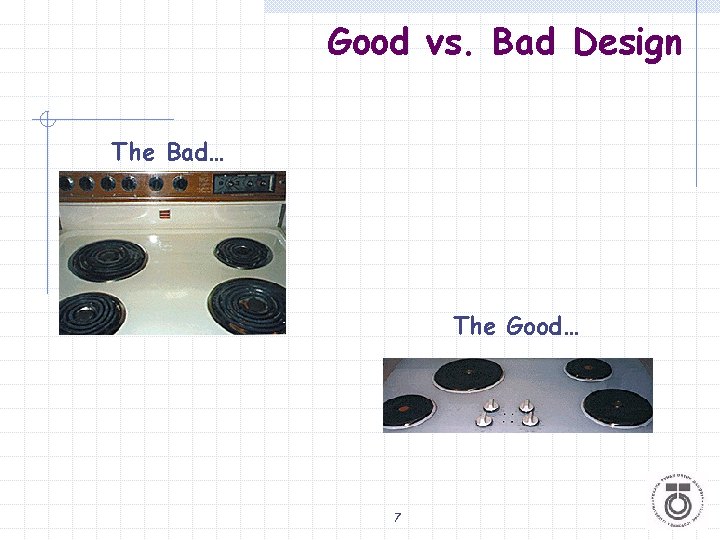
Good vs. Bad Design The Bad… The Good… 7
Good vs. Bad Design 8
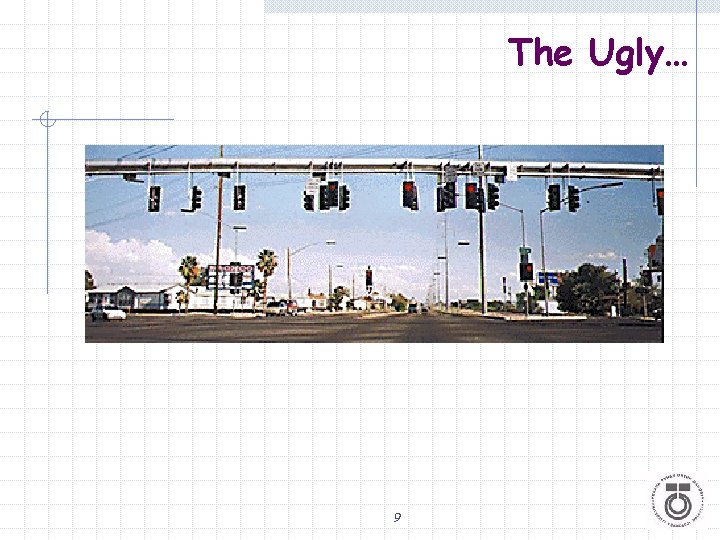
The Ugly… 9
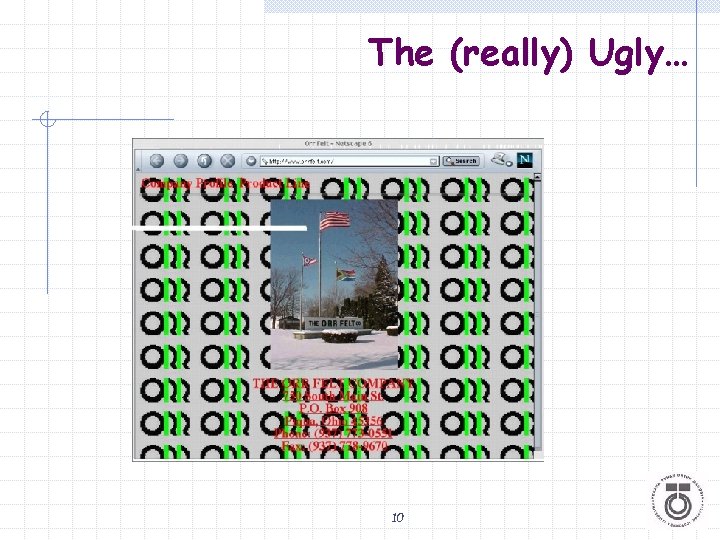
The (really) Ugly… 10
But What Makes it Good? ¤ Functionality ¤ Efficiency – speed, performance, etc. ¤ Reliability, security, integrity ¤ Standardization, consistency ¤ USABILITY ! 11
Closer to Fine: A Philosophy …The human user of any system is the focus of the design process. Planning and implementation is done with the user in mind, and the system is made to fit the user, not the other way around…. 12
“Good Design” Means ¤ Systems are built for humans; must be designed for the user ¤ Recognize individual differences; appreciate design implications of these human factors ¤ Recognize the design of things, procedures, etc. , influences human behavior and well-being ¤ Emphasize empirical data & evaluation ¤ Rely on the scientific method ¤ Things, procedures, environments, and people do not exist in isolation 13
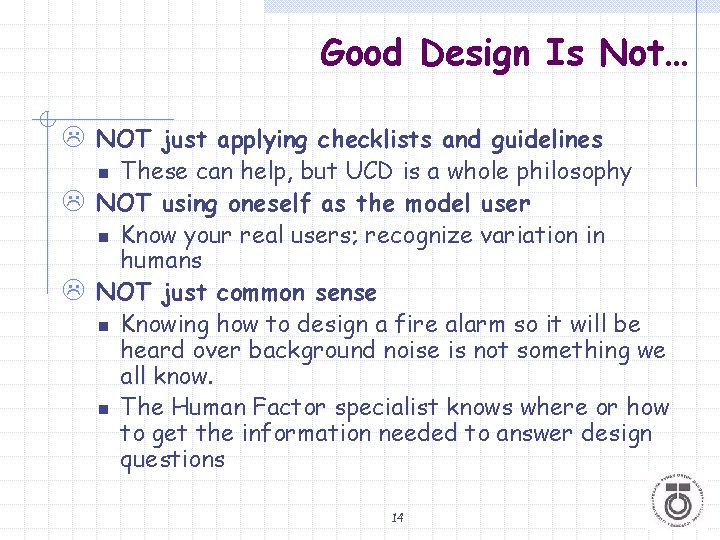
Good Design Is Not… L NOT just applying checklists and guidelines These can help, but UCD is a whole philosophy L NOT using oneself as the model user n Know your real users; recognize variation in humans L NOT just common sense n Knowing how to design a fire alarm so it will be heard over background noise is not something we all know. n The Human Factor specialist knows where or how to get the information needed to answer design questions n 14
User Centered Design ¤A way to force yourself to identify and consider the relevant human factors in your design ¤Helps reduce the number of decisions made out of the blue, and helps focus design activities ¤Helps document and defend decisions that may be reviewed later 15
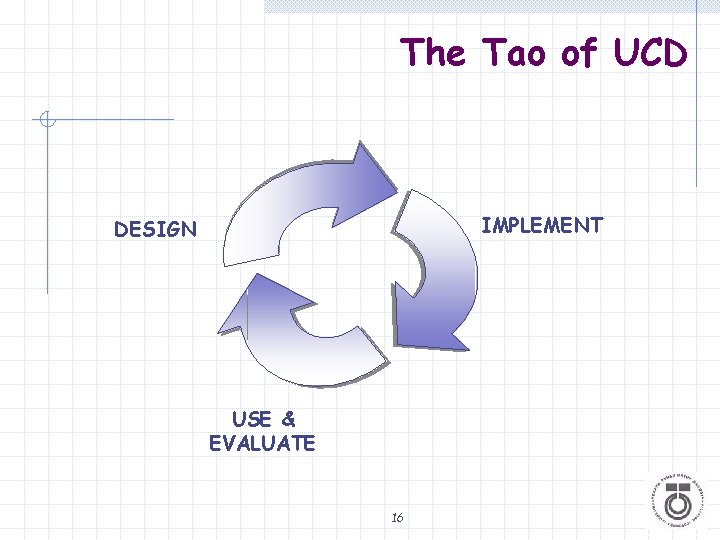
The Tao of UCD IMPLEMENT DESIGN USE & EVALUATE 16
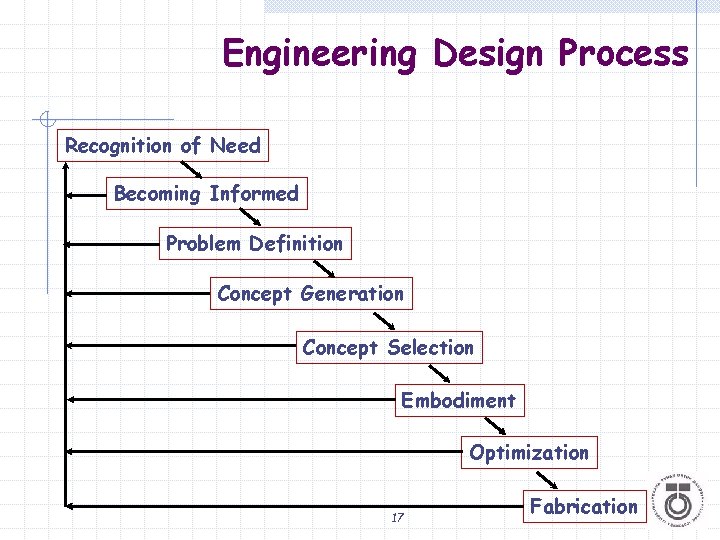
Engineering Design Process Recognition of Need Becoming Informed Problem Definition Concept Generation Concept Selection Embodiment Optimization 17 Fabrication
Initial Processes ¤ Recognition of Need “Identifying Opportunities” n In Industry, often Marketing Department ¤ Becoming Informed n LEARN ABOUT THE PROBLEM! n Literature Searches n Patent Searches n Web Searches n Talk with “experts” and “customers” n 18
Initial Processes ¤Problem Definition n Most problems are ill-defined! Market and User taste analysis Product Specifications - Precise description of what the product has to do in line with customer demand 19
Concept Generation ¤ Most Important Aspect of Design ¤ Most Difficult Aspect of Design ¤ Brainstorming ¤ Suspend Judgement ¤ Bizarre sometimes is Good ¤ Include everyone (Marketing, Purchasers, Manufacturing, etc. )! ¤ Need MANY possible ideas! (The more, the better!) 20
Concept Generation (cont. ) ¤ 5 Step Systematic Plan (Out of Ulrich, and Eppinger) n n n Clarify the problem (back to becoming informed); decompose to simpler parts Search externally (Literature/Patents/etc. ) Search internally (Brainstorming) Explore Systematically (classification trees, concept combination table) Reflect on solutions/process (constructive feedback) 21
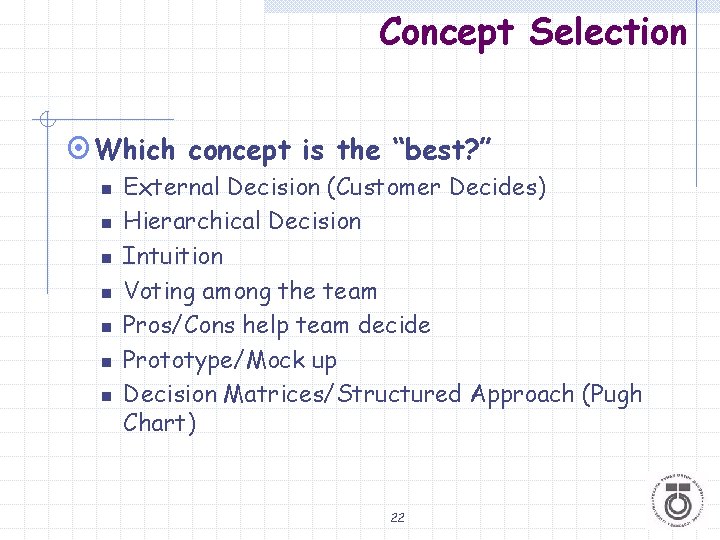
Concept Selection ¤Which concept is the “best? ” n n n n External Decision (Customer Decides) Hierarchical Decision Intuition Voting among the team Pros/Cons help team decide Prototype/Mock up Decision Matrices/Structured Approach (Pugh Chart) 22
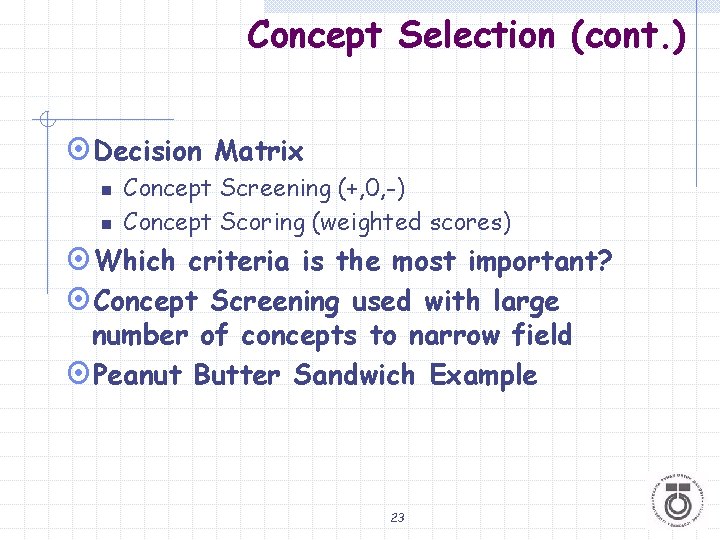
Concept Selection (cont. ) ¤Decision Matrix n n Concept Screening (+, 0, -) Concept Scoring (weighted scores) ¤Which criteria is the most important? ¤Concept Screening used with large number of concepts to narrow field ¤Peanut Butter Sandwich Example 23
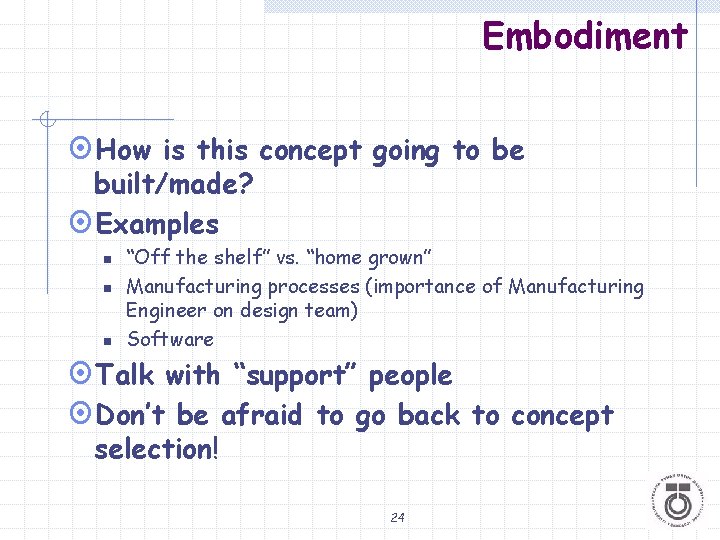
Embodiment ¤How is this concept going to be built/made? ¤Examples n n n “Off the shelf” vs. “home grown” Manufacturing processes (importance of Manufacturing Engineer on design team) Software ¤Talk with “support” people ¤Don’t be afraid to go back to concept selection! 24
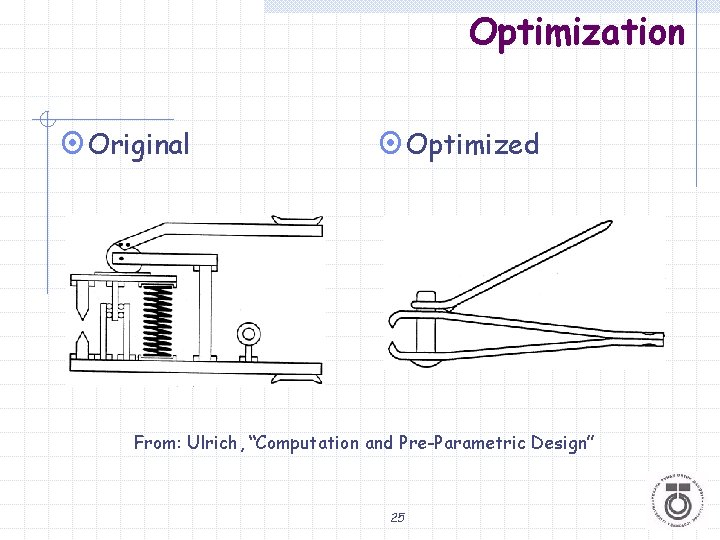
Optimization ¤Original ¤Optimized From: Ulrich, “Computation and Pre-Parametric Design” 25
Finish Design Processes ¤ Fabrication (Lets build it!) ¤ Test it! ¤ Refinement 26