
Lecture 2 OUTLINE Semiconductor Basics Reading Chapter 2
Lecture 2 OUTLINE • Semiconductor Basics Reading: Chapter 2 EE 105 Fall 2011 Lecture 2, Slide 1 Prof. Salahuddin, UC Berkeley

Announcement • Office Hours for tomorrow is cancelled (ONLY for this week) There will be office hours on Friday (2 P-3 P) (ONLY for this week) Thursday’s class will start at 4 P (ONLY for this week) EE 105 Fall 2011 Lecture 2, Slide 2 Prof. Salahuddin, UC Berkeley

What is a Semiconductor? • Low resistivity => “conductor” • High resistivity => “insulator” • Intermediate resistivity => “semiconductor” – conductivity lies between that of conductors and insulators – generally crystalline in structure for IC devices • In recent years, however, non-crystalline semiconductors have become commercially very important polycrystalline amorphous crystalline EE 105 Fall 2011 Lecture 2, Slide 3 Prof. Salahuddin, UC Berkeley

Semiconductor Materials Phosphorus (P) Gallium (Ga) EE 105 Fall 2011 Lecture 2, Slide 4 Prof. Salahuddin, UC Berkeley

Energy Band Description • For current flow, one needs to have electrons in the conduction band or holes in the valence band • Completely full or completely empty bands cannot carry current EE 105 Fall 2011 Lecture 2, Slide 5 Prof. Salahuddin, UC Berkeley
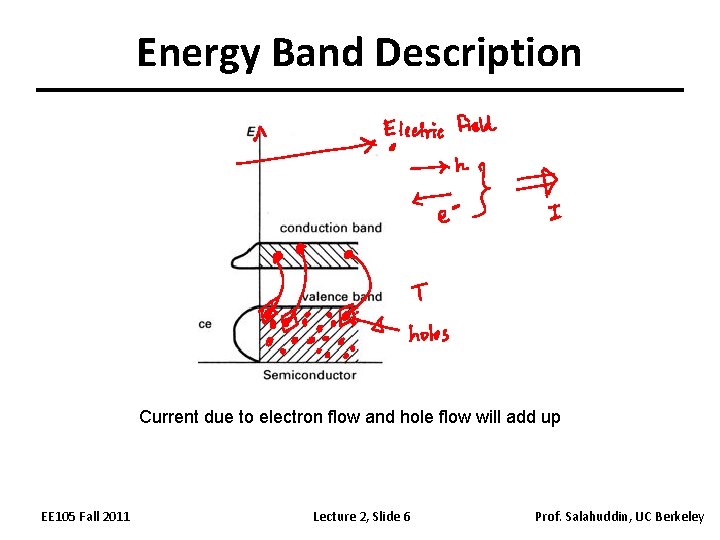
Energy Band Description Current due to electron flow and hole flow will add up EE 105 Fall 2011 Lecture 2, Slide 6 Prof. Salahuddin, UC Berkeley
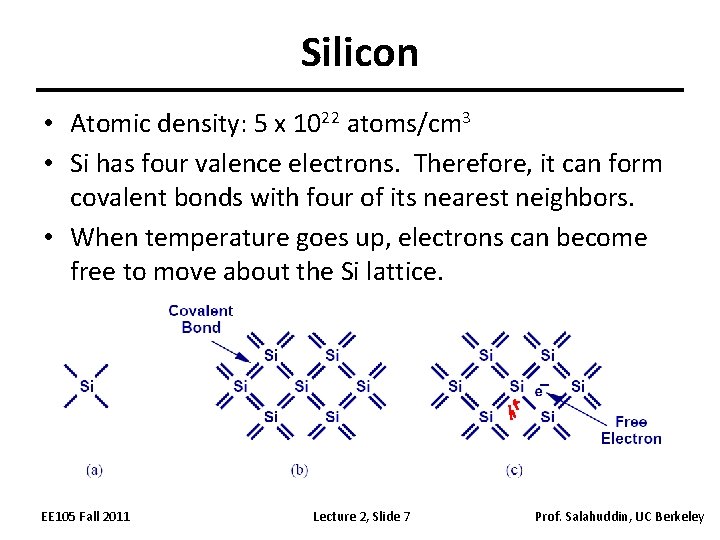
Silicon • Atomic density: 5 x 10²² atoms/cm 3 • Si has four valence electrons. Therefore, it can form covalent bonds with four of its nearest neighbors. • When temperature goes up, electrons can become free to move about the Si lattice. EE 105 Fall 2011 Lecture 2, Slide 7 Prof. Salahuddin, UC Berkeley
Electronic Properties of Si Silicon is a semiconductor material. – Pure Si has a relatively high electrical resistivity at room temperature. There are 2 types of mobile charge-carriers in Si: – – Conduction electrons are negatively charged; Holes are positively charged. The concentration (#/cm 3) of conduction electrons & holes in a semiconductor can be modulated in several ways: • • EE 105 Fall 2011 by adding special impurity atoms ( dopants ) by applying an electric field by changing the temperature by irradiation Lecture 2, Slide 8 Prof. Salahuddin, UC Berkeley
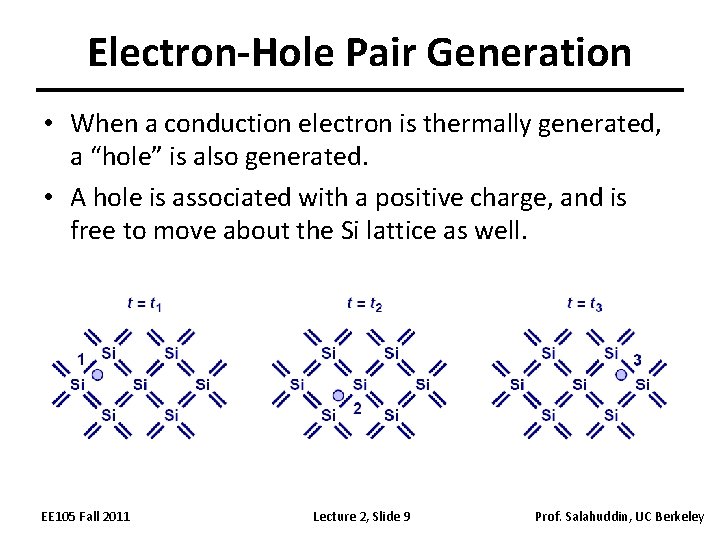
Electron-Hole Pair Generation • When a conduction electron is thermally generated, a “hole” is also generated. • A hole is associated with a positive charge, and is free to move about the Si lattice as well. EE 105 Fall 2011 Lecture 2, Slide 9 Prof. Salahuddin, UC Berkeley
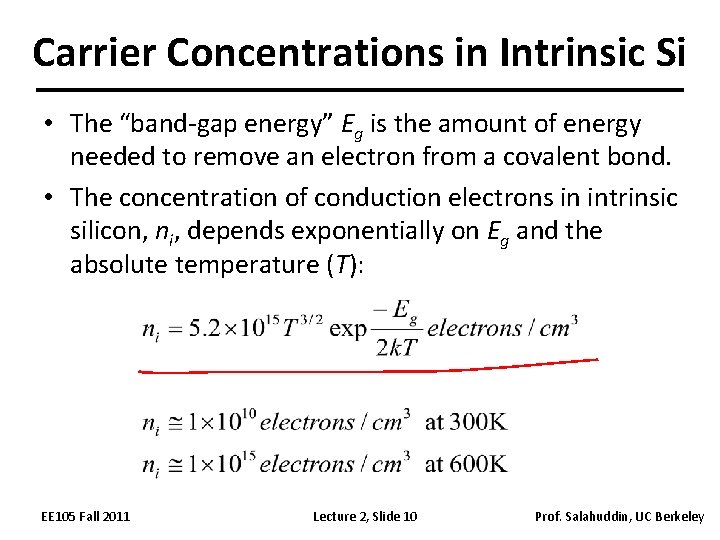
Carrier Concentrations in Intrinsic Si • The “band-gap energy” Eg is the amount of energy needed to remove an electron from a covalent bond. • The concentration of conduction electrons in intrinsic silicon, ni, depends exponentially on Eg and the absolute temperature (T): EE 105 Fall 2011 Lecture 2, Slide 10 Prof. Salahuddin, UC Berkeley
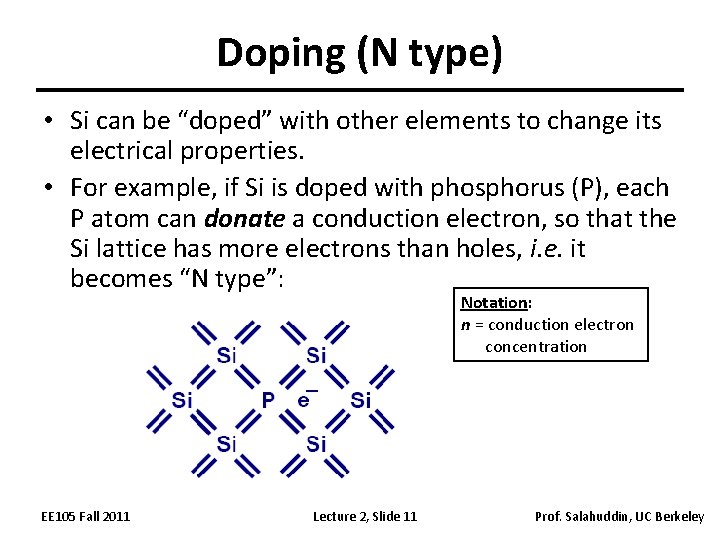
Doping (N type) • Si can be “doped” with other elements to change its electrical properties. • For example, if Si is doped with phosphorus (P), each P atom can donate a conduction electron, so that the Si lattice has more electrons than holes, i. e. it becomes “N type”: Notation: n = conduction electron concentration EE 105 Fall 2011 Lecture 2, Slide 11 Prof. Salahuddin, UC Berkeley
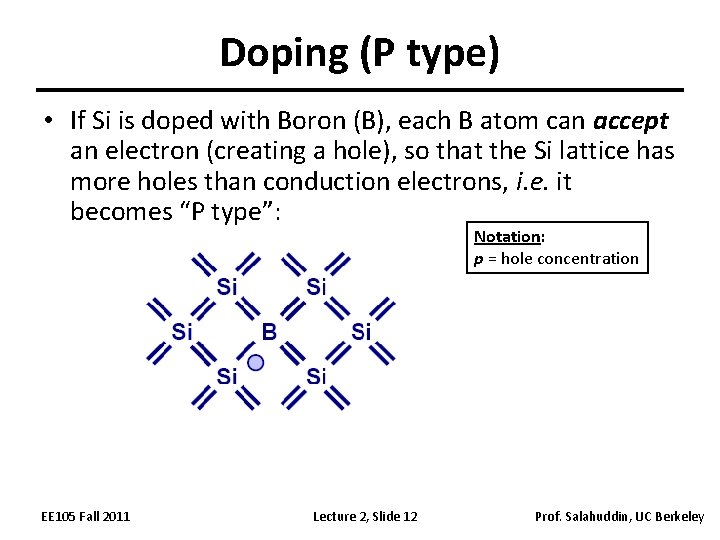
Doping (P type) • If Si is doped with Boron (B), each B atom can accept an electron (creating a hole), so that the Si lattice has more holes than conduction electrons, i. e. it becomes “P type”: Notation: p = hole concentration EE 105 Fall 2011 Lecture 2, Slide 12 Prof. Salahuddin, UC Berkeley
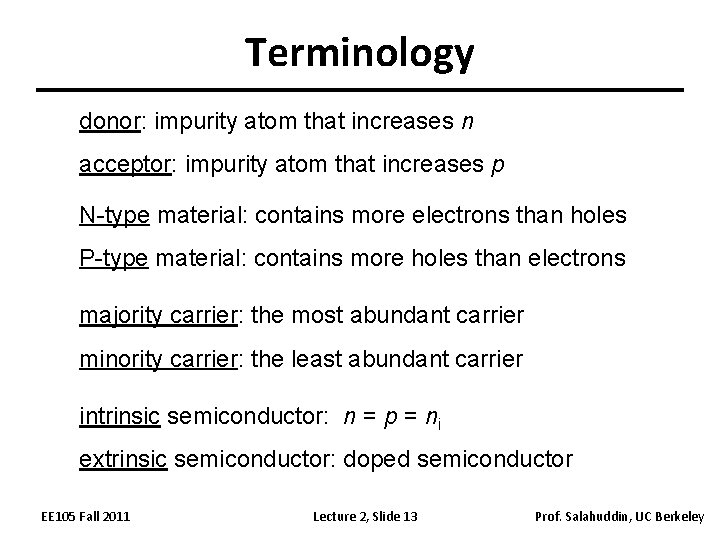
Terminology donor: impurity atom that increases n acceptor: impurity atom that increases p N-type material: contains more electrons than holes P-type material: contains more holes than electrons majority carrier: the most abundant carrier minority carrier: the least abundant carrier intrinsic semiconductor: n = p = ni extrinsic semiconductor: doped semiconductor EE 105 Fall 2011 Lecture 2, Slide 13 Prof. Salahuddin, UC Berkeley
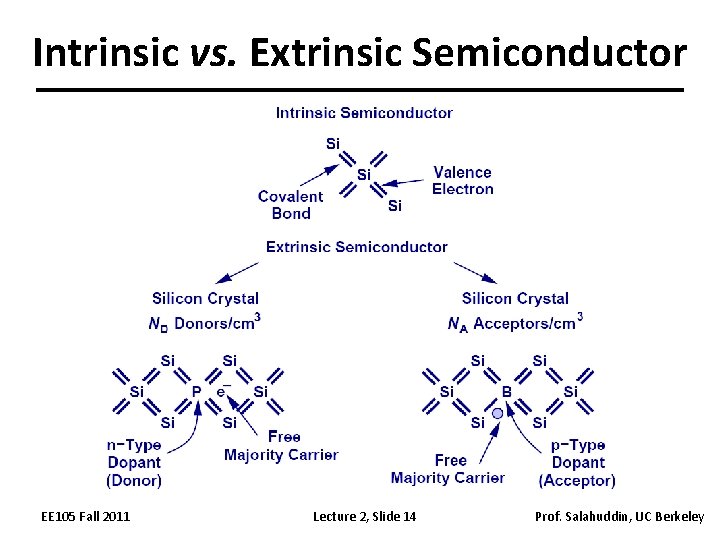
Intrinsic vs. Extrinsic Semiconductor EE 105 Fall 2011 Lecture 2, Slide 14 Prof. Salahuddin, UC Berkeley
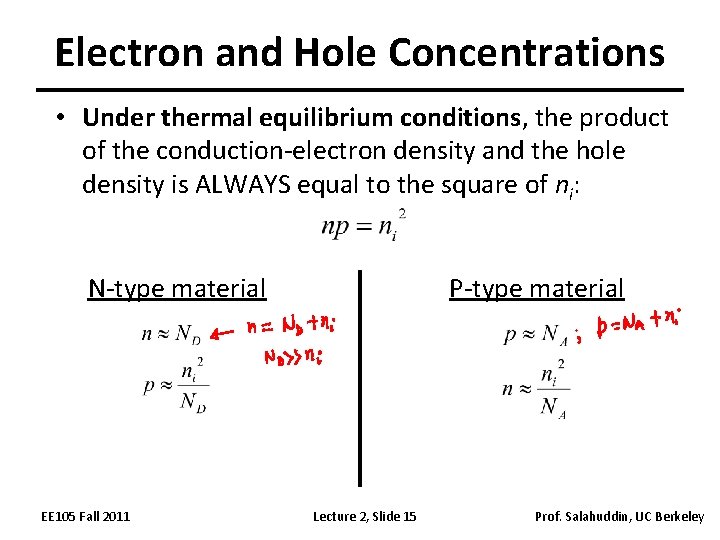
Electron and Hole Concentrations • Under thermal equilibrium conditions, the product of the conduction-electron density and the hole density is ALWAYS equal to the square of ni: N-type material EE 105 Fall 2011 P-type material Lecture 2, Slide 15 Prof. Salahuddin, UC Berkeley
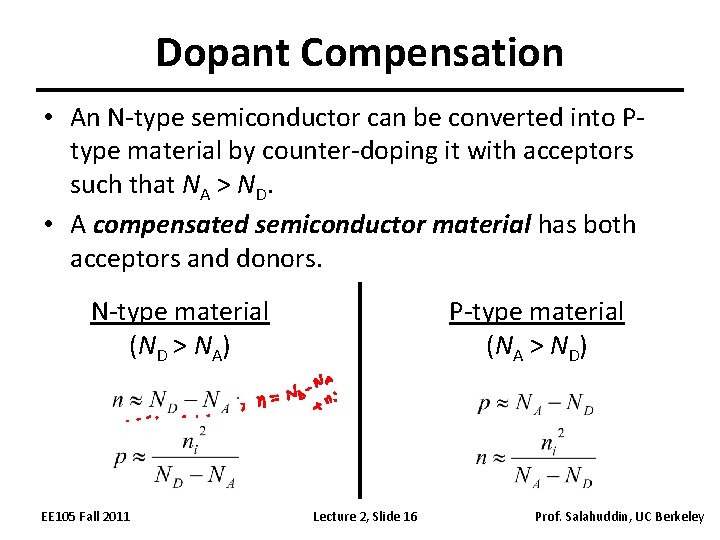
Dopant Compensation • An N-type semiconductor can be converted into Ptype material by counter-doping it with acceptors such that NA > ND. • A compensated semiconductor material has both acceptors and donors. N-type material (ND > NA) EE 105 Fall 2011 P-type material (NA > ND) Lecture 2, Slide 16 Prof. Salahuddin, UC Berkeley
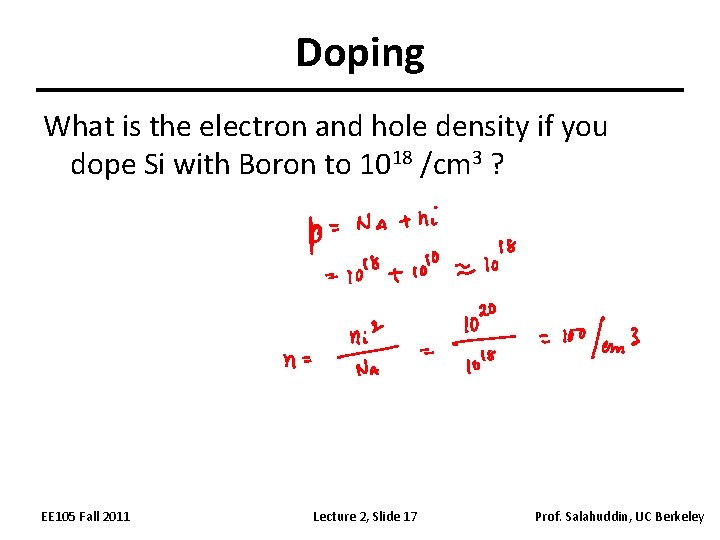
Doping What is the electron and hole density if you dope Si with Boron to 1018 /cm 3 ? EE 105 Fall 2011 Lecture 2, Slide 17 Prof. Salahuddin, UC Berkeley
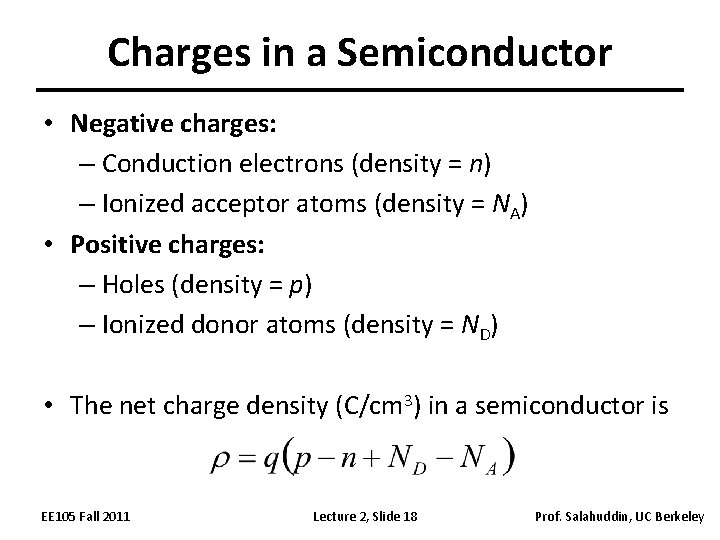
Charges in a Semiconductor • Negative charges: – Conduction electrons (density = n) – Ionized acceptor atoms (density = NA) • Positive charges: – Holes (density = p) – Ionized donor atoms (density = ND) • The net charge density (C/cm 3) in a semiconductor is EE 105 Fall 2011 Lecture 2, Slide 18 Prof. Salahuddin, UC Berkeley
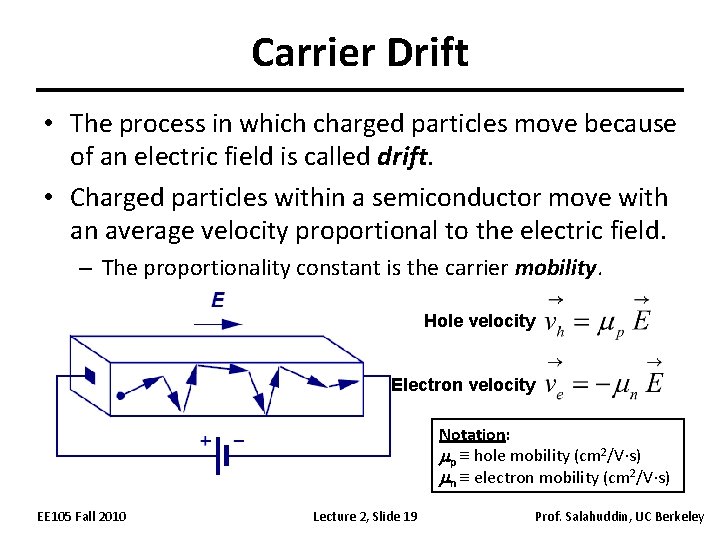
Carrier Drift • The process in which charged particles move because of an electric field is called drift. • Charged particles within a semiconductor move with an average velocity proportional to the electric field. – The proportionality constant is the carrier mobility. Hole velocity Electron velocity Notation: mp hole mobility (cm 2/V·s) mn electron mobility (cm 2/V·s) EE 105 Fall 2010 Lecture 2, Slide 19 Prof. Salahuddin, UC Berkeley
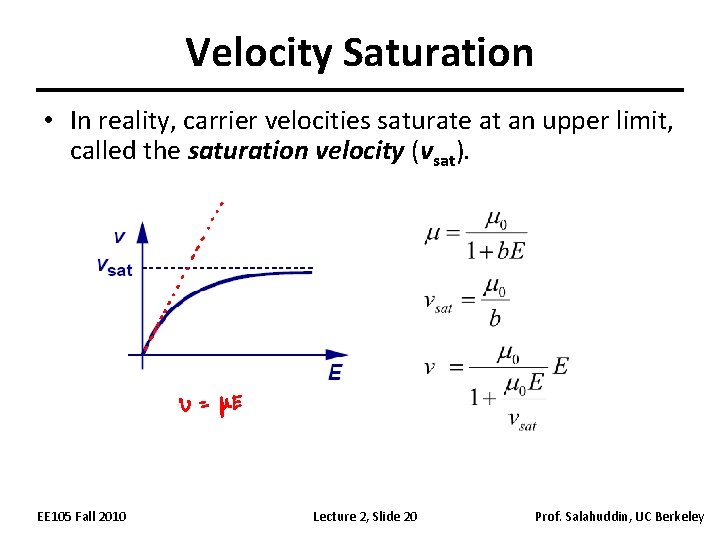
Velocity Saturation • In reality, carrier velocities saturate at an upper limit, called the saturation velocity (vsat). EE 105 Fall 2010 Lecture 2, Slide 20 Prof. Salahuddin, UC Berkeley
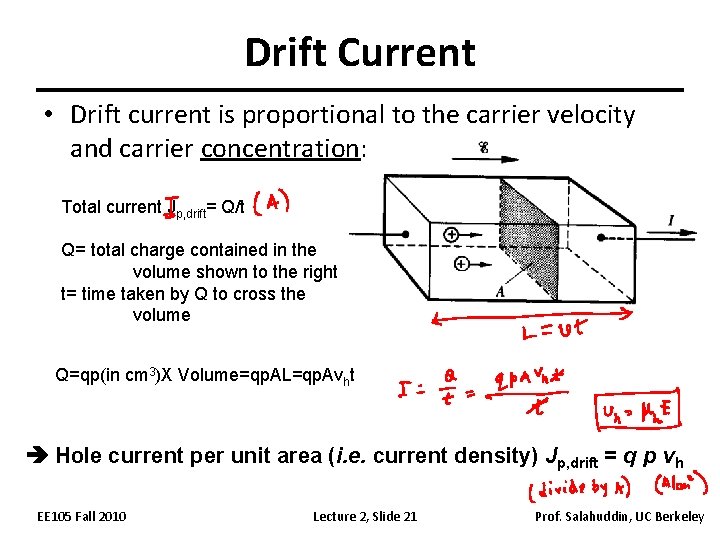
Drift Current • Drift current is proportional to the carrier velocity and carrier concentration: Total current Jp, drift= Q/t Q= total charge contained in the volume shown to the right t= time taken by Q to cross the volume Q=qp(in cm 3)X Volume=qp. AL=qp. Avht Hole current per unit area (i. e. current density) Jp, drift = q p vh EE 105 Fall 2010 Lecture 2, Slide 21 Prof. Salahuddin, UC Berkeley
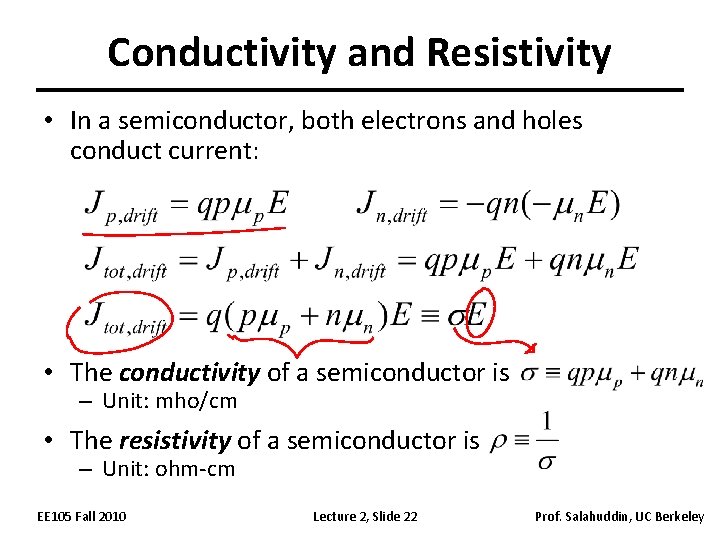
Conductivity and Resistivity • In a semiconductor, both electrons and holes conduct current: • The conductivity of a semiconductor is – Unit: mho/cm • The resistivity of a semiconductor is – Unit: ohm-cm EE 105 Fall 2010 Lecture 2, Slide 22 Prof. Salahuddin, UC Berkeley
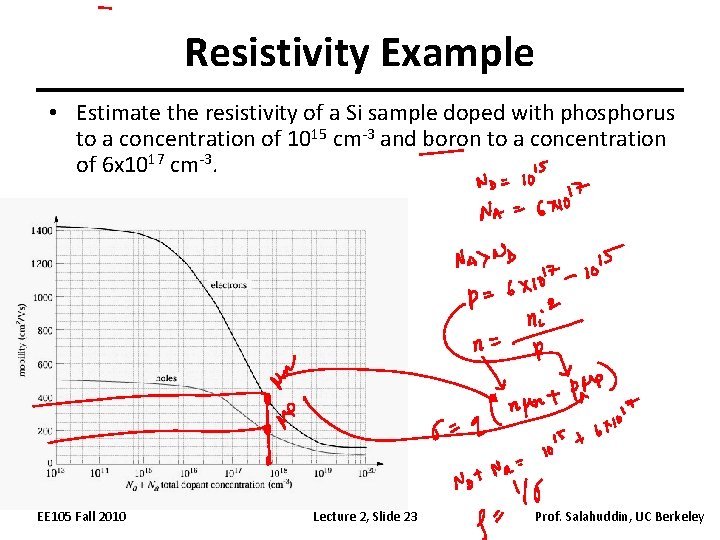
Resistivity Example • Estimate the resistivity of a Si sample doped with phosphorus to a concentration of 1015 cm-3 and boron to a concentration of 6 x 1017 cm-3. EE 105 Fall 2010 Lecture 2, Slide 23 Prof. Salahuddin, UC Berkeley
- Slides: 23