
Lecture 2 Our Place in the Universe Asteroid

- Slides: 65
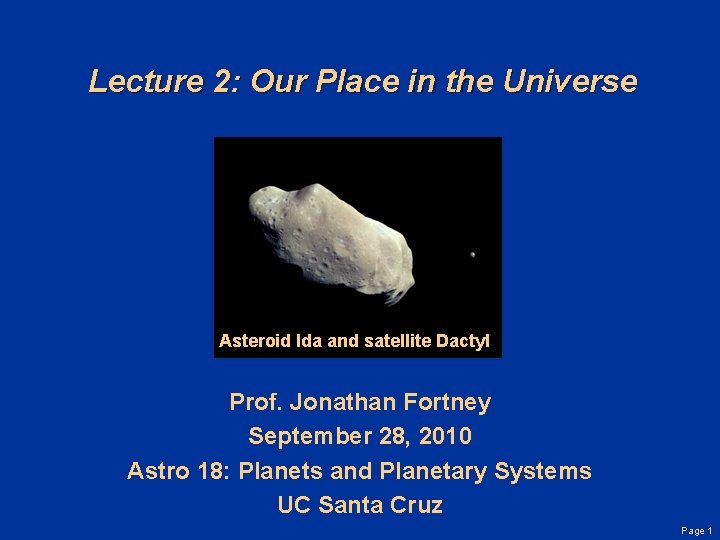
Lecture 2: Our Place in the Universe Asteroid Ida and satellite Dactyl Prof. Jonathan Fortney September 28, 2010 Astro 18: Planets and Planetary Systems UC Santa Cruz Page 1
Topics for this class • Some definitions • What is our place in the universe? • The earth and its place within the Solar System • The Solar System’s place in the Milky Way Galaxy • Our galaxy in the universe at large • Geometry of the Solar System • Plane of the planets’ orbits • Tilt of the earth’s axis • The sky at night Please remind me to take break at 12: 45 • The cosmic distance scale • The expansion of the universe and the Big Bang Page 2
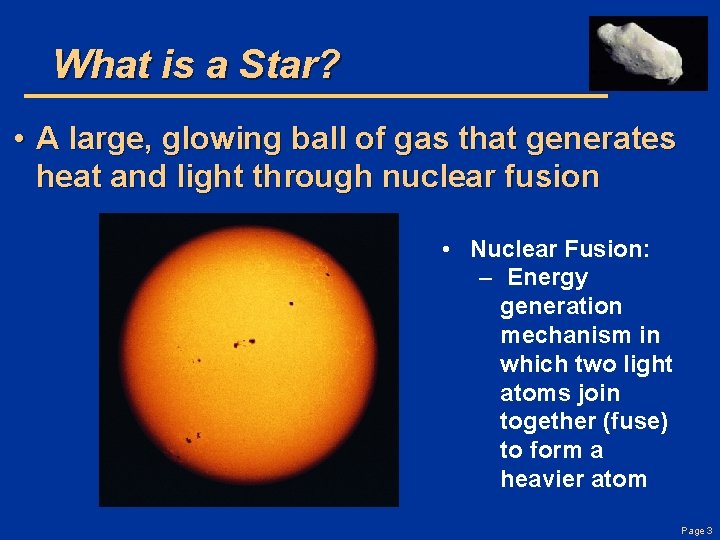
What is a Star? • A large, glowing ball of gas that generates heat and light through nuclear fusion • Nuclear Fusion: – Energy generation mechanism in which two light atoms join together (fuse) to form a heavier atom Page 3
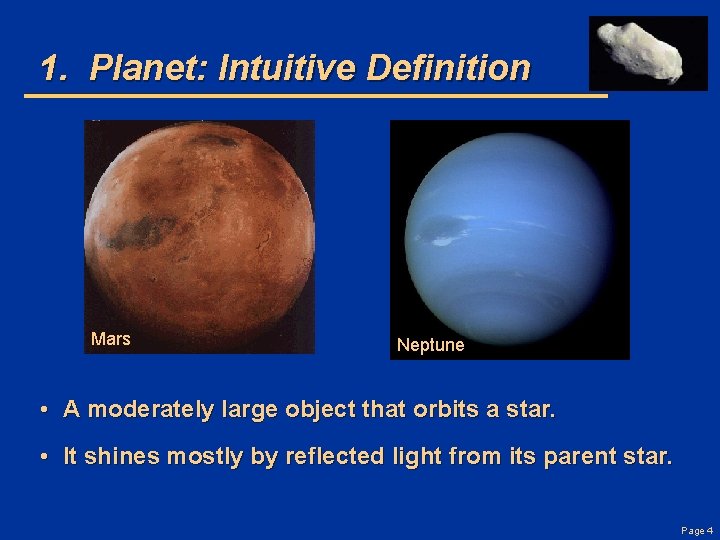
1. Planet: Intuitive Definition Mars Neptune • A moderately large object that orbits a star. • It shines mostly by reflected light from its parent star. Page 4
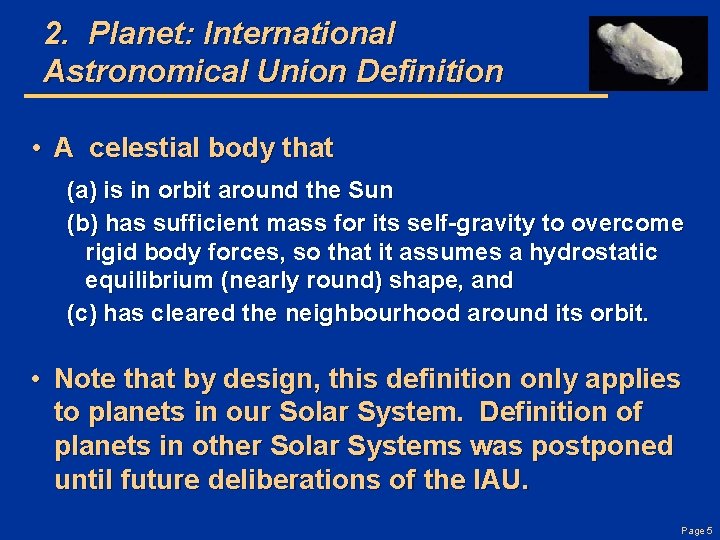
2. Planet: International Astronomical Union Definition • A celestial body that (a) is in orbit around the Sun (b) has sufficient mass for its self-gravity to overcome rigid body forces, so that it assumes a hydrostatic equilibrium (nearly round) shape, and (c) has cleared the neighbourhood around its orbit. • Note that by design, this definition only applies to planets in our Solar System. Definition of planets in other Solar Systems was postponed until future deliberations of the IAU. Page 5
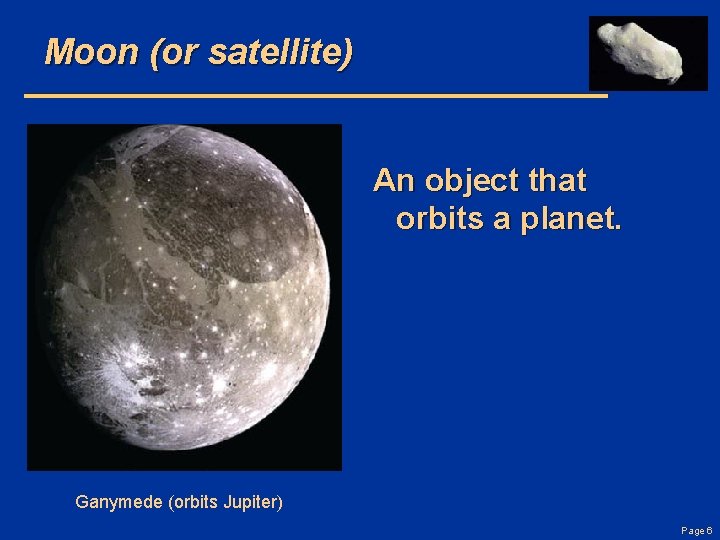
Moon (or satellite) An object that orbits a planet. Ganymede (orbits Jupiter) Page 6
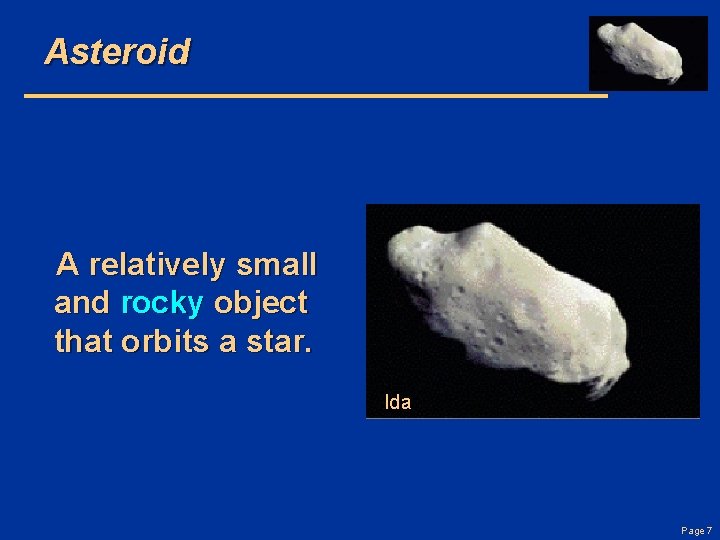
Asteroid A relatively small and rocky object that orbits a star. Ida Page 7
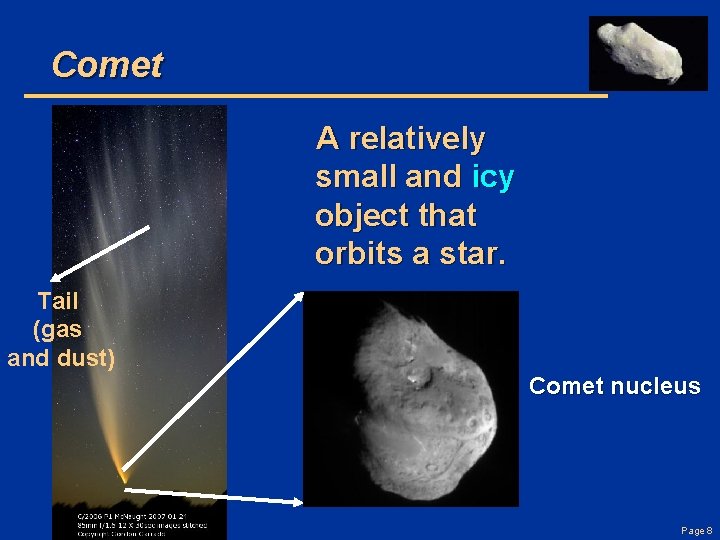
Comet A relatively small and icy object that orbits a star. Tail (gas and dust) Comet nucleus Page 8
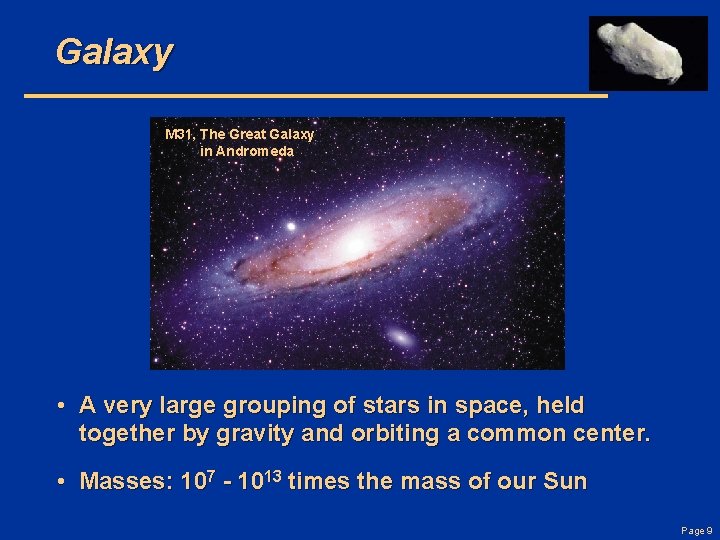
Galaxy M 31, The Great Galaxy in Andromeda • A very large grouping of stars in space, held together by gravity and orbiting a common center. • Masses: 107 - 1013 times the mass of our Sun Page 9
Notation: Orders of magnitude • 102 = 100 = 1 with 2 zeros after it • 103 = 1000 = 1 with 3 zeros after it • 109 = 1 with 9 zeros after it = 1 billion • 1011 = 1 with 11 zeros after it = 100 billion Page 10
Thought Question Suppose you tried to count the more than 100 billion stars in our galaxy, at a rate of one per second… How long would it take you? A. a few weeks B. a few months C. a few years D. a few thousand years Page 11
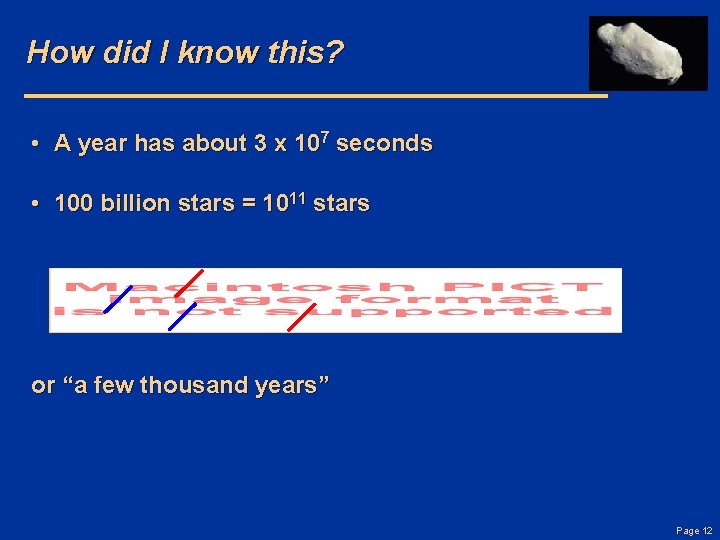
How did I know this? • A year has about 3 x 10⁷ seconds • 100 billion stars = 1011 stars or “a few thousand years” Page 12
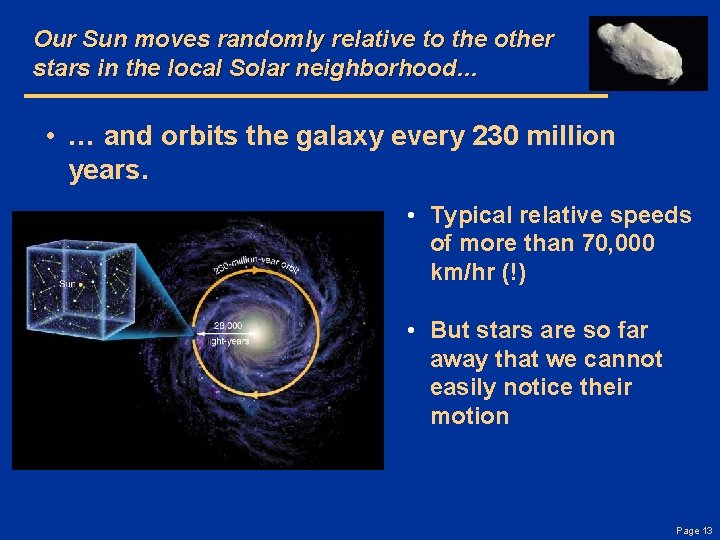
Our Sun moves randomly relative to the other stars in the local Solar neighborhood… • … and orbits the galaxy every 230 million years. • Typical relative speeds of more than 70, 000 km/hr (!) • But stars are so far away that we cannot easily notice their motion Page 13
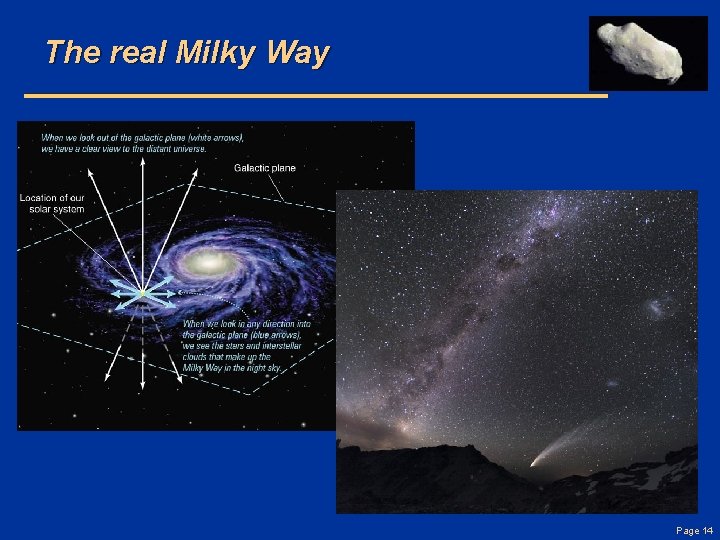
The real Milky Way Page 14
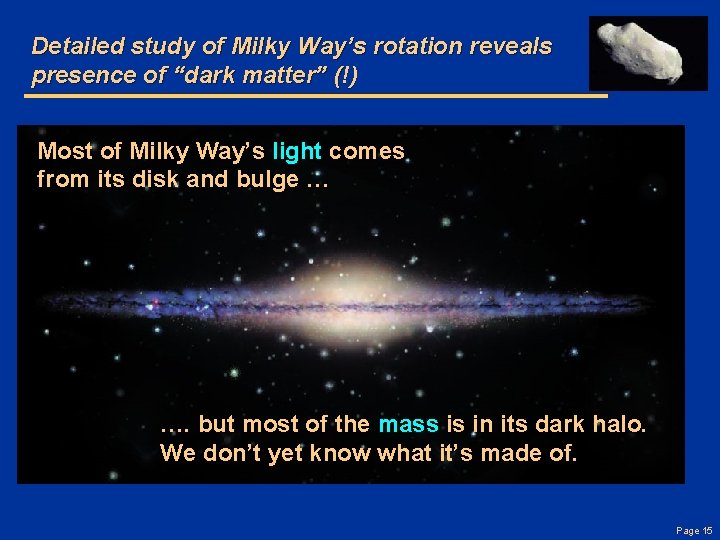
Detailed study of Milky Way’s rotation reveals presence of “dark matter” (!) Most of Milky Way’s light comes from its disk and bulge … …. but most of the mass is in its dark halo. We don’t yet know what it’s made of. Page 15
Universe • The sum total of all matter and energy • That is, everything within and between all galaxies Page 16
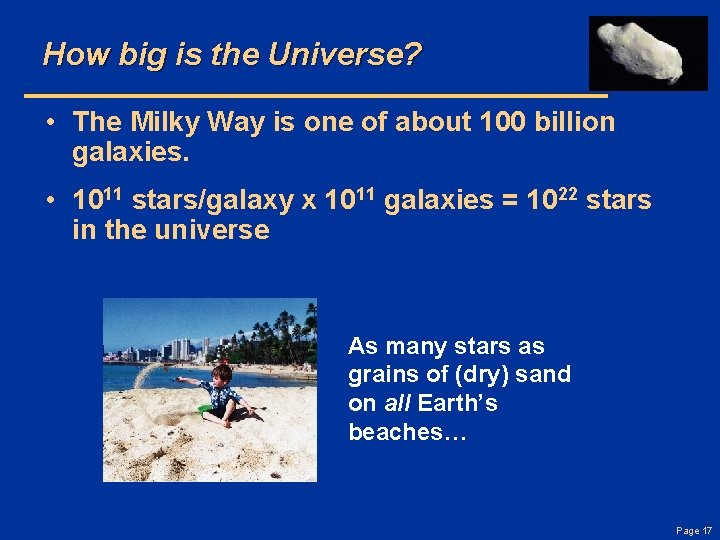
How big is the Universe? • The Milky Way is one of about 100 billion galaxies. • 1011 stars/galaxy x 1011 galaxies = 1022 stars in the universe As many stars as grains of (dry) sand on all Earth’s beaches… Page 17
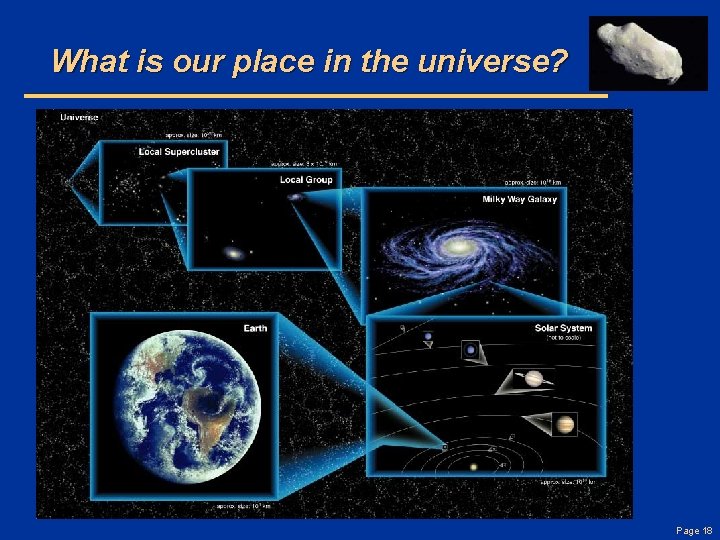
What is our place in the universe? Page 18
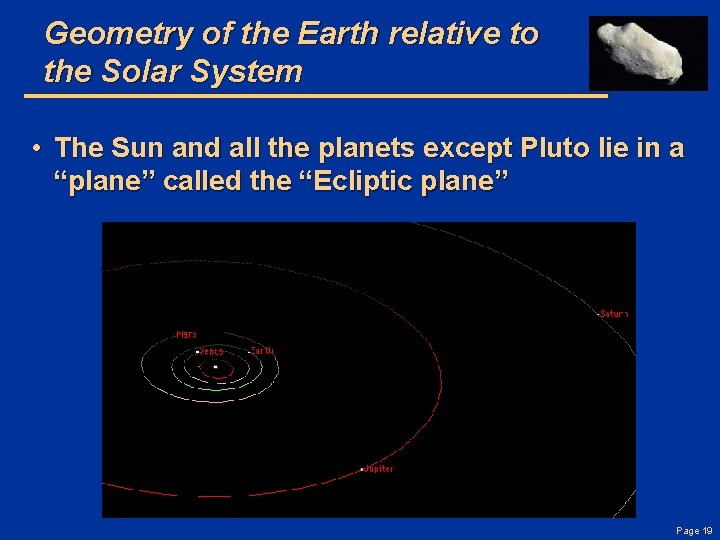
Geometry of the Earth relative to the Solar System • The Sun and all the planets except Pluto lie in a “plane” called the “Ecliptic plane” Page 19
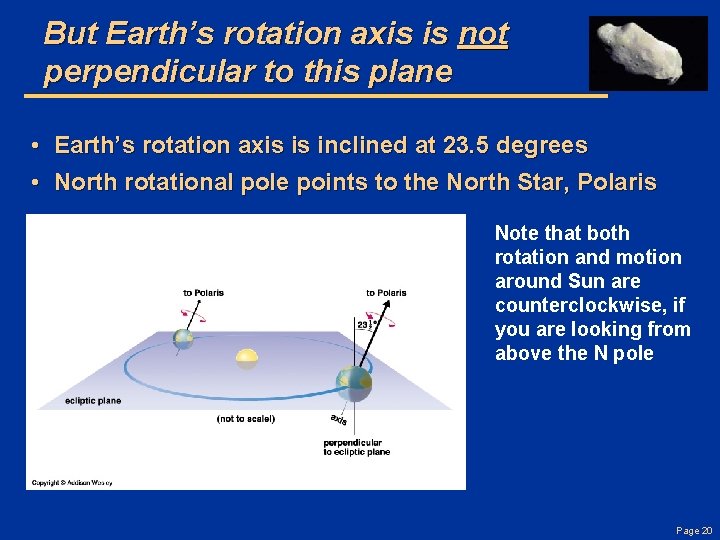
But Earth’s rotation axis is not perpendicular to this plane • Earth’s rotation axis is inclined at 23. 5 degrees • North rotational pole points to the North Star, Polaris Note that both rotation and motion around Sun are counterclockwise, if you are looking from above the N pole Page 20
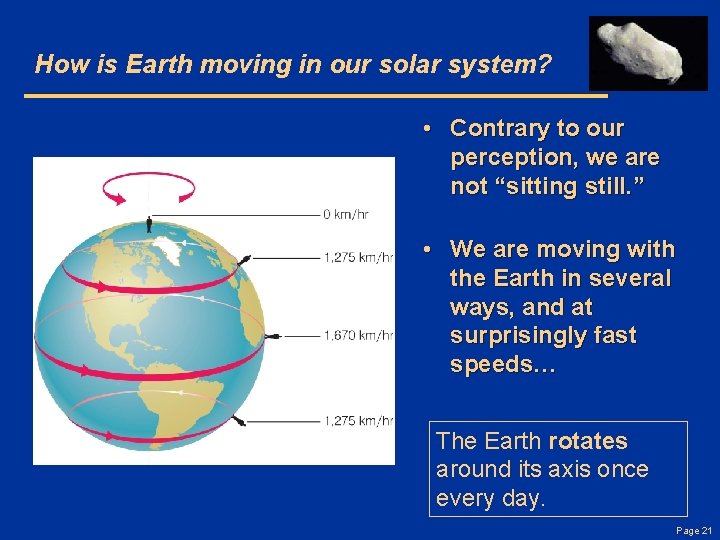
How is Earth moving in our solar system? • Contrary to our perception, we are not “sitting still. ” • We are moving with the Earth in several ways, and at surprisingly fast speeds… The Earth rotates around its axis once every day. Page 21
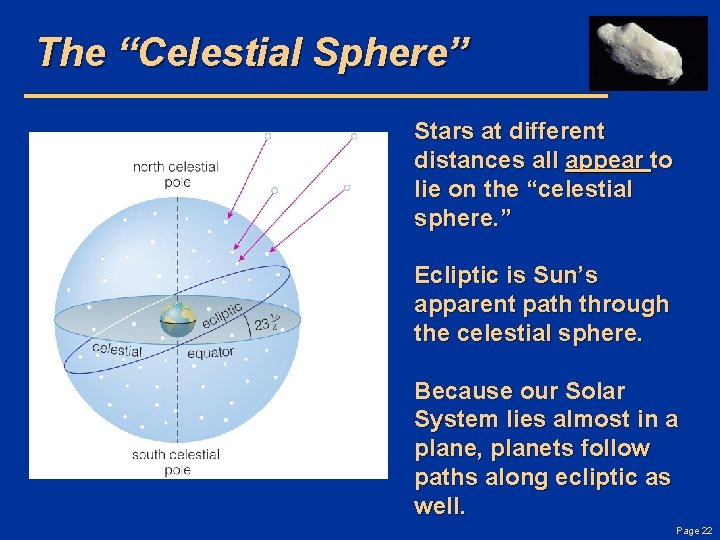
The “Celestial Sphere” Stars at different distances all appear to lie on the “celestial sphere. ” Ecliptic is Sun’s apparent path through the celestial sphere. Because our Solar System lies almost in a plane, planets follow paths along ecliptic as well. Page 22
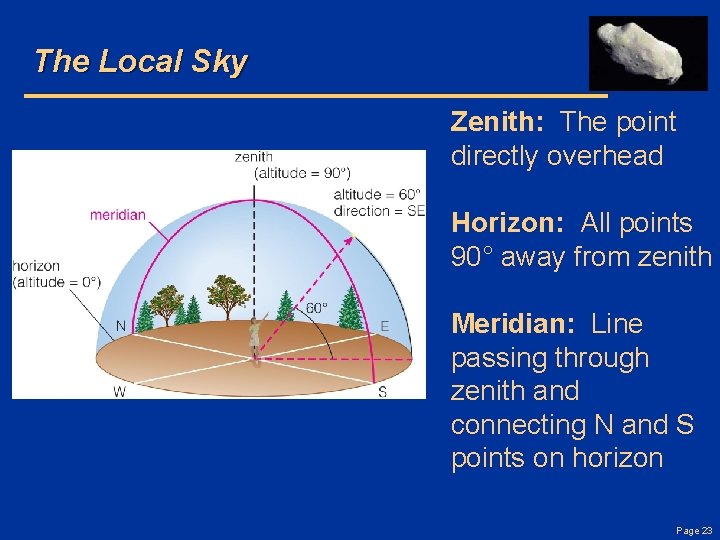
The Local Sky Zenith: The point directly overhead Horizon: All points 90° away from zenith Meridian: Line passing through zenith and connecting N and S points on horizon Page 23
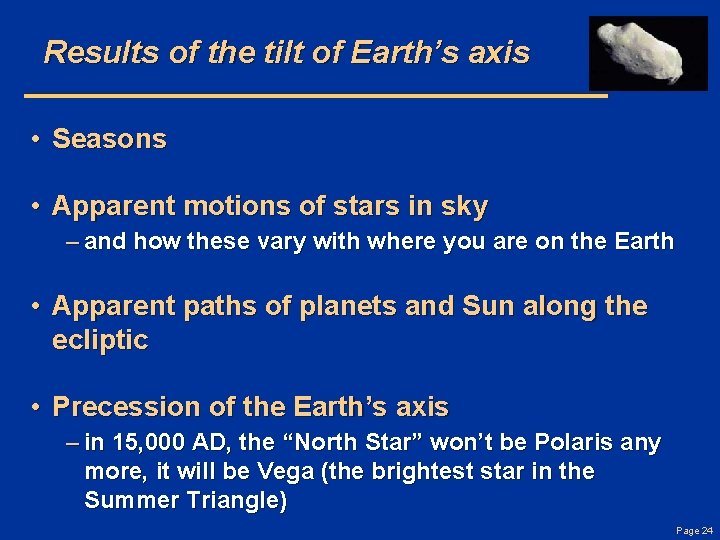
Results of the tilt of Earth’s axis • Seasons • Apparent motions of stars in sky – and how these vary with where you are on the Earth • Apparent paths of planets and Sun along the ecliptic • Precession of the Earth’s axis – in 15, 000 AD, the “North Star” won’t be Polaris any more, it will be Vega (the brightest star in the Summer Triangle) Page 24
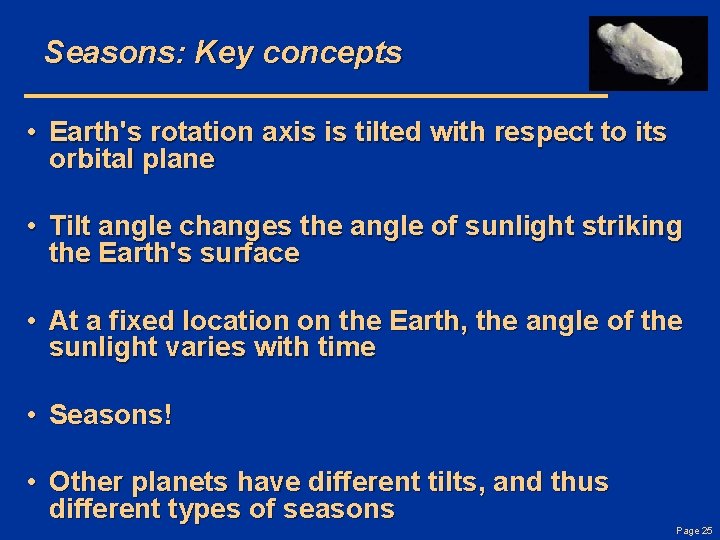
Seasons: Key concepts • Earth's rotation axis is tilted with respect to its orbital plane • Tilt angle changes the angle of sunlight striking the Earth's surface • At a fixed location on the Earth, the angle of the sunlight varies with time • Seasons! • Other planets have different tilts, and thus different types of seasons Page 25
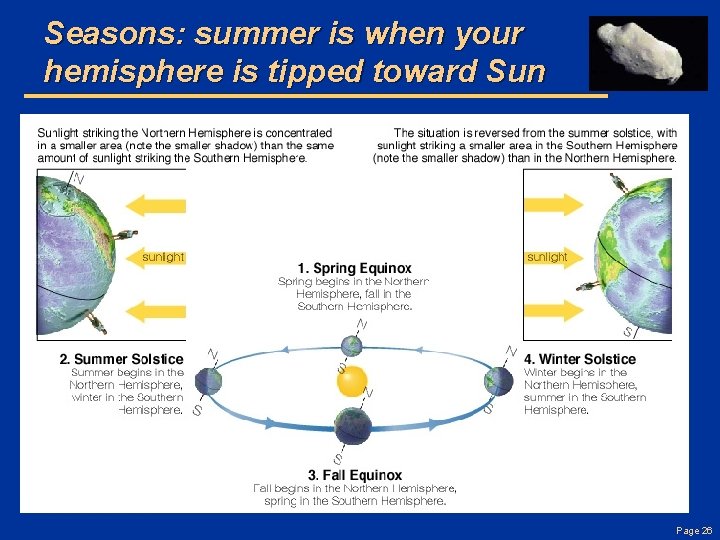
Seasons: summer is when your hemisphere is tipped toward Sun Page 26
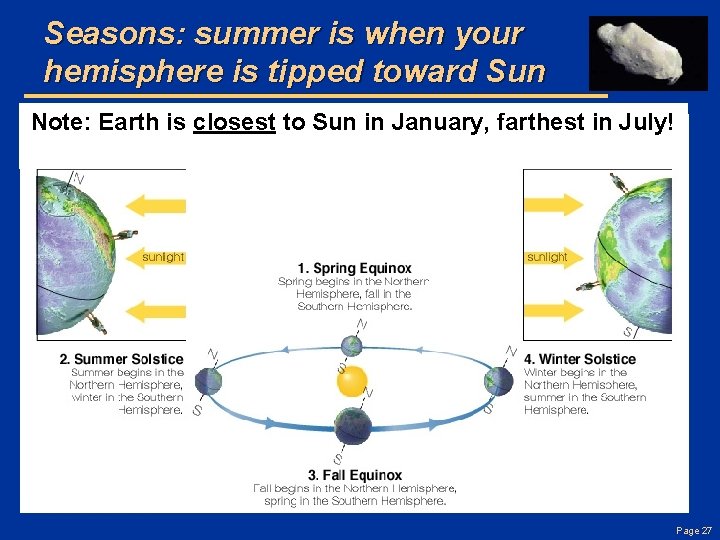
Seasons: summer is when your hemisphere is tipped toward Sun Note: Earth is closest to Sun in January, farthest in July! Page 27
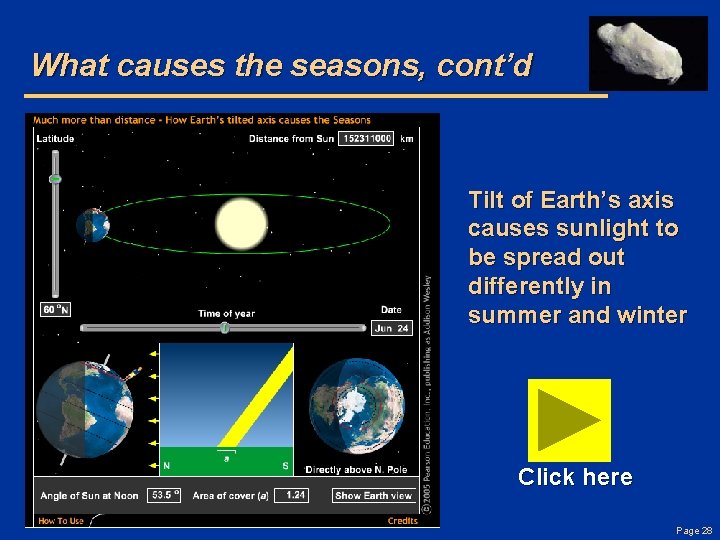
What causes the seasons, cont’d Tilt of Earth’s axis causes sunlight to be spread out differently in summer and winter Click here Page 28
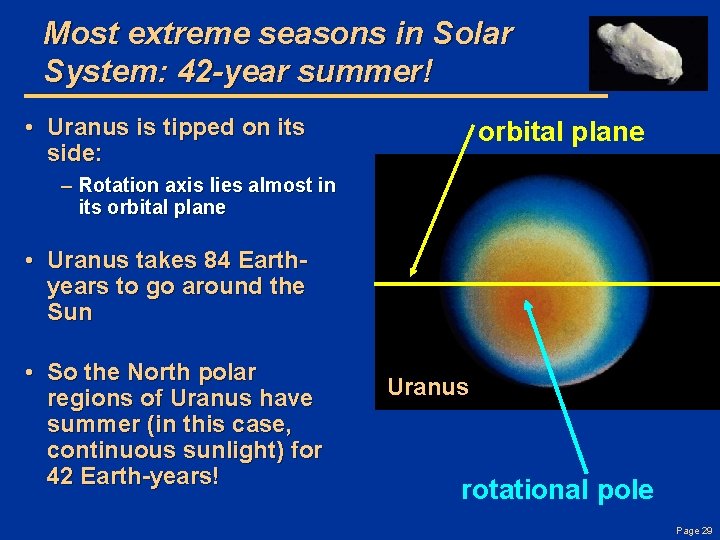
Most extreme seasons in Solar System: 42 -year summer! • Uranus is tipped on its side: orbital plane – Rotation axis lies almost in its orbital plane • Uranus takes 84 Earthyears to go around the Sun • So the North polar regions of Uranus have summer (in this case, continuous sunlight) for 42 Earth-years! Uranus rotational pole Page 29
First Concep. Test I will pose a question on next slide. First, each of you will have one minute to think about the answer (three multiple choices). This is not a trick question: think conceptually. Then, break into groups of 2 or 3 You will have two minutes to convince your neighbors of the best answer. Discuss! I will then ask for a show of hands for the three multiple choices, and we will discuss the results. Page 30
Concep. Test One You are having an argument with a friend about what causes Earth’s seasons. Your friend insists the difference between summer and winter is that the Earth is closer to the Sun in summer than it is in winter. Which of the following is the best fact you can use to convince your friend that his/her explanation must be wrong? Why? a) days are shorter in winter than in summer b) if you are above the Arctic Circle in winter, there is a long period of time when the sun never rises c) when it is winter in the Northern Hemisphere, it is summer in the Southern Hemisphere Page 31
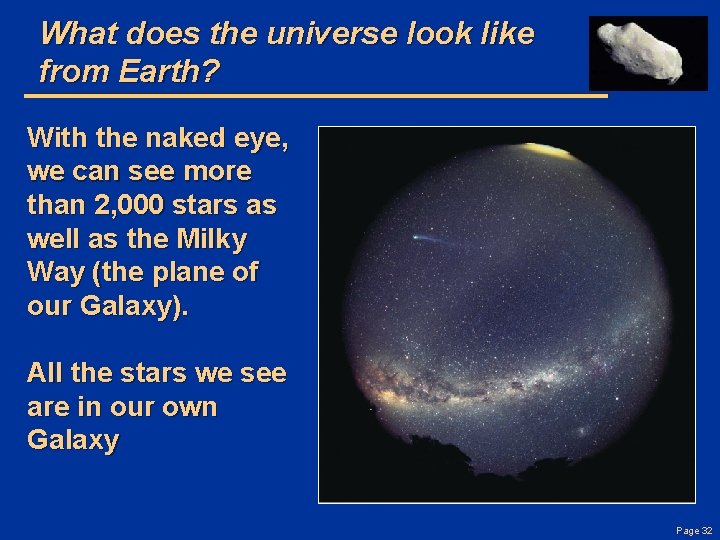
What does the universe look like from Earth? With the naked eye, we can see more than 2, 000 stars as well as the Milky Way (the plane of our Galaxy). All the stars we see are in our own Galaxy Page 32
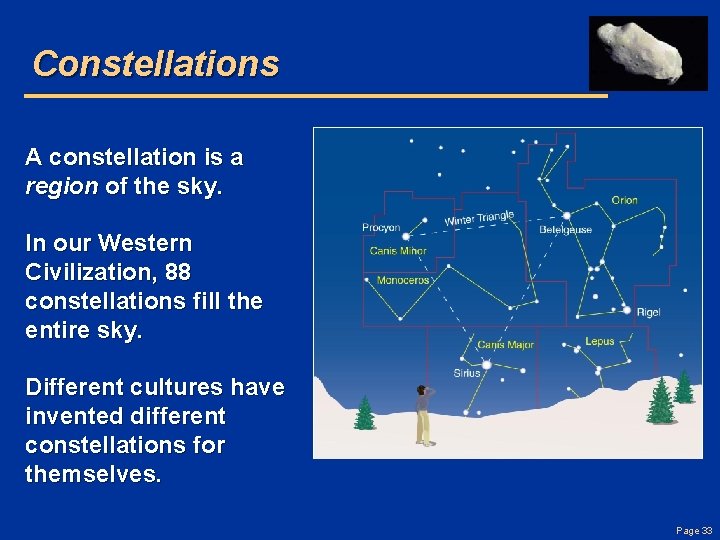
Constellations A constellation is a region of the sky. In our Western Civilization, 88 constellations fill the entire sky. Different cultures have invented different constellations for themselves. Page 33
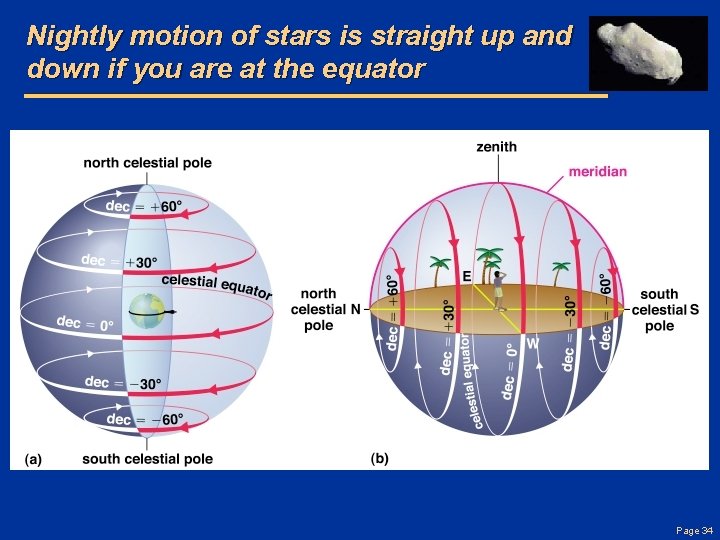
Nightly motion of stars is straight up and down if you are at the equator Page 34
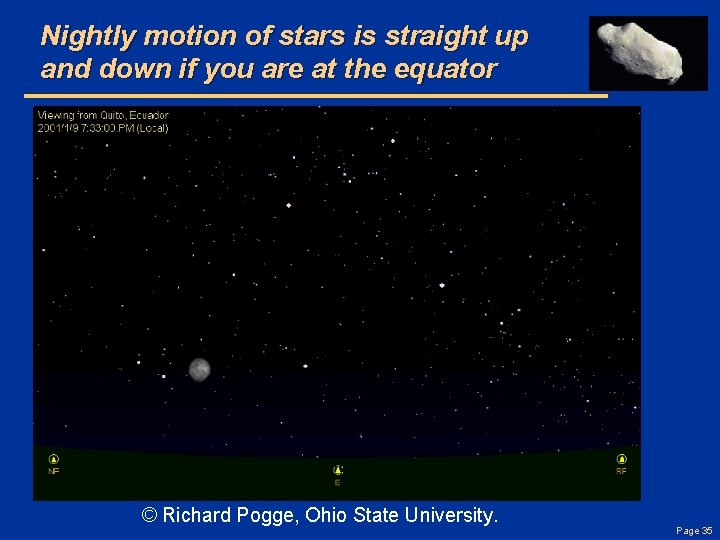
Nightly motion of stars is straight up and down if you are at the equator © Richard Pogge, Ohio State University. Page 35
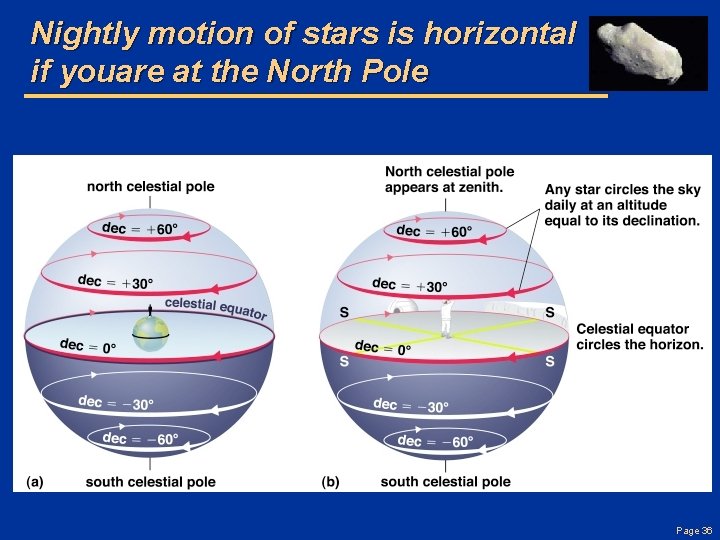
Nightly motion of stars is horizontal if youare at the North Pole Page 36
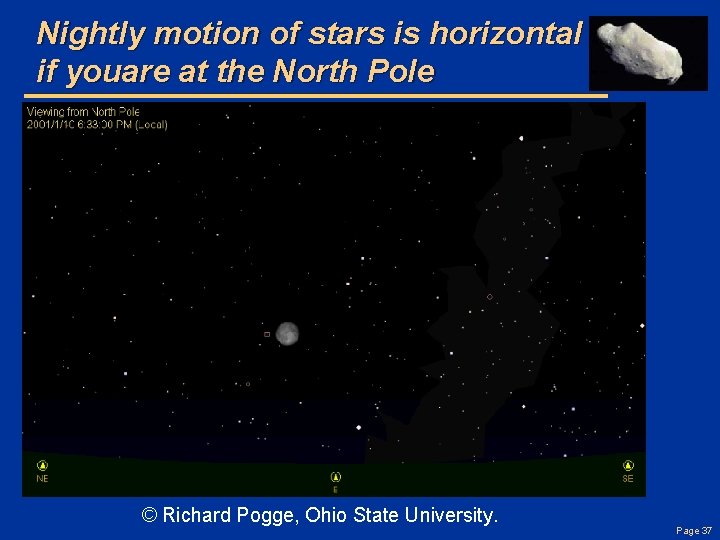
Nightly motion of stars is horizontal if youare at the North Pole © Richard Pogge, Ohio State University. Page 37
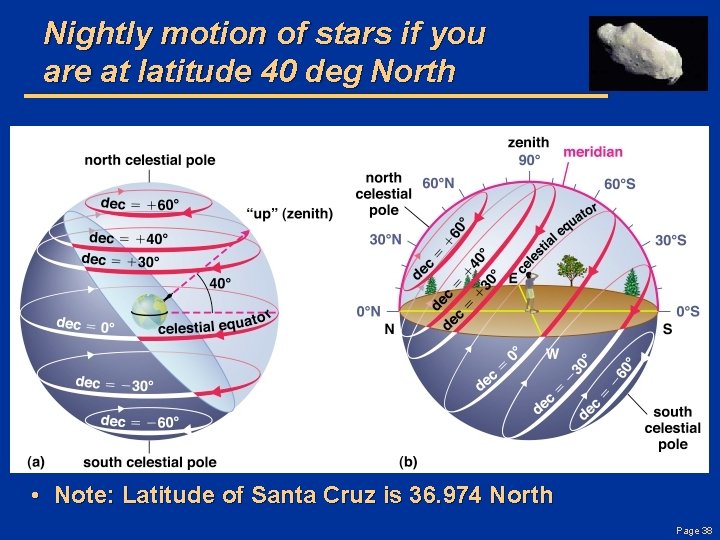
Nightly motion of stars if you are at latitude 40 deg North • Note: Latitude of Santa Cruz is 36. 974 North Page 38
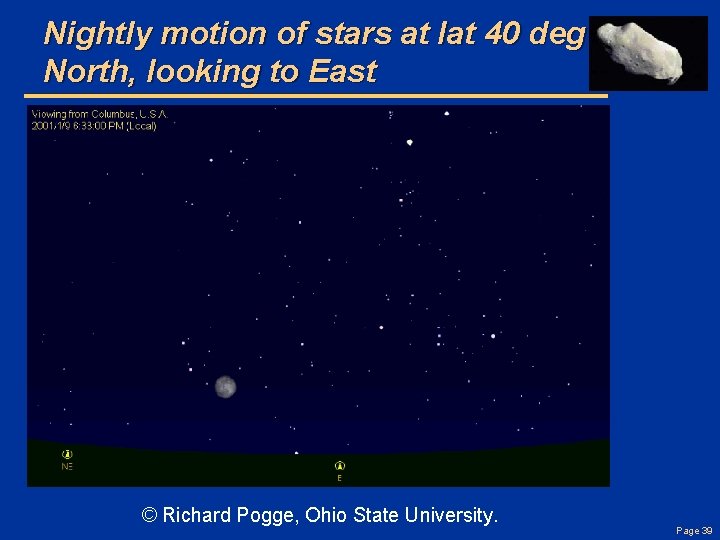
Nightly motion of stars at lat 40 deg North, looking to East © Richard Pogge, Ohio State University. Page 39
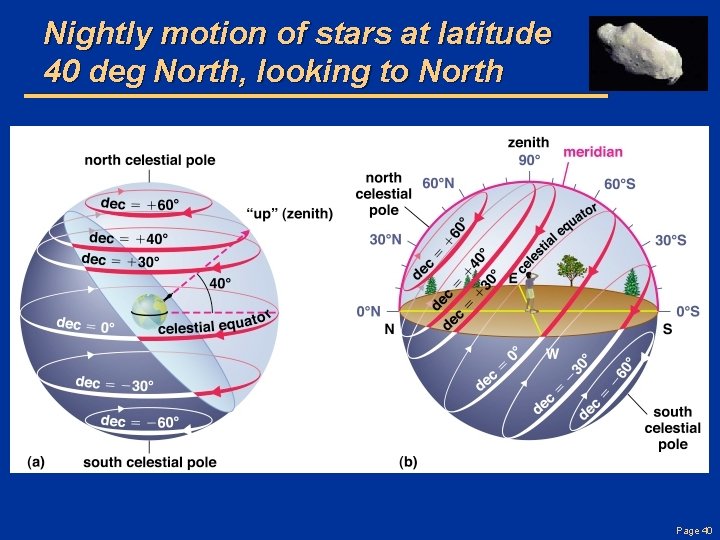
Nightly motion of stars at latitude 40 deg North, looking to North Page 40
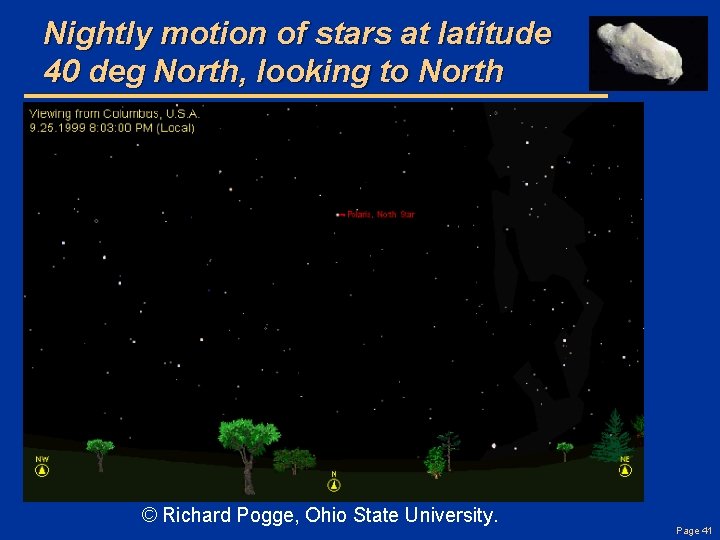
Nightly motion of stars at latitude 40 deg North, looking to North © Richard Pogge, Ohio State University. Page 41
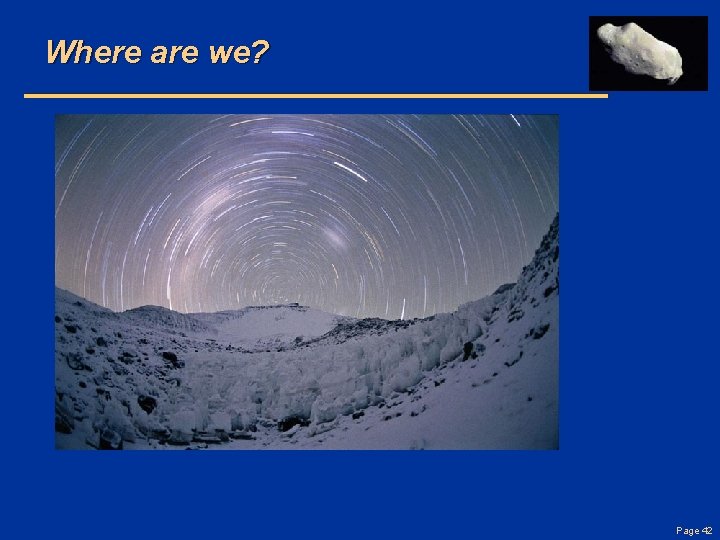
Where are we? Page 42
The Cosmic Distance Scale • What is a light-year? First discuss speed of light. • Light doesn’t travel infinitely fast. • If light propagates in a vacuum (as in outer space), its speed is a very specific number: c = 300, 000 km/sec = 3 x 1010 cm/sec • At this speed, light would circle the Earth eight times in 1 second Page 43
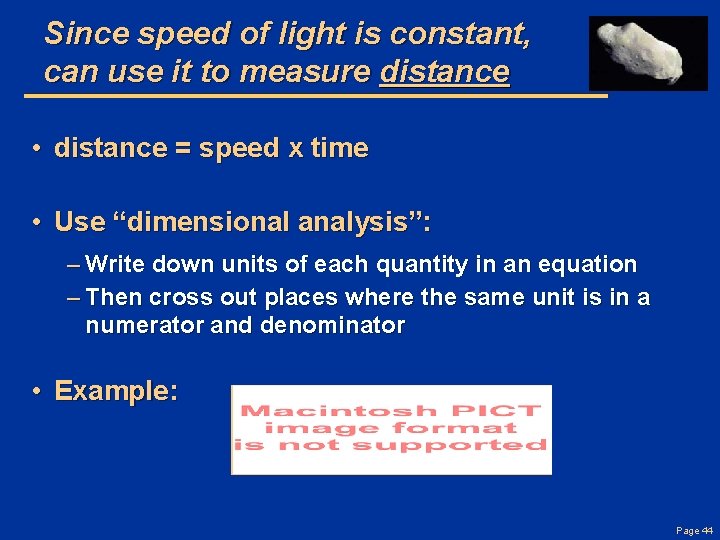
Since speed of light is constant, can use it to measure distance • distance = speed x time • Use “dimensional analysis”: – Write down units of each quantity in an equation – Then cross out places where the same unit is in a numerator and denominator • Example: Page 44
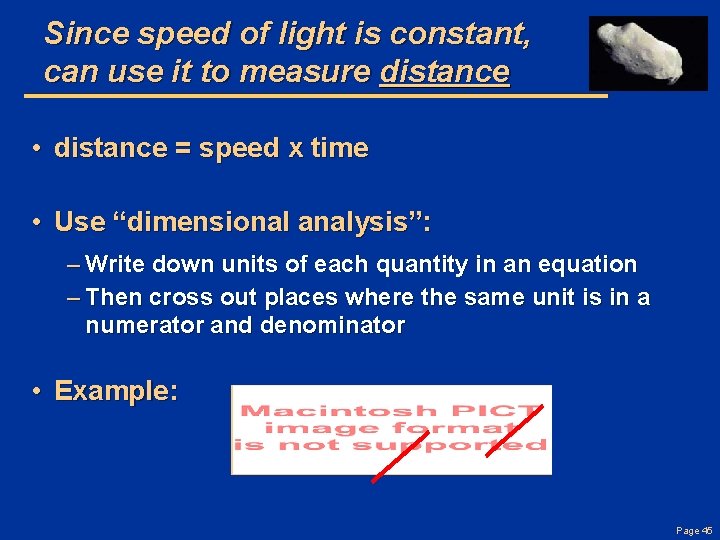
Since speed of light is constant, can use it to measure distance • distance = speed x time • Use “dimensional analysis”: – Write down units of each quantity in an equation – Then cross out places where the same unit is in a numerator and denominator • Example: Page 45
Define a light-year • A light-year is the distance that light travels in one Earth-year • How big is it? Page 46
Some examples of light travel-time • The Moon: – It takes light 1 sec to travel from the moon to the Earth, so the Moon 1 light-sec away • The Sun: – It takes light 8 minutes to travel from the Sun to the Earth, so the Sun is 8 light-minutes away • The nearest star, Proxima Centauri: – It takes light about 4 years to travel from Proxima Centauri to the Earth, so this star is 4 light-years away Page 47
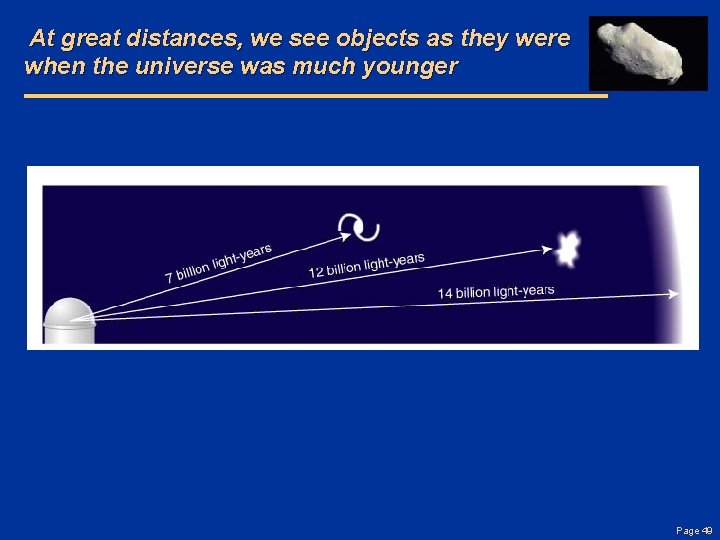
Implications of the finite speed of light • Because it takes light a finite amount of time to reach us, the farther away we look in distance, the further back we look in time • In 1987 when we saw a supernova explosion in the Large Magellanic Cloud (a neighboring galaxy 150, 000 light-years away), the supernova had actually exploded 150, 000 years ago • When we look at galaxies that are more and more distant from us, we are seeing them at younger and younger stages of their evolution Page 48
At great distances, we see objects as they were when the universe was much younger Page 49
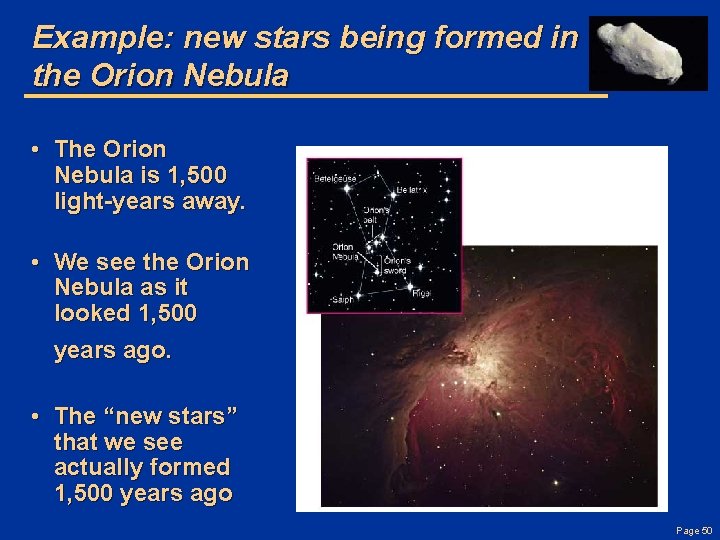
Example: new stars being formed in the Orion Nebula • The Orion Nebula is 1, 500 light-years away. • We see the Orion Nebula as it looked 1, 500 years ago. • The “new stars” that we see actually formed 1, 500 years ago Page 50
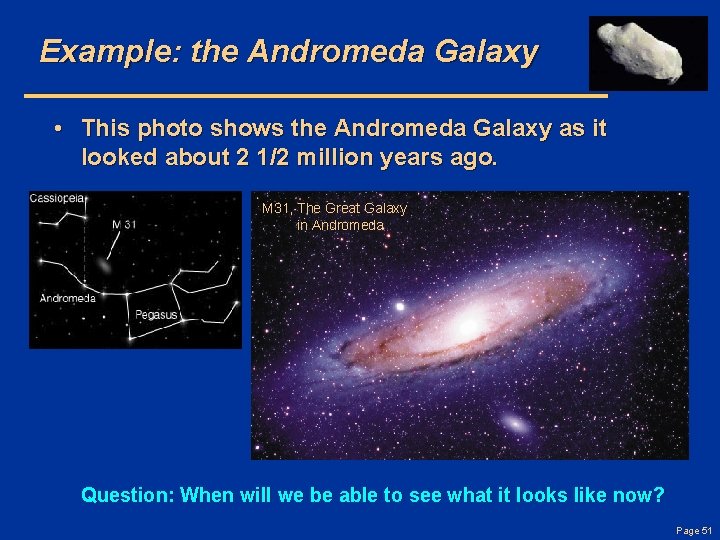
Example: the Andromeda Galaxy • This photo shows the Andromeda Galaxy as it looked about 2 1/2 million years ago. M 31, The Great Galaxy in Andromeda Question: When will we be able to see what it looks like now? Page 51
Concep. Test Two If the speed of light were half what it is now, then a “lightyear” would a) take half as long to traverse at light speed b) take the same amount of time to traverse at light speed c) last twice as many months d) last half as many months Page 52
The expansion of the universe and the Big Bang • Observation: – Virtually every galaxy outside our Local Group is moving away from us – The farther away a galaxy is, the faster it is moving away from us – How is the observation made? From Doppler shift of spectral lines (will discuss in later lecture). » Color of light becomes redder if the object emitting the light is moving away from us. • Recession velocities are large: – tens of thousands to 100’s of thousands of km/sec Page 53
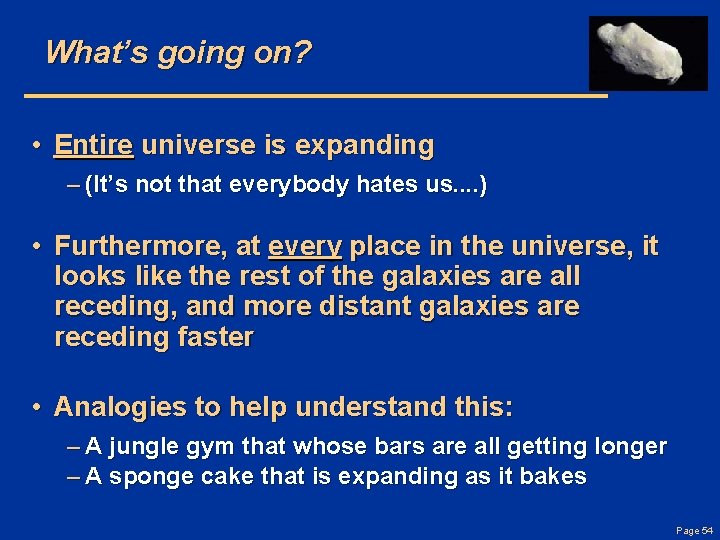
What’s going on? • Entire universe is expanding – (It’s not that everybody hates us. . ) • Furthermore, at every place in the universe, it looks like the rest of the galaxies are all receding, and more distant galaxies are receding faster • Analogies to help understand this: – A jungle gym that whose bars are all getting longer – A sponge cake that is expanding as it bakes Page 54
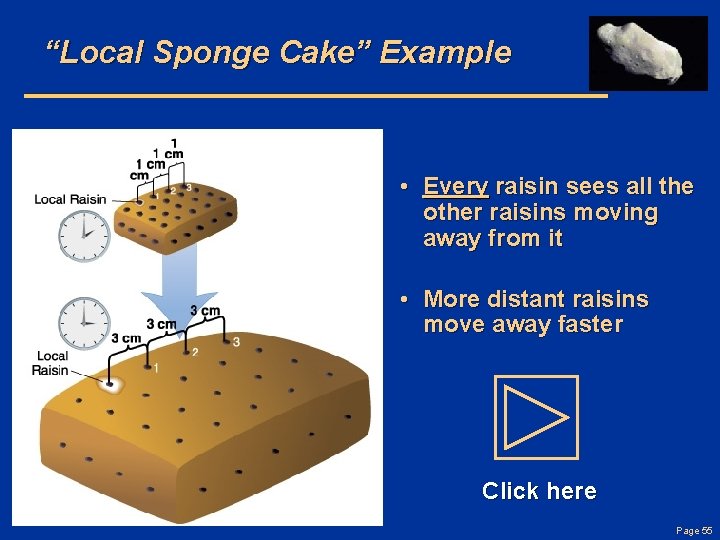
“Local Sponge Cake” Example • Every raisin sees all the other raisins moving away from it • More distant raisins move away faster Click here Page 55
The Big Bang • This is as far back as we can hope to measure • Every place in the universe was (almost) infinitely dense and infinitely hot • Ever since the Big Bang, the universe has been expanding, becoming less dense (on the average), and cooling off Page 56
Concep. Test Three There must be some very large distance such that light from a galaxy at that distance hasn’t reached us during the age of the universe. The expansion velocity of galaxies at that distance, relative to us, must be a) zero b) infinite c) less than the speed of light d) the speed of light or greater Page 57
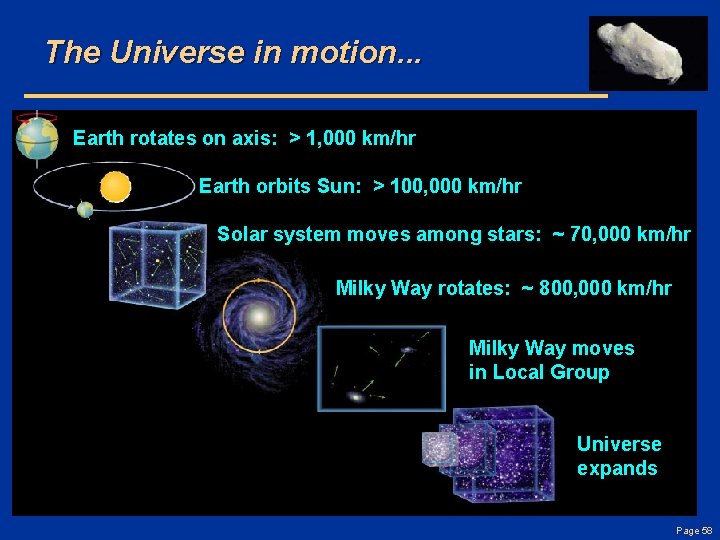
The Universe in motion. . . Earth rotates on axis: > 1, 000 km/hr Earth orbits Sun: > 100, 000 km/hr Solar system moves among stars: ~ 70, 000 km/hr Milky Way rotates: ~ 800, 000 km/hr Milky Way moves in Local Group Universe expands Page 58
Orders of magnitude movie Click here Page 59
What have we learned? • How can we know that the universe was like in the past? – When we look to great distances we are seeing events that happened long ago because light travels at a finite speed • Can we see the entire universe? – No, the observable portion of the universe is about 14 billion light-years in radius because the universe is about 14 billion years old Page 60
Our Celestial Address Earth and Planetary Sciences B 210 UCSC Santa Cruz California USA The Earth The Solar System The Milky Way Galaxy The Local Group of Galaxies The Local Supercluster of Galaxies The Universe Page 61
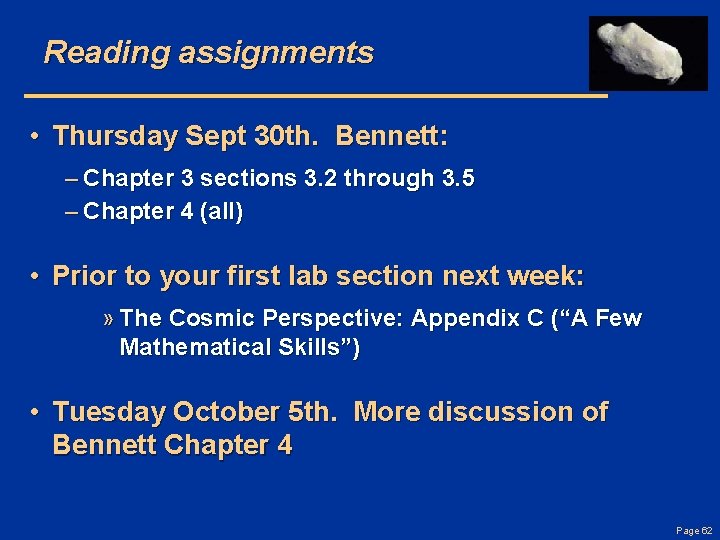
Reading assignments • Thursday Sept 30 th. Bennett: – Chapter 3 sections 3. 2 through 3. 5 – Chapter 4 (all) • Prior to your first lab section next week: » The Cosmic Perspective: Appendix C (“A Few Mathematical Skills”) • Tuesday October 5 th. More discussion of Bennett Chapter 4 Page 62
Homework assignments • Due today – Homework 1 (Please include photo!) – Stellarium Activity Part 1 • Due Thursday Sept 30 th (in preparation for stargazing that night) – Stellarium Activity Part 2 – posted on class webpage • Due Tuesday October 5 th – Homework 2 (will be posted on class webpage) Page 63
Labs and sections will start next week • Jenn Burt will circulate sign-up sheets for timeslots of: • Sections (two timeslots – you only have to come to one section) • Labs (every other week) • Then we will look for classrooms • Results will be posted on web, and announced in class on Thursday Page 64
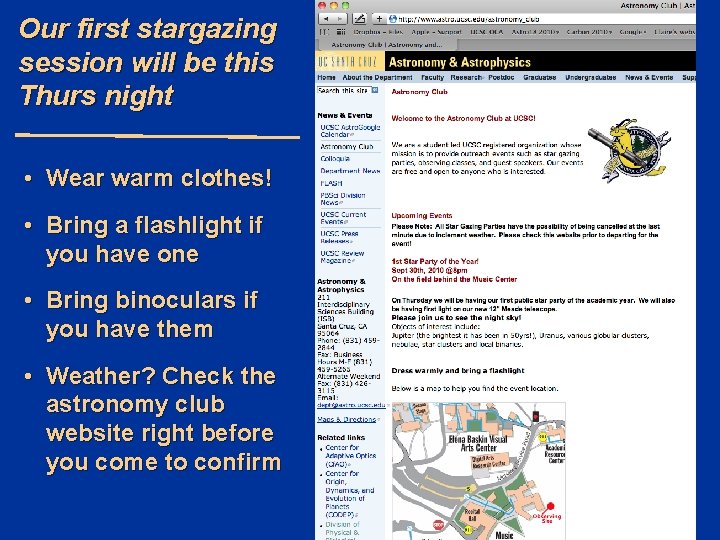
Our first stargazing session will be this Thurs night • Wear warm clothes! • Bring a flashlight if you have one • Bring binoculars if you have them • Weather? Check the astronomy club website right before you come to confirm