
Lecture 2 NyquistShannon Sampling Theorem ESE 150 DIGITAL



- Slides: 55
Lecture #2 – Nyquist-Shannon Sampling Theorem ESE 150 – DIGITAL AUDIO BASICS Based on slides © 2009 --2019 De. Hon and Koditschek Additional Material © 2014 Farmer 1
LECTURE TOPICS � � Where are we on course map? What we did in lab last week � � � How it relates to this week Sampling/Quantization Review Nyquist Shannon Sampling Rate Next Lab References 2
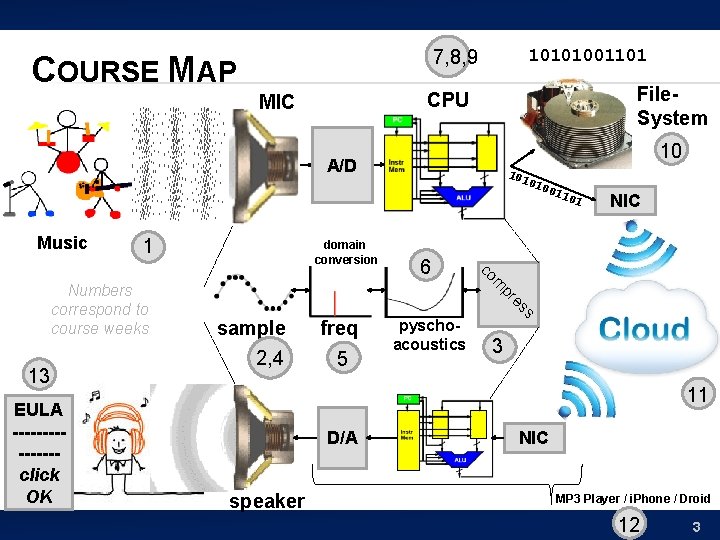
7, 8, 9 COURSE MAP 10101001101 File. System CPU MIC 10 A/D 101 010 Music 1 EULA -------click OK freq 5 pyschoacoustics NIC s es pr 13 sample 2, 4 6 01 m co Numbers correspond to course weeks domain conversion 011 3 11 D/A speaker NIC MP 3 Player / i. Phone / Droid 12 3
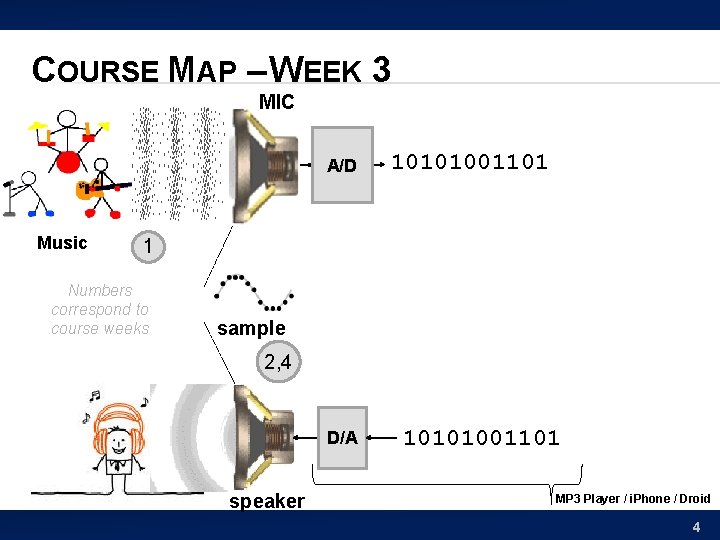
COURSE MAP – WEEK 3 MIC A/D Music 10101001101 1 Numbers correspond to course weeks sample 2, 4 D/A speaker 10101001101 MP 3 Player / i. Phone / Droid 4
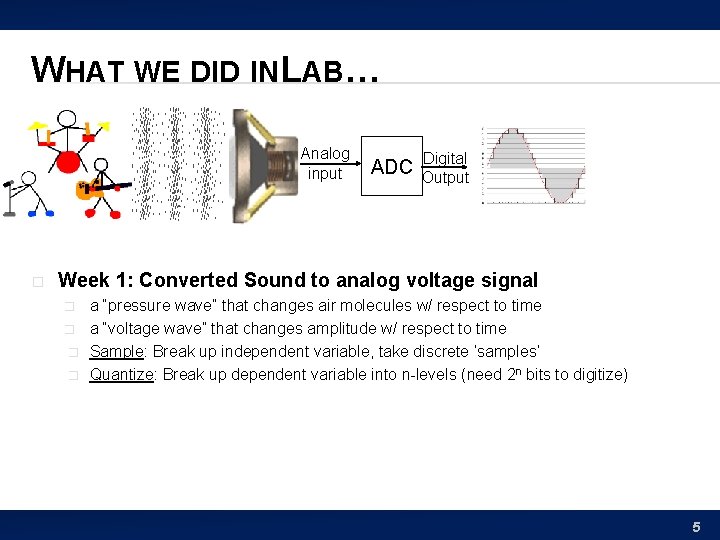
WHAT WE DID IN LAB… Analog input � ADC Digital Output Week 1: Converted Sound to analog voltage signal � � a “pressure wave” that changes air molecules w/ respect to time a “voltage wave” that changes amplitude w/ respect to time Sample: Break up independent variable, take discrete ‘samples’ Quantize: Break up dependent variable into n-levels (need 2 n bits to digitize) 5
SAMPLING VS QUANTIZATION REVIEW 6
ADC – SAMPLING &QUANTIZATION � Analog-to-Digital (ADC) Conversion Converting analog (continuous) signal to digital signal � Digitization process has two important aspects: � � 1) Sampling Converting independent variable of signal from continuous to discrete � e. g. : breaking continuous time down into intervals � � 2) Quantization Converting dependent variable of signal from continuous to discrete � e. g. : breaking continuous voltage down into levels � 7
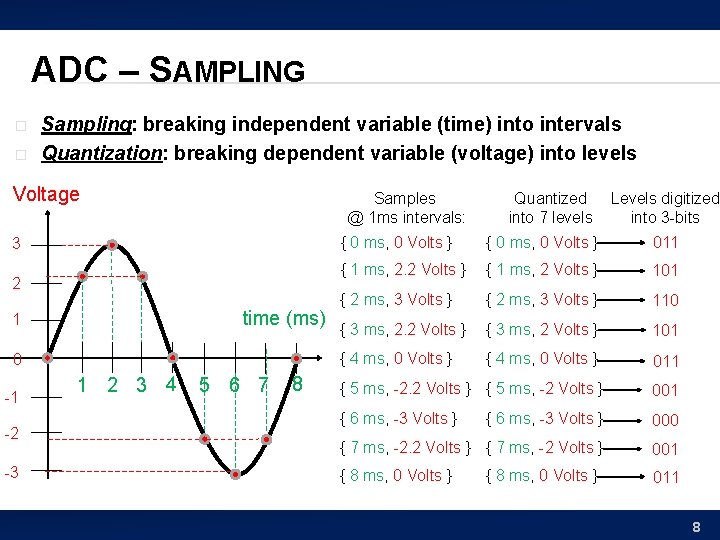
ADC – SAMPLING � � Sampling: breaking independent variable (time) into intervals Quantization: breaking dependent variable (voltage) into levels Voltage Samples @ 1 ms intervals: 3 { 0 ms, 0 Volts } 011 { 1 ms, 2. 2 Volts } { 1 ms, 2 Volts } 101 { 2 ms, 3 Volts } 110 { 3 ms, 2. 2 Volts } { 3 ms, 2 Volts } 101 { 4 ms, 0 Volts } 011 2 time (ms) 1 0 -1 -2 -3 1 2 3 4 5 6 7 8 Quantized into 7 levels Levels digitized into 3 -bits { 5 ms, -2. 2 Volts } { 5 ms, -2 Volts } 001 { 6 ms, -3 Volts } 000 { 7 ms, -2. 2 Volts } { 7 ms, -2 Volts } 001 { 8 ms, 0 Volts } 011 { 8 ms, 0 Volts } 8
TWO KNOBS 1. 2. Quantization level (bits/sample) Sampling rate (samples/second) Impact Quality of sound � Impact costs (resources -- #bits needs to store) � 9
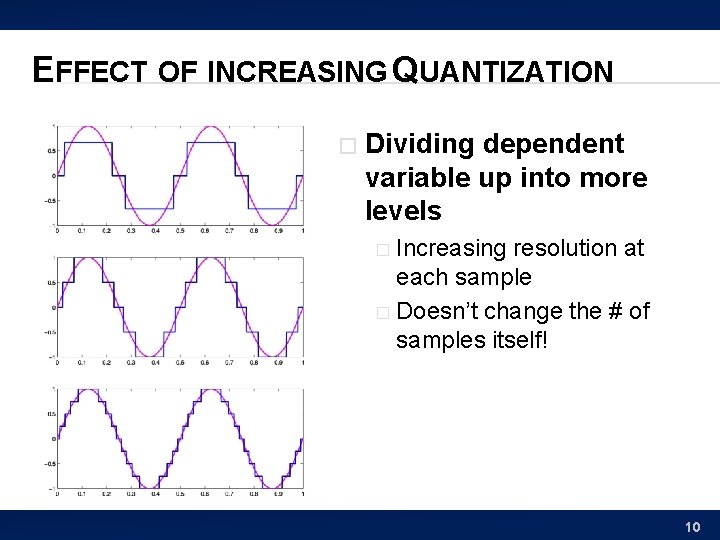
EFFECT OF INCREASING QUANTIZATION � Dividing dependent variable up into more levels Increasing resolution at each sample � Doesn’t change the # of samples itself! � 10
EFFECT OF INCREASING SAMPLING RATE � Increasing how often we take samples also helps � Much like quantization… 1 bit was too few, 16 bits was more than enough � Is there a sweet spot for the sampling rate? � 11
BOTH (QUANTIZATION, SAMPLING) IMPACT STORAGE � How many bytes for 3 minute song sampled at 8 b precision and 1000 samples/s? � at 2000 samples/s? � 16 b precision at 2000 samples/s? 12
KEY QUESTION � What sampling rate should we use? 13
DEFINITION OF GOOD SAMPLING � Definition of proper sampling: � Let’s say you’ve sampled an analog signal… � If you can exactly reconstruct the analog signal from the samples � � Essentially: if you can reverse the process… � � You have done the sampling properly! You’ve capture enough information about the signal Can we formalize this a bit more? � Yes, next few slides will try…. 14
PRECLASS Identify frequencies � Samples � What’s indistinguishable at various sample rates? � 15
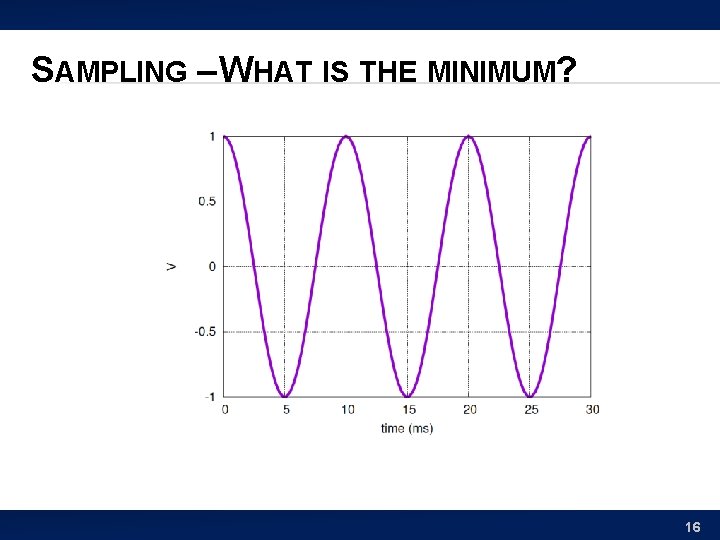
SAMPLING – WHAT IS THE MINIMUM? 16
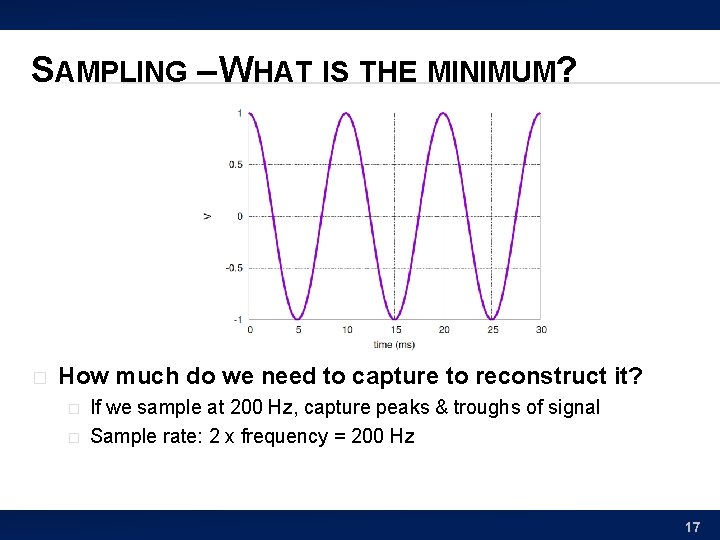
SAMPLING – WHAT IS THE MINIMUM? � How much do we need to capture to reconstruct it? � � If we sample at 200 Hz, capture peaks & troughs of signal Sample rate: 2 x frequency = 200 Hz 17
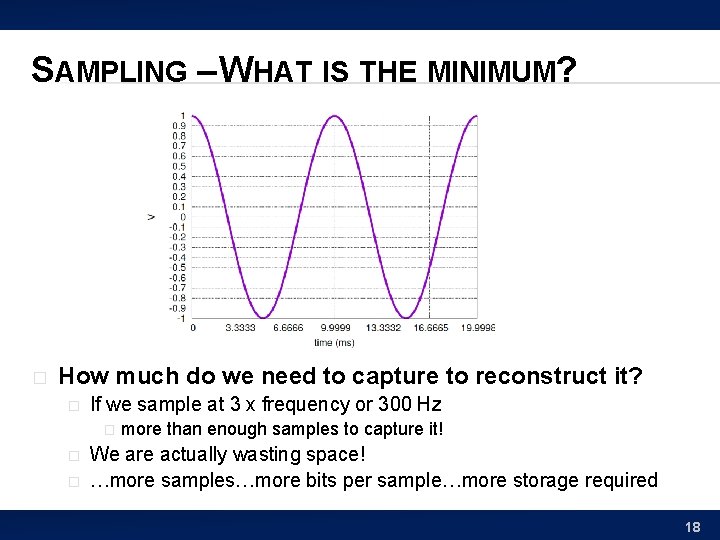
SAMPLING – WHAT IS THE MINIMUM? � How much do we need to capture to reconstruct it? � If we sample at 3 x frequency or 300 Hz � � � more than enough samples to capture it! We are actually wasting space! …more samples…more bits per sample…more storage required 18
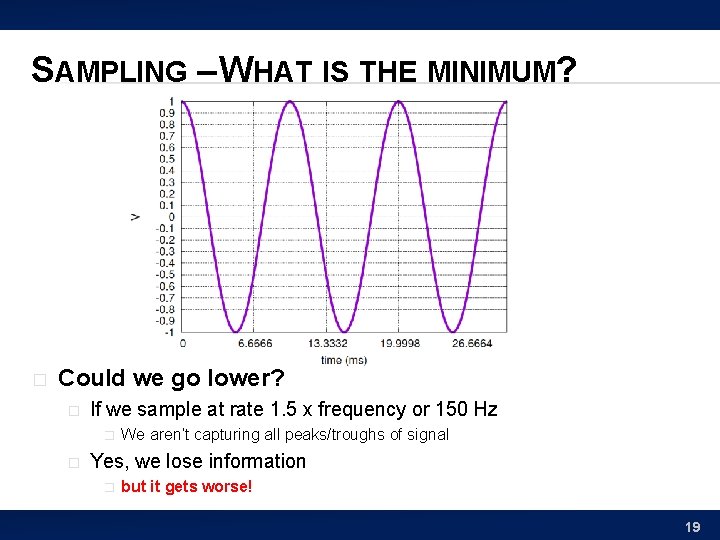
SAMPLING – WHAT IS THE MINIMUM? � Could we go lower? � If we sample at rate 1. 5 x frequency or 150 Hz � � We aren’t capturing all peaks/troughs of signal Yes, we lose information � but it gets worse! 19
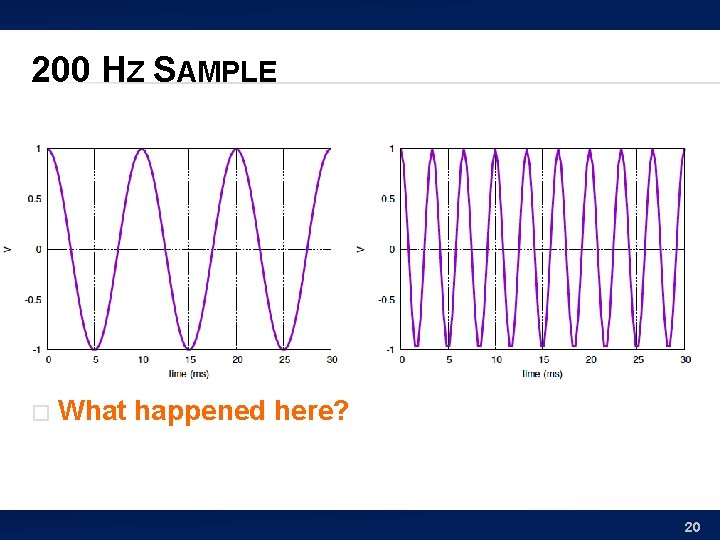
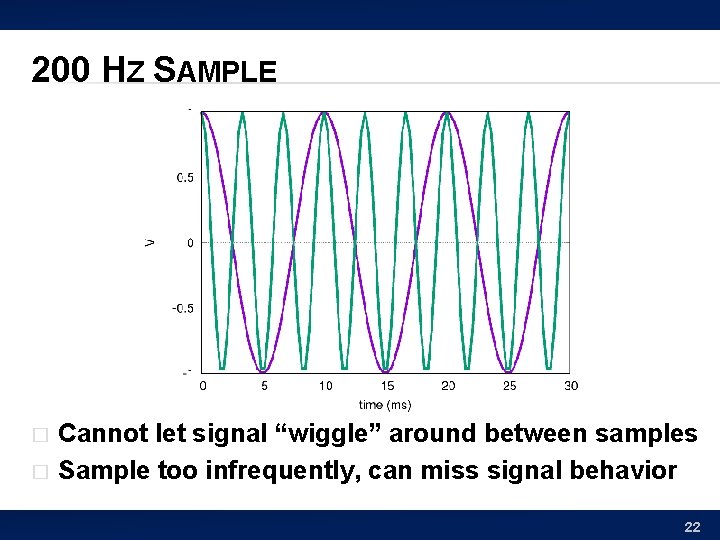
200 HZ SAMPLE � What happened here? 20
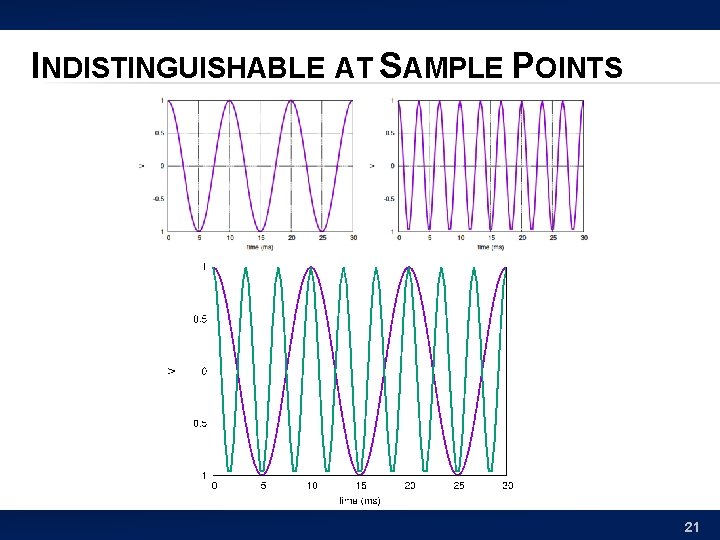
INDISTINGUISHABLE AT SAMPLE POINTS 21
200 HZ SAMPLE � � Cannot let signal “wiggle” around between samples Sample too infrequently, can miss signal behavior 22
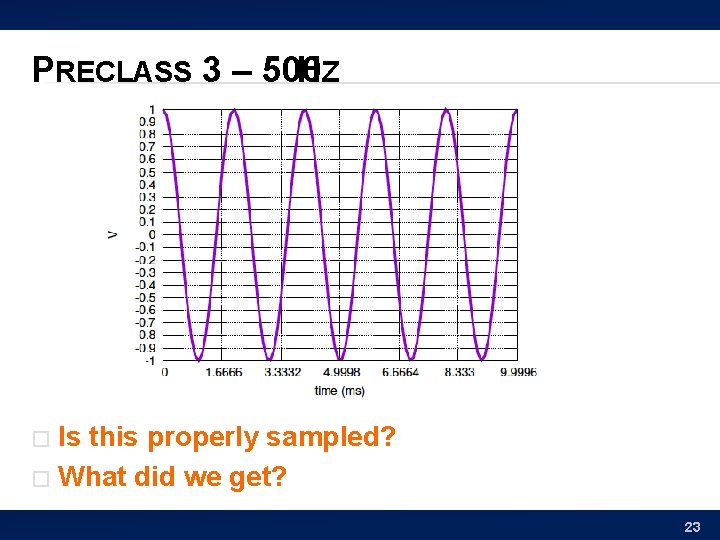
PRECLASS 3 – 500 HZ Is this properly sampled? � What did we get? � 23
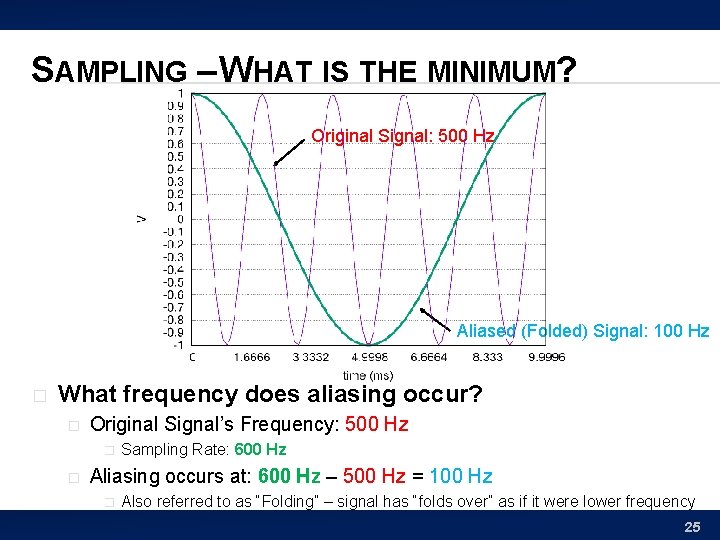
SAMPLING – WHAT IS THE MINIMUM? � Cannot sample lower without reconstruction error � We not only lose information… � � � …but when we ‘reconstruct’ the signal from the samples alone… We will reconstruct at a lower frequency! This phenomenon is called: aliasing 24
SAMPLING – WHAT IS THE MINIMUM? Original Signal: 500 Hz Aliased (Folded) Signal: 100 Hz � What frequency does aliasing occur? � Original Signal’s Frequency: 500 Hz � � Sampling Rate: 600 Hz Aliasing occurs at: 600 Hz – 500 Hz = 100 Hz � Also referred to as “Folding” – signal has “folds over” as if it were lower frequency 25
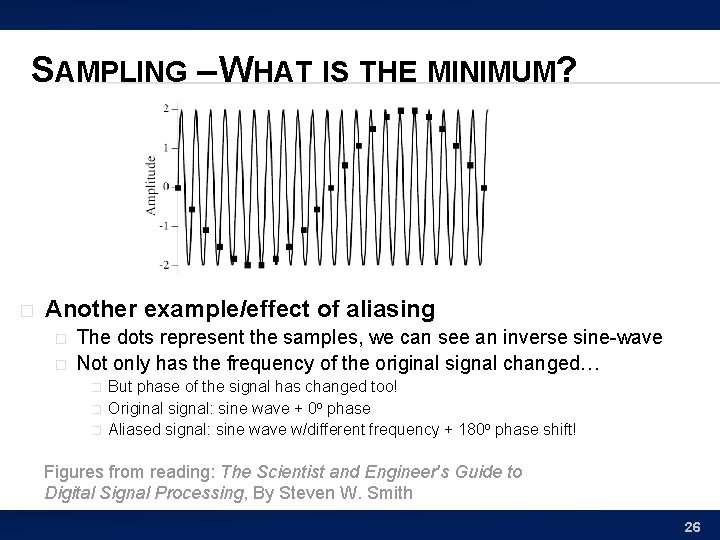
SAMPLING – WHAT IS THE MINIMUM? � Another example/effect of aliasing � � The dots represent the samples, we can see an inverse sine-wave Not only has the frequency of the original signal changed… � � � But phase of the signal has changed too! Original signal: sine wave + 0 o phase Aliased signal: sine wave w/different frequency + 180 o phase shift! Figures from reading: The Scientist and Engineer's Guide to Digital Signal Processing, By Steven W. Smith 26
SAMPLING RATE � Established (by counterexamples) that we can sample too infrequently � � Necessary to sample at 2 x highest frequency present Haven’t shown clearly that 2 x is sufficient (won’t in this class) � Just giving you intution � 27
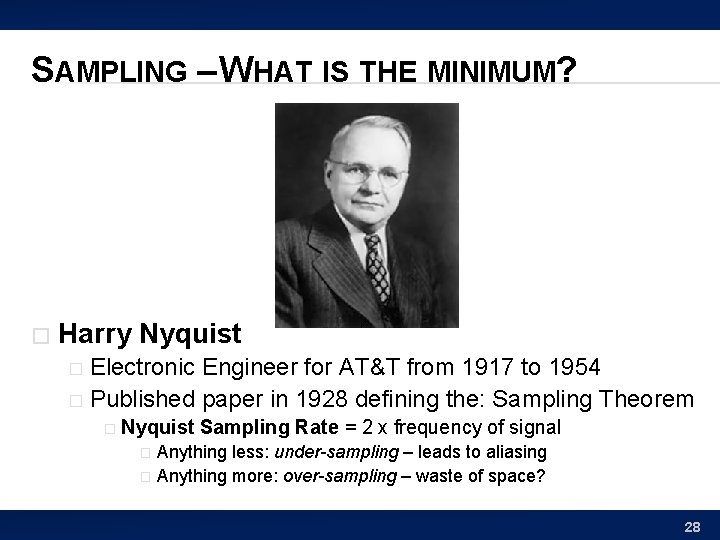
SAMPLING – WHAT IS THE MINIMUM? � Harry Nyquist Electronic Engineer for AT&T from 1917 to 1954 � Published paper in 1928 defining the: Sampling Theorem � � Nyquist Sampling Rate = 2 x frequency of signal Anything less: under-sampling – leads to aliasing � Anything more: over-sampling – waste of space? � 28
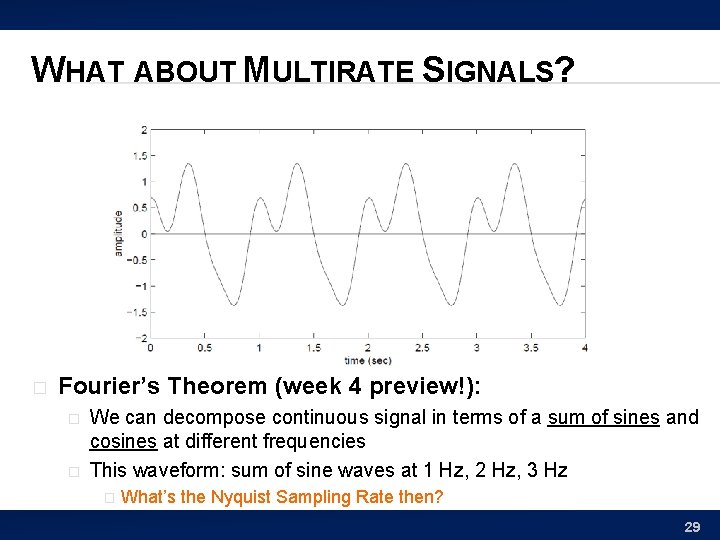
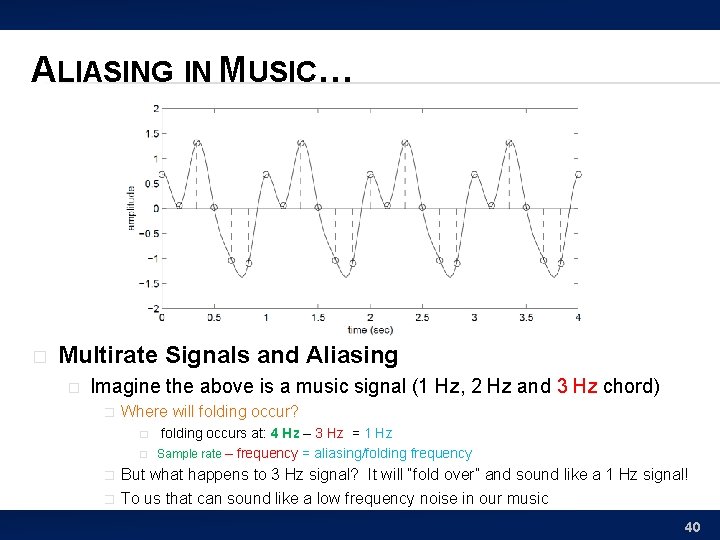
WHAT ABOUT MULTIRATE SIGNALS? � Fourier’s Theorem (week 4 preview!): � � We can decompose continuous signal in terms of a sum of sines and cosines at different frequencies This waveform: sum of sine waves at 1 Hz, 2 Hz, 3 Hz � What’s the Nyquist Sampling Rate then? 29
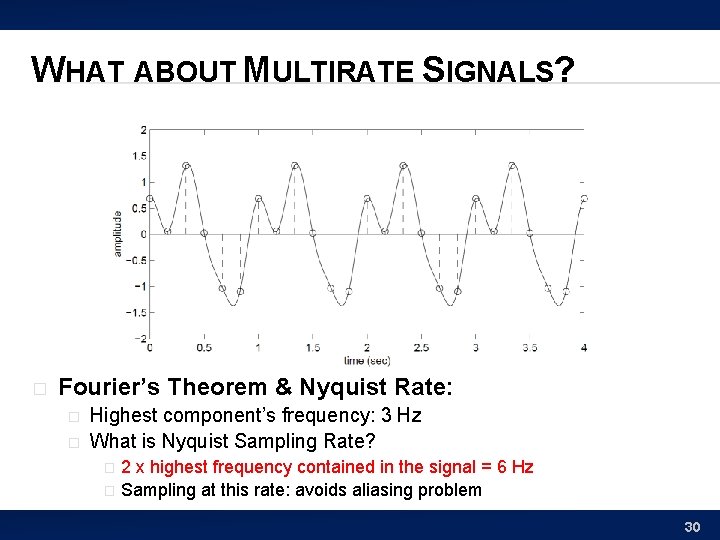
WHAT ABOUT MULTIRATE SIGNALS? � Fourier’s Theorem & Nyquist Rate: � � Highest component’s frequency: 3 Hz What is Nyquist Sampling Rate? 2 x highest frequency contained in the signal = 6 Hz � Sampling at this rate: avoids aliasing problem � 30
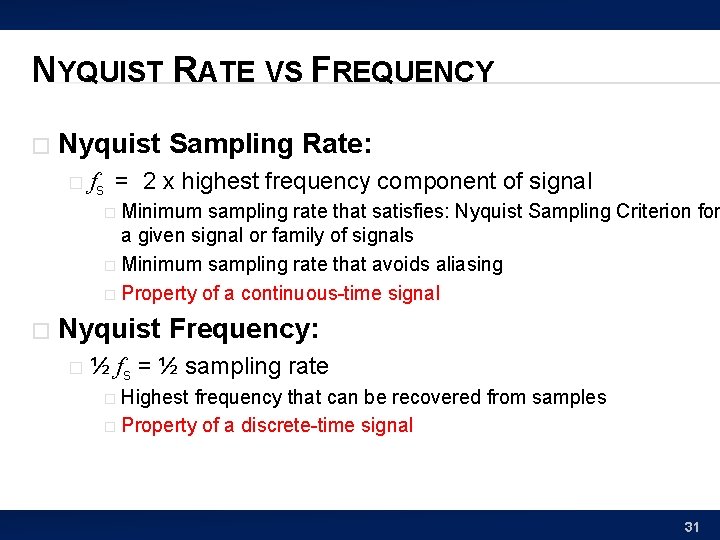
NYQUIST RATE VS FREQUENCY � Nyquist Sampling Rate: � fs = 2 x highest frequency component of signal � Minimum sampling rate that satisfies: Nyquist Sampling Criterion for a given signal or family of signals � Minimum sampling rate that avoids aliasing � Property of a continuous-time signal � Nyquist Frequency: � ½ fs = ½ sampling rate � Highest frequency that can be recovered from samples � Property of a discrete-time signal 31
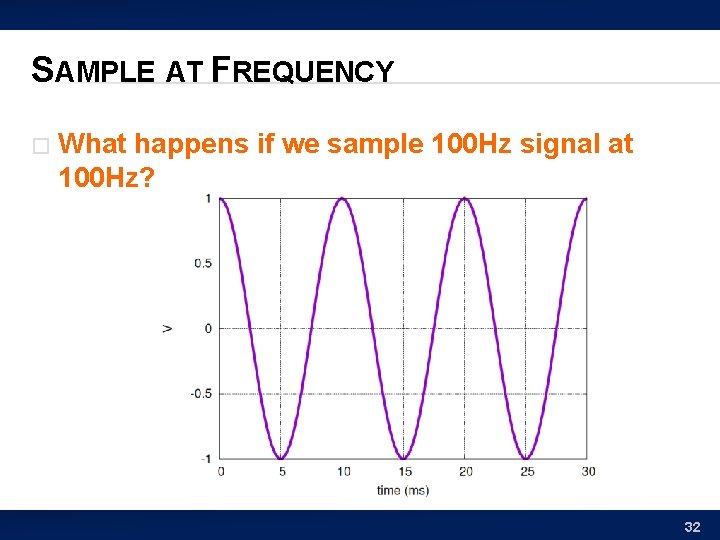
SAMPLE AT FREQUENCY � What happens if we sample 100 Hz signal at 100 Hz? 32
INTERLUDE 33
VIDEO � How many frames/second for video (TV, Film? ) � http: //www. youtube. com/watch? v=j. HS 9 JGk. EOm. A 34
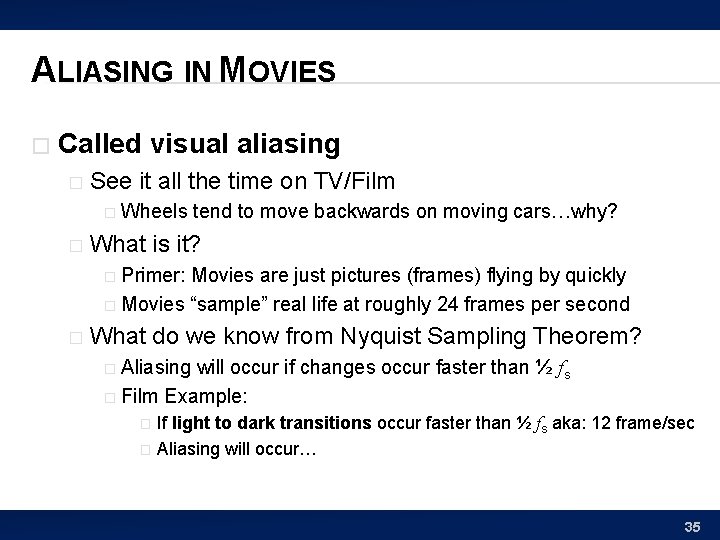
ALIASING IN MOVIES � Called visual aliasing � See it all the time on TV/Film � Wheels tend to move backwards on moving cars…why? � What is it? � Primer: Movies are just pictures (frames) flying by quickly � Movies “sample” real life at roughly 24 frames per second � What do we know from Nyquist Sampling Theorem? � Aliasing will occur if changes occur faster than ½ fs � Film Example: If light to dark transitions occur faster than ½ fs aka: 12 frame/sec � Aliasing will occur… � 35
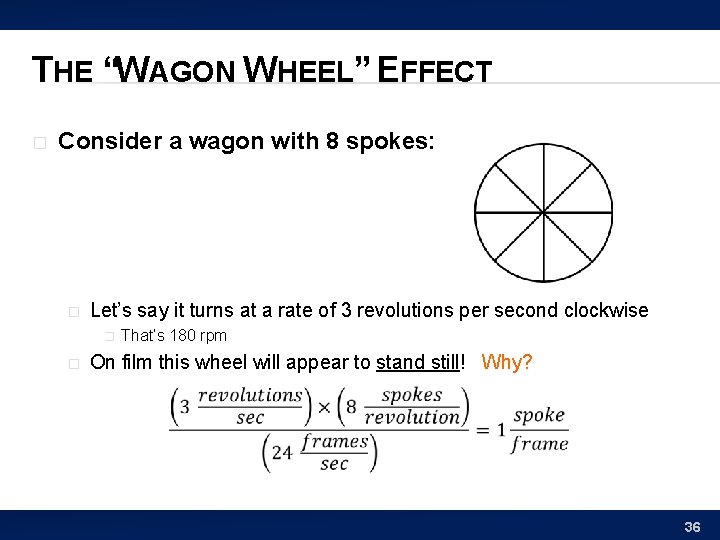
THE “WAGON WHEEL” EFFECT � Consider a wagon with 8 spokes: � Let’s say it turns at a rate of 3 revolutions per second clockwise � � That’s 180 rpm On film this wheel will appear to stand still! Why? 36
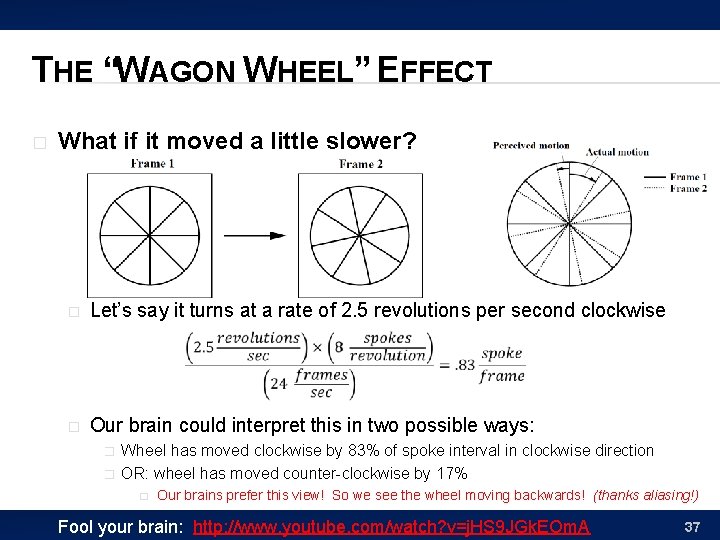
THE “WAGON WHEEL” EFFECT � What if it moved a little slower? � Let’s say it turns at a rate of 2. 5 revolutions per second clockwise � Our brain could interpret this in two possible ways: � � Wheel has moved clockwise by 83% of spoke interval in clockwise direction OR: wheel has moved counter-clockwise by 17% � Our brains prefer this view! So we see the wheel moving backwards! (thanks aliasing!) Fool your brain: http: //www. youtube. com/watch? v=j. HS 9 JGk. EOm. A 37
EFFECTS OF ALIASING 38
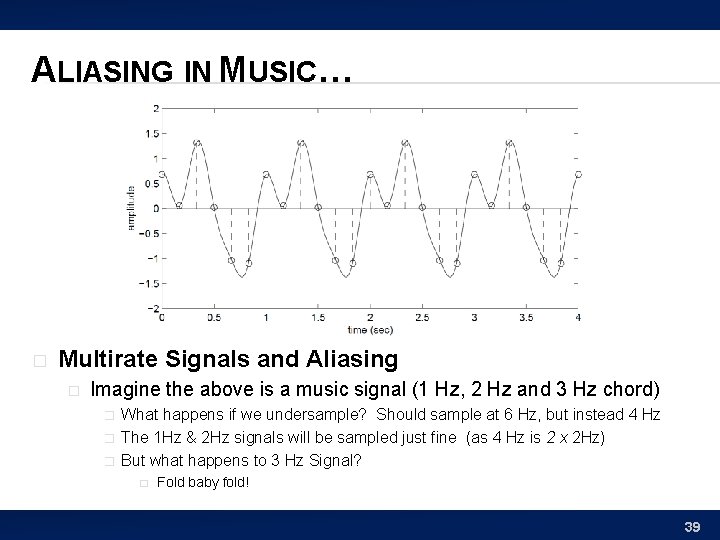
ALIASING IN MUSIC… � Multirate Signals and Aliasing � Imagine the above is a music signal (1 Hz, 2 Hz and 3 Hz chord) � � � What happens if we undersample? Should sample at 6 Hz, but instead 4 Hz The 1 Hz & 2 Hz signals will be sampled just fine (as 4 Hz is 2 x 2 Hz) But what happens to 3 Hz Signal? � Fold baby fold! 39
ALIASING IN MUSIC… � Multirate Signals and Aliasing � Imagine the above is a music signal (1 Hz, 2 Hz and 3 Hz chord) � Where will folding occur? � � folding occurs at: 4 Hz – 3 Hz = 1 Hz Sample rate – frequency = aliasing/folding frequency But what happens to 3 Hz signal? It will “fold over” and sound like a 1 Hz signal! To us that can sound like a low frequency noise in our music 40
ANTI-ALIASING 41
HOW DO WE FIX THIS? � It’s simple…sample at the Nyquist Rate But…what if your rate is fixed? Like 24 frames/sec? � Or our eye’s sampling rate: 60 cycles/degree � � Spatial variations finer than this are undetectable! 42
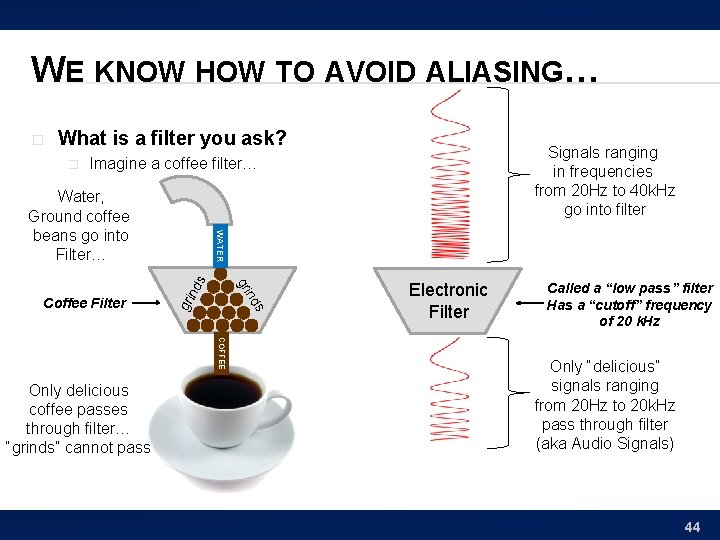
HOW TO AVOID ALIASING WITH DIGITAL MUSIC? � If we simply sample at 2 x highest frequency of signal… (AKA: Nyquist Rate) � …we won’t encounter aliasing! But how do we guarantee highest frequency of our signal? � Audio: this is easy! � � We know the range of human ear: 20 Hz to 20 k. Hz… � The highest frequency component in music is then: 20 k. Hz � …so, before sound goes into ADC, we apply a filter! � � Blocks any frequency above 20 k. Hz from going into ADC � Essentially, we are fixing our sampling rate & ‘bluring’ or filtering our incoming signal 43
WE KNOW HOW TO AVOID ALIASING… � What is a filter you ask? � Signals ranging in frequencies from 20 Hz to 40 k. Hz go into filter Imagine a coffee filter… gri nd s nd Coffee Filter gri s WATER Water, Ground coffee beans go into Filter… COFFEE Only delicious coffee passes through filter… “grinds” cannot pass Electronic Filter Called a “low pass” filter Has a “cutoff” frequency of 20 k. Hz Only “delicious” signals ranging from 20 Hz to 20 k. Hz pass through filter (aka Audio Signals) 44
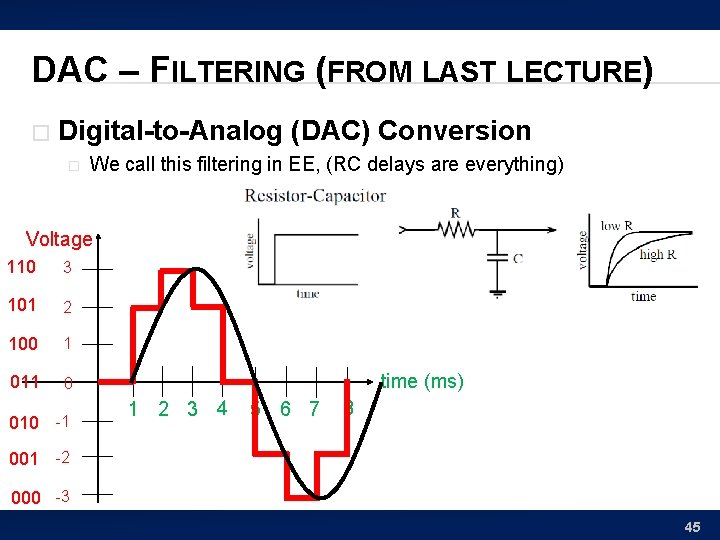
DAC – FILTERING (FROM LAST LECTURE) � Digital-to-Analog (DAC) Conversion � We call this filtering in EE, (RC delays are everything) Voltage 110 3 101 2 100 1 011 0 010 -1 time (ms) 1 2 3 4 5 6 7 8 001 -2 000 -3 45
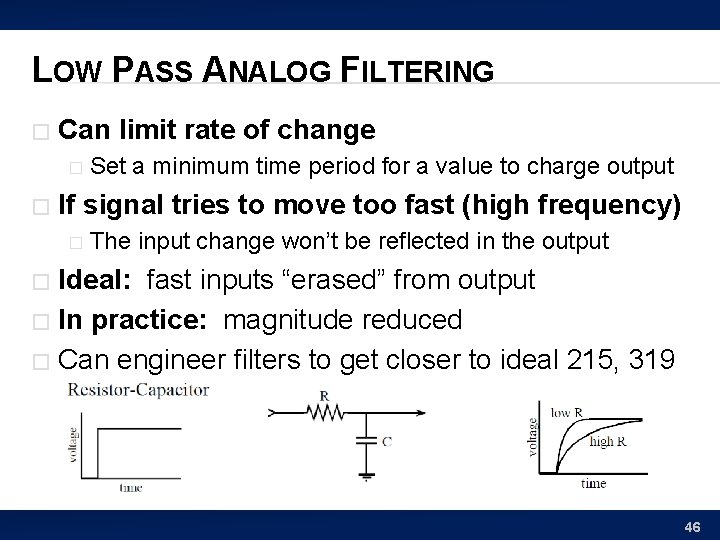
LOW PASS ANALOG FILTERING � Can limit rate of change � � Set a minimum time period for a value to charge output If signal tries to move too fast (high frequency) � The input change won’t be reflected in the output Ideal: fast inputs “erased” from output � In practice: magnitude reduced � Can engineer filters to get closer to ideal 215, 319 � 46
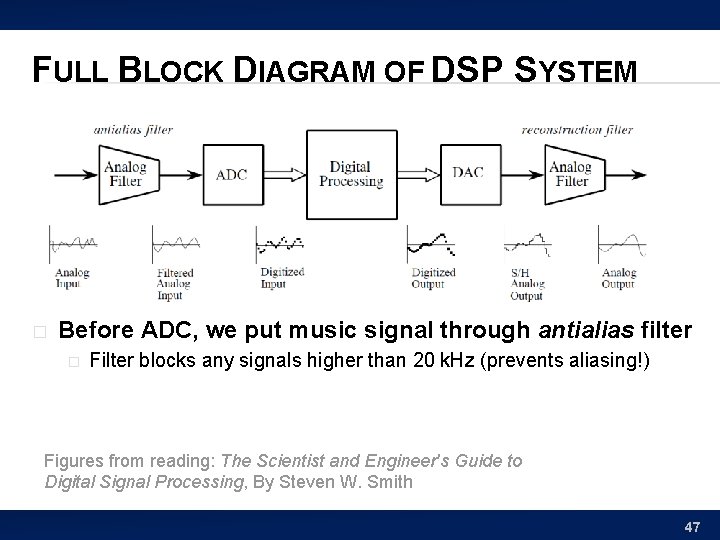
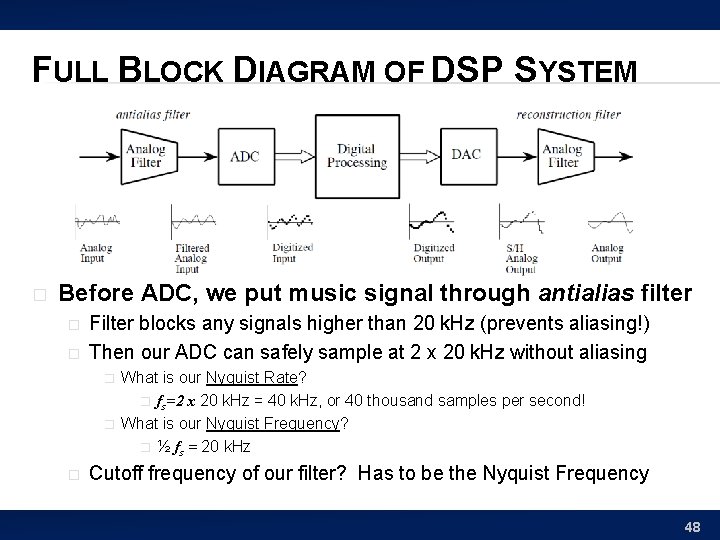
FULL BLOCK DIAGRAM OF DSP SYSTEM � Before ADC, we put music signal through antialias filter � Filter blocks any signals higher than 20 k. Hz (prevents aliasing!) Figures from reading: The Scientist and Engineer's Guide to Digital Signal Processing, By Steven W. Smith 47
FULL BLOCK DIAGRAM OF DSP SYSTEM � Before ADC, we put music signal through antialias filter � � Filter blocks any signals higher than 20 k. Hz (prevents aliasing!) Then our ADC can safely sample at 2 x 20 k. Hz without aliasing � � � What is our Nyquist Rate? � fs=2 x 20 k. Hz = 40 k. Hz, or 40 thousand samples per second! What is our Nyquist Frequency? � ½ fs = 20 k. Hz Cutoff frequency of our filter? Has to be the Nyquist Frequency 48
WHY DO WE NEED THE ANTIALIAS FILTER? � If we can’t hear anything above 20 k. Hz… � Why do we need to filter it out? � Dog’s can hear from 40 Hz to 60 k. Hz � � so clearly there are sounds above 20 k. Hz Let’s imagine a high frequency noise in music studio � Let’s say it’s a vibration occurring at 25 k. Hz � No human can hear it, why filter it out? � Because of aliasing: � Frequency aliasing/folding will occur: � Sample rate – frequency = aliasing/folding frequency � 40 k. Hz - 25 k. Hz = 15 k. Hz � The 25 k. Hz vibration will fold-over to a 15 k. Hz “hum” or audible noise � It will ruin our recording and source of noise wouldn’t be obvious! 49
BIG IDEAS � Sample at twice the maximum frequency � � If have frequencies > sample_freq/2 � � Can reconstruct perfectly Will get aliasing … as high frequencies fold Avoid aliasing with analog Anti-Alias prefilter before sampling 52
THIS WEEK IN LAB � Lab 2: D 2 A – play back the samples you recorded last week � Reminder: lab writeups due on Friday. c 53
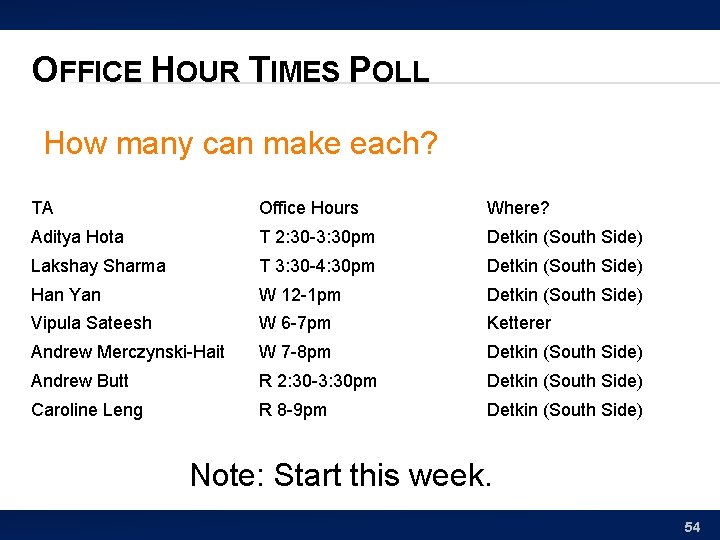
OFFICE HOUR TIMES POLL How many can make each? TA Office Hours Where? Aditya Hota T 2: 30 -3: 30 pm Detkin (South Side) Lakshay Sharma T 3: 30 -4: 30 pm Detkin (South Side) Han Yan W 12 -1 pm Detkin (South Side) Vipula Sateesh W 6 -7 pm Ketterer Andrew Merczynski-Hait W 7 -8 pm Detkin (South Side) Andrew Butt R 2: 30 -3: 30 pm Detkin (South Side) Caroline Leng R 8 -9 pm Detkin (South Side) Note: Start this week. 54
PIAZZA � Signup piazza Reminders and administrivia � Answer questions from lecture � 55
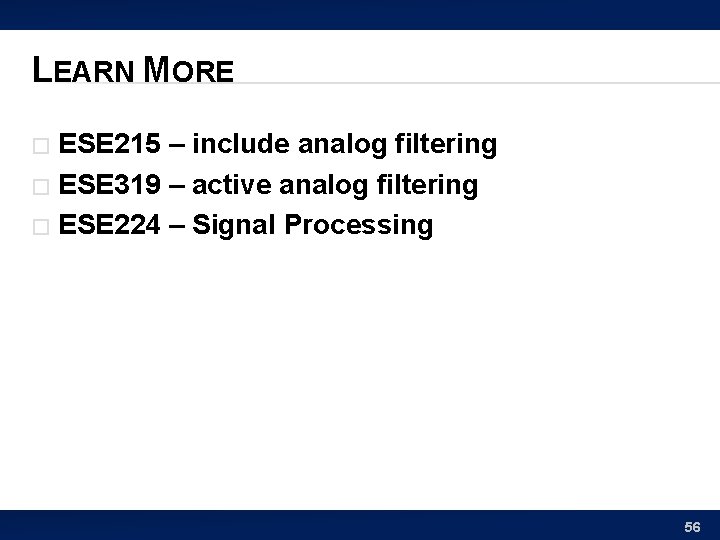
LEARN MORE ESE 215 – include analog filtering � ESE 319 – active analog filtering � ESE 224 – Signal Processing � 56
REFERENCES � S. Smith, “The Scientists and Engineer’s Guide to Digital Signal Processing, ” 1997. http: //en. wikipedia. org/wiki/Nyquist_frequency � http: //en. wikipedia. org/wiki/Nyquist_rate � http: //en. wikipedia. org/wiki/Oversampling � http: //en. wikipedia. org/wiki/Sampling_rate � http: //en. wikipedia. org/wiki/Hearing_range � http: //electronics. howstuffworks. com/telephone 6. htm � B. Olshausen, “Aliasing”, PSC 129 – Sensory Processes Course Notes, UC Davis � 57