
Lecture 2 Number Systems n n Binary numbers
Lecture 2: Number Systems n n Binary numbers Base conversion Arithmetic Number systems ¡ ¡ ¡ n Sign and magnitude Ones-complement Twos-complement Binary-coded decimal (BCD) 1
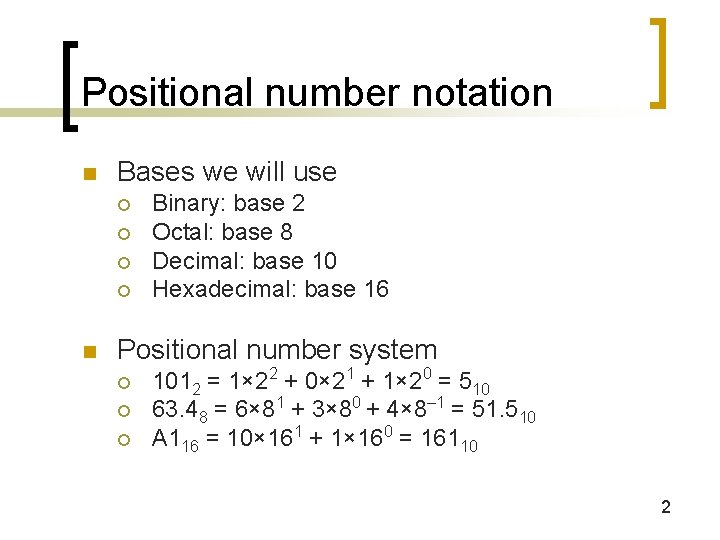
Positional number notation n Bases we will use ¡ ¡ n Binary: base 2 Octal: base 8 Decimal: base 10 Hexadecimal: base 16 Positional number system ¡ ¡ ¡ 1012 = 1× 22 + 0× 21 + 1× 20 = 510 63. 48 = 6× 81 + 3× 80 + 4× 8– 1 = 51. 510 A 116 = 10× 161 + 1× 160 = 16110 2
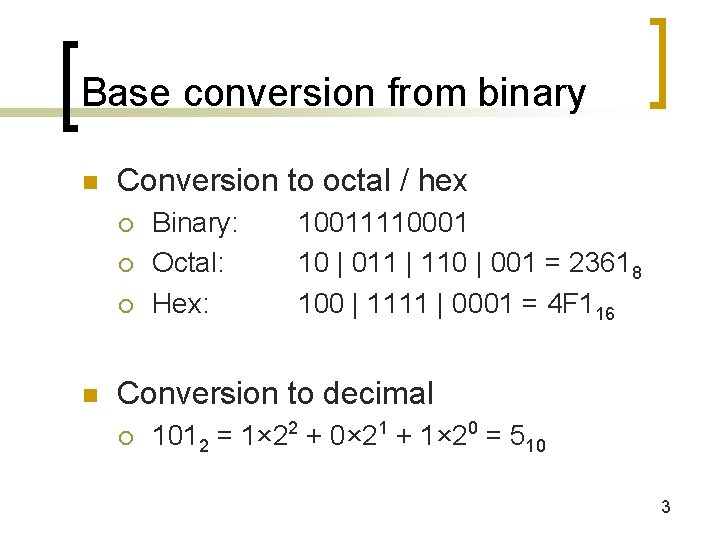
Base conversion from binary n Conversion to octal / hex ¡ ¡ ¡ n Binary: Octal: Hex: 10011110001 10 | 011 | 110 | 001 = 23618 100 | 1111 | 0001 = 4 F 116 Conversion to decimal ¡ 1012 = 1× 22 + 0× 21 + 1× 20 = 510 3
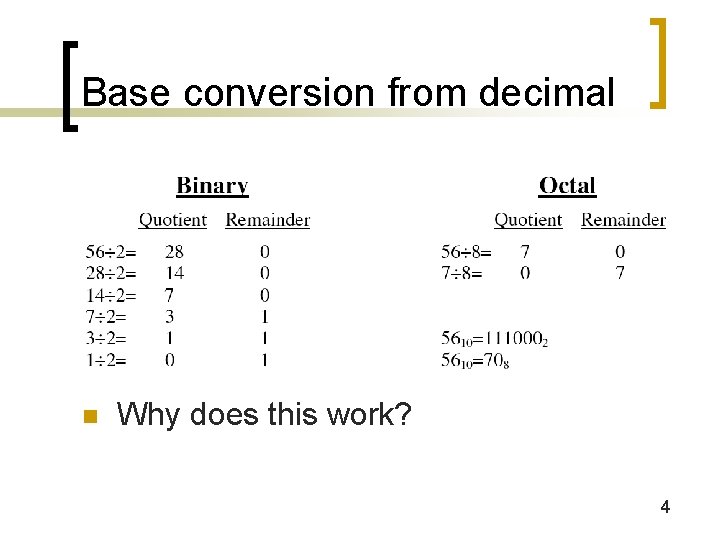
Base conversion from decimal n Why does this work? 4
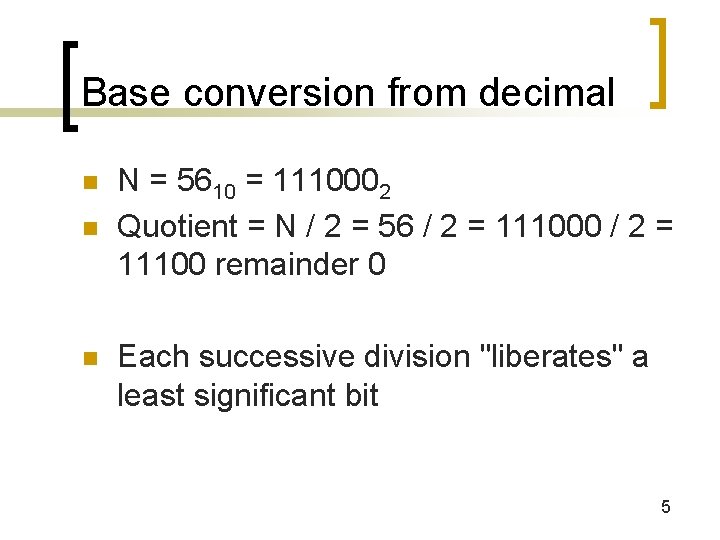
Base conversion from decimal n n n N = 5610 = 1110002 Quotient = N / 2 = 56 / 2 = 111000 / 2 = 11100 remainder 0 Each successive division "liberates" a least significant bit 5
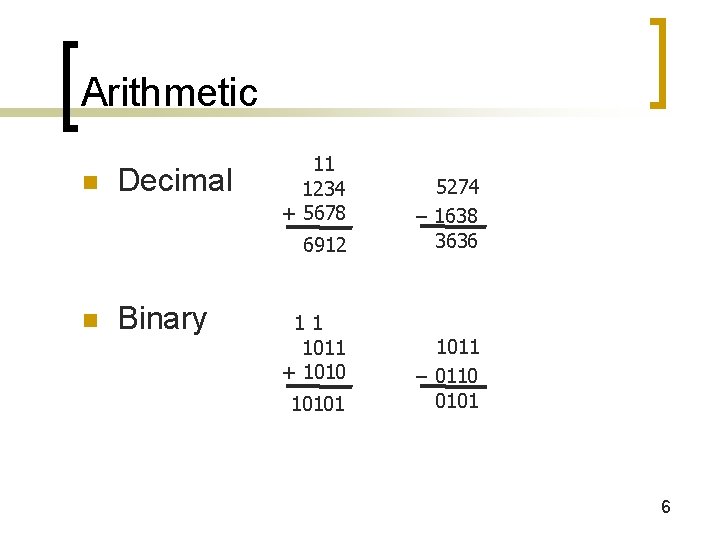
Arithmetic n Decimal 11 1234 + 5678 6912 n Binary 11 1011 + 10101 5274 – 1638 3636 1011 – 0110 0101 6
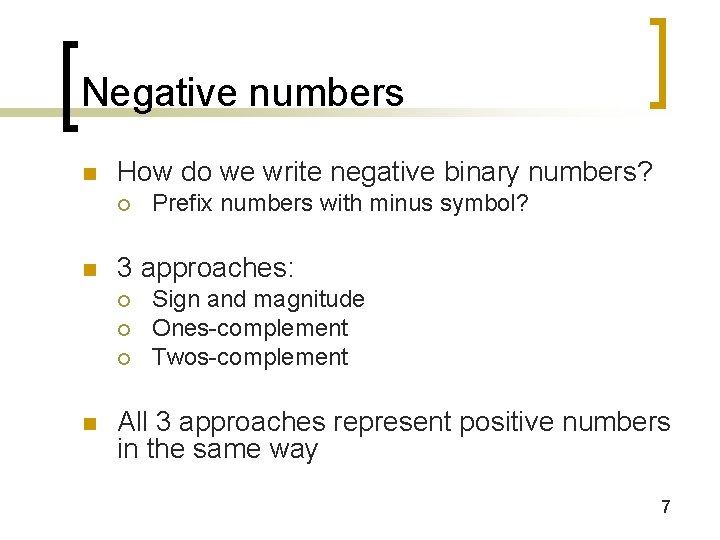
Negative numbers n How do we write negative binary numbers? ¡ n 3 approaches: ¡ ¡ ¡ n Prefix numbers with minus symbol? Sign and magnitude Ones-complement Twos-complement All 3 approaches represent positive numbers in the same way 7
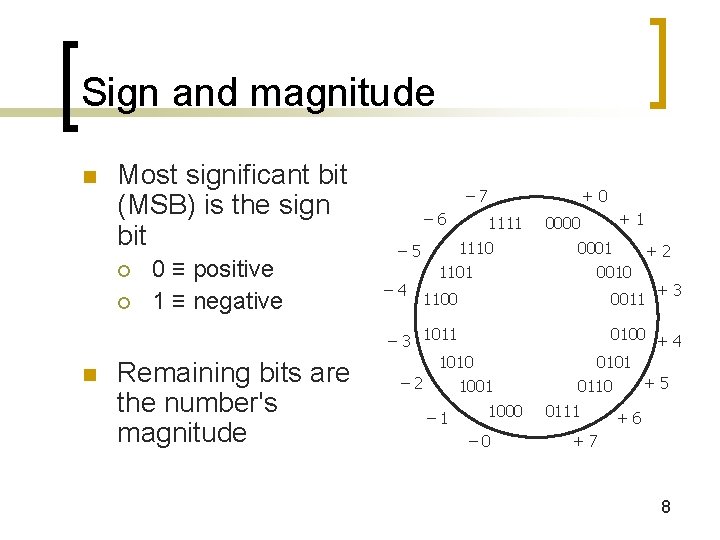
Sign and magnitude n Most significant bit (MSB) is the sign bit ¡ ¡ n 0 ≡ positive 1 ≡ negative Remaining bits are the number's magnitude – 7 – 6 1111 1110 – 5 – 4 +0 +1 0000 0001 1101 +2 0010 +3 1100 0011 – 3 1011 1010 – 2 1001 0100 + 4 0101 +5 0110 – 1 1000 – 0 0111 +6 +7 8
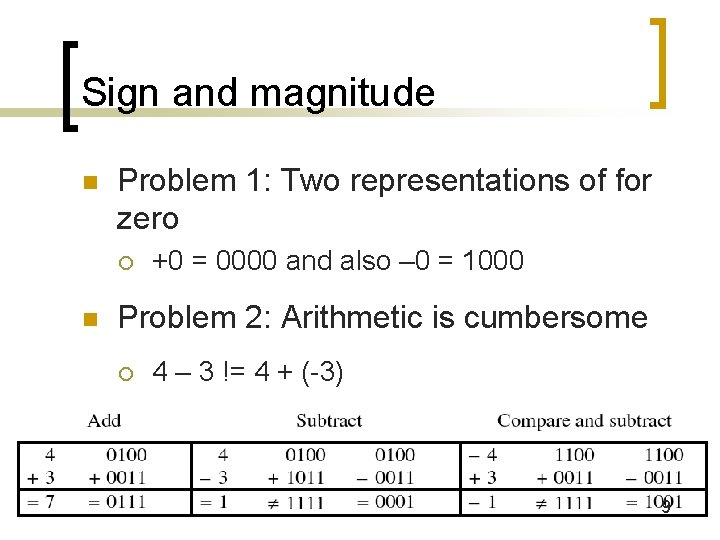
Sign and magnitude n Problem 1: Two representations of for zero ¡ n +0 = 0000 and also – 0 = 1000 Problem 2: Arithmetic is cumbersome ¡ 4 – 3 != 4 + (-3) 9
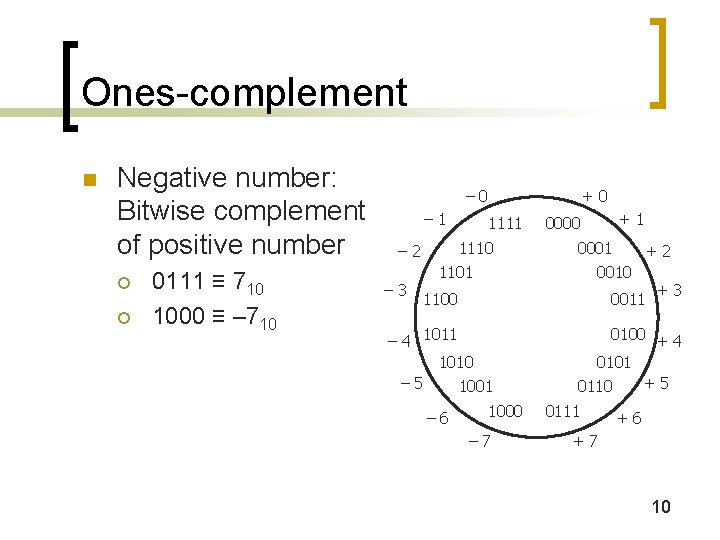
Ones-complement n Negative number: Bitwise complement of positive number ¡ ¡ 0111 ≡ 710 1000 ≡ – 710 – 1 1110 – 2 – 3 +0 +1 0000 0001 1101 +2 0010 +3 1100 0011 – 4 1011 1010 – 5 1001 0100 + 4 0101 +5 0110 – 6 1000 – 7 0111 +6 +7 10
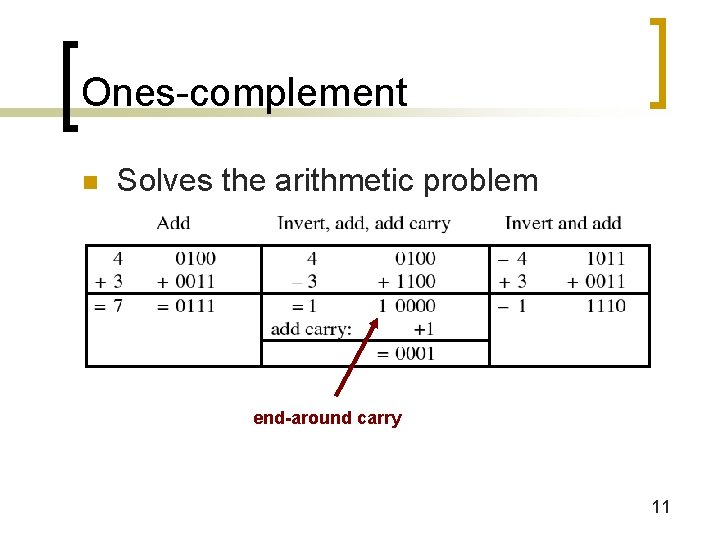
Ones-complement n Solves the arithmetic problem end-around carry 11
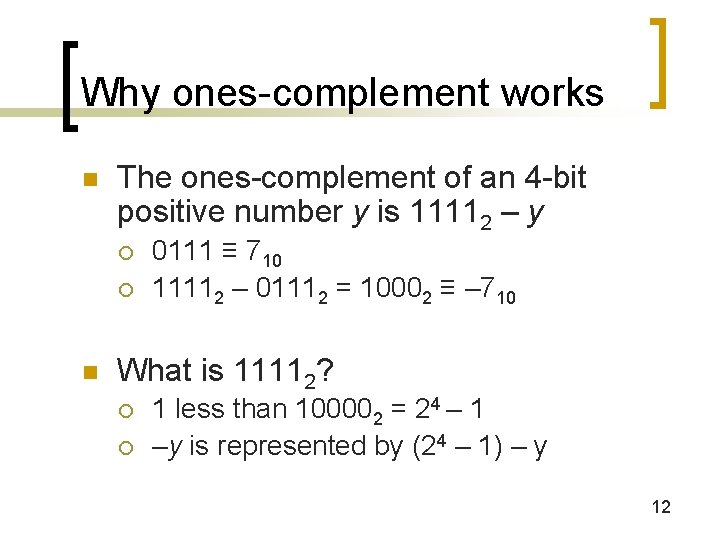
Why ones-complement works n The ones-complement of an 4 -bit positive number y is 11112 – y ¡ ¡ n 0111 ≡ 710 11112 – 01112 = 10002 ≡ – 710 What is 11112? ¡ ¡ 1 less than 100002 = 24 – 1 –y is represented by (24 – 1) – y 12
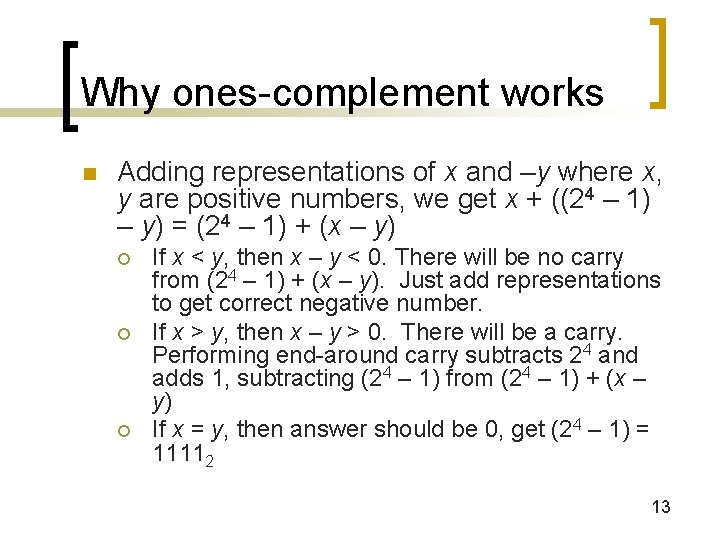
Why ones-complement works n Adding representations of x and –y where x, y are positive numbers, we get x + ((24 – 1) – y) = (24 – 1) + (x – y) ¡ ¡ ¡ If x < y, then x – y < 0. There will be no carry from (24 – 1) + (x – y). Just add representations to get correct negative number. If x > y, then x – y > 0. There will be a carry. Performing end-around carry subtracts 24 and adds 1, subtracting (24 – 1) from (24 – 1) + (x – y) If x = y, then answer should be 0, get (24 – 1) = 11112 13
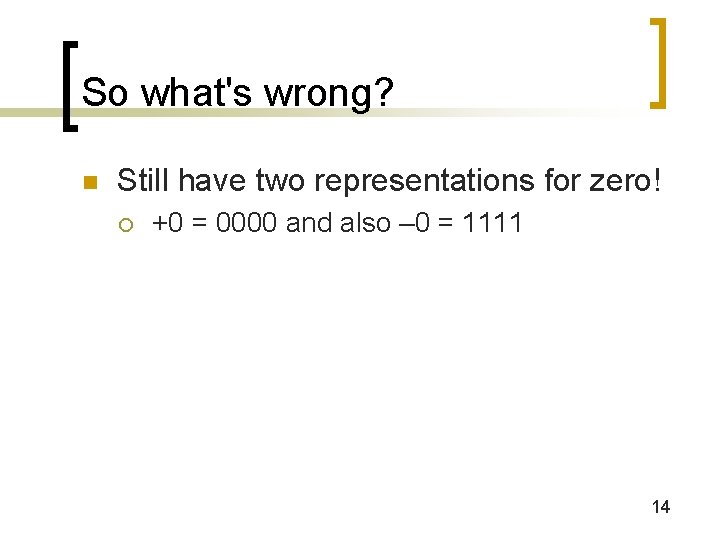
So what's wrong? n Still have two representations for zero! ¡ +0 = 0000 and also – 0 = 1111 14
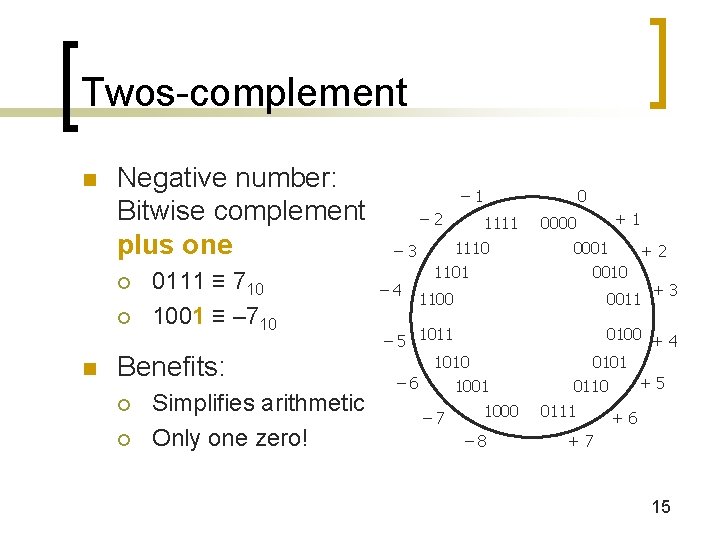
Twos-complement n Negative number: Bitwise complement plus one ¡ ¡ n 0111 ≡ 710 1001 ≡ – 710 Benefits: ¡ ¡ Simplifies arithmetic Only one zero! – 1 – 2 1111 1110 – 3 – 4 0 +1 0000 0001 1101 +2 0010 +3 1100 0011 – 5 1011 1010 – 6 1001 0100 + 4 0101 +5 0110 – 7 1000 – 8 0111 +6 +7 15

Twos-complement 16
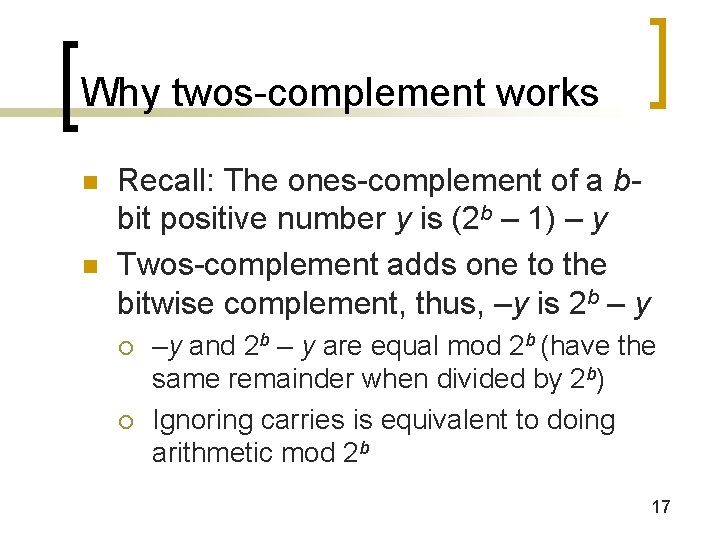
Why twos-complement works n n Recall: The ones-complement of a bbit positive number y is (2 b – 1) – y Twos-complement adds one to the bitwise complement, thus, –y is 2 b – y ¡ ¡ –y and 2 b – y are equal mod 2 b (have the same remainder when divided by 2 b) Ignoring carries is equivalent to doing arithmetic mod 2 b 17
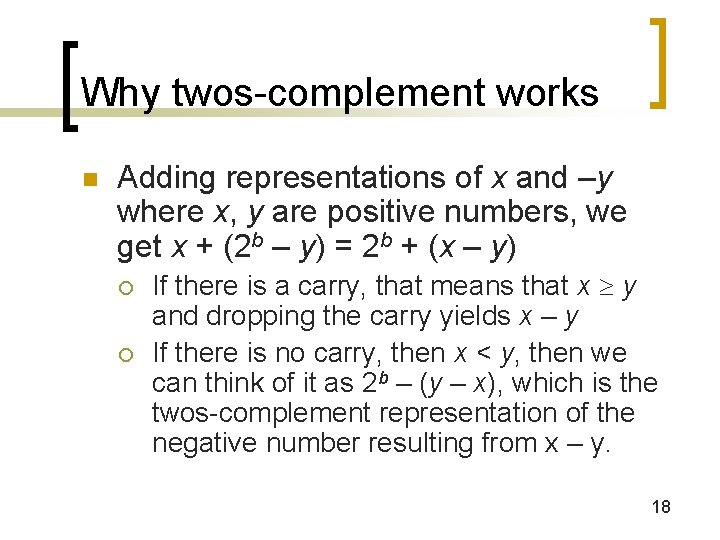
Why twos-complement works n Adding representations of x and –y where x, y are positive numbers, we get x + (2 b – y) = 2 b + (x – y) ¡ ¡ If there is a carry, that means that x y and dropping the carry yields x – y If there is no carry, then x < y, then we can think of it as 2 b – (y – x), which is the twos-complement representation of the negative number resulting from x – y. 18
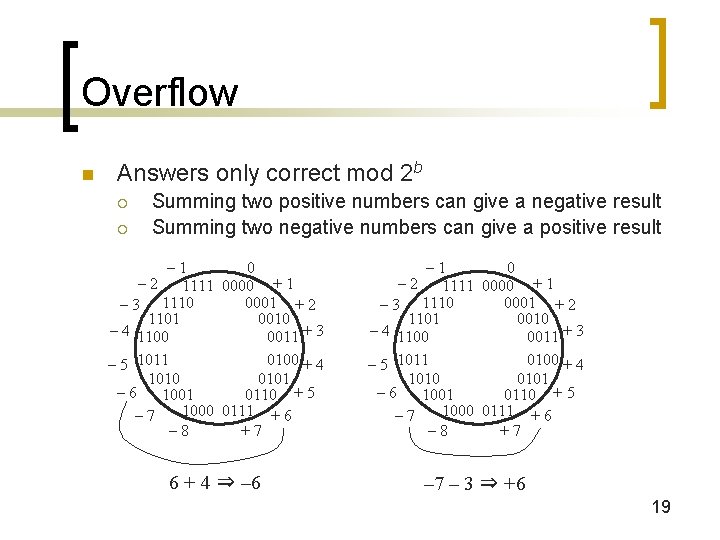
Overflow n Answers only correct mod 2 b ¡ ¡ Summing two positive numbers can give a negative result Summing two negative numbers can give a positive result – 1 0 – 2 1111 0000 + 1 0001 + 2 – 3 1110 1101 0010 – 4 1100 0011 + 3 0100 + 4 – 5 1011 1010 0101 – 6 1001 0110 + 5 1000 0111 + 6 – 7 – 8 +7 6 + 4 ⇒ – 6 – 7 – 3 ⇒ +6 19
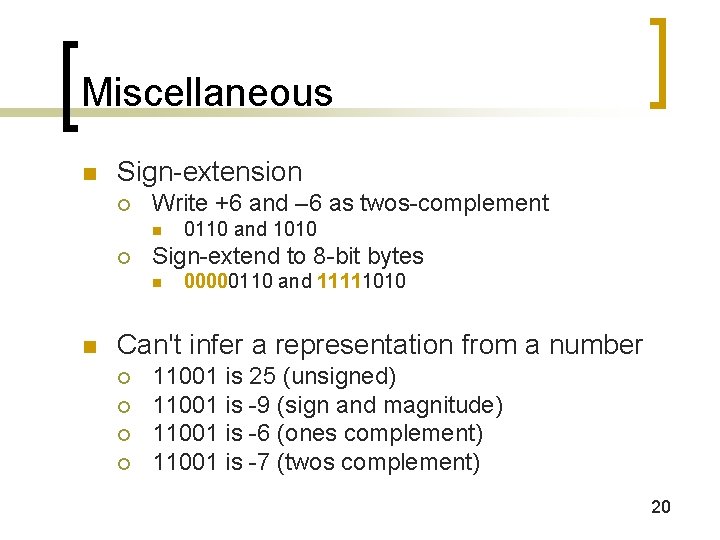
Miscellaneous n Sign-extension ¡ Write +6 and – 6 as twos-complement n ¡ Sign-extend to 8 -bit bytes n n 0110 and 1010 00000110 and 11111010 Can't infer a representation from a number ¡ ¡ 11001 is 25 (unsigned) 11001 is -9 (sign and magnitude) 11001 is -6 (ones complement) 11001 is -7 (twos complement) 20
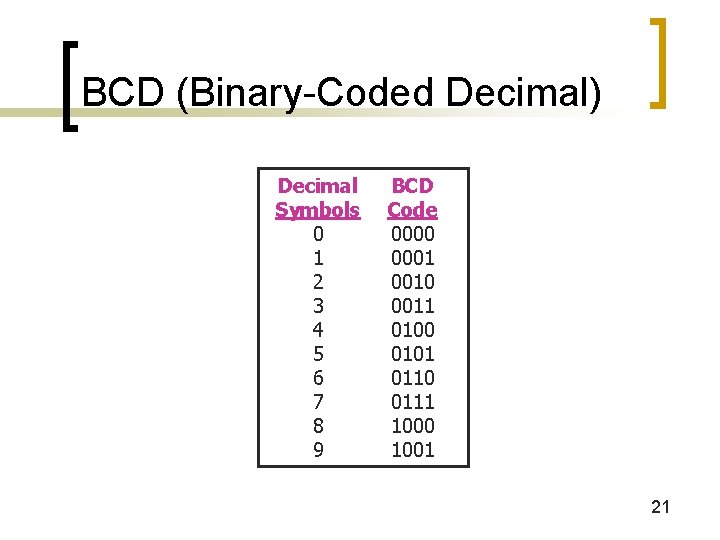
BCD (Binary-Coded Decimal) Decimal Symbols 0 1 2 3 4 5 6 7 8 9 BCD Code 0000 0001 0010 0011 0100 0101 0110 0111 1000 1001 21
- Slides: 21