
Lecture 2 Multiculturalism A Theoretical Framework Plan 1

- Slides: 26
Lecture 2. Multiculturalism: A Theoretical Framework Plan 1. The issue of multiculturalism. 2. The forms of multiculturalism. 3. Multiculturalism and American Literature. 4. Multiculturalism and Canadian Literature.
Multiculturalism is the practice of giving importance to all cultures in a society and it includes people of several, different races, religions, languages and traditions [Oxford Advanced Learners Dictionary] Multicultural as an adjective of, relating to, or adopted to diverse cultures and multiculturalism is noun form of it [Merriam Webster Dictionary]. Multiculturalism is one manifestation of the postmodernist reaction to the de-legitimization of the state and the erosion of the hegemony of the dominant culture in advanced capitalist countries [Terence Sheldon Turner in his book Anthropology and Multiculturalism ] Multiculturalism draws our attention to the differences that inform our social existence and not merely to what is common to all human beings. These differences are constitutive of what we are and wish to be although in other respects we may have the same concern as the rest [Valerian Rodrigues ‘Is There a Case for Multiculturalism? ’]
Bhikhu Parekh Rethinking Multiculturalism: Cultural Diversity and Political Theory (2002) Multiculturalism is neither a political doctrine nor a philosophical issue but actually a perspective on as way of viewing human life. Increasing cultural diversity focuses on the promotion of rights for different religion and cultural groups. The rights for cultural groups form basis for multiculturalism.
C. James Trotman Multiculturalism: Roots and Realities (2011) Multiculturalism is valuable because it uses several disciplines to highlight neglected aspect of our social history, particularly the histories of women and minorities…. . and promotes respect for the dignity of the lives and voices of the forgotten. By closing gaps, by raising consciousness about the past, multiculturalism tries to restore a sense of wholeness in a postmodern era that fragments human life and thought.
The issue of multiculturalism • • • Nirmala Rao Khadpekar Will Kymlicka Tariq Modood Rajeev Bhargava Bhikhu Parekh
Forms of Multiculturalism According to Andrew Heywood: Descriptive M. has been taken to refer to cultural diversity Normative M. implies a positive celebration of communal diversity, typically, based on either the rights of different groups to respect and recognition or to the alleged benefits to the larger society of moral and cultural diversity.
Forms of Multiculturalism According to Ashok Chaskar: • Democratic multiculturalism recognizes the reality of cultural diversity and differences and gives them a political dimension. • Liberal multiculturalism celebrates the value of individualism. • Critical multiculturalism focuses itself on the importance of the positive socio-cultural transformations. • Conservative multiculturalism is less accommodative than the other forms.
Multiculturalism and American Literature Robert Lee represents a selective analysis of four multicultural arenas — Native America, Afro-America, Latino/a America and Asian America / “Multicultural American Literature: Comparative Black, Native, Latino/a, and Asian American Fictions” (2003). For 500 years, immigrants from diverse cultures have sought freedom and opportunity in what is now the United States of America. The writers among them recorded their experiences in letters, journals, poems, and books, from early colonial days to the present. “We are a nation of many voices, ” writes Marie Arana.
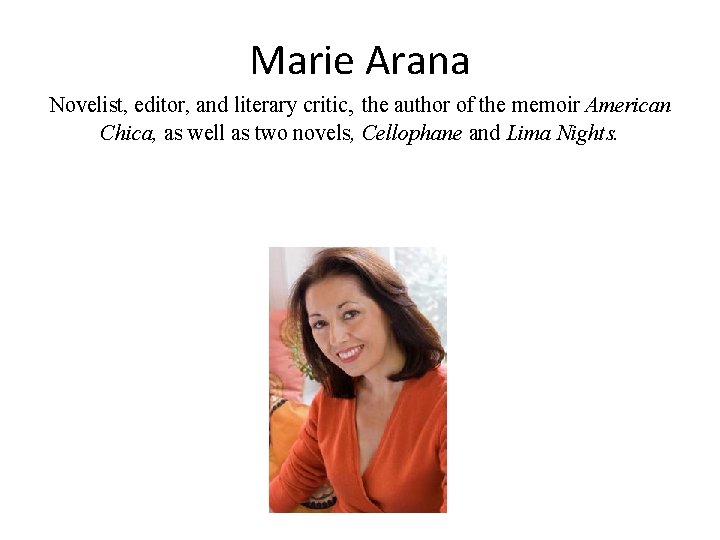
Marie Arana Novelist, editor, and literary critic, the author of the memoir American Chica, as well as two novels, Cellophane and Lima Nights.
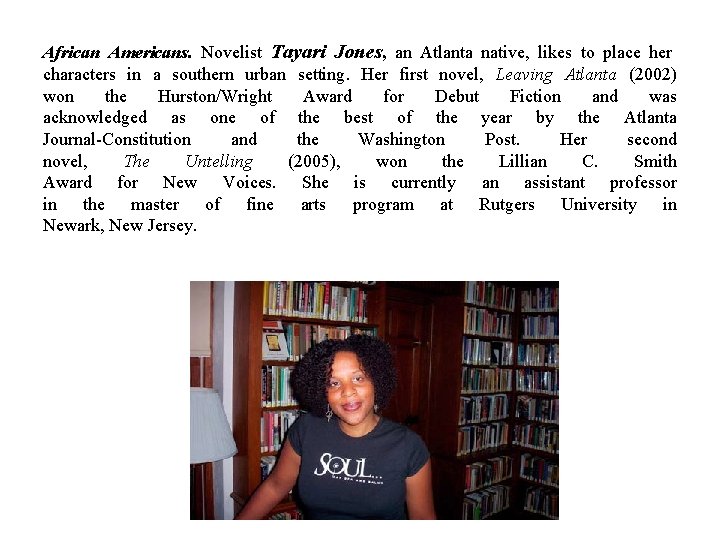
African Americans. Novelist Tayari Jones, an Atlanta native, likes to place her characters in a southern urban setting. Her first novel, Leaving Atlanta (2002) won the Hurston/Wright Award for Debut Fiction and was acknowledged as one of the best of the year by the Atlanta Journal-Constitution and the Washington Post. Her second novel, The Untelling (2005), won the Lillian C. Smith Award for New Voices. She is currently an assistant professor in the master of fine arts program at Rutgers University in Newark, New Jersey.
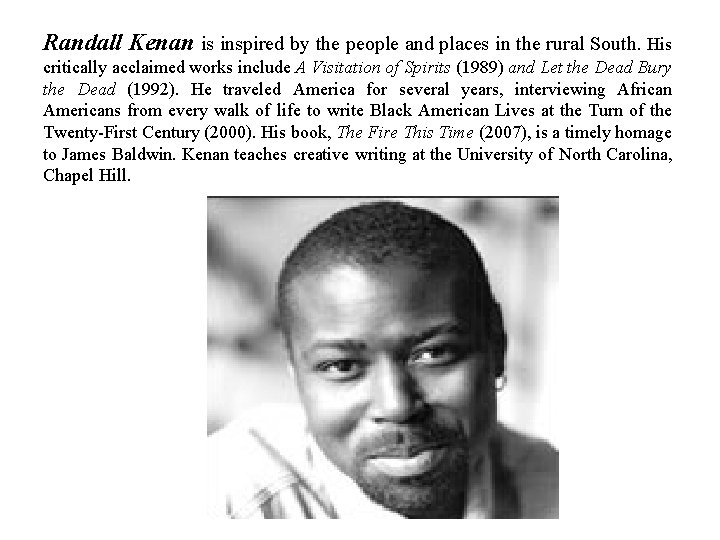
Randall Kenan is inspired by the people and places in the rural South. His critically acclaimed works include A Visitation of Spirits (1989) and Let the Dead Bury the Dead (1992). He traveled America for several years, interviewing African Americans from every walk of life to write Black American Lives at the Turn of the Twenty-First Century (2000). His book, The Fire This Time (2007), is a timely homage to James Baldwin. Kenan teaches creative writing at the University of North Carolina, Chapel Hill.
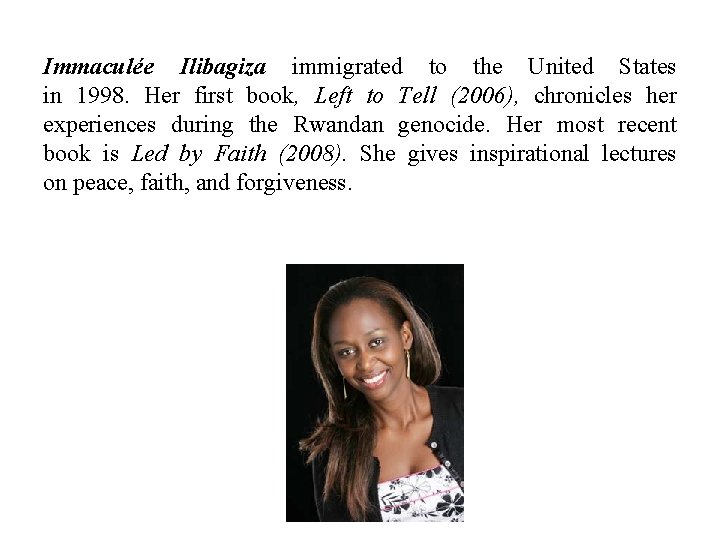
Immaculée Ilibagiza immigrated to the United States in 1998. Her first book, Left to Tell (2006), chronicles her experiences during the Rwandan genocide. Her most recent book is Led by Faith (2008). She gives inspirational lectures on peace, faith, and forgiveness.
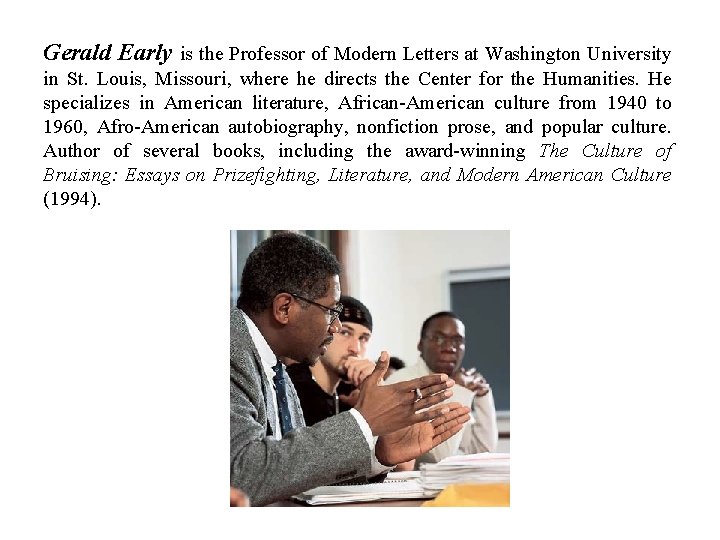
Gerald Early is the Professor of Modern Letters at Washington University in St. Louis, Missouri, where he directs the Center for the Humanities. He specializes in American literature, African-American culture from 1940 to 1960, Afro-American autobiography, nonfiction prose, and popular culture. Author of several books, including the award-winning The Culture of Bruising: Essays on Prizefighting, Literature, and Modern American Culture (1994).
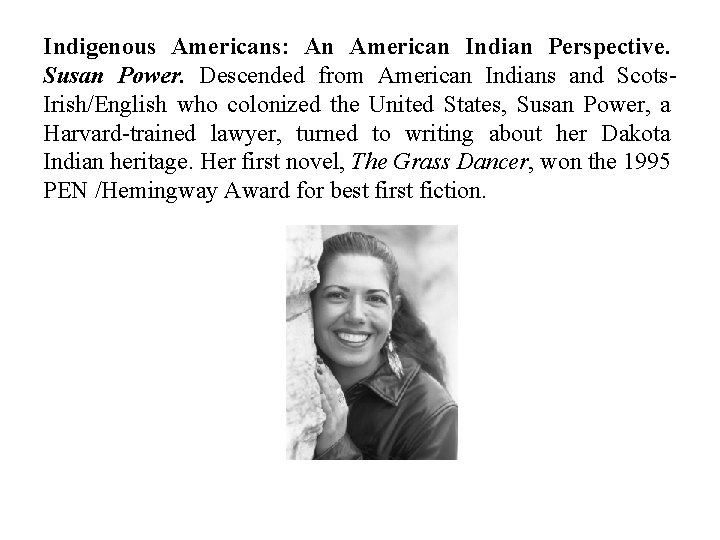
Indigenous Americans: An American Indian Perspective. Susan Power. Descended from American Indians and Scots. Irish/English who colonized the United States, Susan Power, a Harvard-trained lawyer, turned to writing about her Dakota Indian heritage. Her first novel, The Grass Dancer, won the 1995 PEN /Hemingway Award for best first fiction.
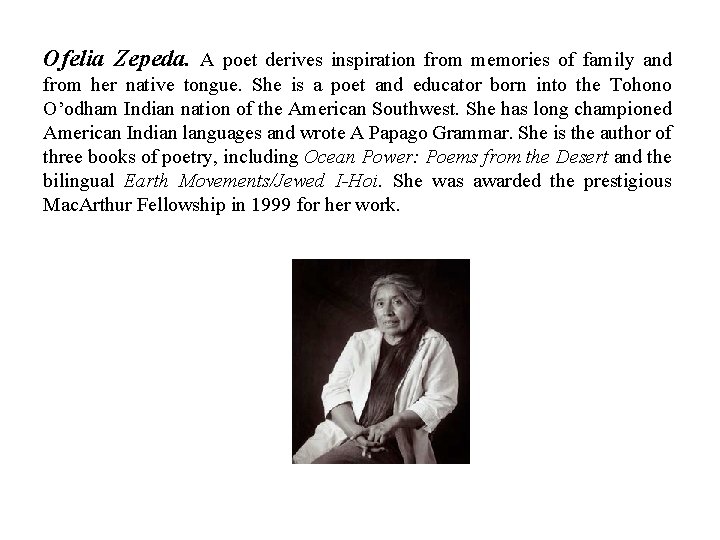
Ofelia Zepeda. A poet derives inspiration from memories of family and from her native tongue. She is a poet and educator born into the Tohono O’odham Indian nation of the American Southwest. She has long championed American Indian languages and wrote A Papago Grammar. She is the author of three books of poetry, including Ocean Power: Poems from the Desert and the bilingual Earth Movements/Jewed I-Hoi. She was awarded the prestigious Mac. Arthur Fellowship in 1999 for her work.
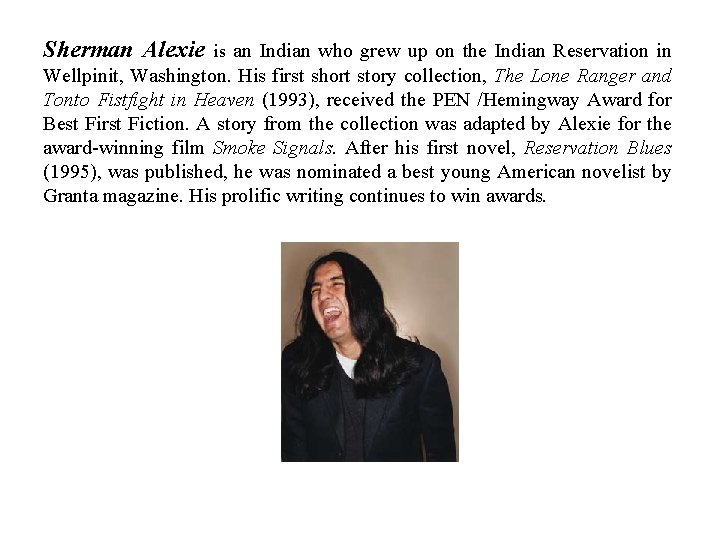
Sherman Alexie is an Indian who grew up on the Indian Reservation in Wellpinit, Washington. His first short story collection, The Lone Ranger and Tonto Fistfight in Heaven (1993), received the PEN /Hemingway Award for Best First Fiction. A story from the collection was adapted by Alexie for the award-winning film Smoke Signals. After his first novel, Reservation Blues (1995), was published, he was nominated a best young American novelist by Granta magazine. His prolific writing continues to win awards.
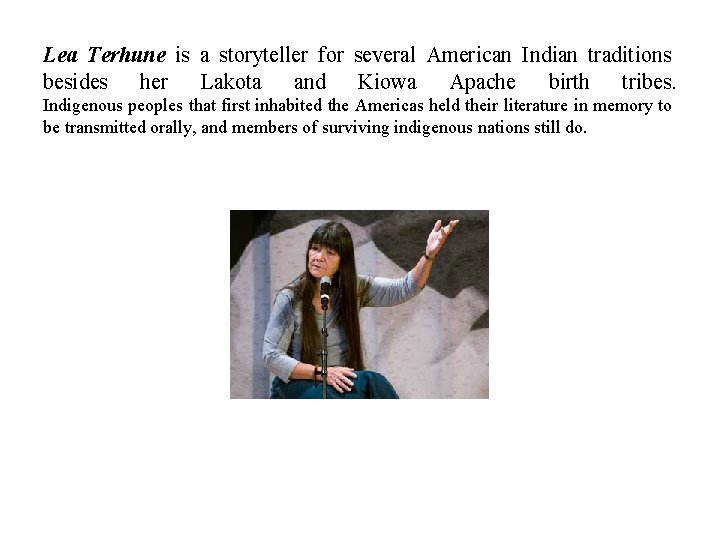
Lea Terhune is a storyteller for several American Indian traditions besides her Lakota and Kiowa Apache birth tribes. Indigenous peoples that first inhabited the Americas held their literature in memory to be transmitted orally, and members of surviving indigenous nations still do.
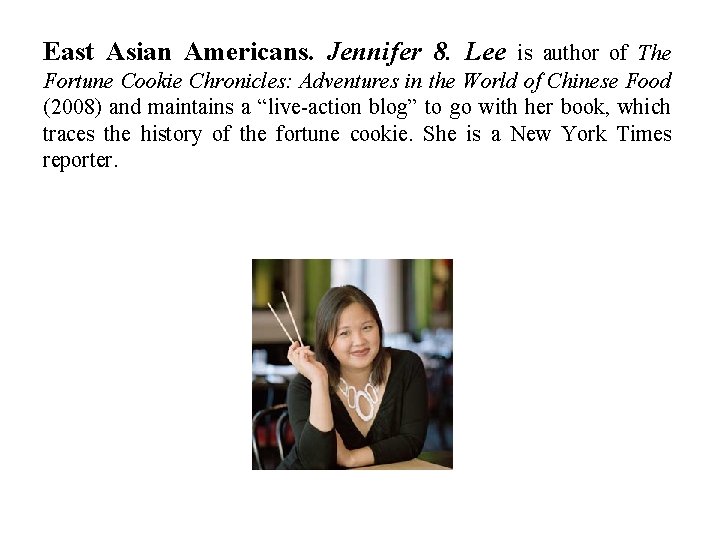
East Asian Americans. Jennifer 8. Lee is author of The Fortune Cookie Chronicles: Adventures in the World of Chinese Food (2008) and maintains a “live-action blog” to go with her book, which traces the history of the fortune cookie. She is a New York Times reporter.
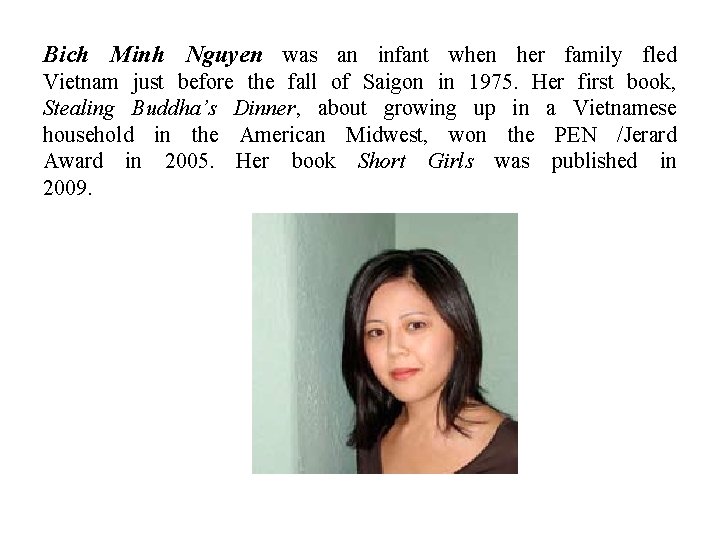
Bich Minh Nguyen was an infant when her family fled Vietnam just before the fall of Saigon in 1975. Her first book, Stealing Buddha’s Dinner, about growing up in a Vietnamese household in the American Midwest, won the PEN /Jerard Award in 2005. Her book Short Girls was published in 2009.
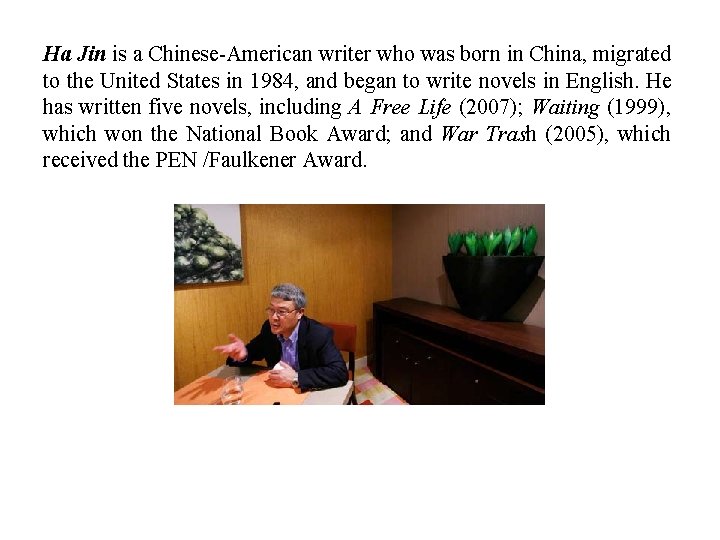
Ha Jin is a Chinese-American writer who was born in China, migrated to the United States in 1984, and began to write novels in English. He has written five novels, including A Free Life (2007); Waiting (1999), which won the National Book Award; and War Trash (2005), which received the PEN /Faulkener Award.
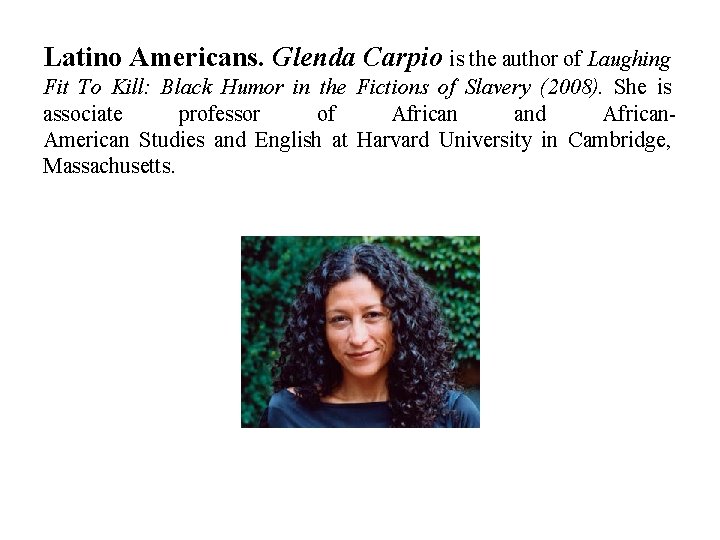
Latino Americans. Glenda Carpio is the author of Laughing Fit To Kill: Black Humor in the Fictions of Slavery (2008). She is associate professor of African and African. American Studies and English at Harvard University in Cambridge, Massachusetts.
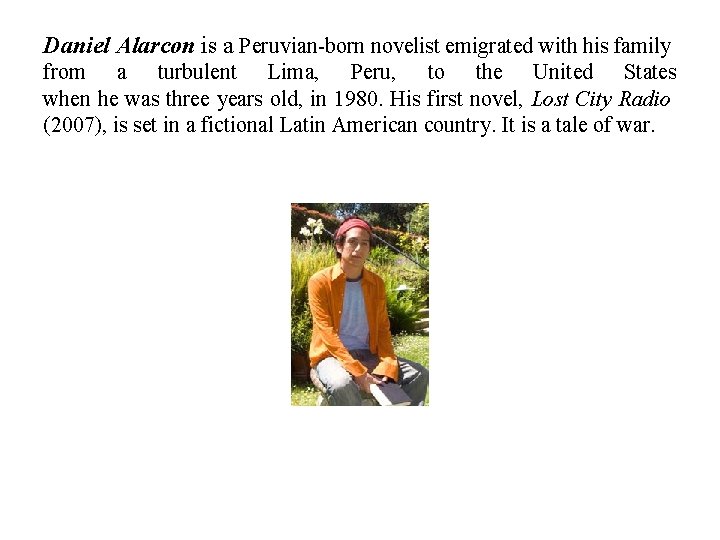
Daniel Alarcon is a Peruvian-born novelist emigrated with his family from a turbulent Lima, Peru, to the United States when he was three years old, in 1980. His first novel, Lost City Radio (2007), is set in a fictional Latin American country. It is a tale of war.
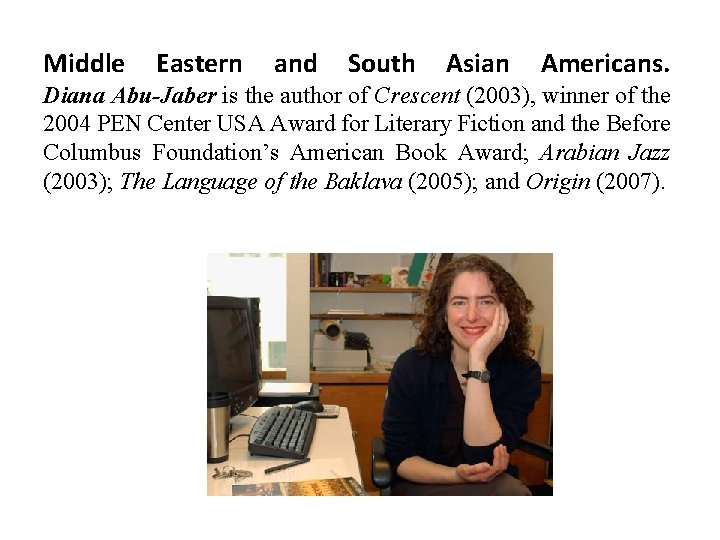
Middle Eastern and South Asian Americans. Diana Abu-Jaber is the author of Crescent (2003), winner of the 2004 PEN Center USA Award for Literary Fiction and the Before Columbus Foundation’s American Book Award; Arabian Jazz (2003); The Language of the Baklava (2005); and Origin (2007).
Multiculturalism and Canadian Literature • The mission of creating a national literature that should have a test of regional culture: Margaret Lawrence, Alice Munro, Margaret Atwood, Hugh Mc. Lennan, Ethel Davis Wilson and Ernest Buckler. • A radical shift from national to the transnational-multicultural literature is described significantly by W. J. (William John) Keith in Canadian Literature in English Vol. II
The development of Multicultural Canadian Literary tradition can be seen as follows: - The literature is the only source that can help to the process of acculturation. - Literature as a form of culture sustains the great cultural tradition and at the same time denotes the significant changes in the social conducts. - Canadian Literature in English reflects the contemporary life that is under the influence of the multiculturalism. - The secularism in the religious orientation and the cultural conducts can be realized in the literary expressions of the period. - Canada as an officially bilingual country holds a collage of different cultures and creates an eclectic model of contemporary consciousness that gave birth to the new vibrant literature. - The literature of the period not only locates the commonalities among the people but also focuses on the differences. - In this period Literature is the only valid solution that can bridge these differences to create the nation as organic whole. - Contemporary Canadian Literary Tradition has a capacity to sustain the cultural equality.
v Canada has the literary traditions like French-Canadian Literature, English-Canadian Literature, Irish-Canadian Literature, Chinese-Canadian Literature and so forth. These categorizations of Canadian literature suggest its multicultural nature. v Mordecai Richler, Margaret Laurence, Rohinton Mistry, Michael Ondaatje and Wayson Choy. v Articulation of Interculturalism in Chinese-Canadian Literature (2000) v The thematic concern of Canadian literature: the portrayal of cultural differences, search for collective voice, immigrant problems to themes like problem of acculturation, cultural crisis, transcultural marriages, problems of cultural harmony and self-identity in the globalization.