
Lecture 2 MILLING THEORY OF COMMINUTION MILLING Behavior
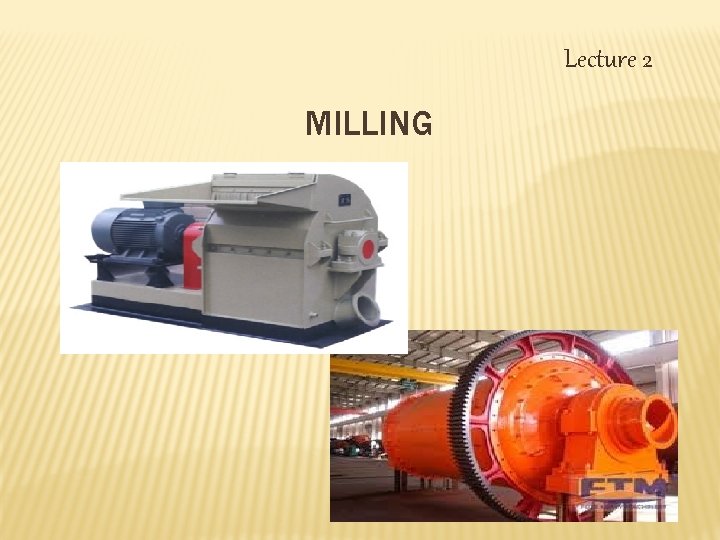
Lecture 2 MILLING
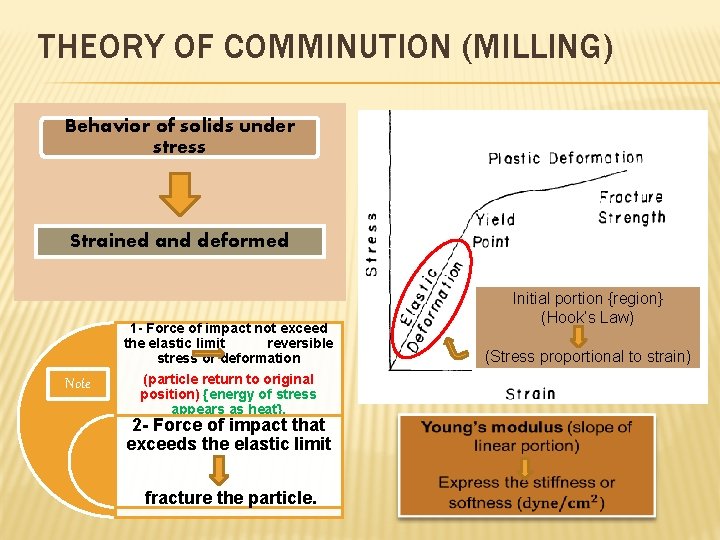
THEORY OF COMMINUTION (MILLING) Behavior of solids under stress Strained and deformed Initial portion {region} (Hook’s Law) 1 - Force of impact not exceed the elastic limit reversible stress or deformation Note (particle return to original position) {energy of stress appears as heat}. 2 - Force of impact that exceeds the elastic limit fracture the particle. (Stress proportional to strain)
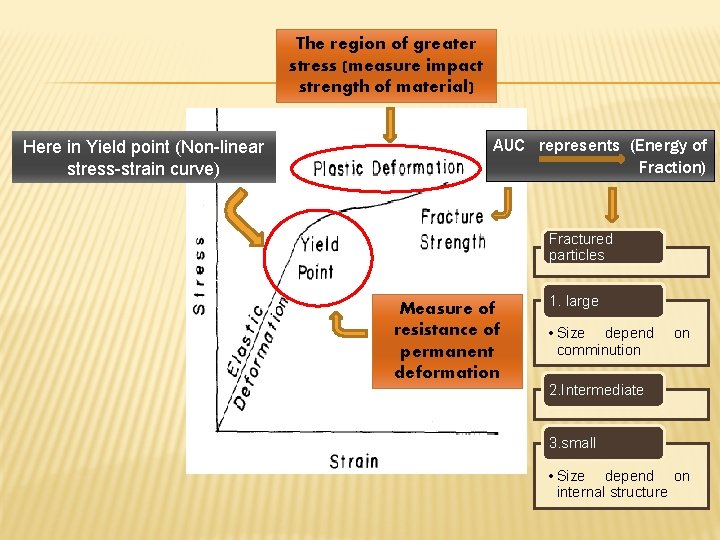
The region of greater stress (measure impact strength of material) Here in Yield point (Non-linear stress-strain curve) AUC represents (Energy of Fraction) Fractured particles Measure of resistance of permanent deformation 1. large • Size depend on comminution 2. Intermediate 3. small • Size depend on internal structure
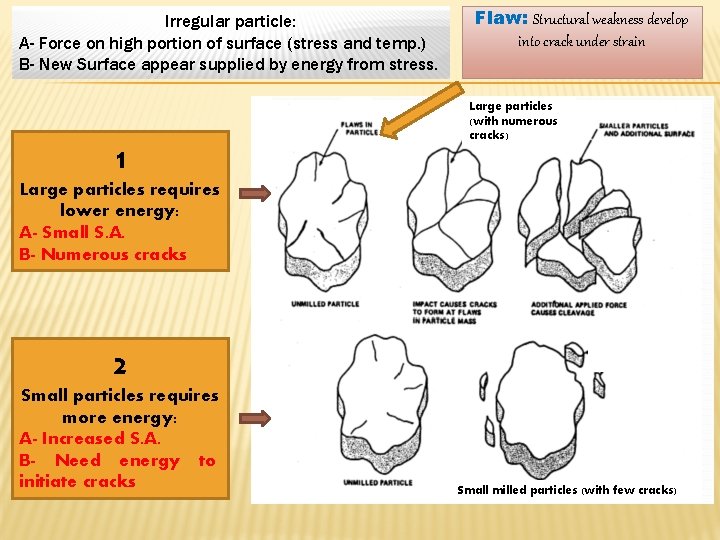
Irregular particle: A- Force on high portion of surface (stress and temp. ) B- New Surface appear supplied by energy from stress. 1 Flaw: Structural weakness develop into crack under strain Large particles (with numerous cracks) Large particles requires lower energy: A- Small S. A. B- Numerous cracks 2 Small particles requires more energy: A- Increased S. A. B- Need energy to initiate cracks Small milled particles (with few cracks)
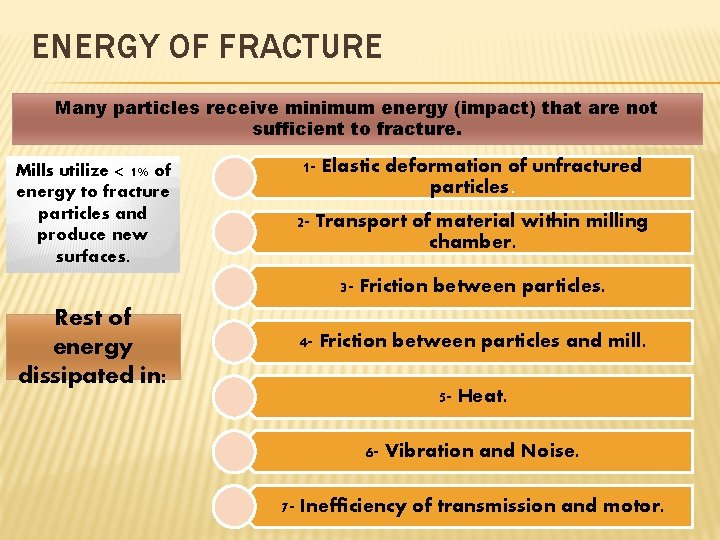
ENERGY OF FRACTURE Many particles receive minimum energy (impact) that are not sufficient to fracture. Mills utilize < 1% of energy to fracture particles and produce new surfaces. 1 - Elastic deformation of unfractured particles. 2 - Transport of material within milling chamber. 3 - Friction between particles. Rest of energy dissipated in: 4 - Friction between particles and mill. 5 - Heat. 6 - Vibration and Noise. 7 - Inefficiency of transmission and motor.
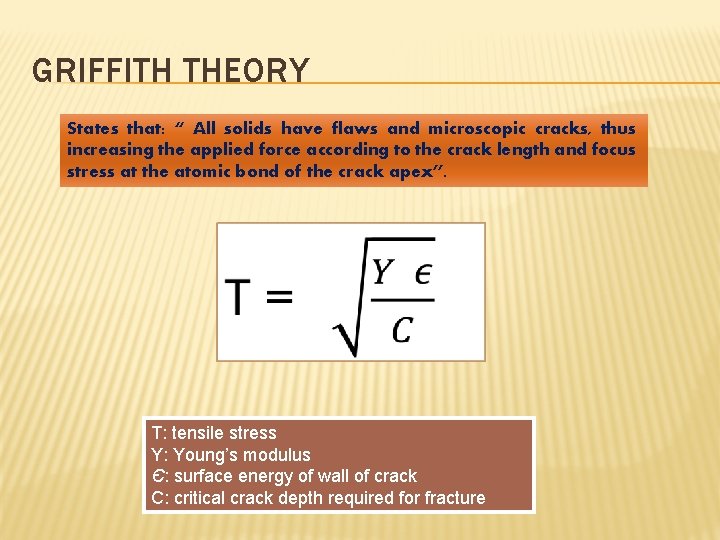
GRIFFITH THEORY States that: “ All solids have flaws and microscopic cracks, thus increasing the applied force according to the crack length and focus stress at the atomic bond of the crack apex”. T: tensile stress Y: Young’s modulus Є: surface energy of wall of crack C: critical crack depth required for fracture
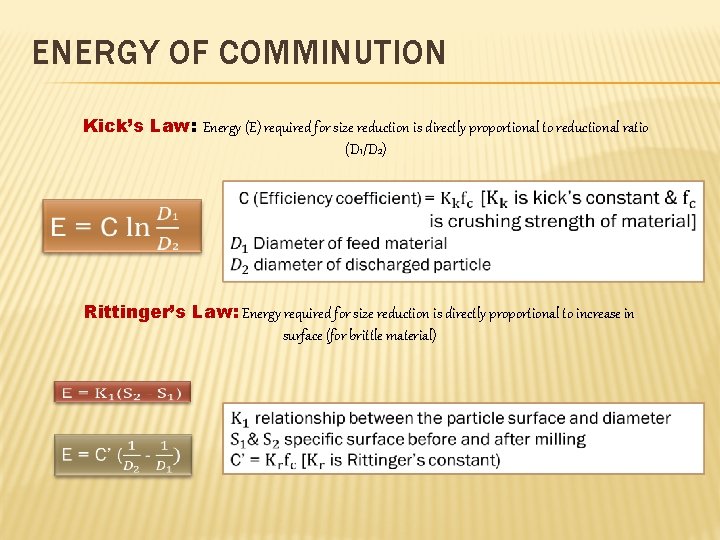
ENERGY OF COMMINUTION Kick’s Law: Energy (E) required for size reduction is directly proportional to reductional ratio (D 1/D 2) Rittinger’s Law: Energy required for size reduction is directly proportional to increase in surface (for brittle material)
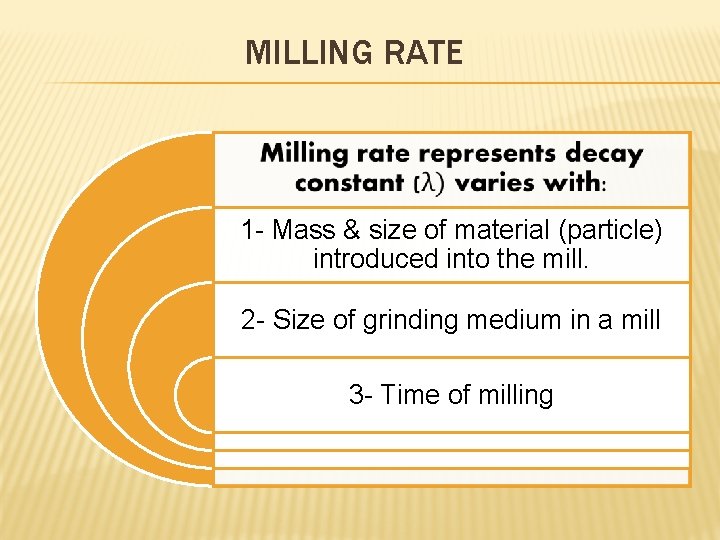
MILLING RATE 1 - Mass & size of material (particle) introduced into the mill. 2 - Size of grinding medium in a mill 3 - Time of milling
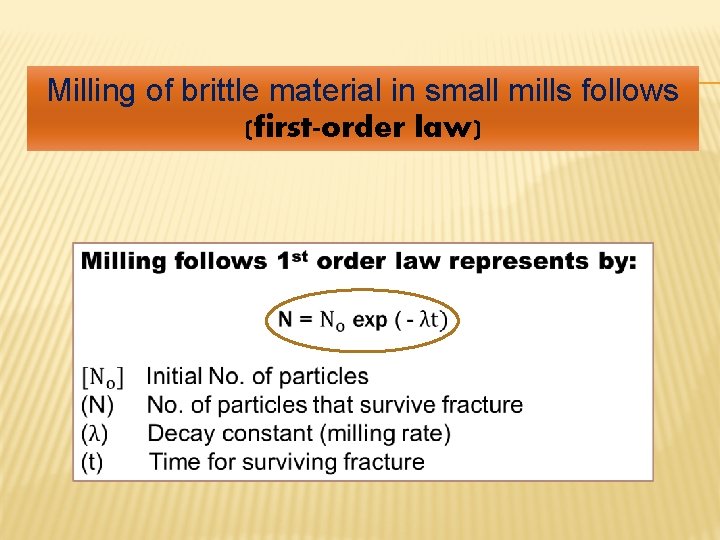
Milling of brittle material in small mills follows (first-order law)
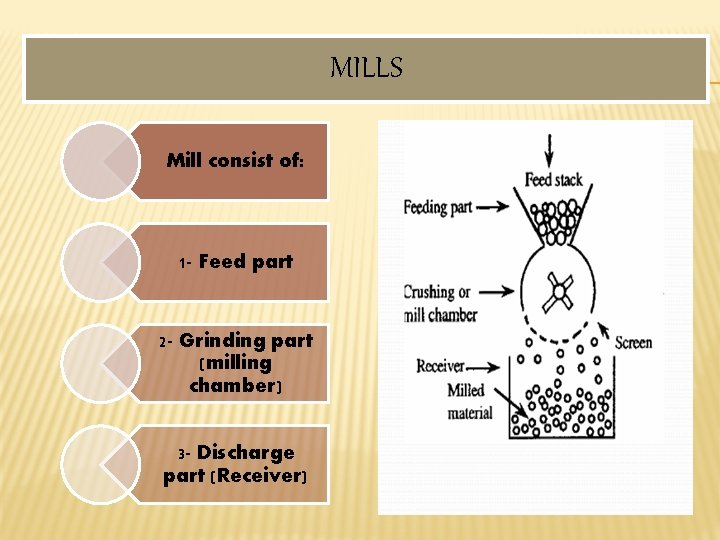
MILLS Mill consist of: 1 - Feed part 2 - Grinding part (milling chamber) 3 - Discharge part (Receiver)
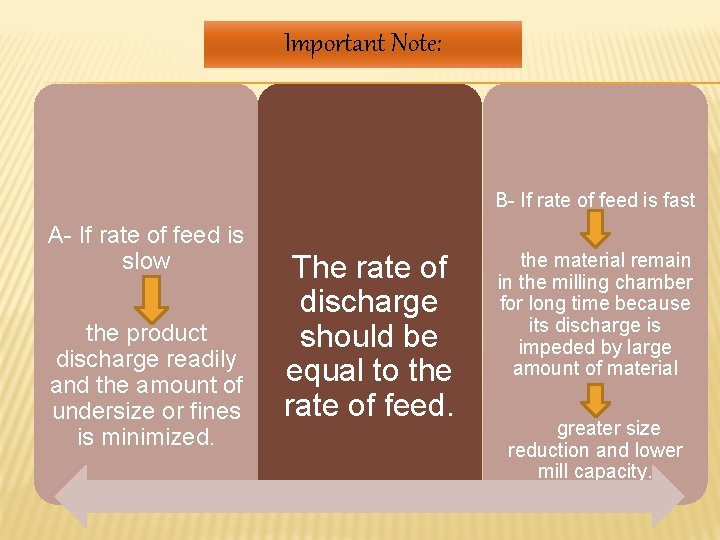
Important Note: B- If rate of feed is fast A- If rate of feed is slow the product discharge readily and the amount of undersize or fines is minimized. The rate of discharge should be equal to the rate of feed. the material remain in the milling chamber for long time because its discharge is impeded by large amount of material greater size reduction and lower mill capacity.
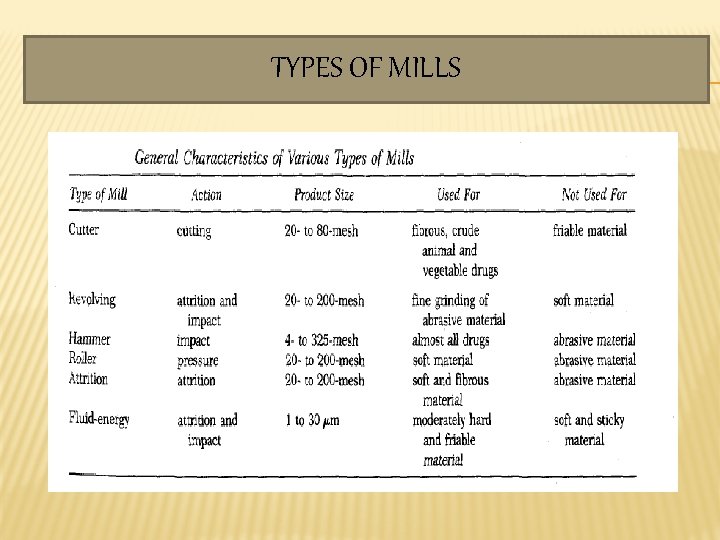
TYPES OF MILLS
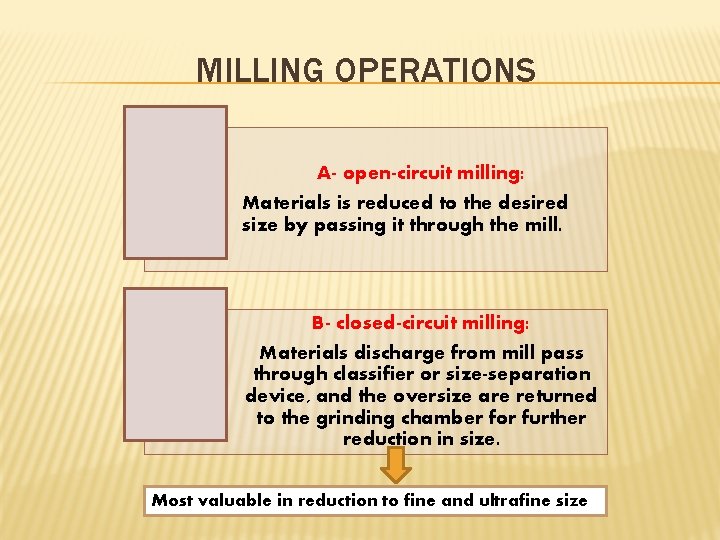
MILLING OPERATIONS A- open-circuit milling: Materials is reduced to the desired size by passing it through the mill. B- closed-circuit milling: Materials discharge from mill pass through classifier or size-separation device, and the oversize are returned to the grinding chamber for further reduction in size. Most valuable in reduction to fine and ultrafine size
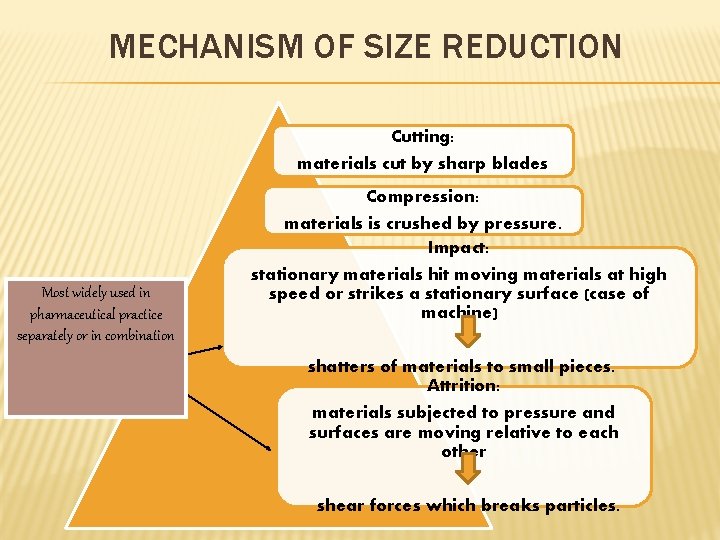
MECHANISM OF SIZE REDUCTION Cutting: materials cut by sharp blades Compression: Most widely used in pharmaceutical practice separately or in combination materials is crushed by pressure. Impact: stationary materials hit moving materials at high speed or strikes a stationary surface (case of machine) shatters of materials to small pieces. Attrition: materials subjected to pressure and surfaces are moving relative to each other shear forces which breaks particles.
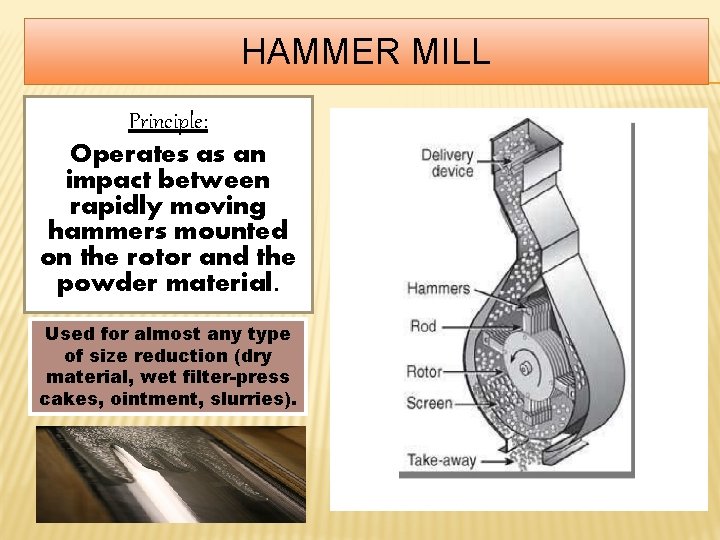
HAMMER MILL Principle: Operates as an impact between rapidly moving hammers mounted on the rotor and the powder material. Used for almost any type of size reduction (dry material, wet filter-press cakes, ointment, slurries).
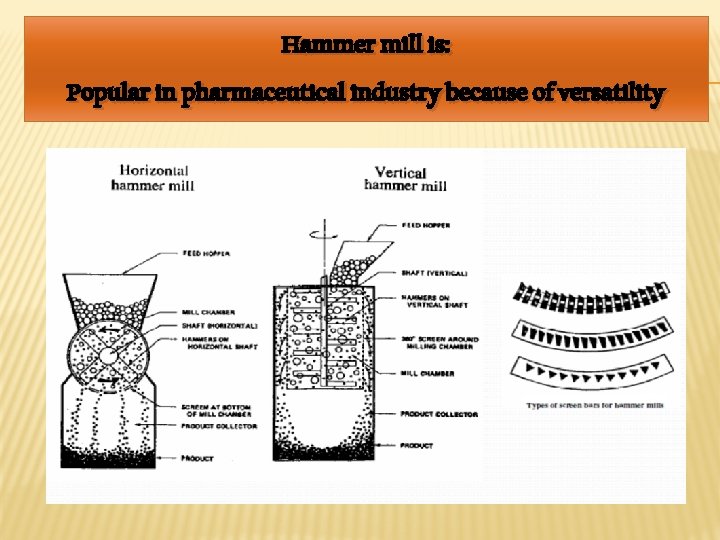
Hammer mill is: Popular in pharmaceutical industry because of versatility
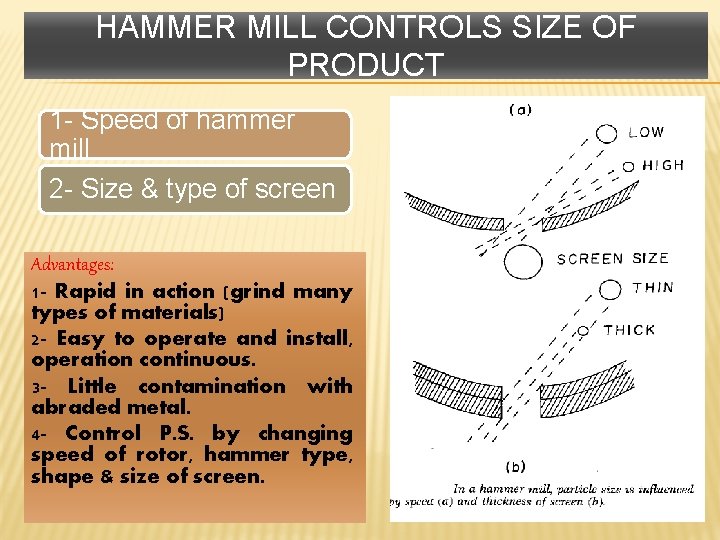
HAMMER MILL CONTROLS SIZE OF PRODUCT 1 - Speed of hammer mill 2 - Size & type of screen Advantages: 1 - Rapid in action (grind many types of materials) 2 - Easy to operate and install, operation continuous. 3 - Little contamination with abraded metal. 4 - Control P. S. by changing speed of rotor, hammer type, shape & size of screen.
Disadvantages: 1 - Heat buildup during milling, therefore product degradation is possible. 2 - Cannot be employed to mill (sticky, fibrous and hard materials). 3 - Screens get clogged (closed). 4 - Wearing of mill and screen is more with abrasive materials.
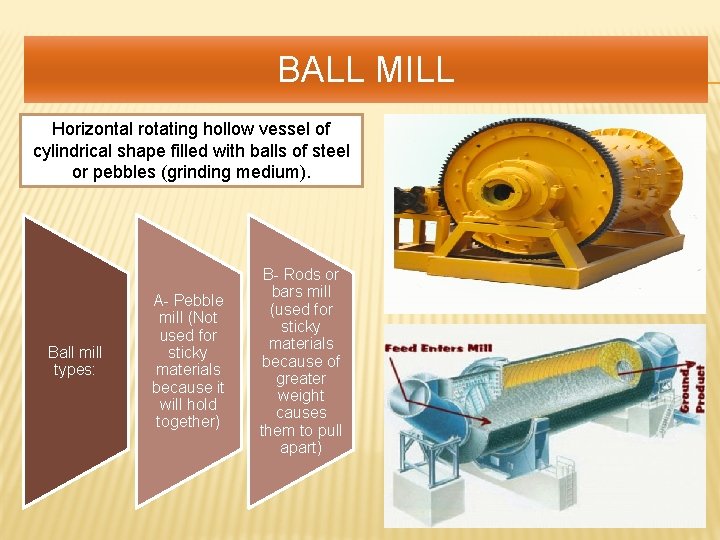
BALL MILL Horizontal rotating hollow vessel of cylindrical shape filled with balls of steel or pebbles (grinding medium). Ball mill types: A- Pebble mill (Not used for sticky materials because it will hold together) B- Rods or bars mill (used for sticky materials because of greater weight causes them to pull apart)
Increasing Efficiency of ball mill (Increasing fineness of powder) 1 - By increasing No. of balls 2 - By using balls containing material with higher density (50% of volume of mill). A- steel balls (fast grinding) B- porcelain balls (Non-sparking for explosive materials) C- Stainless balls (for ophthalmic and parenteral because of less contamination)
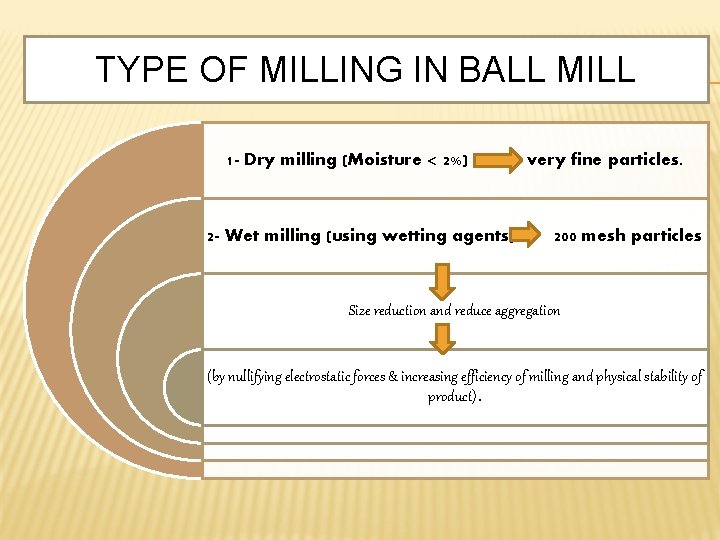
TYPE OF MILLING IN BALL MILL 1 - Dry milling (Moisture < 2%) 2 - Wet milling (using wetting agents) very fine particles. 200 mesh particles Size reduction and reduce aggregation (by nullifying electrostatic forces & increasing efficiency of milling and physical stability of product).
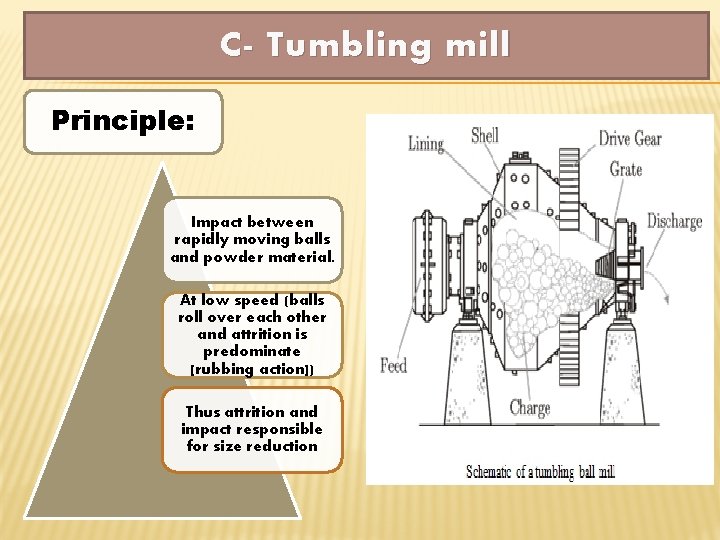
C- Tumbling mill Principle: Impact between rapidly moving balls and powder material. At low speed (balls roll over each other and attrition is predominate [rubbing action]) Thus attrition and impact responsible for size reduction
advantages: 1 - Produce very fine particles. 2 - Dry and wet grinding process. 3 - Toxic substances ground (closed system). 4 - Rods or bars as a grinding media (reducing size of sticky materials). 5 - Low install, operation and labour. Disadvantages: 1 - Noisy machine. 2 - Slow process. 3 - Soft, fibrous material cannot be milled.
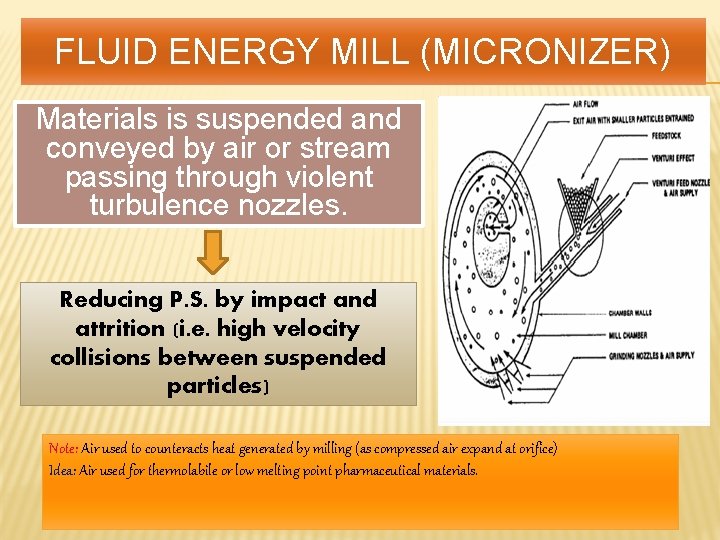
FLUID ENERGY MILL (MICRONIZER) Materials is suspended and conveyed by air or stream passing through violent turbulence nozzles. Reducing P. S. by impact and attrition (i. e. high velocity collisions between suspended particles) Note: Air used to counteracts heat generated by milling (as compressed air expand at orifice) Idea: Air used for thermolabile or low melting point pharmaceutical materials.
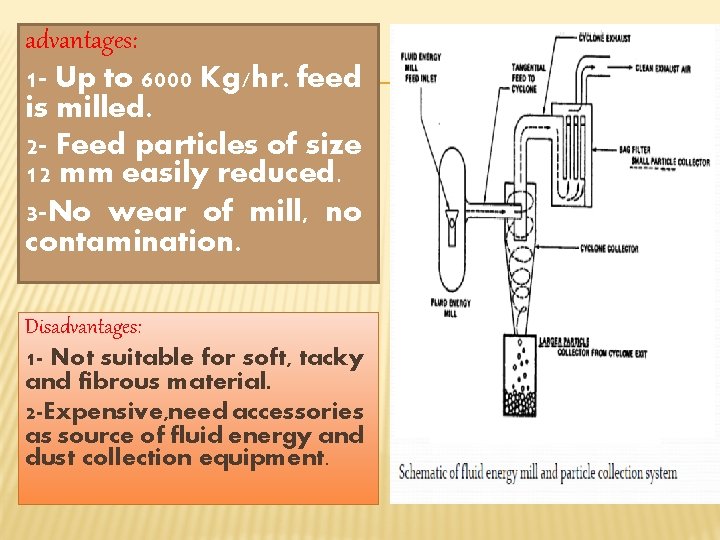
advantages: 1 - Up to 6000 Kg/hr. feed is milled. 2 - Feed particles of size 12 mm easily reduced. 3 -No wear of mill, no contamination. Disadvantages: 1 - Not suitable for soft, tacky and fibrous material. 2 -Expensive, need accessories as source of fluid energy and dust collection equipment.
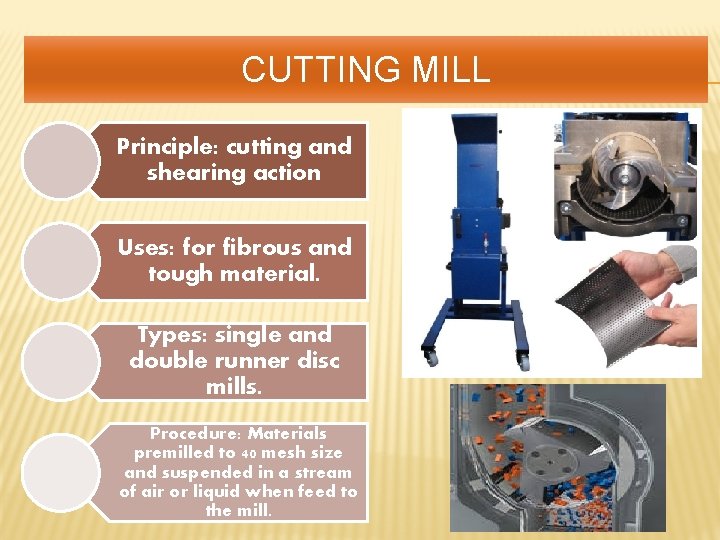
CUTTING MILL Principle: cutting and shearing action Uses: for fibrous and tough material. Types: single and double runner disc mills. Procedure: Materials premilled to 40 mesh size and suspended in a stream of air or liquid when feed to the mill.
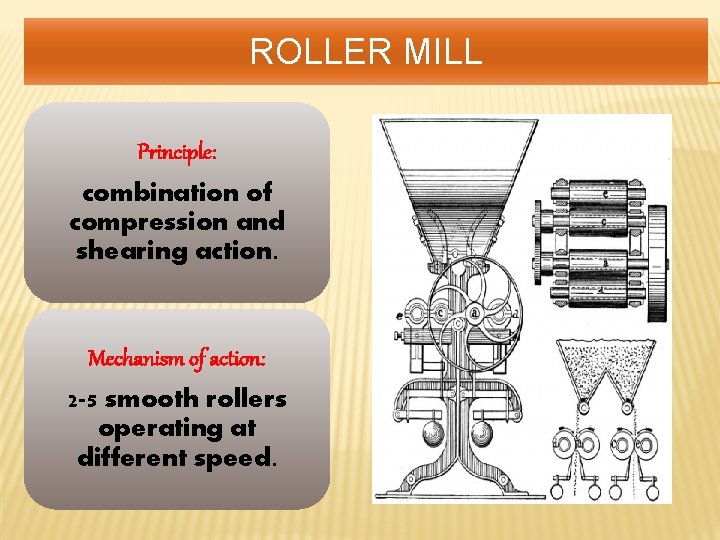
ROLLER MILL Principle: combination of compression and shearing action. Mechanism of action: 2 -5 smooth rollers operating at different speed.
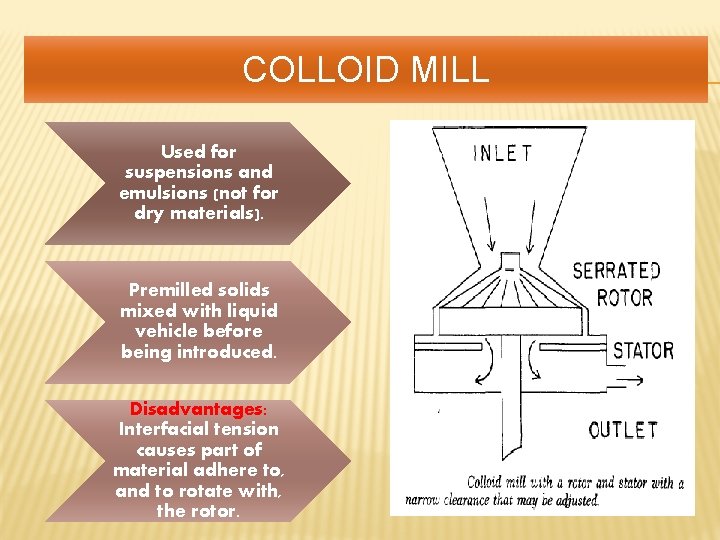
COLLOID MILL Used for suspensions and emulsions (not for dry materials). Premilled solids mixed with liquid vehicle before being introduced. Disadvantages: Interfacial tension causes part of material adhere to, and to rotate with, the rotor.

- Slides: 29