
Lecture 2 Magnetization cables and ac losses Magnetization
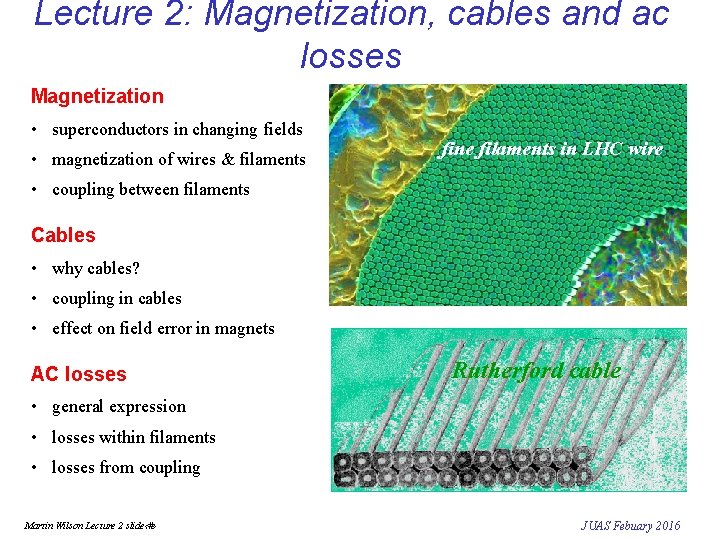
Lecture 2: Magnetization, cables and ac losses Magnetization • superconductors in changing fields • magnetization of wires & filaments fine filaments in LHC wire • coupling between filaments Cables • why cables? • coupling in cables • effect on field error in magnets AC losses Rutherford cable • general expression • losses within filaments • losses from coupling Martin Wilson Lecture 2 slide‹#› JUAS Febuary 2016

Superconductors in changing magnetic fields I E Ḃ E Faraday’s Law of EM Induction • changing field → changing flux linked by loop → electric field E in superconductor → current Ir flows around the loop • change stops → electric field goes to zero → superconductor current falls back to Ic (not zero) → current circulates for ever persistent current Ic Ir changing magnetic fields on superconductors → electric field → resistance → power dissipation Martin Wilson Lecture 2 slide‹#› JUAS Febuary 2016
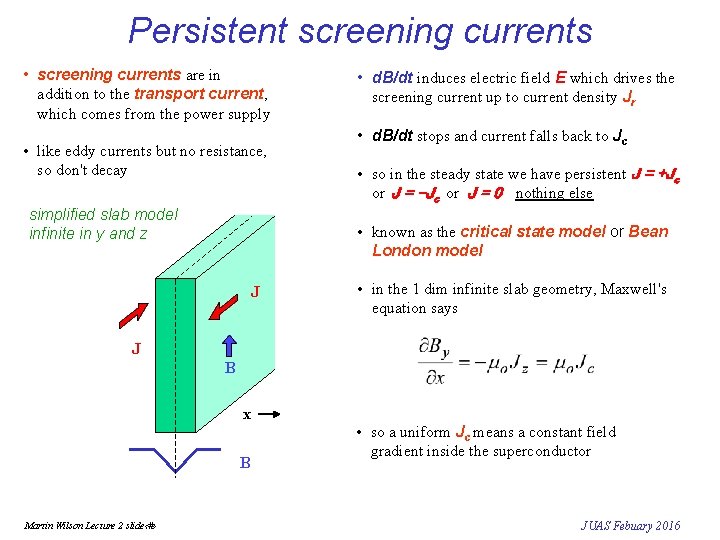
Persistent screening currents • screening currents are in addition to the transport current, which comes from the power supply • like eddy currents but no resistance, so don't decay simplified slab model infinite in y and z • d. B/dt induces electric field E which drives the screening current up to current density Jr • d. B/dt stops and current falls back to Jc • so in the steady state we have persistent J = +Jc or J = -Jc or J = 0 nothing else • known as the critical state model or Bean London model J • in the 1 dim infinite slab geometry, Maxwell's equation says J B x B Martin Wilson Lecture 2 slide‹#› • so a uniform Jc means a constant field gradient inside the superconductor JUAS Febuary 2016
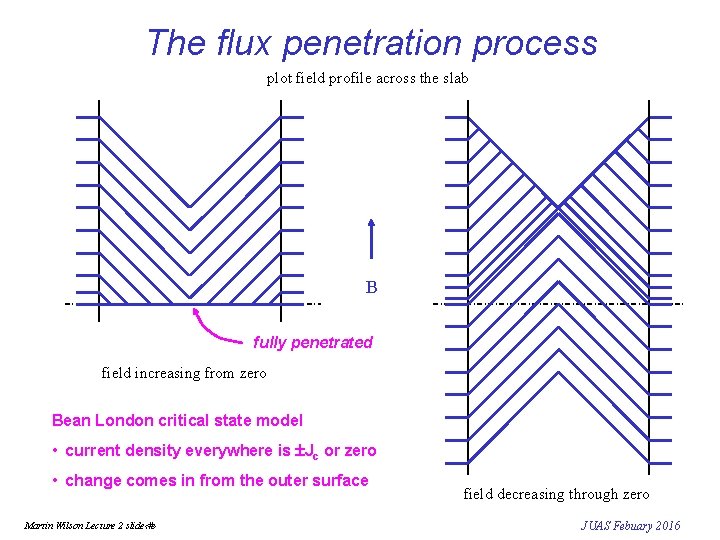
The flux penetration process plot field profile across the slab B fully penetrated field increasing from zero Bean London critical state model • current density everywhere is Jc or zero • change comes in from the outer surface Martin Wilson Lecture 2 slide‹#› field decreasing through zero JUAS Febuary 2016
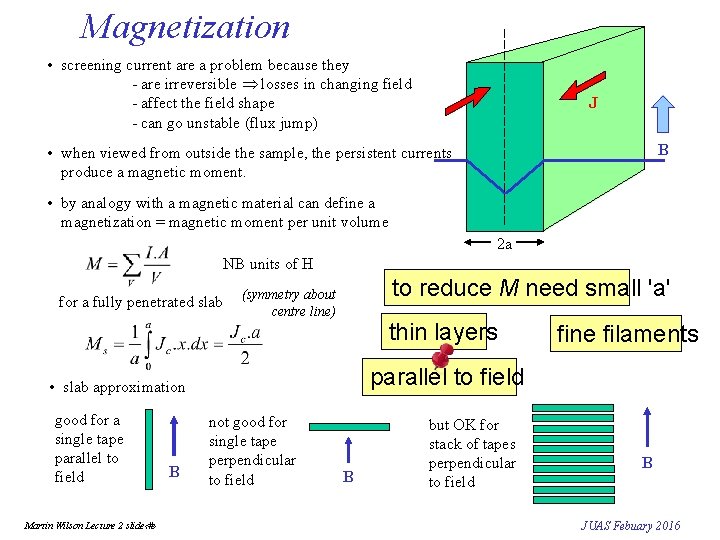
Magnetization • screening current are a problem because they - are irreversible losses in changing field - affect the field shape - can go unstable (flux jump) J B • when viewed from outside the sample, the persistent currents produce a magnetic moment. • by analogy with a magnetic material can define a magnetization = magnetic moment per unit volume 2 a NB units of H for a fully penetrated slab to reduce M need small 'a' (symmetry about centre line) thin layers parallel to field • slab approximation good for a single tape parallel to field Martin Wilson Lecture 2 slide‹#› B fine filaments not good for single tape perpendicular to field B but OK for stack of tapes perpendicular to field B JUAS Febuary 2016
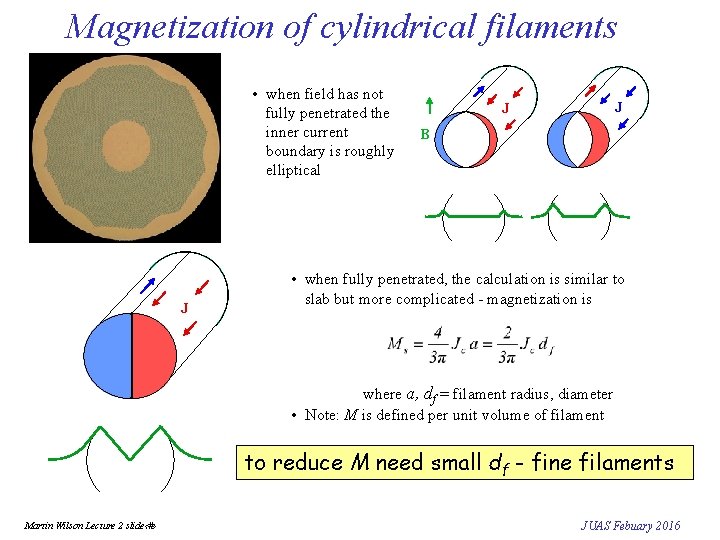
Magnetization of cylindrical filaments • when field has not fully penetrated the inner current boundary is roughly elliptical J J J B • when fully penetrated, the calculation is similar to slab but more complicated - magnetization is where a, df = filament radius, diameter • Note: M is defined per unit volume of filament to reduce M need small df - fine filaments Martin Wilson Lecture 2 slide‹#› JUAS Febuary 2016
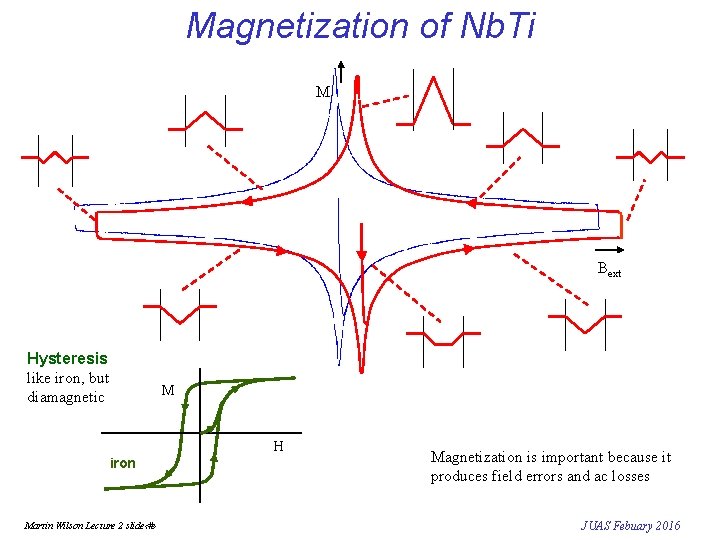
Magnetization of Nb. Ti M Bext Hysteresis like iron, but diamagnetic M H iron Martin Wilson Lecture 2 slide‹#› Magnetization is important because it produces field errors and ac losses JUAS Febuary 2016
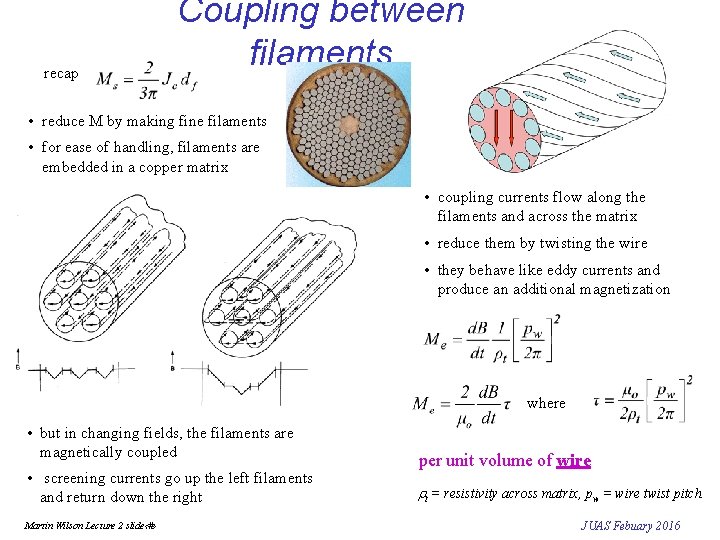
recap Coupling between filaments • reduce M by making fine filaments • for ease of handling, filaments are embedded in a copper matrix • coupling currents flow along the filaments and across the matrix • reduce them by twisting the wire • they behave like eddy currents and produce an additional magnetization where • but in changing fields, the filaments are magnetically coupled • screening currents go up the left filaments and return down the right Martin Wilson Lecture 2 slide‹#› per unit volume of wire rt = resistivity across matrix, pw = wire twist pitch JUAS Febuary 2016
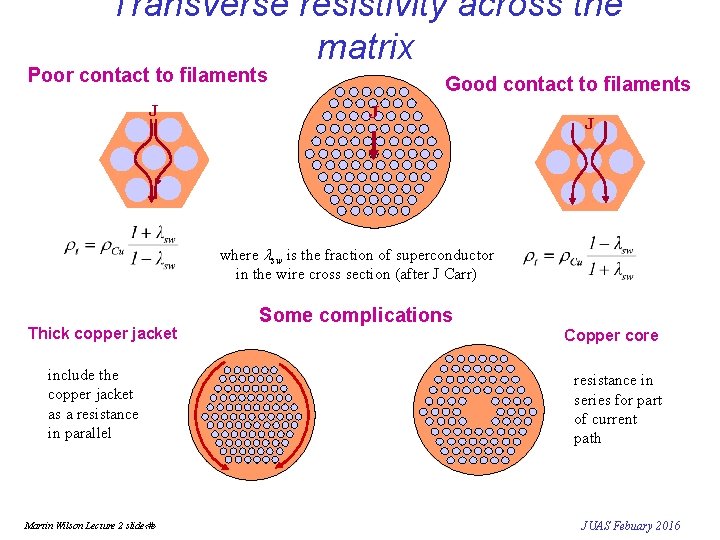
Transverse resistivity across the matrix Poor contact to filaments J Good contact to filaments J J where lsw is the fraction of superconductor in the wire cross section (after J Carr) Thick copper jacket include the copper jacket as a resistance in parallel Martin Wilson Lecture 2 slide‹#› Some complications Copper core resistance in series for part of current path JUAS Febuary 2016
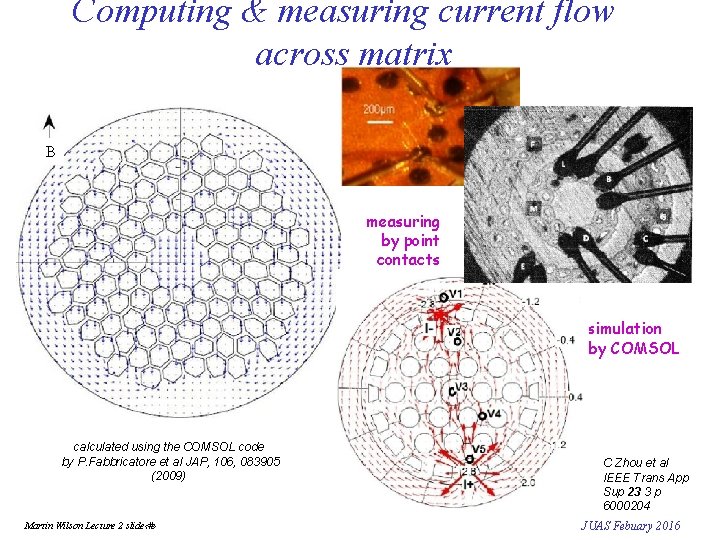
Computing & measuring current flow across matrix B measuring by point contacts simulation by COMSOL calculated using the COMSOL code by P. Fabbricatore et al JAP, 106, 083905 (2009) Martin Wilson Lecture 2 slide‹#› C Zhou et al IEEE Trans App Sup 23 3 p 6000204 JUAS Febuary 2016
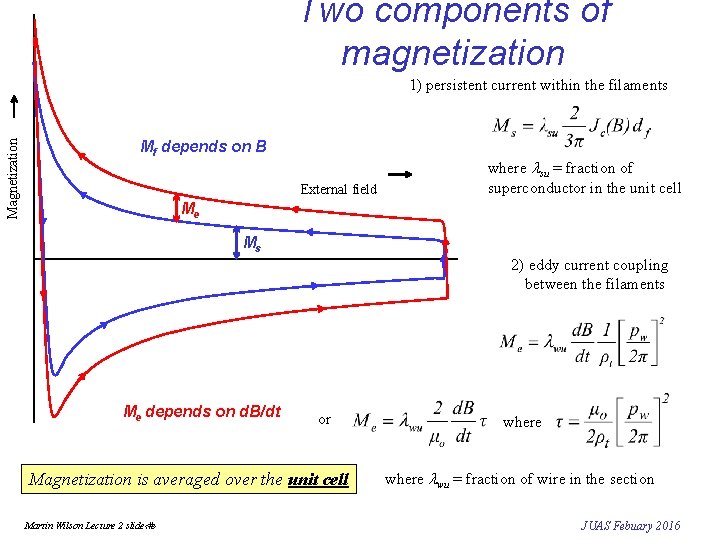
Two components of magnetization Magnetization 1) persistent current within the filaments Mf depends on B External field where lsu = fraction of superconductor in the unit cell Me Ms 2) eddy current coupling between the filaments Me depends on d. B/dt or Magnetization is averaged over the unit cell Martin Wilson Lecture 2 slide‹#› where lwu = fraction of wire in the section JUAS Febuary 2016

Measurement of magnetization • in field, superconductor behaves like a magnetic material. • can plot the magnetization curve using a magnetometer • shows hysteresis - just like iron but here magnetization can be diamagnetic or paramagnetic. integrate M B Note the minor loops, where field and therefore screening currents are reversing Two balanced search coils connected in series opposition, are placed within the bore of a superconducting solenoid. With a superconducting sample in one coil, the integrator measures DM when the solenoid field is swept up and down Martin Wilson Lecture 2 slide‹#› JUAS Febuary 2016
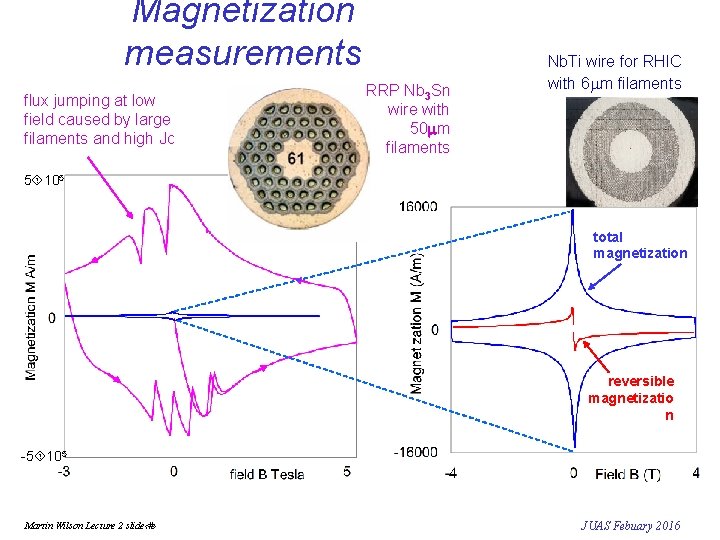
Magnetization measurements flux jumping at low field caused by large filaments and high Jc RRP Nb 3 Sn wire with 50 mm filaments Nb. Ti wire for RHIC with 6 mm filaments 5 105 total magnetization reversible magnetizatio n -5 105 Martin Wilson Lecture 2 slide‹#› JUAS Febuary 2016
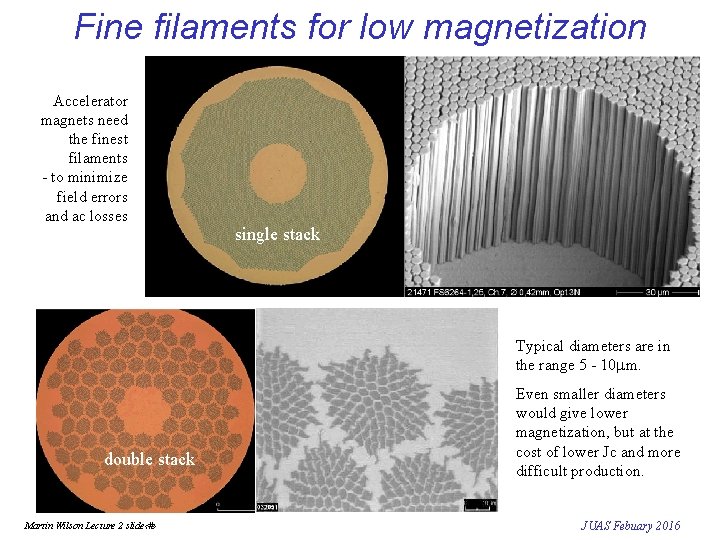
Fine filaments for low magnetization Accelerator magnets need the finest filaments - to minimize field errors and ac losses single stack Typical diameters are in the range 5 - 10 mm. double stack Martin Wilson Lecture 2 slide‹#› Even smaller diameters would give lower magnetization, but at the cost of lower Jc and more difficult production. JUAS Febuary 2016
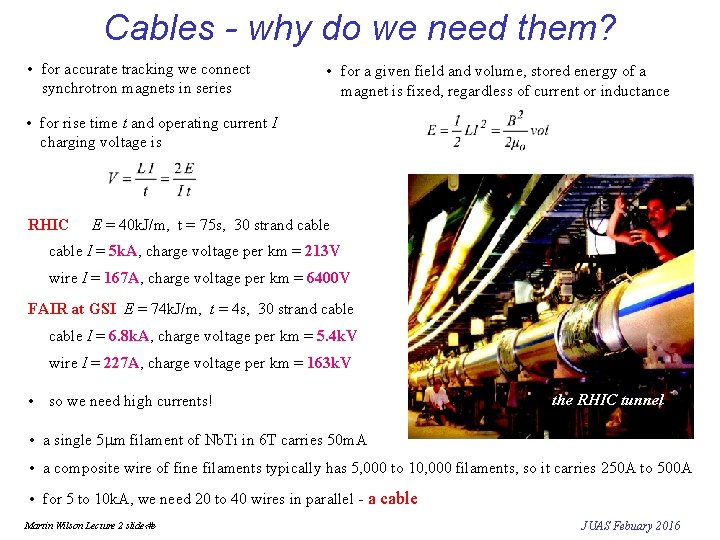
Cables - why do we need them? • for accurate tracking we connect synchrotron magnets in series • for a given field and volume, stored energy of a magnet is fixed, regardless of current or inductance • for rise time t and operating current I charging voltage is RHIC E = 40 k. J/m, t = 75 s, 30 strand cable I = 5 k. A, charge voltage per km = 213 V wire I = 167 A, charge voltage per km = 6400 V FAIR at GSI E = 74 k. J/m, t = 4 s, 30 strand cable I = 6. 8 k. A, charge voltage per km = 5. 4 k. V wire I = 227 A, charge voltage per km = 163 k. V • so we need high currents! the RHIC tunnel • a single 5 mm filament of Nb. Ti in 6 T carries 50 m. A • a composite wire of fine filaments typically has 5, 000 to 10, 000 filaments, so it carries 250 A to 500 A • for 5 to 10 k. A, we need 20 to 40 wires in parallel - a cable Martin Wilson Lecture 2 slide‹#› JUAS Febuary 2016
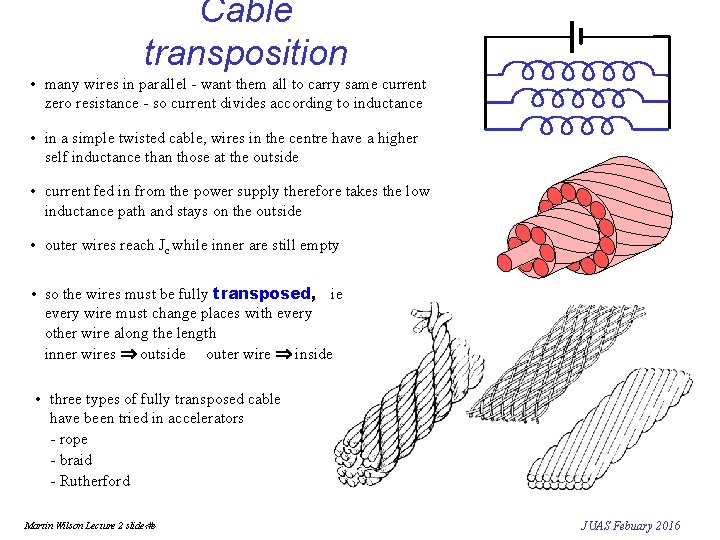
Cable transposition • many wires in parallel - want them all to carry same current zero resistance - so current divides according to inductance • in a simple twisted cable, wires in the centre have a higher self inductance than those at the outside • current fed in from the power supply therefore takes the low inductance path and stays on the outside • outer wires reach Jc while inner are still empty • so the wires must be fully transposed, ie every wire must change places with every other wire along the length inner wires outside outer wire inside • three types of fully transposed cable have been tried in accelerators - rope - braid - Rutherford Martin Wilson Lecture 2 slide‹#› JUAS Febuary 2016
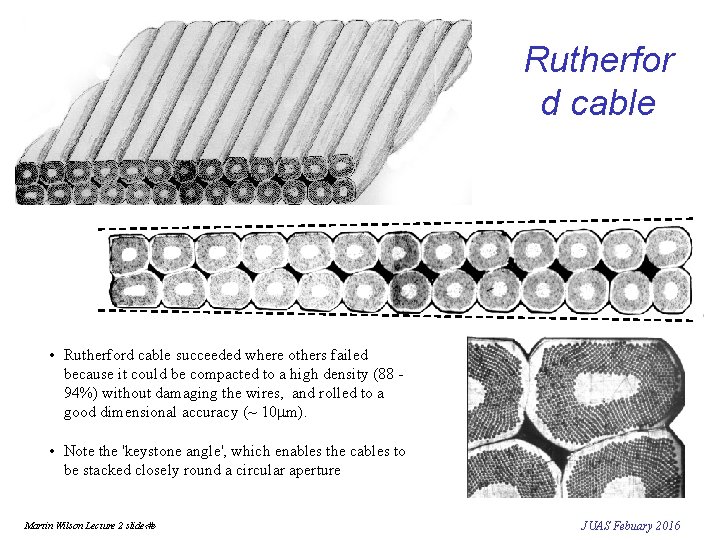
Rutherfor d cable • Rutherford cable succeeded where others failed because it could be compacted to a high density (88 94%) without damaging the wires, and rolled to a good dimensional accuracy (~ 10 mm). • Note the 'keystone angle', which enables the cables to be stacked closely round a circular aperture Martin Wilson Lecture 2 slide‹#› JUAS Febuary 2016
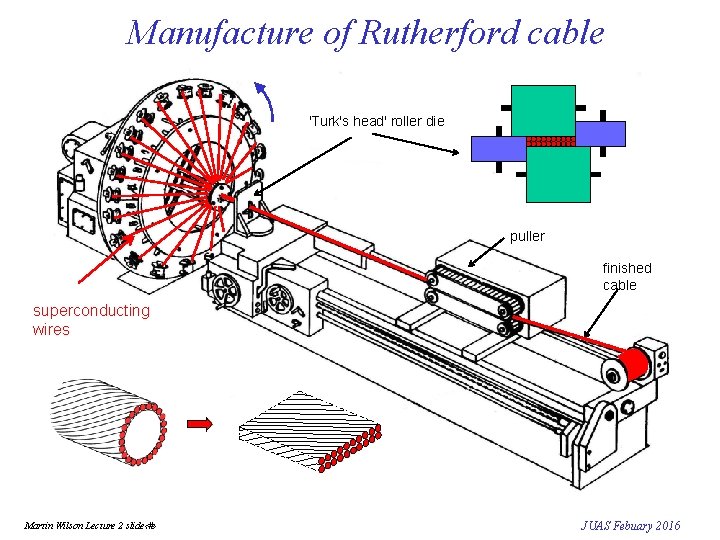
Manufacture of Rutherford cable 'Turk's head' roller die puller finished cable superconducting wires Martin Wilson Lecture 2 slide‹#› JUAS Febuary 2016
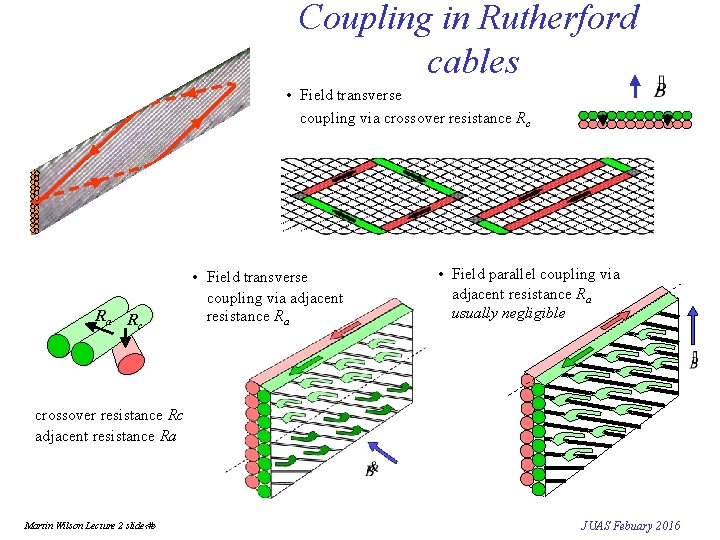
Coupling in Rutherford cables • Field transverse coupling via crossover resistance Rc Ra Rc • Field transverse coupling via adjacent resistance Ra • Field parallel coupling via adjacent resistance Ra usually negligible crossover resistance Rc adjacent resistance Ra Martin Wilson Lecture 2 slide‹#› JUAS Febuary 2016
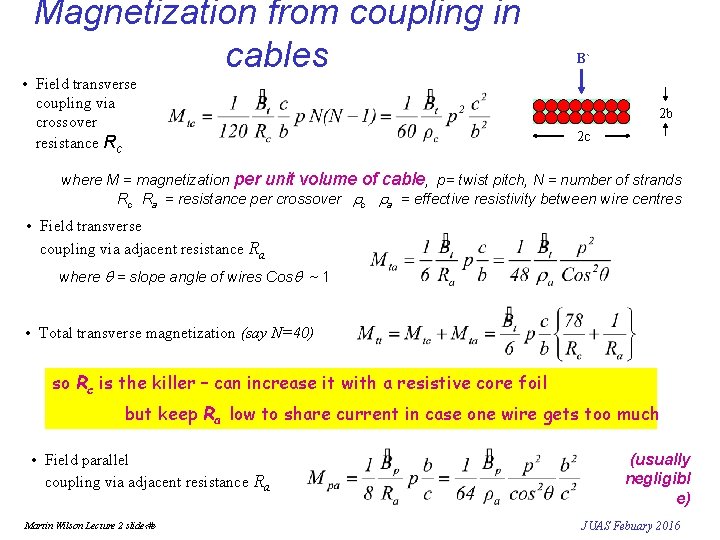
Magnetization from coupling in cables • Field transverse coupling via crossover resistance Rc B` 2 b 2 c where M = magnetization per unit volume of cable, p= twist pitch, N = number of strands Rc Ra = resistance per crossover rc ra = effective resistivity between wire centres • Field transverse coupling via adjacent resistance Ra where q = slope angle of wires Cosq ~ 1 • Total transverse magnetization (say N=40) so Rc is the killer – can increase it with a resistive core foil but keep Ra low to share current in case one wire gets too much • Field parallel coupling via adjacent resistance Ra Martin Wilson Lecture 2 slide‹#› (usually negligibl e) JUAS Febuary 2016
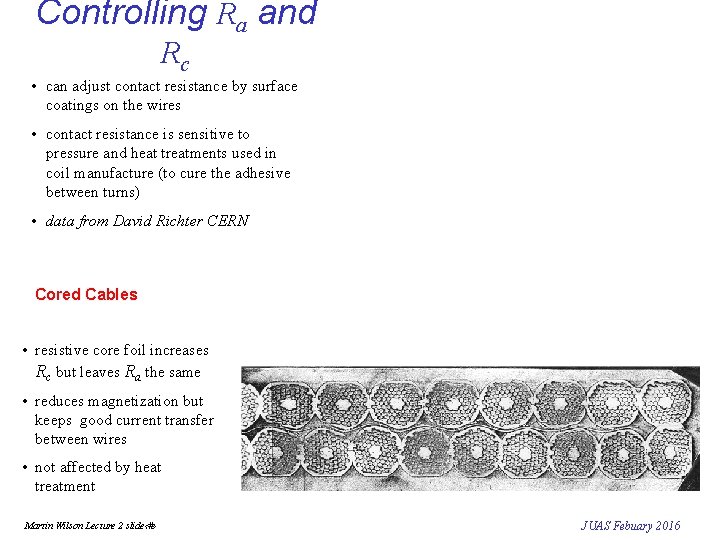
Controlling Ra and Rc • can adjust contact resistance by surface coatings on the wires • contact resistance is sensitive to pressure and heat treatments used in coil manufacture (to cure the adhesive between turns) • data from David Richter CERN Cored Cables • resistive core foil increases Rc but leaves Ra the same • reduces magnetization but keeps good current transfer between wires • not affected by heat treatment Martin Wilson Lecture 2 slide‹#› JUAS Febuary 2016
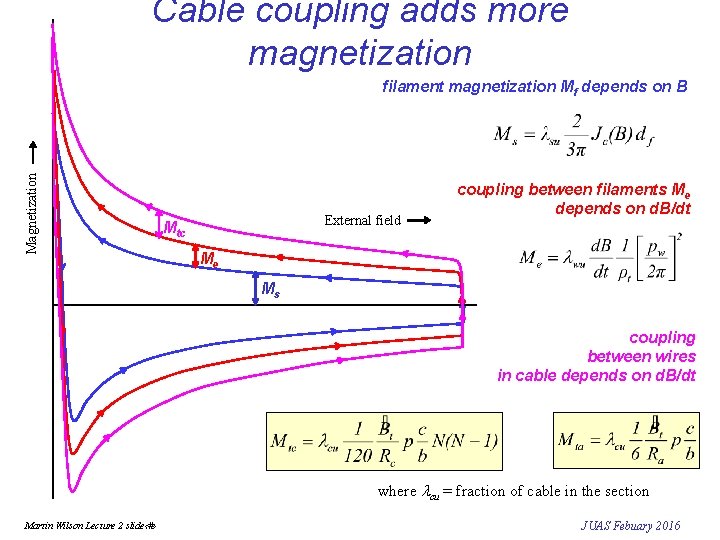
Cable coupling adds more magnetization Magnetization filament magnetization Mf depends on B External field Mtc coupling between filaments Me depends on d. B/dt Me Ms coupling between wires in cable depends on d. B/dt where lcu = fraction of cable in the section Martin Wilson Lecture 2 slide‹#› JUAS Febuary 2016
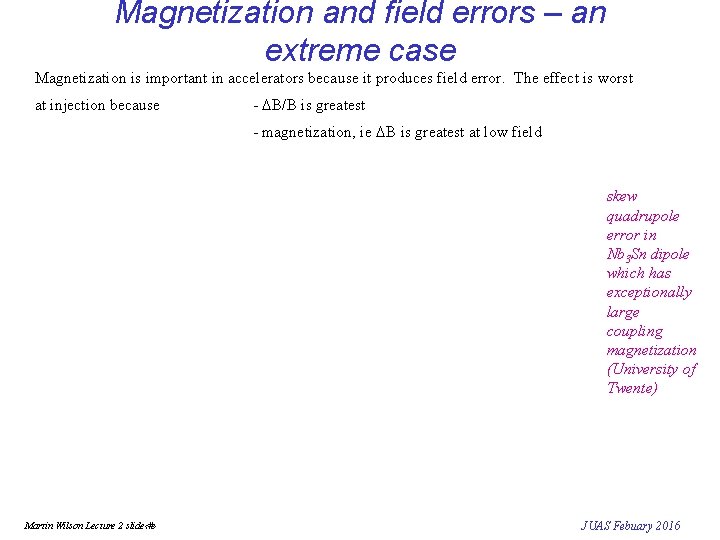
Magnetization and field errors – an extreme case Magnetization is important in accelerators because it produces field error. The effect is worst at injection because - DB/B is greatest - magnetization, ie DB is greatest at low field skew quadrupole error in Nb 3 Sn dipole which has exceptionally large coupling magnetization (University of Twente) Martin Wilson Lecture 2 slide‹#› JUAS Febuary 2016
Tutorial 1: Magnetization and field errors Question The cable used in dipole GSI 001 has the parameters listed below. For an injection field of either 0. 2 T or 1 T, calculate the magnetization averaged over the winding volume coming from the screening currents flowing within the filaments In order to assess whether this will give significant field errors, express these magnetizations as a fraction of each of the two possible dipole aperture fields. Data The average field over the winding is about 60% of the aperture field Jc(0. 12 T) = 3 × 10⁴ Amm-2 Jc(0. 6 T) = 1. 3 × 10⁴ Amm-2 filament diameter df = 6 mm filling factor of superconductor in unit cell lsu = 22%, Martin Wilson Lecture 2 slide‹#› JUAS Febuary 2016
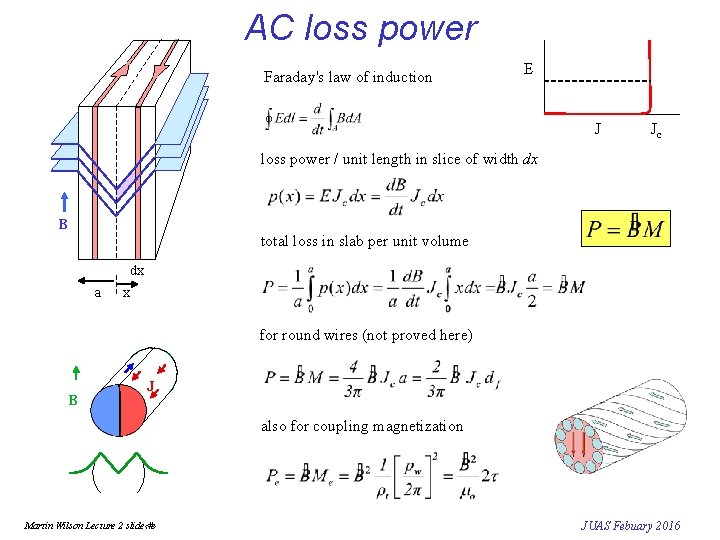
AC loss power Faraday's law of induction E J Jc loss power / unit length in slice of width dx B total loss in slab per unit volume dx a x for round wires (not proved here) B J also for coupling magnetization Martin Wilson Lecture 2 slide‹#› JUAS Febuary 2016
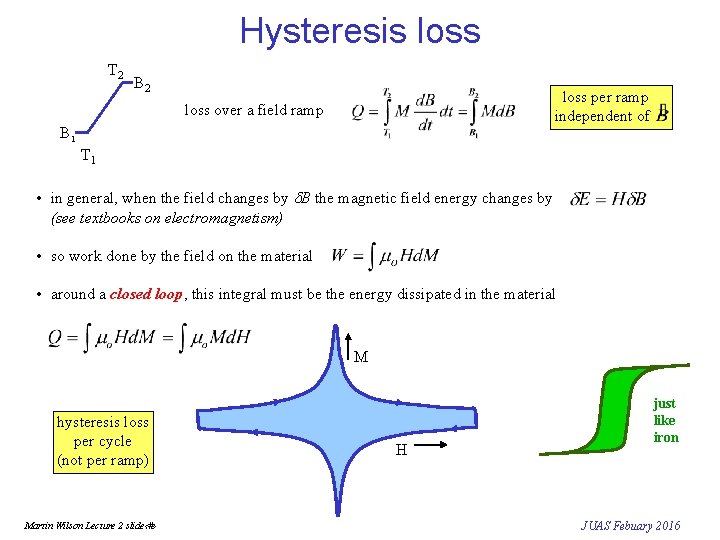
Hysteresis loss T 2 B 2 loss per ramp independent of loss over a field ramp B 1 T 1 • in general, when the field changes by d. B the magnetic field energy changes by (see textbooks on electromagnetism) • so work done by the field on the material • around a closed loop, this integral must be the energy dissipated in the material M hysteresis loss per cycle (not per ramp) Martin Wilson Lecture 2 slide‹#› H just like iron JUAS Febuary 2016
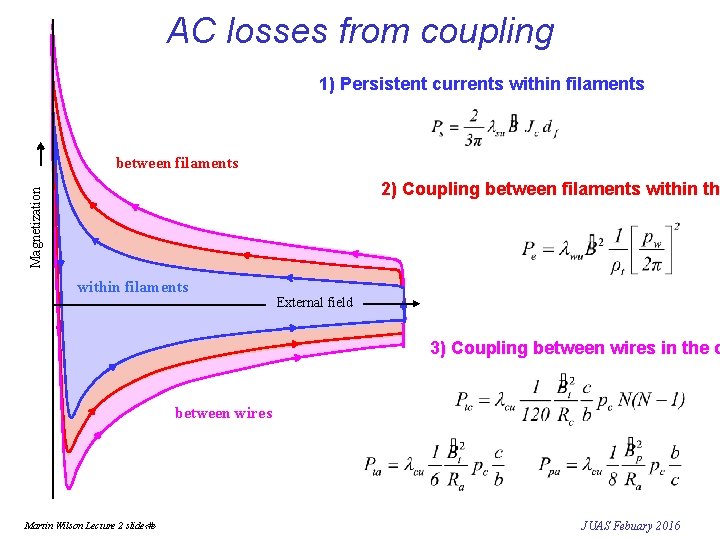
AC losses from coupling 1) Persistent currents within filaments between filaments Magnetization 2) Coupling between filaments within the within filaments External field 3) Coupling between wires in the c between wires Martin Wilson Lecture 2 slide‹#› JUAS Febuary 2016
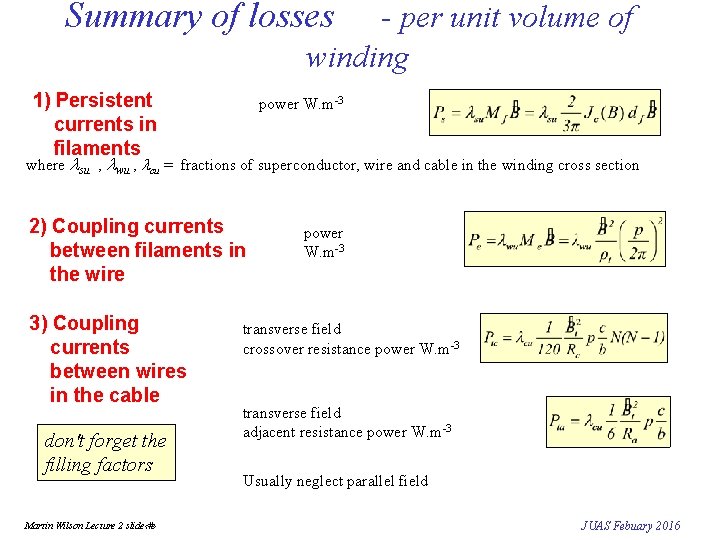
Summary of losses - per unit volume of winding 1) Persistent currents in filaments where lsu , lwu , lcu = power W. m-3 fractions of superconductor, wire and cable in the winding cross section 2) Coupling currents between filaments in the wire 3) Coupling currents between wires in the cable don't forget the filling factors Martin Wilson Lecture 2 slide‹#› power W. m-3 transverse field crossover resistance power W. m-3 transverse field adjacent resistance power W. m-3 Usually neglect parallel field JUAS Febuary 2016
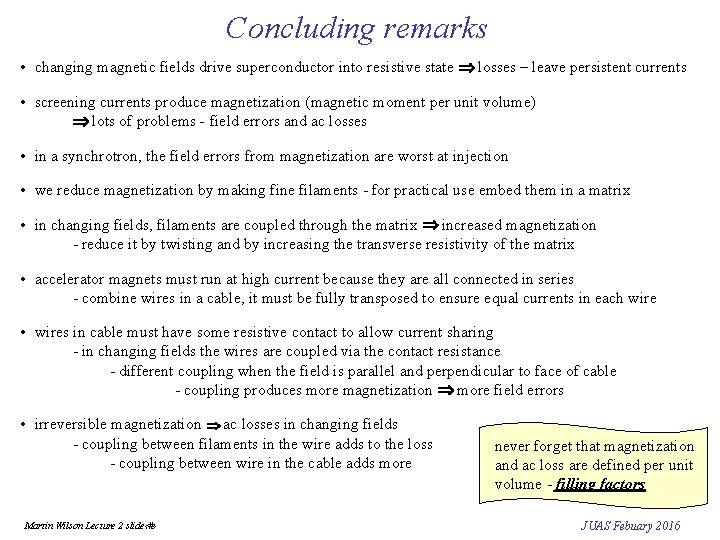
Concluding remarks • changing magnetic fields drive superconductor into resistive state losses – leave persistent currents • screening currents produce magnetization (magnetic moment per unit volume) lots of problems - field errors and ac losses • in a synchrotron, the field errors from magnetization are worst at injection • we reduce magnetization by making fine filaments - for practical use embed them in a matrix • in changing fields, filaments are coupled through the matrix increased magnetization - reduce it by twisting and by increasing the transverse resistivity of the matrix • accelerator magnets must run at high current because they are all connected in series - combine wires in a cable, it must be fully transposed to ensure equal currents in each wire • wires in cable must have some resistive contact to allow current sharing - in changing fields the wires are coupled via the contact resistance - different coupling when the field is parallel and perpendicular to face of cable - coupling produces more magnetization more field errors • irreversible magnetization ac losses in changing fields - coupling between filaments in the wire adds to the loss - coupling between wire in the cable adds more Martin Wilson Lecture 2 slide‹#› never forget that magnetization and ac loss are defined per unit volume - filling factors JUAS Febuary 2016
- Slides: 29