
Lecture 2 Lecture topics HRM Training and Development
- Slides: 13
Lecture 2 Lecture topics : HRM Training and Development
Concept of T & D • Training and Development is an integral part of staffing function. After completing the employee socialization process Training and development of employees should be completed. • Training: Training program is for non executive employees i. e. workers. It is performance oriented, not knowledge oriented. • Management Development: Management development program is for executives i. e. managers. It is knowledge oriented program.
Symptoms Determine training needs 1. Inadequate/poor performance: If employees are responsible for poor performance then they need training. But if equipment are responsible for poor performance then training of employees are meaningless. 2. Decrease in productivity: If employees are responsible for decrease in productivity then they need training.
Symptoms Determine training needs 3. High accident rate: If employees are responsible for accident then it is certain that something going wrong with organization’s worker. So, they need training. 4. High turn over rate: If organization’s turn over rate is very high then employees need training program.
Symptoms Determine training needs 5. Poor commitment: If employees commitment level is poor then they need training. 6. Less motivation: If organization’s employees motivation level is very low then they need training program. 7. High job dissatisfaction: If employees are dissatisfied with their job then they need a training program for overcome that.
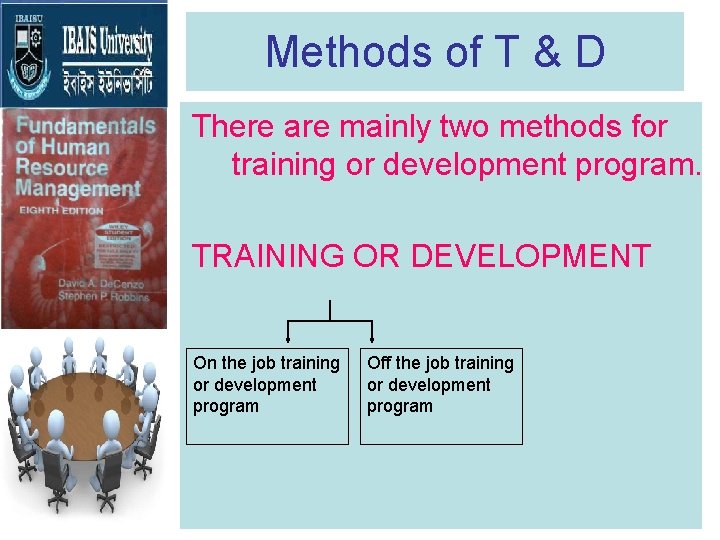
Methods of T & D There are mainly two methods for training or development program. TRAINING OR DEVELOPMENT On the job training or development program Off the job training or development program
On the job Training • No special arrangement is there • Trainee learns by doing job Ex : Jewelery workers 1. Apprenticeship training program Probationary period. Get consolidated amount. Does not enjoy full status of employee. 2. JIT (Job training Instruction)
Off the Job Training • Learners are set to in an artificial environment. – 1. Classroom lectures or conference : • There will be a single instructor and number of participants with the traditional lecture system. – 2. Film motion pictures : • This process is designed in such a way that actors are playing the roles of executives.
Off the Job Training – 3. Simulation exercise : • A. Case Exercise: – Intensive methods of training. Facts, past experiences are discussed with participants. – Makes learner more mature, more reasonable, more logical. • B. Experimental exercise: – Both the learners and instructors do not have any idea about problem. • C. Computer modeling: – Computer software is used a guide.
Management Development • On the job development: – A. Coaching – B. Under study assignment – C. Job Rotation • Off the job development: – 1. Sensitivity training: • To modify behavior pattern of managers is the purpose of ST. – 2. Personality training: • Objective is change prospective managers personality.
Off the job Dev. . – Personality consists of » A. The parent: It creates superiority within individuals. Experienced and dominating character. » B. The child: Suffer in childish behavior, quickly convinced » C. The adults: Think, behave, act reasonably. – 3. Lecture courses: • Conceptual and analytical skills are to be developed by giving lecture. – 4. Simulation Exercise: • A. Case study: – Discuss a problem that organization experienced.
Off the job Dev. . • B. Decision game: – It is the development methods of executives by different software program which developed for particular problem. • C. Role play: – An artificial environment is created and participants of the program are asked to play an particular role/position.