
Lecture 2 IFP Introduction Unit I Grading Structure

- Slides: 25
Lecture 2 IFP Introduction, Unit I
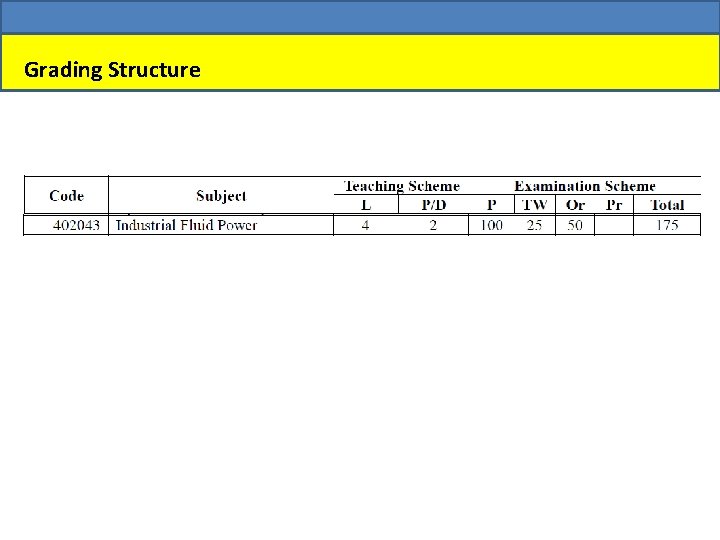
Grading Structure
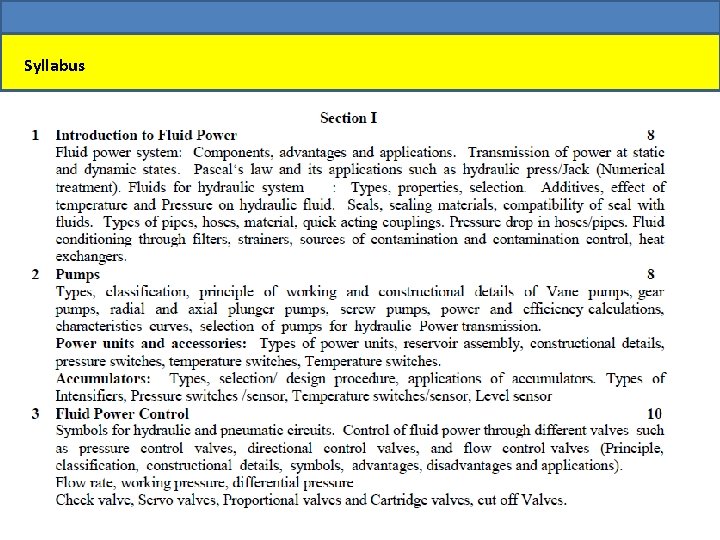
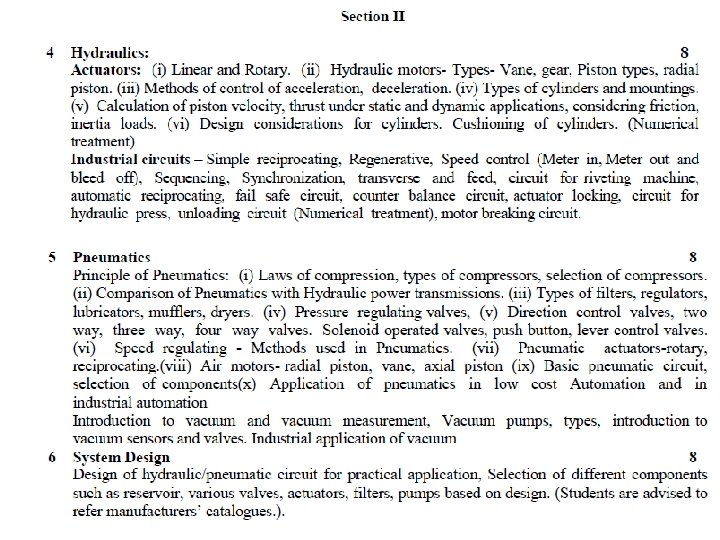
Syllabus
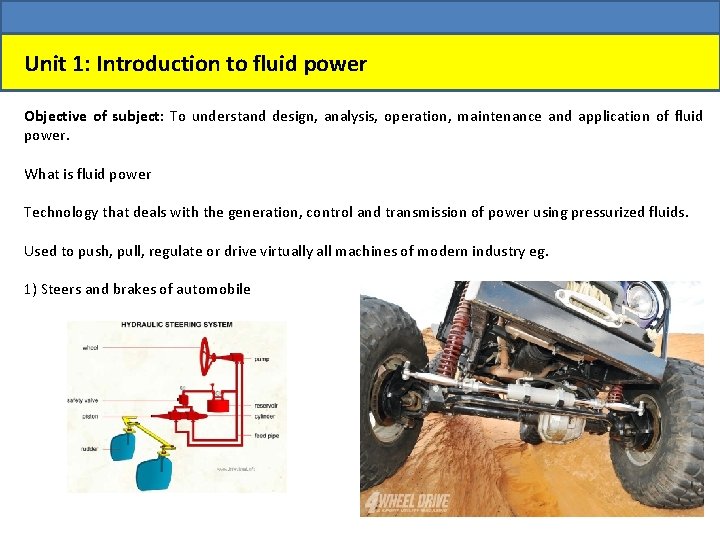
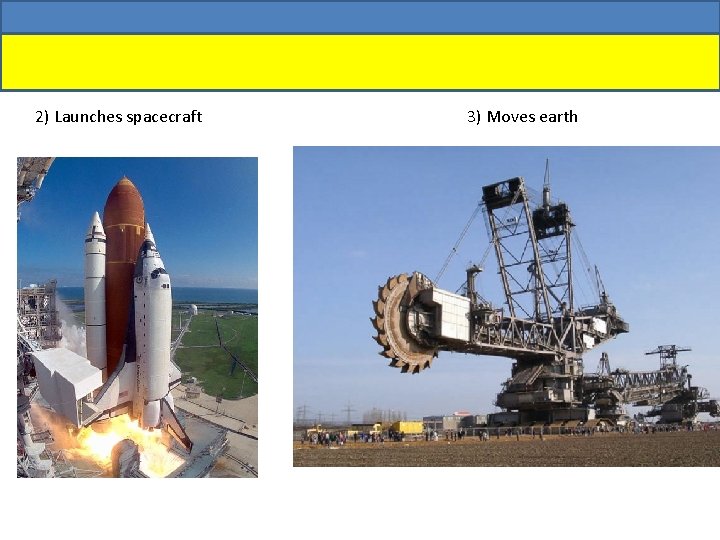
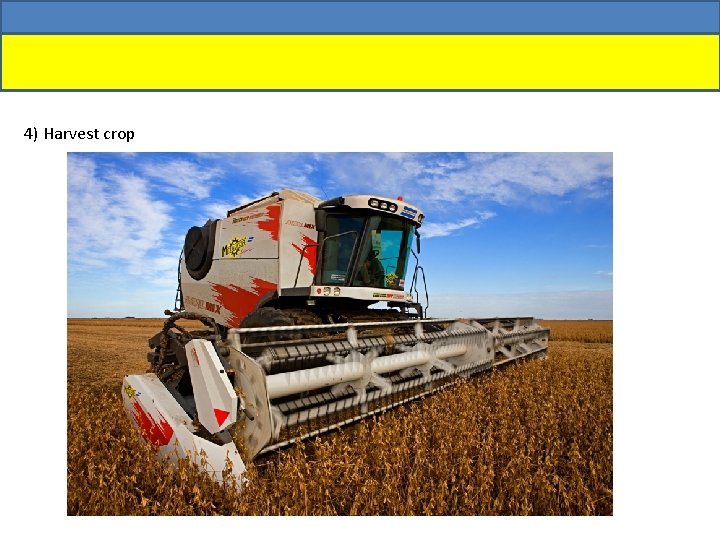
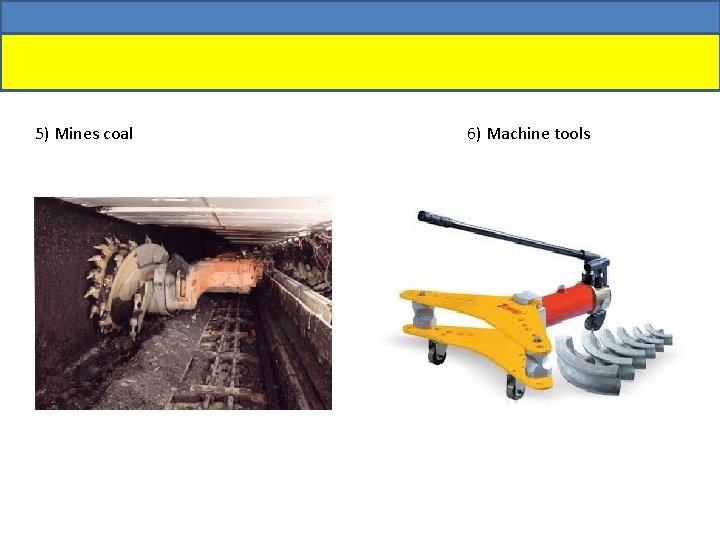
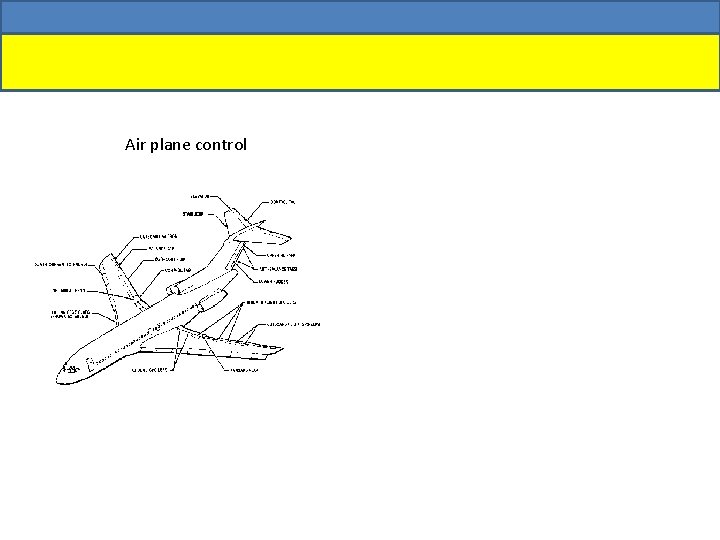
Unit 1: Introduction to fluid power Objective of subject: To understand design, analysis, operation, maintenance and application of fluid power. What is fluid power Technology that deals with the generation, control and transmission of power using pressurized fluids. Used to push, pull, regulate or drive virtually all machines of modern industry eg. 1) Steers and brakes of automobile
2) Launches spacecraft 3) Moves earth
4) Harvest crop
5) Mines coal 6) Machine tools
Air plane control
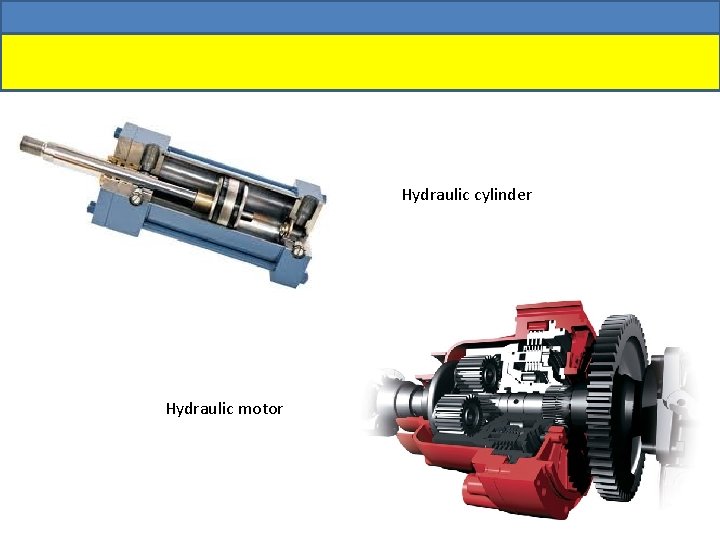
Fluid power is called hydraulics when fluid is liquid and is called pneumatics when the fluid is gas. Hydraulic systems use liquids such as petroleum oil, synthetic oil and water. The first hydraulic fluid used was water, it has many deficiencies such as freezes readily, poor lubricant and tends to rust metal components. There are two different types of fluid systems i. e. fluid transport and fluid power Fluid transport: used to transport fluid from one location to another. E. g. pumping stations, cross country gas lines, chemical processing etc. Fluid power: it is designed specifically to perform work, accomplished by pressurized fluid bearing directly on an operating fluid cylinder or fluid motor. Fluid cylinder produces force in linear direction while fluid motor produces torque in rotary motion. Both cylinders and motors are called as actuators.
Hydraulic cylinder Hydraulic motor
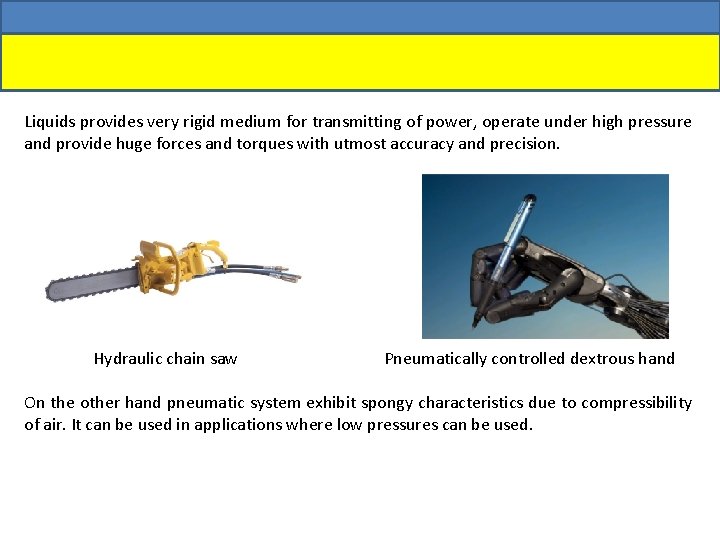
Liquids provides very rigid medium for transmitting of power, operate under high pressure and provide huge forces and torques with utmost accuracy and precision. Hydraulic chain saw Pneumatically controlled dextrous hand On the other hand pneumatic system exhibit spongy characteristics due to compressibility of air. It can be used in applications where low pressures can be used.
Advantages of fluid power Power can be transmitted by three basic methods i. e. electrical, mechanical and fluid power. Most applications use combination of three methods to obtain efficienct overall system. Fluid power can transmit power economically over greater distances than mechanical types but restricted to shorter distances than electrical systems. Fluid power is versatile and manageable, it is not hindered by the geometry of machine as in case of mechanical system. Advantages: 1) Ease and accuracy of control: By the use of simple levers and push buttons, operator can start, stop, speed up and slow down and position forces with very close tolerances. 2) Multiplication of force: A fluid power system (without using cumbersome gears, pulleys and levers) can multiply forces from fraction of Newton to tons of output. 3) Constant force or torque: Only fluid power systems are capable of providing constant force or torque regardless of speed changes. 4) Simplicity, safety and economy: Use fewer moving parts, simpler to maintain and operate, therefore more safe, compact and reliable
Drawbacks of fluid power Hydraulic oils are messy, leakage is impossible to eliminate completely Hydraulic lines can burst resulting in injuries to people due to high speed oil jets and flying pieces of metal if proper design is not implemented. Prolong exposure to loud noise, such as that produced by pumps can result in loss of hearing. Hydraulic oil can cause fire if leaks.
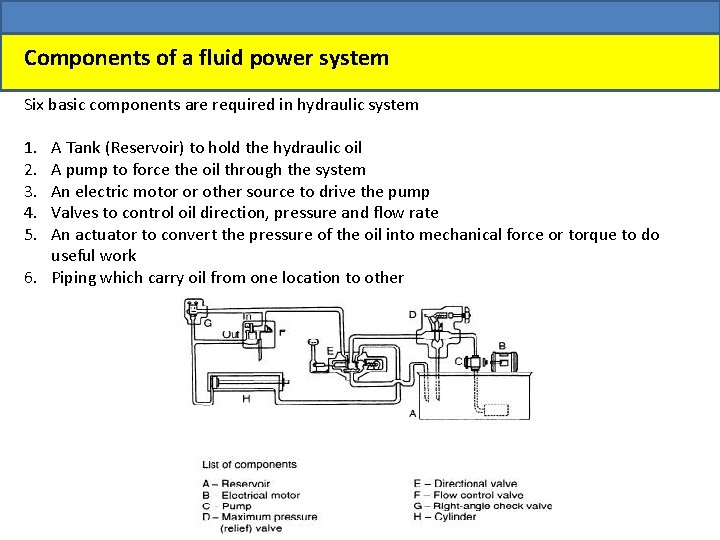
Components of a fluid power system Six basic components are required in hydraulic system 1. 2. 3. 4. 5. A Tank (Reservoir) to hold the hydraulic oil A pump to force the oil through the system An electric motor or other source to drive the pump Valves to control oil direction, pressure and flow rate An actuator to convert the pressure of the oil into mechanical force or torque to do useful work 6. Piping which carry oil from one location to other
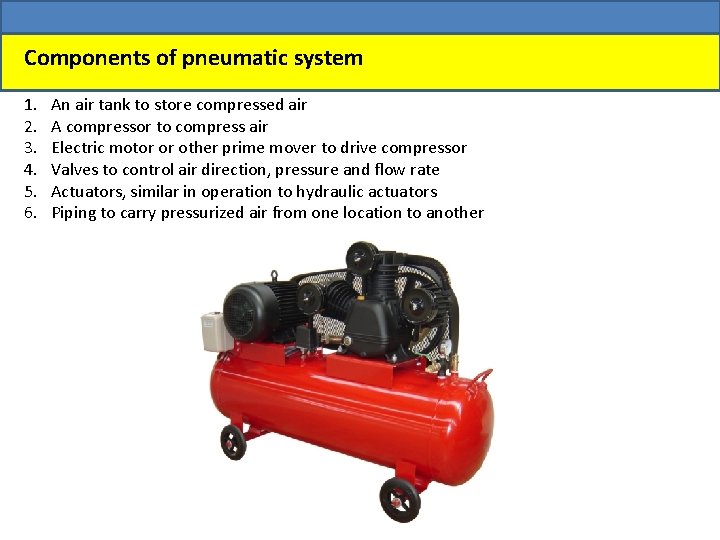
Components of pneumatic system 1. 2. 3. 4. 5. 6. An air tank to store compressed air A compressor to compress air Electric motor or other prime mover to drive compressor Valves to control air direction, pressure and flow rate Actuators, similar in operation to hydraulic actuators Piping to carry pressurized air from one location to another
Hydraulic fluid characteristic have crucial effect on equipment performance and life. Clean, high quality fluid achieve efficient hydraulic system operation. Modern hydraulic system contain fluid with special additives to provide desired characteristics Hydraulic fluid has the following four primary functions 1. Transmit power 2. Lubricate moving parts 3. Seal clearances between mating parts 4. Dissipate heat
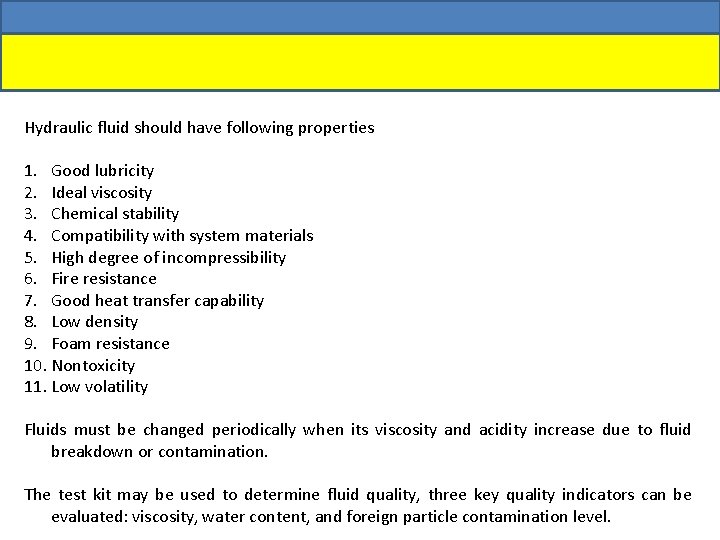
Hydraulic fluid should have following properties 1. Good lubricity 2. Ideal viscosity 3. Chemical stability 4. Compatibility with system materials 5. High degree of incompressibility 6. Fire resistance 7. Good heat transfer capability 8. Low density 9. Foam resistance 10. Nontoxicity 11. Low volatility Fluids must be changed periodically when its viscosity and acidity increase due to fluid breakdown or contamination. The test kit may be used to determine fluid quality, three key quality indicators can be evaluated: viscosity, water content, and foreign particle contamination level.
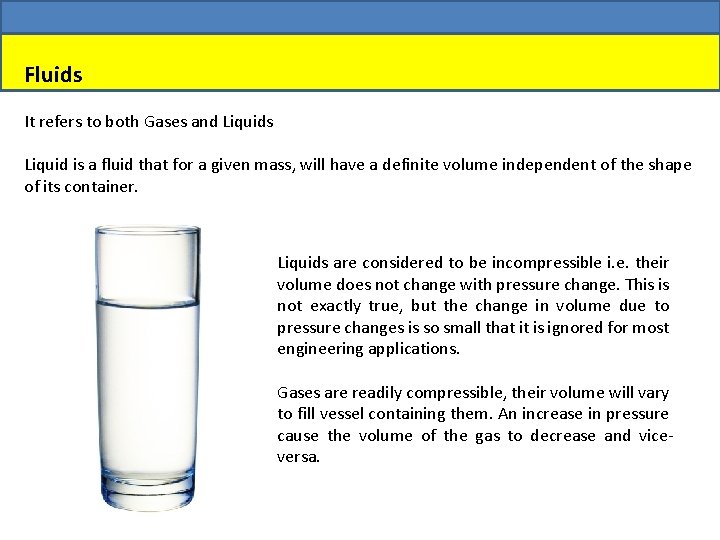
Fluids It refers to both Gases and Liquids Liquid is a fluid that for a given mass, will have a definite volume independent of the shape of its container. Liquids are considered to be incompressible i. e. their volume does not change with pressure change. This is not exactly true, but the change in volume due to pressure changes is so small that it is ignored for most engineering applications. Gases are readily compressible, their volume will vary to fill vessel containing them. An increase in pressure cause the volume of the gas to decrease and viceversa.
Properties of fluids are density, pressure, compressibility, viscosity and viscosity index. 1. Specific weight, density and specific gravity Weight: All objects solids or fluids are pulled towards the center of the earth by the force of attraction. This force is called as weight and is proportional to the object mass, and defined by F = W = mg Specific weight: It is the ratio of weight of fluid to its volume, denoted by symbol ϒ. Density: it is defined as mass per unit volume. denoted by symbol ρ.
2. Force, Pressure and Head Pressure is defined as force per unit area, i. e. amount of force acting over unit area P = F/A Head: 1 meter height of water is commonly called a pressure head
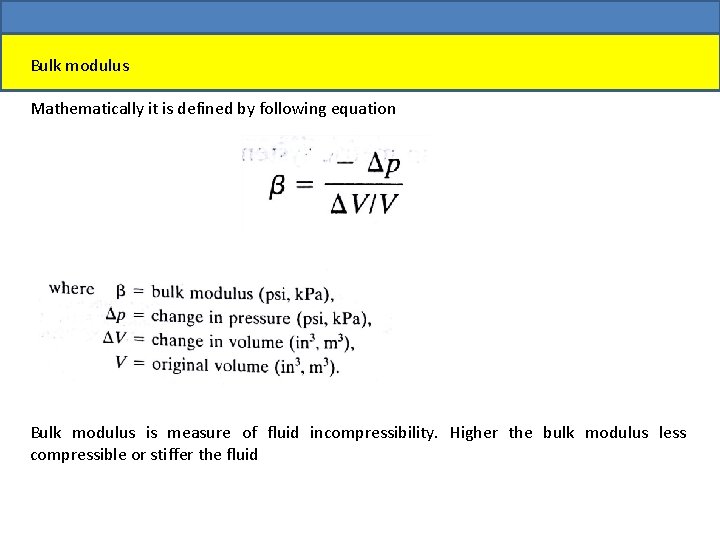
Bulk modulus Mathematically it is defined by following equation Bulk modulus is measure of fluid incompressibility. Higher the bulk modulus less compressible or stiffer the fluid
Viscosity It is single most important property of hydraulic fluid. It is measure of fluid resistance to flow, when fluid viscosity is low, the fluid flows easily and is thin in appearance. Ideal viscosity for a given hydraulic system is a compromise. Too high viscosity results in 1. 2. 3. 4. High resistance to flow, sluggish operation Increased power consumption due to frictional losses Increased pressure drop through valves and lines High temperatures caused by friction Too low viscosity results in 1. Increased oil leakage past seals 2. Excessive wear due to breakdown of the oil film between mating moving parts
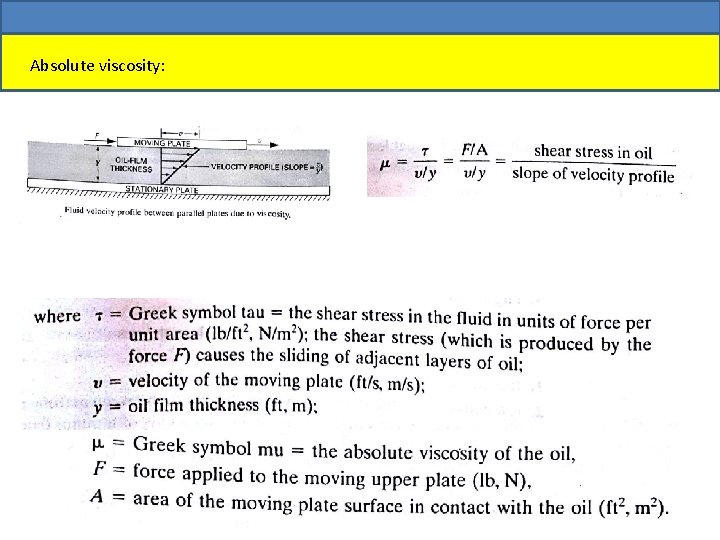
Absolute viscosity:
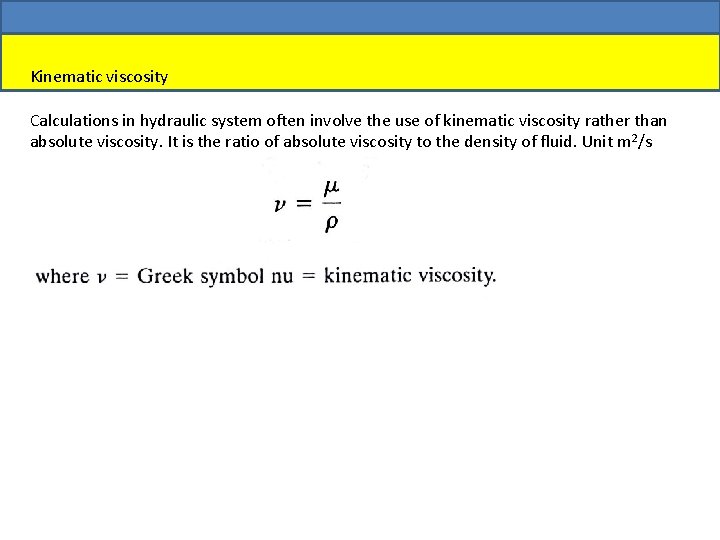
Kinematic viscosity Calculations in hydraulic system often involve the use of kinematic viscosity rather than absolute viscosity. It is the ratio of absolute viscosity to the density of fluid. Unit m 2/s