
LECTURE 2 GERMANIC LANGUAGES 1 2 Ancient Germanic





- Slides: 33
LECTURE 2 GERMANIC LANGUAGES 1. 2. Ancient Germanic tribes and classification of their languages Chief characteristics of the Germanic languages
� � � "Primitive Germanic" "Proto Germanic" split from the other IE languages between the 15 th and the 10 th c. BC North Germanic West Germanic East Germanic
from southern Scandinavia and all along North Sea and Baltic coasts � from the Meuse river in the west to the Vistula in the east around 750 BC. � The southward movement ca 600 BC – ca 300 BC �
� the writings of Caesar, Tacitus, etc. Groups of Germanic-speaking peoples: � The Oder and Vistula (the Vindili) � the lower Rhine (Istvaeones) � the river Elbe (Irminones or Hermiones);
Jutland the Danish islands (Ingvaeones); � the territory of Dacia, close to modern Rumania (the Peucini and Bastarnae); � Scandinavia (the Hilleviones). �
19 th century classification � � � East Germanic (Vindili: the Goths, Vandals, Burgundians) West Germanic (Ingvaeones: the Saxons, Angles, Jutes, Frisians; Istvaeones: the Franks; Hermiones: the Bavarians, Thuringians) North Germanic (the Hilleviones)
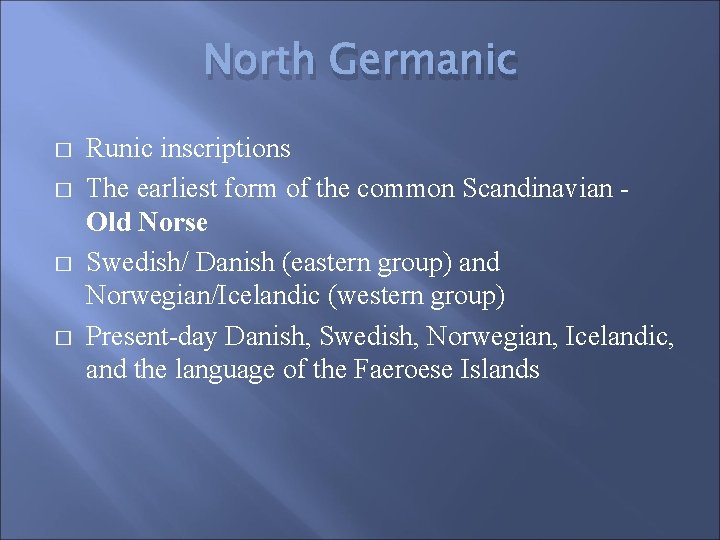
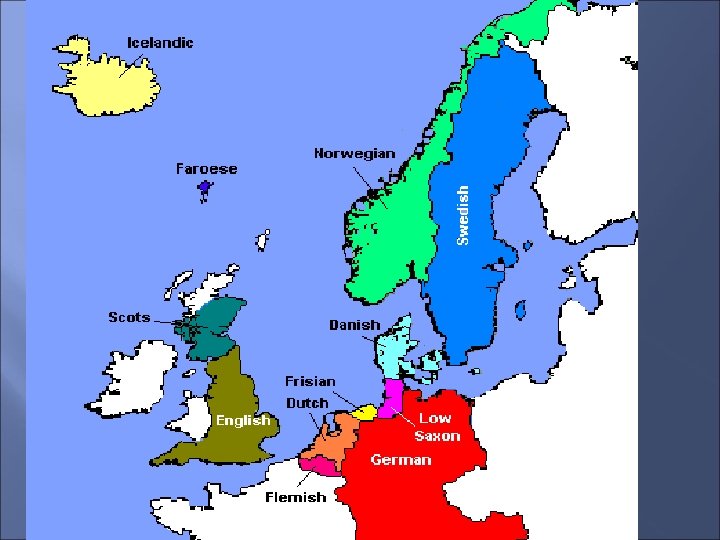
North Germanic � � Runic inscriptions The earliest form of the common Scandinavian Old Norse Swedish/ Danish (eastern group) and Norwegian/Icelandic (western group) Present day Danish, Swedish, Norwegian, Icelandic, and the language of the Faeroese Islands
West Germanic High German: Modern High German and Yiddish) � Low German: Modern Low German, Afrikaans, Dutch, Flemish, Frisian, and English �
2. Peculiarities of Germanic languages 1. 2. 3. � � Germanic has a number of unique words Restructuring of the accent system Simplification of the verbal system: categories of tense and aspect Present and Preterite (Past)
4. Ablaut (Gradation): the vowel interchange in the root of nouns and verbs eg. : везу/ воз, гремит/ гром � ablaut in strong verbs
(1) The Infinitive � (2) The Past Singular � (3) The Past Plural � (4) The Second Participle �
Class Infinitive Past singular Past Second Plural Participle I reisan rais risum risans II kiusan kaus kusum kusans
� The gradation series are: � Class I: i: – ai – i � Class II: iu – au – u
5. Germanic developed a preterite tense (also called weak) � dental suffix -d or -t 6. The Noun in Germanic the root + a stem building suffix + a grammatical inflection
(1) Vocalic stems: -a-, - ō-, -i-, -ustems. (2) N-stems. � (3) Stems in other consonants: -s- and –r - stems. � (4) Root stems. �
Gothic dative plural nouns: � dagam (to days) belong to the –a stem, � gibōm (to gifts) belong to the – ō stem, � sunum (to sons) u stem. �
7. Germanic developed weak and strong adjectives � Lat. : bonus hortus � Old English: ӡeonӡan ceorlas 'the young fellows' ӡeonӡe ceorlas 'young fellows. '
� Some Indo European vowels changed in Germanic languages
INDO-EUROPEAN VOWEL ANCIENT GERMANIC VOWEL o a ночь (Russian) Nahts (Gothic) ā ō mater (Latin) mōdor (Old English)
9. A consonant shift (change of sounds) occurred in Germanic. Jacob Grimm (“Grimm’s law”)
IE aspirated voiced stops lost aspiration in Germanic bh b bhratar (Sanscrit) broþor (Gothic) gh g dh d
IE voiced stops became voiceless in Germanic b p болото (Russian) pool (English) d t duo (Latin) twai (Gothic) g k genu (Latin) knee (Old English)
IE voiceless stops became fricatives in Germanic p f пламя (Russian) flame (Old English) t þ tres (Latin) þreis (Gothic) k h кров (Russian) hrov (Old English)
Grimm’s Law 1. 2. 3. Indo European bh, dh, gh b, d, g p, t, k → → → Germanic b, d, g, p, t, k f, ѳ, h
Explanations: � Latin octo (eight) Gothic ahtau � IE voiceless stop ‘k’ became fricative ‘h’ in Germanic. �
Verner’s law � � � For example: Latin pater, Greek patēr, Sanscrit pitat Gothic fadar Old English fæder
Voicing of voiceless fricatives occurred if they were non word initial and if the vowel preceding them carried no stress in PIE � patér – early PGmc faθár – fáðar – Gothic fádar �
� If an IE voiceless stop was preceded by an unstressed vowel, the voiceless fricative which developed from it in accordance with Grimm’s law became voiced, and later this voiced fricative became a voiced stop.
Rhotacism � s-z–r Goth hausjan – OE hieran Goth maiza – OE māra
� � PGmc had a synthetic type of form building Synthetic languages : content root morpheme with one or more affixes Inflections, sound interchange, suppletion Synthetic vs. analytic
1. 2. 3. 4. 5. 6. What is the name of the parent language of the Germanic peoples. What are the branches of the Germanic group of languages? When did the Germanic language become separated from other IE languages? Which is the only East Germanic language that we have written records of? What is the other name of for the Past Tense? The earliest from of North Germanic is…?
1. 2. 3. 4. 5. 6. List the living languages that belong to the North Germanic branch. List the living languages that belong to the West Germanic branch. How is the Gmc word accent different from that if the IE ? How was the IE verb system simplified in Germanic? What is Ablaut? Where can it best be seen in Germanic? What is the way of forming weak verbs in Germanic?