
Lecture 2 Functions of ANS Autonomic Nervous System
- Slides: 26
Lecture 2 Functions of ANS
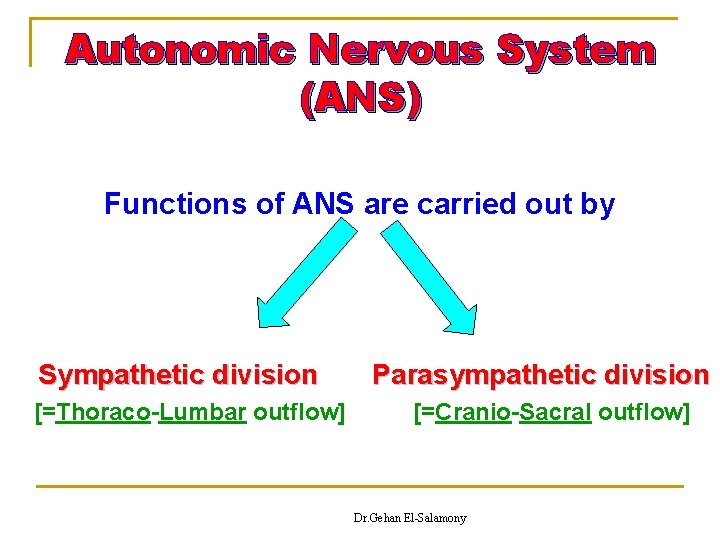
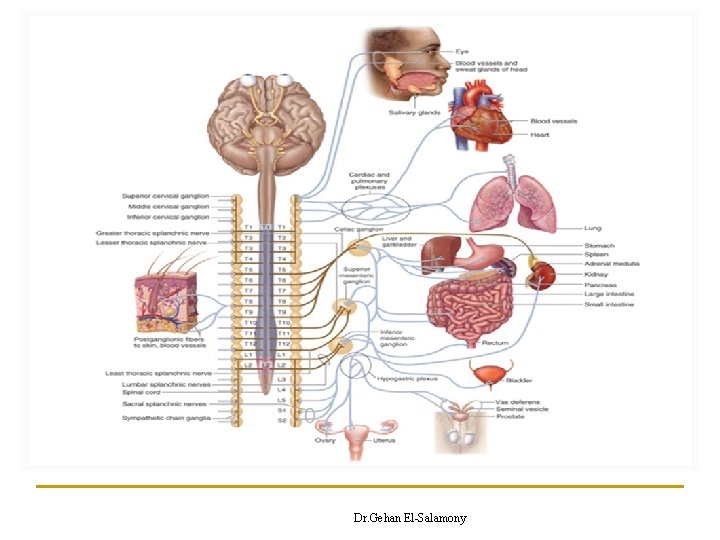
Autonomic Nervous System (ANS) Functions of ANS are carried out by Sympathetic division [=Thoraco-Lumbar outflow] Parasympathetic division [=Cranio-Sacral outflow] Dr. Gehan El-Salamony
Both divisions of ANS antagonize each other in most of the body organs. (one speeds up an organ, while the other slows down the same organ) e. g. sympathetic NS increases heart rate while parasympathetic NS decreases heart rate. n At rest, the body is regulated by the parasympathetic NS. n In stress conditions, the sympathetic NS dominates. n Dr. Gehan El-Salamony
Sympathetic NS Ø Sympathetic division of the ANS prepares the body to deal with stress Ø It is called the fight and flight division Dr. Gehan El-Salamony
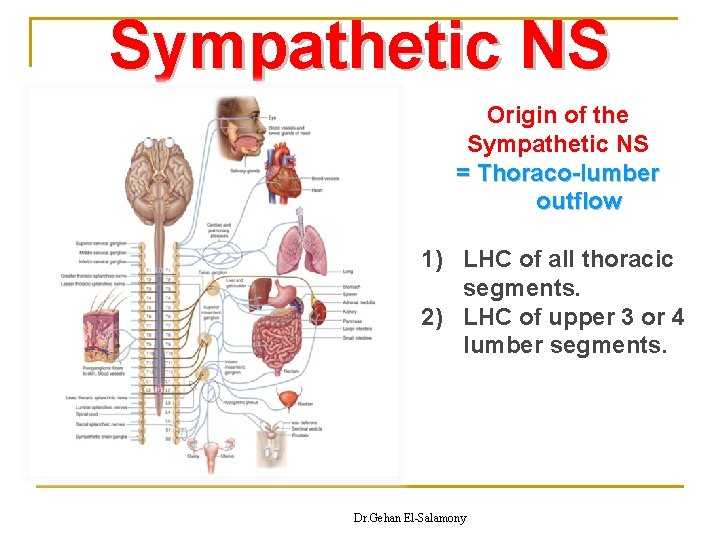
Sympathetic NS Origin of the Sympathetic NS = Thoraco-lumber outflow 1) LHC of all thoracic segments. 2) LHC of upper 3 or 4 lumber segments. Dr. Gehan El-Salamony
Parasympathetic Ø Parasympathetic. NS NS allows the body to recover from stress Ø It is called the rest and sleep division of the ANS Dr. Gehan El-Salamony
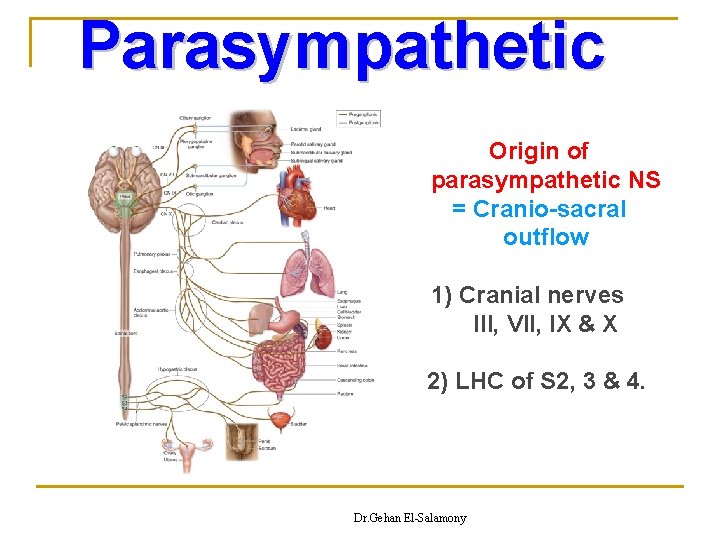
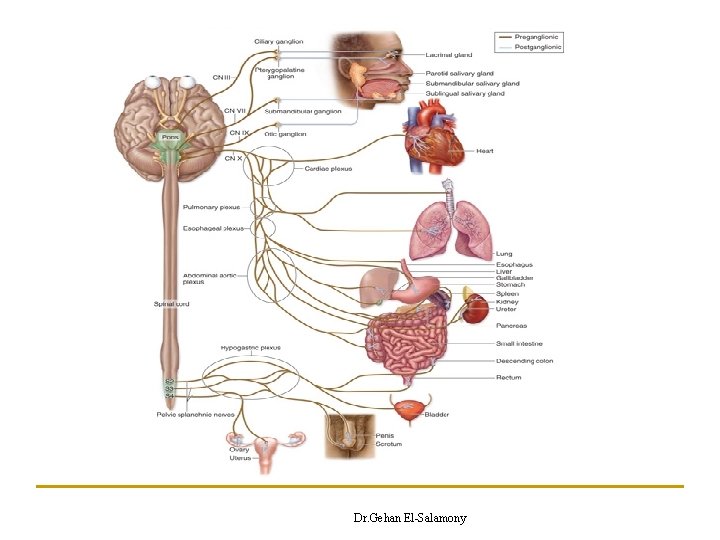
Parasympathetic NS Origin of parasympathetic NS = Cranio-sacral outflow 1) Cranial nerves III, VII, IX & X 2) LHC of S 2, 3 & 4. Dr. Gehan El-Salamony
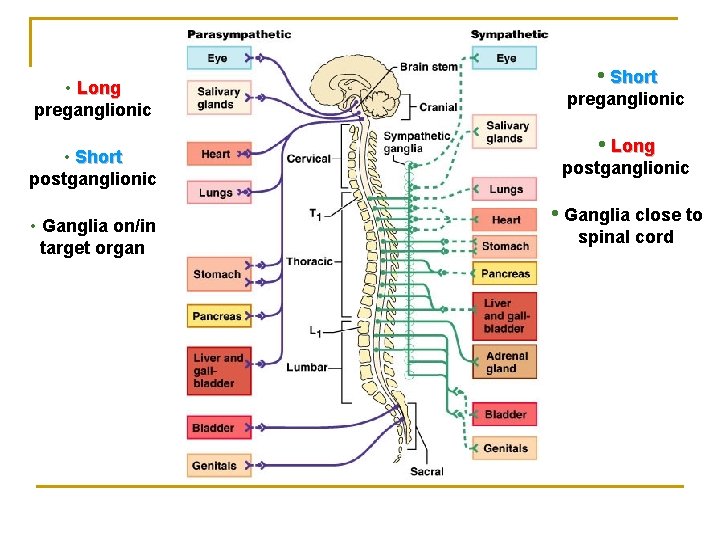
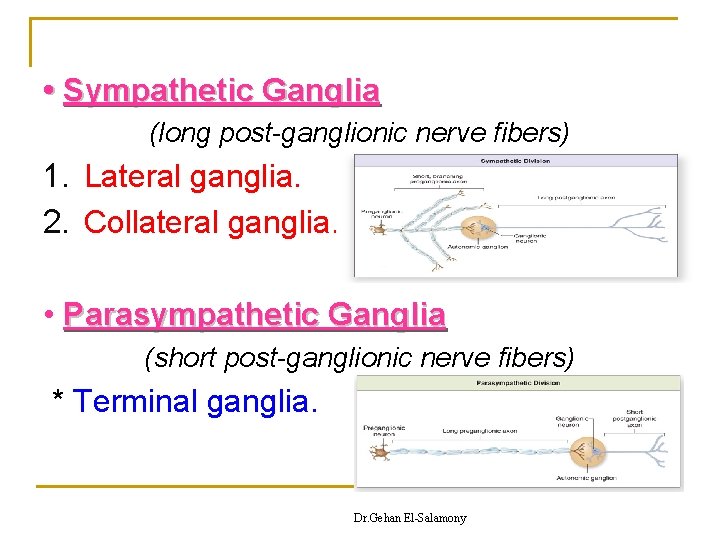
• Long preganglionic • Short postganglionic • Ganglia on/in target organ • Short preganglionic • Long postganglionic • Ganglia close to spinal cord
• Sympathetic Ganglia (long post-ganglionic nerve fibers) 1. Lateral ganglia. 2. Collateral ganglia. • Parasympathetic Ganglia (short post-ganglionic nerve fibers) * Terminal ganglia. Dr. Gehan El-Salamony
Dr. Gehan El-Salamony
Functions of Sympathetic & Parasympathetic Nervous System
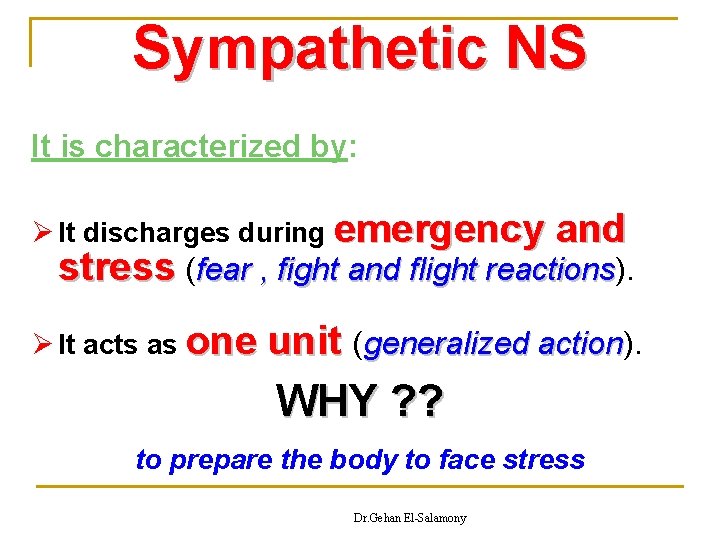
Sympathetic NS It is characterized by: Ø It discharges during emergency and stress (fear , fight and flight reactions). reactions Ø It acts as one unit (generalized action). action WHY ? ? to prepare the body to face stress Dr. Gehan El-Salamony
Sympathetic Nervous System prepares the body through the following effects :
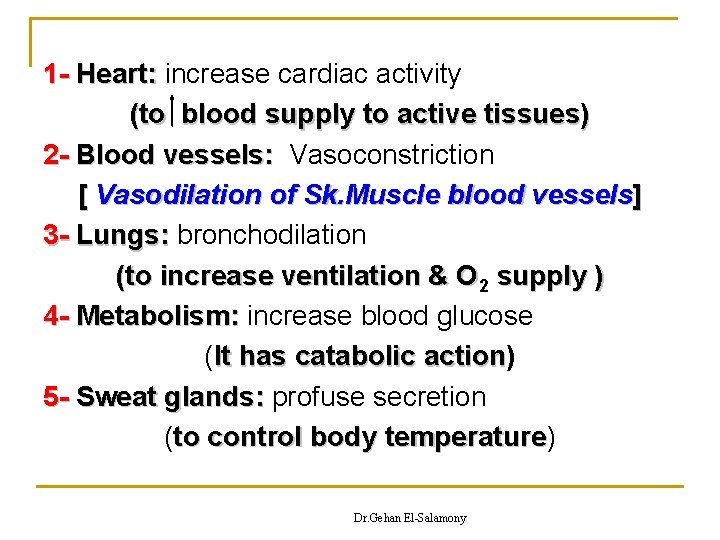
1 - Heart: increase cardiac activity (to blood supply to active tissues) 2 - Blood vessels: Vasoconstriction [ Vasodilation of Sk. Muscle blood vessels] 3 - Lungs: bronchodilation (to increase ventilation & O 2 supply ) 4 - Metabolism: increase blood glucose (It has catabolic action) action 5 - Sweat glands: profuse secretion (to control body temperature) temperature Dr. Gehan El-Salamony
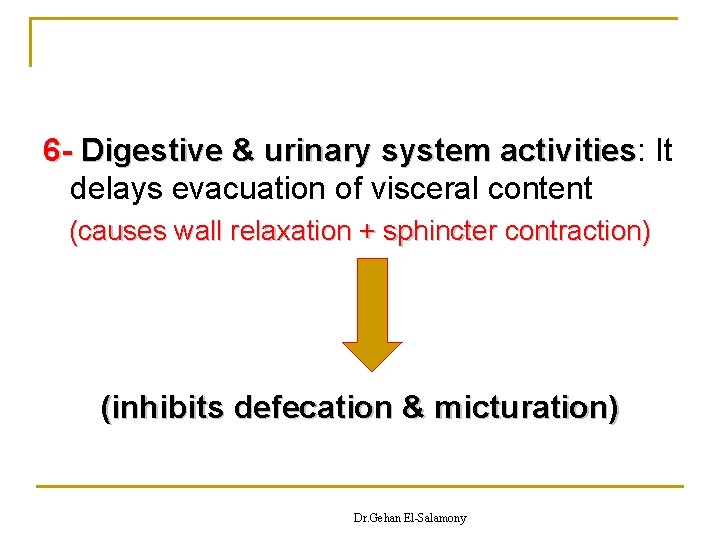
6 - Digestive & urinary system activities: activities It delays evacuation of visceral content (causes wall relaxation + sphincter contraction) (inhibits defecation & micturation) Dr. Gehan El-Salamony
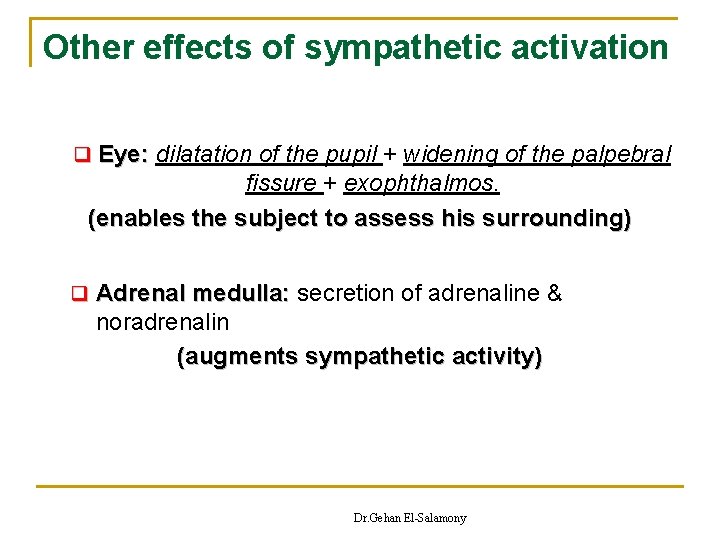
Other effects of sympathetic activation q Eye: dilatation of the pupil + widening of the palpebral fissure + exophthalmos. (enables the subject to assess his surrounding) q Adrenal medulla: secretion of adrenaline & noradrenalin (augments sympathetic activity) Dr. Gehan El-Salamony
Dr. Gehan El-Salamony
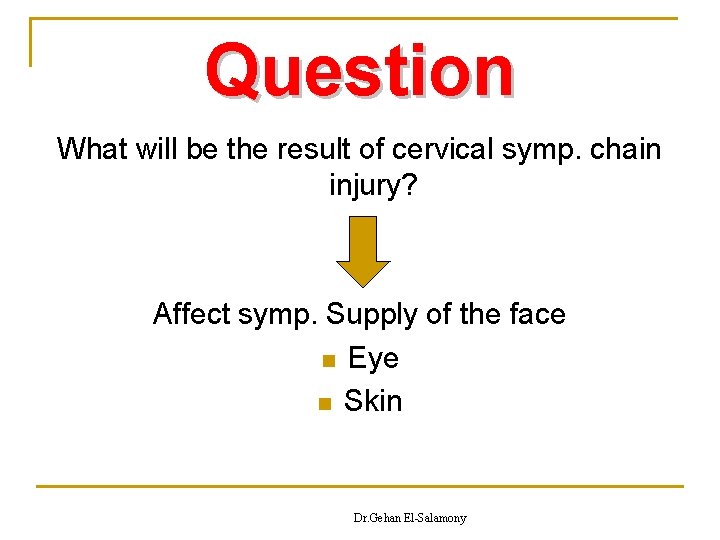
Question What will be the result of cervical symp. chain injury? Affect symp. Supply of the face n Eye n Skin Dr. Gehan El-Salamony
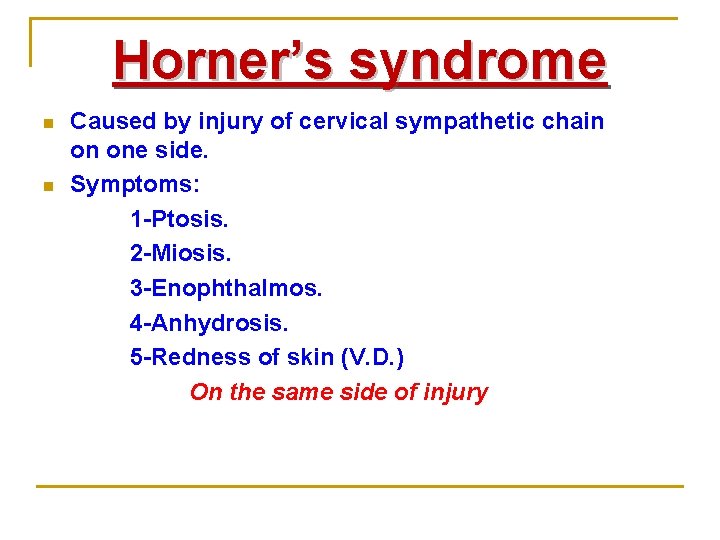
Horner’s syndrome n n Caused by injury of cervical sympathetic chain on one side. Symptoms: 1 -Ptosis. 2 -Miosis. 3 -Enophthalmos. 4 -Anhydrosis. 5 -Redness of skin (V. D. ) On the same side of injury
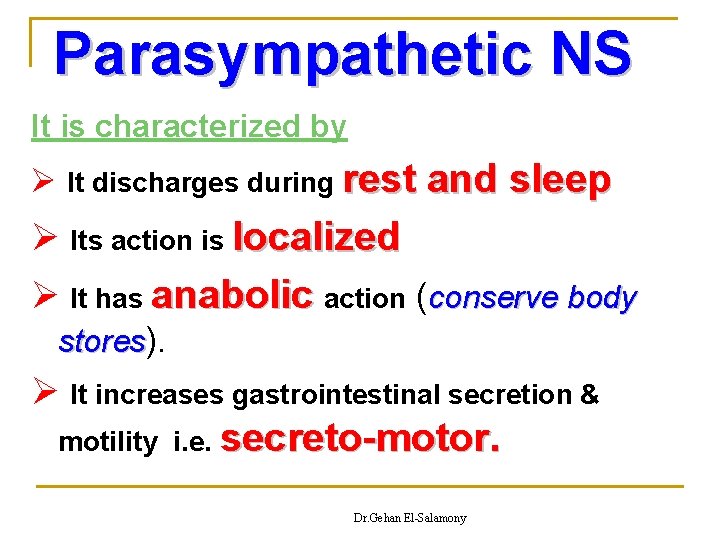
Parasympathetic NS It is characterized by Ø It discharges during rest and sleep Ø Its action is localized Ø It has anabolic action (conserve body stores). Ø It increases gastrointestinal secretion & motility i. e. secreto-motor. Dr. Gehan El-Salamony
Dr. Gehan El-Salamony
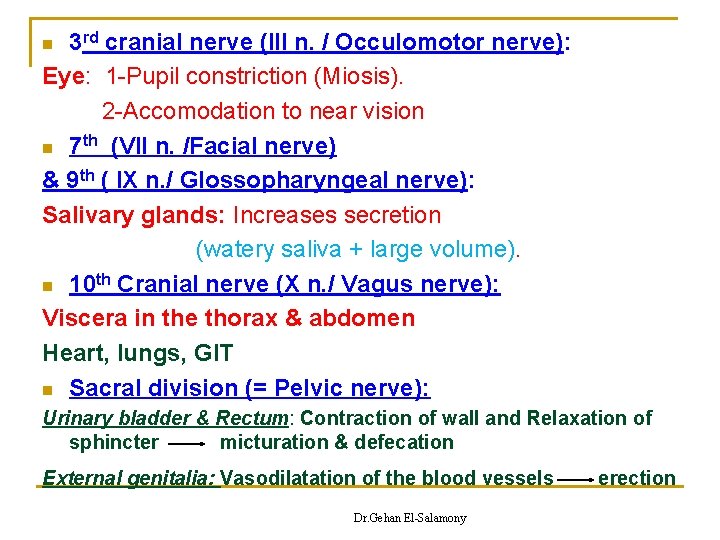
3 rd cranial nerve (III n. / Occulomotor nerve): Eye: 1 -Pupil constriction (Miosis). 2 -Accomodation to near vision n 7 th (VII n. /Facial nerve) & 9 th ( IX n. / Glossopharyngeal nerve): Salivary glands: Increases secretion (watery saliva + large volume). n 10 th Cranial nerve (X n. / Vagus nerve): Viscera in the thorax & abdomen Heart, lungs, GIT n Sacral division (= Pelvic nerve): n Urinary bladder & Rectum: Contraction of wall and Relaxation of sphincter micturation & defecation External genitalia: Vasodilatation of the blood vessels Dr. Gehan El-Salamony erection
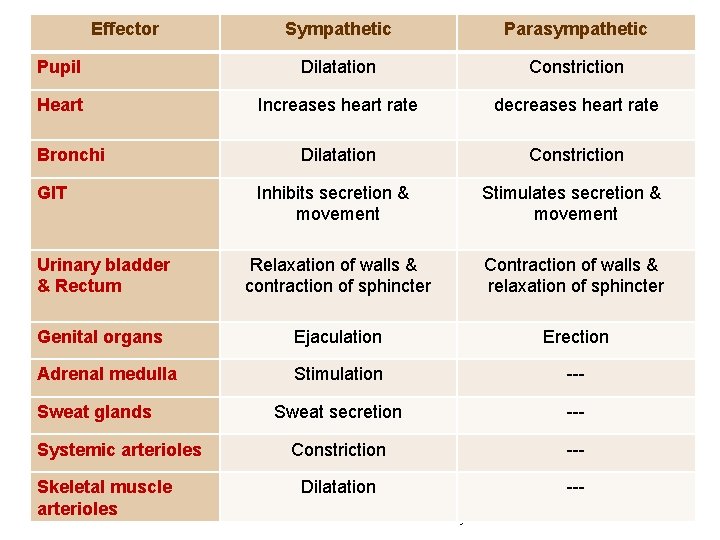
Effector Sympathetic Parasympathetic Pupil Dilatation Constriction Heart Increases heart rate decreases heart rate Dilatation Constriction Inhibits secretion & movement Stimulates secretion & movement Urinary bladder & Rectum Relaxation of walls & contraction of sphincter Contraction of walls & relaxation of sphincter Genital organs Ejaculation Erection Adrenal medulla Stimulation --- Sweat secretion --- Constriction --- Dilatation --- Bronchi GIT Sweat glands Systemic arterioles Skeletal muscle arterioles Dr. Gehan El-Salamony
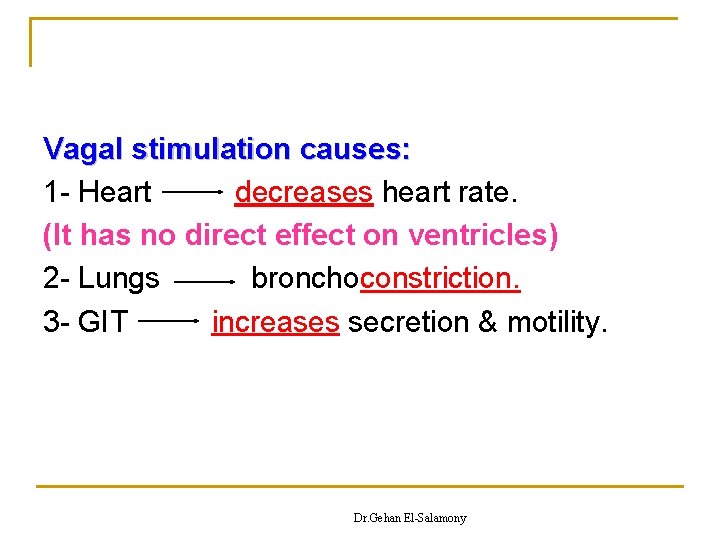
Vagal stimulation causes: 1 - Heart decreases heart rate. (It has no direct effect on ventricles) 2 - Lungs bronchoconstriction. 3 - GIT increases secretion & motility. Dr. Gehan El-Salamony
Question Compare between the 2 divisions of ANS regarding: Ø Origin Ø Relay in ganglia Ø Effect of stimulation Ø Chemical transmission Dr. Gehan El-Salamony
Dr. Gehan El-Salamony