
LECTURE 2 Electromagnetic Energy and Remote Sensing Department



- Slides: 57
LECTURE #2 Electromagnetic Energy and Remote Sensing Department of City & Regional Planning Lahore College for Women University, Lahore. Notes By: Saba Islam
HISTORY(PART OF LECTURE 1) 1839 - first photograph 1858 - first photo from a balloon 1903 - first plane 1909 first photo from a plane 1903 -4 -B/W infrared film WW I and WW II 1960 - space
Electromagnetic Energy and Remote Sensing History EMR EMS Radiation Characteristics Spectral Signatures
EM WAVES EM energy can travel with the speed of light: One thing which is very important to understand for the Remote Sensing specialist is the wave length in EM energy � “Which is defined as the distance between the successive wave crest”. It can measure in meters (m) nanometers (nm) or micrometers (μm) Frequency is the number of cycles of a wave passing a fixed point over a specific period of time. Frequency is normally measured in hertz(Hz) Since the speed of light is constant, wavelength and frequency are inversely related to each other.
ELECTROMAGNETIC RADIATION (EMR) wavelength frequency
EMR Remote sensing is concerned with the measurement of EMR returned by the earth’s natural and cultural features that first receive energy from the sun or an artificial source such as a radar transmitter.
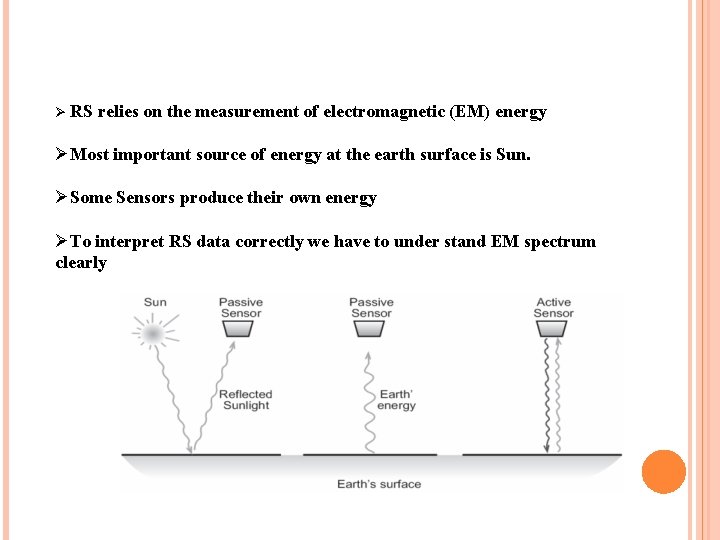
Ø RS relies on the measurement of electromagnetic (EM) energy ØMost important source of energy at the earth surface is Sun. ØSome Sensors produce their own energy ØTo interpret RS data correctly we have to under stand EM spectrum clearly
EMR Because different objects return different types and amounts of EMR, the objective in remote sensing is to detect these differences with the appropriate instruments. This, in turn, makes it possible for us to identify and assess a broad range of surficial features and their conditions.
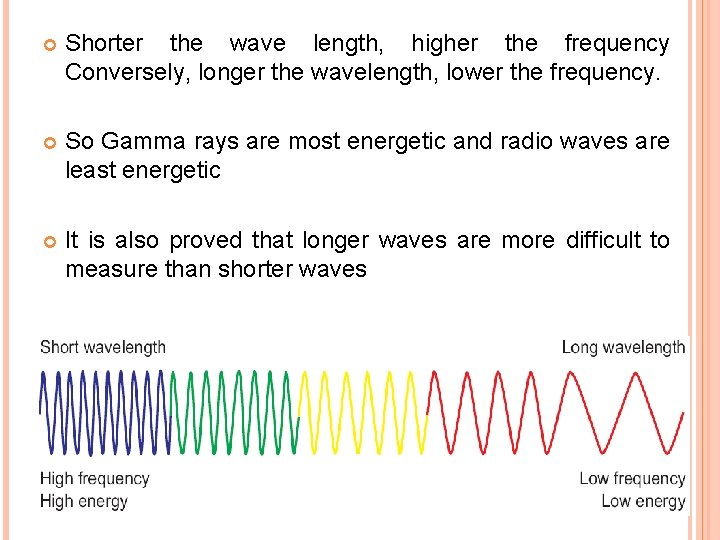
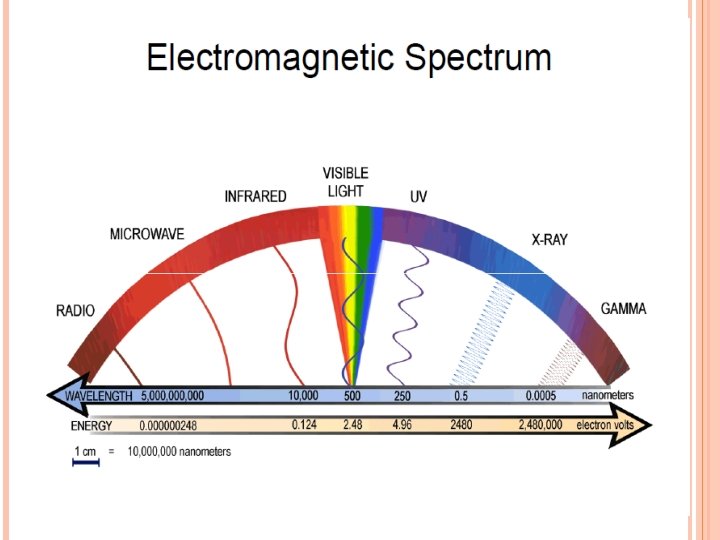
Shorter the wave length, higher the frequency Conversely, longer the wavelength, lower the frequency. So Gamma rays are most energetic and radio waves are least energetic It is also proved that longer waves are more difficult to measure than shorter waves
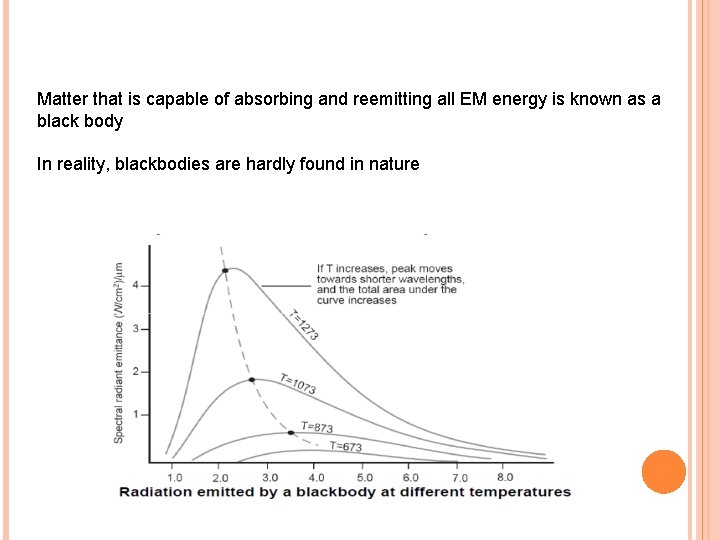
Matter that is capable of absorbing and reemitting all EM energy is known as a black body In reality, blackbodies are hardly found in nature
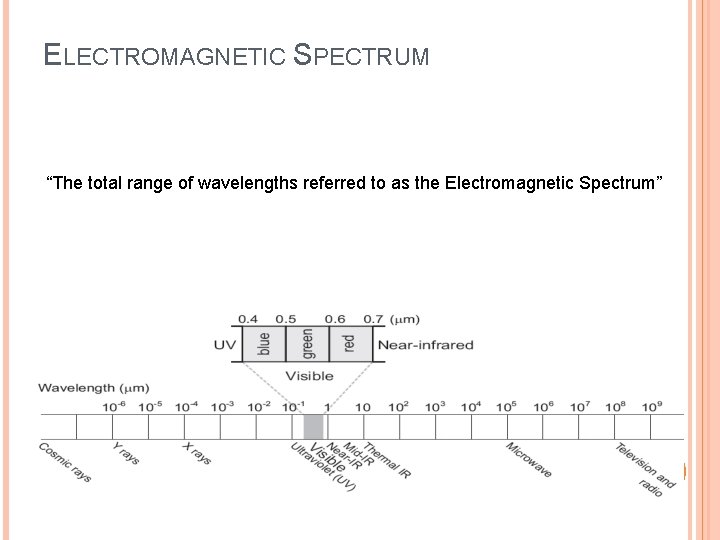
ELECTROMAGNETIC SPECTRUM “The total range of wavelengths referred to as the Electromagnetic Spectrum”
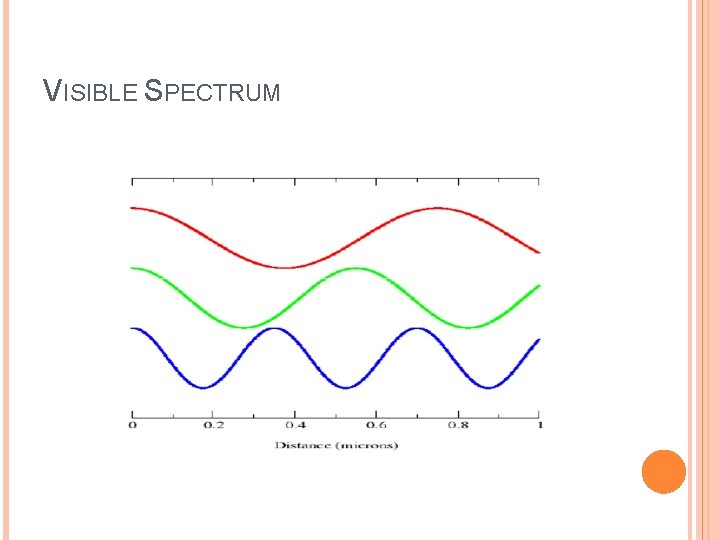
VISIBLE SPECTRUM
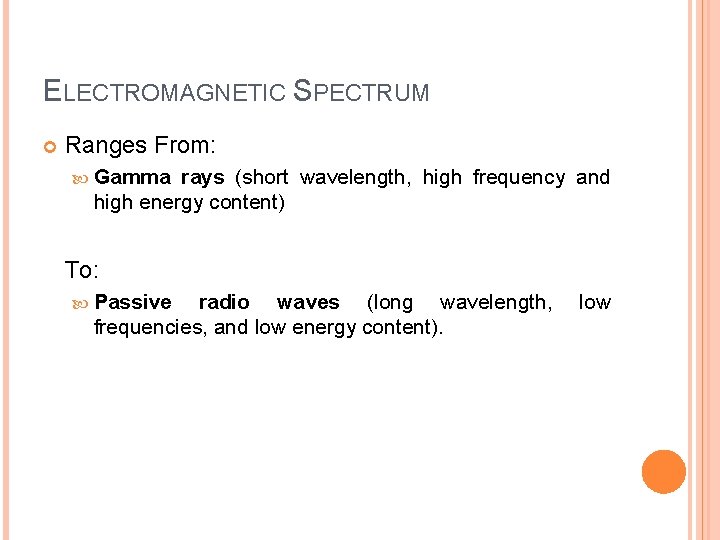
ELECTROMAGNETIC SPECTRUM Ranges From: Gamma rays (short wavelength, high frequency and high energy content) To: Passive radio waves (long wavelength, frequencies, and low energy content). low
R/S SPECTRAL REGIONS Ultraviolet (UV) Visible Infrared (IR) Microwave
R/S SPECTRAL REGIONS Traditionally, the most common used region of the EMS in remote sensing has been the visible band. Its wavelength span is from 0. 4 to 0. 7 micrometers, limits established by the sensitivity of the human eye.
VISIBLE LIGHT Composed of colors (different wavelengths) These familiar colors range from violet (shortest wavelength) through indigo, blue, green, yellow, orange and red (ROYGBIV).
COLOR The visible spectrum is also viewed as being composed of three equal-wavelength segments that represent the additive primary colors; Blue (0. 4 to 0. 5 micrometers) Green (0. 5 to 0. 6 micrometers) Red ( 0. 6 to 0. 7 micrometers)
PRIMARY COLORS A primary color is one that cannot be made from any other color. All colors perceived by the human optical system can be produced by combining the proper proportions of light representing the three primaries. This principle forms the basis for the operation of the color TV.
COLOR The chlorophyll of healthy grass selectively absorbs more of the blue and red wavelengths of white light and reflects relatively more of the green wavelengths to our eyes.
INFRARED (IR) BAND The infrared (IR) band has wavelengths between red visible light (0. 7 micrometers) and microwaves at 1, 000 micrometers. Infrared means “below the red. ” In remote sensing the IR band is usually divided into two components that are based on basic property differences; Reflected IR band Emitted/Thermal IR band
REFLECTED IR The reflected IR band represents reflected solar radiation which behaves like visible light. Its wavelength span is from 0. 7 to about 3 micrometers.
THERMAL IR (HEAT) The dominant type of energy in thermal IR band is heat energy, which is continuously emitted by the atmosphere and all objects on the earth’s surface. Its wavelength span is from about 3 micrometers to 1, 000 micrometers or 0. 1 centimeters.
MICROWAVE BAND The microwave band falls between the IR and radio bands and has a wavelength range extending from approximately 0. 1 centimeters to 1 meter.
ENERGY INTERACTION IN THE ATMOSPHERE Three fundamental interactions are possible. Reflection Transmission Absorption Scattering (Most important in RS)
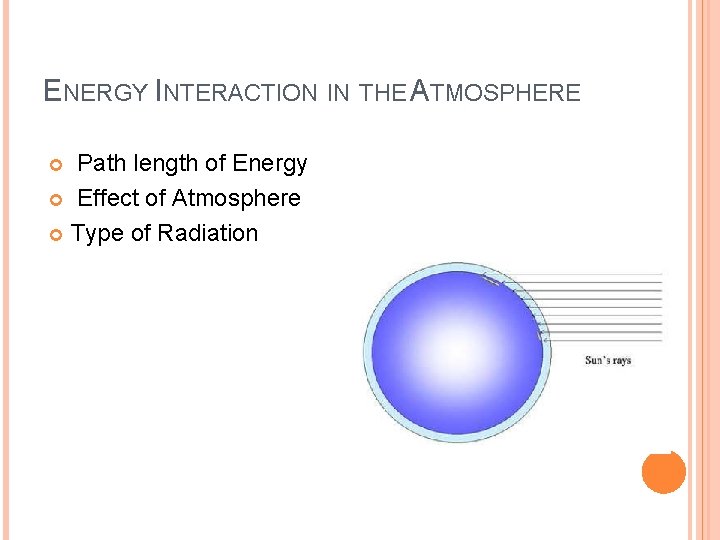
ENERGY INTERACTION IN THE ATMOSPHERE Path length of Energy Effect of Atmosphere Type of Radiation
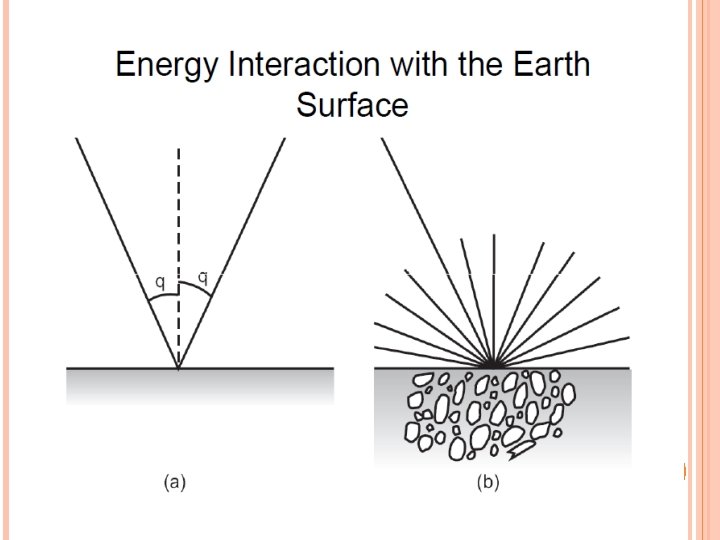
REFLECTION Reflection (also called specular reflection) is the process where incident radiation “bounces off” the surface of the substance in a single, predictable direction.
REFLECTION The angle of reflection is always equal and opposite to the angle of incidence. Reflection is caused by surfaces that are smooth relative to the wavelength of the incident radiation. These smooth mirror-like surfaces are called specular reflectors. Specular reflection causes no change to either EMR velocity or wavelength.
ABSORPTION OF EM ENERGY Significant absorbers of EMR in the atmosphere; oxygen nitrogen ozone carbon dioxide water vapor
TRANSMISSION Transmission is the process by which incident radiation passes through matter without measurable attenuation. The substance is thus transparent to the radiation.
TRANSMISSION Transmission through material media of different densities (such as air to water) causes the radiation to be refracted or deflected from a straight-line path with an accompanying change in its velocity and wavelength; frequency always remains constant.
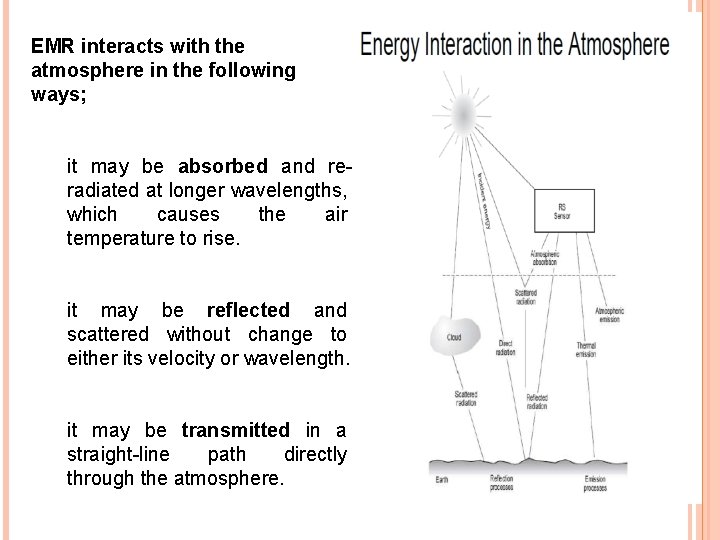
EMR interacts with the atmosphere in the following ways; it may be absorbed and reradiated at longer wavelengths, which causes the air temperature to rise. it may be reflected and scattered without change to either its velocity or wavelength. it may be transmitted in a straight-line path directly through the atmosphere.
ENERGY INTERACTION IN THE ATMOSPHERE Scattering Atmospheric Scattering is the unpredictable diffusion of radiation by particles in the atmosphere. The amount of scattering depends on several factors. » Wavelength of the radiation » Amount of particles and gasses » Distance the radiation pass through the atmosphere
TYPES OF SCATTERING Rayleigh Scattering Mie Scattering Non-selective scattering
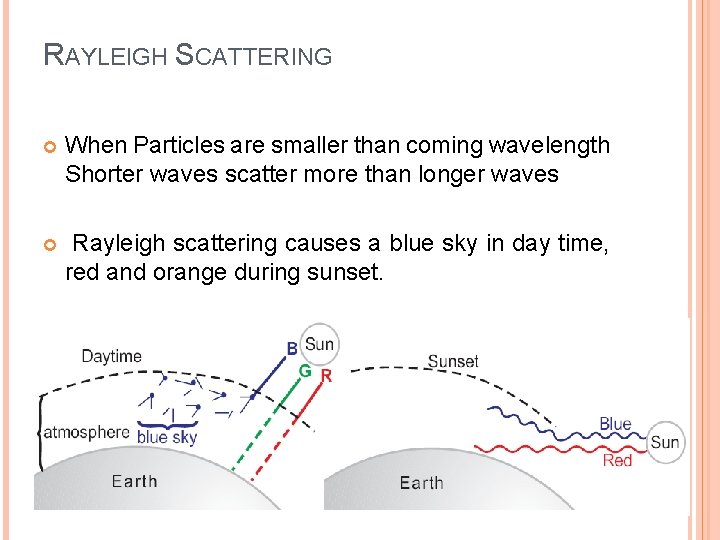
RAYLEIGH SCATTERING When Particles are smaller than coming wavelength Shorter waves scatter more than longer waves Rayleigh scattering causes a blue sky in day time, red and orange during sunset.
MIE SCATTERING When waves are similar than the particles. It is generally restricted to the lower atmosphere. Non Selective Scattering When particle size is much larger than the radiation wavelength. like water droplets and larger dust particles.
MIE SCATTERING When waves are similar than the particles. It is generally restricted to the lower atmosphere. Non Selective Scattering When particle size is much larger than the radiation wavelength. like water droplets and larger dust particles.
EMR - SURFACE INTERACTIONS The natural and cultural features of the earth’s surface interact differently with solar radiation. Albedo or Spectral Reflectance is the percentage radiation reflected by an object.
SOLAR AND TERRESTRIAL RADIATION Most remote sensing systems are designed to detect; Solar radiation which passes through the atmosphere and is reflected in varying degrees by the earth’s surface features. Terrestrial radiation which is continuously emitted by these same features.
SOLAR AND TERRESTRIAL RADIATION About half the solar radiation passes through the earth’s atmosphere and is absorbed in varying degrees by surface features of the earth. Most of this absorbed radiation is transformed into lowtemperature heat (warming the surface), which is continuously emitted back into the atmosphere at longer thermal IR wavelengths.
SOLAR AND TERRESTRIAL RADIATION Because the wavelengths covering most of the earth’s energy output are several times longer than those covering most of the solar output, terrestrial radiation is frequently called longwave radiation and solar radiation is termed shortwave radiation.
SPECTRAL SIGNATURES Every natural and synthetic object reflects and emits EMR over a range of wavelengths in its own characteristic manner according , in large measure, to its chemical composition and physical state.
SPECTRAL SIGNATURES Spectral signatures are the distinctive reflectance and emittance properties of objects. Within some limited spectral region, a particular object will usually exhibit a unique spectral response pattern that differs from that of other objects.
SPECTRAL SIGNATURES Remote sensing depends upon operation in wavelength regions of the spectrum where these detectable differences in reflected and emitted radiation occur.
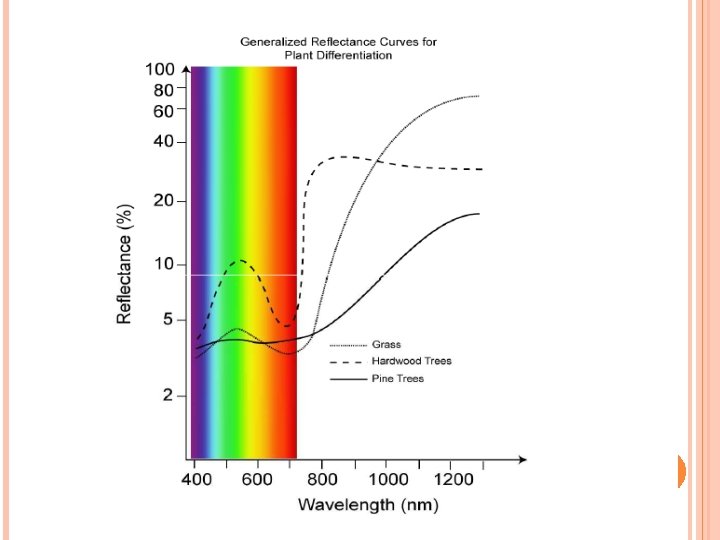
SPECTRAL SIGNATURES The diagnostic response patterns of that make it possible to discriminate objects (spectral signatures) often lie beyond the narrow confines of the visible spectrum where no detectable differences occur.
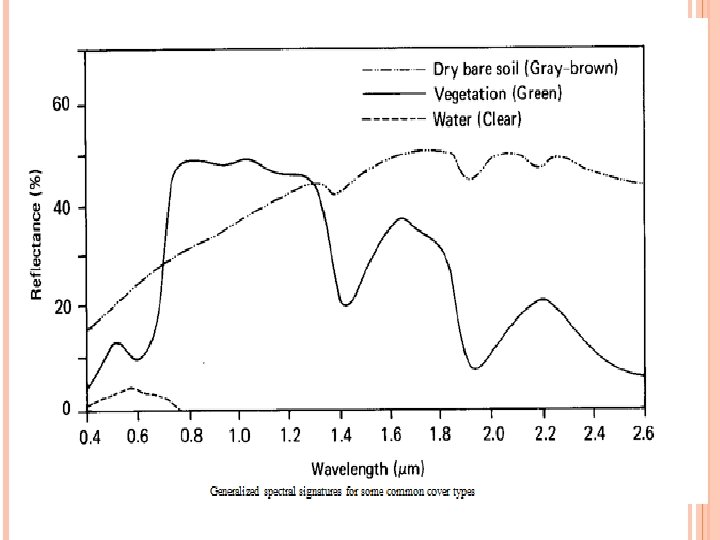
SPECTRAL SIGNATURES For any given material, the amount of solar radiation that is reflected (absorbed, transmitted) will vary with wavelength. This important property of matter allows us to separate distinct cover types based on their response values for a given wavelength. When we plot the response characteristics of a certain cover type against wavelength, we define what is termed the spectral signature of that cover.
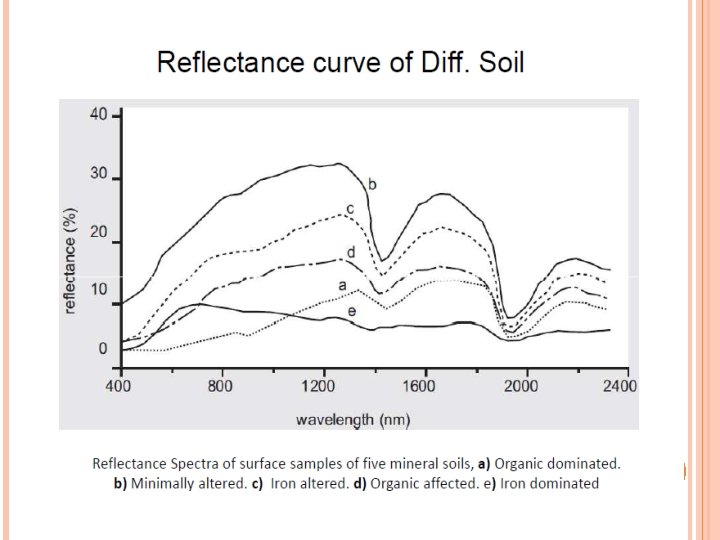
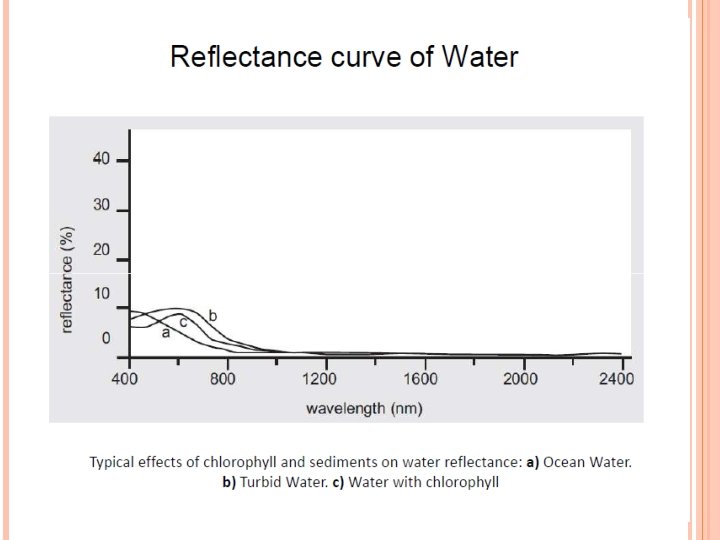
SPECTRAL SIGNATURES Radiometer measurements are used to prepare spectral signature curves which are line plots showing the radiation intensity for various features as a function of wavelength. Here are typical spectral signature curves for three common materials; vegetation, soil and water.
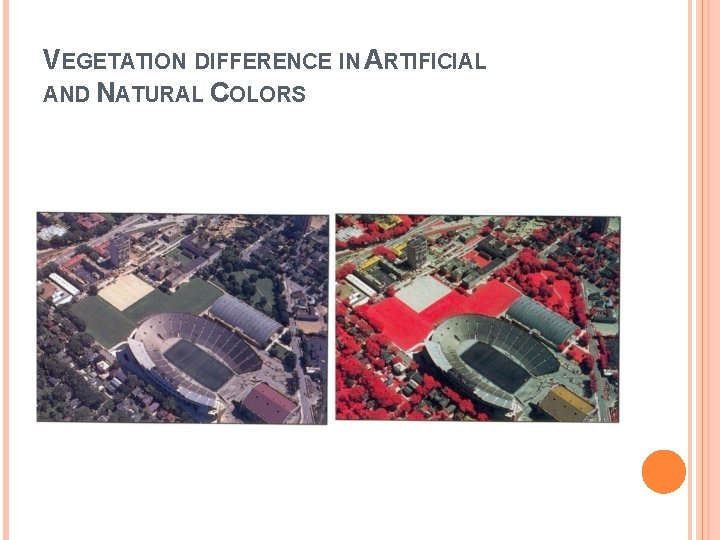
VEGETATION DIFFERENCE IN ARTIFICIAL AND NATURAL COLORS
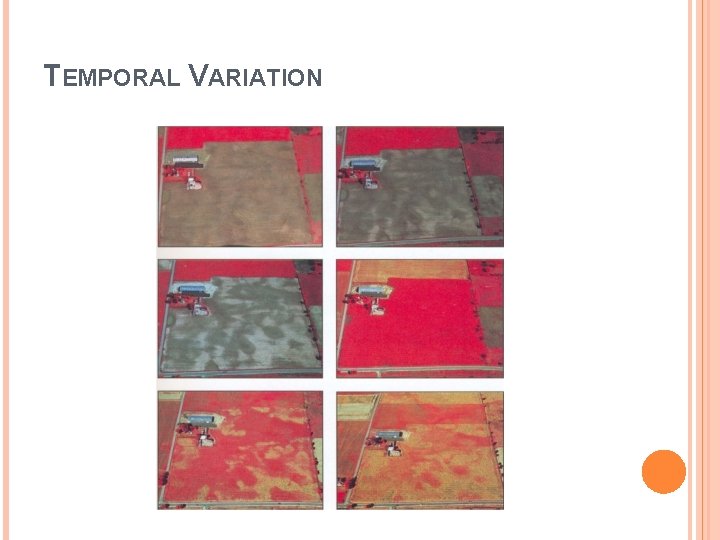
TEMPORAL VARIATION
URBAN SPRAWL IN LAS VEGAS
Assignment # 2 Write down the impotence of different energy bands in RS. What range of band do you think is important in RS ? Explain how ? Reflectance curve of vegetation write down your analysis