
Lecture 2 Data Mining Techniques As Bigdata Tools
Lecture 2: Data Mining Techniques As Bigdata Tools
What Is Data Mining? n Data mining (knowledge discovery in databases): n n Alternative names and their “inside stories”: n n 2 Extraction of interesting (non-trivial, implicit, previously unknown and potentially useful) information or patterns from data in large databases Data mining: a misnomer? Knowledge discovery(mining) in databases (KDD), knowledge extraction, data/pattern analysis, data archeology, data dredging, information harvesting, business intelligence, etc.
Why Data Mining? — Potential Applications n Database analysis and decision support n n Other Applications n n 3 Market analysis and management n target marketing, customer relation management, market basket analysis, cross selling, market segmentation Risk analysis and management n Forecasting, customer retention, improved underwriting, quality control, competitive analysis Fraud detection and management Text mining (news group, email, documents) and Web analysis. Intelligent query answering
Market Analysis and Management (1) n Where are the data sources for analysis? n n Target marketing n n 4 Find clusters of “model” customers who share the same characteristics: interest, income level, spending habits, etc. Determine customer purchasing patterns over time n n Credit card transactions, loyalty cards, discount coupons, customer complaint calls, plus (public) lifestyle studies Conversion of single to a joint bank account: marriage, etc. Cross-market analysis n Associations/co-relations between product sales n Prediction based on the association information
Market Analysis and Management (2) n Customer profiling n n Identifying customer requirements n n n identifying the best products for different customers use prediction to find what factors will attract new customers Provides summary information n n 5 data mining can tell you what types of customers buy what products (clustering or classification) various multidimensional summary reports statistical summary information (data central tendency and variation)
Fraud Detection and Management (1) n Applications n n Approach n n use historical data to build models of fraudulent behavior and use data mining to help identify similar instances Examples n n n 6 widely used in health care, retail, credit card services, telecommunications (phone card fraud), etc. auto insurance: detect a group of people who stage accidents to collect on insurance money laundering: detect suspicious money transactions (US Treasury's Financial Crimes Enforcement Network) medical insurance: detect professional patients and ring of doctors and ring of references
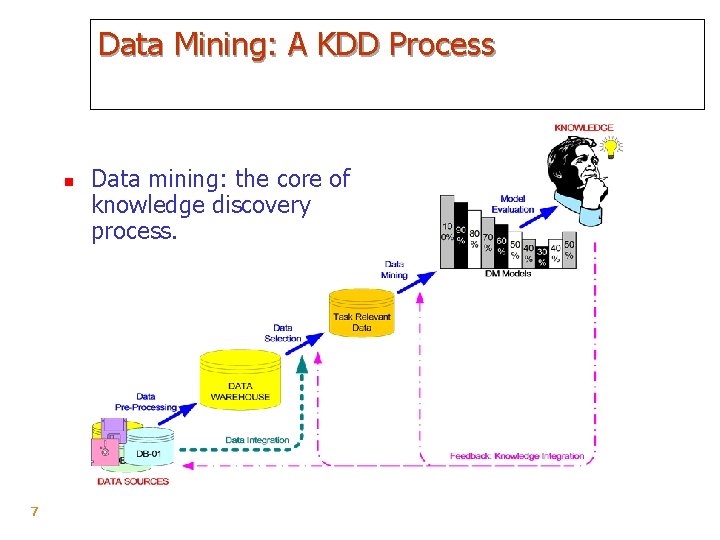
Data Mining: A KDD Process n 7 Data mining: the core of knowledge discovery process.
Steps of a KDD Process n Learning the application domain: n n Creating a target data set: data selection Data cleaning and preprocessing: (may take 60% of effort!) Data reduction and transformation: n n 8 Summarization, classification, regression, association, clustering. Choosing the mining algorithm(s) Data mining: search for patterns of interest Pattern evaluation and knowledge presentation n n Find useful features, dimensionality/variable reduction, invariant representation. Choosing functions of data mining n n relevant prior knowledge and goals of application Visualization, transformation, removing redundant patterns, etc. Deployement: Use of discovered knowledge
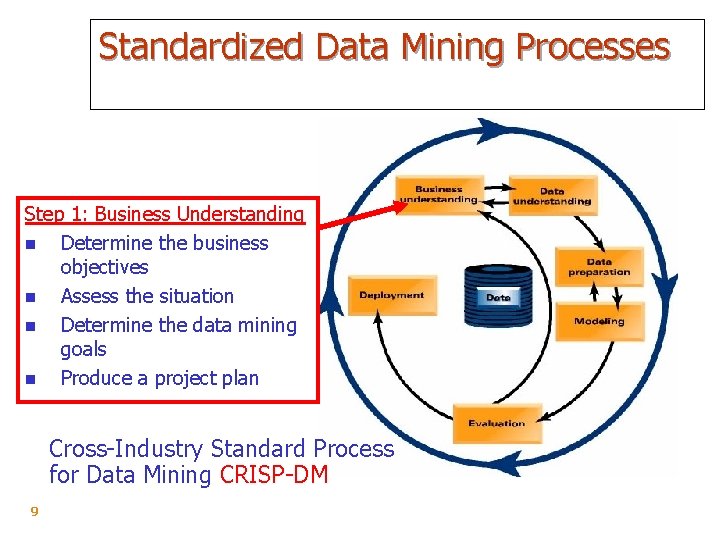
Standardized Data Mining Processes Step 1: Business Understanding n Determine the business objectives n Assess the situation n Determine the data mining goals n Produce a project plan Cross-Industry Standard Process for Data Mining CRISP-DM 9
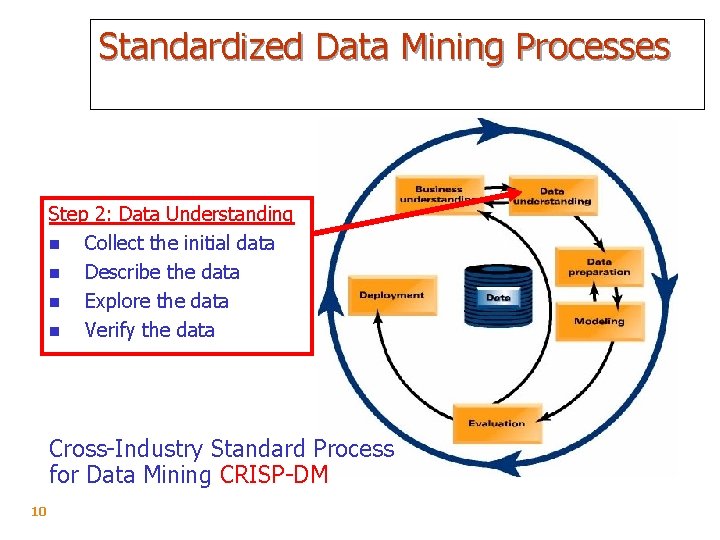
Standardized Data Mining Processes Step 2: Data Understanding n Collect the initial data n Describe the data n Explore the data n Verify the data Cross-Industry Standard Process for Data Mining CRISP-DM 10
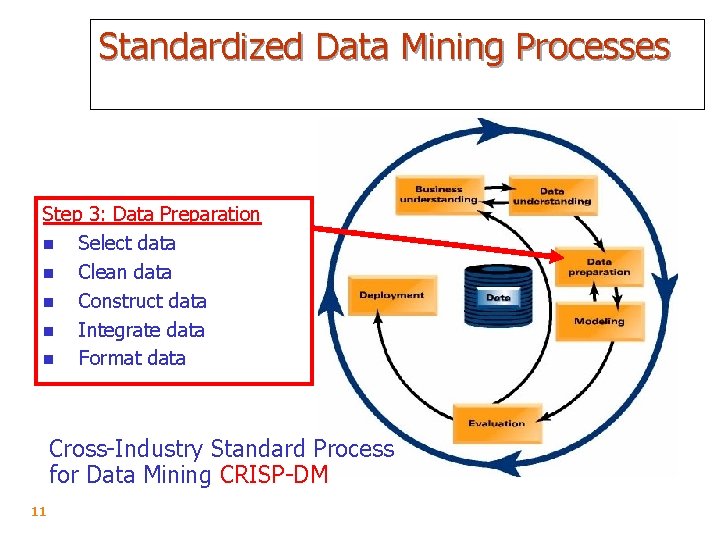
Standardized Data Mining Processes Step 3: Data Preparation n Select data n Clean data n Construct data n Integrate data n Format data Cross-Industry Standard Process for Data Mining CRISP-DM 11
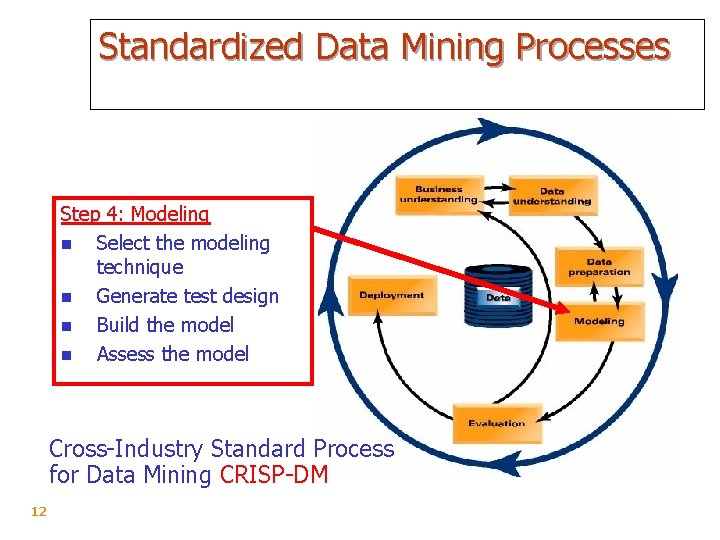
Standardized Data Mining Processes Step 4: Modeling n Select the modeling technique n Generate test design n Build the model n Assess the model Cross-Industry Standard Process for Data Mining CRISP-DM 12
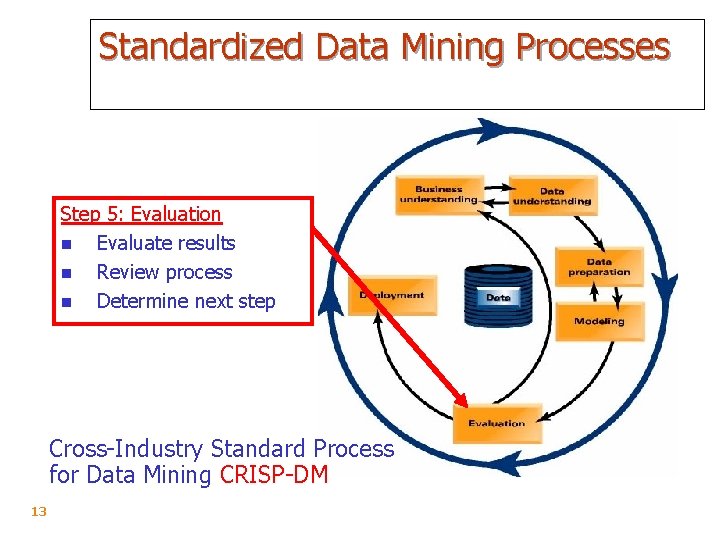
Standardized Data Mining Processes Step 5: Evaluation n Evaluate results n Review process n Determine next step Cross-Industry Standard Process for Data Mining CRISP-DM 13
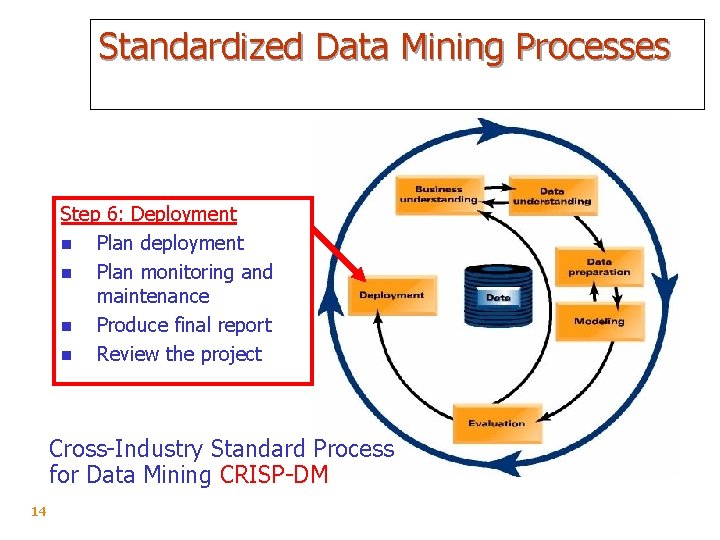
Standardized Data Mining Processes Step 6: Deployment n Plan deployment n Plan monitoring and maintenance n Produce final report n Review the project Cross-Industry Standard Process for Data Mining CRISP-DM 14
Data Mining Functionalities (1) n Concept description: Characterization and discrimination n n Generalize, summarize, and contrast data characteristics, e. g. , dry vs. wet regions Association (correlation and causality) n n n Multi-dimensional vs. single-dimensional association age(X, “ 20. . 29”) ^ income(X, “ 20. . 29 K”) àbuys(X, “PC”) [support = 2%, confidence = 60%] contains(T, “computer”) àcontains(x, “software”) [1%, 75%] 15
Data Mining Functionalities (2) n Classification and Prediction n n Cluster analysis n n 16 Finding models (functions) that describe and distinguish classes or concepts for future prediction E. g. , classify countries based on climate, or classify cars based on gas mileage Presentation: decision-tree, classification rule, ANN Prediction: Predict some unknown or missing numerical values Class label is unknown: Group data to form new classes, e. g. , cluster houses to find distribution patterns Clustering based on the principle: maximizing the intra-class similarity and minimizing the interclass similarity
Data Mining Functionalities (3) n Outlier analysis n n n Trend and evolution analysis n n n 17 Outlier: a data object that does not comply with the general behavior of the data It can be considered as noise or exception but is quite useful in fraud detection, rare events analysis Trend and deviation: regression analysis Sequential pattern mining, periodicity analysis Similarity-based analysis
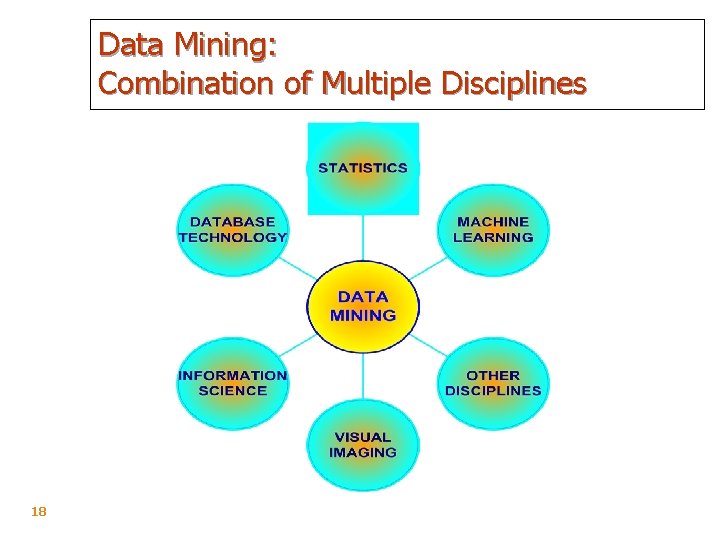
Data Mining: Combination of Multiple Disciplines 18
A Multi-Dimensional View of Data Mining Classification n Databases to be mined n n Knowledge to be extracted n n n Database-oriented, data warehouse (OLAP), machine learning, statistics, visualization, neural network, etc. Applications adapted n 19 Characterization, discrimination, association, classification, clustering, trend, deviation and outlier analysis, etc. Multiple/integrated functions and mining at multiple levels Techniques to utilized n n Relational, transactional, object-oriented, object-relational, active, spatial, time-series, text, multi-media, heterogeneous, legacy, WWW, etc. Retail, telecommunication, banking, fraud analysis, DNA mining, stock market analysis, Web mining, Weblog analysis, etc.
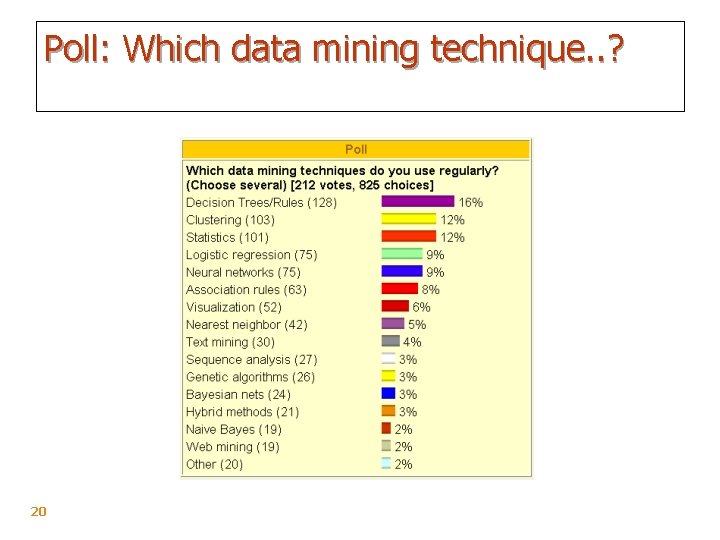
Poll: Which data mining technique. . ? 20
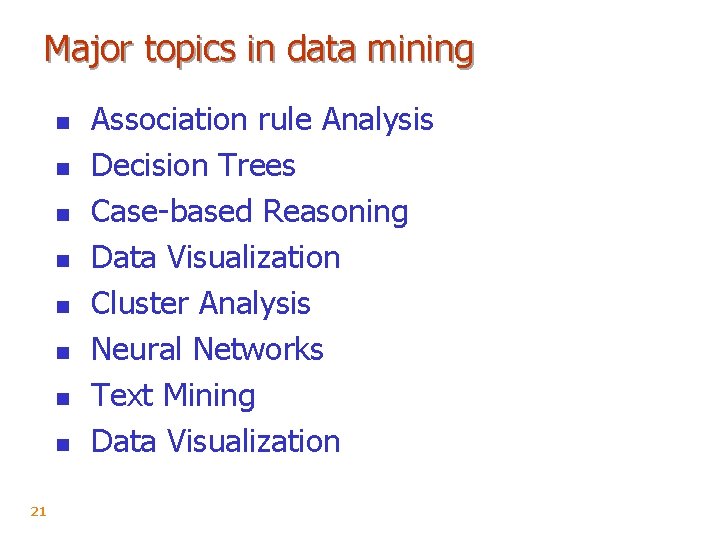
Major topics in data mining n n n n 21 Association rule Analysis Decision Trees Case-based Reasoning Data Visualization Cluster Analysis Neural Networks Text Mining Data Visualization
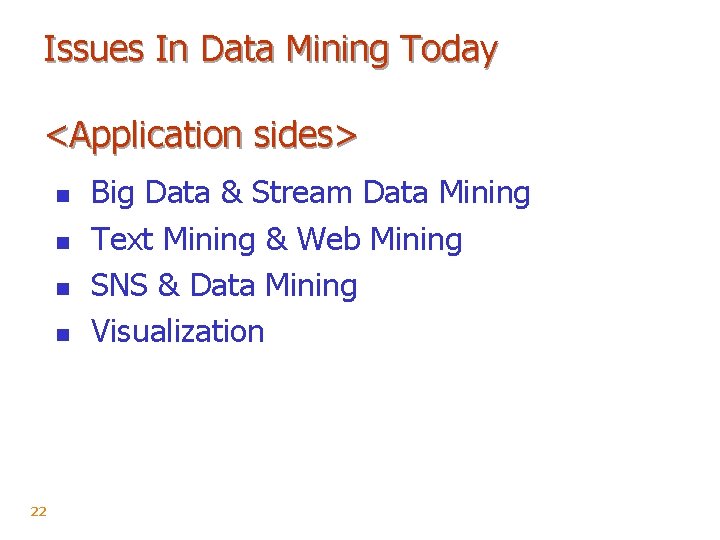
Issues In Data Mining Today <Application sides> n n 22 Big Data & Stream Data Mining Text Mining & Web Mining SNS & Data Mining Visualization
- Slides: 22