
Lecture 2 Cryogenic Properties of Materials Part I

- Slides: 30
Lecture 2 Cryogenic Properties of Materials : Part I J. G. Weisend II
Goals § Describe the issues associated with use of materials at cryogenic temperatures § List suitable and unsuitable materials for use in cryogenic systems § Give the physical explanation behind the variation of material properties with temperature § Provide pointers to material properties Slide 2
Issues with Materials at Cryogenic Temperatures § Material properties change significantly with temperature. These changes must be allowed for in the design. § Many materials are unsuitable for cryogenic use. § Material selection must always be done carefully. Testing may be required. Slide 3
Material Selection § Some suitable materials for cryogenic use include: • Austenitic stainless steels e. g. 304, 304 L, 316, 321 • Aluminum alloys e. g. 6061, 6063, 1100 • Copper e. g. OFHC, ETP and phosphorous deoxidized • Brass • Fiber reinforced plastics such as G – 10 and G – 11 • Niobium & Titanium (frequently used in superconducting RF systems) • Invar (Ni /Fe alloy) useful in making washers due to its lower coefficient of expansion • Indium (used as an O ring material) • Kapton and Mylar (used in Multilayer Insulation and as electrical insulation • Quartz (used in windows) Slide 4
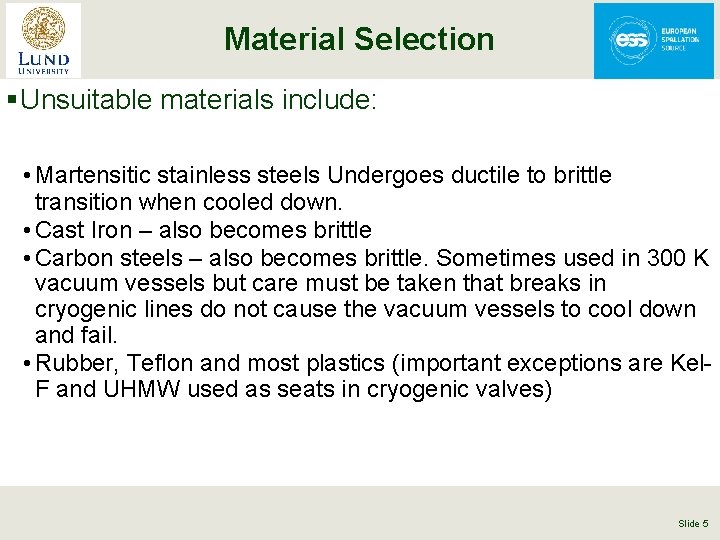
Material Selection § Unsuitable materials include: • Martensitic stainless steels Undergoes ductile to brittle transition when cooled down. • Cast Iron – also becomes brittle • Carbon steels – also becomes brittle. Sometimes used in 300 K vacuum vessels but care must be taken that breaks in cryogenic lines do not cause the vacuum vessels to cool down and fail. • Rubber, Teflon and most plastics (important exceptions are Kel. F and UHMW used as seats in cryogenic valves) Slide 5
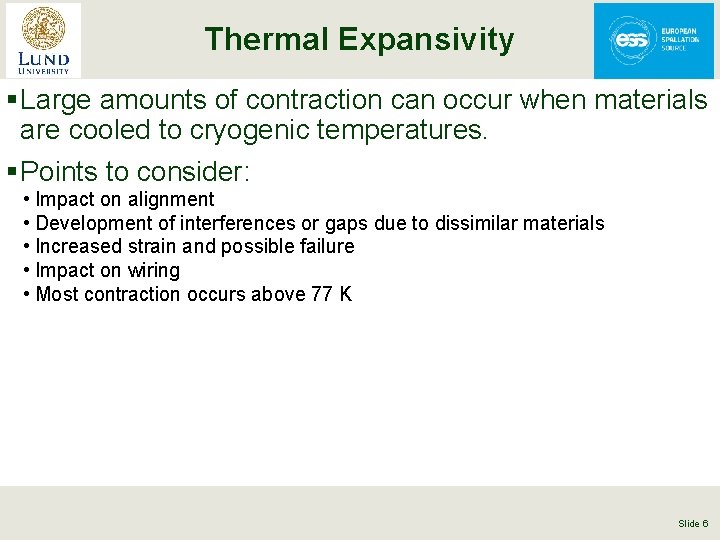
Thermal Expansivity § Large amounts of contraction can occur when materials are cooled to cryogenic temperatures. § Points to consider: • Impact on alignment • Development of interferences or gaps due to dissimilar materials • Increased strain and possible failure • Impact on wiring • Most contraction occurs above 77 K Slide 6
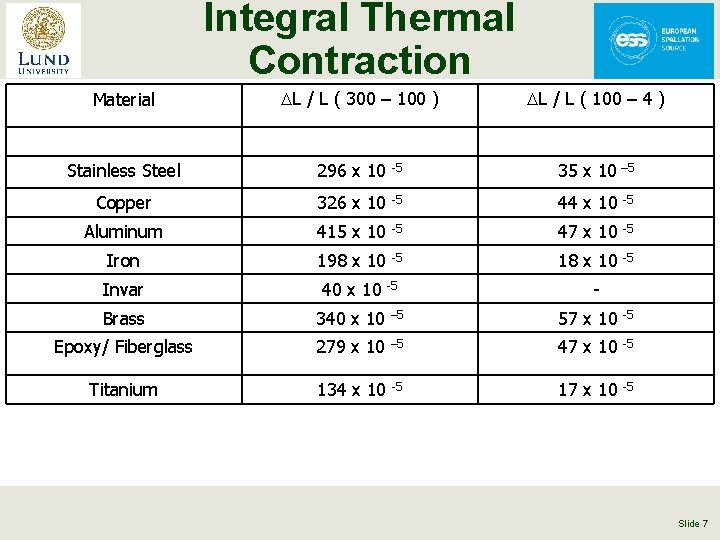
Integral Thermal Contraction Material DL / L ( 300 – 100 ) DL / L ( 100 – 4 ) Stainless Steel 296 x 10 -5 35 x 10 – 5 Copper 326 x 10 -5 44 x 10 -5 Aluminum 415 x 10 -5 47 x 10 -5 Iron 198 x 10 -5 18 x 10 -5 Invar 40 x 10 Brass 340 x 10 – 5 57 x 10 -5 Epoxy/ Fiberglass 279 x 10 – 5 47 x 10 -5 Titanium 134 x 10 -5 17 x 10 -5 -5 - Slide 7
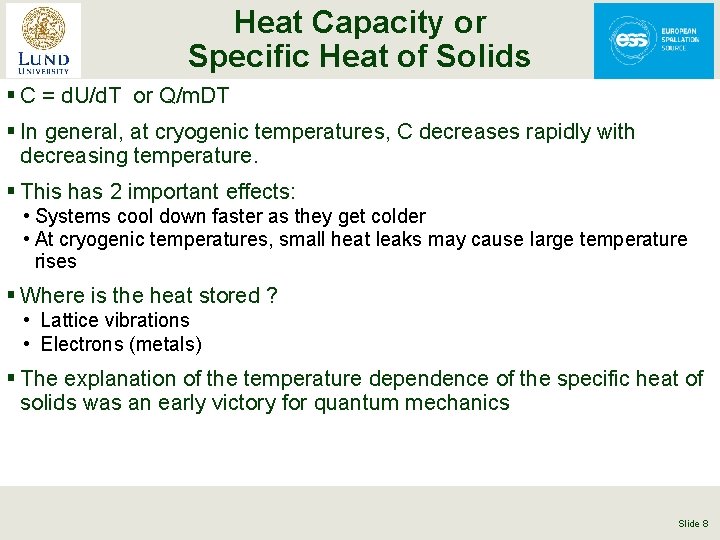
Heat Capacity or Specific Heat of Solids § C = d. U/d. T or Q/m. DT § In general, at cryogenic temperatures, C decreases rapidly with decreasing temperature. § This has 2 important effects: • Systems cool down faster as they get colder • At cryogenic temperatures, small heat leaks may cause large temperature rises § Where is the heat stored ? • Lattice vibrations • Electrons (metals) § The explanation of the temperature dependence of the specific heat of solids was an early victory for quantum mechanics Slide 8
Specific Heat of Solids § The total specific heat of metals at low temperatures may be written: C = AT 3 +BT - the contribution of the electrons is only important at < 4 K § Paramagnetic materials and other special materials have anomalous specific heats -always double check Slide 9
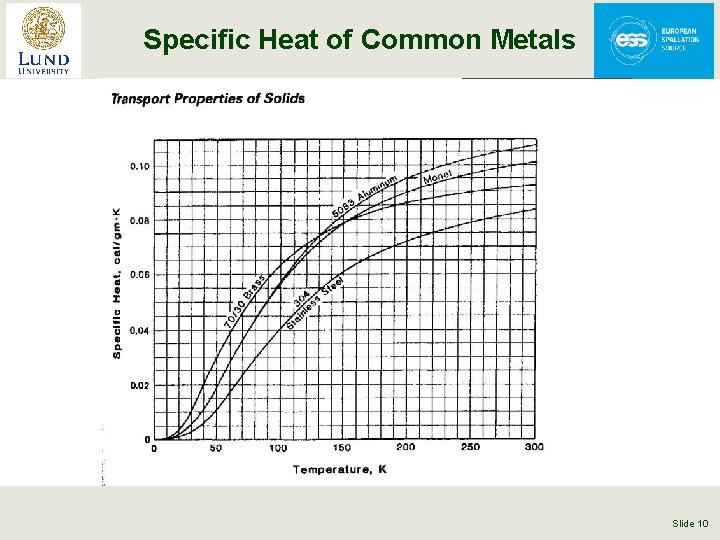
Specific Heat of Common Metals From Cryogenic Engineering – T. Flynn (1997) Slide 10
Thermal Conductivity § Q = -K(T) A(x) d. T/dx § K Varies significantly with temperature § Temperature dependence must be considered when calculating heat transfer rates Slide 11
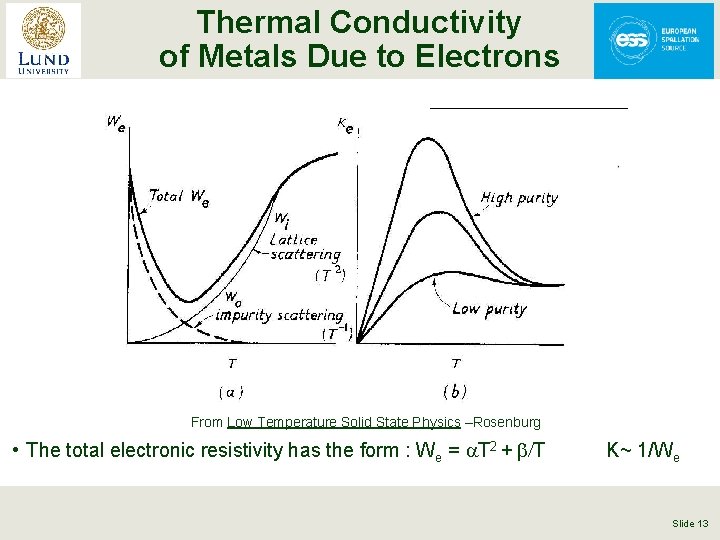
Thermal Conductivity of Metals § Energy is transferred both by lattice vibrations (phonons) and conduction electrons § In “reasonably pure” metals the contribution of the conduction electrons dominates § There are 2 scattering mechanisms for the conduction electrons: • Scattering off impurities (Wo = b/T) • Scattering off phonons (Wi = a. T 2) § The total electronic resistivity has the form : We = a. T 2 + b/T Slide 12
Thermal Conductivity of Metals Due to Electrons From Low Temperature Solid State Physics –Rosenburg • The total electronic resistivity has the form : We = a. T 2 + b/T K~ 1/We Slide 13
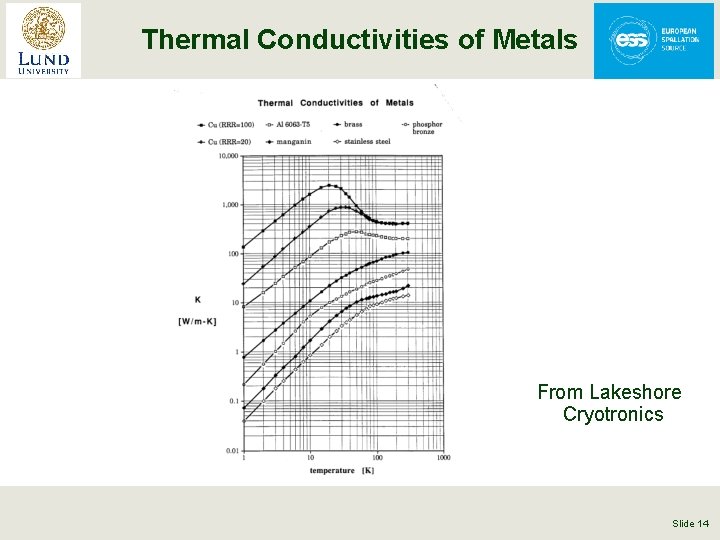
Thermal Conductivities of Metals From Lakeshore Cryotronics Slide 14
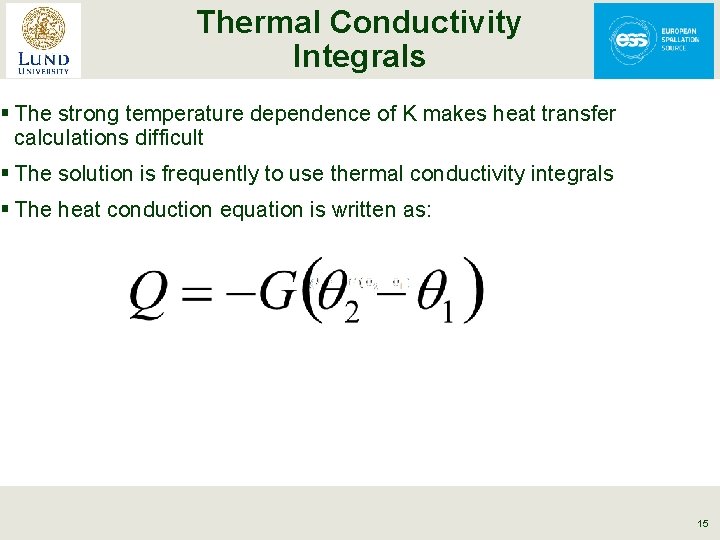
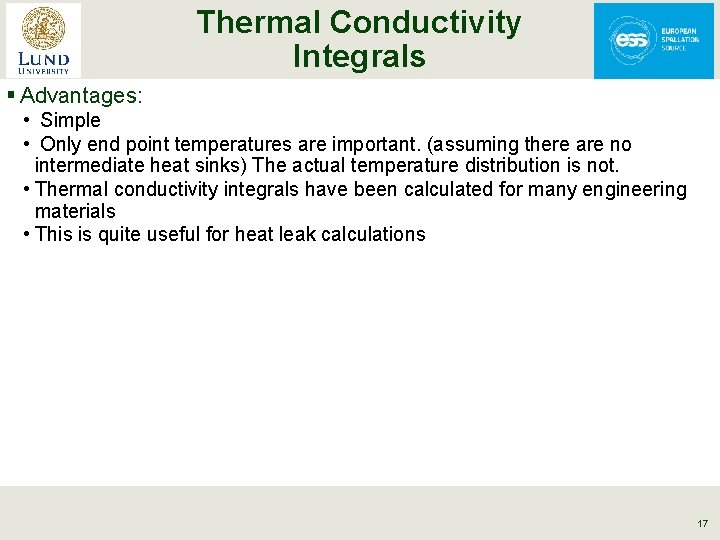
Thermal Conductivity Integrals § The strong temperature dependence of K makes heat transfer calculations difficult § The solution is frequently to use thermal conductivity integrals § The heat conduction equation is written as: 15
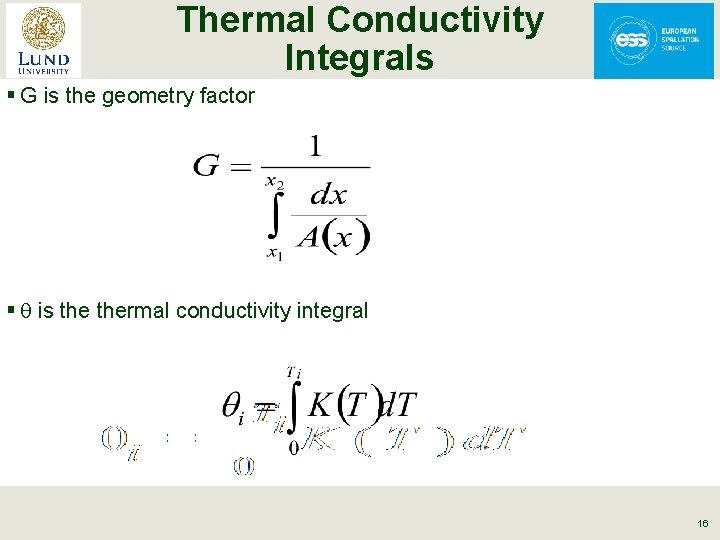
Thermal Conductivity Integrals § G is the geometry factor § q is thermal conductivity integral 16
Thermal Conductivity Integrals § Advantages: • Simple • Only end point temperatures are important. (assuming there are no intermediate heat sinks) The actual temperature distribution is not. • Thermal conductivity integrals have been calculated for many engineering materials • This is quite useful for heat leak calculations 17
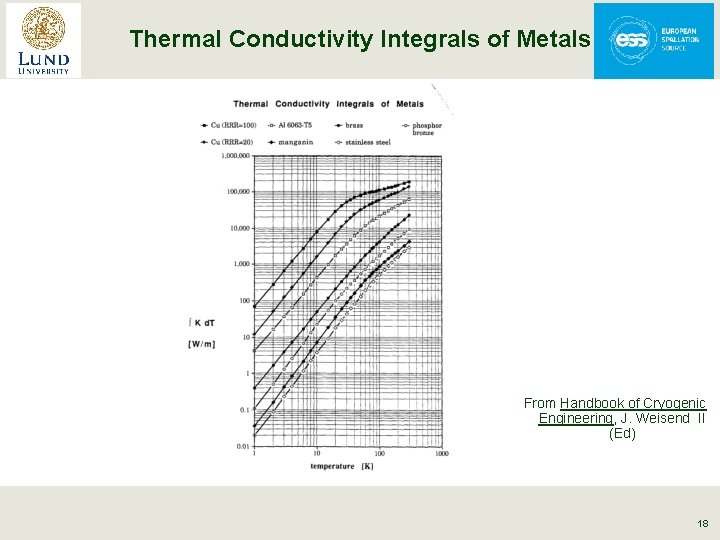
Thermal Conductivity Integrals of Metals From Handbook of Cryogenic Engineering, J. Weisend II (Ed) 18
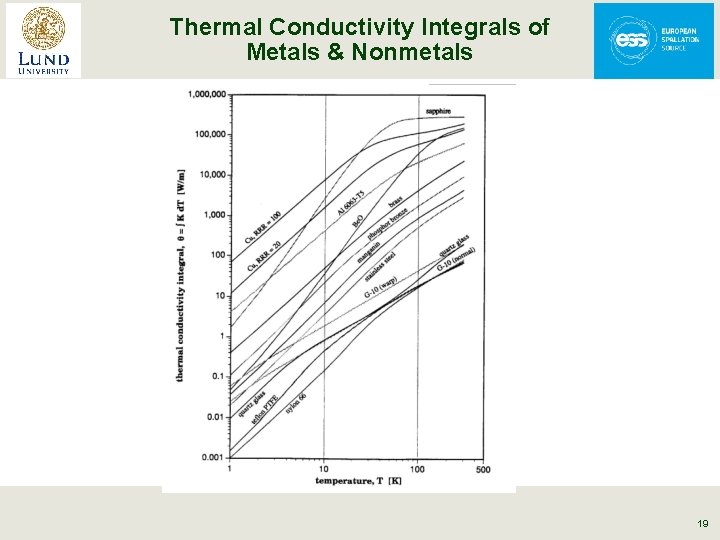
Thermal Conductivity Integrals of Metals & Nonmetals From Lakeshore Cryotronics 19
Sources of Data for the Cryogenic Properties of Material § “A Reference Guide for Cryogenic Properties of Materials”, Weisend, Flynn, Thompson; SLAC-TN-03 -023 on indico page § Cryogenic Materials Data Handbook: Durham et al. C 13. 6/3. 961 : § Metal. Pak: computer code produced by Cryo. Data http: //www. htess. com/software. htm § Cryo. Comp: computer Code produced by Eckels Engineering http: //www. eckelsengineering. com/ Slide 20
Backup Slides Slide 21
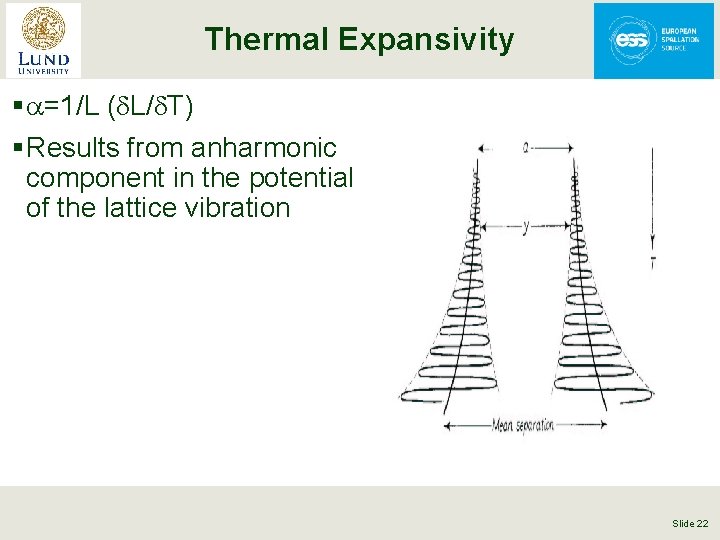
Thermal Expansivity § a=1/L (d. L/d. T) § Results from anharmonic component in the potential of the lattice vibration Slide 22
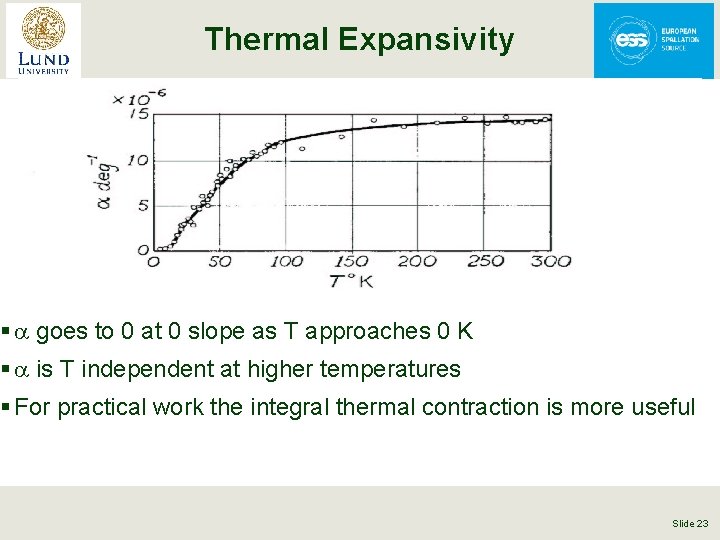
Thermal Expansivity § a goes to 0 at 0 slope as T approaches 0 K § a is T independent at higher temperatures § For practical work the integral thermal contraction is more useful Slide 23
Integral Thermal Contraction § Roughly speaking • Metals – 0. 5% or less • Polymers – 1. 5 – 3% • Some amorphous materials have 0 or even negative thermal contraction Slide 24
Lattice Contribution § Dulong Petit Law § Energy stored in a 3 D oscillator = 3 Nk. T = 3 RT § Specific heat = 3 R = constant • Generally OK for T= 300 K or higher • Doesn’t take into account quantum mechanics Slide 25
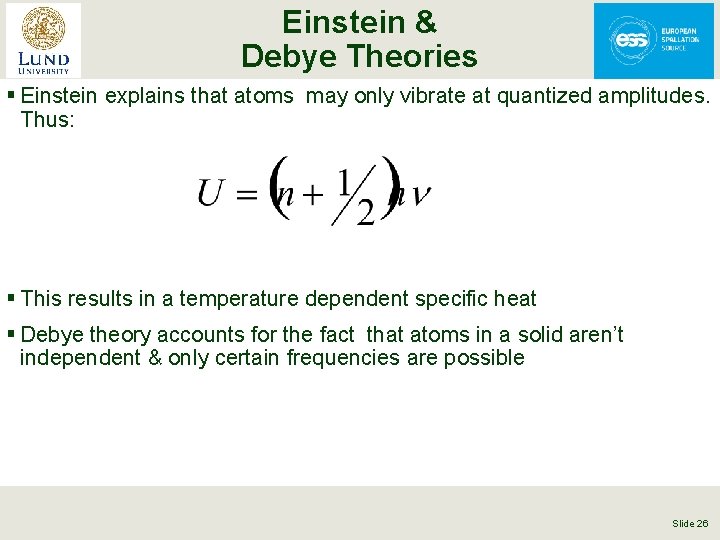
Einstein & Debye Theories § Einstein explains that atoms may only vibrate at quantized amplitudes. Thus: § This results in a temperature dependent specific heat § Debye theory accounts for the fact that atoms in a solid aren’t independent & only certain frequencies are possible Slide 26
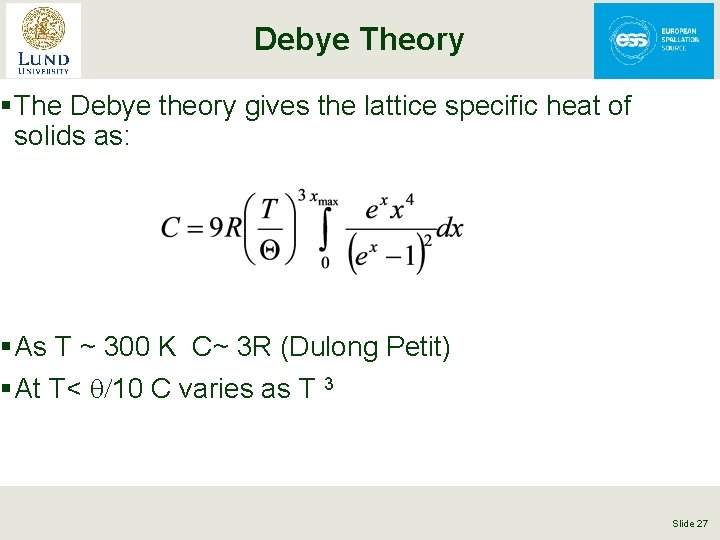
Debye Theory § The Debye theory gives the lattice specific heat of solids as: § As T ~ 300 K C~ 3 R (Dulong Petit) § At T< q/10 C varies as T 3 Slide 27
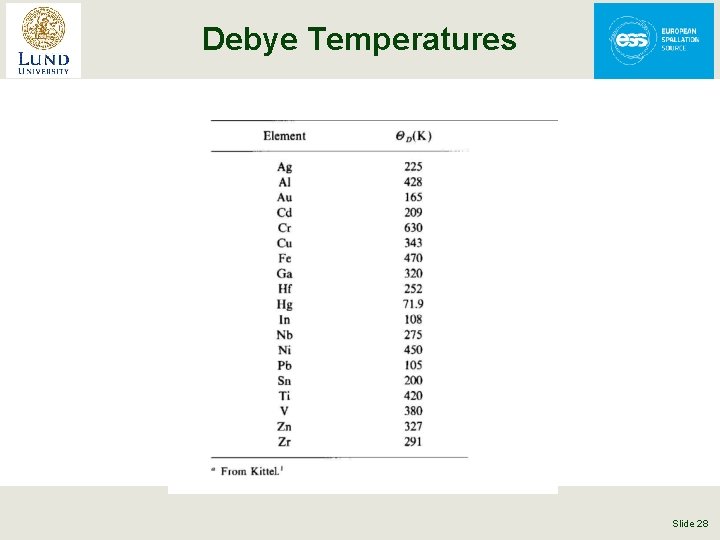
Debye Temperatures Slide 28
Impact of Electrons in Metals on Specific Heat § Thermal energy is also stored in the free electrons in the metal § Quantum theory shows that electrons in a metal can only have certain well defined energies § Only a small fraction of the total electrons can be excited to higher states & participate in the specific heat § It can be shown that Ce = g. T Slide 29
Heat Conduction by Lattice Vibrations in Metals § Another mechanism for heat transfer in metals are lattice vibrations or phonons § The main resistance to this type of heat transfer is scattering of phonons off conduction electrons § This resistance is given by W = A/T 2 § Phonon heat transfer in metals is generally neglected Slide 30