
Lecture 2 Basic Concepts Use the course notes
Lecture 2: Basic Concepts § Use the course notes on: § § Direction and solid angles Fundamental radiation field variables Directional properties of radiation MCNP reinforcement of concepts § § § Shultis and Faw tutorial Additional macro surfaces Introduction to Vis. Ed Determining solid angles Representing particle beams and reflection 1

Shultis and Faw tutorial § § In the course Public area Same authors as our textbook 2
Additional macro surfaces § We will build on the SPH (sphere) that we learned last week by adding § § RPP (rectangular parallelpiped = box) RCC (right circular cylinder) TRC (truncated cone) TX, TY, and TZ (torus) 3
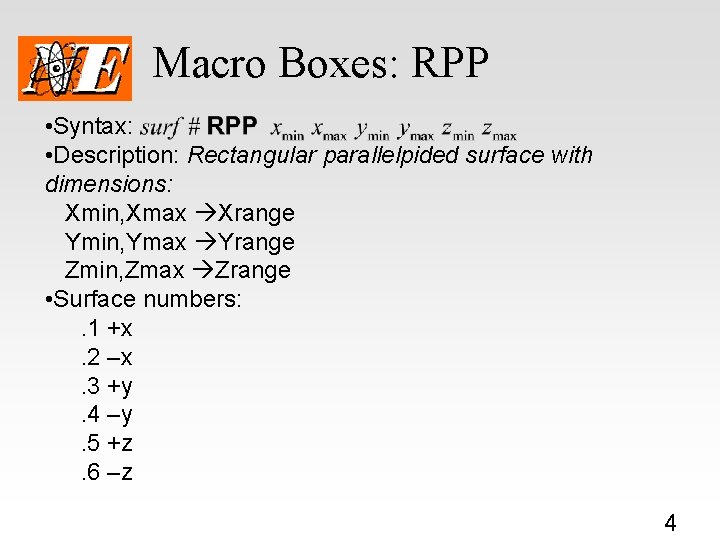
Macro Boxes: RPP • Syntax: • Description: Rectangular parallelpided surface with dimensions: Xmin, Xmax Xrange Ymin, Ymax Yrange Zmin, Zmax Zrange • Surface numbers: . 1 +x. 2 –x. 3 +y. 4 –y. 5 +z. 6 –z 4
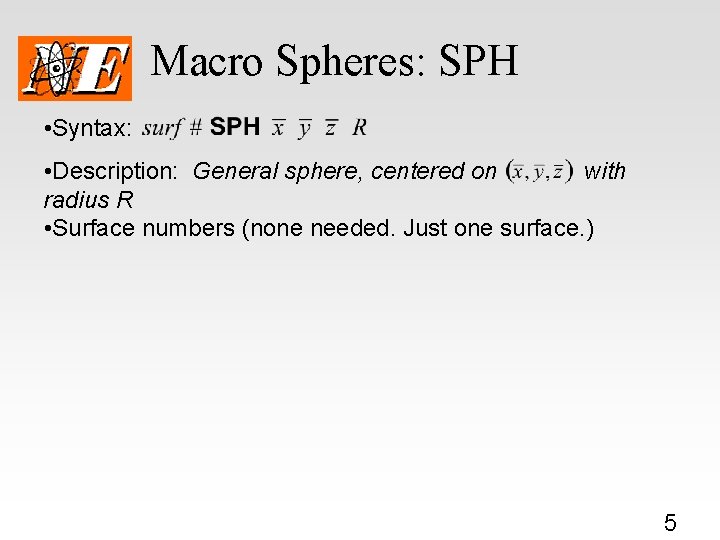
Macro Spheres: SPH • Syntax: • Description: General sphere, centered on with radius R • Surface numbers (none needed. Just one surface. ) 5
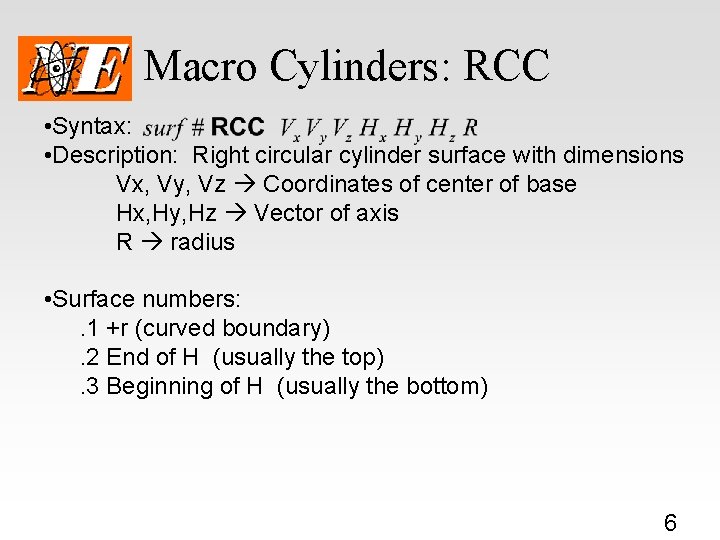
Macro Cylinders: RCC • Syntax: • Description: Right circular cylinder surface with dimensions Vx, Vy, Vz Coordinates of center of base Hx, Hy, Hz Vector of axis R radius • Surface numbers: . 1 +r (curved boundary). 2 End of H (usually the top). 3 Beginning of H (usually the bottom) 6
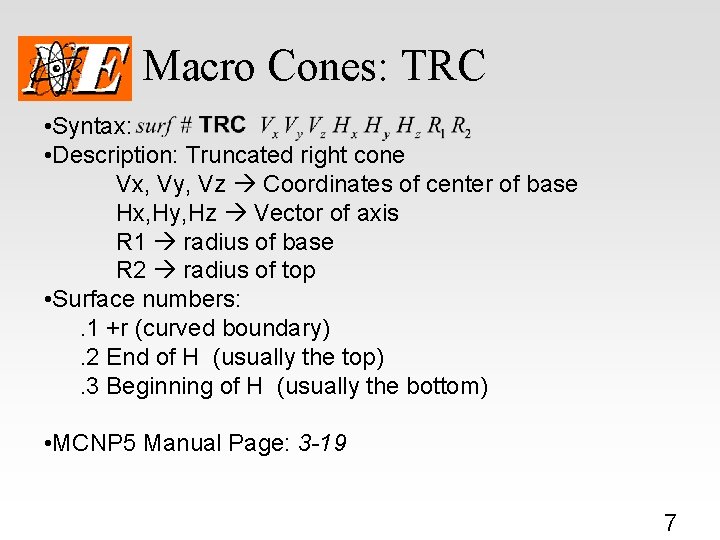
Macro Cones: TRC • Syntax: • Description: Truncated right cone Vx, Vy, Vz Coordinates of center of base Hx, Hy, Hz Vector of axis R 1 radius of base R 2 radius of top • Surface numbers: . 1 +r (curved boundary). 2 End of H (usually the top). 3 Beginning of H (usually the bottom) • MCNP 5 Manual Page: 3 -19 7
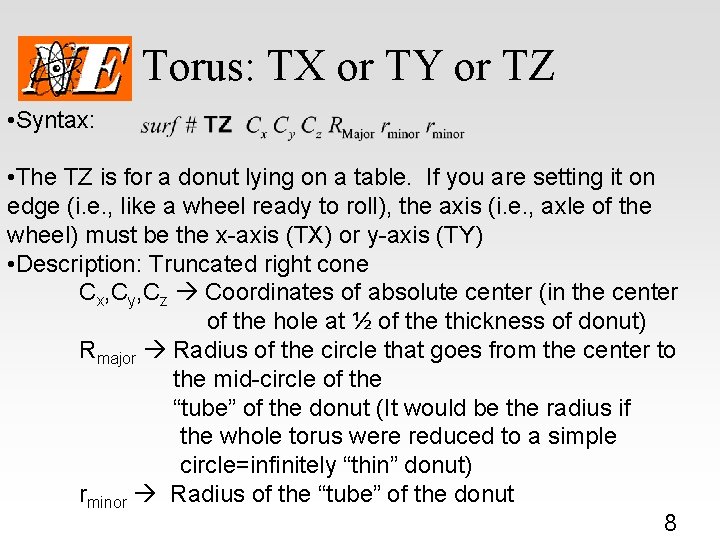
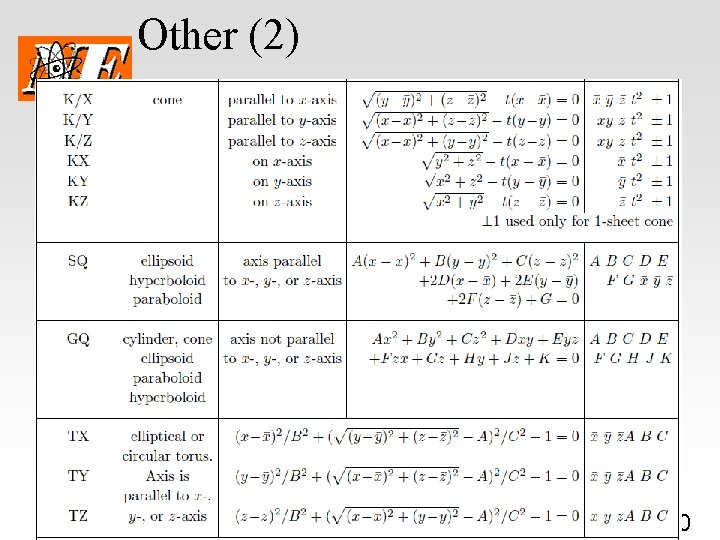
Torus: TX or TY or TZ • Syntax: • The TZ is for a donut lying on a table. If you are setting it on edge (i. e. , like a wheel ready to roll), the axis (i. e. , axle of the wheel) must be the x-axis (TX) or y-axis (TY) • Description: Truncated right cone Cx, Cy, Cz Coordinates of absolute center (in the center of the hole at ½ of the thickness of donut) Rmajor Radius of the circle that goes from the center to the mid-circle of the “tube” of the donut (It would be the radius if the whole torus were reduced to a simple circle=infinitely “thin” donut) rminor Radius of the “tube” of the donut 8
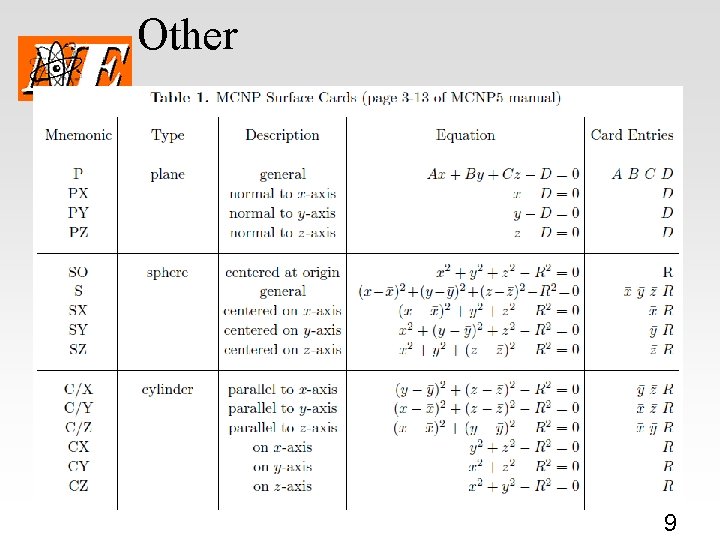
Other 9
Other (2) 10
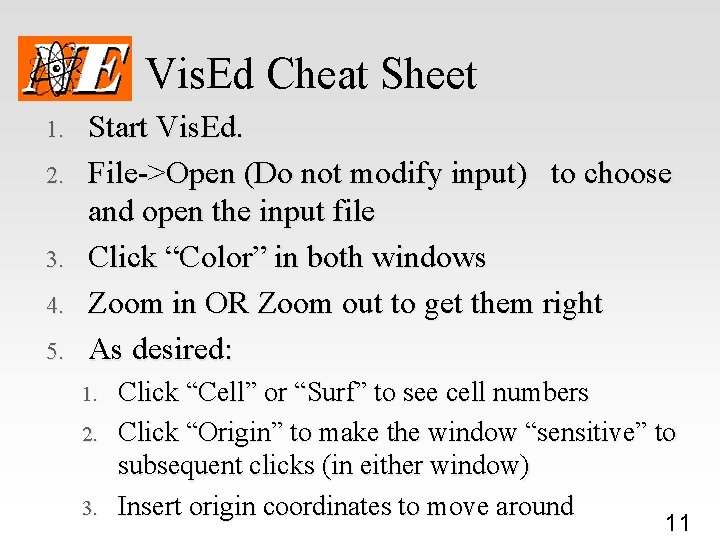
Vis. Ed Cheat Sheet 1. 2. 3. 4. 5. Start Vis. Ed. File->Open (Do not modify input) to choose and open the input file Click “Color” in both windows Zoom in OR Zoom out to get them right As desired: 1. 2. 3. Click “Cell” or “Surf” to see cell numbers Click “Origin” to make the window “sensitive” to subsequent clicks (in either window) Insert origin coordinates to move around 11
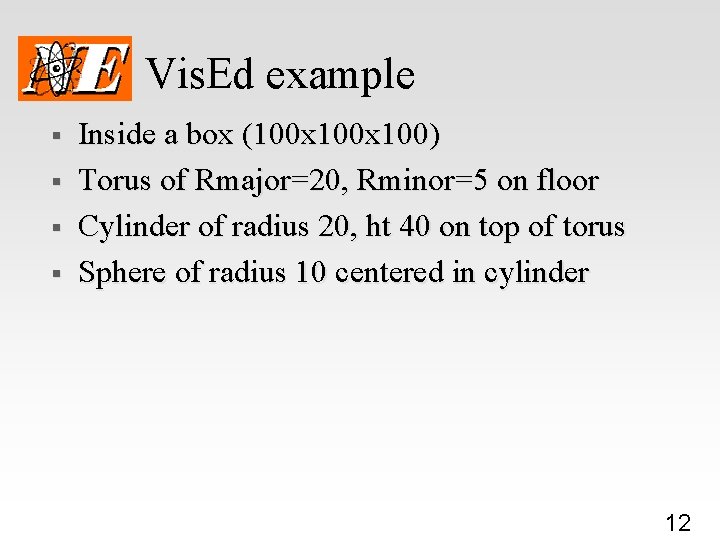
Vis. Ed example § § Inside a box (100 x 100) Torus of Rmajor=20, Rminor=5 on floor Cylinder of radius 20, ht 40 on top of torus Sphere of radius 10 centered in cylinder 12
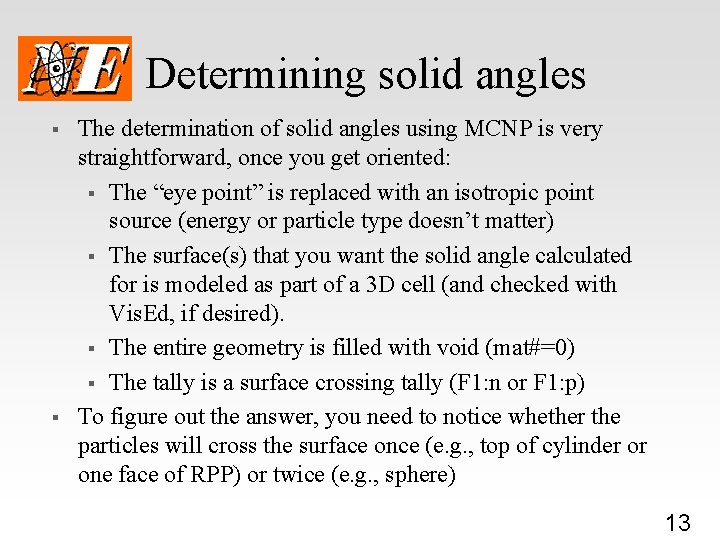
Determining solid angles § § The determination of solid angles using MCNP is very straightforward, once you get oriented: § The “eye point” is replaced with an isotropic point source (energy or particle type doesn’t matter) § The surface(s) that you want the solid angle calculated for is modeled as part of a 3 D cell (and checked with Vis. Ed, if desired). § The entire geometry is filled with void (mat#=0) § The tally is a surface crossing tally (F 1: n or F 1: p) To figure out the answer, you need to notice whether the particles will cross the surface once (e. g. , top of cylinder or one face of RPP) or twice (e. g. , sphere) 13
Solid Angle Examples § § § Disk of radius 1 from 10 above Sphere of radius 2 from 20 above center Torus (Rmajor=10, Rminor=2) from 20 cm above its center 14
HW 1. 1 § § Use a hand calculation to compute the solid angle subtended by a sphere of radius 5 cm whose center is 25 cm from the point of view Check your calculation with an MCNP calculation (within 0. 1% error) 15
HW 1. 2 § § Use a hand calculation to compute the solid angle subtended by a torus (lying flat on the floor) with major radius 10 cm and minor radius of 1 cm, as viewed from the point 20 cm above the floor. Check your calculation with an MCNP calculation (within 0. 1% error) 16
HW 1. 3 § § Use a hand calculation to calculate both the average flux and the average current on a 5 cm radius disk lying on the z=0 plane, centered on the origin. For the source use a point isotropic 2 Me. V neutron source located at (0, 0, 10). Assume void material fills an enclosing sphere of radius 30 cm (centered on the origin). Check your calculation with an MCNP calculation (within 0. 1% error) 17
- Slides: 17