
Lecture 2 An Overview of Financial System Outline
- Slides: 14
Lecture 2 An Overview of Financial System: Outline A. B. C. D. Methods of channeling funds Why Financial Markets exist? How to classify financial markets Why Financial Intermediaries exist
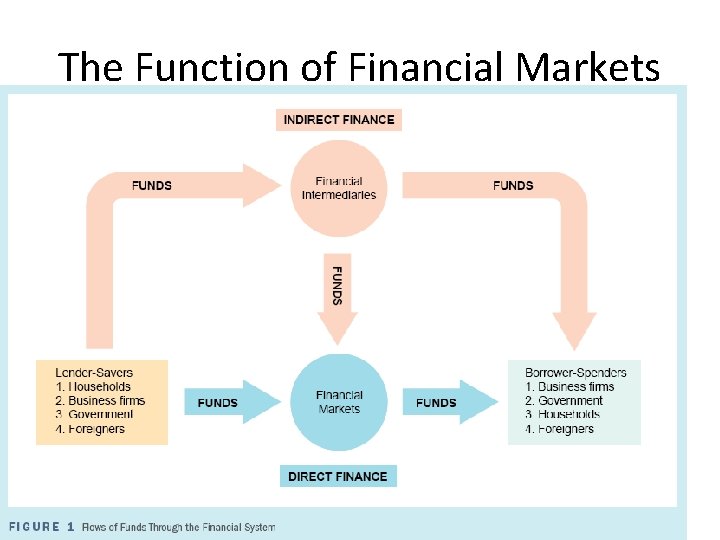
The Function of Financial Markets
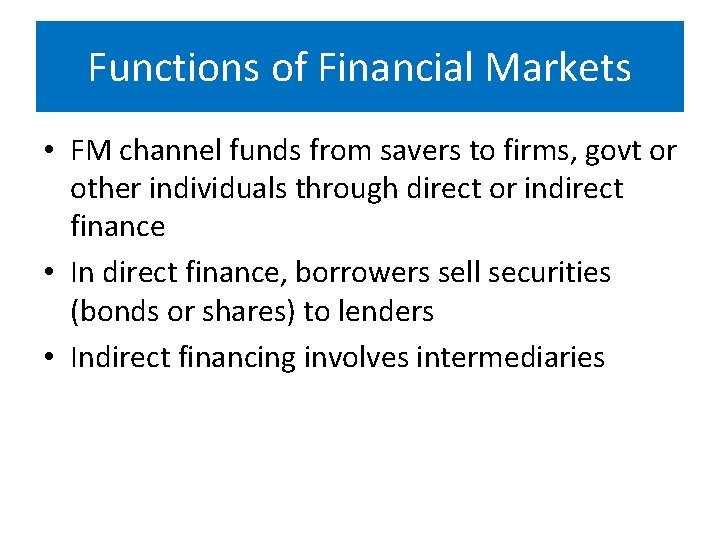
Functions of Financial Markets • FM channel funds from savers to firms, govt or other individuals through direct or indirect finance • In direct finance, borrowers sell securities (bonds or shares) to lenders • Indirect financing involves intermediaries
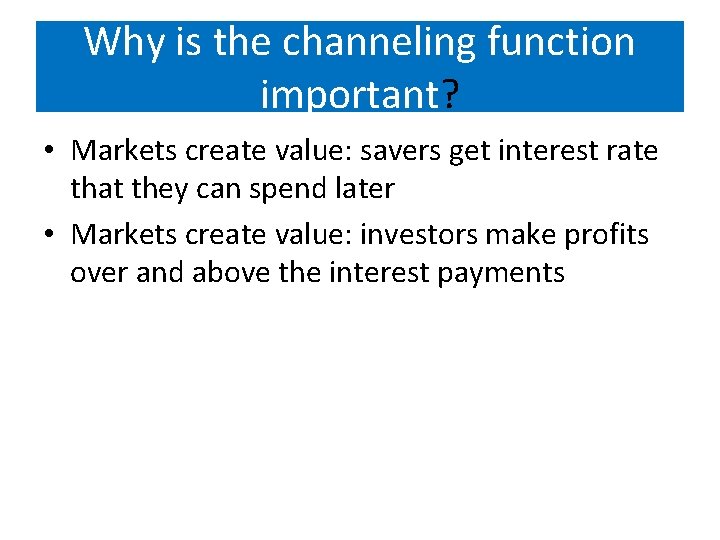
Why is the channeling function important? • Markets create value: savers get interest rate that they can spend later • Markets create value: investors make profits over and above the interest payments
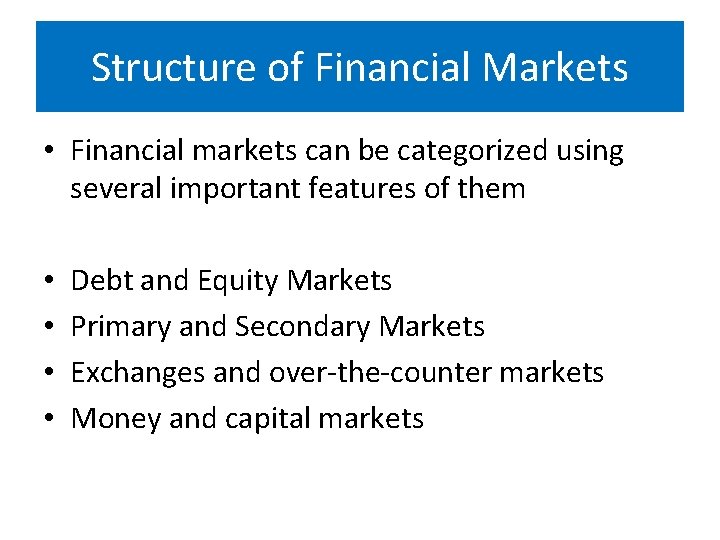
Structure of Financial Markets • Financial markets can be categorized using several important features of them • • Debt and Equity Markets Primary and Secondary Markets Exchanges and over-the-counter markets Money and capital markets
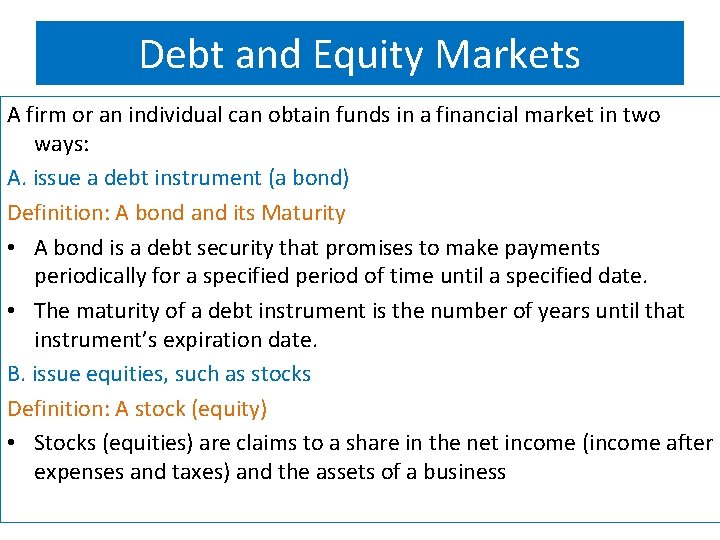
Debt and Equity Markets A firm or an individual can obtain funds in a financial market in two ways: A. issue a debt instrument (a bond) Definition: A bond and its Maturity • A bond is a debt security that promises to make payments periodically for a specified period of time until a specified date. • The maturity of a debt instrument is the number of years until that instrument’s expiration date. B. issue equities, such as stocks Definition: A stock (equity) • Stocks (equities) are claims to a share in the net income (income after expenses and taxes) and the assets of a business
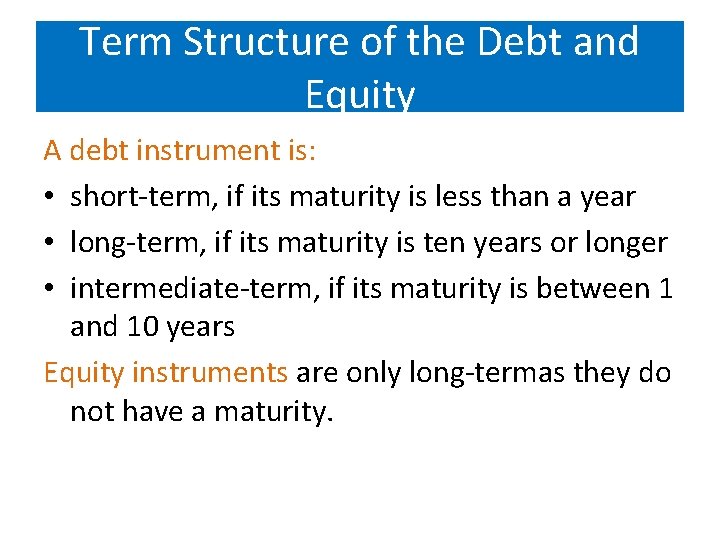
Term Structure of the Debt and Equity A debt instrument is: • short-term, if its maturity is less than a year • long-term, if its maturity is ten years or longer • intermediate-term, if its maturity is between 1 and 10 years Equity instruments are only long-termas they do not have a maturity.
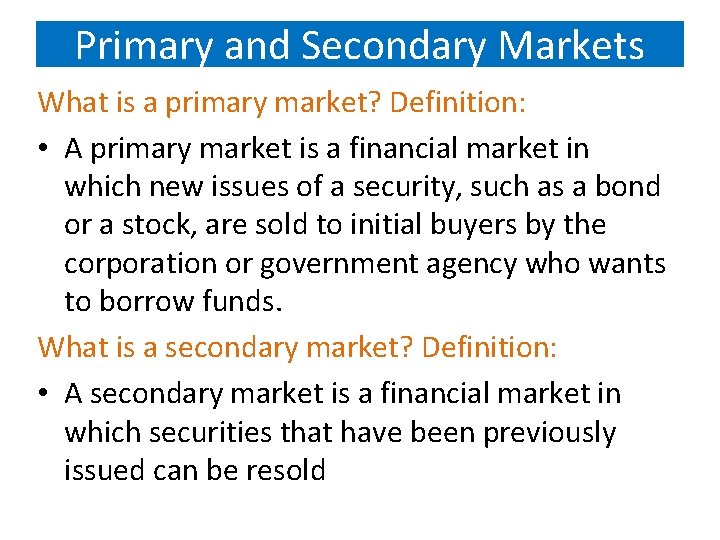
Primary and Secondary Markets What is a primary market? Definition: • A primary market is a financial market in which new issues of a security, such as a bond or a stock, are sold to initial buyers by the corporation or government agency who wants to borrow funds. What is a secondary market? Definition: • A secondary market is a financial market in which securities that have been previously issued can be resold
Exchanges and Over-the-Counter Markets Secondary markets are organized in two ways: • Exchanges: where buyers and sellers of securities meet in one central location to conduct trades like stock exchange • Over-the-counter markets: dealers at different locations who have securities and stand ready to sell them. They are usually computertraded.
Money and Capital Markets Money markets: a market where short-term securities are traded (maturity less than 1 year like T-bills and Commercial papers) Capital markets: a market where long-term securities are traded – bonds and equity with maturity of more than 1 year
Why Financial Intermediaries? Why financial intermediaries exist? To reduce transaction costs and information costs Transaction costs Which means the time and money spent on carrying out financial transactions • TC are major problem for people who have excess funds to lend • In absence of FIs, every lender will need a lawyer to write a contract for him which will be very costly • •
Transaction and Information costs • Financial intermediaries can reduce these costs as they have developed expertise in lower them and large size allow them to have economies of scale • For example, one a bank pays a lawyer for one contract and pay him even a higher price for a loan contract, the same contract can be used in many other loan contracts
Asymmetric Information: Adverse selection and Moral Hazard • Another reason for the presence of financial intermediaries is that one party often does not know enough about the other party to make accurate decision of lending • Asymmetric information means the inequality in the level of information between two parties • For example, a borrower usually have better information about the potential returns and risks of the project for which funds borrowed than the lender does
Information Problems: Adverse Selection and Moral Hazards • Information asymmetry creates two problems in the financial system on two fronts: – A. Before the transaction is entered into – B. After the transaction • Adverse Selection: Borrowers that can create undesirable outcome will actively seek out a loan and are thus most likely to be selected. Fearing of making a wrong decision, lenders will hesitate even to lend to good borrowers