
Lecture 19 Inequality A Challenge to Democracy Civil
- Slides: 25
Lecture 19 Inequality A Challenge to Democracy?
Civil Rights Act of 1964 • Outlawed discrimination in public accommodations under the Interstate Commerce Act • No tax dollars could go to organizations that discriminated • Outlawed job discrimination on the basis of race, religion, national origin, or sex • Created the Equal Employment Opportunity Commission (EEOC) to enforce these rules
Political Impact of Hurricane Katrina • Widespread sympathetic media coverage of race and poverty of storm victims: Newsweek article • FEMA and director Michael Brown discredited • Some evidence of racism in the policy response to Katrina • Negative media coverage of Bush Administration • Decline in Bush’s popularity
Affirmative Action • Equality of opportunity vs. equality of outcomes • Requires businesses and universities to keep records of minority hiring and to increase efforts to recruit underrepresented groups • Legally, quotas can only be imposed if a court finds proof of intent to discriminate
Challenges to Affirmative Action • Politically, “quota” label is used to discredit any special treatment of a minority group. • Claims of “reverse discrimination” against males, whites and Asians • Opposed by most whites and some blacks • Now banned in some states: California, Texas • 2005 Bollinger decisions upheld “diversity” as a valid factor for admissions at the University of Michigan. Strongly supported by business groups and the military.
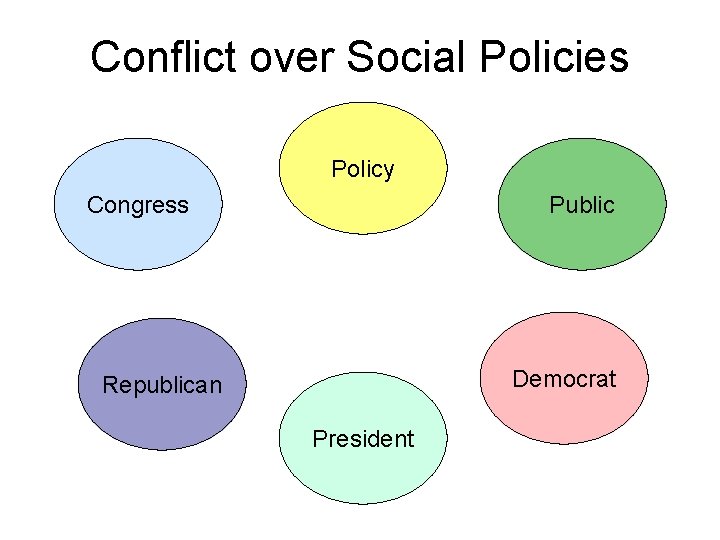
Conflict over Social Policies Policy Congress Public Democrat Republican President
Laissez-faire An economic theory that the federal government's only role in the economy is to ensure a stable supply of money. Minimal taxation and regulation
Conservatives/Republicans • Support of laissez-faire, operation of markets, individualism • Government interference with markets hurts incentives to work and save • Help the poor through private charity, churches, education
Liberals/Democrats • Markets create winners and losers • In a complex world economy, even hard work does not guarantee a job or savings • Children should not suffer because their parents are unable or unwilling to work • Government welfare programs help the economy by maintaining consumer demand
FDR • Became President in 1933 • During the Great Depression the U. S. suffered 25% unemployment. End of public support for laissez-faire and balanced budgets • Roosevelt’s Administration instituted the New Deal: help for the unemployed, support for labor unions, federal minimum wage law • FDR used public works programs and government spending to spur on the economy
17 -3 b The Evolution of Social Welfare Policy Government programs that provide goods and services to citizens to improve the quality of their lives.
Social Welfare Programs • Income maintenance programs: welfare, Social Security • Nutrition programs: WIC • Health programs: Medicare • Housing programs: Section 8 • Education programs: ESEA • Many provided by state or local governments
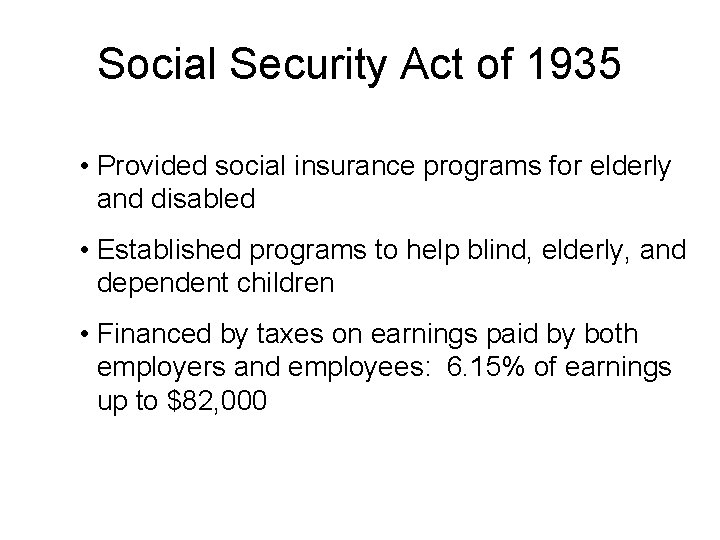
Social Security Act of 1935 • Provided social insurance programs for elderly and disabled • Established programs to help blind, elderly, and dependent children • Financed by taxes on earnings paid by both employers and employees: 6. 15% of earnings up to $82, 000
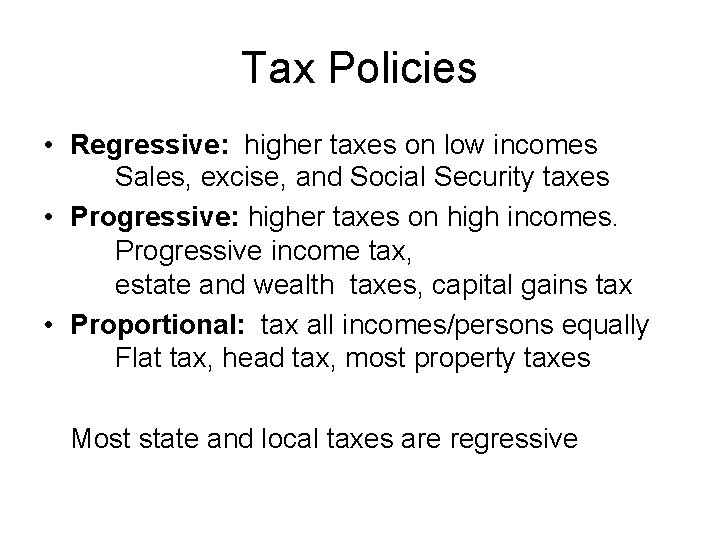
Tax Policies • Regressive: higher taxes on low incomes Sales, excise, and Social Security taxes • Progressive: higher taxes on high incomes. Progressive income tax, estate and wealth taxes, capital gains tax • Proportional: tax all incomes/persons equally Flat tax, head tax, most property taxes Most state and local taxes are regressive
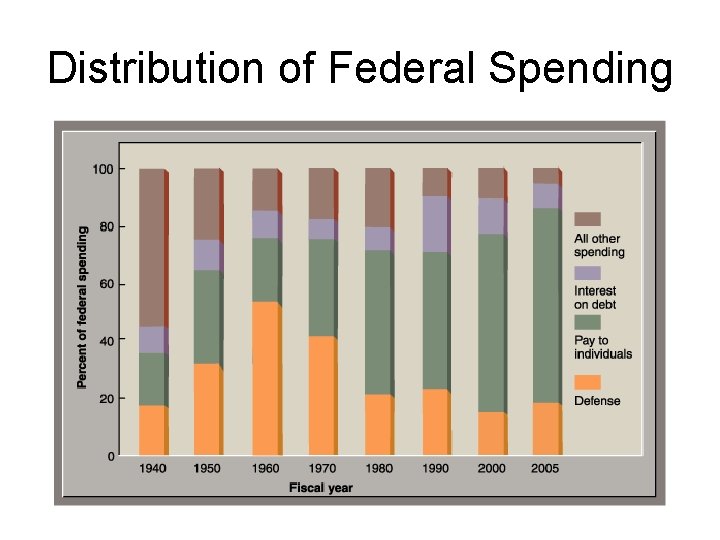
Distribution of Federal Spending
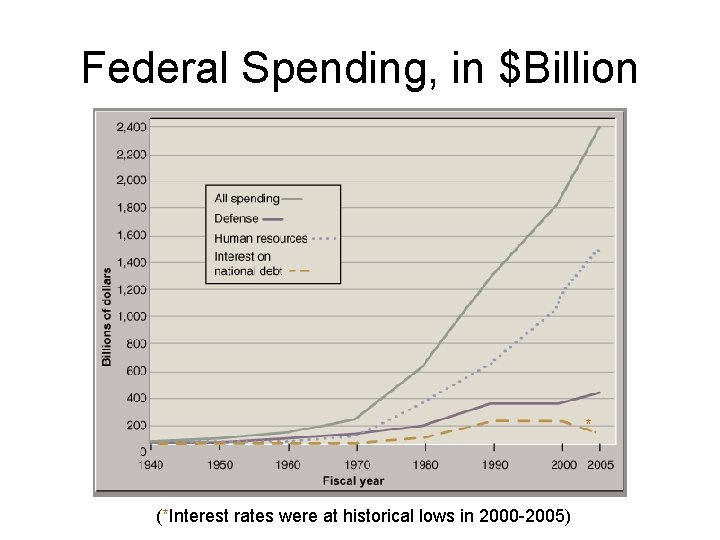
Federal Spending, in $Billion * (*Interest rates were at historical lows in 2000 -2005)
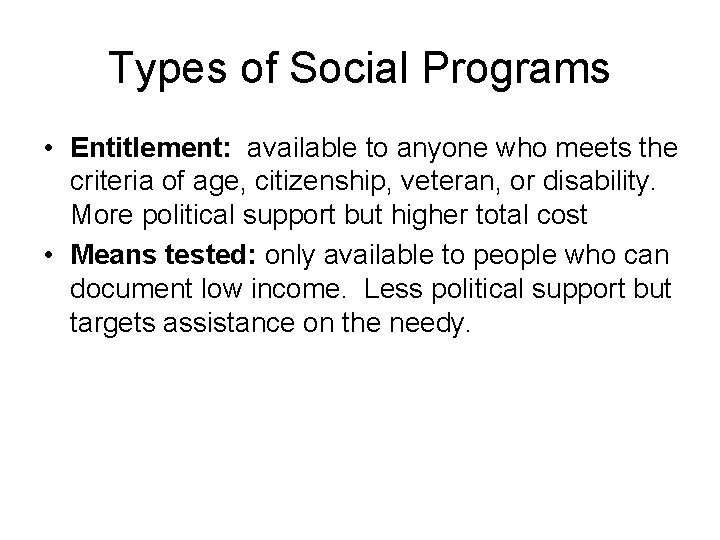
Types of Social Programs • Entitlement: available to anyone who meets the criteria of age, citizenship, veteran, or disability. More political support but higher total cost • Means tested: only available to people who can document low income. Less political support but targets assistance on the needy.
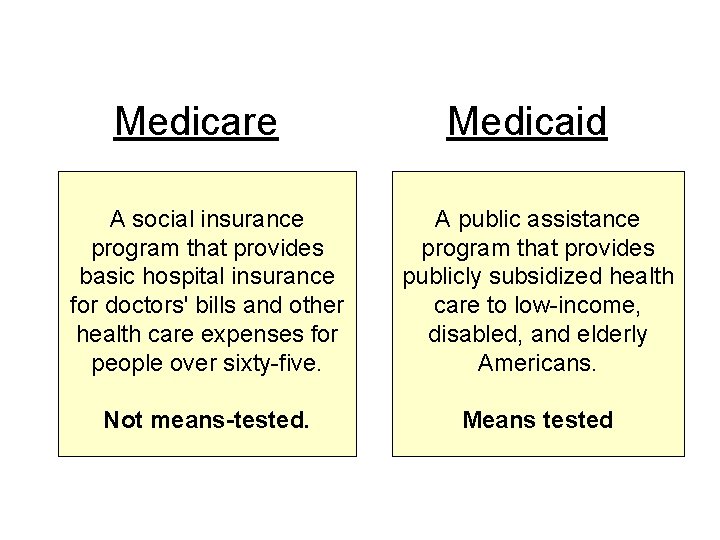
Medicare Medicaid A social insurance program that provides basic hospital insurance for doctors' bills and other health care expenses for people over sixty-five. A public assistance program that provides publicly subsidized health care to low-income, disabled, and elderly Americans. Not means-tested. Means tested
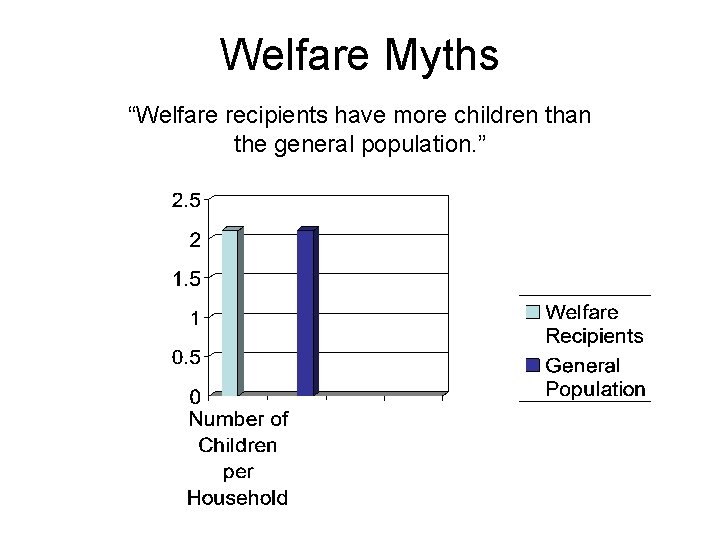
Welfare Myths “Welfare recipients have more children than the general population. ”
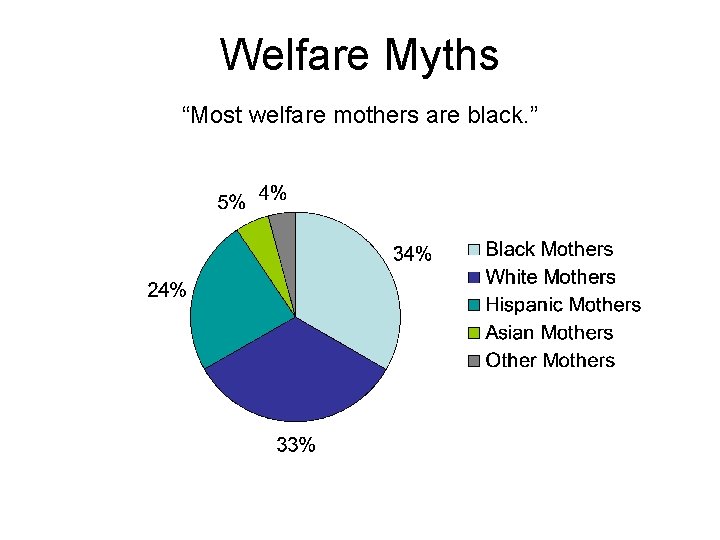
Welfare Myths “Most welfare mothers are black. ”
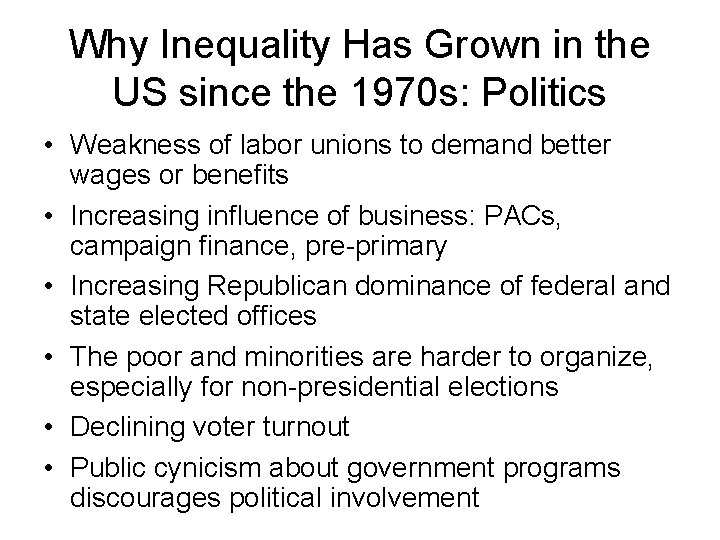
Why Inequality Has Grown in the US since the 1970 s: Politics • Weakness of labor unions to demand better wages or benefits • Increasing influence of business: PACs, campaign finance, pre-primary • Increasing Republican dominance of federal and state elected offices • The poor and minorities are harder to organize, especially for non-presidential elections • Declining voter turnout • Public cynicism about government programs discourages political involvement
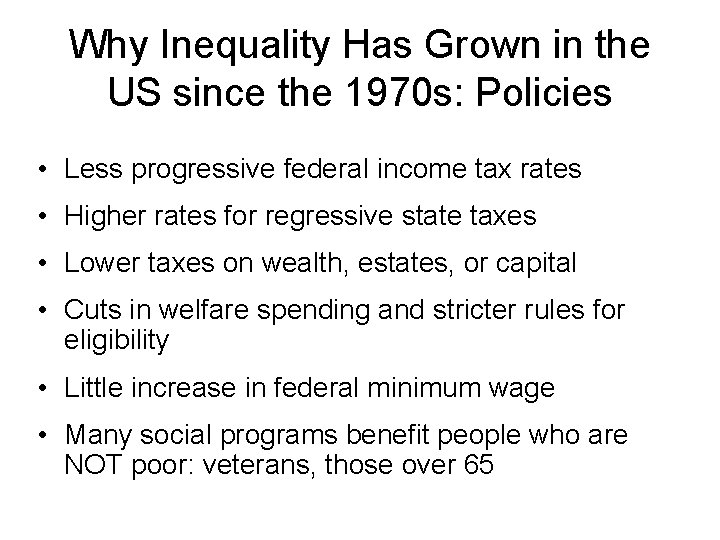
Why Inequality Has Grown in the US since the 1970 s: Policies • Less progressive federal income tax rates • Higher rates for regressive state taxes • Lower taxes on wealth, estates, or capital • Cuts in welfare spending and stricter rules for eligibility • Little increase in federal minimum wage • Many social programs benefit people who are NOT poor: veterans, those over 65
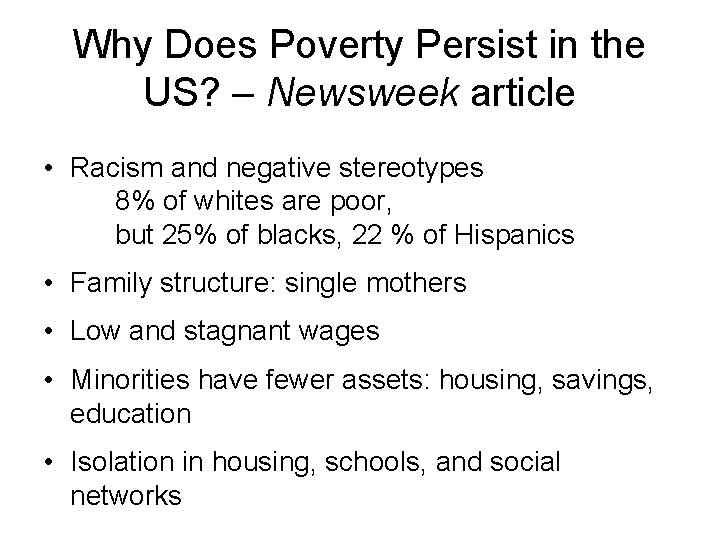
Why Does Poverty Persist in the US? – Newsweek article • Racism and negative stereotypes 8% of whites are poor, but 25% of blacks, 22 % of Hispanics • Family structure: single mothers • Low and stagnant wages • Minorities have fewer assets: housing, savings, education • Isolation in housing, schools, and social networks
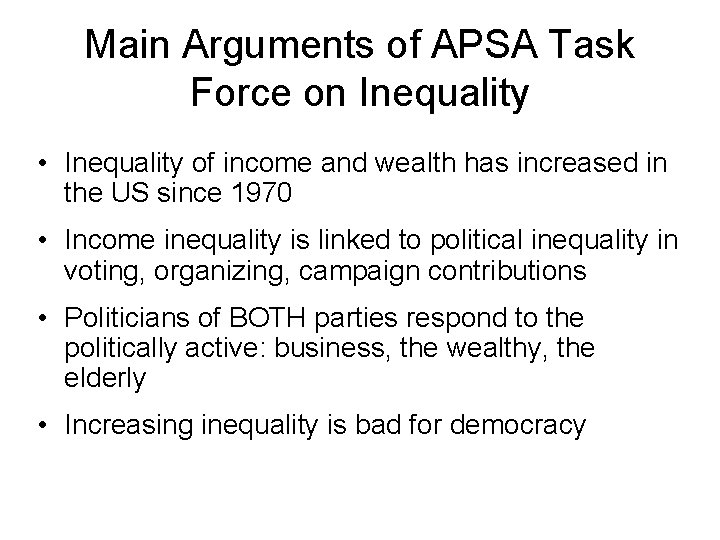
Main Arguments of APSA Task Force on Inequality • Inequality of income and wealth has increased in the US since 1970 • Income inequality is linked to political inequality in voting, organizing, campaign contributions • Politicians of BOTH parties respond to the politically active: business, the wealthy, the elderly • Increasing inequality is bad for democracy
Reforms to Increase Political Equality • Enact policies to benefit the needs and values of ordinary people, like health care • Improve economic conditions for minorities • Encourage non-governmental institutions like unions, churches, and political parties • Better media coverage of political issues, candidates, and policy options