
Lecture 19 EvolutionPhylogeny Introduction to Bioinformatics Bioinformatics Nothing
Lecture 19: Evolution/Phylogeny Introduction to Bioinformatics
Bioinformatics “Nothing in Biology makes sense except in the light of evolution” (Theodosius Dobzhansky (1900 -1975)) “Nothing in bioinformatics makes sense except in the light of Biology”
Evolution • Most of bioinformatics is comparative biology • Comparative biology is based upon evolutionary relationships between compared entities • Evolutionary relationships are normally depicted in a phylogenetic tree
Where can phylogeny be used • For example, finding out about orthology versus paralogy • Predicting secondary structure of RNA • Studying host-parasite relationships • Mapping cell-bound receptors onto their binding ligands • Multiple sequence alignment (e. g. Clustal)
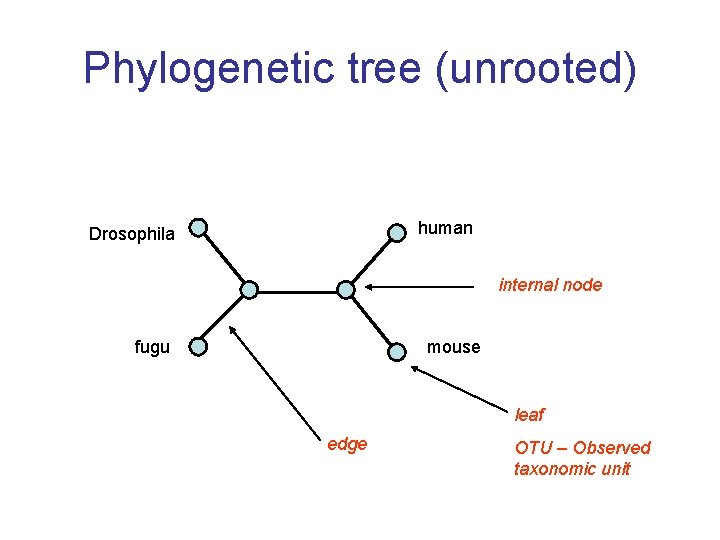
Phylogenetic tree (unrooted) human Drosophila internal node fugu mouse leaf edge OTU – Observed taxonomic unit
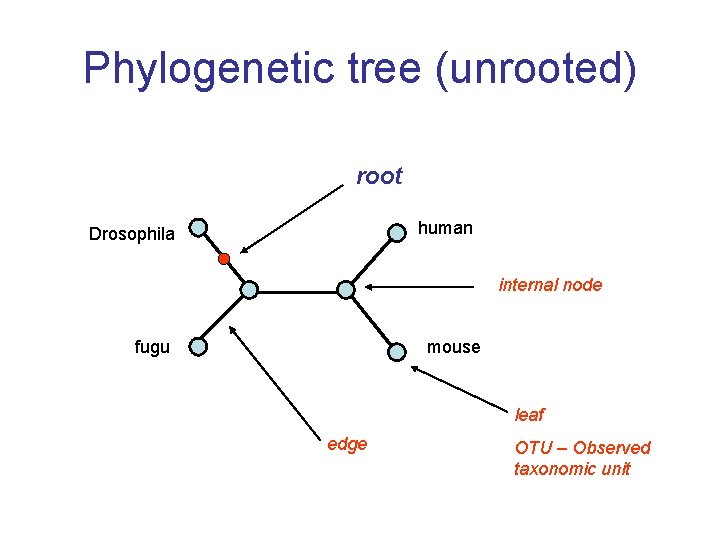
Phylogenetic tree (unrooted) root human Drosophila internal node fugu mouse leaf edge OTU – Observed taxonomic unit
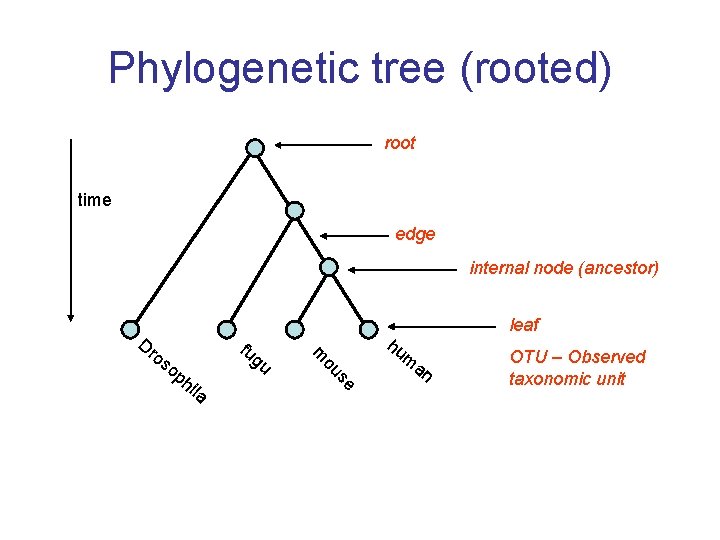
Phylogenetic tree (rooted) root time edge internal node (ancestor) hi la gu se op fu ou os m Dr hu m an leaf OTU – Observed taxonomic unit
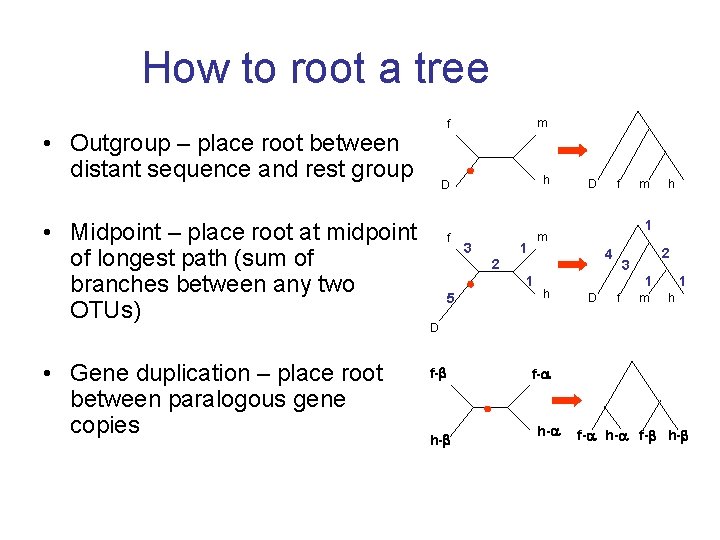
How to root a tree • Outgroup – place root between distant sequence and rest group • Midpoint – place root at midpoint of longest path (sum of branches between any two OTUs) • Gene duplication – place root between paralogous gene copies f m D h f m 3 1 D 4 1 h m h 1 2 5 f 2 3 1 D f m 1 h D f- h- f- h-
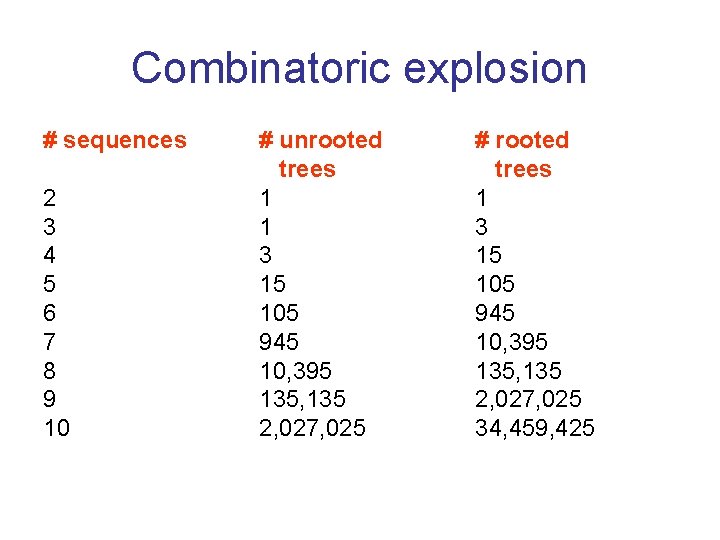
Combinatoric explosion # sequences 2 3 4 5 6 7 8 9 10 # unrooted trees 1 1 3 15 105 945 10, 395 135, 135 2, 027, 025 # rooted trees 1 3 15 105 945 10, 395 135, 135 2, 027, 025 34, 459, 425
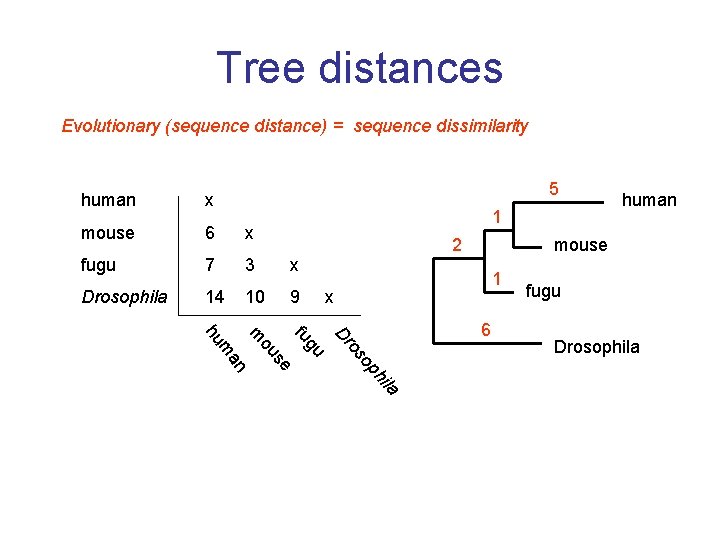
Tree distances Evolutionary (sequence distance) = sequence dissimilarity 5 human x mouse 6 x fugu 7 3 x Drosophila 14 10 9 1 human mouse 2 1 x la hi op os Dr gu fu se ou m an m hu 6 fugu Drosophila
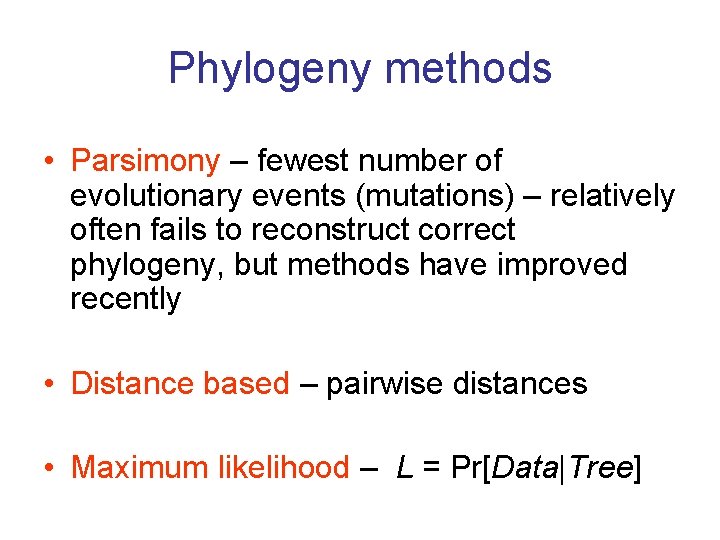
Phylogeny methods • Parsimony – fewest number of evolutionary events (mutations) – relatively often fails to reconstruct correct phylogeny, but methods have improved recently • Distance based – pairwise distances • Maximum likelihood – L = Pr[Data|Tree]
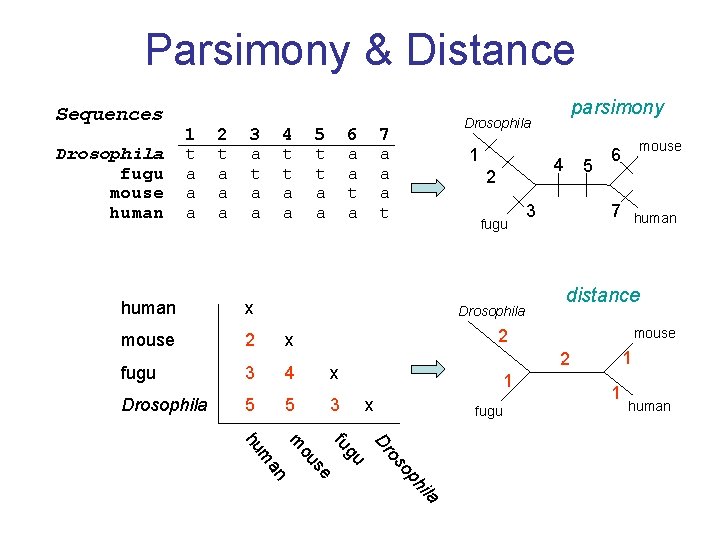
Parsimony & Distance Sequences Drosophila fugu mouse human 1 t a a a 2 t a a a 3 a t a a 4 t t a a 5 t t a a 6 a a t a human x mouse 2 x fugu 3 4 x Drosophila 5 5 3 parsimony Drosophila 7 a a a t 1 4 2 fugu Drosophila 5 3 mouse 6 7 human distance mouse 2 1 x fugu 1 human la i ph o os Dr gu fu se ou m an m hu
Maximum likelihood • If data=alignment, hypothesis = tree, and under a given evolutionary model, maximum likelihood selects the hypothesis (tree) that maximises the observed data • Extremely time consuming method • We also can test the relative fit to the tree of different models (Huelsenbeck & Rannala, 1997)
Bayesian methods • Calculates the posterior probability of a tree (Huelsenbeck et al. , 2001) –- probability that tree is true tree given evolutionary model • Most computer intensive technique • Feasible thanks to Markov chain Monte Carlo (MCMC) numerical technique for integrating over probability distributions • Gives confidence number (posterior probability) per node
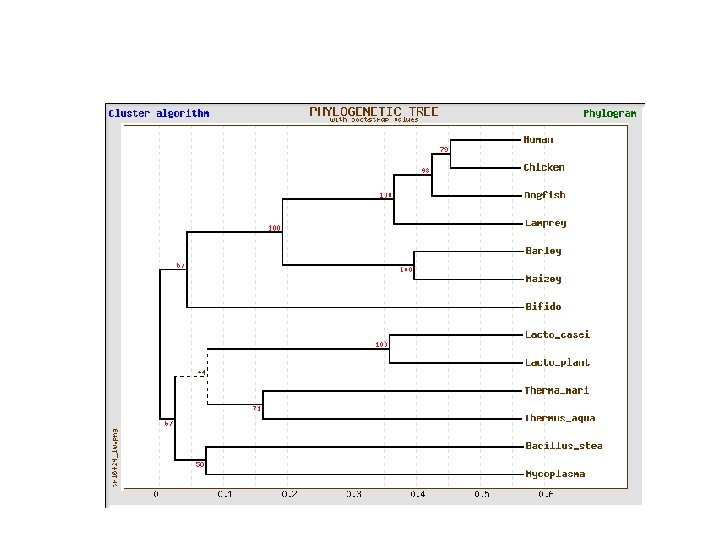
Distance methods: fastest • Clustering criterion using a distance matrix • Distance matrix filled with alignment scores (sequence identity, alignment scores, E-values, etc. ) • Cluster criterion
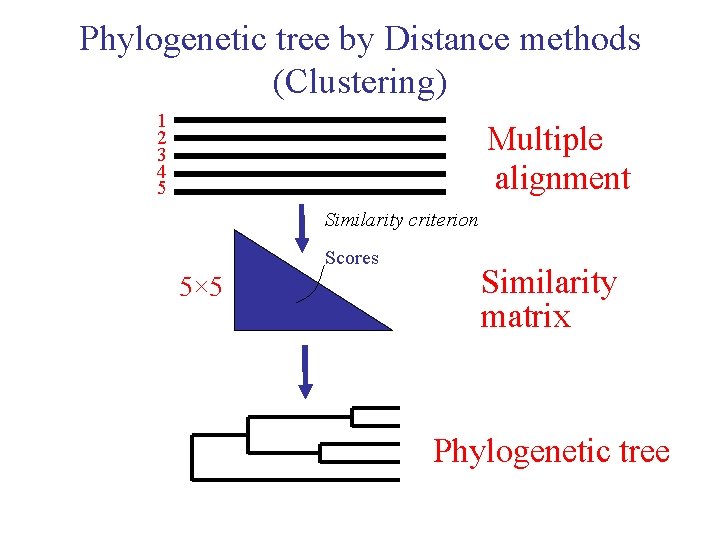
Phylogenetic tree by Distance methods (Clustering) 1 2 3 4 5 Multiple alignment Similarity criterion Scores 5× 5 Similarity matrix Phylogenetic tree
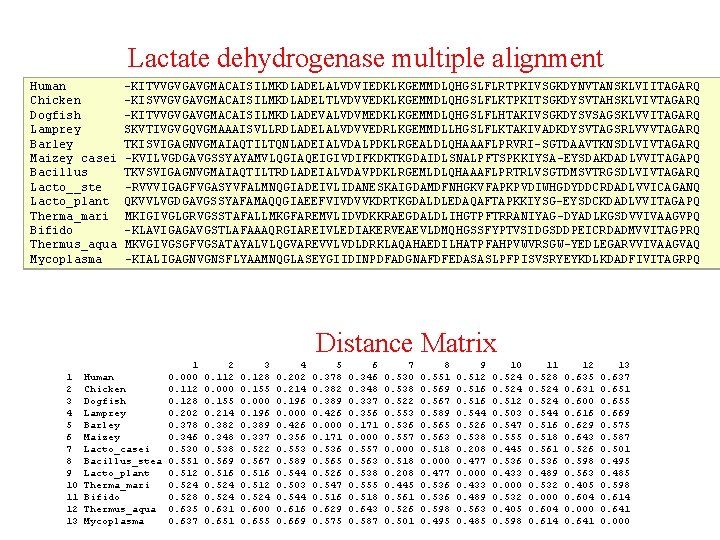
Lactate dehydrogenase multiple alignment Human Chicken Dogfish Lamprey Barley Maizey casei Bacillus Lacto__ste Lacto_plant Therma_mari Bifido Thermus_aqua Mycoplasma -KITVVGVGAVGMACAISILMKDLADELALVDVIEDKLKGEMMDLQHGSLFLRTPKIVSGKDYNVTANSKLVIITAGARQ -KISVVGVGAVGMACAISILMKDLADELTLVDVVEDKLKGEMMDLQHGSLFLKTPKITSGKDYSVTAHSKLVIVTAGARQ –KITVVGVGAVGMACAISILMKDLADEVALVDVMEDKLKGEMMDLQHGSLFLHTAKIVSGKDYSVSAGSKLVVITAGARQ SKVTIVGVGQVGMAAAISVLLRDLADELALVDVVEDRLKGEMMDLLHGSLFLKTAKIVADKDYSVTAGSRLVVVTAGARQ TKISVIGAGNVGMAIAQTILTQNLADEIALVDALPDKLRGEALDLQHAAAFLPRVRI-SGTDAAVTKNSDLVIVTAGARQ -KVILVGDGAVGSSYAYAMVLQGIAQEIGIVDIFKDKTKGDAIDLSNALPFTSPKKIYSA-EYSDAKDADLVVITAGAPQ TKVSVIGAGNVGMAIAQTILTRDLADEIALVDAVPDKLRGEMLDLQHAAAFLPRTRLVSGTDMSVTRGSDLVIVTAGARQ -RVVVIGAGFVGASYVFALMNQGIADEIVLIDANESKAIGDAMDFNHGKVFAPKPVDIWHGDYDDCRDADLVVICAGANQ QKVVLVGDGAVGSSYAFAMAQQGIAEEFVIVDVVKDRTKGDALDLEDAQAFTAPKKIYSG-EYSDCKDADLVVITAGAPQ MKIGIVGLGRVGSSTAFALLMKGFAREMVLIDVDKKRAEGDALDLIHGTPFTRRANIYAG-DYADLKGSDVVIVAAGVPQ -KLAVIGAGAVGSTLAFAAAQRGIAREIVLEDIAKERVEAEVLDMQHGSSFYPTVSIDGSDDPEICRDADMVVITAGPRQ MKVGIVGSGFVGSATAYALVLQGVAREVVLVDLDRKLAQAHAEDILHATPFAHPVWVRSGW-YEDLEGARVVIVAAGVAQ -KIALIGAGNVGNSFLYAAMNQGLASEYGIIDINPDFADGNAFDFEDASASLPFPISVSRYEYKDLKDADFIVITAGRPQ Distance Matrix 1 1 Human 0. 000 2 Chicken 0. 112 3 Dogfish 0. 128 4 Lamprey 0. 202 5 Barley 0. 378 6 Maizey 0. 346 7 Lacto_casei 0. 530 8 Bacillus_stea 0. 551 9 Lacto_plant 0. 512 10 Therma_mari 0. 524 11 Bifido 0. 528 12 Thermus_aqua 0. 635 13 Mycoplasma 0. 637 2 0. 112 0. 000 0. 155 0. 214 0. 382 0. 348 0. 538 0. 569 0. 516 0. 524 0. 631 0. 651 3 0. 128 0. 155 0. 000 0. 196 0. 389 0. 337 0. 522 0. 567 0. 516 0. 512 0. 524 0. 600 0. 655 4 0. 202 0. 214 0. 196 0. 000 0. 426 0. 356 0. 553 0. 589 0. 544 0. 503 0. 544 0. 616 0. 669 5 0. 378 0. 382 0. 389 0. 426 0. 000 0. 171 0. 536 0. 565 0. 526 0. 547 0. 516 0. 629 0. 575 6 0. 348 0. 337 0. 356 0. 171 0. 000 0. 557 0. 563 0. 538 0. 555 0. 518 0. 643 0. 587 7 0. 530 0. 538 0. 522 0. 553 0. 536 0. 557 0. 000 0. 518 0. 208 0. 445 0. 561 0. 526 0. 501 8 0. 551 0. 569 0. 567 0. 589 0. 565 0. 563 0. 518 0. 000 0. 477 0. 536 0. 598 0. 495 9 0. 512 0. 516 0. 544 0. 526 0. 538 0. 208 0. 477 0. 000 0. 433 0. 489 0. 563 0. 485 10 0. 524 0. 512 0. 503 0. 547 0. 555 0. 445 0. 536 0. 433 0. 000 0. 532 0. 405 0. 598 11 0. 528 0. 524 0. 544 0. 516 0. 518 0. 561 0. 536 0. 489 0. 532 0. 000 0. 604 0. 614 12 0. 635 0. 631 0. 600 0. 616 0. 629 0. 643 0. 526 0. 598 0. 563 0. 405 0. 604 0. 000 0. 641 13 0. 637 0. 651 0. 655 0. 669 0. 575 0. 587 0. 501 0. 495 0. 485 0. 598 0. 614 0. 641 0. 000
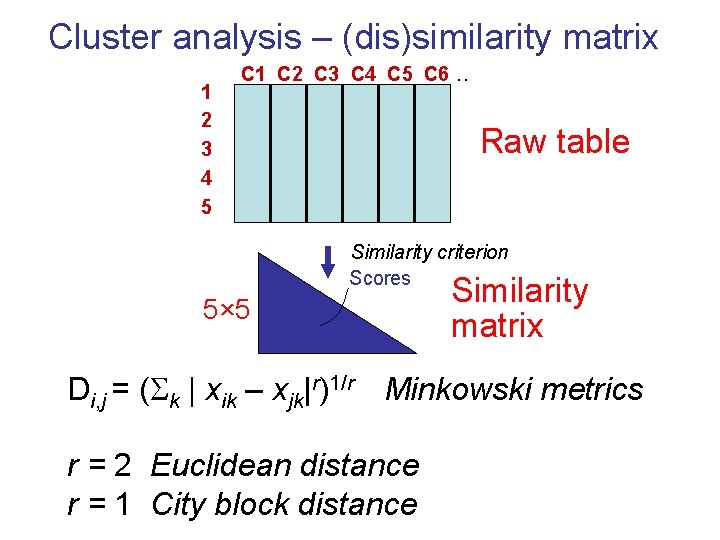
Cluster analysis – (dis)similarity matrix 1 2 3 4 5 C 1 C 2 C 3 C 4 C 5 C 6 . . Raw table Similarity criterion Scores 5× 5 Similarity matrix Di, j = ( k | xik – xjk|r)1/r Minkowski metrics r = 2 Euclidean distance r = 1 City block distance
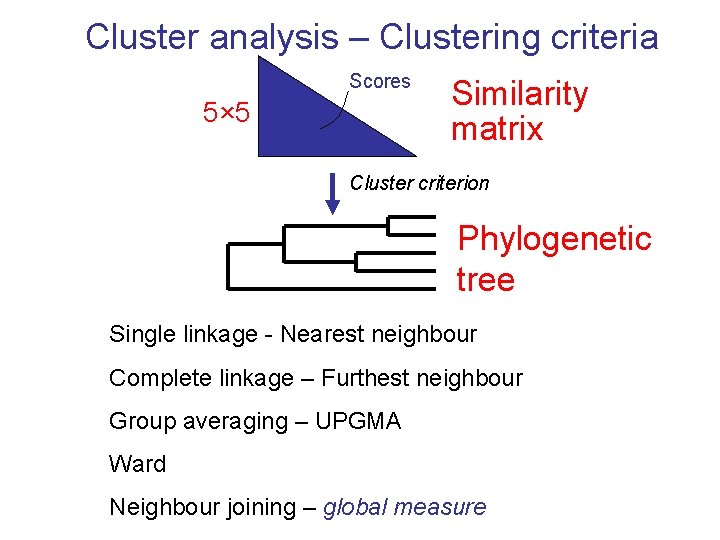
Cluster analysis – Clustering criteria Scores 5× 5 Similarity matrix Cluster criterion Phylogenetic tree Single linkage - Nearest neighbour Complete linkage – Furthest neighbour Group averaging – UPGMA Ward Neighbour joining – global measure
Neighbour joining • Global measure – keeps total branch length minimal, tends to produce a tree with minimal total branch length • At each step, join two nodes such that distances are minimal (criterion of minimal evolution) • Agglomerative algorithm • Leads to unrooted tree
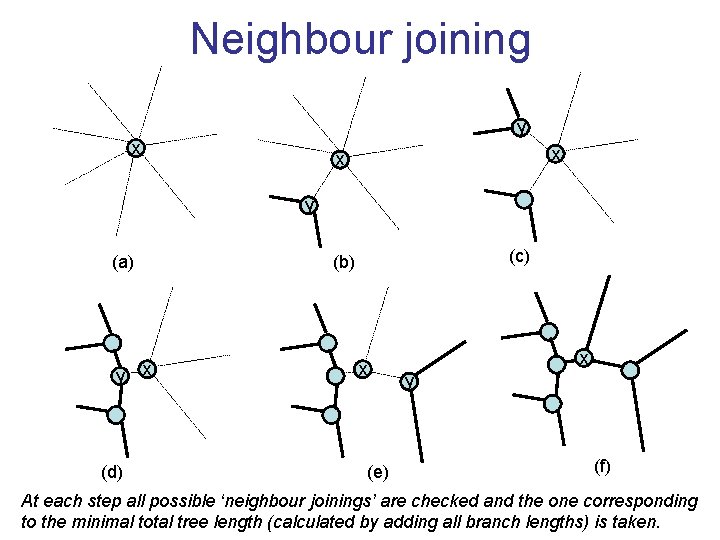
Neighbour joining y x x x y (a) y (d) (c) (b) x x (e) x y (f) At each step all possible ‘neighbour joinings’ are checked and the one corresponding to the minimal total tree length (calculated by adding all branch lengths) is taken.
How to assess confidence in tree • Bayesian method – time consuming – The Bayesian posterior probabilities (BPP) are assigned to internal branches in consensus tree – Bayesian Markov chain Monte Carlo (MCMC) analytical software such as Mr. Bayes (Huelsenbeck and Ronquist, 2001) and BAMBE (Simon and Larget, 1998) is now commonly used – Uses all the data • Distance method – bootstrap: – – – Select multiple alignment columns with replacement Recalculate tree Compare branches with original (target) tree Repeat 100 -1000 times, so calculate 100 -1000 different trees How often is branching (point between 3 nodes) preserved for each internal node? – Uses samples of the data
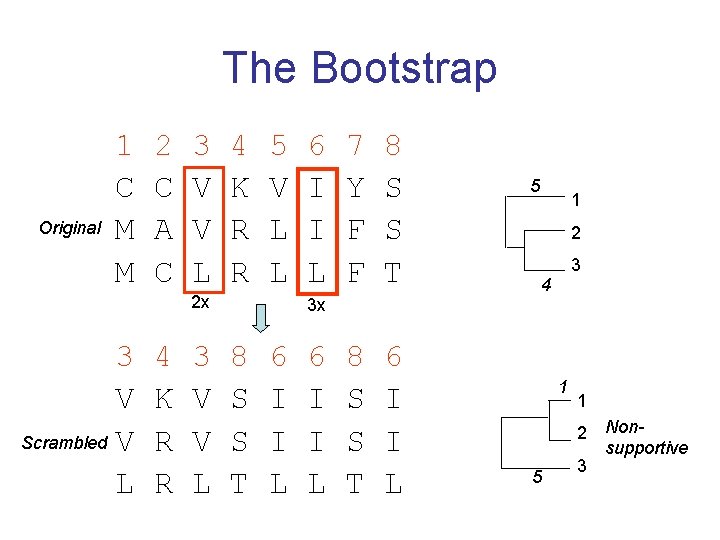
The Bootstrap Original 1 C M M 2 C A C 3 V V L 4 K R R 5 V L L 2 x 3 V Scrambled V L 4 K R R 3 V V L 6 I I L 7 Y F F 8 S S T 6 I I L 3 x 8 S S T 6 I I L 5 1 2 3 4 1 1 2 5 3 Nonsupportive
- Slides: 24