
Lecture 19 Country Risk Analysis Chapter Objectives n
Lecture 19 Country Risk Analysis
Chapter Objectives n To identify the common factors used by MNCs to measure a country’s political risk and financial risk; n To explain the techniques used to measure country risk; and n To explain how MNCs use the assessment of country risk when making financial decisions. 16 - 2
Why Country Risk Analysis Is Important • Country risk represents the potentially adverse impact of a country’s environment on an MNC’s cash flows. 16 - 3
Why Country Risk Analysis Is Important • Country risk analysis can be used: to monitor countries where the MNC is currently doing business; ¤ as a screening device to avoid conducting business in countries with excessive risk; and ¤ to revise its investment or financing decisions in light of recent events. ¤ 16 - 4
Political Risk Factors • Attitude of consumers in the host country Some consumers are very loyal to locally manufactured products. Actions of host government ¤ The host government may impose special requirements or taxes, restrict fund transfers, and subsidize local firms. MNCs can also be hurt by a lack of restrictions, such as failure to enforce copyright laws. ¤ • 16 - 5

Political Risk Factors • Blockage of fund transfers ¤ If fund transfers are blocked, subsidiaries will have to undertake projects that may not be optimal for the MNC. • Currency inconvertibility ¤ The MNC parent may need to exchange earnings for goods if the foreign currency cannot be changed into other currencies. 16 - 6
Political Risk Factors • War ¤ Internal and external battles, or even the threat of war, can have devastating effects. • Bureaucracy ¤ Bureaucracy can complicate businesses. • Corruption ¤ Corruption can increase the cost of conducting business or reduce revenue. 16 - 7
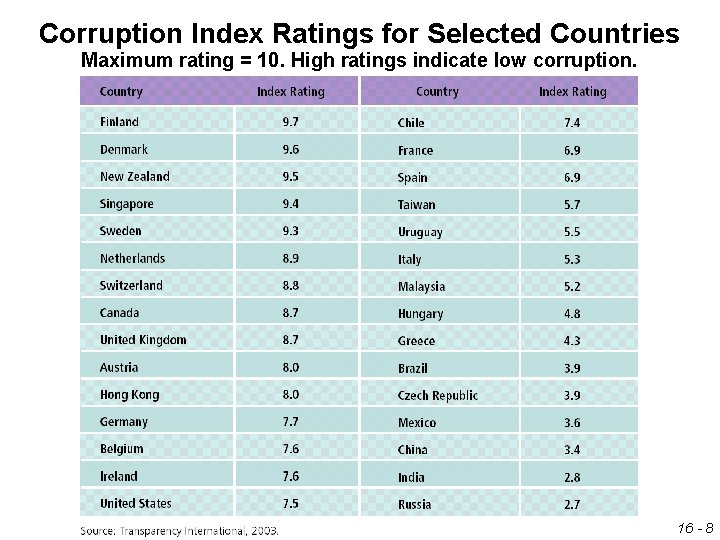
Corruption Index Ratings for Selected Countries Maximum rating = 10. High ratings indicate low corruption. 16 - 8
Financial Risk Factors • Indicators of economic growth The current and potential state of a country’s economy is important since a recession can severely reduce demand. ¤ A country’s economic growth is dependent on several financial factors - interest rates, exchange rates, inflation, etc. ¤ 16 - 9
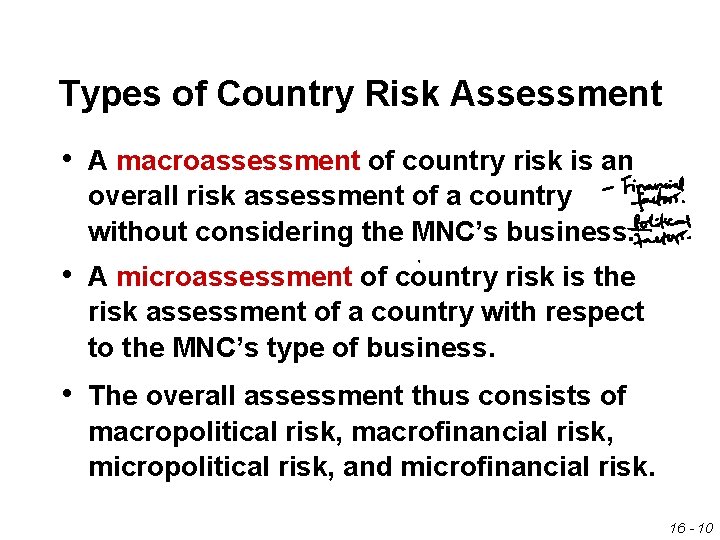
Types of Country Risk Assessment • A macroassessment of country risk is an overall risk assessment of a country without considering the MNC’s business. • A microassessment of country risk is the risk assessment of a country with respect to the MNC’s type of business. • The overall assessment thus consists of macropolitical risk, macrofinancial risk, micropolitical risk, and microfinancial risk. 16 - 10
Types of Country Risk Assessment • Note that there is clearly a degree of subjectivity in: ¤ identifying the relevant political and financial factors, ¤ determining the relative importance of each factor, and ¤ predicting the values of factors that cannot be measured objectively. 16 - 11
Techniques of Assessing Country Risk • The checklist approach involves rating and weighting all the macro and micro political and financial factors to derive an overall assessment of country risk. • The Delphi technique involves collecting various independent opinions and then averaging and measuring the dispersion of those opinions. 16 - 12
Techniques of Assessing Country Risk • Quantitative analysis techniques like regression analysis can be applied to historical data to assess the sensitivity of the business to various risk factors. • Inspection visits involve traveling to a country and meeting with government officials, firm executives, and consumers to clarify uncertainties. 16 - 13
Techniques of Assessing Country Risk • Often, firms use a variety of techniques for making country risk assessments. • For example, they may use the checklist approach to develop an overall country risk rating, and some of the other techniques to assign ratings to the factors. 16 - 14
• Source: Adopted from South. Western/Thomson Learning © 2006 16 - 15
- Slides: 15