
Lecture 19 Coriolis Acceleration Ocean Circulations and Climate

- Slides: 37
Lecture 19 Coriolis Acceleration, Ocean Circulations, and Climate John Rundle GEL/EPS 131 WQ 2014
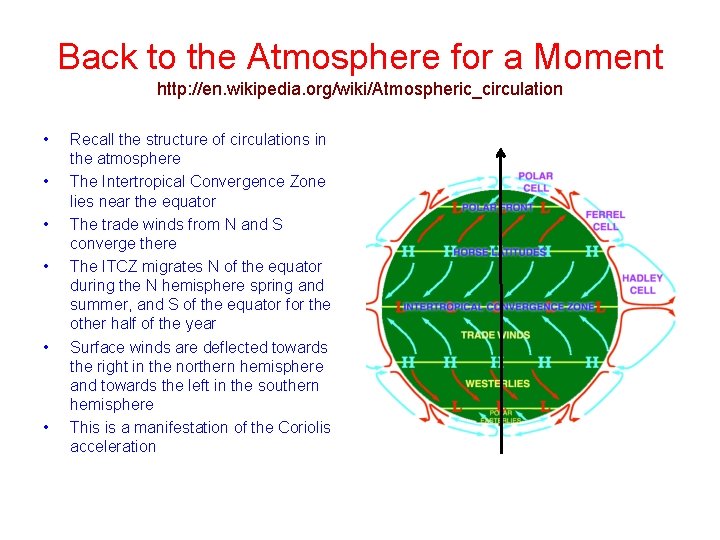
Back to the Atmosphere for a Moment http: //en. wikipedia. org/wiki/Atmospheric_circulation • • • Recall the structure of circulations in the atmosphere The Intertropical Convergence Zone lies near the equator The trade winds from N and S converge there The ITCZ migrates N of the equator during the N hemisphere spring and summer, and S of the equator for the other half of the year Surface winds are deflected towards the right in the northern hemisphere and towards the left in the southern hemisphere This is a manifestation of the Coriolis acceleration
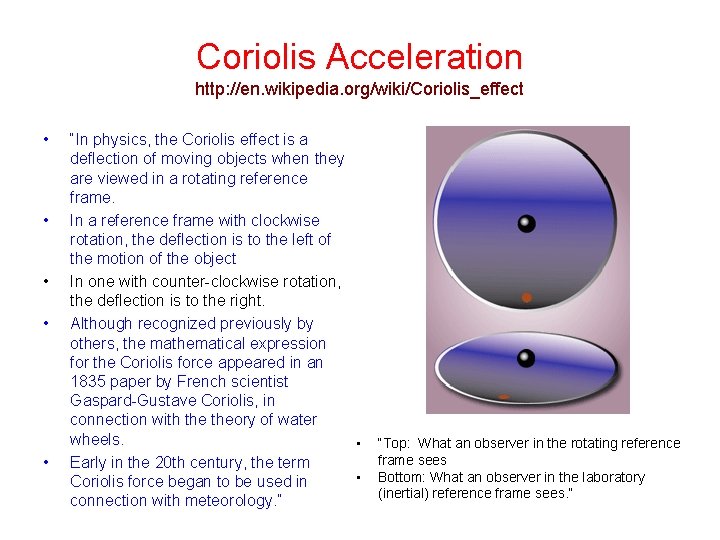
Coriolis Acceleration http: //en. wikipedia. org/wiki/Coriolis_effect • • • “In physics, the Coriolis effect is a deflection of moving objects when they are viewed in a rotating reference frame. In a reference frame with clockwise rotation, the deflection is to the left of the motion of the object In one with counter-clockwise rotation, the deflection is to the right. Although recognized previously by others, the mathematical expression for the Coriolis force appeared in an 1835 paper by French scientist Gaspard-Gustave Coriolis, in connection with theory of water wheels. • Early in the 20 th century, the term • Coriolis force began to be used in connection with meteorology. ” “Top: What an observer in the rotating reference frame sees Bottom: What an observer in the laboratory (inertial) reference frame sees. ”
Coriolis Acceleration on the Earth • • “Perhaps the most commonly encountered rotating reference frame is the Earth. The Coriolis effect is caused by the rotation of the Earth and the inertia of the mass experiencing the effect. Because the Earth completes only one rotation per day, the Coriolis force is quite small, and its effects generally become noticeable only for motions occurring over large distances and long periods of time, such as large-scale movement of air in the atmosphere or water in the ocean. Such motions are constrained by the surface of the earth, so only the horizontal component of the Coriolis force is generally important. This force causes moving objects on the surface of the Earth to be deflected to the right in the Northern Hemisphere and to the left in the Southern Hemisphere. Rather than flowing directly from areas of high pressure to low pressure, as they would in a non-rotating system, winds and currents tend to flow to the right of this direction north of the equator and to the left of this direction south of it. This effect is responsible for the rotation of large cyclones (see Coriolis effects in meteorology). ”
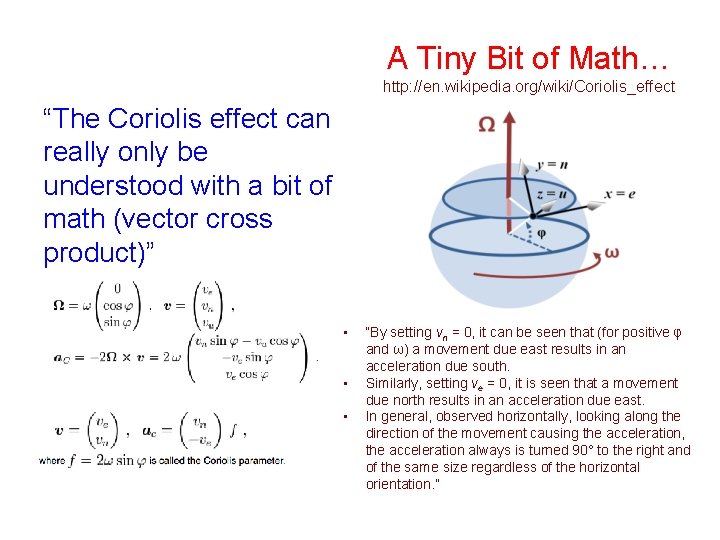
A Tiny Bit of Math… http: //en. wikipedia. org/wiki/Coriolis_effect “The Coriolis effect can really only be understood with a bit of math (vector cross product)” • • • “By setting vn = 0, it can be seen that (for positive φ and ω) a movement due east results in an acceleration due south. Similarly, setting ve = 0, it is seen that a movement due north results in an acceleration due east. In general, observed horizontally, looking along the direction of the movement causing the acceleration, the acceleration always is turned 90° to the right and of the same size regardless of the horizontal orientation. ”
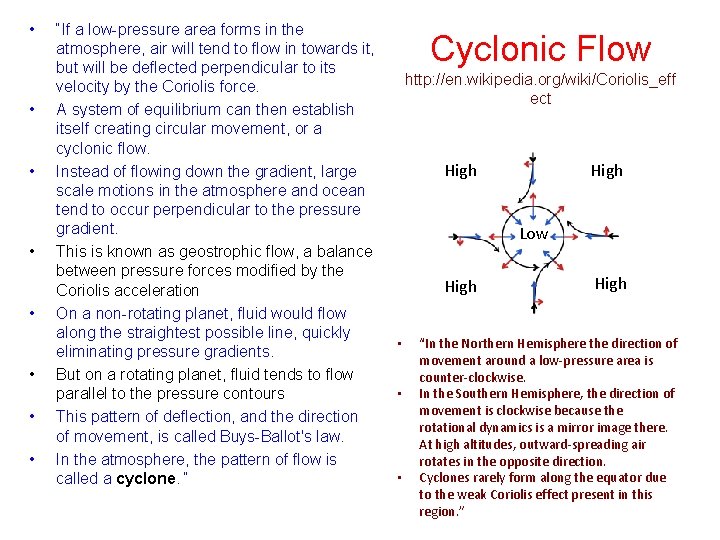
• • “If a low-pressure area forms in the atmosphere, air will tend to flow in towards it, but will be deflected perpendicular to its velocity by the Coriolis force. A system of equilibrium can then establish itself creating circular movement, or a cyclonic flow. Instead of flowing down the gradient, large scale motions in the atmosphere and ocean tend to occur perpendicular to the pressure gradient. This is known as geostrophic flow, a balance between pressure forces modified by the Coriolis acceleration On a non-rotating planet, fluid would flow along the straightest possible line, quickly eliminating pressure gradients. But on a rotating planet, fluid tends to flow parallel to the pressure contours This pattern of deflection, and the direction of movement, is called Buys-Ballot's law. In the atmosphere, the pattern of flow is called a cyclone. “ Cyclonic Flow http: //en. wikipedia. org/wiki/Coriolis_eff ect High Low High • • • High “In the Northern Hemisphere the direction of movement around a low-pressure area is counter-clockwise. In the Southern Hemisphere, the direction of movement is clockwise because the rotational dynamics is a mirror image there. At high altitudes, outward-spreading air rotates in the opposite direction. Cyclones rarely form along the equator due to the weak Coriolis effect present in this region. ”
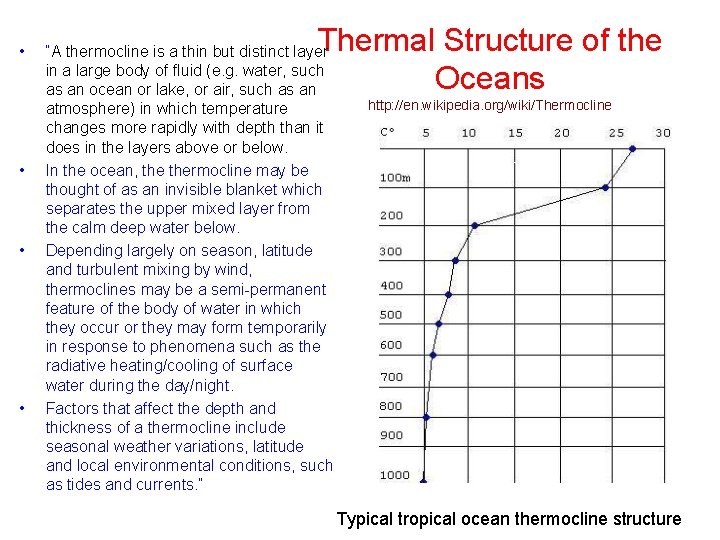
• • Thermal Structure of the Oceans “A thermocline is a thin but distinct layer in a large body of fluid (e. g. water, such as an ocean or lake, or air, such as an atmosphere) in which temperature changes more rapidly with depth than it does in the layers above or below. In the ocean, thermocline may be thought of as an invisible blanket which separates the upper mixed layer from the calm deep water below. Depending largely on season, latitude and turbulent mixing by wind, thermoclines may be a semi-permanent feature of the body of water in which they occur or they may form temporarily in response to phenomena such as the radiative heating/cooling of surface water during the day/night. Factors that affect the depth and thickness of a thermocline include seasonal weather variations, latitude and local environmental conditions, such as tides and currents. ” http: //en. wikipedia. org/wiki/Thermocline Typical tropical ocean thermocline structure
Ocean Layers http: //en. wikipedia. org/wiki/Thermocline • “Most of the heat energy of sunlight is absorbed in the first few centimeters at the ocean's surface, which heats during the day and cools at night as heat energy is lost to space by radiation. • Waves mix the water near the surface layer and distribute heat to deeper water such that the temperature may be relatively uniform in the upper 100 m (300 ft), depending on wave strength and the existence of surface turbulence caused by currents. • Below this mixed layer, the temperature remains relatively stable over day/night cycles. • The temperature of the deep ocean drops gradually with depth. As saline water does not freeze until it reaches − 2. 3 °C (colder as depth and pressure increase) the temperature well below the surface is usually not far from zero degrees. ”
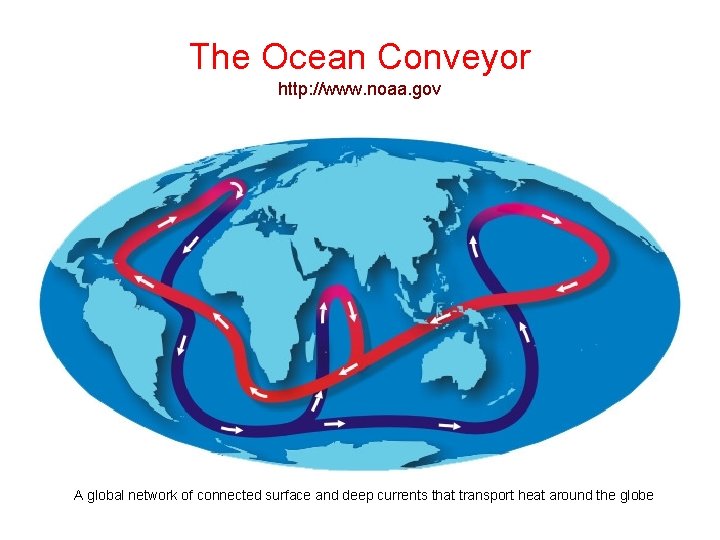
The Ocean Conveyor http: //www. noaa. gov A global network of connected surface and deep currents that transport heat around the globe
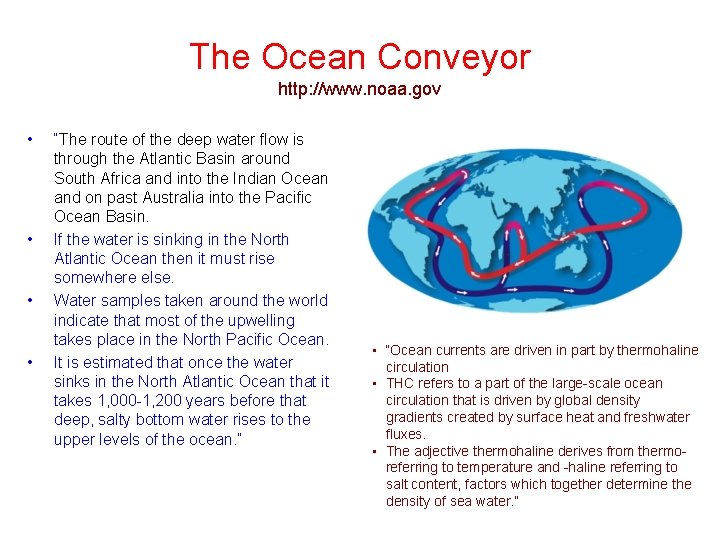
The Ocean Conveyor http: //www. noaa. gov • • “The route of the deep water flow is through the Atlantic Basin around South Africa and into the Indian Ocean and on past Australia into the Pacific Ocean Basin. If the water is sinking in the North Atlantic Ocean then it must rise somewhere else. Water samples taken around the world indicate that most of the upwelling takes place in the North Pacific Ocean. It is estimated that once the water sinks in the North Atlantic Ocean that it takes 1, 000 -1, 200 years before that deep, salty bottom water rises to the upper levels of the ocean. ” • “Ocean currents are driven in part by thermohaline circulation • THC refers to a part of the large-scale ocean circulation that is driven by global density gradients created by surface heat and freshwater fluxes. • The adjective thermohaline derives from thermoreferring to temperature and -haline referring to salt content, factors which together determine the density of sea water. ”
And the Ocean Conveyor is Slowing – A Bad Sign https: //www. nature. com/articles/s 41586 -018 -0006 -5 https: //www. washingtonpost. com/news/energy-environment/wp/2018/04/11/theoceans-circulation-hasnt-been-this-sluggish-in-1000 -years-thats-bad-news/
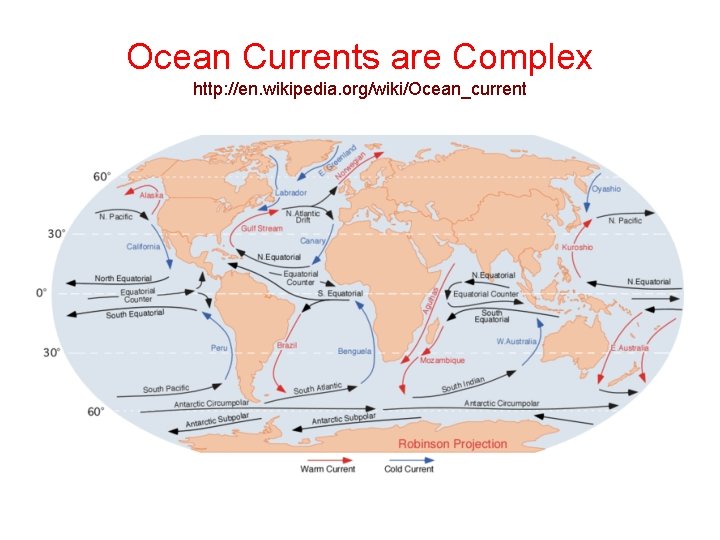
Ocean Currents are Complex http: //en. wikipedia. org/wiki/Ocean_current
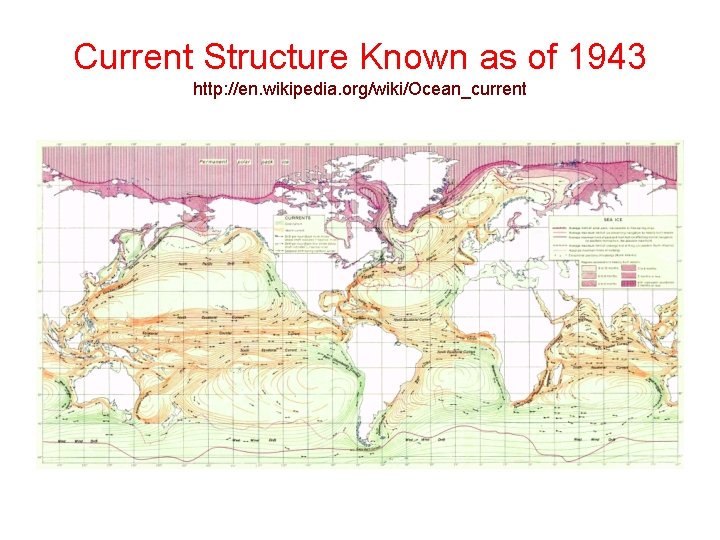
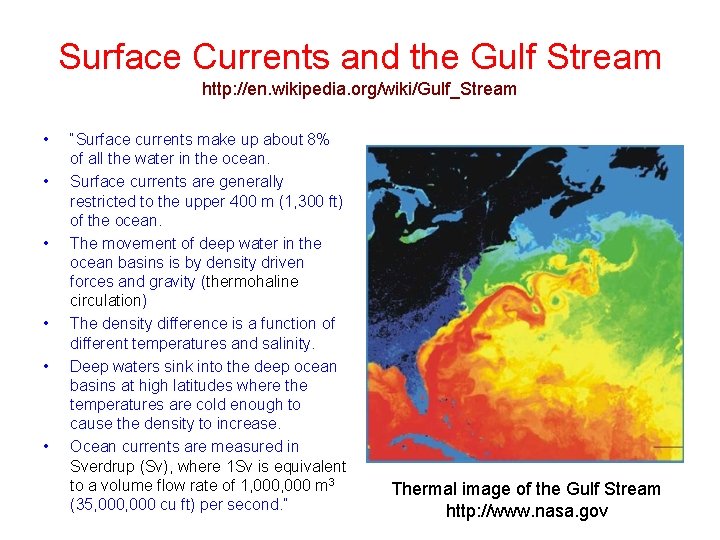
Ocean Currents http: //en. wikipedia. org/wiki/Ocean_current • • “An ocean current is a continuous, directed movement of ocean water generated by the forces acting upon this mean flow, such as breaking waves, wind, Coriolis effect, temperature and salinity differences and tides caused by the gravitational pull of the Moon and the Sun. Depth contours, shoreline configurations and interaction with other currents influence a current's direction and strength. A deep current is any ocean current at a depth of greater than 100 m. A part of oceanography is the science studying ocean currents. Ocean currents can flow for great distances, and together they create the great flow of the global conveyor belt which plays a dominant part in determining the climate of many of the Earth’s regions. Perhaps the most striking example is the Gulf Stream, which makes northwest Europe much more temperate than any other region at the same latitude. Another example is Lima, Peru, where the climate is cooler (sub-tropical) than the tropical latitudes in which the area is located, due to the effect of the Humboldt Current. ”
Current Structure Known as of 1943 http: //en. wikipedia. org/wiki/Ocean_current
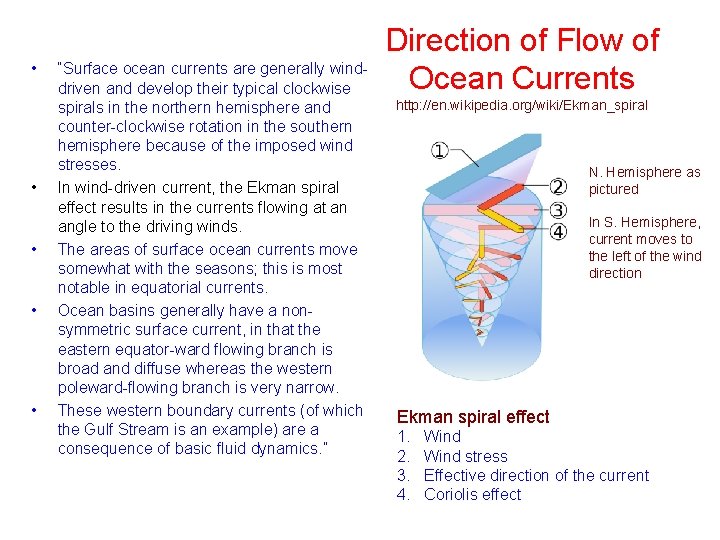
• • • “Surface ocean currents are generally winddriven and develop their typical clockwise spirals in the northern hemisphere and counter-clockwise rotation in the southern hemisphere because of the imposed wind stresses. In wind-driven current, the Ekman spiral effect results in the currents flowing at an angle to the driving winds. The areas of surface ocean currents move somewhat with the seasons; this is most notable in equatorial currents. Ocean basins generally have a nonsymmetric surface current, in that the eastern equator-ward flowing branch is broad and diffuse whereas the western poleward-flowing branch is very narrow. These western boundary currents (of which the Gulf Stream is an example) are a consequence of basic fluid dynamics. ” Direction of Flow of Ocean Currents http: //en. wikipedia. org/wiki/Ekman_spiral N. Hemisphere as pictured In S. Hemisphere, current moves to the left of the wind direction Ekman spiral effect 1. 2. 3. 4. Wind stress Effective direction of the current Coriolis effect
Surface Currents and the Gulf Stream http: //en. wikipedia. org/wiki/Gulf_Stream • • • “Surface currents make up about 8% of all the water in the ocean. Surface currents are generally restricted to the upper 400 m (1, 300 ft) of the ocean. The movement of deep water in the ocean basins is by density driven forces and gravity (thermohaline circulation) The density difference is a function of different temperatures and salinity. Deep waters sink into the deep ocean basins at high latitudes where the temperatures are cold enough to cause the density to increase. Ocean currents are measured in Sverdrup (Sv), where 1 Sv is equivalent to a volume flow rate of 1, 000 m 3 (35, 000 cu ft) per second. ” Thermal image of the Gulf Stream http: //www. nasa. gov
Atmospheric Dynamics by Time Scale • Weather and synoptic-scale meteorology: (Hours to Weeks to Months): Storms, Tropical Cyclones, flood events, droughts, etc. • Seasonal variations (Related to earth’s orbit around the sun): the four seasons that we know • Dynamical modes (Years to Decades): Includes events such as El Niños and La Niñas • Climatology (Decadal time scales to Millennia): Major changes in planetary-scale phenomena, such as ice cover
Climatology (Decades to Millennia) http: //en. wikipedia. org/wiki/Climatology • • • “In contrast to meteorology, which studies short term weather systems lasting up to a few weeks, climatology studies the frequency and trends of those systems over decades and longer It studies the periodicity of weather events over years to millennia, as well as changes in long-term average weather patterns, in relation to atmospheric conditions. Climatologists, those who practice climatology, study both the nature of climates – local, regional or global – and the natural or human-induced factors that cause climates to change. Climatology considers the past and can help predict future climate change. Phenomena of climatological interest include – the atmospheric boundary layer, – circulation patterns, heat transfer (radiative, convective and latent), – interactions between the atmosphere and the oceans and land surface (particularly vegetation, – land use and topography), and – the chemical and physical composition of the atmosphere.
Brief History of Climate Studies http: //en. wikipedia. org/wiki/Climatology • • • “Chinese scientist Shen Kuo (1031– 1095) inferred that climates naturally shifted over an enormous span of time, after observing petrified bamboos found underground near Yanzhou (modern day Yan'an, Shaanxi province), a dry-climate area unsuitable for the growth of bamboo. Early climate researchers include Edmund Halley, who published a map of the trade winds in 1686 after a voyage to the southern hemisphere. Benjamin Franklin (1706 -1790) first mapped the course of the Gulf Stream for use in sending mail from the United States to Europe. Francis Galton (1822 -1911) invented the term anticyclone. Helmut Landsberg (1906 -1985) fostered the use of statistical analysis in climatology, which led to its evolution into a physical science. ”
Study of Climate http: //en. wikipedia. org/wiki/Climatology • • “The study of contemporary climates incorporates meteorological data accumulated over many years, such as records of rainfall, temperature and atmospheric composition. Knowledge of the atmosphere and its dynamics is also embodied in models, either statistical or mathematical, which help by integrating different observations and testing how they fit together. Modeling is used for understanding past, present and potential future climates. Historical climatology is the study of climate as related to human history and thus focuses only on the last few thousand years. Climate research is made difficult by the large scale, long time periods, and complex processes which govern climate. Climate is governed by physical laws which can be expressed as differential equations. These equations are coupled and nonlinear, so that approximate solutions are obtained by using numerical methods to create global climate models. Climate is sometimes modeled as a stochastic (statistical) process but this is generally accepted as an approximation to processes that are otherwise too complicated to analyze. ”
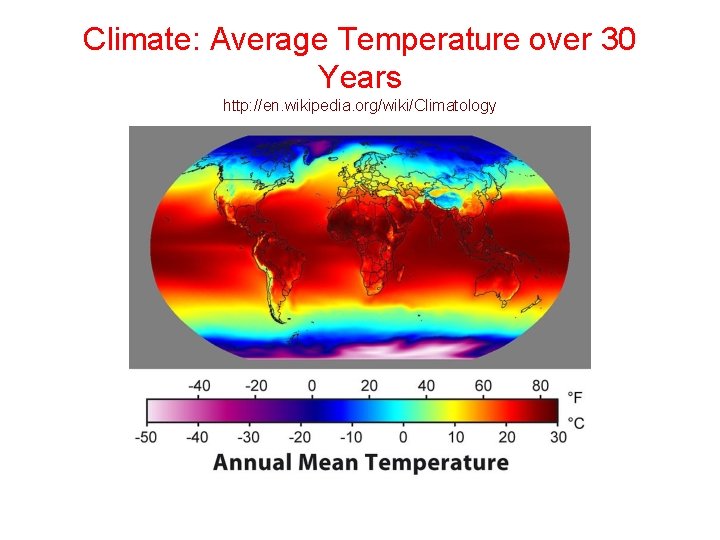
Climate: Average Temperature over 30 Years http: //en. wikipedia. org/wiki/Climatology
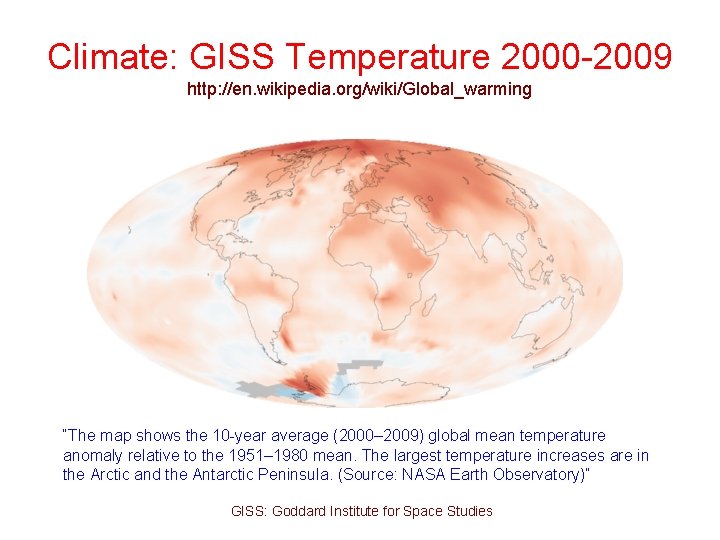
Climate: GISS Temperature 2000 -2009 http: //en. wikipedia. org/wiki/Global_warming “The map shows the 10 -year average (2000– 2009) global mean temperature anomaly relative to the 1951– 1980 mean. The largest temperature increases are in the Arctic and the Antarctic Peninsula. (Source: NASA Earth Observatory)” GISS: Goddard Institute for Space Studies
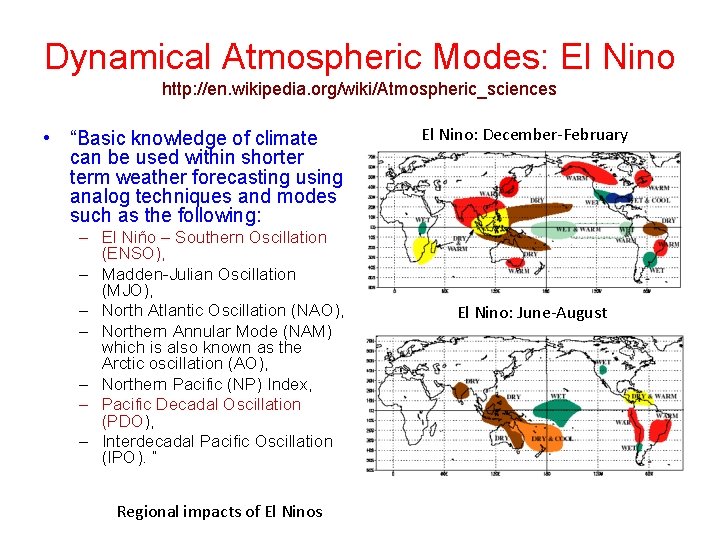
Dynamical Atmospheric Modes: El Nino http: //en. wikipedia. org/wiki/Atmospheric_sciences • “Basic knowledge of climate can be used within shorter term weather forecasting using analog techniques and modes such as the following: – El Niño – Southern Oscillation (ENSO), – Madden-Julian Oscillation (MJO), – North Atlantic Oscillation (NAO), – Northern Annular Mode (NAM) which is also known as the Arctic oscillation (AO), – Northern Pacific (NP) Index, – Pacific Decadal Oscillation (PDO), – Interdecadal Pacific Oscillation (IPO). “ Regional impacts of El Ninos El Nino: December-February El Nino: June-August
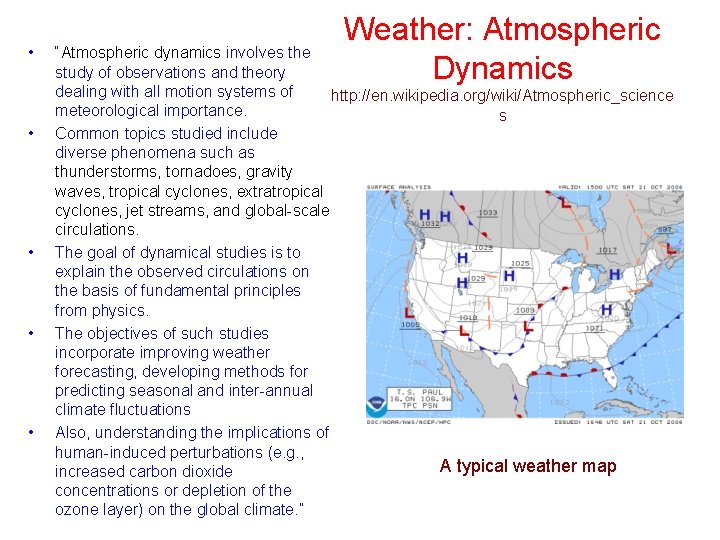
• • • Weather: Atmospheric Dynamics “Atmospheric dynamics involves the study of observations and theory dealing with all motion systems of http: //en. wikipedia. org/wiki/Atmospheric_science meteorological importance. s Common topics studied include diverse phenomena such as thunderstorms, tornadoes, gravity waves, tropical cyclones, extratropical cyclones, jet streams, and global-scale circulations. The goal of dynamical studies is to explain the observed circulations on the basis of fundamental principles from physics. The objectives of such studies incorporate improving weather forecasting, developing methods for predicting seasonal and inter-annual climate fluctuations Also, understanding the implications of human-induced perturbations (e. g. , A typical weather map increased carbon dioxide concentrations or depletion of the ozone layer) on the global climate. ”
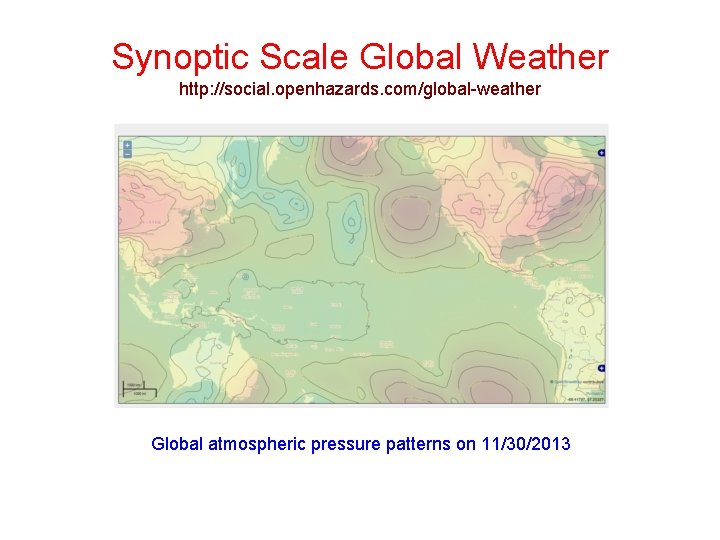
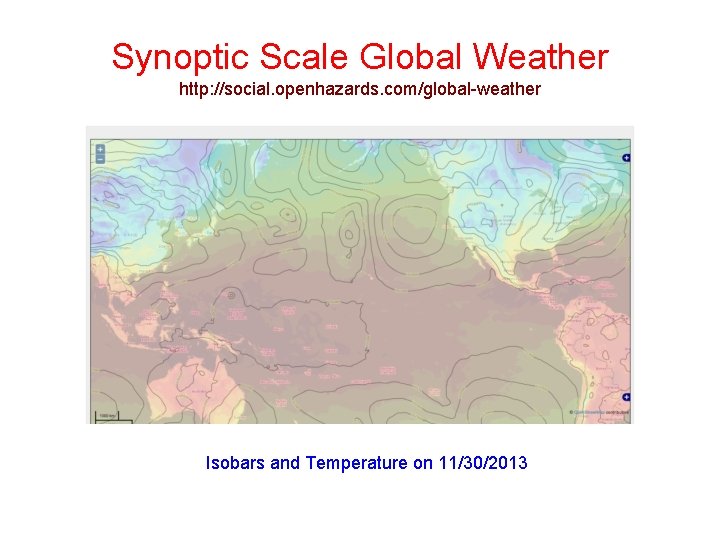
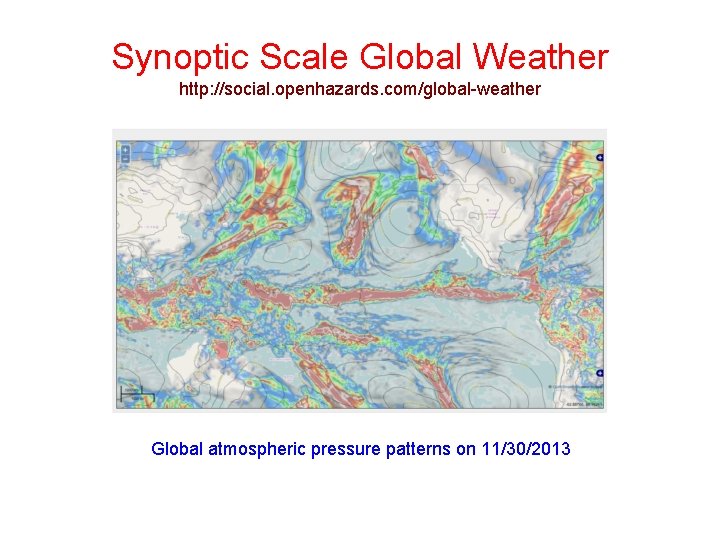
The Synoptic Scale http: //en. wikipedia. org/wiki/Synoptic_scale_meteorology • • “The synoptic scale in meteorology (also known as large scale or cyclonic scale) is a horizontal length scale of the order of 1000 kilometers (about 620 miles) or more. This corresponds to a horizontal scale typical of mid-latitude depressions (e. g. extratropical cyclones). Most high and low-pressure areas seen on weather maps such as surface weather analyses are synoptic-scale systems, driven by the location of Rossby waves in their respective hemisphere. Low-pressure areas and their related frontal zones occur on the leading edge of a trough within the Rossby wave pattern, while surface highs form on the back edge of the trough. Most precipitation areas occur near frontal zones. The word synoptic is derived from the Greek word συνοπτικός (synoptikos), meaning seen together. The Navier–Stokes equations applied to atmospheric motion can be simplified by scale analysis in the synoptic scale. It can be shown that the main terms in horizontal equations are Coriolis force and pressure gradient terms; therefore, one can use geostrophic approximation. In vertical coordinates, the momentum equation simplifies to the hydrostatic equilibrium equation. ”
Synoptic Scale Global Weather http: //social. openhazards. com/global-weather Global atmospheric pressure patterns on 11/30/2013
Synoptic Scale Global Weather http: //social. openhazards. com/global-weather Isobars and Temperature on 11/30/2013
Synoptic Scale Global Weather http: //social. openhazards. com/global-weather Global atmospheric pressure patterns on 11/30/2013
NOAA Monthly Climate Report https: //www. ncdc. noaa. gov/sotc/global/202011
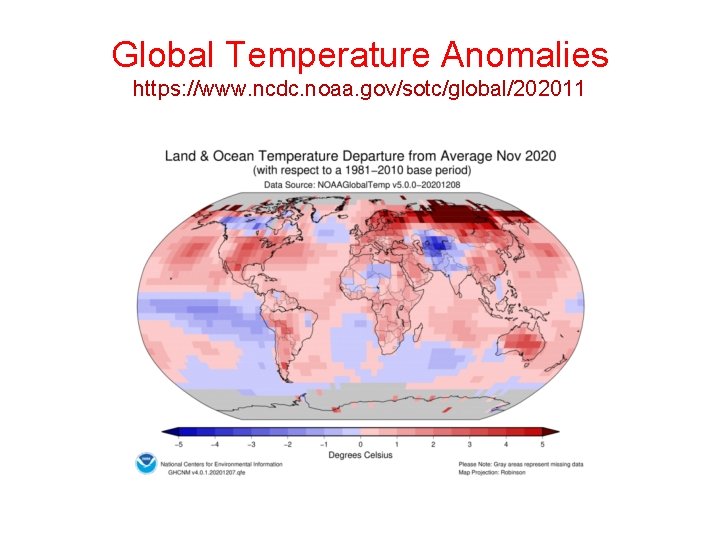
Global Temperature Anomalies https: //www. ncdc. noaa. gov/sotc/global/202011
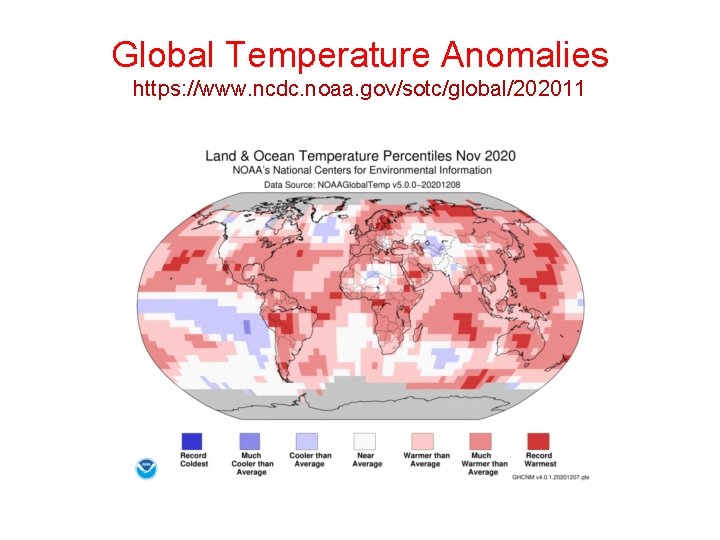
Global Temperature Anomalies https: //www. ncdc. noaa. gov/sotc/global/202011
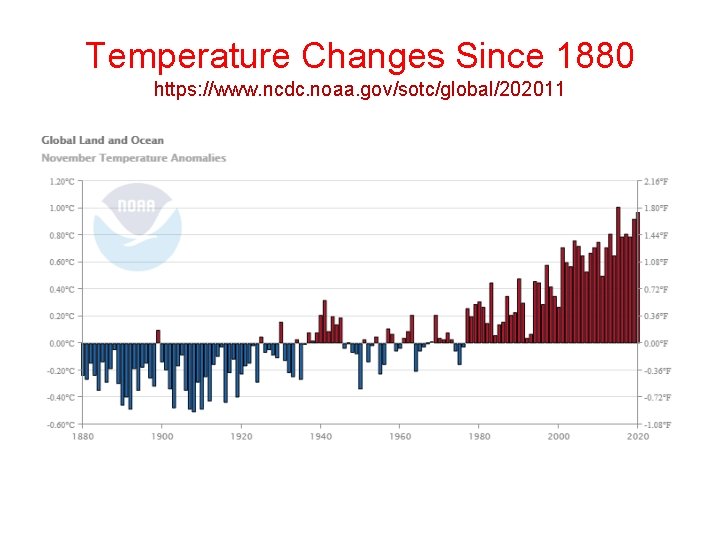
Temperature Changes Since 1880 https: //www. ncdc. noaa. gov/sotc/global/202011
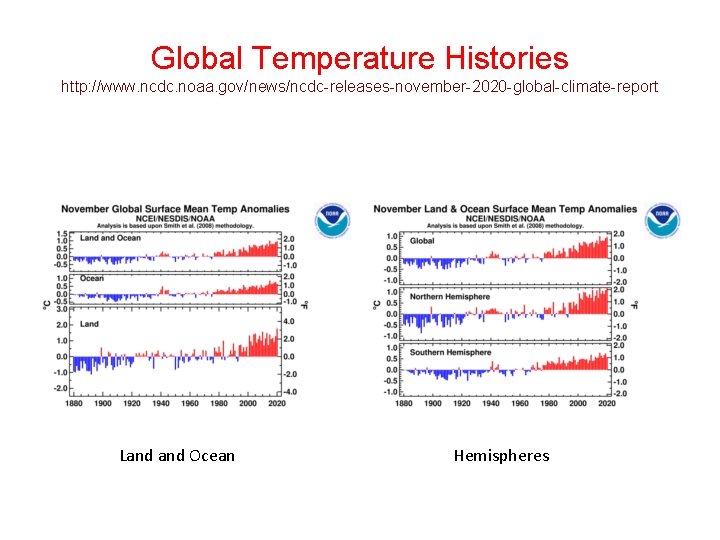
Global Temperature Histories http: //www. ncdc. noaa. gov/news/ncdc-releases-november-2020 -global-climate-report Land Ocean Hemispheres
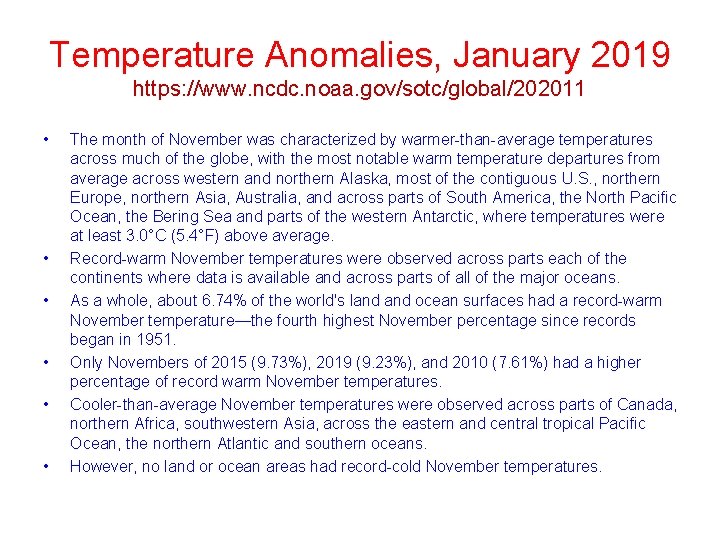
Temperature Anomalies, January 2019 https: //www. ncdc. noaa. gov/sotc/global/202011 • • • The month of November was characterized by warmer-than-average temperatures across much of the globe, with the most notable warm temperature departures from average across western and northern Alaska, most of the contiguous U. S. , northern Europe, northern Asia, Australia, and across parts of South America, the North Pacific Ocean, the Bering Sea and parts of the western Antarctic, where temperatures were at least 3. 0°C (5. 4°F) above average. Record-warm November temperatures were observed across parts each of the continents where data is available and across parts of all of the major oceans. As a whole, about 6. 74% of the world's land ocean surfaces had a record-warm November temperature—the fourth highest November percentage since records began in 1951. Only Novembers of 2015 (9. 73%), 2019 (9. 23%), and 2010 (7. 61%) had a higher percentage of record warm November temperatures. Cooler-than-average November temperatures were observed across parts of Canada, northern Africa, southwestern Asia, across the eastern and central tropical Pacific Ocean, the northern Atlantic and southern oceans. However, no land or ocean areas had record-cold November temperatures.
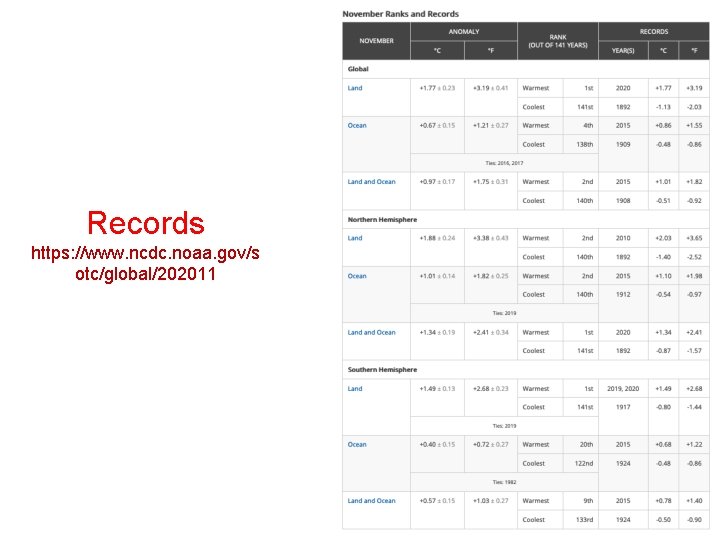
Records https: //www. ncdc. noaa. gov/s otc/global/202011
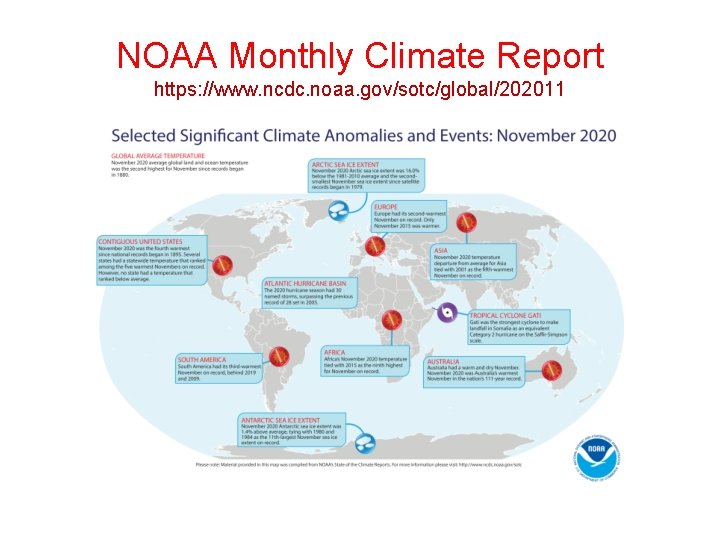
NOAA Monthly Climate Report https: //www. ncdc. noaa. gov/sotc/global/202011
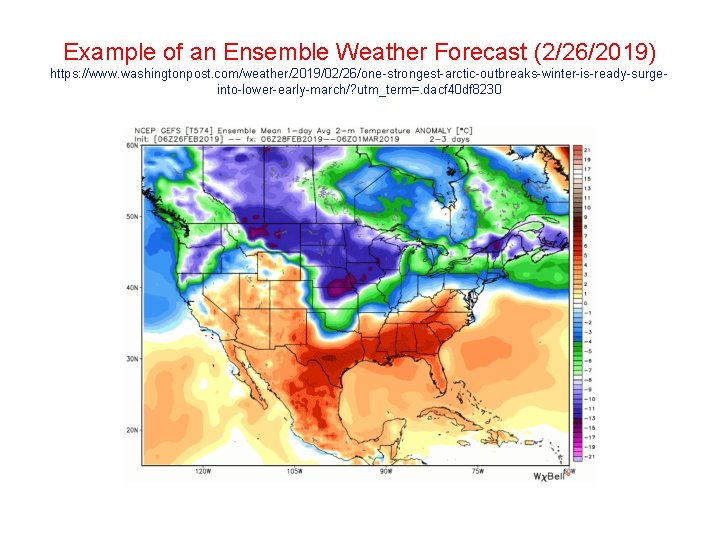
Example of an Ensemble Weather Forecast (2/26/2019) https: //www. washingtonpost. com/weather/2019/02/26/one-strongest-arctic-outbreaks-winter-is-ready-surgeinto-lower-early-march/? utm_term=. dacf 40 df 8230