
Lecture 1819 Stimulus Control Pavlovian Instrumental Learning Psychology
- Slides: 29
Lecture 18&19: Stimulus Control (Pavlovian & Instrumental) Learning, Psychology 3510 Fall, 2018 Professor Delamater
Stimulus Control: How to Measure it How to assess stimulus control? • What specific stimuli do organisms learn to respond to? • What are the processes involved in this learning? • This is the study of stimulus control.
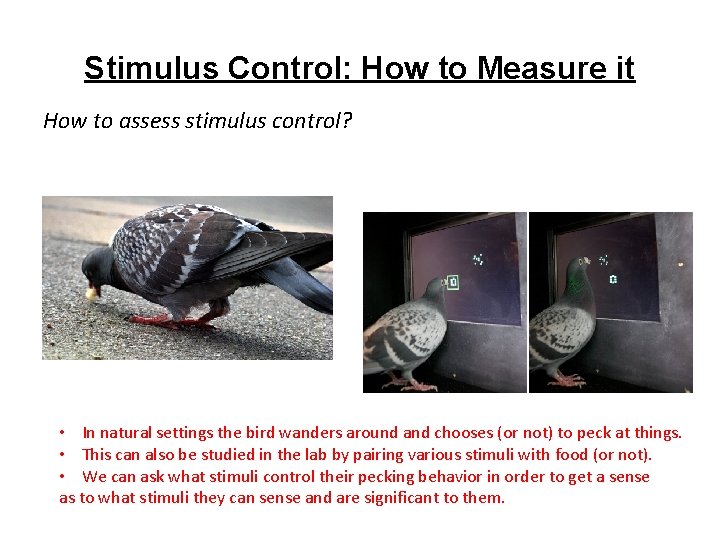
Stimulus Control: How to Measure it How to assess stimulus control? • In natural settings the bird wanders around and chooses (or not) to peck at things. • This can also be studied in the lab by pairing various stimuli with food (or not). • We can ask what stimuli control their pecking behavior in order to get a sense as to what stimuli they can sense and are significant to them.
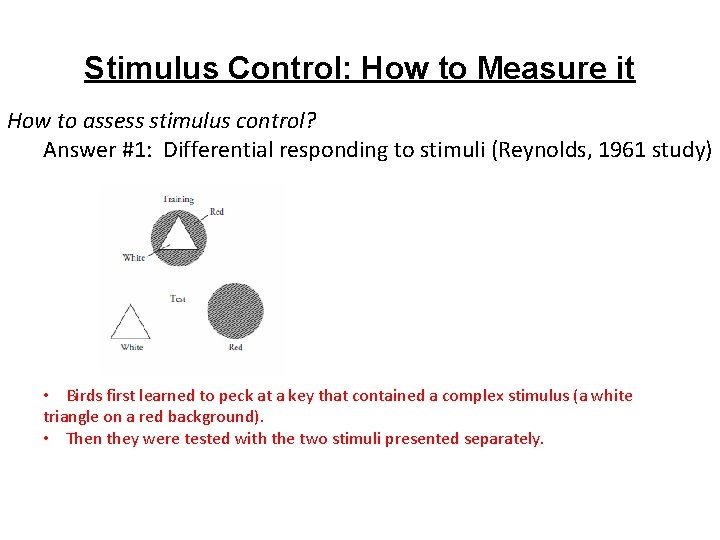
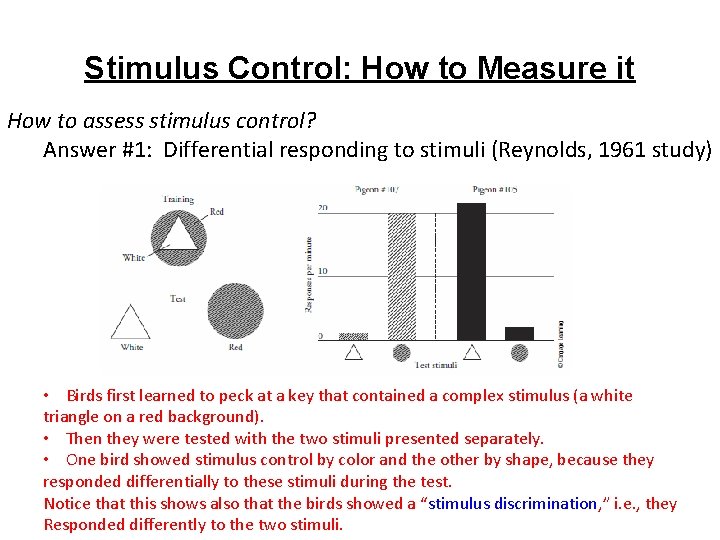
Stimulus Control: How to Measure it How to assess stimulus control? Answer #1: Differential responding to stimuli (Reynolds, 1961 study) • Birds first learned to peck at a key that contained a complex stimulus (a white triangle on a red background). • Then they were tested with the two stimuli presented separately.
Stimulus Control: How to Measure it How to assess stimulus control? Answer #1: Differential responding to stimuli (Reynolds, 1961 study) • Birds first learned to peck at a key that contained a complex stimulus (a white triangle on a red background). • Then they were tested with the two stimuli presented separately. • One bird showed stimulus control by color and the other by shape, because they responded differentially to these stimuli during the test. Notice that this shows also that the birds showed a “stimulus discrimination, ” i. e. , they Responded differently to the two stimuli.
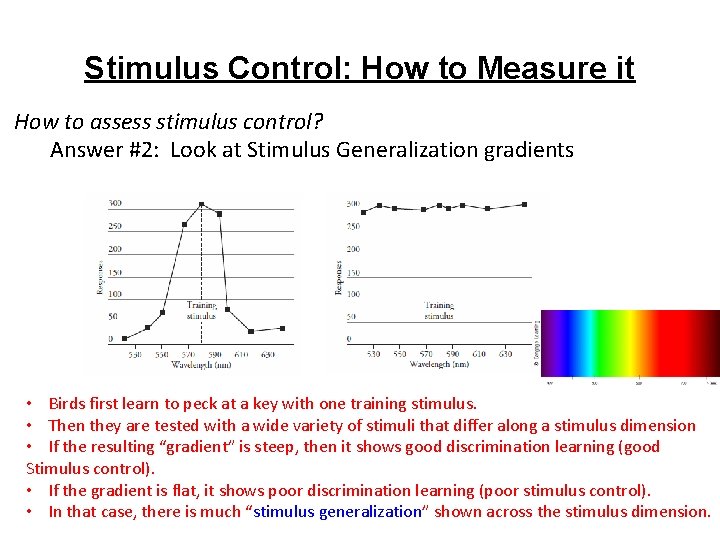
Stimulus Control: How to Measure it How to assess stimulus control? Answer #2: Look at Stimulus Generalization gradients • Birds first learn to peck at a key with one training stimulus. • Then they are tested with a wide variety of stimuli that differ along a stimulus dimension • If the resulting “gradient” is steep, then it shows good discrimination learning (good Stimulus control). • If the gradient is flat, it shows poor discrimination learning (poor stimulus control). • In that case, there is much “stimulus generalization” shown across the stimulus dimension.
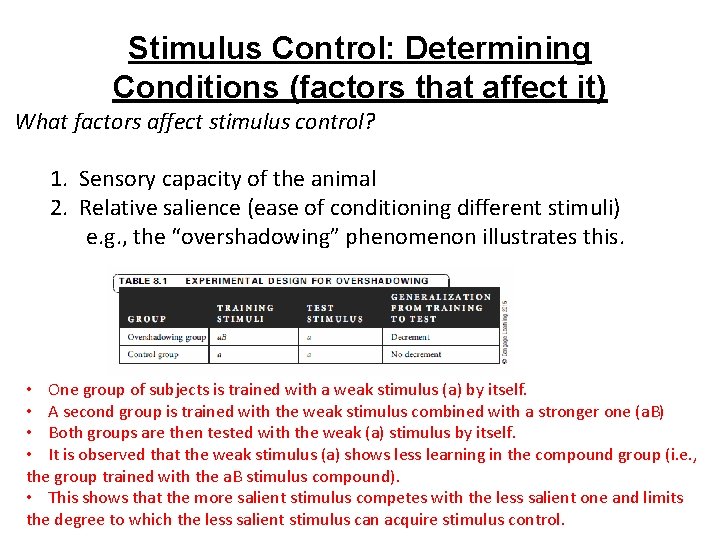
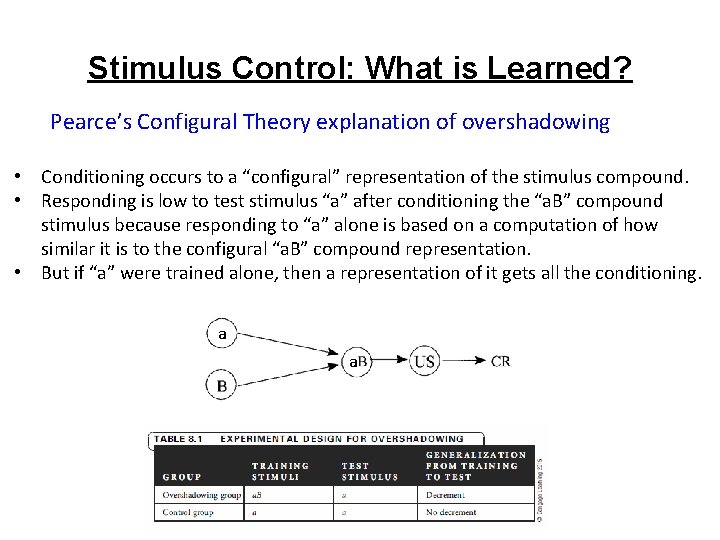
Stimulus Control: Determining Conditions (factors that affect it) What factors affect stimulus control? 1. Sensory capacity of the animal 2. Relative salience (ease of conditioning different stimuli) e. g. , the “overshadowing” phenomenon illustrates this. • One group of subjects is trained with a weak stimulus (a) by itself. • A second group is trained with the weak stimulus combined with a stronger one (a. B) • Both groups are then tested with the weak (a) stimulus by itself. • It is observed that the weak stimulus (a) shows less learning in the compound group (i. e. , the group trained with the a. B stimulus compound). • This shows that the more salient stimulus competes with the less salient one and limits the degree to which the less salient stimulus can acquire stimulus control.
Stimulus Control: Determining Conditions (factors that affect it) What factors affect stimulus control? 1. Sensory capacity of the animal 2. Relative salience (ease of conditioning different stimuli) e. g. , the “overshadowing” phenomenon illustrates this. 3. Type of reinforcement (or stimulus-reinforcer relation) Foree & Lo. Lordo (1971) experiment
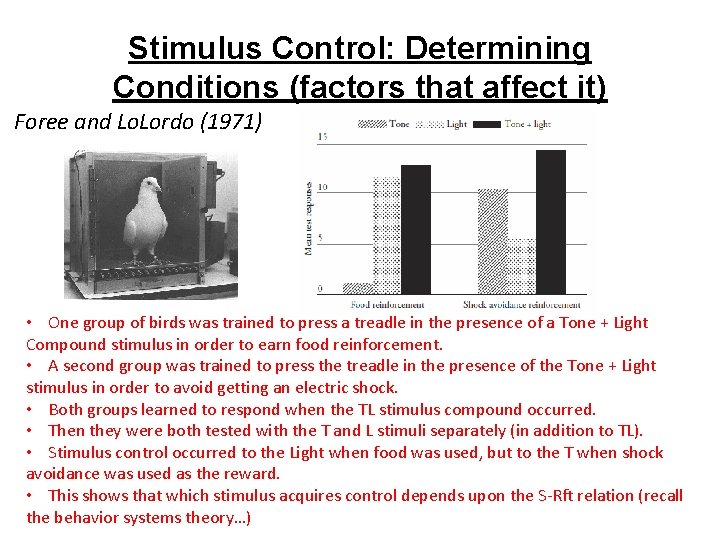
Stimulus Control: Determining Conditions (factors that affect it) Foree and Lo. Lordo (1971) • One group of birds was trained to press a treadle in the presence of a Tone + Light Compound stimulus in order to earn food reinforcement. • A second group was trained to press the treadle in the presence of the Tone + Light stimulus in order to avoid getting an electric shock. • Both groups learned to respond when the TL stimulus compound occurred. • Then they were both tested with the T and L stimuli separately (in addition to TL). • Stimulus control occurred to the Light when food was used, but to the T when shock avoidance was used as the reward. • This shows that which stimulus acquires control depends upon the S-Rft relation (recall the behavior systems theory…)
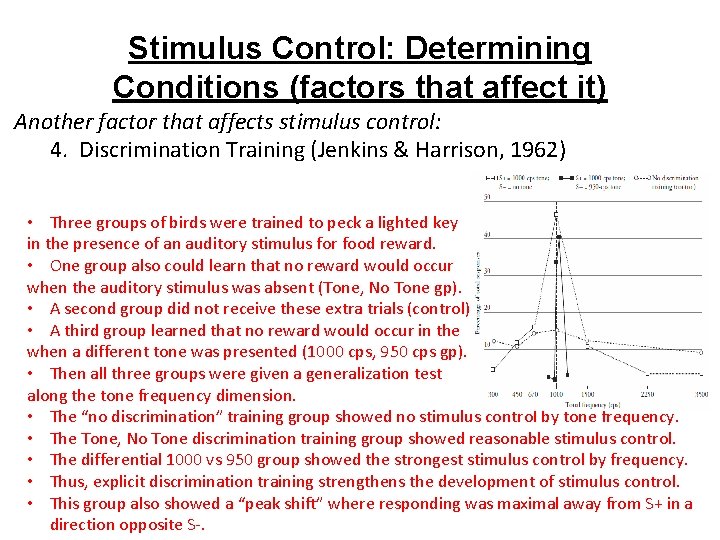
Stimulus Control: Determining Conditions (factors that affect it) Another factor that affects stimulus control: 4. Discrimination Training (Jenkins & Harrison, 1962) • Three groups of birds were trained to peck a lighted key in the presence of an auditory stimulus for food reward. • One group also could learn that no reward would occur when the auditory stimulus was absent (Tone, No Tone gp). • A second group did not receive these extra trials (control) • A third group learned that no reward would occur in the when a different tone was presented (1000 cps, 950 cps gp). • Then all three groups were given a generalization test along the tone frequency dimension. • The “no discrimination” training group showed no stimulus control by tone frequency. • The Tone, No Tone discrimination training group showed reasonable stimulus control. • The differential 1000 vs 950 group showed the strongest stimulus control by frequency. • Thus, explicit discrimination training strengthens the development of stimulus control. • This group also showed a “peak shift” where responding was maximal away from S+ in a direction opposite S-.
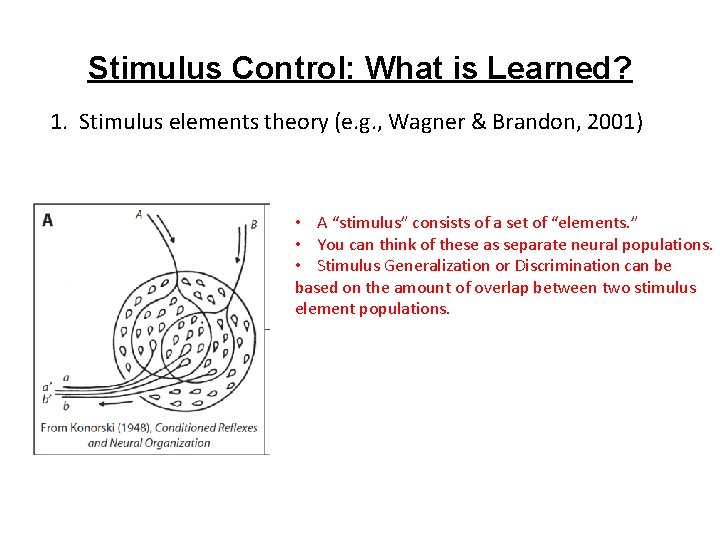
Stimulus Control: What is Learned? 1. Stimulus elements theory (e. g. , Wagner & Brandon, 2001) • A “stimulus” consists of a set of “elements. ” • You can think of these as separate neural populations. • Stimulus Generalization or Discrimination can be based on the amount of overlap between two stimulus element populations.
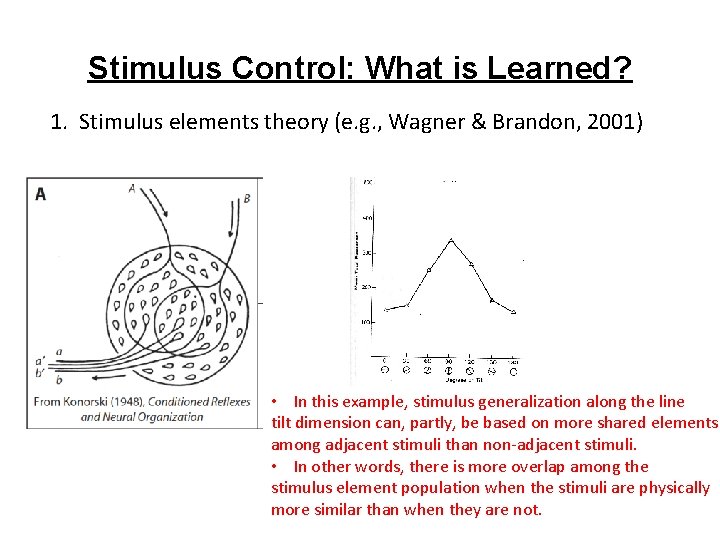
Stimulus Control: What is Learned? 1. Stimulus elements theory (e. g. , Wagner & Brandon, 2001) • In this example, stimulus generalization along the line tilt dimension can, partly, be based on more shared elements among adjacent stimuli than non-adjacent stimuli. • In other words, there is more overlap among the stimulus element population when the stimuli are physically more similar than when they are not.
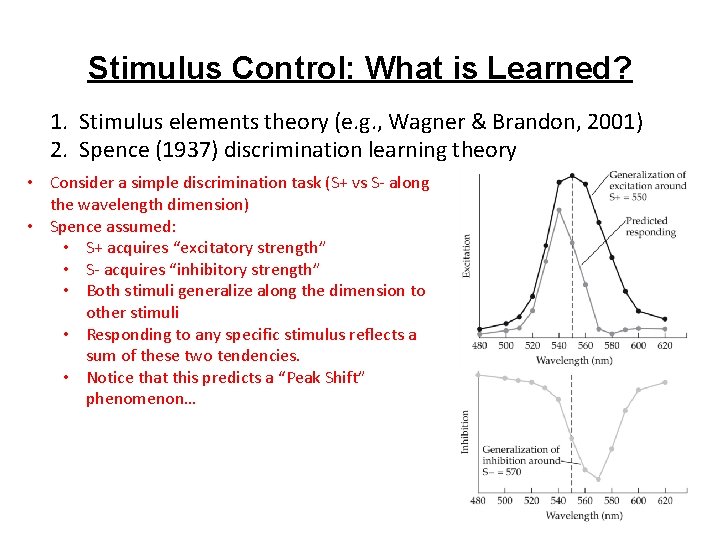
Stimulus Control: What is Learned? 1. Stimulus elements theory (e. g. , Wagner & Brandon, 2001) 2. Spence (1937) discrimination learning theory • Consider a simple discrimination task (S+ vs S- along the wavelength dimension) • Spence assumed: • S+ acquires “excitatory strength” • S- acquires “inhibitory strength” • Both stimuli generalize along the dimension to other stimuli • Responding to any specific stimulus reflects a sum of these two tendencies. • Notice that this predicts a “Peak Shift” phenomenon…
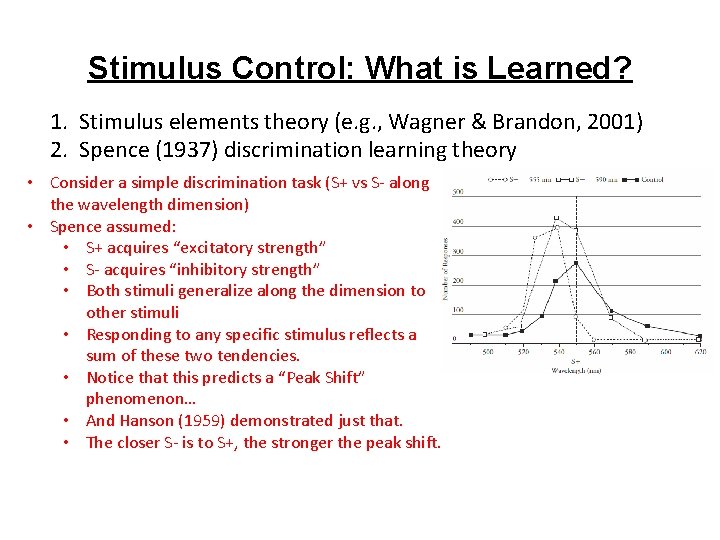
Stimulus Control: What is Learned? 1. Stimulus elements theory (e. g. , Wagner & Brandon, 2001) 2. Spence (1937) discrimination learning theory • Consider a simple discrimination task (S+ vs S- along the wavelength dimension) • Spence assumed: • S+ acquires “excitatory strength” • S- acquires “inhibitory strength” • Both stimuli generalize along the dimension to other stimuli • Responding to any specific stimulus reflects a sum of these two tendencies. • Notice that this predicts a “Peak Shift” phenomenon… • And Hanson (1959) demonstrated just that. • The closer S- is to S+, the stronger the peak shift.
Stimulus Control: What is Learned? 1. Stimulus elements theory (e. g. , Wagner & Brandon, 2001) 2. Spence (1937) discrimination learning theory 3. Pearce (1987; 1994; 2002) Configural Theory
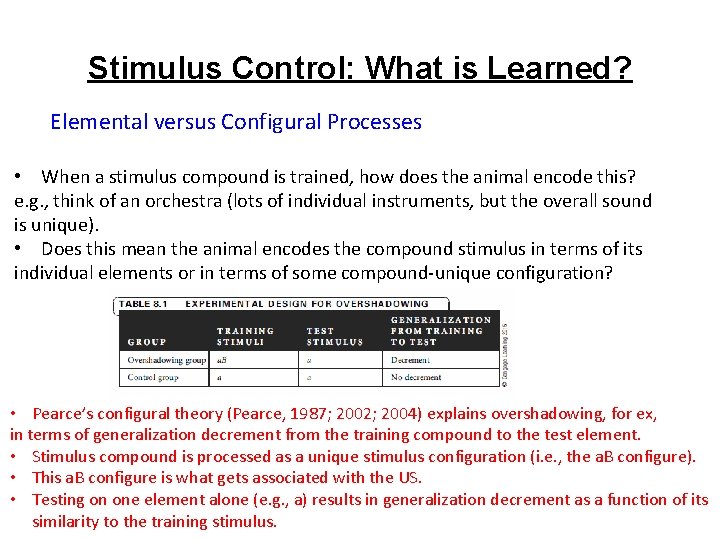
Stimulus Control: What is Learned? Elemental versus Configural Processes • When a stimulus compound is trained, how does the animal encode this? e. g. , think of an orchestra (lots of individual instruments, but the overall sound is unique). • Does this mean the animal encodes the compound stimulus in terms of its individual elements or in terms of some compound-unique configuration? • Pearce’s configural theory (Pearce, 1987; 2002; 2004) explains overshadowing, for ex, in terms of generalization decrement from the training compound to the test element. • Stimulus compound is processed as a unique stimulus configuration (i. e. , the a. B configure). • This a. B configure is what gets associated with the US. • Testing on one element alone (e. g. , a) results in generalization decrement as a function of its similarity to the training stimulus.
Stimulus Control: What is Learned? Pearce’s Configural Theory explanation of overshadowing • Conditioning occurs to a “configural” representation of the stimulus compound. • Responding is low to test stimulus “a” after conditioning the “a. B” compound stimulus because responding to “a” alone is based on a computation of how similar it is to the configural “a. B” compound representation. • But if “a” were trained alone, then a representation of it gets all the conditioning. a a
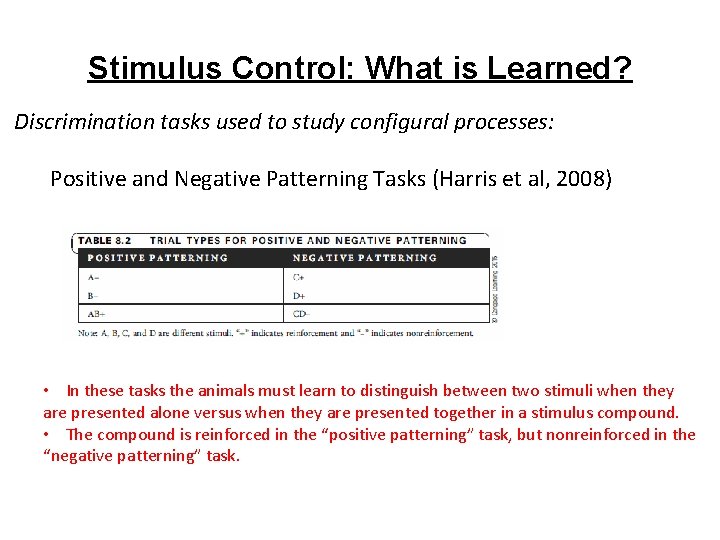
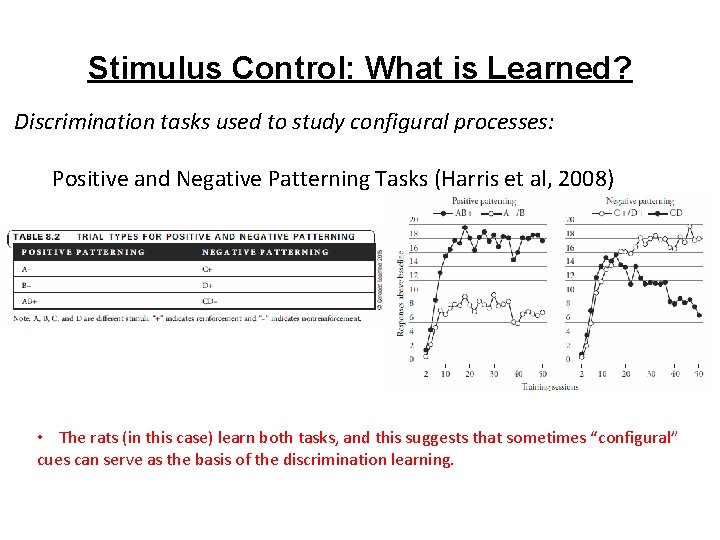
Stimulus Control: What is Learned? Discrimination tasks used to study configural processes: Positive and Negative Patterning Tasks (Harris et al, 2008) • In these tasks the animals must learn to distinguish between two stimuli when they are presented alone versus when they are presented together in a stimulus compound. • The compound is reinforced in the “positive patterning” task, but nonreinforced in the “negative patterning” task.
Stimulus Control: What is Learned? Discrimination tasks used to study configural processes: Positive and Negative Patterning Tasks (Harris et al, 2008) • The rats (in this case) learn both tasks, and this suggests that sometimes “configural” cues can serve as the basis of the discrimination learning.
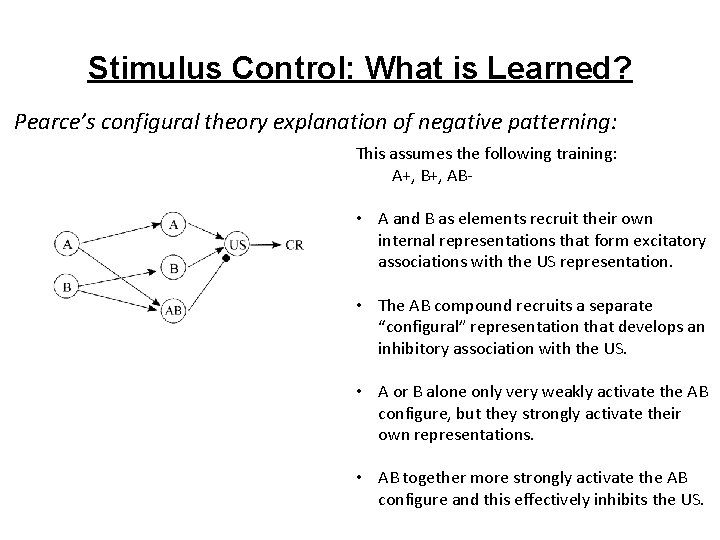
Stimulus Control: What is Learned? Pearce’s configural theory explanation of negative patterning: This assumes the following training: A+, B+, AB- • A and B as elements recruit their own internal representations that form excitatory associations with the US representation. • The AB compound recruits a separate “configural” representation that develops an inhibitory association with the US. • A or B alone only very weakly activate the AB configure, but they strongly activate their own representations. • AB together more strongly activate the AB configure and this effectively inhibits the US.
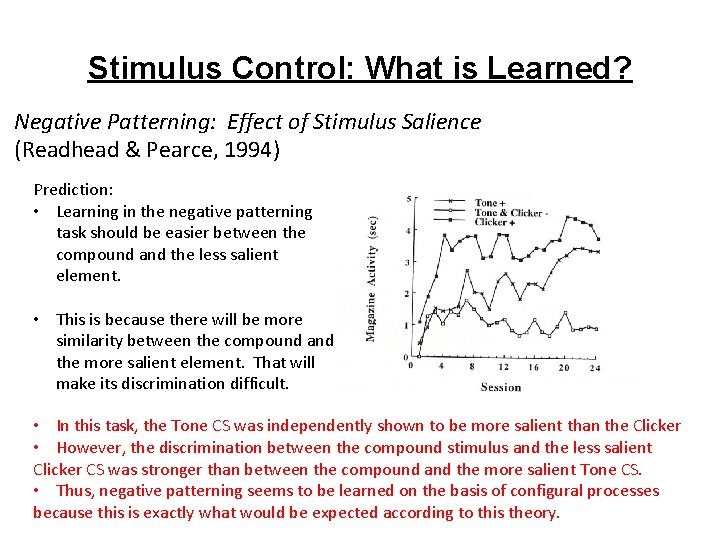
Stimulus Control: What is Learned? Negative Patterning: Effect of Stimulus Salience (Readhead & Pearce, 1994) Prediction: • Learning in the negative patterning task should be easier between the compound and the less salient element. • This is because there will be more similarity between the compound and the more salient element. That will make its discrimination difficult. • In this task, the Tone CS was independently shown to be more salient than the Clicker • However, the discrimination between the compound stimulus and the less salient Clicker CS was stronger than between the compound and the more salient Tone CS. • Thus, negative patterning seems to be learned on the basis of configural processes because this is exactly what would be expected according to this theory.
Stimulus Control: Enhancing Stimulus Generalization • We have seen that physical similarity plays a role in stimulus generalization. • But this is not the only factor: Stimulus Equivalence training can promote it. • This means that physically distinct stimuli can acquire a sort of functional equivalence between them such that they are “coded” as being more similar.
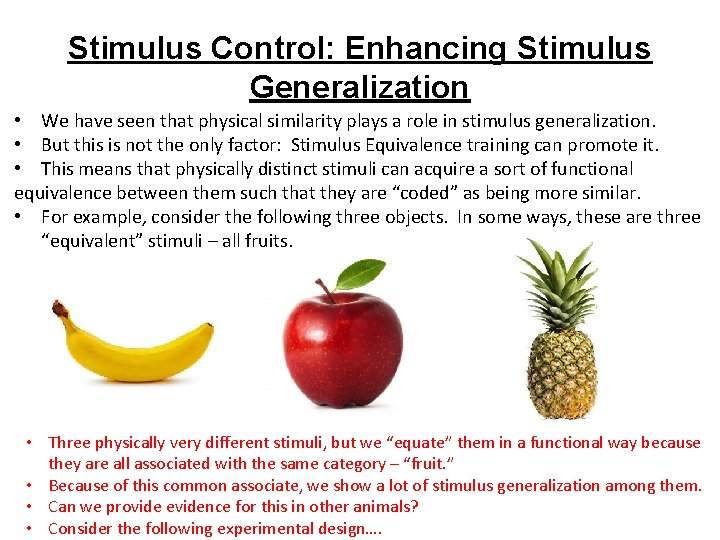
Stimulus Control: Enhancing Stimulus Generalization • We have seen that physical similarity plays a role in stimulus generalization. • But this is not the only factor: Stimulus Equivalence training can promote it. • This means that physically distinct stimuli can acquire a sort of functional equivalence between them such that they are “coded” as being more similar. • For example, consider the following three objects. In some ways, these are three “equivalent” stimuli – all fruits. • Three physically very different stimuli, but we “equate” them in a functional way because they are all associated with the same category – “fruit. ” • Because of this common associate, we show a lot of stimulus generalization among them. • Can we provide evidence for this in other animals? • Consider the following experimental design….
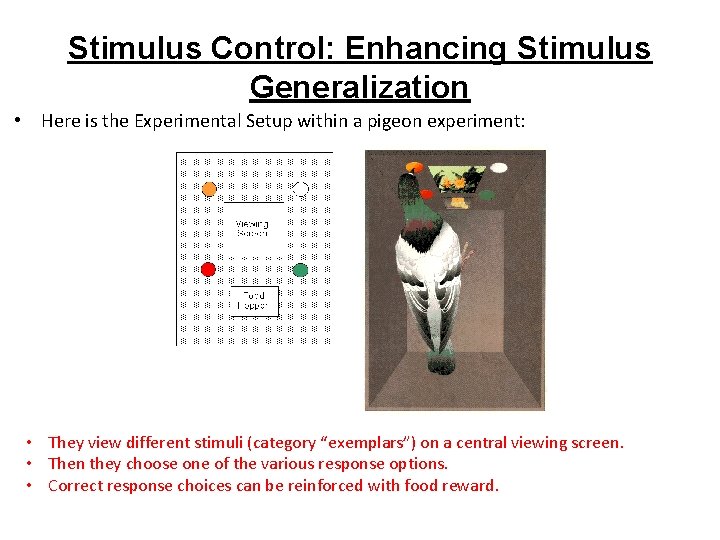
Stimulus Control: Enhancing Stimulus Generalization • Here is the Experimental Setup within a pigeon experiment: • They view different stimuli (category “exemplars”) on a central viewing screen. • Then they choose one of the various response options. • Correct response choices can be reinforced with food reward.
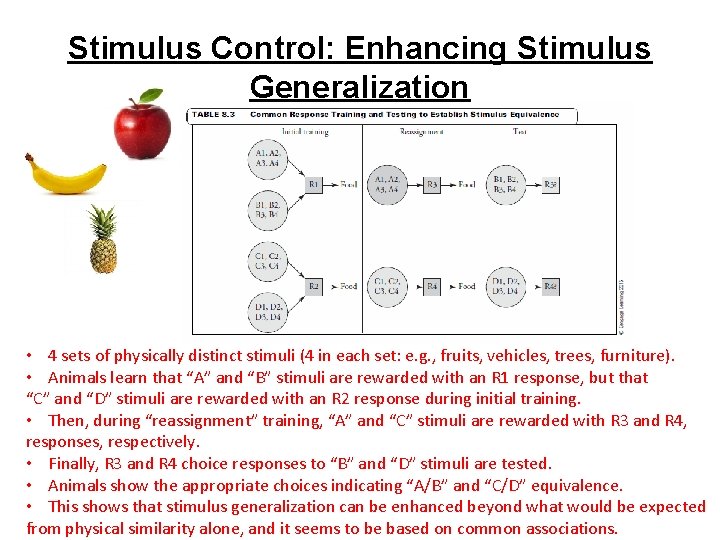
Stimulus Control: Enhancing Stimulus Generalization • 4 sets of physically distinct stimuli (4 in each set: e. g. , fruits, vehicles, trees, furniture). • Animals learn that “A” and “B” stimuli are rewarded with an R 1 response, but that “C” and “D” stimuli are rewarded with an R 2 response during initial training. • Then, during “reassignment” training, “A” and “C” stimuli are rewarded with R 3 and R 4, responses, respectively. • Finally, R 3 and R 4 choice responses to “B” and “D” stimuli are tested. • Animals show the appropriate choices indicating “A/B” and “C/D” equivalence. • This shows that stimulus generalization can be enhanced beyond what would be expected from physical similarity alone, and it seems to be based on common associations.
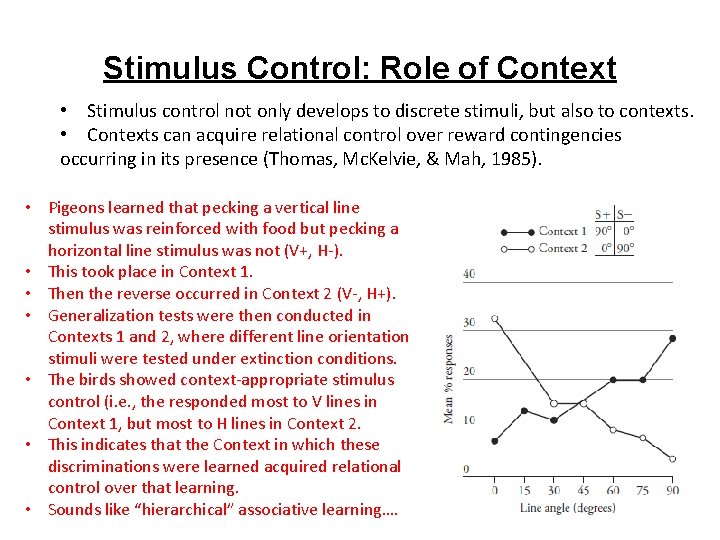
Stimulus Control: Role of Context • Stimulus control not only develops to discrete stimuli, but also to contexts. • Contexts can acquire relational control over reward contingencies occurring in its presence (Thomas, Mc. Kelvie, & Mah, 1985). • Pigeons learned that pecking a vertical line stimulus was reinforced with food but pecking a horizontal line stimulus was not (V+, H-). • This took place in Context 1. • Then the reverse occurred in Context 2 (V-, H+). • Generalization tests were then conducted in Contexts 1 and 2, where different line orientation stimuli were tested under extinction conditions. • The birds showed context-appropriate stimulus control (i. e. , the responded most to V lines in Context 1, but most to H lines in Context 2. • This indicates that the Context in which these discriminations were learned acquired relational control over that learning. • Sounds like “hierarchical” associative learning….
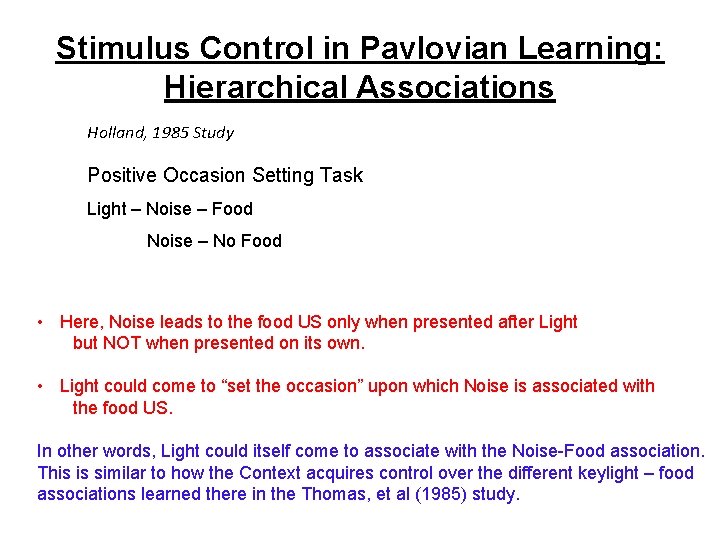
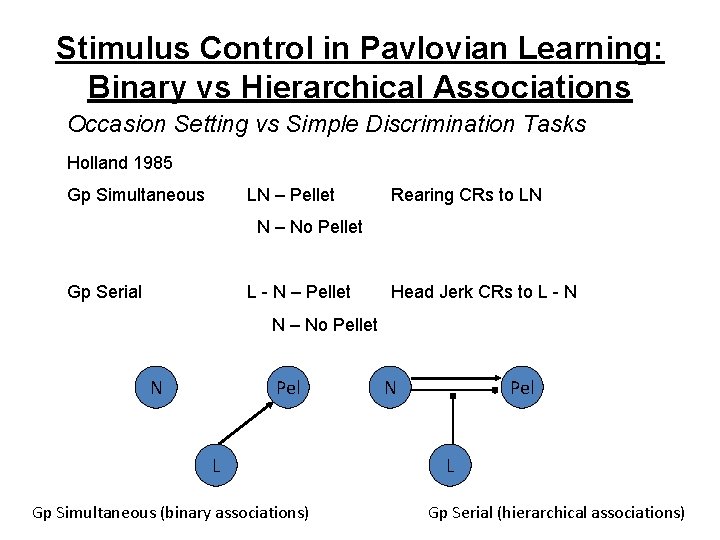
Stimulus Control in Pavlovian Learning: Hierarchical Associations Holland, 1985 Study Positive Occasion Setting Task Light – Noise – Food Noise – No Food • Here, Noise leads to the food US only when presented after Light but NOT when presented on its own. • Light could come to “set the occasion” upon which Noise is associated with the food US. In other words, Light could itself come to associate with the Noise-Food association. This is similar to how the Context acquires control over the different keylight – food associations learned there in the Thomas, et al (1985) study.
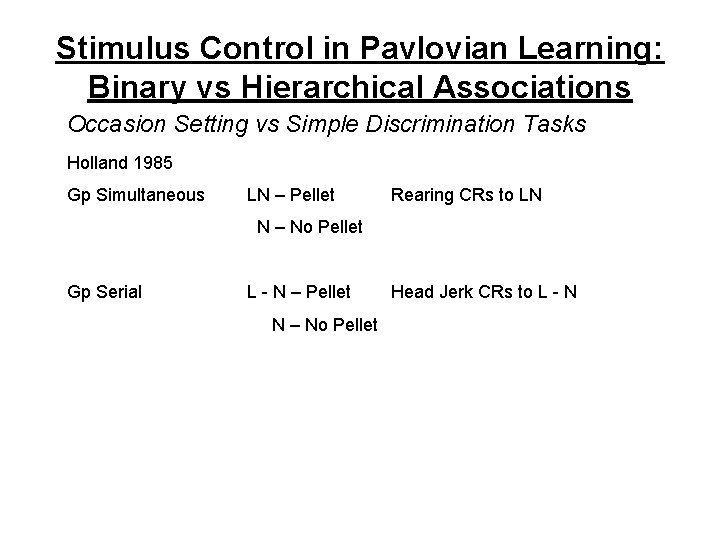
Stimulus Control in Pavlovian Learning: Binary vs Hierarchical Associations Occasion Setting vs Simple Discrimination Tasks Holland 1985 Gp Simultaneous LN – Pellet Rearing CRs to LN N – No Pellet Gp Serial L - N – Pellet N – No Pellet Head Jerk CRs to L - N
Stimulus Control in Pavlovian Learning: Binary vs Hierarchical Associations Occasion Setting vs Simple Discrimination Tasks Holland 1985 Gp Simultaneous LN – Pellet Rearing CRs to LN N – No Pellet Gp Serial L - N – Pellet Head Jerk CRs to L - N N – No Pellet N Pel L Gp Simultaneous (binary associations) N Pel L Gp Serial (hierarchical associations)