
Lecture 18 Learning Vikas Ashok Department of Computer
- Slides: 27
Lecture 18 Learning Vikas Ashok Department of Computer Science ODU Reading for This Class: Chapters 15, 16 Artificial Intelligence
Review • Last Class – Swarm Intelligence – Ant Colony Optimization – Ant Clustering • This Class – Learning • Next Class – Artificial Neural Network Artificial Intelligence
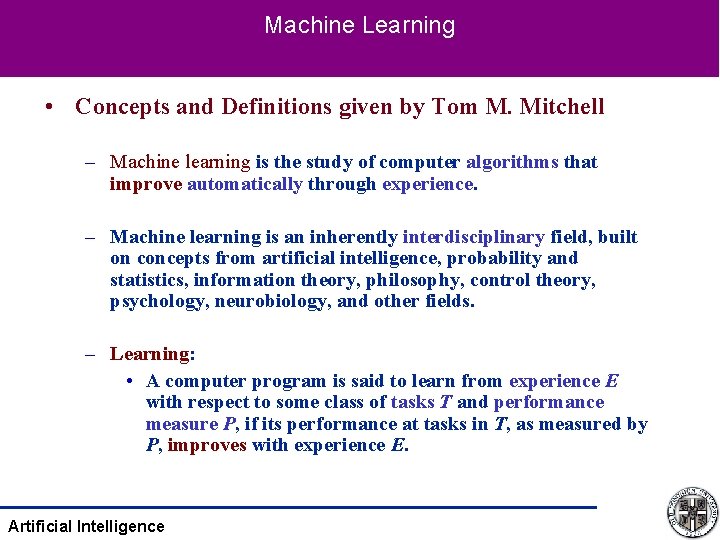
Machine Learning • Concepts and Definitions given by Tom M. Mitchell – Machine learning is the study of computer algorithms that improve automatically through experience. – Machine learning is an inherently interdisciplinary field, built on concepts from artificial intelligence, probability and statistics, information theory, philosophy, control theory, psychology, neurobiology, and other fields. – Learning: • A computer program is said to learn from experience E with respect to some class of tasks T and performance measure P, if its performance at tasks in T, as measured by P, improves with experience E. Artificial Intelligence
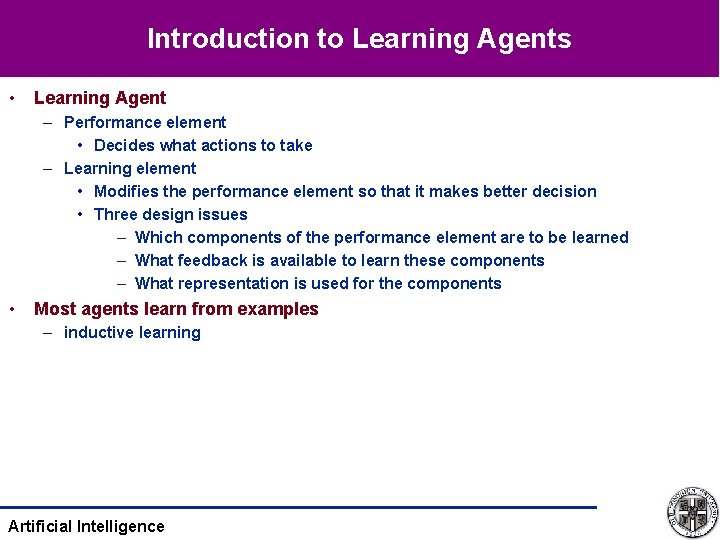
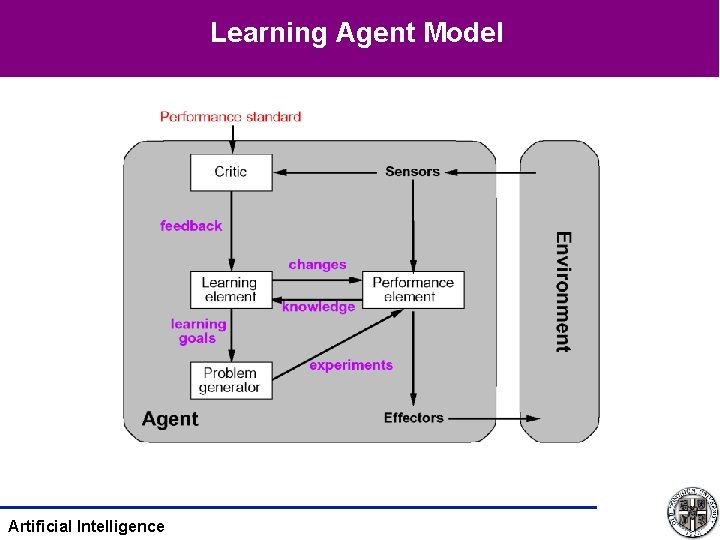
Introduction to Learning Agents • Learning Agent – Performance element • Decides what actions to take – Learning element • Modifies the performance element so that it makes better decision • Three design issues – Which components of the performance element are to be learned – What feedback is available to learn these components – What representation is used for the components • Most agents learn from examples – inductive learning Artificial Intelligence
Learning Agent Model Artificial Intelligence
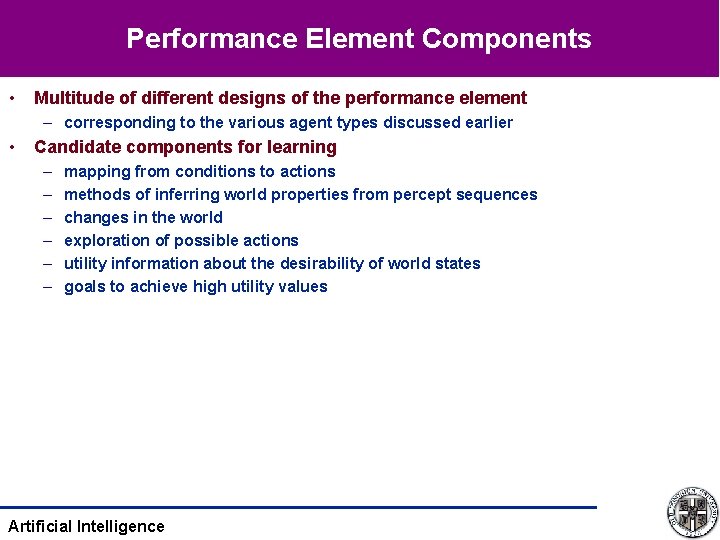
Performance Element Components • Multitude of different designs of the performance element – corresponding to the various agent types discussed earlier • Candidate components for learning – – – mapping from conditions to actions methods of inferring world properties from percept sequences changes in the world exploration of possible actions utility information about the desirability of world states goals to achieve high utility values Artificial Intelligence
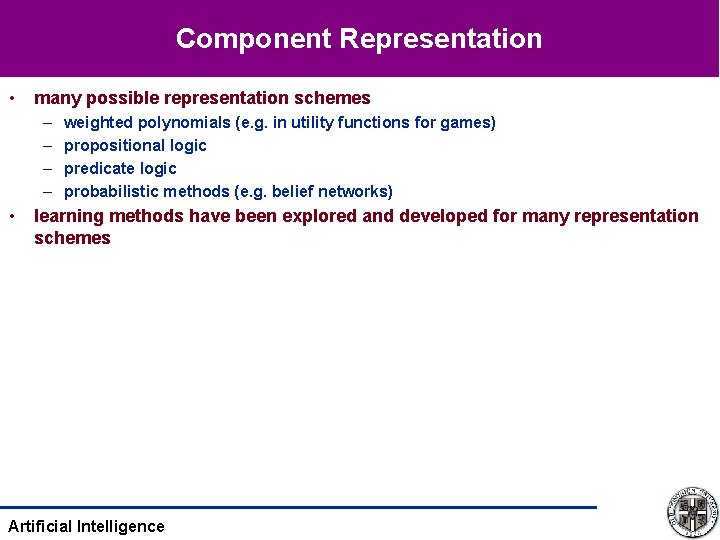
Component Representation • many possible representation schemes – – • weighted polynomials (e. g. in utility functions for games) propositional logic predicate logic probabilistic methods (e. g. belief networks) learning methods have been explored and developed for many representation schemes Artificial Intelligence
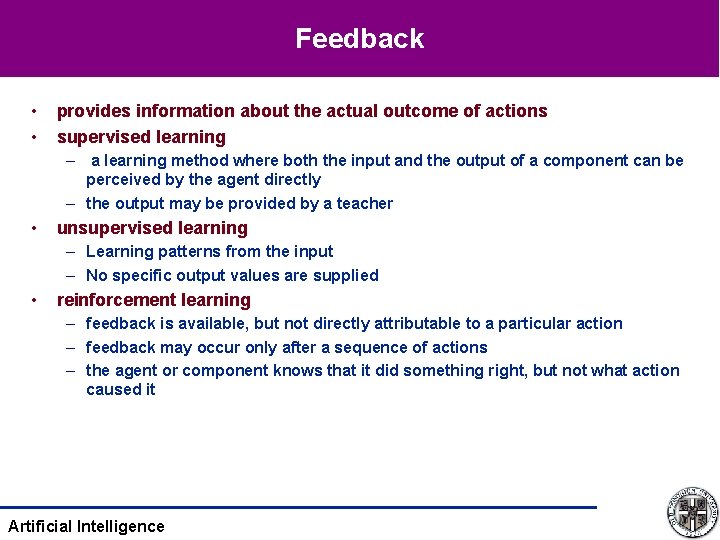
Feedback • • provides information about the actual outcome of actions supervised learning – a learning method where both the input and the output of a component can be perceived by the agent directly – the output may be provided by a teacher • unsupervised learning – Learning patterns from the input – No specific output values are supplied • reinforcement learning – feedback is available, but not directly attributable to a particular action – feedback may occur only after a sequence of actions – the agent or component knows that it did something right, but not what action caused it Artificial Intelligence
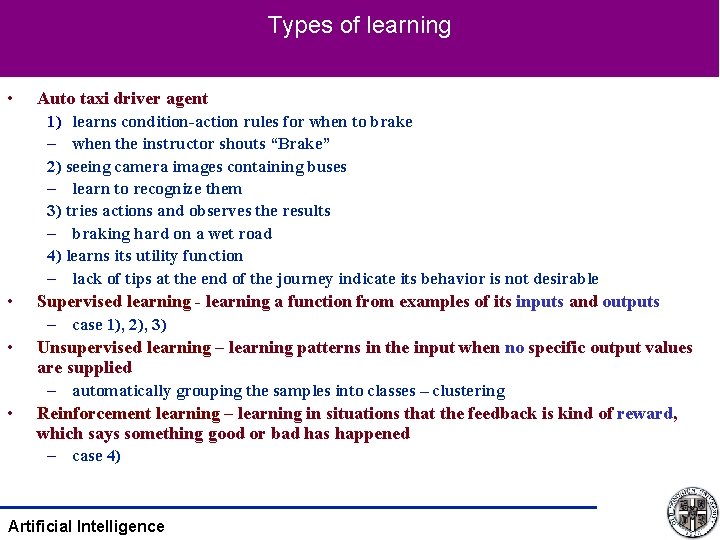
Types of learning • Auto taxi driver agent 1) learns condition-action rules for when to brake – when the instructor shouts “Brake” 2) seeing camera images containing buses – learn to recognize them 3) tries actions and observes the results – braking hard on a wet road 4) learns its utility function – lack of tips at the end of the journey indicate its behavior is not desirable • • • Supervised learning - learning a function from examples of its inputs and outputs – case 1), 2), 3) Unsupervised learning – learning patterns in the input when no specific output values are supplied – automatically grouping the samples into classes – clustering Reinforcement learning – learning in situations that the feedback is kind of reward, which says something good or bad has happened – case 4) Artificial Intelligence
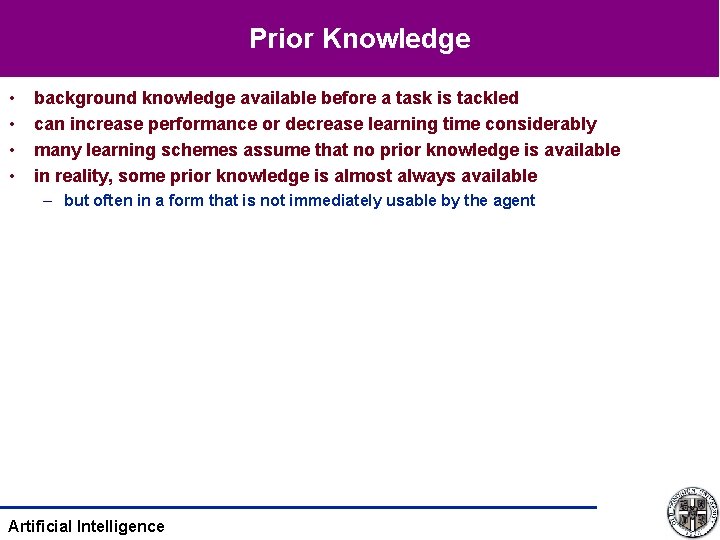
Prior Knowledge • • background knowledge available before a task is tackled can increase performance or decrease learning time considerably many learning schemes assume that no prior knowledge is available in reality, some prior knowledge is almost always available – but often in a form that is not immediately usable by the agent Artificial Intelligence
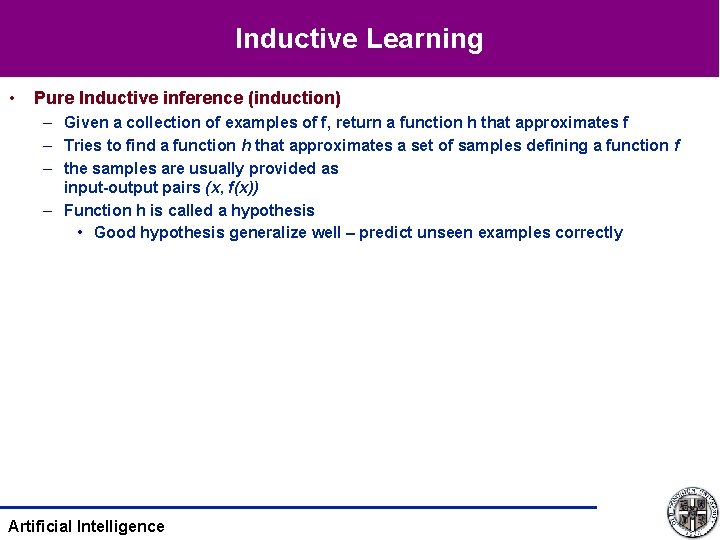
Inductive Learning • Pure Inductive inference (induction) – Given a collection of examples of f, return a function h that approximates f – Tries to find a function h that approximates a set of samples defining a function f – the samples are usually provided as input-output pairs (x, f(x)) – Function h is called a hypothesis • Good hypothesis generalize well – predict unseen examples correctly Artificial Intelligence
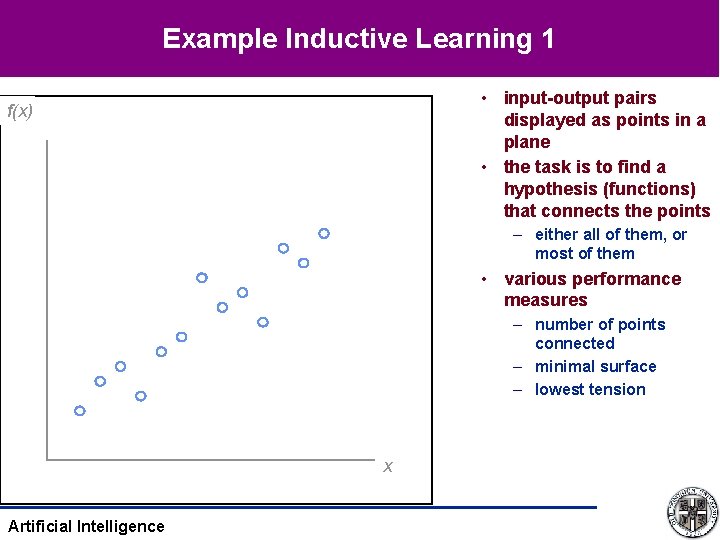
Example Inductive Learning 1 • input-output pairs displayed as points in a plane • the task is to find a hypothesis (functions) that connects the points f(x) – either all of them, or most of them • various performance measures – number of points connected – minimal surface – lowest tension x Artificial Intelligence
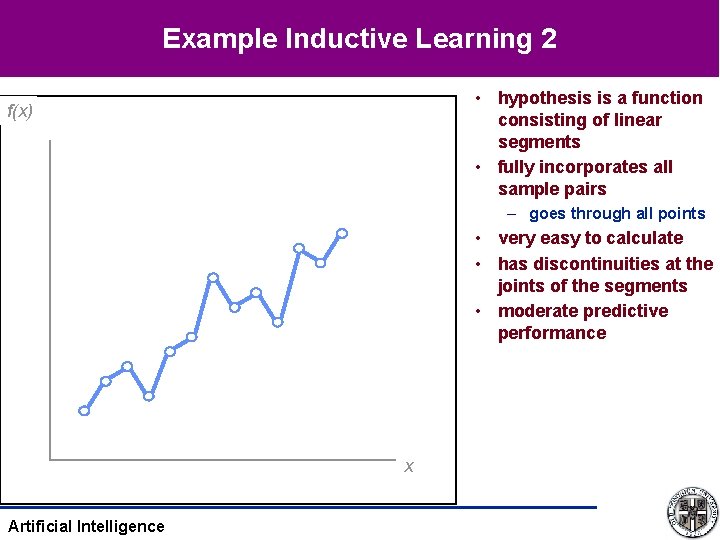
Example Inductive Learning 2 • hypothesis is a function consisting of linear segments • fully incorporates all sample pairs f(x) – goes through all points • very easy to calculate • has discontinuities at the joints of the segments • moderate predictive performance x Artificial Intelligence
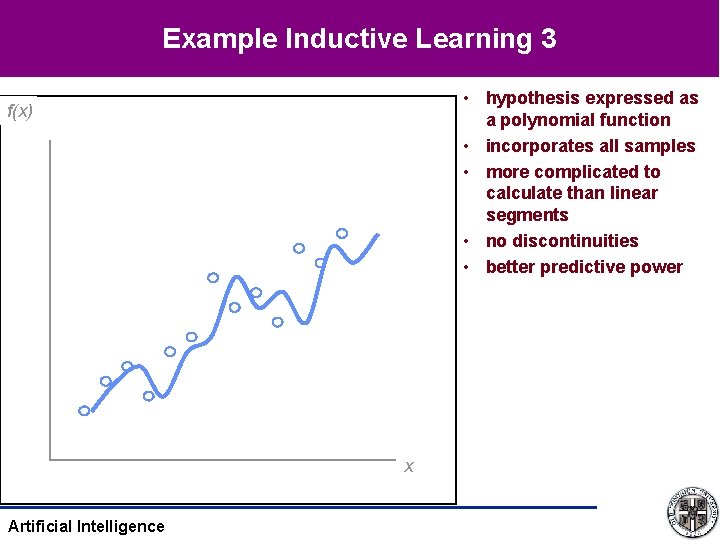
Example Inductive Learning 3 • hypothesis expressed as a polynomial function • incorporates all samples • more complicated to calculate than linear segments • no discontinuities • better predictive power f(x) x Artificial Intelligence
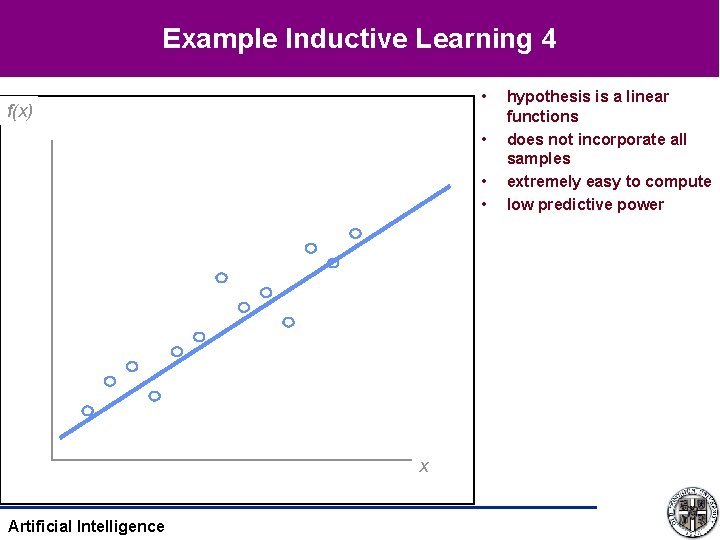
Example Inductive Learning 4 • f(x) • • • x Artificial Intelligence hypothesis is a linear functions does not incorporate all samples extremely easy to compute low predictive power
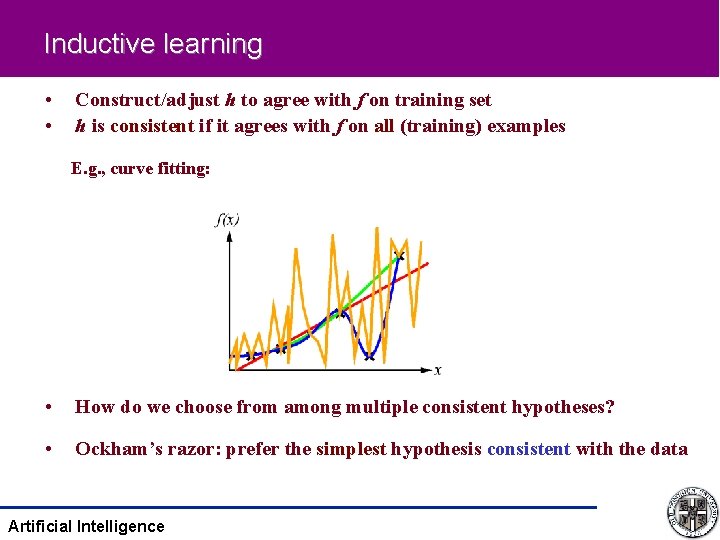
Inductive learning • • Construct/adjust h to agree with f on training set h is consistent if it agrees with f on all (training) examples E. g. , curve fitting: • How do we choose from among multiple consistent hypotheses? • Ockham’s razor: prefer the simplest hypothesis consistent with the data Artificial Intelligence
Decision tree learning • Regression learning – learning continuous function • Classification learning – learning discrete-valued function – Boolean classification of examples is positive (T) or negative (F) • A decision tree – simplest yet useful inductive learning algorithm – takes as input an example described by a set of attributes and returns a “decision” – the predicted output value for the input • An example: whether to wait for a table at a restaurant – To learn a definition for the goal predicate Will. Wait – Need attributes that describes examples in the domain Artificial Intelligence
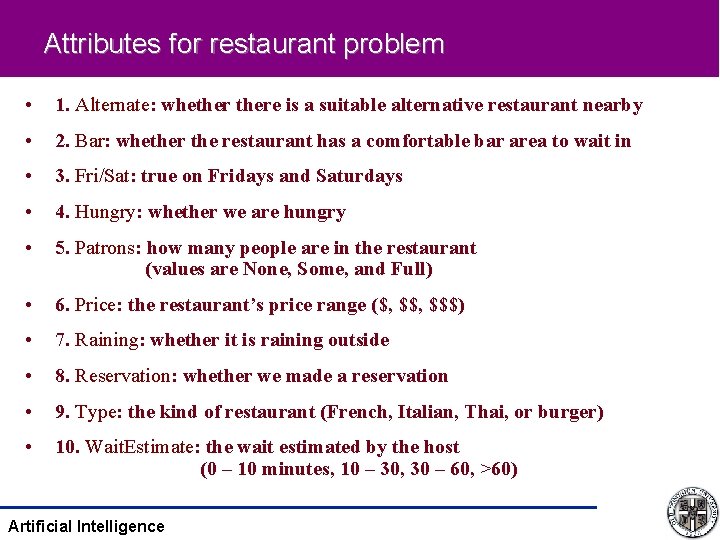
Attributes for restaurant problem • 1. Alternate: whethere is a suitable alternative restaurant nearby • 2. Bar: whether the restaurant has a comfortable bar area to wait in • 3. Fri/Sat: true on Fridays and Saturdays • 4. Hungry: whether we are hungry • 5. Patrons: how many people are in the restaurant (values are None, Some, and Full) • 6. Price: the restaurant’s price range ($, $$$) • 7. Raining: whether it is raining outside • 8. Reservation: whether we made a reservation • 9. Type: the kind of restaurant (French, Italian, Thai, or burger) • 10. Wait. Estimate: the wait estimated by the host (0 – 10 minutes, 10 – 30, 30 – 60, >60) Artificial Intelligence
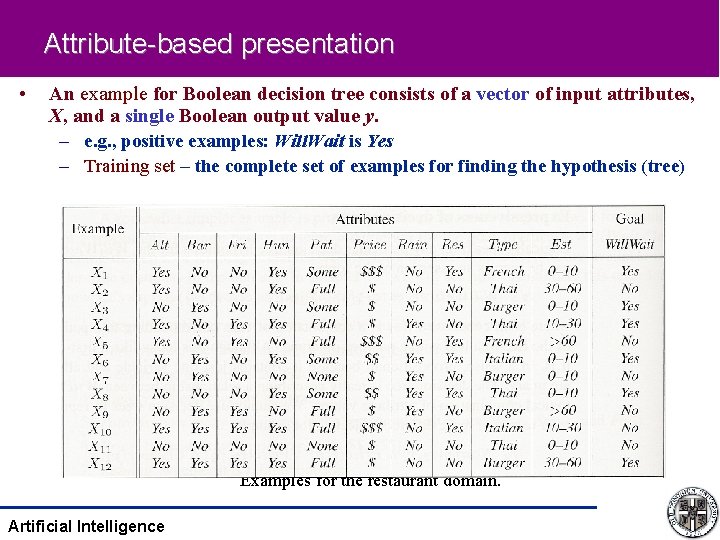
Attribute-based presentation • An example for Boolean decision tree consists of a vector of input attributes, X, and a single Boolean output value y. – e. g. , positive examples: Will. Wait is Yes – Training set – the complete set of examples for finding the hypothesis (tree) Examples for the restaurant domain. Artificial Intelligence
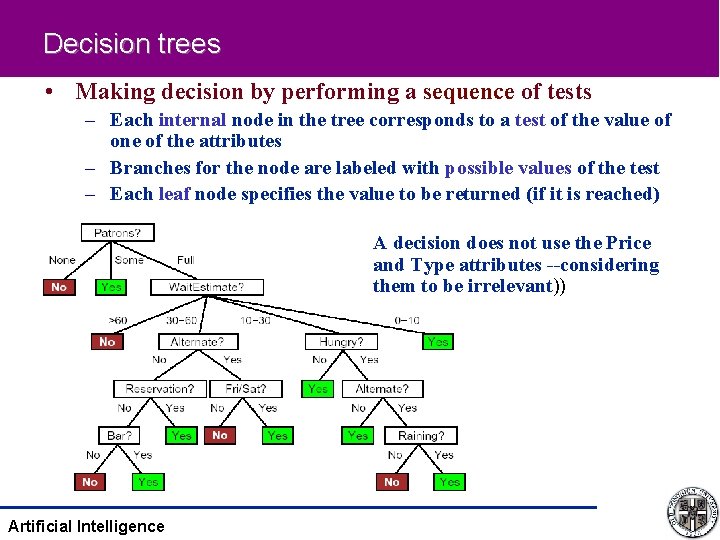
Decision trees • Making decision by performing a sequence of tests – Each internal node in the tree corresponds to a test of the value of one of the attributes – Branches for the node are labeled with possible values of the test – Each leaf node specifies the value to be returned (if it is reached) A decision does not use the Price and Type attributes --considering them to be irrelevant)) Artificial Intelligence
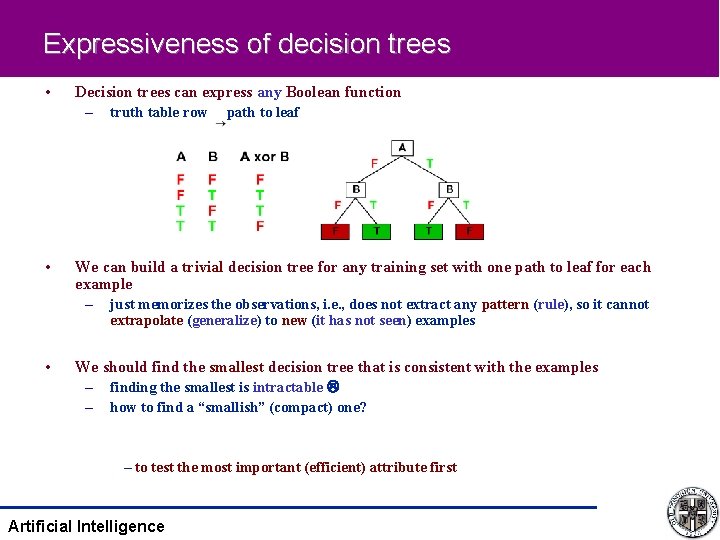
Expressiveness of decision trees • Decision trees can express any Boolean function – truth table row path to leaf • We can build a trivial decision tree for any training set with one path to leaf for each example – just memorizes the observations, i. e. , does not extract any pattern (rule), so it cannot extrapolate (generalize) to new (it has not seen) examples • We should find the smallest decision tree that is consistent with the examples – finding the smallest is intractable – how to find a “smallish” (compact) one? – to test the most important (efficient) attribute first Artificial Intelligence
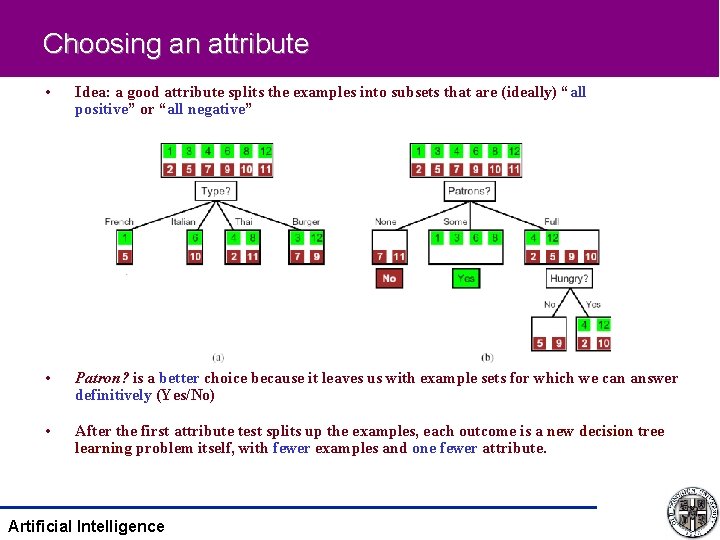
Choosing an attribute • Idea: a good attribute splits the examples into subsets that are (ideally) “all positive” or “all negative” • Patron? is a better choice because it leaves us with example sets for which we can answer definitively (Yes/No) • After the first attribute test splits up the examples, each outcome is a new decision tree learning problem itself, with fewer examples and one fewer attribute. Artificial Intelligence
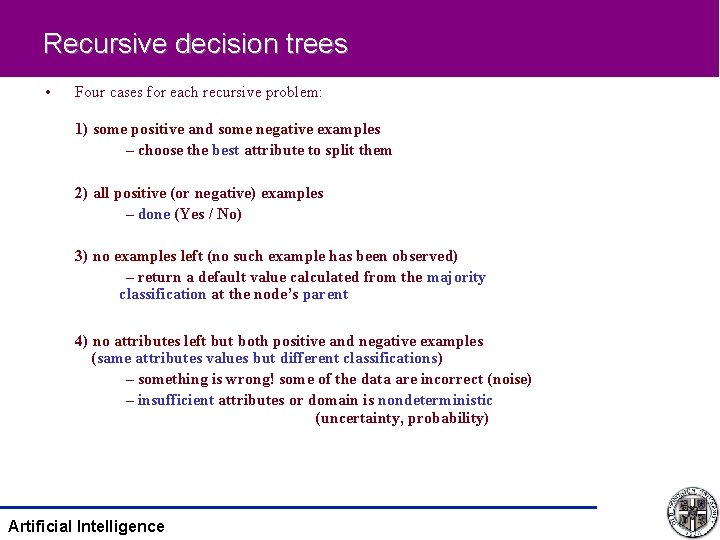
Recursive decision trees • Four cases for each recursive problem: 1) some positive and some negative examples – choose the best attribute to split them 2) all positive (or negative) examples – done (Yes / No) 3) no examples left (no such example has been observed) – return a default value calculated from the majority classification at the node’s parent 4) no attributes left but both positive and negative examples (same attributes values but different classifications) – something is wrong! some of the data are incorrect (noise) – insufficient attributes or domain is nondeterministic (uncertainty, probability) Artificial Intelligence
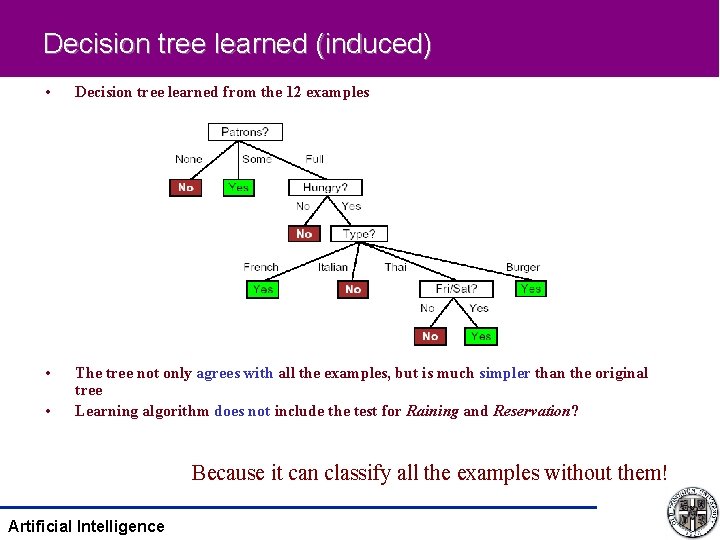
Decision tree learned (induced) • Decision tree learned from the 12 examples • The tree not only agrees with all the examples, but is much simpler than the original tree Learning algorithm does not include the test for Raining and Reservation? • Because it can classify all the examples without them! Artificial Intelligence
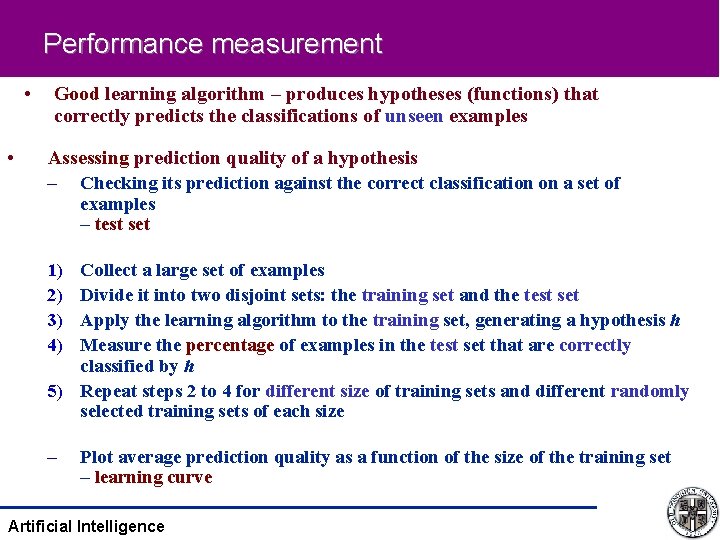
Performance measurement • • Good learning algorithm – produces hypotheses (functions) that correctly predicts the classifications of unseen examples Assessing prediction quality of a hypothesis – Checking its prediction against the correct classification on a set of examples – test set 1) 2) 3) 4) Collect a large set of examples Divide it into two disjoint sets: the training set and the test set Apply the learning algorithm to the training set, generating a hypothesis h Measure the percentage of examples in the test set that are correctly classified by h 5) Repeat steps 2 to 4 for different size of training sets and different randomly selected training sets of each size – Plot average prediction quality as a function of the size of the training set – learning curve Artificial Intelligence
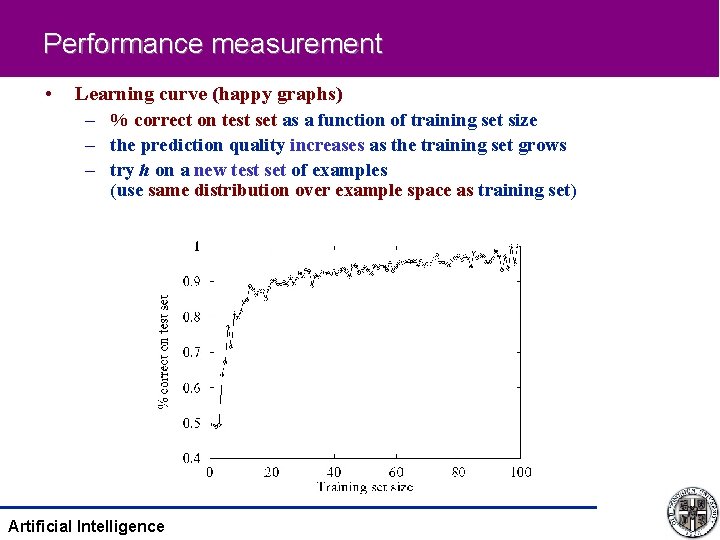
Performance measurement • Learning curve (happy graphs) – % correct on test set as a function of training set size – the prediction quality increases as the training set grows – try h on a new test set of examples (use same distribution over example space as training set) Artificial Intelligence
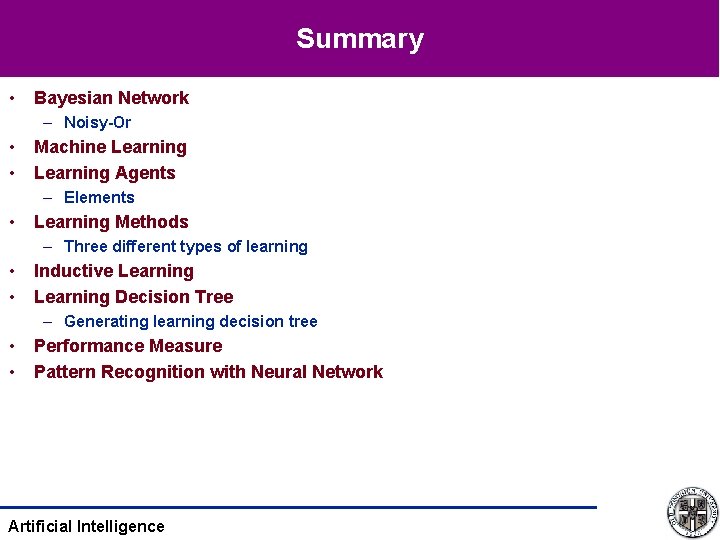
Summary • Bayesian Network – Noisy-Or • • Machine Learning Agents – Elements • Learning Methods – Three different types of learning • • Inductive Learning Decision Tree – Generating learning decision tree • • Performance Measure Pattern Recognition with Neural Network Artificial Intelligence