
Lecture 18 Important Undecidable Problems and what to
Lecture 18: Important Undecidable Problems (and what to do about them) cs 302: Theory of Computation University of Virginia Computer Science David Evans http: //www. cs. virginia. edu/evans
Menu • What does undecidability mean for problems real people (not just CS theorists) care about? • What do you do when your application’s requirements require “solving” an undecidable problem? 2
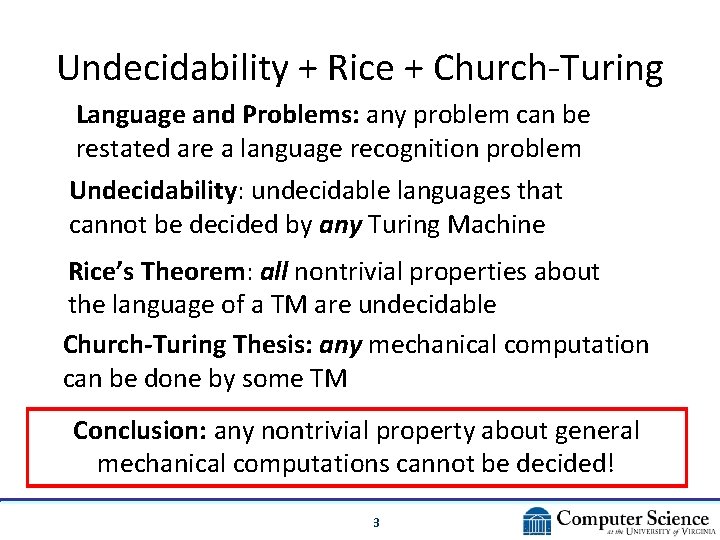
Undecidability + Rice + Church-Turing Language and Problems: any problem can be restated are a language recognition problem Undecidability: undecidable languages that cannot be decided by any Turing Machine Rice’s Theorem: all nontrivial properties about the language of a TM are undecidable Church-Turing Thesis: any mechanical computation can be done by some TM Conclusion: any nontrivial property about general mechanical computations cannot be decided! 3
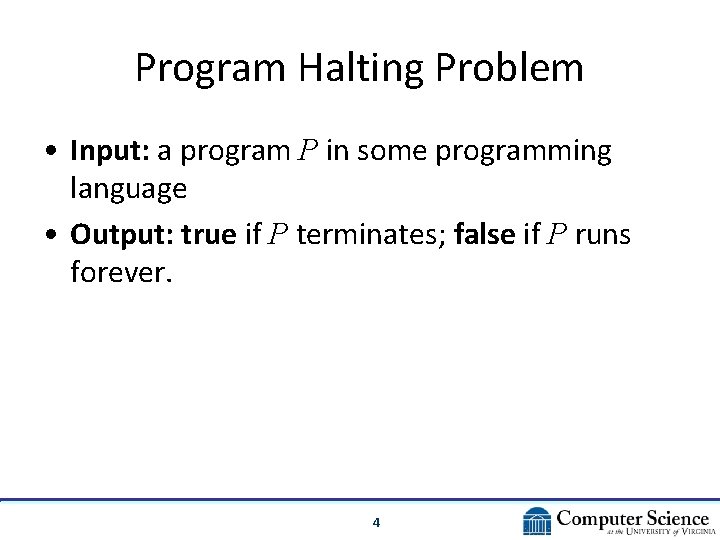
Program Halting Problem • Input: a program P in some programming language • Output: true if P terminates; false if P runs forever. 4
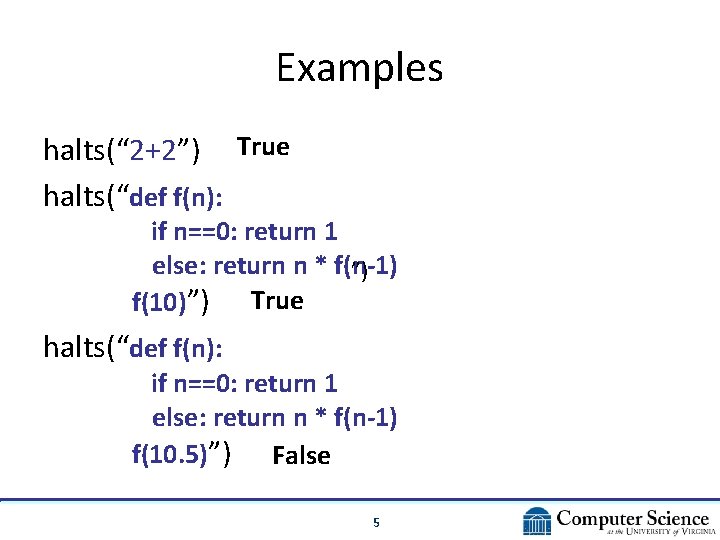
Examples halts(“ 2+2”) True halts(“def f(n): if n==0: return 1 else: return n * f(n-1) ”) f(10)”) True halts(“def f(n): if n==0: return 1 else: return n * f(n-1) f(10. 5)”) False 5
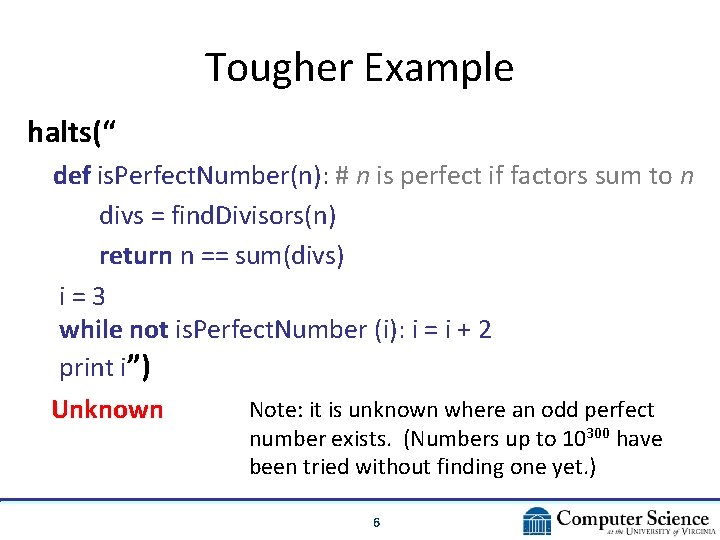
Tougher Example halts(“ def is. Perfect. Number(n): # n is perfect if factors sum to n divs = find. Divisors(n) return n == sum(divs) i=3 while not is. Perfect. Number (i): i = i + 2 print i”) Note: it is unknown where an odd perfect Unknown number exists. (Numbers up to 10300 have been tried without finding one yet. ) 6
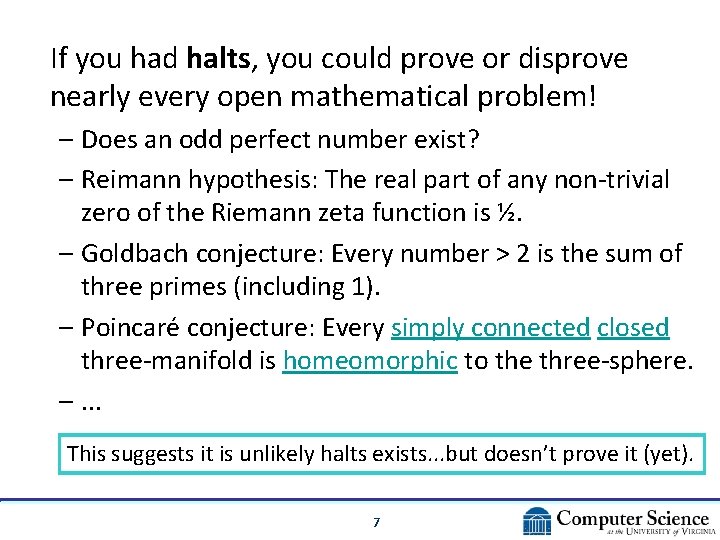
If you had halts, you could prove or disprove nearly every open mathematical problem! – Does an odd perfect number exist? – Reimann hypothesis: The real part of any non-trivial zero of the Riemann zeta function is ½. – Goldbach conjecture: Every number > 2 is the sum of three primes (including 1). – Poincaré conjecture: Every simply connected closed three-manifold is homeomorphic to the three-sphere. –. . . This suggests it is unlikely halts exists. . . but doesn’t prove it (yet). 7
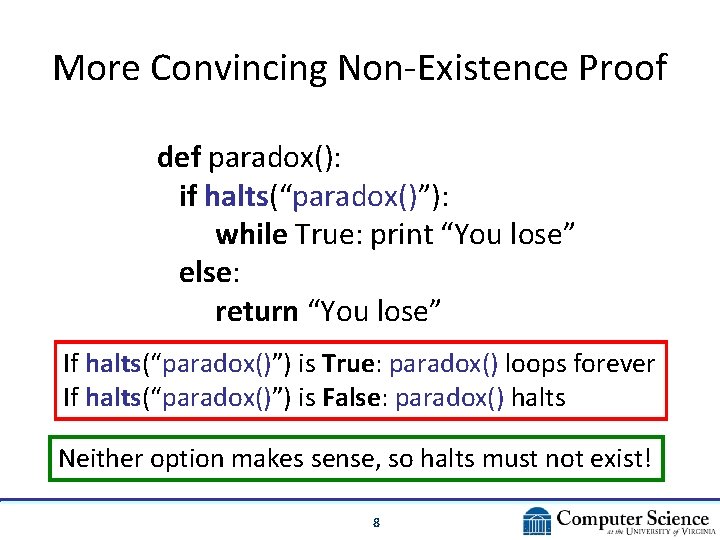
More Convincing Non-Existence Proof def paradox(): if halts(“paradox()”): while True: print “You lose” else: return “You lose” If halts(“paradox()”) is True: paradox() loops forever If halts(“paradox()”) is False: paradox() halts Neither option makes sense, so halts must not exist! 8
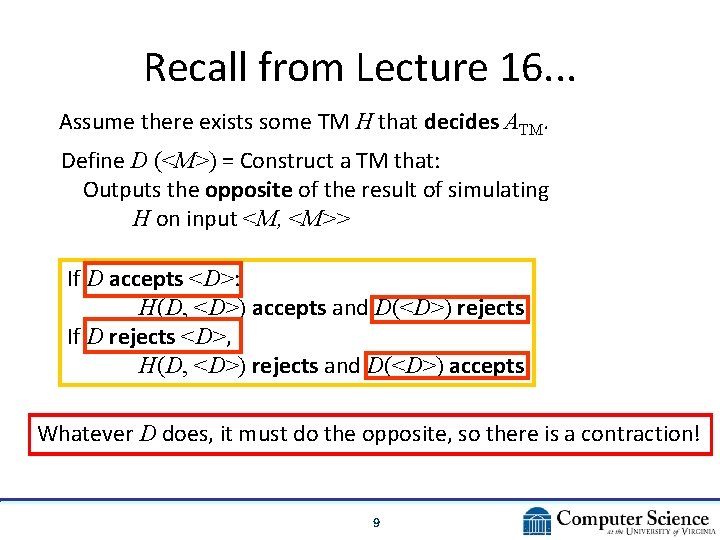
Recall from Lecture 16. . . Assume there exists some TM H that decides ATM. Define D (<M>) = Construct a TM that: Outputs the opposite of the result of simulating H on input <M, <M>> If D accepts <D>: H(D, <D>) accepts and D(<D>) rejects If D rejects <D>, H(D, <D>) rejects and D(<D>) accepts Whatever D does, it must do the opposite, so there is a contraction! 9
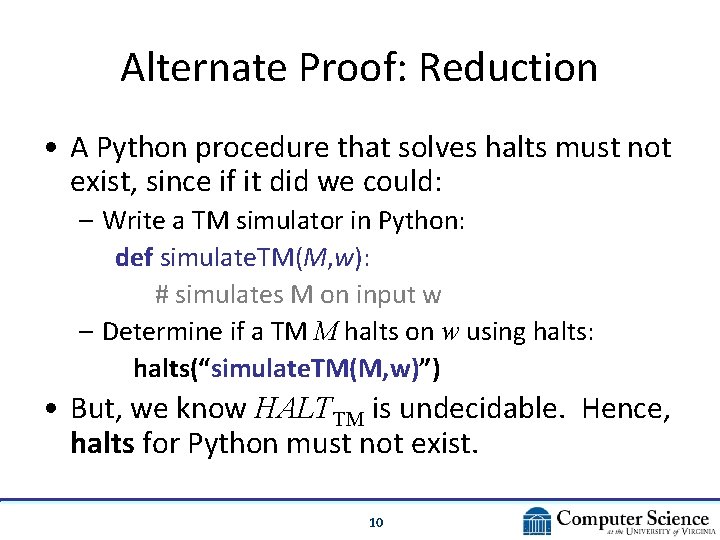
Alternate Proof: Reduction • A Python procedure that solves halts must not exist, since if it did we could: – Write a TM simulator in Python: def simulate. TM(M, w): # simulates M on input w – Determine if a TM M halts on w using halts: halts(“simulate. TM(M, w)”) • But, we know HALTTM is undecidable. Hence, halts for Python must not exist. 10
Does this work for Java? 11
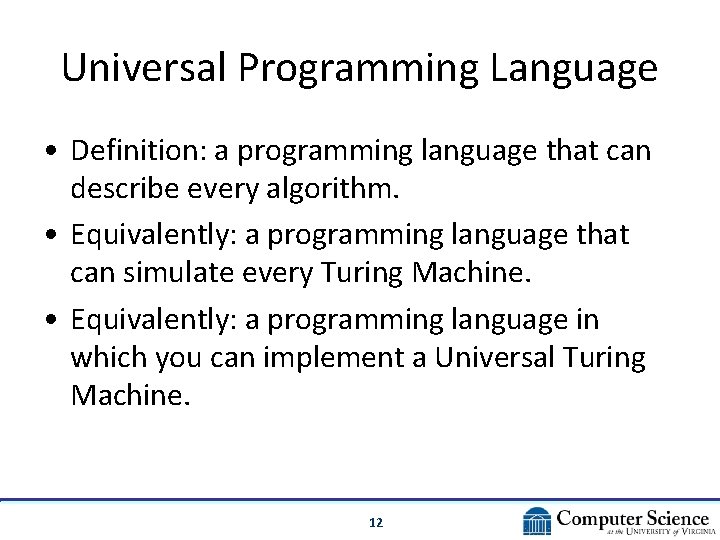
Universal Programming Language • Definition: a programming language that can describe every algorithm. • Equivalently: a programming language that can simulate every Turing Machine. • Equivalently: a programming language in which you can implement a Universal Turing Machine. 12
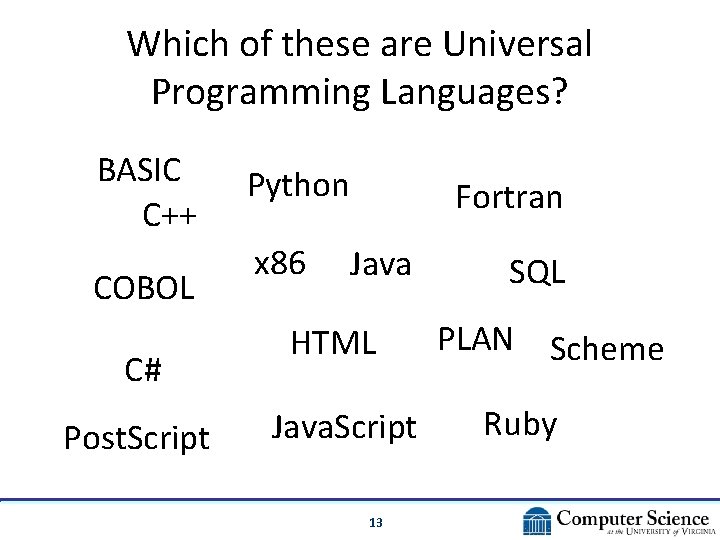
Which of these are Universal Programming Languages? BASIC C++ COBOL C# Post. Script Python x 86 Fortran Java HTML Java. Script 13 SQL PLAN Scheme Ruby
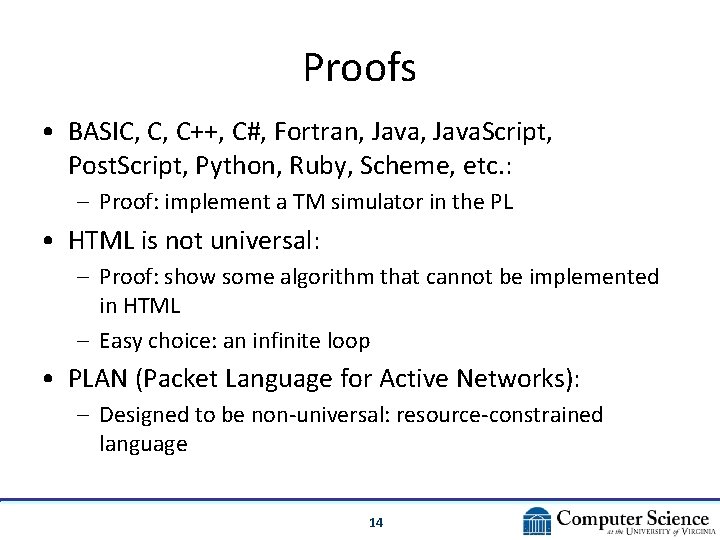
Proofs • BASIC, C, C++, C#, Fortran, Java. Script, Post. Script, Python, Ruby, Scheme, etc. : – Proof: implement a TM simulator in the PL • HTML is not universal: – Proof: show some algorithm that cannot be implemented in HTML – Easy choice: an infinite loop • PLAN (Packet Language for Active Networks): – Designed to be non-universal: resource-constrained language 14
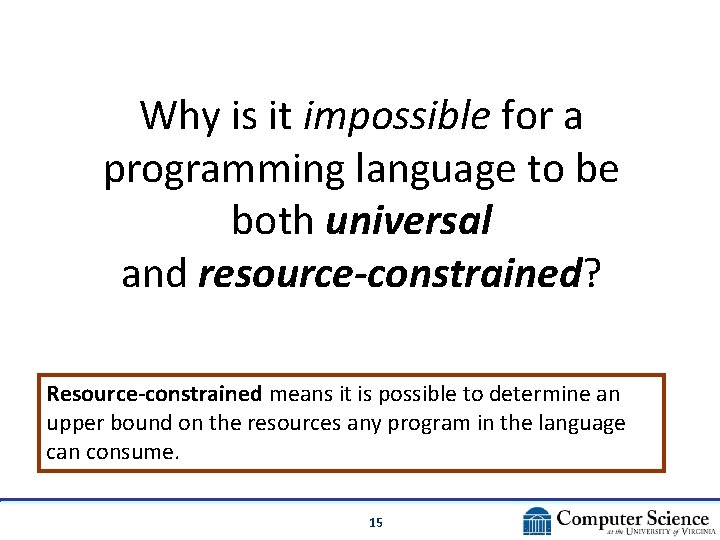
Why is it impossible for a programming language to be both universal and resource-constrained? Resource-constrained means it is possible to determine an upper bound on the resources any program in the language can consume. 15
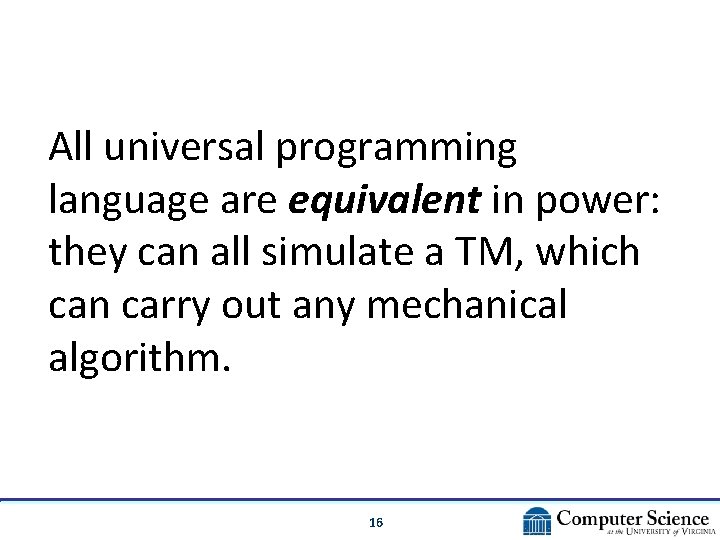
All universal programming language are equivalent in power: they can all simulate a TM, which can carry out any mechanical algorithm. 16
Why so many programming languages? 17
Proliferation of Universal PLs • “Aesthetics” – Some people like : =, others prefer =. – Some people think whitespace shouldn’t matter (e. g. , Java), others think programs should be formatted like they mean (e. g. , Python) – Some people like goto, others like throw. • Expressiveness vs. “Truthiness” – How much you can say with a little code vs. how likely it is your code means what you think it does 18
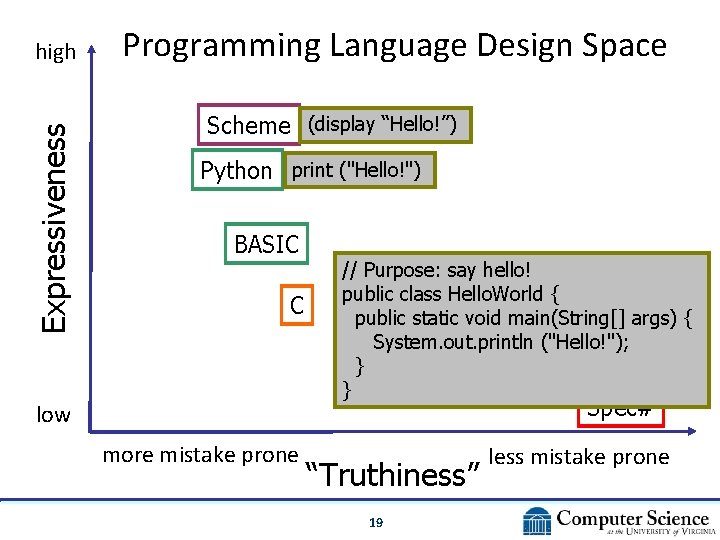
Expressiveness high Programming Language Design Space Scheme (display “Hello!”) Python print ("Hello!") BASIC C // Purpose: say hello! strict C++class Hello. World public { typing, static public static void main(String[] args) { System. out. println ("Hello!"); Java } Ada } Spec# low more mistake prone “Truthiness” 19 less mistake prone
Are any Important Problems Undecidable? 20
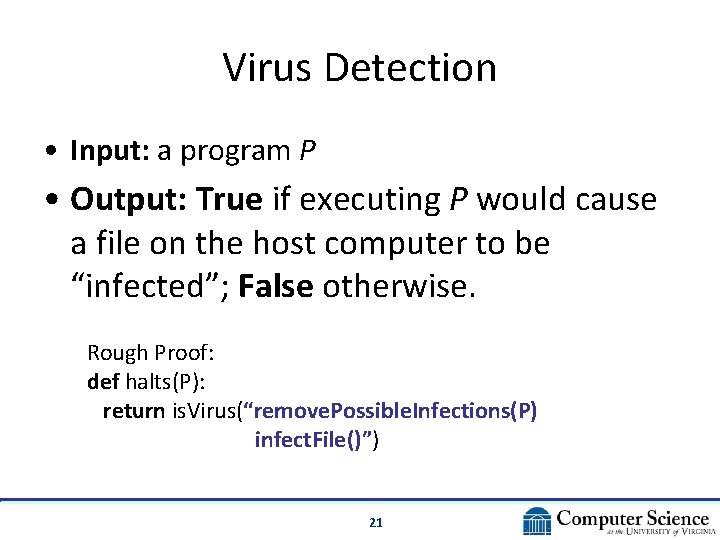
Virus Detection • Input: a program P • Output: True if executing P would cause a file on the host computer to be “infected”; False otherwise. Rough Proof: def halts(P): return is. Virus(“remove. Possible. Infections(P) infect. File()”) 21
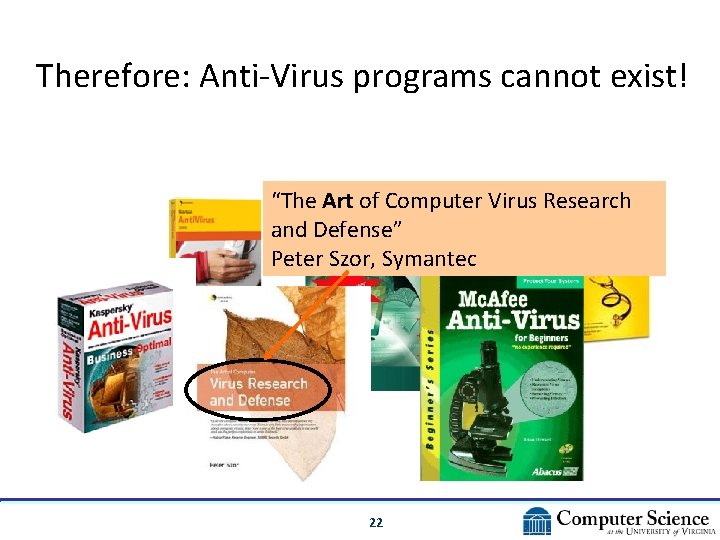
Therefore: Anti-Virus programs cannot exist! “The Art of Computer Virus Research and Defense” Peter Szor, Symantec 22
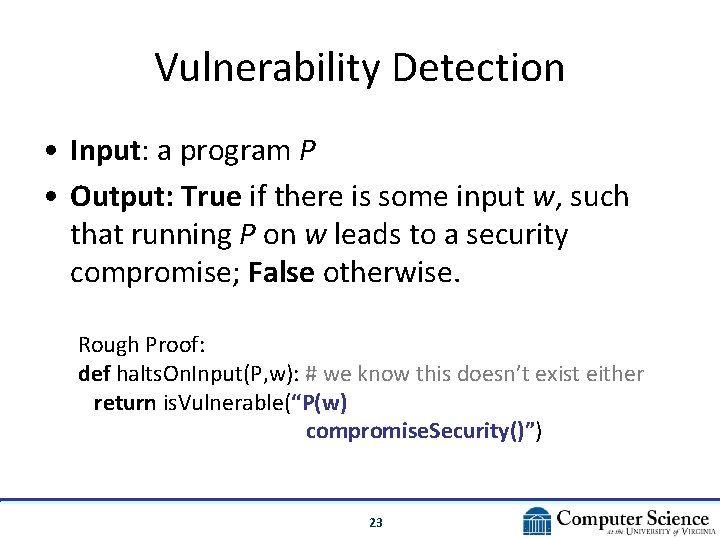
Vulnerability Detection • Input: a program P • Output: True if there is some input w, such that running P on w leads to a security compromise; False otherwise. Rough Proof: def halts. On. Input(P, w): # we know this doesn’t exist either return is. Vulnerable(“P(w) compromise. Security()”) 23
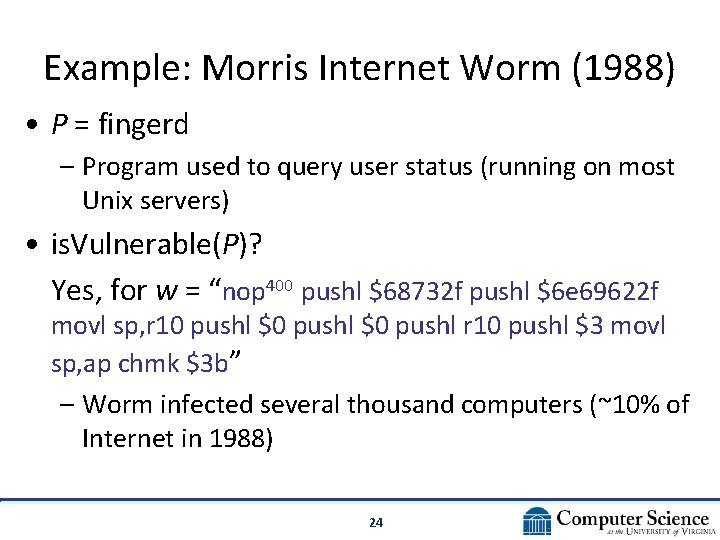
Example: Morris Internet Worm (1988) • P = fingerd – Program used to query user status (running on most Unix servers) • is. Vulnerable(P)? Yes, for w = “nop 400 pushl $68732 f pushl $6 e 69622 f movl sp, r 10 pushl $0 pushl r 10 pushl $3 movl sp, ap chmk $3 b” – Worm infected several thousand computers (~10% of Internet in 1988) 24
Impossibility of Vulnerability Detection 25
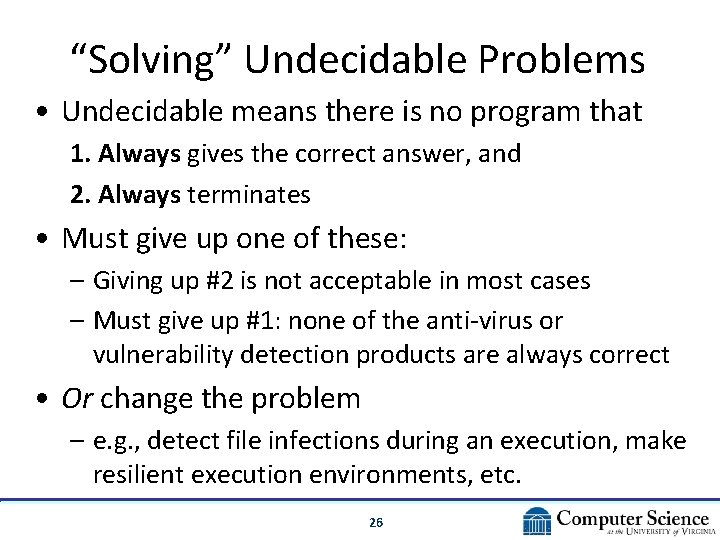
“Solving” Undecidable Problems • Undecidable means there is no program that 1. Always gives the correct answer, and 2. Always terminates • Must give up one of these: – Giving up #2 is not acceptable in most cases – Must give up #1: none of the anti-virus or vulnerability detection products are always correct • Or change the problem – e. g. , detect file infections during an execution, make resilient execution environments, etc. 26
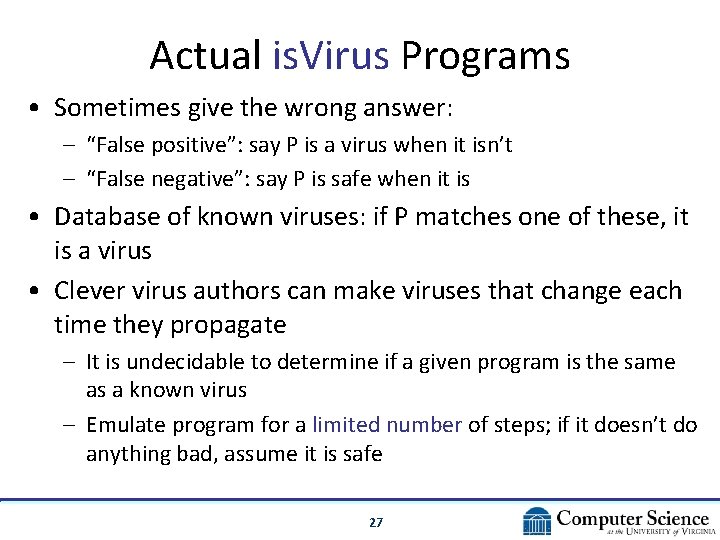
Actual is. Virus Programs • Sometimes give the wrong answer: – “False positive”: say P is a virus when it isn’t – “False negative”: say P is safe when it is • Database of known viruses: if P matches one of these, it is a virus • Clever virus authors can make viruses that change each time they propagate – It is undecidable to determine if a given program is the same as a known virus – Emulate program for a limited number of steps; if it doesn’t do anything bad, assume it is safe 27
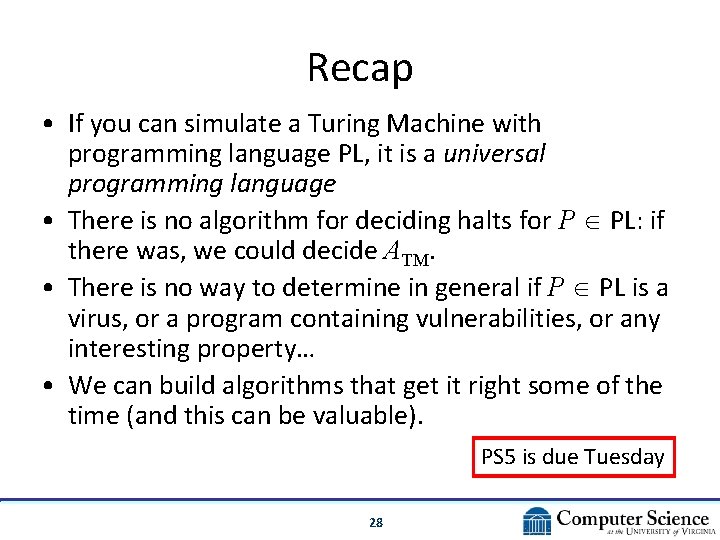
Recap • If you can simulate a Turing Machine with programming language PL, it is a universal programming language • There is no algorithm for deciding halts for P PL: if there was, we could decide ATM. • There is no way to determine in general if P PL is a virus, or a program containing vulnerabilities, or any interesting property… • We can build algorithms that get it right some of the time (and this can be valuable). PS 5 is due Tuesday 28
- Slides: 28