
Lecture 18 Hydrological modelling Outline Basics of hydrology
Lecture 18 Hydrological modelling Outline: – Basics of hydrology – Creating hydrologically correct DEMs – Modelling catchment variables Week 22 GEOG 2750 – Earth Observation and GIS of the Physical 1

Basics of Hydrology • The “Golden Rule” of hydrology. . . “water flows down hill” – – under force of gravity BUT, may move up through system via: Ø capillary action in soil Ø hydraulic pressure in groundwater aquifers Ø evapotranspiration Week 22 GEOG 2750 – Earth Observation and GIS of the Physical 2
The hydrological cycle • Representation of: – flows Ø water Ø energy Ø suspended/dissolved – materials inputs/outputs to/from sub-systems Ø catchment/watershed Ø atmosphere Ø water Week 22 stores (soil, bedrock, channel, etc. ) GEOG 2750 – Earth Observation and GIS of the Physical 3
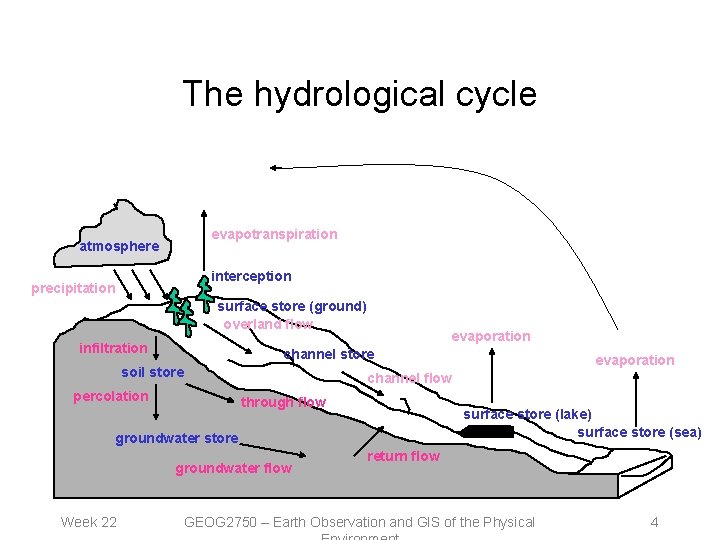
The hydrological cycle evapotranspiration atmosphere interception precipitation surface store (ground) overland flow infiltration evaporation channel store soil store channel flow percolation through flow surface store (lake) surface store (sea) groundwater store groundwater flow Week 22 evaporation return flow GEOG 2750 – Earth Observation and GIS of the Physical 4
Catchment models • Catchment-based models: – spatial representation Ø lumped Ø distributed – process representation Ø black-box Ø grey-box Ø white-box Week 22 GEOG 2750 – Earth Observation and GIS of the Physical 5
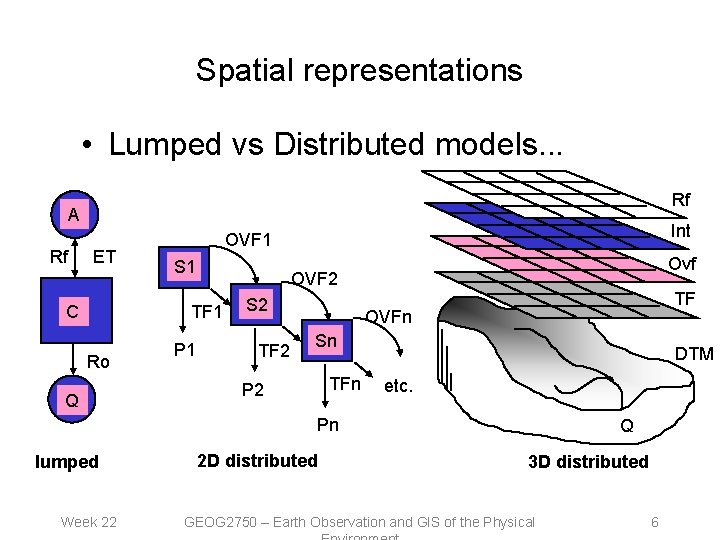
Spatial representations • Lumped vs Distributed models. . . Rf A Rf ET C S 1 Q P 1 Ovf OVF 2 TF 1 Ro Int OVF 1 S 2 TF OVFn Sn TFn P 2 DTM etc. Pn lumped Week 22 2 D distributed Q 3 D distributed GEOG 2750 – Earth Observation and GIS of the Physical 6
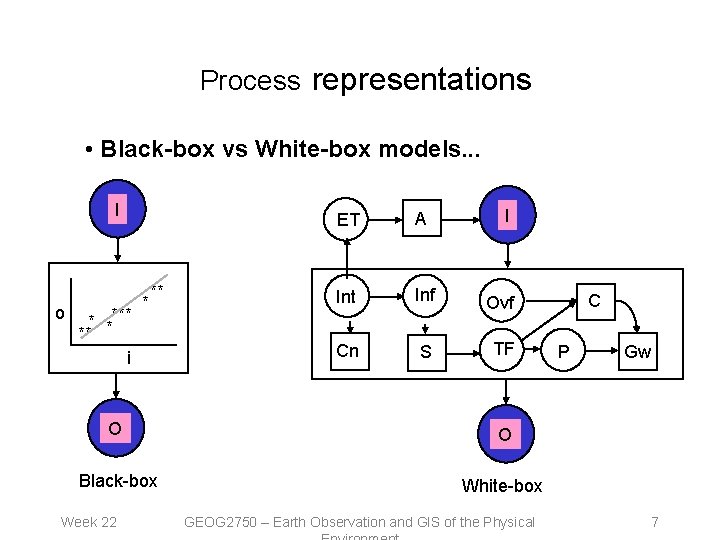
Process representations • Black-box vs White-box models. . . I o * **** ** i * ** I ET A Int Inf Ovf Cn S TF O O Black-box White-box Week 22 GEOG 2750 – Earth Observation and GIS of the Physical C P Gw 7
Role of DTMs • Surface shape determines water behaviour – characterise surface using DTM Ø slope Ø aspect Ø (altitude) – delineate drainage system: Ø catchment boundary (watershed) Ø sub-catchments Ø stream network – quantify catchment variables Ø soil moisture, etc. Ø flow times. . . catchment response Week 22 GEOG 2750 – Earth Observation and GIS of the Physical 8
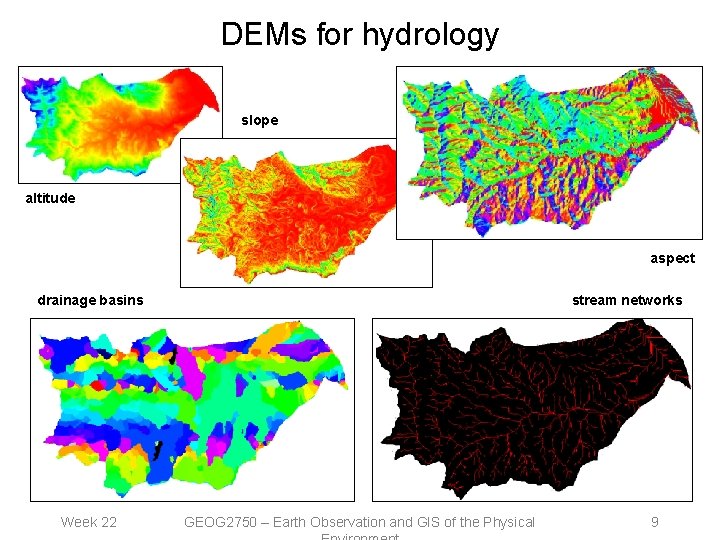
DEMs for hydrology slope altitude aspect drainage basins Week 22 stream networks GEOG 2750 – Earth Observation and GIS of the Physical 9
More spatial variables • Other key catchment variables: – soils Ø type and association Ø derived characteristics – geology Ø type Ø derived – characteristics land use Ø vegetation cover Ø management practices – artificial drainage Ø storm Week 22 drains/sewers GEOG 2750 – Earth Observation and GIS of the Physical 10
Catchment inputs/outputs • Inputs: – precipitation (rain or snow) – suspended/dissolved load – pollutants (point source/non-point source) • Outputs: – – – Week 22 stream discharge water vapour (evapotranspiration) groundwater recharge/transfer suspended/dissolved load pollutants GEOG 2750 – Earth Observation and GIS of the Physical 11
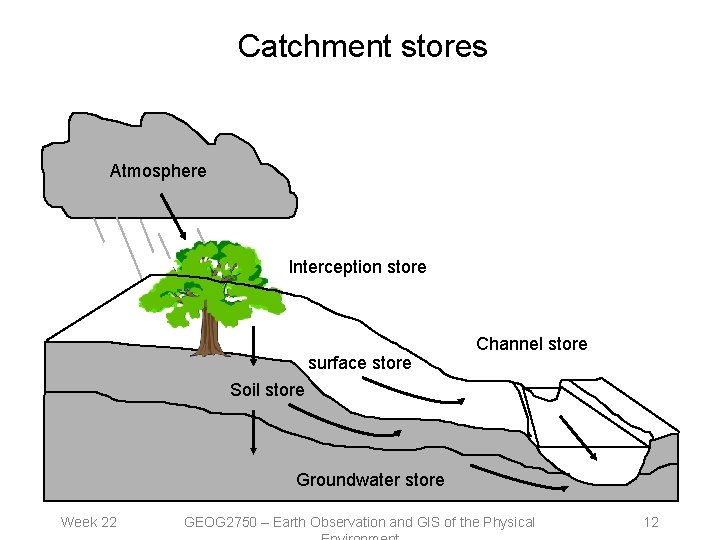
Catchment stores Atmosphere Interception store surface store Channel store Soil store Groundwater store Week 22 GEOG 2750 – Earth Observation and GIS of the Physical 12
GIS-based catchment models • Use data layers to represent: – – catchment characteristics inputs and outputs water stored in system flows within system • Calculations between layers used to: – represent relationships – model processes – predict RESPONSE Week 22 GEOG 2750 – Earth Observation and GIS of the Physical 13
Question… – Why do we need to correct DEM to be hydrologically correct? – What problems might occur if we use an uncorrected DEM? Week 22 GEOG 2750 – Earth Observation and GIS of the Physical 14

Creating a hydrologically correct DEM FLOWDIRECTION SINK Yes Are there any sinks? No FILL Delineate watersheds WATERSHED BASIN Delineate stream network FLOWACCUMULATION Threshold FLOWACCUMULATION output streamnet = con (flowacc > 100, 1) STREAMLINE Week 22 STREAMLINK STREAMORDER GEOG 2750 – Earth Observation and GIS of the Physical 15
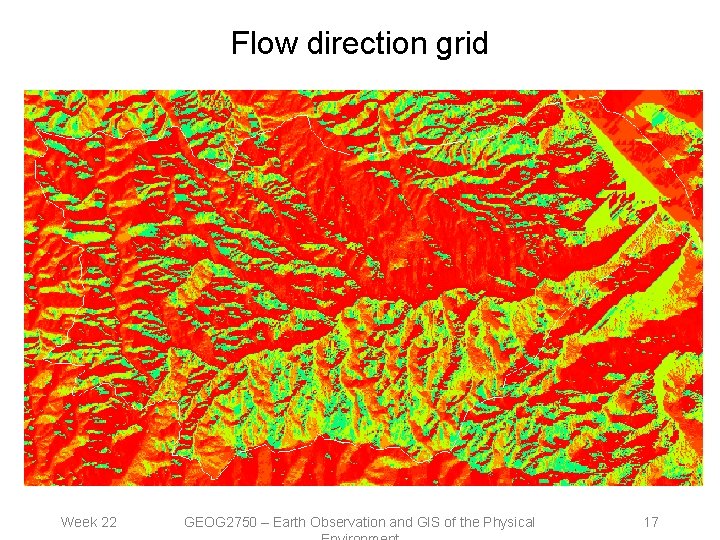
Calculating flow direction • Arc. GRID. . . – flowdirection Ø determines direction of flow from every cell Ø based on DTM Ø uses D 8 algorithm Ø finds sinks Week 22 GEOG 2750 – Earth Observation and GIS of the Physical 16
Flow direction grid Week 22 GEOG 2750 – Earth Observation and GIS of the Physical 17

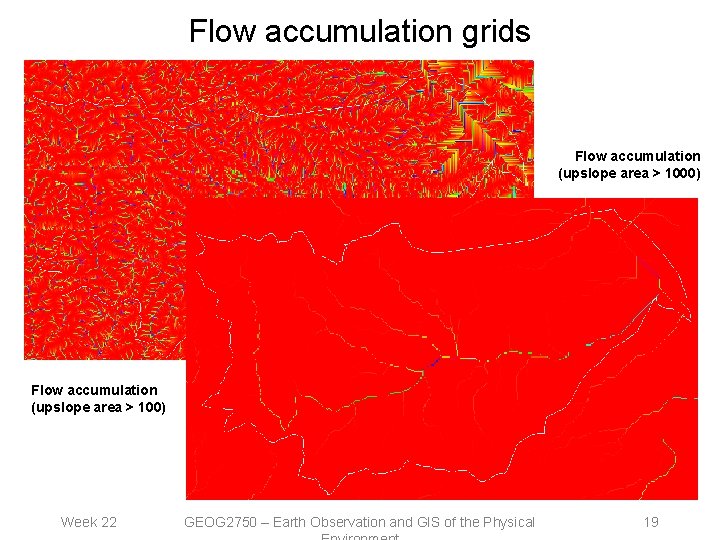
Flow accumulation • Arc. GRID. . . – flowaccumulation Ø calculates accumulated weight of all cells flowing into each downslope cell Ø based on flowdirection_grid Ø high values = channels, zero values = ridges Ø may specify weight_grid Week 22 GEOG 2750 – Earth Observation and GIS of the Physical 18
Flow accumulation grids Flow accumulation (upslope area > 1000) Flow accumulation (upslope area > 100) Week 22 GEOG 2750 – Earth Observation and GIS of the Physical 19
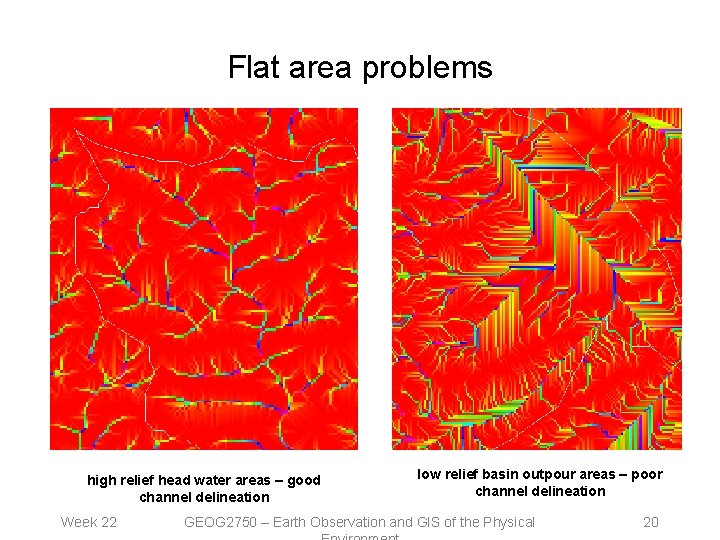
Flat area problems high relief head water areas – good channel delineation Week 22 low relief basin outpour areas – poor channel delineation GEOG 2750 – Earth Observation and GIS of the Physical 20
Handling convergent drainage • The problem with pits… – closed depressions in DEM – real or artefacts of DEM data model? – often found in narrow valley bottoms where width of flood plain < cellsize of DEM – also found in low relief areas due to interpolation errors – disrupt drainage topology • To remove or not remove? – fill in to obtain continuous flow direction network Week 22 GEOG 2750 – Earth Observation and GIS of the Physical 21
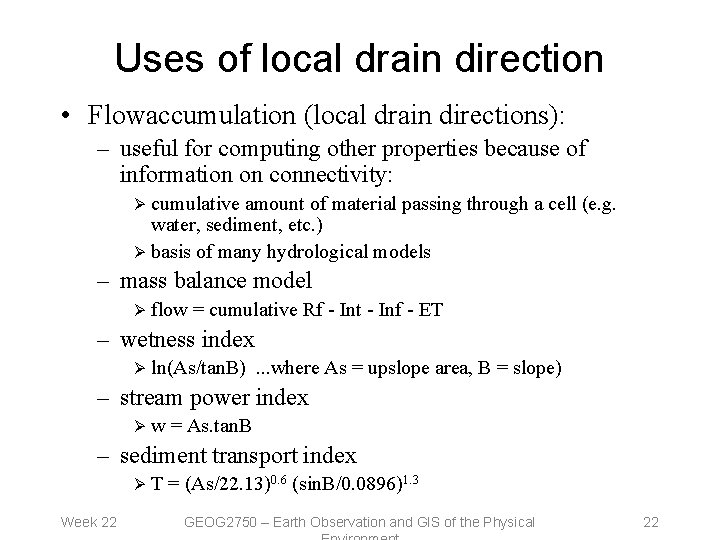
Uses of local drain direction • Flowaccumulation (local drain directions): – useful for computing other properties because of information on connectivity: Ø cumulative amount of material passing through a cell (e. g. water, sediment, etc. ) Ø basis of many hydrological models – mass balance model Ø flow = cumulative Rf - Int - Inf - ET – wetness index Ø ln(As/tan. B) . . . where As = upslope area, B = slope) – stream power index Øw = As. tan. B – sediment transport index ØT Week 22 = (As/22. 13)0. 6 (sin. B/0. 0896)1. 3 GEOG 2750 – Earth Observation and GIS of the Physical 22
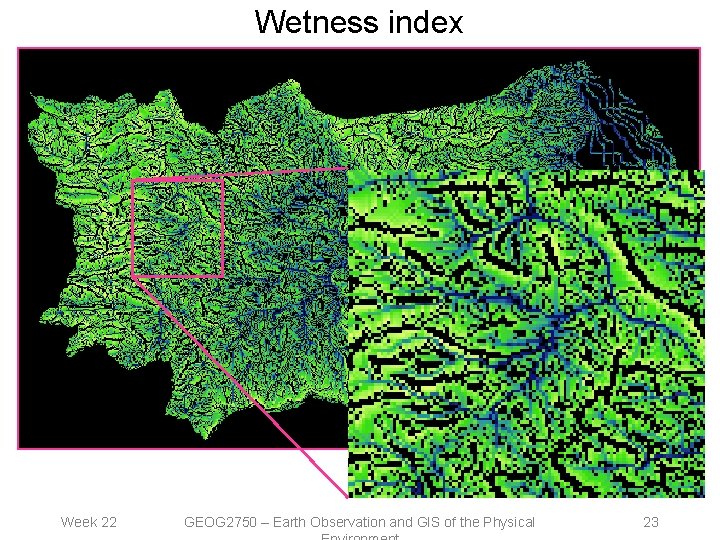
Wetness index Week 22 GEOG 2750 – Earth Observation and GIS of the Physical 23
Calculating watersheds • Arc. GRID. . . – watershed Ø calculates upslope area contributing flow at a given location Ø based on flowdirection_grid and ‘pour points’ Week 22 GEOG 2750 – Earth Observation and GIS of the Physical 24
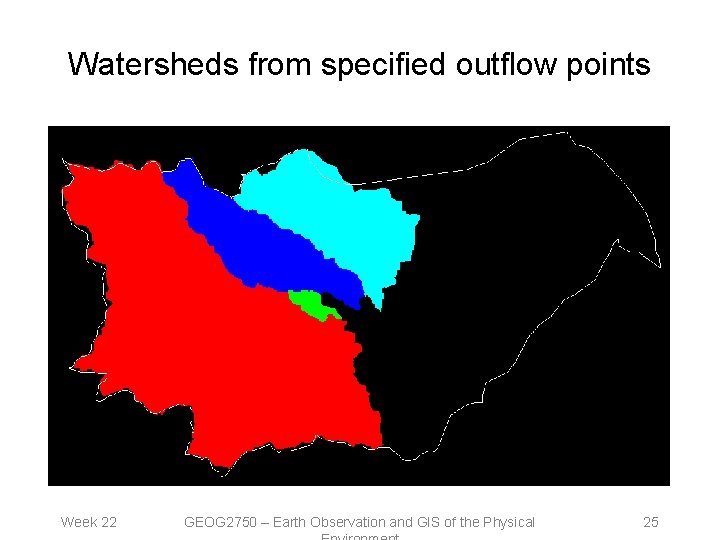
Watersheds from specified outflow points Week 22 GEOG 2750 – Earth Observation and GIS of the Physical 25

Defining stream networks • Arc. GRID. . . – stream networks con or setnull functions to delineate stream networks, i. e. streamnet = con (flowacc > 100, 1) streamnet = setnull (flowacc < 100, 1) Ø based on flowaccumulation_grid and threshold value Ø use Week 22 GEOG 2750 – Earth Observation and GIS of the Physical 26
Calculating stream order • Arc. GRID. . . – streamorder Ø calculates stream order Ø based on either STRAHLER or SHREVE ordering Week 22 GEOG 2750 – Earth Observation and GIS of the Physical 27

Stream order - Strahler Week 22 GEOG 2750 – Earth Observation and GIS of the Physical 28
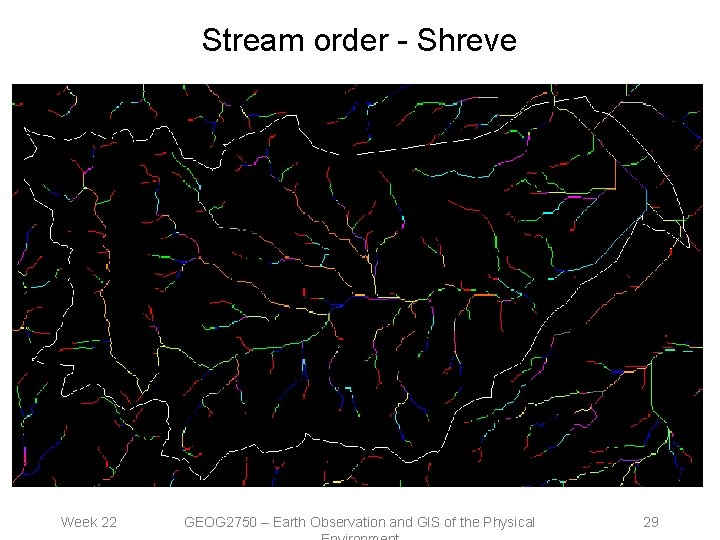
Stream order - Shreve Week 22 GEOG 2750 – Earth Observation and GIS of the Physical 29

Conclusions • DEMs are important for modelling the hydrological cycle – water flows down hill – other variables • Need to create hydrologically correct DEMs for accurate modelling Week 22 GEOG 2750 – Earth Observation and GIS of the Physical 30
Practical • Catchment modelling • Task: Derive a stream network from a DEM • Data: The following datasets are provided… – Section of Upper Tyne Valley DEM (50 m resolution) – River network (1: 50, 000) Week 22 GEOG 2750 – Earth Observation and GIS of the Physical 31
Practical • Steps: 1. Follow flow chart (supplied) to correct the DEM and derive a stream network 2. Compare derived stream network with 1: 50, 000 stream network 3. Identify problem areas and possible causes Week 22 GEOG 2750 – Earth Observation and GIS of the Physical 32
Learning outcomes • Experience with DEM correction and stream network derivation in Arc. GRID • Familiarity with problems of deriving stream networks in GIS Week 22 GEOG 2750 – Earth Observation and GIS of the Physical 33
Useful web links • Hydrological modelling – http: //www. gisdevelopment. net/application/nrm/water/s urface/watsw 0004. htm • DEMs and watershed modelling – http: //www. basic. org/projects/dtmdemo. html Week 22 GEOG 2750 – Earth Observation and GIS of the Physical 34
Next week… • Environmental assessment – Basics of EIA – Using GIS to perform EIA – Examples • Practical: – Develop EIA for wind farm example Week 22 GEOG 2750 – Earth Observation and GIS of the Physical 35
- Slides: 35