
Lecture 18 Eigenvalue Problems II ShangHua Teng Diagonalizing
Lecture 18 Eigenvalue Problems II Shang-Hua Teng
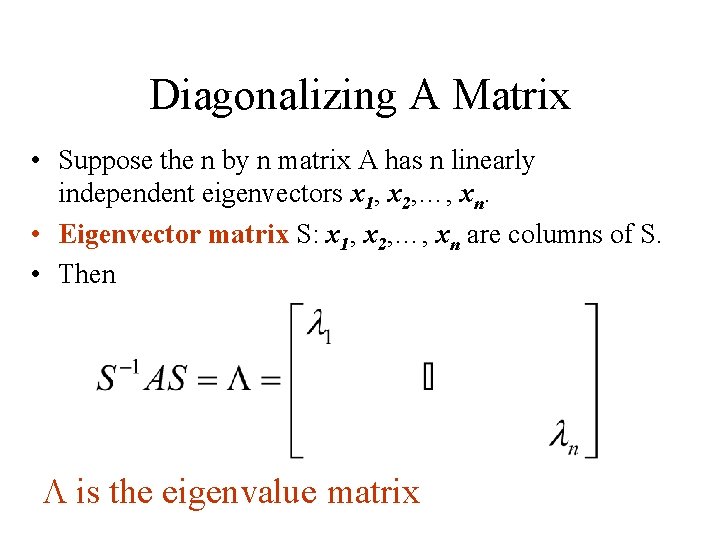
Diagonalizing A Matrix • Suppose the n by n matrix A has n linearly independent eigenvectors x 1, x 2, …, xn. • Eigenvector matrix S: x 1, x 2, …, xn are columns of S. • Then L is the eigenvalue matrix
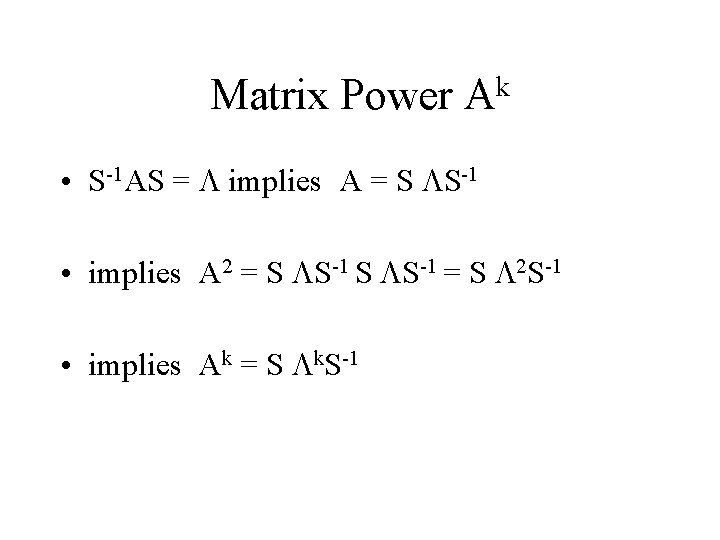
Matrix Power k A • S-1 AS = L implies A = S LS-1 • implies A 2 = S LS-1 = S L 2 S-1 • implies Ak = S Lk. S-1

Random walks How long does it take to get completely lost?
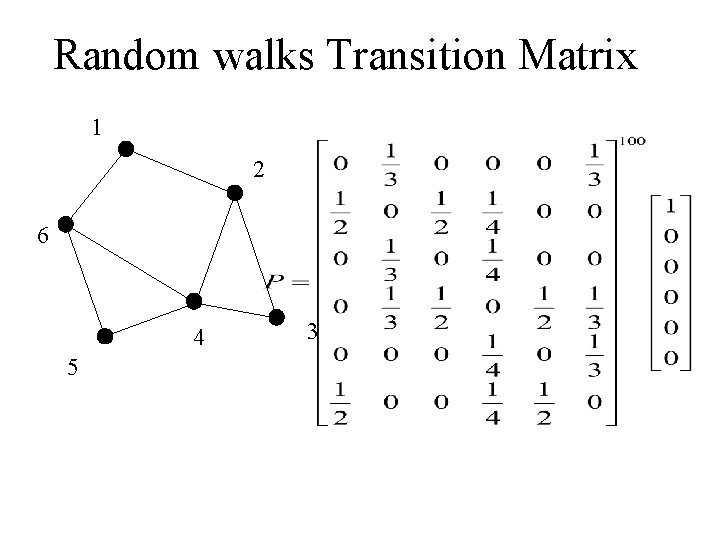
Random walks Transition Matrix 1 2 6 4 5 3
Matrix Powers • If A is diagonalizable as A = S LS-1 then for any vector u, we can compute Aku efficiently – Solve S c = u – Aku = S Lk. S-1 S c = S Lk c • As if A is a diagonal matrix!!!!
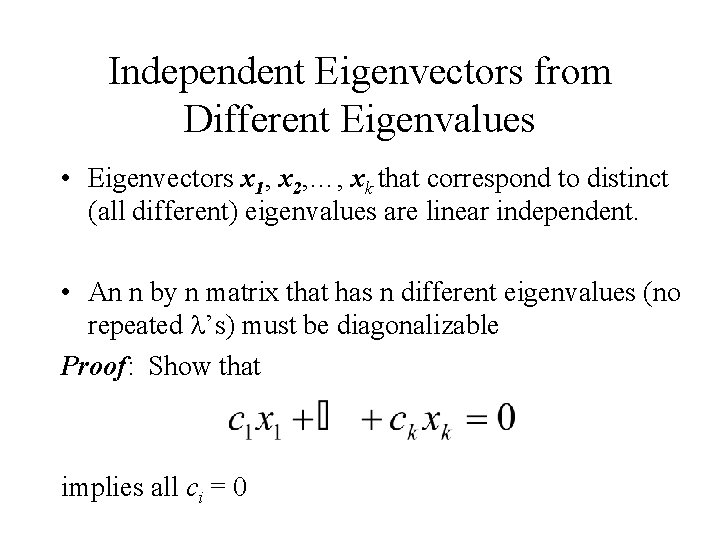
Independent Eigenvectors from Different Eigenvalues • Eigenvectors x 1, x 2, …, xk that correspond to distinct (all different) eigenvalues are linear independent. • An n by n matrix that has n different eigenvalues (no repeated l’s) must be diagonalizable Proof: Show that implies all ci = 0
Addition, Multiplication, and Eigenvalues • If l is an eigenvalue of A and b is an eigenvalue of B, then in general lb is not an eigenvalue of AB • If l is an eigenvalue of A and b is an eigenvalue of B, then in general l+b is not an eigenvalue of A+B
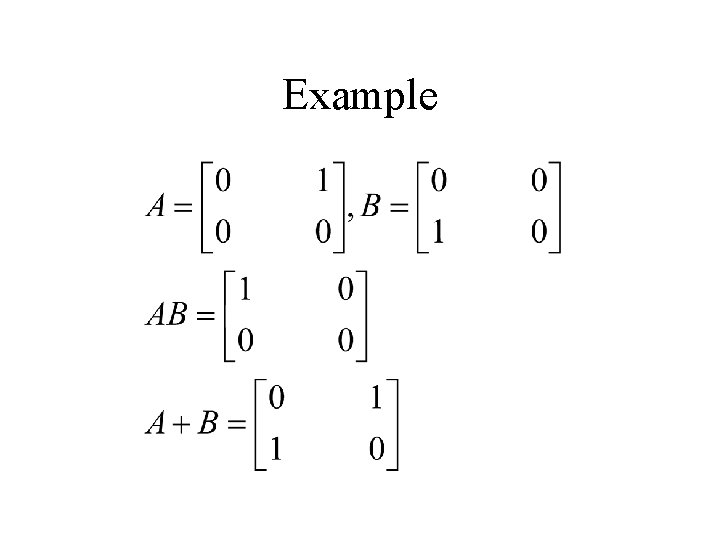
Example
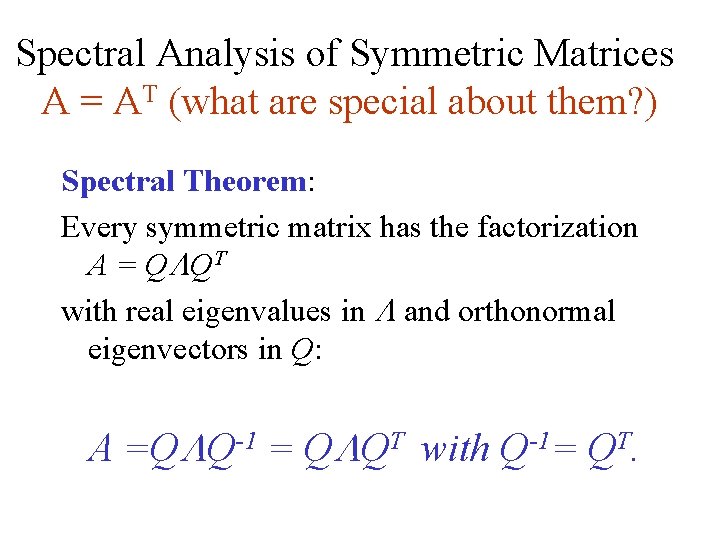
Spectral Analysis of Symmetric Matrices A = AT (what are special about them? ) Spectral Theorem: Every symmetric matrix has the factorization A = Q LQ T with real eigenvalues in L and orthonormal eigenvectors in Q: A =QLQ-1 = QLQT with Q-1= QT.
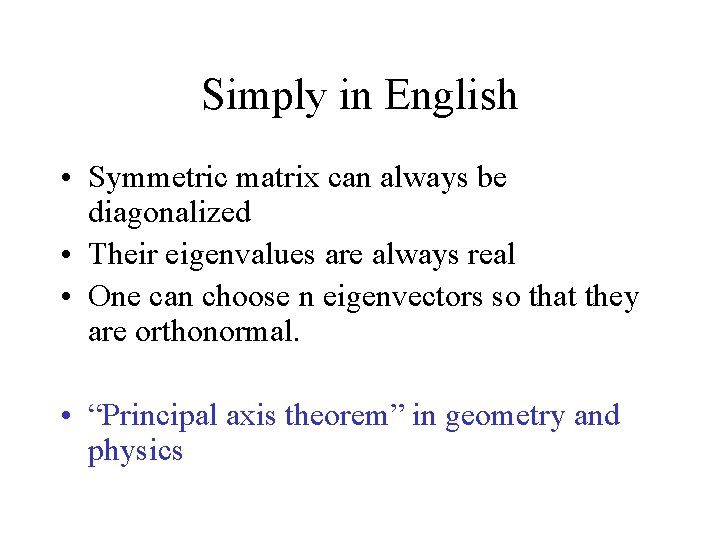
Simply in English • Symmetric matrix can always be diagonalized • Their eigenvalues are always real • One can choose n eigenvectors so that they are orthonormal. • “Principal axis theorem” in geometry and physics
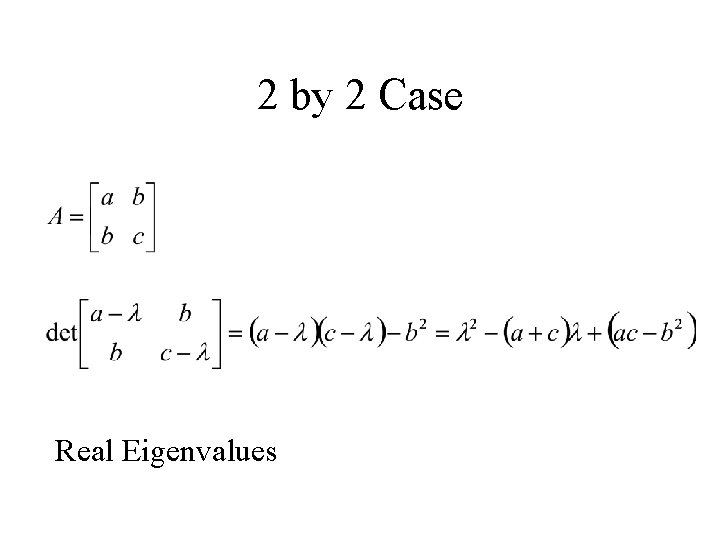
2 by 2 Case Real Eigenvalues
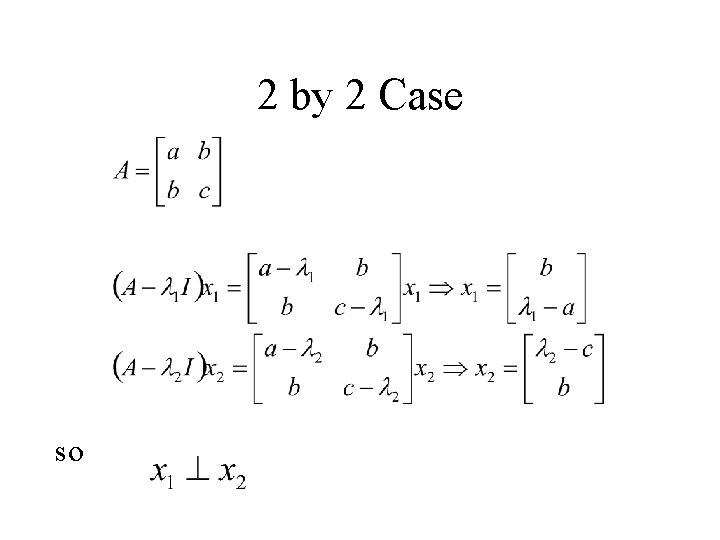
2 by 2 Case so
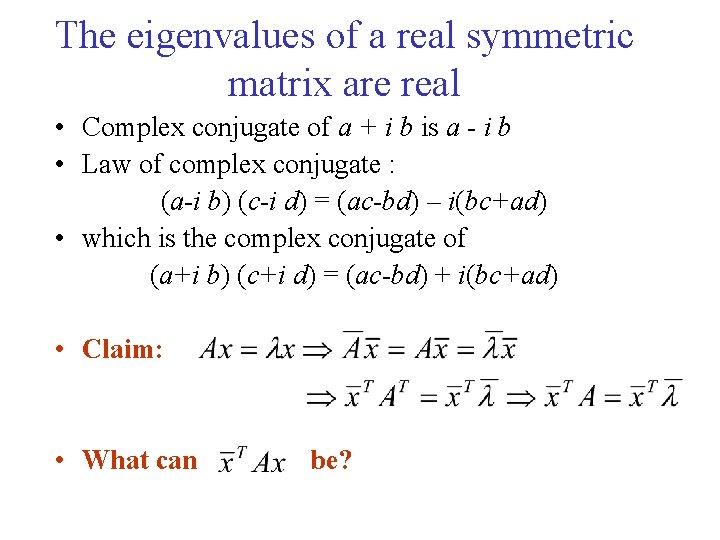
The eigenvalues of a real symmetric matrix are real • Complex conjugate of a + i b is a - i b • Law of complex conjugate : (a-i b) (c-i d) = (ac-bd) – i(bc+ad) • which is the complex conjugate of (a+i b) (c+i d) = (ac-bd) + i(bc+ad) • Claim: • What can be?
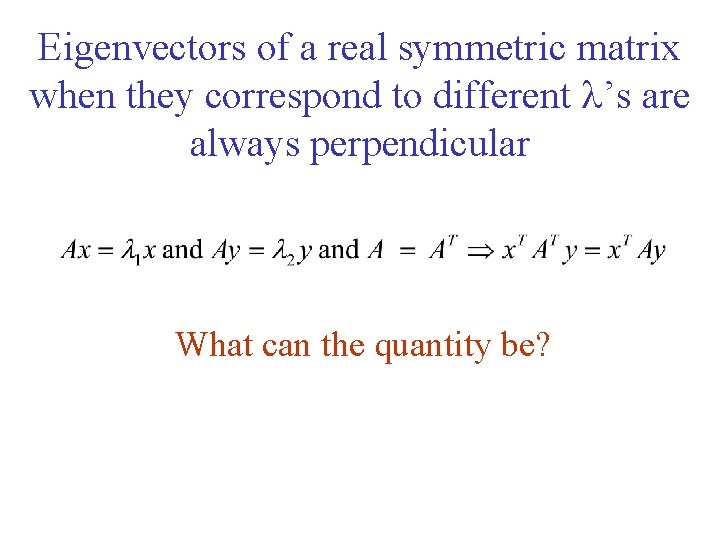
Eigenvectors of a real symmetric matrix when they correspond to different l’s are always perpendicular What can the quantity be?
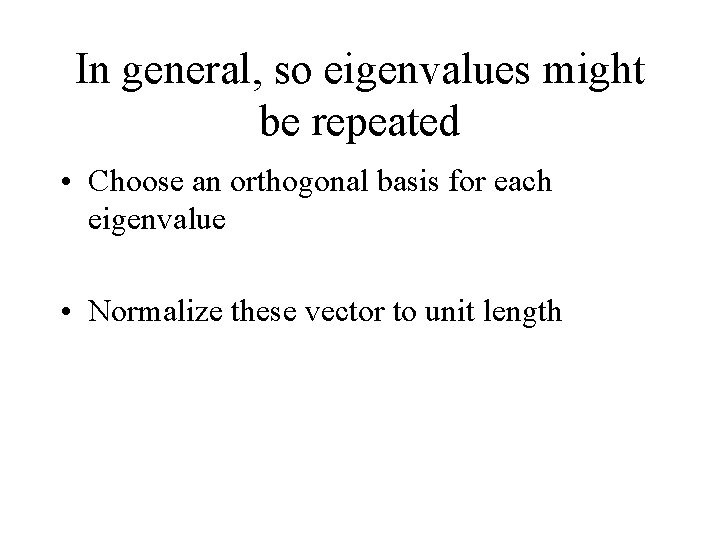
In general, so eigenvalues might be repeated • Choose an orthogonal basis for each eigenvalue • Normalize these vector to unit length
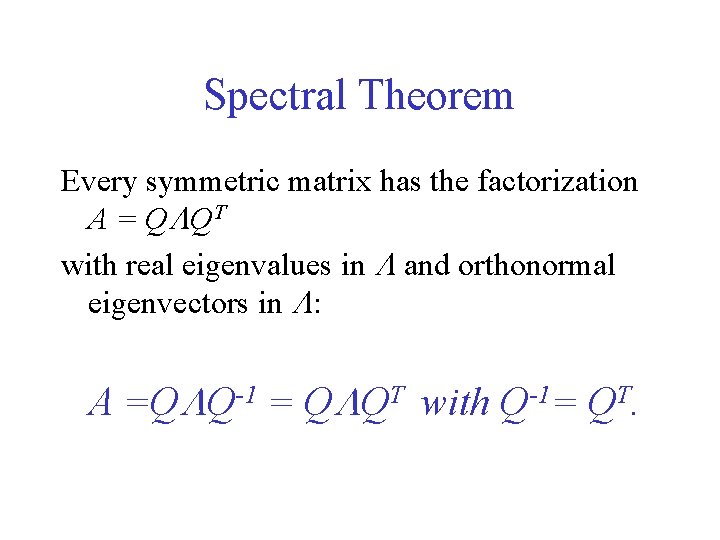
Spectral Theorem Every symmetric matrix has the factorization A = Q LQ T with real eigenvalues in L and orthonormal eigenvectors in L: A =QLQ-1 = QLQT with Q-1= QT.
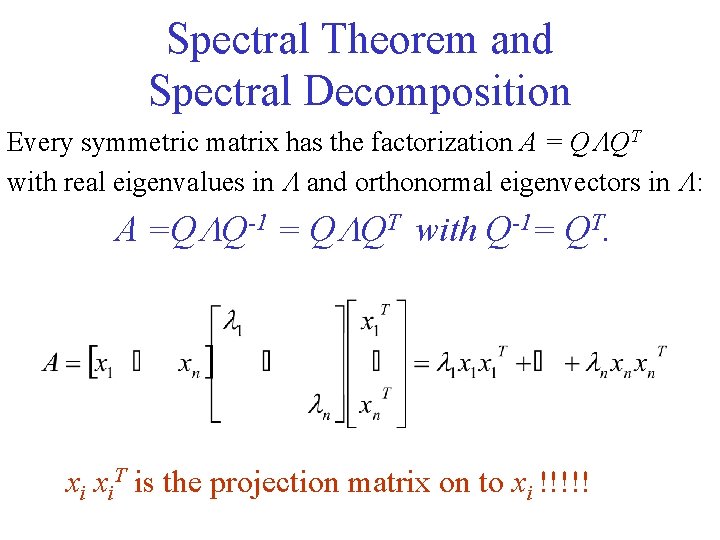
Spectral Theorem and Spectral Decomposition Every symmetric matrix has the factorization A = QLQT with real eigenvalues in L and orthonormal eigenvectors in L: A =QLQ-1 = QLQT with Q-1= QT. xi xi. T is the projection matrix on to xi !!!!!
- Slides: 18