
Lecture 17 Introduction to Reinforcement Learning Q Learning
![Example: TD-Gammon • Learns to Play Backgammon [Tesauro, 1995] – Predecessor: Neuro. Gammon [Tesauro](https://slidetodoc.com/presentation_image_h/eb8b5b23426fd55ceacddb27023b1381/image-4.jpg "Example: TD-Gammon • Learns to Play Backgammon [Tesauro, 1995] – Predecessor: Neuro. Gammon [Tesauro")
- Slides: 18
Lecture 17 Introduction to Reinforcement Learning: Q Learning Thursday 29 October 2002 William H. Hsu Department of Computing and Information Sciences, KSU http: //www. kddresearch. org http: //www. cis. ksu. edu/~bhsu Readings: Sections 13. 3 -13. 4, Mitchell Sections 20. 1 -20. 2, Russell and Norvig CIS 732: Machine Learning and Pattern Recognition Kansas State University Department of Computing and Information Sciences
Lecture Outline • Readings: Chapter 13, Mitchell; Sections 20. 1 -20. 2, Russell and Norvig – Today: Sections 13. 1 -13. 4, Mitchell – Review: “Learning to Predict by the Method of Temporal Differences”, Sutton • Suggested Exercises: 13. 2, Mitchell; 20. 5, 20. 6, Russell and Norvig • Control Learning – Control policies that choose optimal actions – MDP framework, continued – Issues • Delayed reward • Active learning opportunities • Partial observability • Reuse requirement • Q Learning – Dynamic programming algorithm – Deterministic and nondeterministic cases; convergence properties CIS 732: Machine Learning and Pattern Recognition Kansas State University Department of Computing and Information Sciences
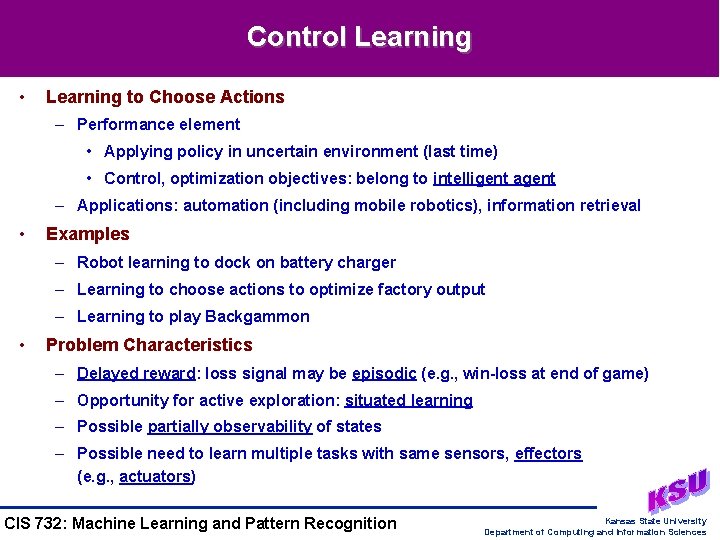
Control Learning • Learning to Choose Actions – Performance element • Applying policy in uncertain environment (last time) • Control, optimization objectives: belong to intelligent agent – Applications: automation (including mobile robotics), information retrieval • Examples – Robot learning to dock on battery charger – Learning to choose actions to optimize factory output – Learning to play Backgammon • Problem Characteristics – Delayed reward: loss signal may be episodic (e. g. , win-loss at end of game) – Opportunity for active exploration: situated learning – Possible partially observability of states – Possible need to learn multiple tasks with same sensors, effectors (e. g. , actuators) CIS 732: Machine Learning and Pattern Recognition Kansas State University Department of Computing and Information Sciences
Example: TD-Gammon • Learns to Play Backgammon [Tesauro, 1995] – Predecessor: Neuro. Gammon [Tesauro and Sejnowski, 1989] • Learned from examples of labelled moves (very tedious for human expert) • Result: strong computer player, but not grandmaster-level – TD-Gammon: first version, 1992 - used reinforcement learning • Immediate Reward – +100 if win – -100 if loss – 0 for all other states • Learning in TD-Gammon – Algorithm: temporal differences [Sutton, 1988] - next time – Training: playing 200000 - 1. 5 million games against itself (several weeks) – Learning curve: improves until ~1. 5 million games – Result: now approximately equal to best human player (won World Cup of Backgammon in 1992; among top 3 since 1995) CIS 732: Machine Learning and Pattern Recognition Kansas State University Department of Computing and Information Sciences
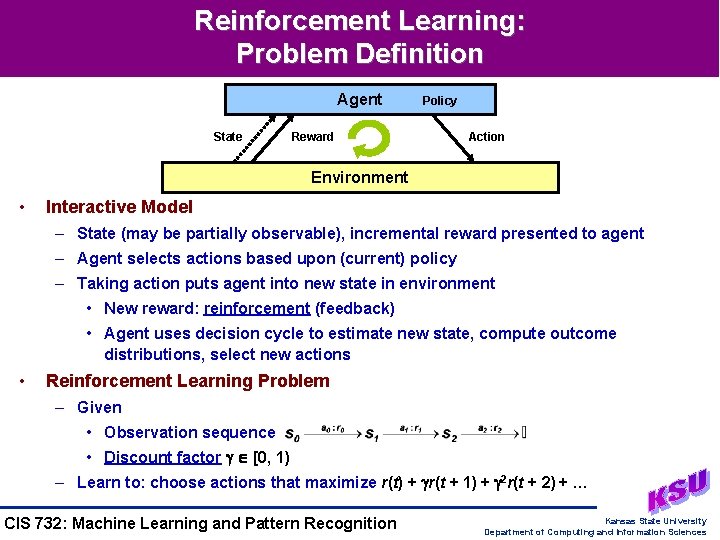
Reinforcement Learning: Problem Definition Agent State Policy Reward Action Environment • Interactive Model – State (may be partially observable), incremental reward presented to agent – Agent selects actions based upon (current) policy – Taking action puts agent into new state in environment • New reward: reinforcement (feedback) • Agent uses decision cycle to estimate new state, compute outcome distributions, select new actions • Reinforcement Learning Problem – Given • Observation sequence • Discount factor [0, 1) – Learn to: choose actions that maximize r(t) + r(t + 1) + 2 r(t + 2) + … CIS 732: Machine Learning and Pattern Recognition Kansas State University Department of Computing and Information Sciences
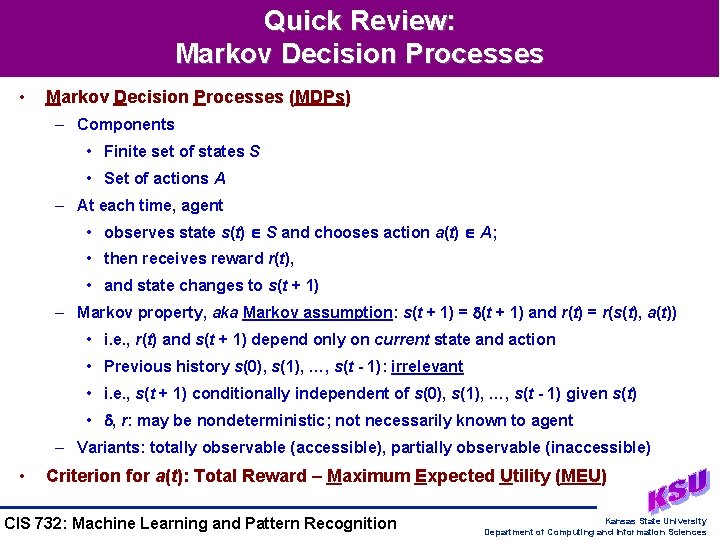
Quick Review: Markov Decision Processes • Markov Decision Processes (MDPs) – Components • Finite set of states S • Set of actions A – At each time, agent • observes state s(t) S and chooses action a(t) A; • then receives reward r(t), • and state changes to s(t + 1) – Markov property, aka Markov assumption: s(t + 1) = (t + 1) and r(t) = r(s(t), a(t)) • i. e. , r(t) and s(t + 1) depend only on current state and action • Previous history s(0), s(1), …, s(t - 1): irrelevant • i. e. , s(t + 1) conditionally independent of s(0), s(1), …, s(t - 1) given s(t) • , r: may be nondeterministic; not necessarily known to agent – Variants: totally observable (accessible), partially observable (inaccessible) • Criterion for a(t): Total Reward – Maximum Expected Utility (MEU) CIS 732: Machine Learning and Pattern Recognition Kansas State University Department of Computing and Information Sciences
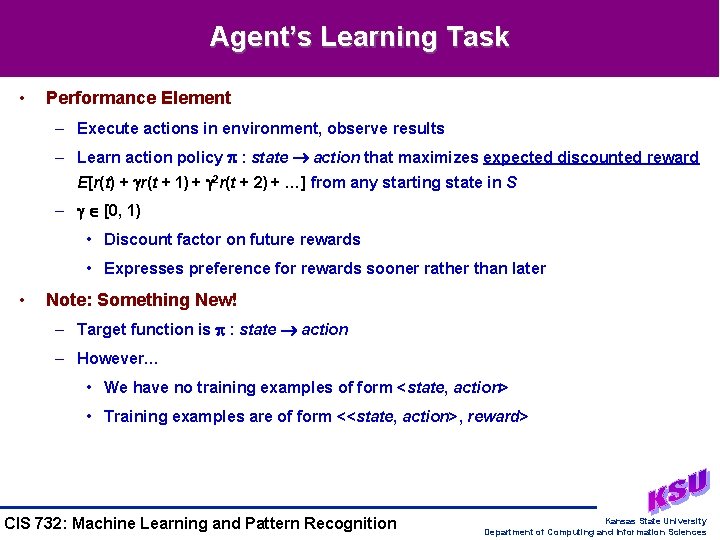
Agent’s Learning Task • Performance Element – Execute actions in environment, observe results – Learn action policy : state action that maximizes expected discounted reward E[r(t) + r(t + 1) + 2 r(t + 2) + …] from any starting state in S – [0, 1) • Discount factor on future rewards • Expresses preference for rewards sooner rather than later • Note: Something New! – Target function is : state action – However… • We have no training examples of form <state, action> • Training examples are of form <<state, action>, reward> CIS 732: Machine Learning and Pattern Recognition Kansas State University Department of Computing and Information Sciences
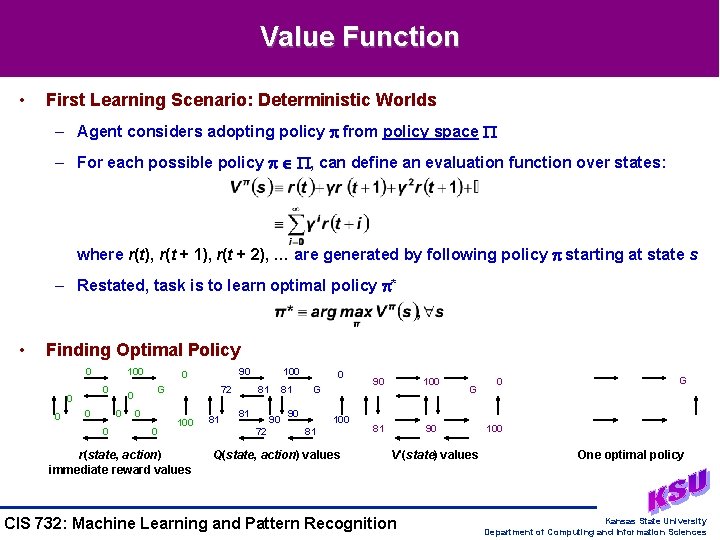
Value Function • First Learning Scenario: Deterministic Worlds – Agent considers adopting policy from policy space – For each possible policy , can define an evaluation function over states: where r(t), r(t + 1), r(t + 2), … are generated by following policy starting at state s – Restated, task is to learn optimal policy * • Finding Optimal Policy 0 0 100 0 0 G 0 0 90 0 72 100 r(state, action) immediate reward values 81 100 81 81 90 72 81 0 G 90 100 81 Q(state, action) values 90 100 81 90 G V*(state) values CIS 732: Machine Learning and Pattern Recognition 0 G 100 One optimal policy Kansas State University Department of Computing and Information Sciences
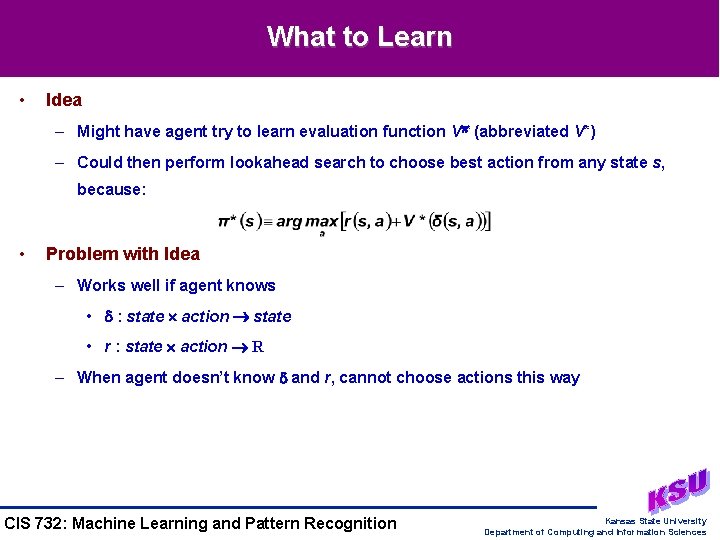
What to Learn • Idea – Might have agent try to learn evaluation function V * (abbreviated V*) – Could then perform lookahead search to choose best action from any state s, because: • Problem with Idea – Works well if agent knows • : state action state • r : state action R – When agent doesn’t know and r, cannot choose actions this way CIS 732: Machine Learning and Pattern Recognition Kansas State University Department of Computing and Information Sciences
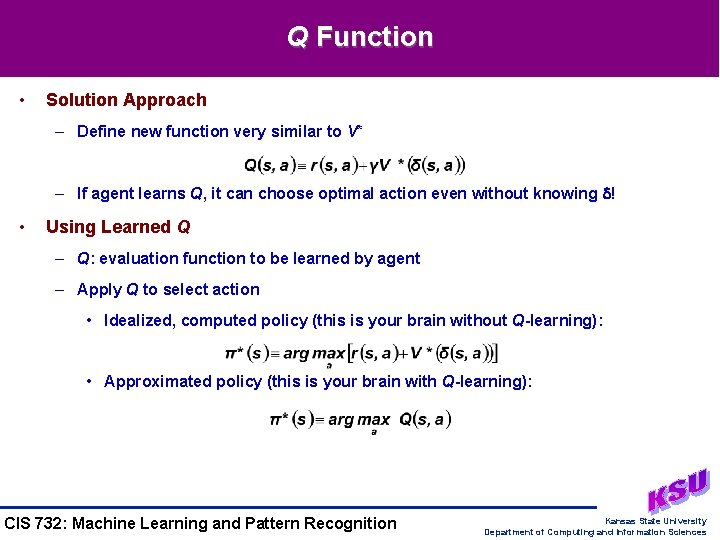
Q Function • Solution Approach – Define new function very similar to V* – If agent learns Q, it can choose optimal action even without knowing ! • Using Learned Q – Q: evaluation function to be learned by agent – Apply Q to select action • Idealized, computed policy (this is your brain without Q-learning): • Approximated policy (this is your brain with Q-learning): CIS 732: Machine Learning and Pattern Recognition Kansas State University Department of Computing and Information Sciences
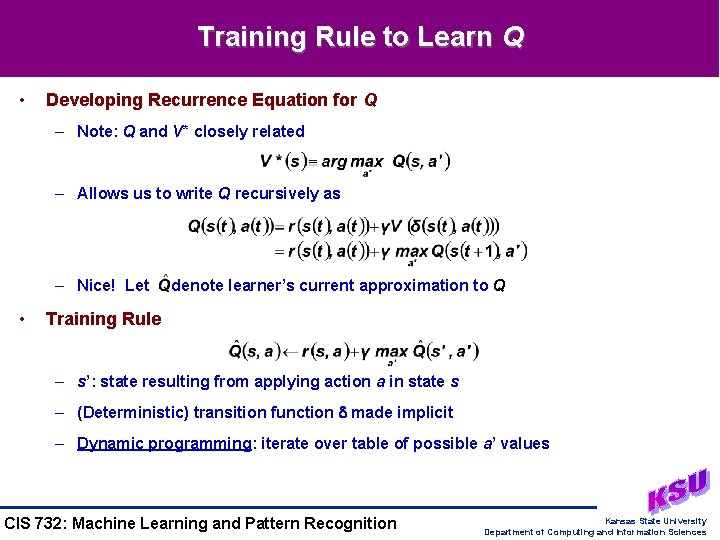
Training Rule to Learn Q • Developing Recurrence Equation for Q – Note: Q and V* closely related – Allows us to write Q recursively as – Nice! Let • denote learner’s current approximation to Q Training Rule – s’: state resulting from applying action a in state s – (Deterministic) transition function made implicit – Dynamic programming: iterate over table of possible a’ values CIS 732: Machine Learning and Pattern Recognition Kansas State University Department of Computing and Information Sciences
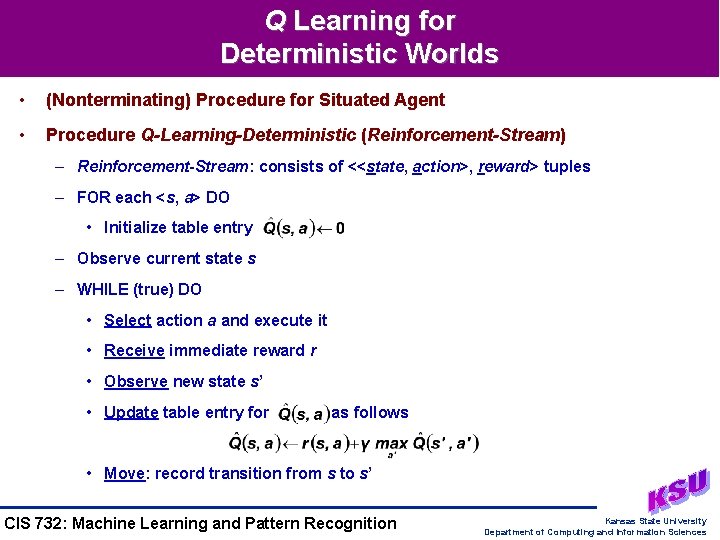
Q Learning for Deterministic Worlds • (Nonterminating) Procedure for Situated Agent • Procedure Q-Learning-Deterministic (Reinforcement-Stream) – Reinforcement-Stream: consists of <<state, action>, reward> tuples – FOR each <s, a> DO • Initialize table entry – Observe current state s – WHILE (true) DO • Select action a and execute it • Receive immediate reward r • Observe new state s’ • Update table entry for as follows • Move: record transition from s to s’ CIS 732: Machine Learning and Pattern Recognition Kansas State University Department of Computing and Information Sciences
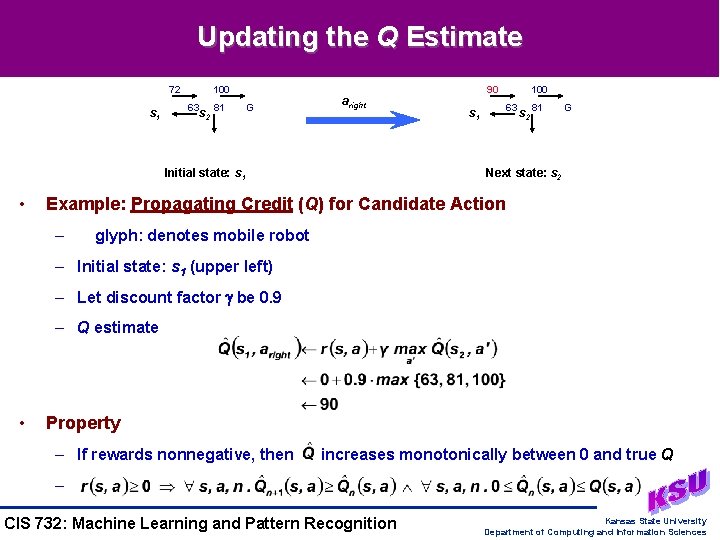
Updating the Q Estimate 72 s 1 100 63 s 2 81 G aright Initial state: s 1 • 90 100 63 s 1 s 2 81 G Next state: s 2 Example: Propagating Credit (Q) for Candidate Action – glyph: denotes mobile robot – Initial state: s 1 (upper left) – Let discount factor be 0. 9 – Q estimate • Property – If rewards nonnegative, then increases monotonically between 0 and true Q – CIS 732: Machine Learning and Pattern Recognition Kansas State University Department of Computing and Information Sciences
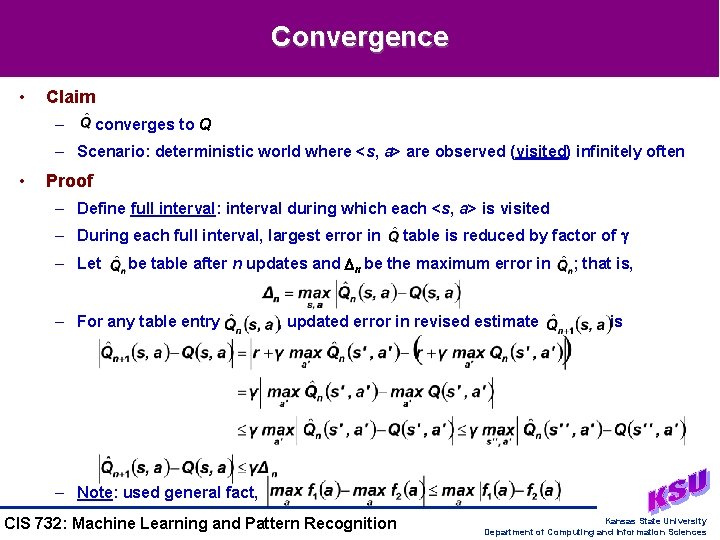
Convergence • Claim – converges to Q – Scenario: deterministic world where <s, a> are observed (visited) infinitely often • Proof – Define full interval: interval during which each <s, a> is visited – During each full interval, largest error in – Let table is reduced by factor of be table after n updates and n be the maximum error in – For any table entry , updated error in revised estimate ; that is, is – Note: used general fact, CIS 732: Machine Learning and Pattern Recognition Kansas State University Department of Computing and Information Sciences
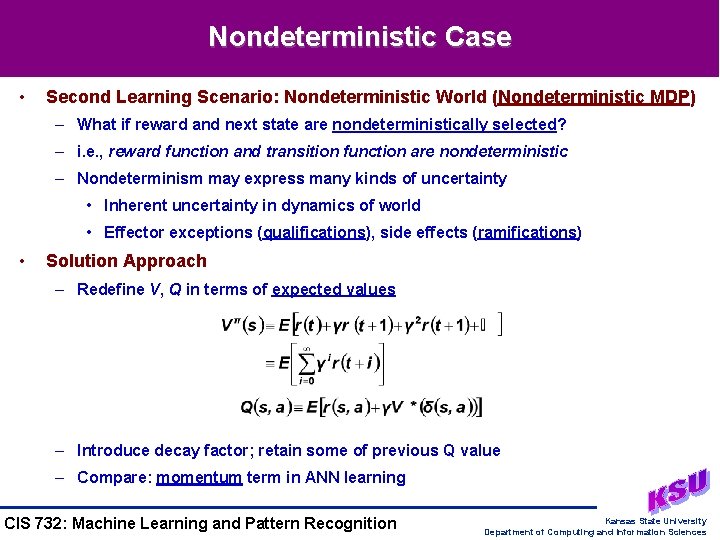
Nondeterministic Case • Second Learning Scenario: Nondeterministic World (Nondeterministic MDP) – What if reward and next state are nondeterministically selected? – i. e. , reward function and transition function are nondeterministic – Nondeterminism may express many kinds of uncertainty • Inherent uncertainty in dynamics of world • Effector exceptions (qualifications), side effects (ramifications) • Solution Approach – Redefine V, Q in terms of expected values – Introduce decay factor; retain some of previous Q value – Compare: momentum term in ANN learning CIS 732: Machine Learning and Pattern Recognition Kansas State University Department of Computing and Information Sciences
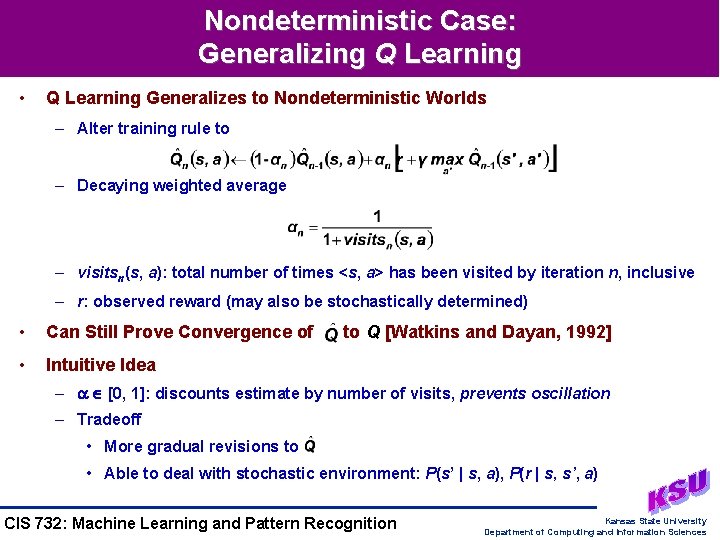
Nondeterministic Case: Generalizing Q Learning • Q Learning Generalizes to Nondeterministic Worlds – Alter training rule to – Decaying weighted average – visitsn(s, a): total number of times <s, a> has been visited by iteration n, inclusive – r: observed reward (may also be stochastically determined) • Can Still Prove Convergence of • Intuitive Idea to Q [Watkins and Dayan, 1992] – [0, 1]: discounts estimate by number of visits, prevents oscillation – Tradeoff • More gradual revisions to • Able to deal with stochastic environment: P(s’ | s, a), P(r | s, s’, a) CIS 732: Machine Learning and Pattern Recognition Kansas State University Department of Computing and Information Sciences
Terminology • Reinforcement Learning (RL) – RL: learning to choose optimal actions from <state, reward, action> observations – Scenarios • Delayed reward: reinforcement is deferred until end of episode • Active learning: agent can control collection of experience • Partial observability: may only be able to observe rewards (must infer state) • Reuse requirement: sensors, effectors may be required for multiple tasks • Markov Decision Processes (MDPs) – Markovity (aka Markov property, Markov assumption): CI assumption on states over time – Maximum expected utility (MEU): maximum expected total reward (under additive decomposition assumption) • Q Learning – Action-value function Q : state action value – Q learning: training rule and dynamic programming algorithm for RL CIS 732: Machine Learning and Pattern Recognition Kansas State University Department of Computing and Information Sciences
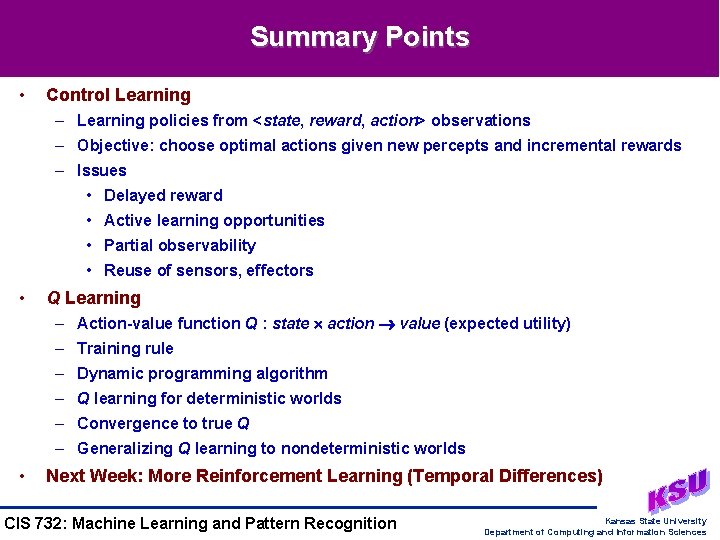
Summary Points • Control Learning – Learning policies from <state, reward, action> observations – Objective: choose optimal actions given new percepts and incremental rewards – Issues • Delayed reward • Active learning opportunities • Partial observability • Reuse of sensors, effectors • Q Learning – Action-value function Q : state action value (expected utility) – Training rule – Dynamic programming algorithm – Q learning for deterministic worlds – Convergence to true Q – Generalizing Q learning to nondeterministic worlds • Next Week: More Reinforcement Learning (Temporal Differences) CIS 732: Machine Learning and Pattern Recognition Kansas State University Department of Computing and Information Sciences