
Lecture 17 Analyzing Algorithms CS 51 P November
Lecture 17: Analyzing Algorithms CS 51 P November 6, 2019
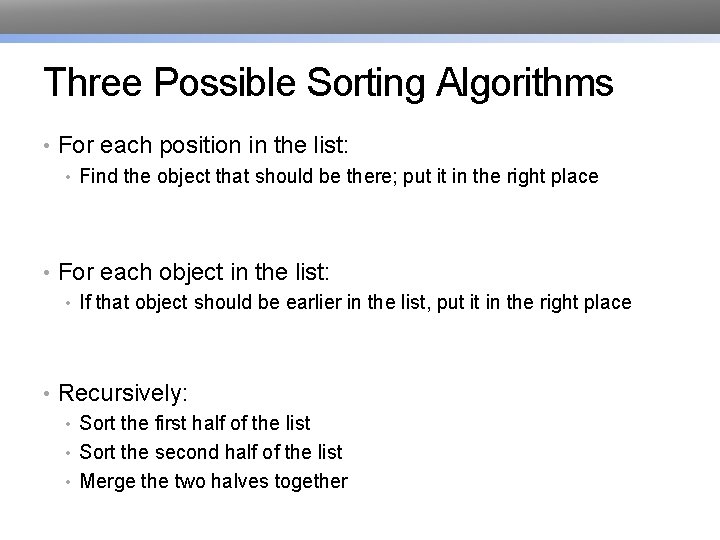
Three Possible Sorting Algorithms • For each position in the list: • Find the object that should be there; put it in the right place • For each object in the list: • If that object should be earlier in the list, put it in the right place • Recursively: • Sort the first half of the list • Sort the second half of the list • Merge the two halves together
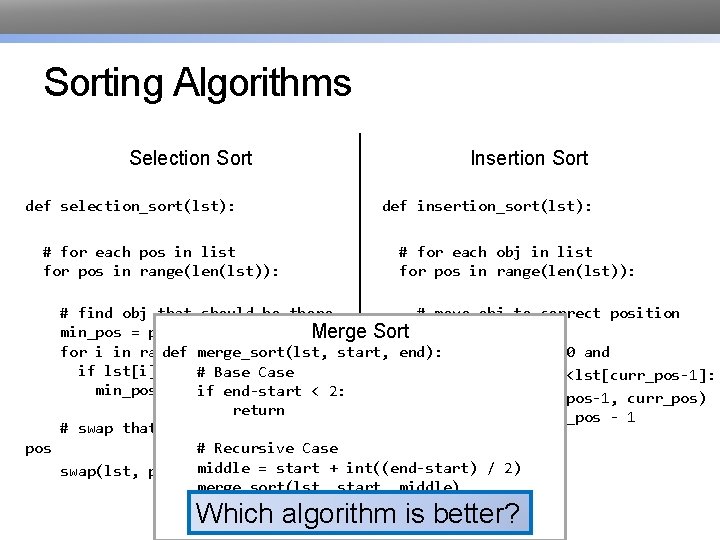
Sorting Algorithms Selection Sort def selection_sort(lst): # for each pos in list for pos in range(len(lst)): Insertion Sort def insertion_sort(lst): # for each obj in list for pos in range(len(lst)): # find obj that should be there # move obj to correct position min_pos = pos Merge Sort curr_pos = pos for i in range(pos+1, len(lst)): start, end): while curr_pos > 0 and def merge_sort(lst, if lst[i] < lst[min_pos]: # Base Case lst[curr_pos]<lst[curr_pos-1]: min_pos = i if end-start < 2: swap(lst, curr_pos-1, curr_pos) return curr_pos = curr_pos - 1 # swap that obj into position pos # Recursive Case middle = start + int((end-start) / 2) swap(lst, pos, min_pos) merge_sort(lst, start, middle) merge_sort(lst, middle, end) merge(lst, start, end) Which algorithm is better?
4 What Makes a Good Algorithm? Suppose you have two possible algorithms that do the same thing; which is better? What do we mean by better? • • Correct(er)? Faster? Less space? Less power consumption? Easier to code? Easier to maintain? Required for homework?

5 Basic Step: one “constant time” operation Constant time operation: its time doesn’t depend on the size or length of anything. Always roughly the same. Time is bounded above by some number Example Basic steps: • Access value of a variable, list element, or object attr • Assign to a variable, list element, or object attr • Do one arithmetic or logical operation • Call a function
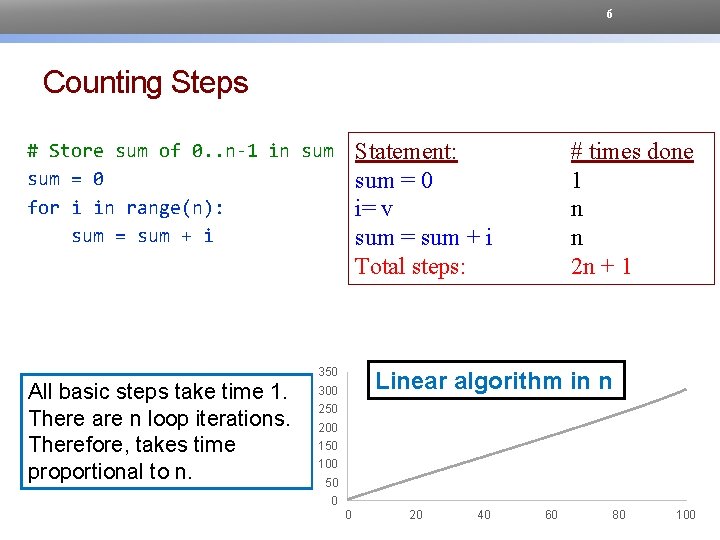
6 Counting Steps Statement: sum = 0 i= v sum = sum + i Total steps: # Store sum of 0. . n-1 in sum = 0 for i in range(n): sum = sum + i 350 All basic steps take time 1. There are n loop iterations. Therefore, takes time proportional to n. # times done 1 n n 2 n + 1 Linear algorithm in n 300 250 200 150 100 50 0 0 20 40 60 80 100
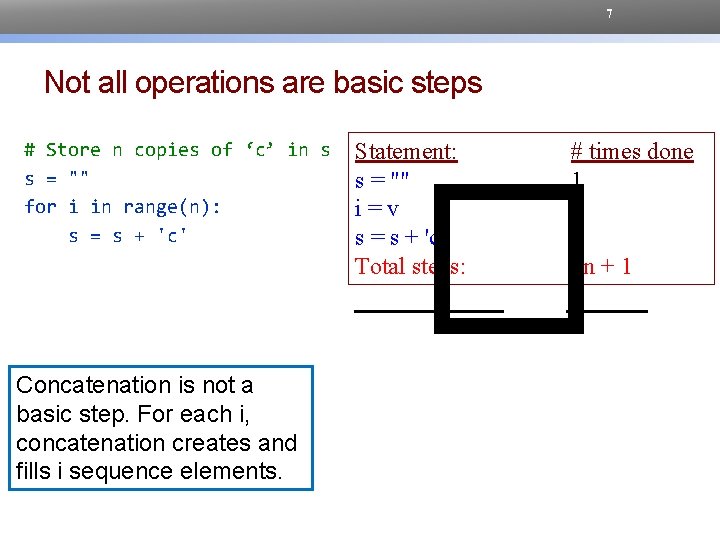
7 Not all operations are basic steps # Store n copies of ‘c’ in s s = "" for i in range(n): s = s + 'c' Concatenation is not a basic step. For each i, concatenation creates and fills i sequence elements. Statement: s = "" i=v s = s + 'c' Total steps: # times done 1 n n 2 n + 1 �
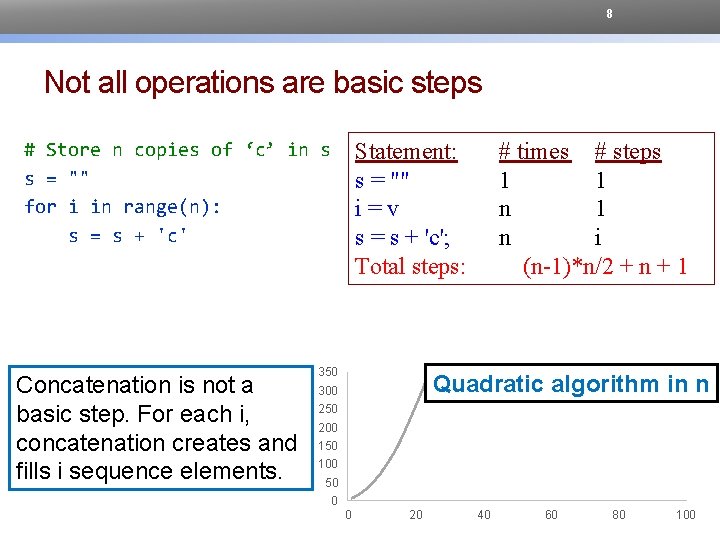
8 Not all operations are basic steps Statement: s = "" i=v s = s + 'c'; Total steps: # Store n copies of ‘c’ in s s = "" for i in range(n): s = s + 'c' Concatenation is not a basic step. For each i, concatenation creates and fills i sequence elements. 350 # times # steps 1 1 n i (n-1)*n/2 + n + 1 Quadratic algorithm in n 300 250 200 150 100 50 0 0 20 40 60 80 100
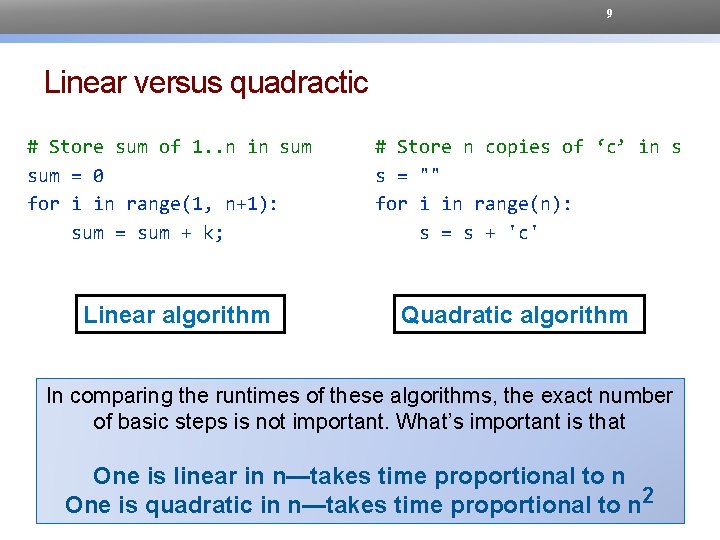
9 Linear versus quadractic # Store sum of 1. . n in sum = 0 for i in range(1, n+1): sum = sum + k; Linear algorithm # Store n copies of ‘c’ in s s = "" for i in range(n): s = s + 'c' Quadratic algorithm In comparing the runtimes of these algorithms, the exact number of basic steps is not important. What’s important is that One is linear in n—takes time proportional to n One is quadratic in n—takes time proportional to n 2
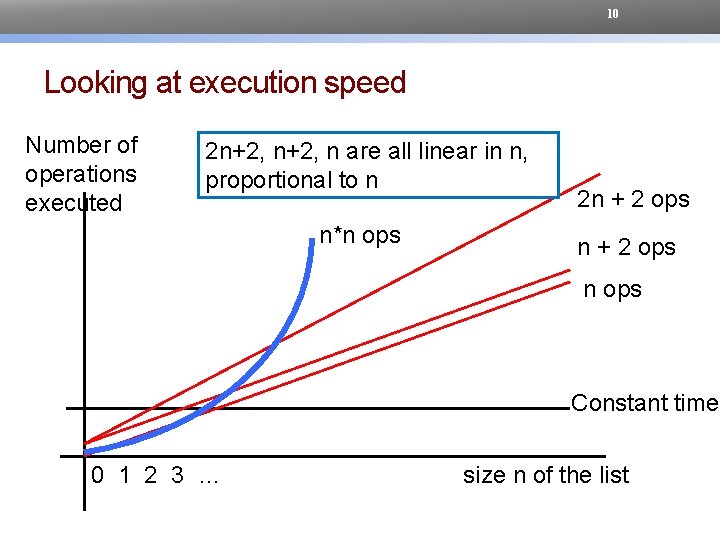
10 Looking at execution speed Number of operations executed 2 n+2, n are all linear in n, proportional to n n*n ops 2 n + 2 ops n ops Constant time 0 1 2 3 … size n of the list
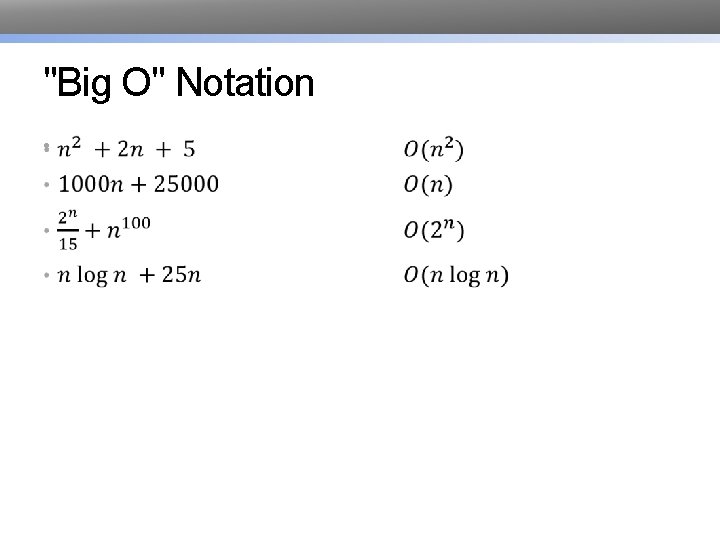
"Big O" Notation •
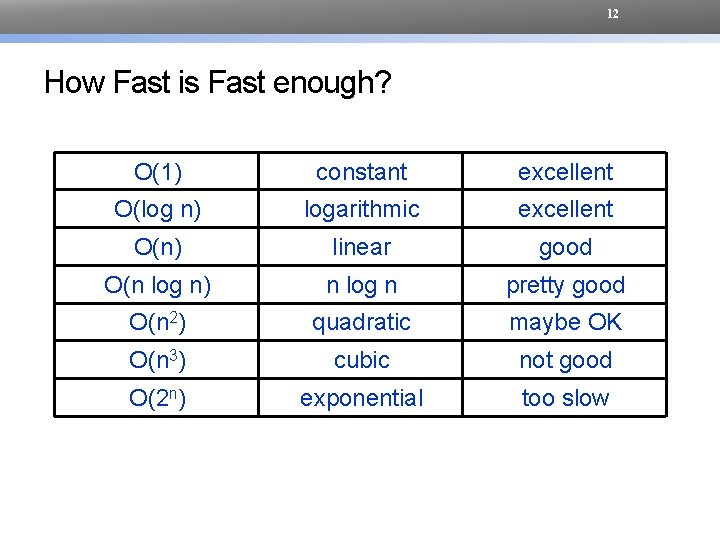
12 How Fast is Fast enough? O(1) constant excellent O(log n) logarithmic excellent O(n) linear good O(n log n) n log n pretty good O(n 2) quadratic maybe OK O(n 3) cubic not good O(2 n) exponential too slow
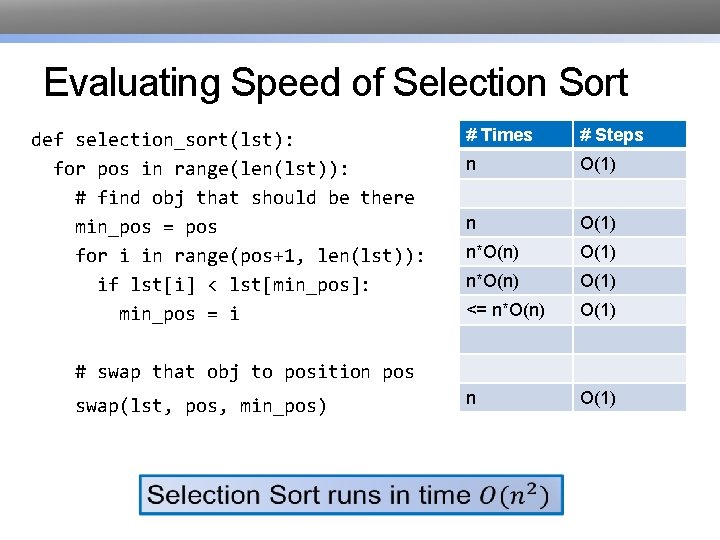
Evaluating Speed of Selection Sort def selection_sort(lst): for pos in range(len(lst)): # find obj that should be there min_pos = pos for i in range(pos+1, len(lst)): if lst[i] < lst[min_pos]: min_pos = i # Times # Steps n O(1) n*O(n) O(1) <= n*O(n) O(1) n O(1) # swap that obj to position pos swap(lst, pos, min_pos)
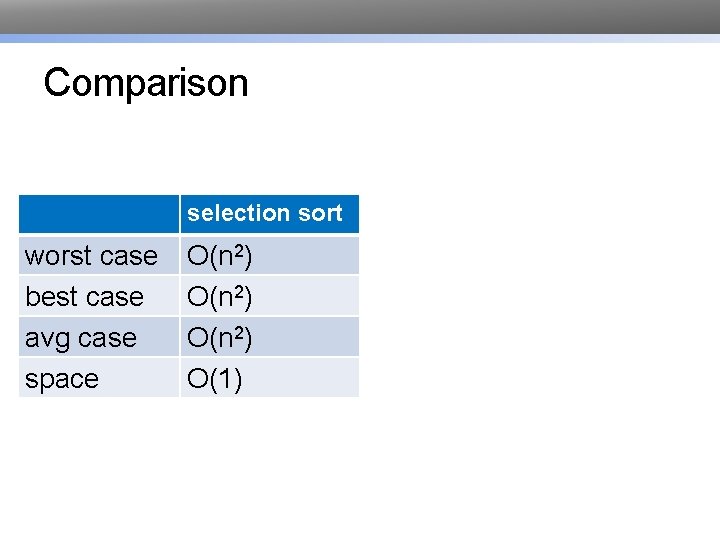
Comparison selection sort worst case best case avg case space O(n 2) O(1)
![Evaluating Speed of Insertion Sort # Times # Steps n O(1) <=n*O(n) O(1) lst[curr_pos]<lst[curr_pos-1]:](http://slidetodoc.com/presentation_image_h2/6e52790b876babb49cf938e6c76dfc81/image-15.jpg "Evaluating Speed of Insertion Sort # Times # Steps n O(1) <=n*O(n) O(1) lst[curr_pos]<lst[curr_pos-1]:")
Evaluating Speed of Insertion Sort # Times # Steps n O(1) <=n*O(n) O(1) lst[curr_pos]<lst[curr_pos-1]: swap(lst, curr_pos-1, curr_pos) <= n*O(n) curr_pos = curr_pos - 1 O(1) def insertion_sort(lst): for pos in range(len(lst)): # swap that obj to right place curr_pos = pos while curr_pos > 0 and O(1)
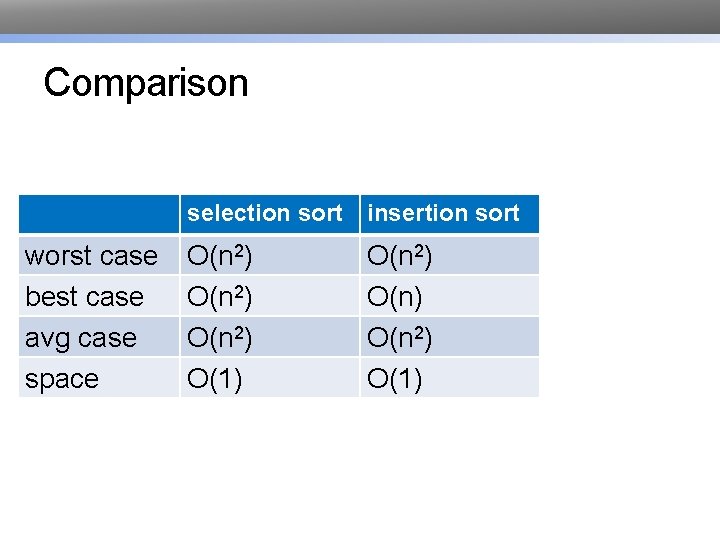
Comparison worst case best case avg case space selection sort insertion sort O(n 2) O(n 2) O(1)
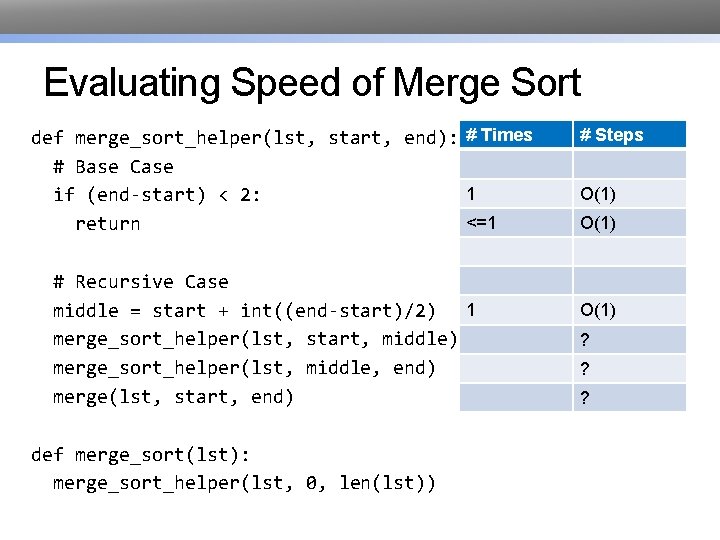
Evaluating Speed of Merge Sort def merge_sort_helper(lst, start, end): # Times # Base Case 1 if (end-start) < 2: <=1 return # Recursive Case middle = start + int((end-start)/2) 1 merge_sort_helper(lst, start, middle) merge_sort_helper(lst, middle, end) merge(lst, start, end) def merge_sort(lst): merge_sort_helper(lst, 0, len(lst)) # Steps O(1) ? ? ?
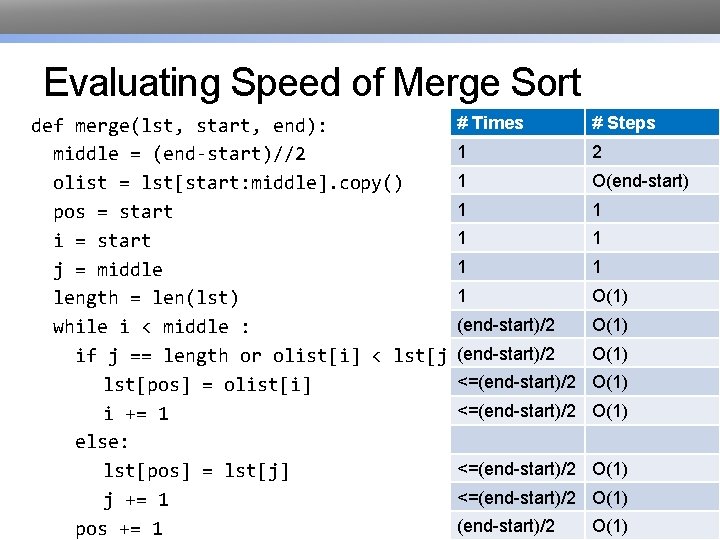
Evaluating Speed of Merge Sort # Times def merge(lst, start, end): 1 middle = (end-start)//2 1 olist = lst[start: middle]. copy() 1 pos = start 1 i = start 1 j = middle 1 length = len(lst) (end-start)/2 while i < middle : (end-start)/2 if j == length or olist[i] < lst[j]: <=(end-start)/2 lst[pos] = olist[i] <=(end-start)/2 i += 1 else: <=(end-start)/2 lst[pos] = lst[j] <=(end-start)/2 j += 1 (end-start)/2 pos += 1 # Steps 2 O(end-start) 1 1 1 O(1) O(1)
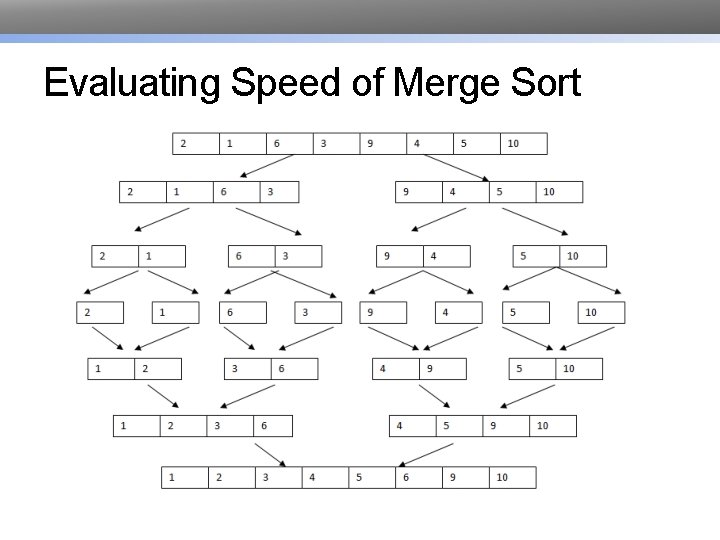
Evaluating Speed of Merge Sort
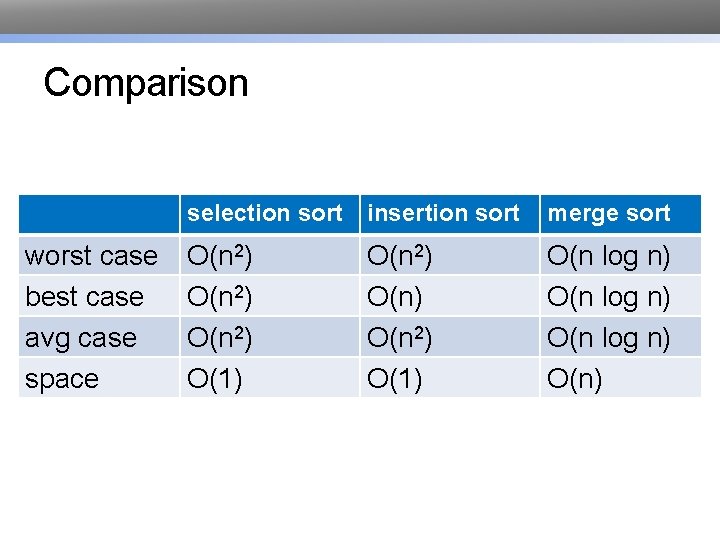
Comparison worst case best case avg case space selection sort insertion sort merge sort O(n 2) O(n 2) O(1) O(n log n) O(n)
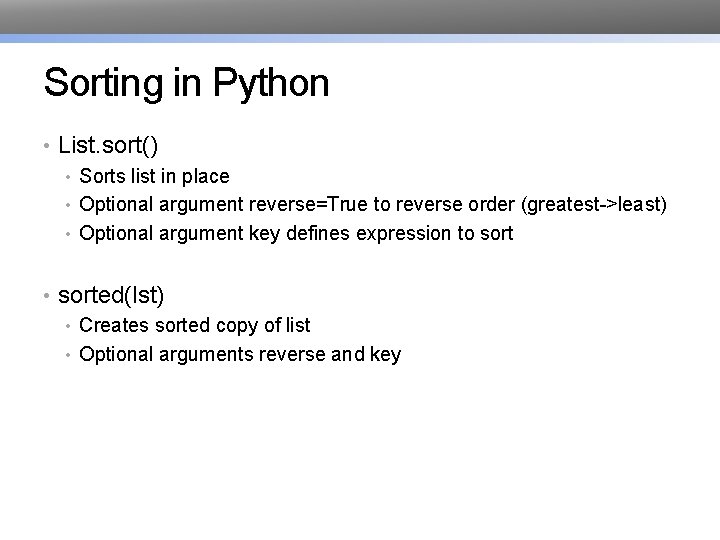
Sorting in Python • List. sort() • Sorts list in place • Optional argument reverse=True to reverse order (greatest->least) • Optional argument key defines expression to sort • sorted(lst) • Creates sorted copy of list • Optional arguments reverse and key
- Slides: 21