
Lecture 16 Terrain modelling the basics Outline introduction
Lecture 16 Terrain modelling: the basics • Outline – introduction – DEMs and DTMs – derived variables – example applications Week 19 GEOG 2750 – Earth Observation and GIS of the Physical 1
Adding the third dimension • In high relief areas variables such as altitude, aspect and slope strongly influence both human and physical environments – a 3 D data model is therefore essential – use a Digital Terrain Model (DTM) – derive information on: Ø height (altitude), aspect and slope (gradient) Ø watersheds (catchments) Ø solar radiation and hill shading Ø cut and fill calculations Ø etc. Week 19 GEOG 2750 – Earth Observation and GIS of the Physical 2
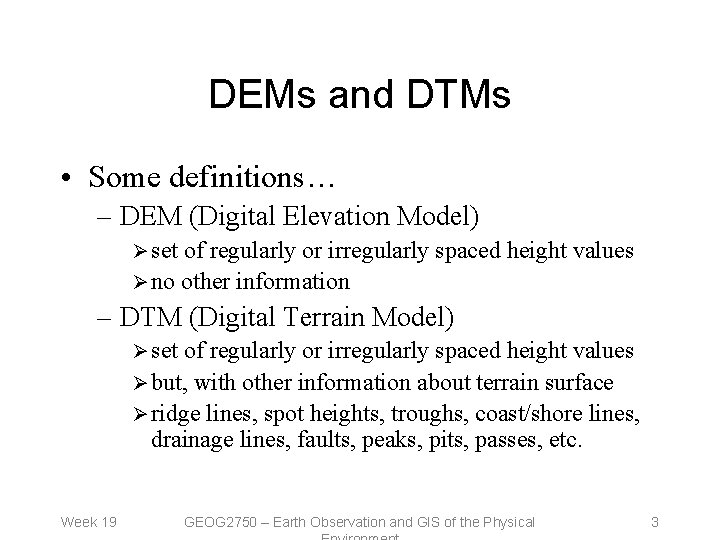
DEMs and DTMs • Some definitions… – DEM (Digital Elevation Model) Ø set of regularly or irregularly spaced height values Ø no other information – DTM (Digital Terrain Model) Ø set of regularly or irregularly spaced height values Ø but, with other information about terrain surface Ø ridge lines, spot heights, troughs, coast/shore lines, drainage lines, faults, peaks, pits, passes, etc. Week 19 GEOG 2750 – Earth Observation and GIS of the Physical 3
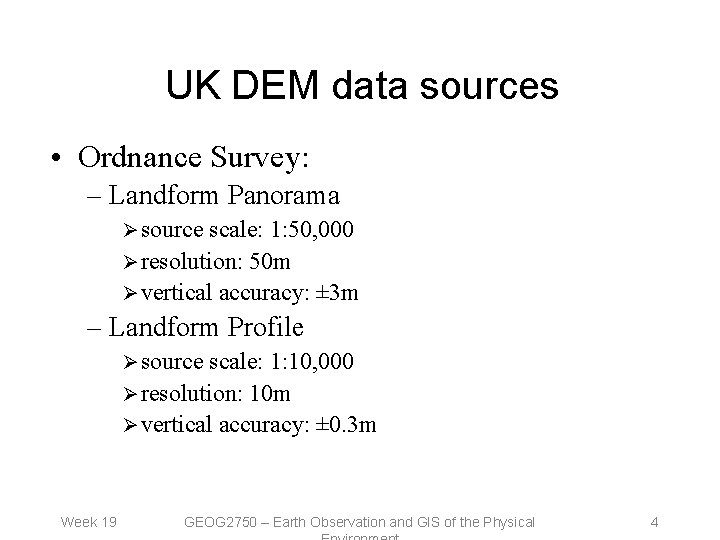
UK DEM data sources • Ordnance Survey: – Landform Panorama Ø source scale: 1: 50, 000 Ø resolution: 50 m Ø vertical accuracy: ± 3 m – Landform Profile Ø source scale: 1: 10, 000 Ø resolution: 10 m Ø vertical accuracy: ± 0. 3 m Week 19 GEOG 2750 – Earth Observation and GIS of the Physical 4
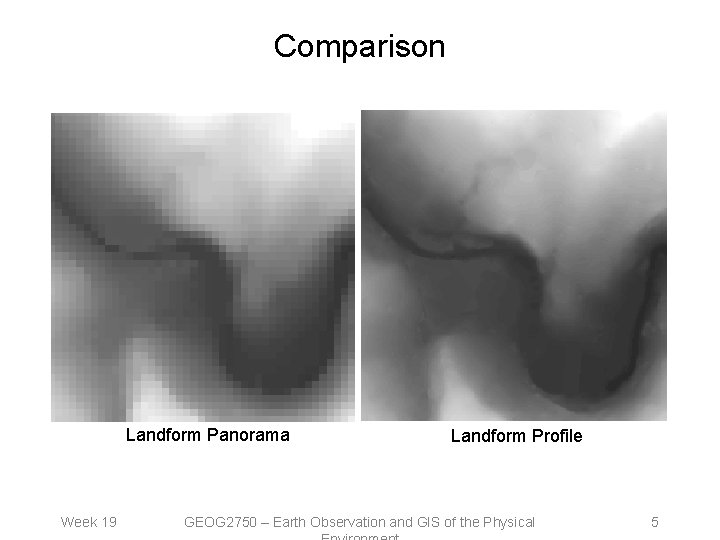
Comparison Landform Panorama Week 19 Landform Profile GEOG 2750 – Earth Observation and GIS of the Physical 5
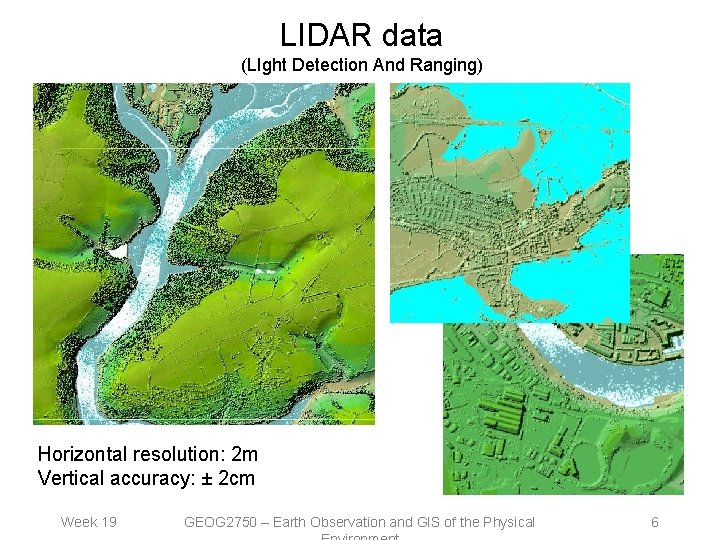
LIDAR data (LIght Detection And Ranging) Horizontal resolution: 2 m Vertical accuracy: ± 2 cm Week 19 GEOG 2750 – Earth Observation and GIS of the Physical 6
Modelling building and topological structures • Two main approaches: – Digital Elevation Models (DEMs) based on data sampled on a regular grid (lattice) – Triangular Irregular Networks (TINs) based on irregular sampled data and Delaunay triangulation Week 19 GEOG 2750 – Earth Observation and GIS of the Physical 7
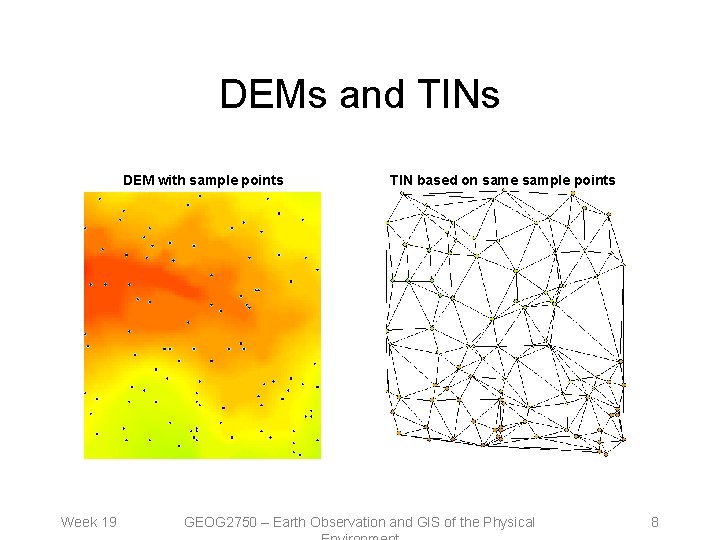
DEMs and TINs DEM with sample points Week 19 TIN based on same sample points GEOG 2750 – Earth Observation and GIS of the Physical 8
Advantages/disadvantages • DEMs: – – – accept data direct from digital altitude matrices must be resampled if irregular data used may miss complex topographic features may include redundant data in low relief areas less complex and CPU intensive • TINs: – accept randomly sampled data without resampling – accept linear features such as contours and breaklines (ridges and troughs) – accept point features (spot heights and peaks) – vary density of sample points according to terrain complexity Week 19 GEOG 2750 – Earth Observation and GIS of the Physical 9
Task • Make you own TIN from a piece of paper Week 19 GEOG 2750 – Earth Observation and GIS of the Physical 10
Derived variables • Primary use of DTMs is calculation of three main terrain variables: – height Ø altitude above datum – aspect Ø direction area of terrain is facing – slope Ø gradient Week 19 or angle of terrain GEOG 2750 – Earth Observation and GIS of the Physical 11
Question • What might slope and aspect maps be used for? Week 19 GEOG 2750 – Earth Observation and GIS of the Physical 12
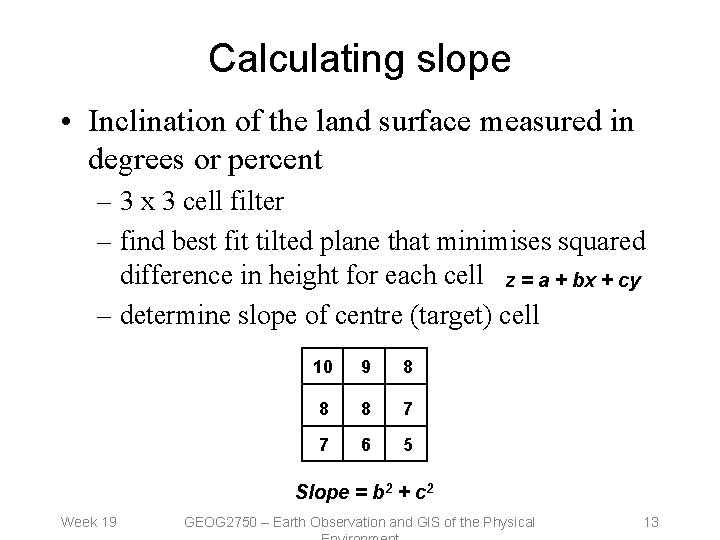
Calculating slope • Inclination of the land surface measured in degrees or percent – 3 x 3 cell filter – find best fit tilted plane that minimises squared difference in height for each cell z = a + bx + cy – determine slope of centre (target) cell 10 9 8 8 8 7 7 6 5 Slope = b 2 + c 2 Week 19 GEOG 2750 – Earth Observation and GIS of the Physical 13
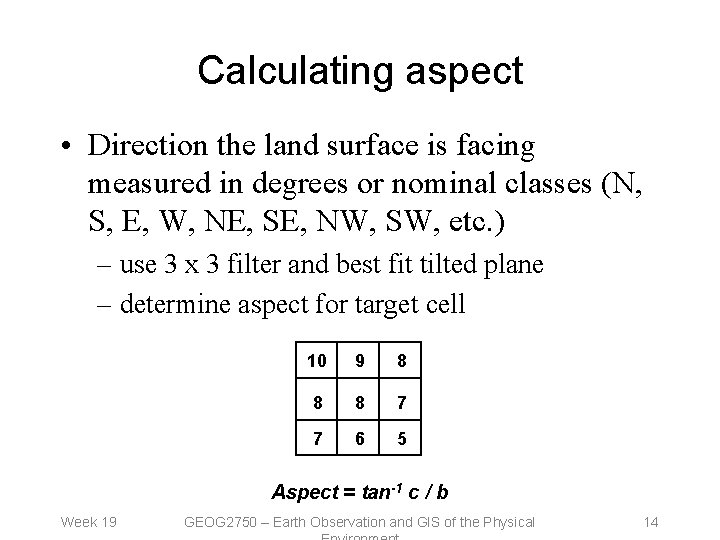
Calculating aspect • Direction the land surface is facing measured in degrees or nominal classes (N, S, E, W, NE, SE, NW, SW, etc. ) – use 3 x 3 filter and best fit tilted plane – determine aspect for target cell 10 9 8 8 8 7 7 6 5 Aspect = tan-1 c / b Week 19 GEOG 2750 – Earth Observation and GIS of the Physical 14
Other derived variables • Many other variables describing terrain features/characteristics – hillshading – profile and plan curvature – feature extraction – etc. Week 19 GEOG 2750 – Earth Observation and GIS of the Physical 15
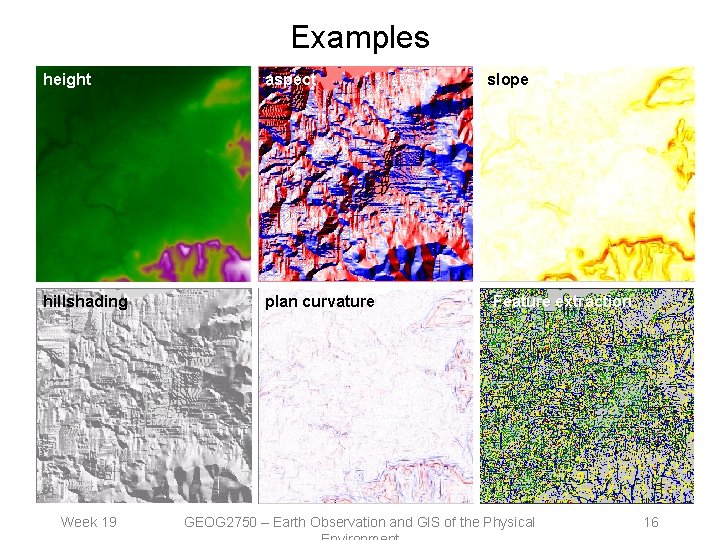
Examples height aspect hillshading plan curvature Week 19 slope Feature extraction GEOG 2750 – Earth Observation and GIS of the Physical 16
Question • What other important variables can be derived from DEMs? Week 19 GEOG 2750 – Earth Observation and GIS of the Physical 17
Problems with DEMs • Issues worth considering when creating/using DTMs – quality of data used to generate DEM – interpolation technique – give rise to errors in surface such as: Ø sloping lakes and rivers flowing uphill Ø local minima Ø stepped appearance Ø etc. Week 19 GEOG 2750 – Earth Observation and GIS of the Physical 18
Example applications • Visualisation – terrain and other 3 D surfaces • Visibility analysis – intervisibility matrices and viewsheds • Hydrological modelling – catchment modelling and flow models • Engineering – cut & fill, profiles, etc. Week 19 GEOG 2750 – Earth Observation and GIS of the Physical 19
Terrain visualisation • Analytical hillshading • Orthographic views – any azimuth, altitude, view distance/point – surface drapes (point, line and area data) • Animated ‘fly-through’ • What if? modelling – photorealism – photomontage – CAD Week 19 GEOG 2750 – Earth Observation and GIS of the Physical 20
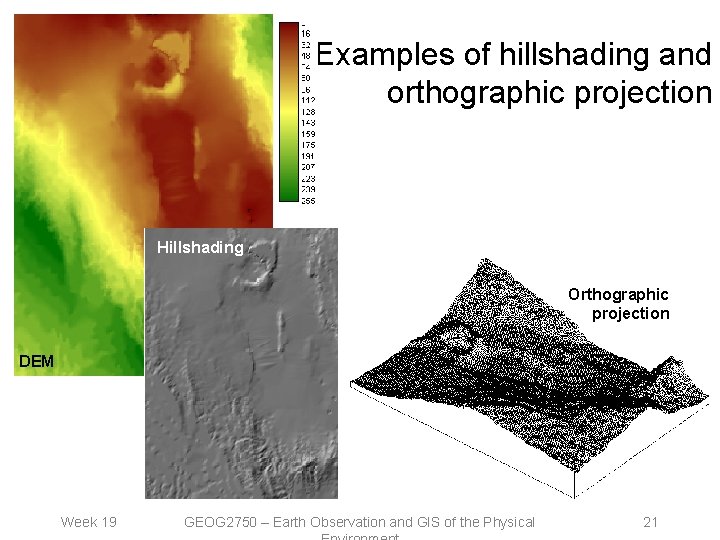
Examples of hillshading and orthographic projection Hillshading Orthographic projection DEM Week 19 GEOG 2750 – Earth Observation and GIS of the Physical 21
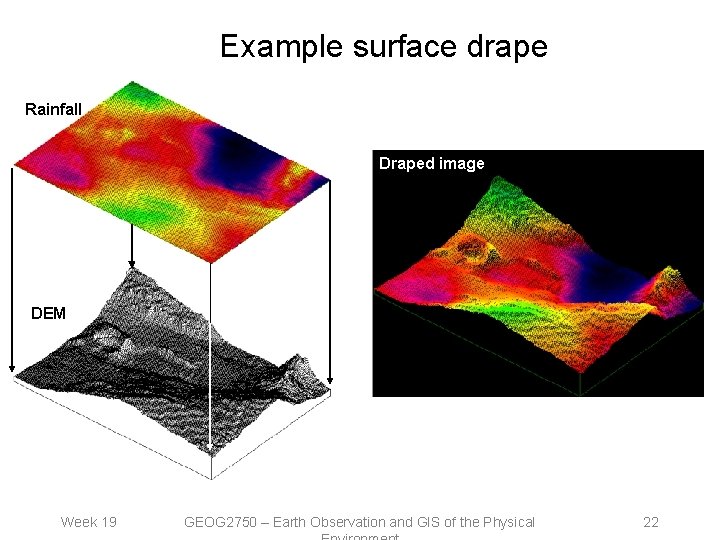
Example surface drape Rainfall Draped image DEM Week 19 GEOG 2750 – Earth Observation and GIS of the Physical 22
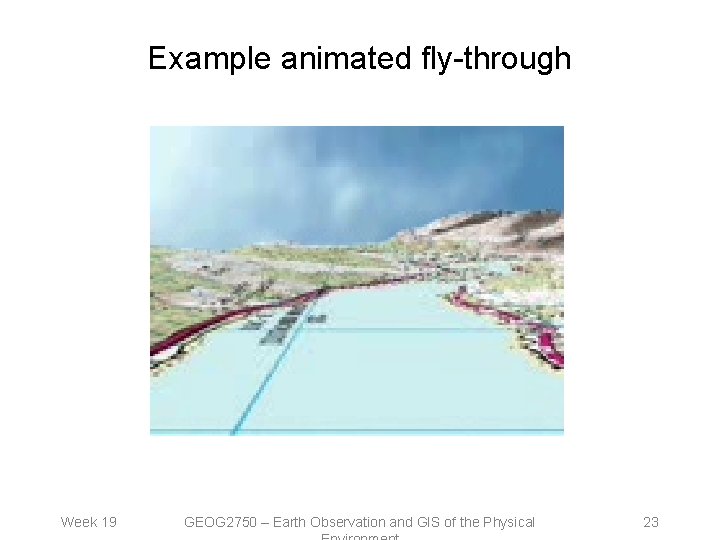
Example animated fly-through Week 19 GEOG 2750 – Earth Observation and GIS of the Physical 23
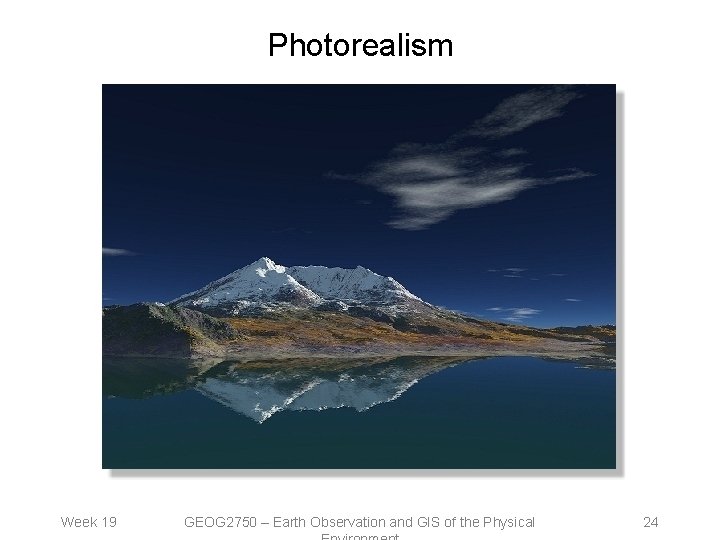
Photorealism Week 19 GEOG 2750 – Earth Observation and GIS of the Physical 24
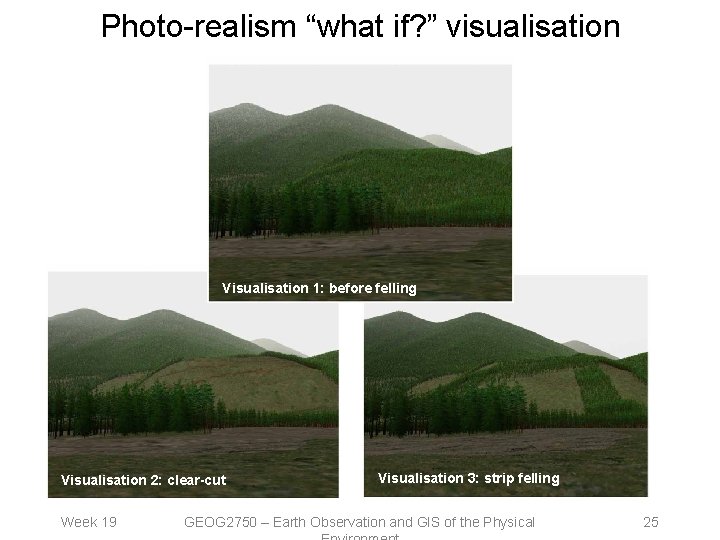
Photo-realism “what if? ” visualisation Visualisation 1: before felling Visualisation 2: clear-cut Week 19 Visualisation 3: strip felling GEOG 2750 – Earth Observation and GIS of the Physical 25
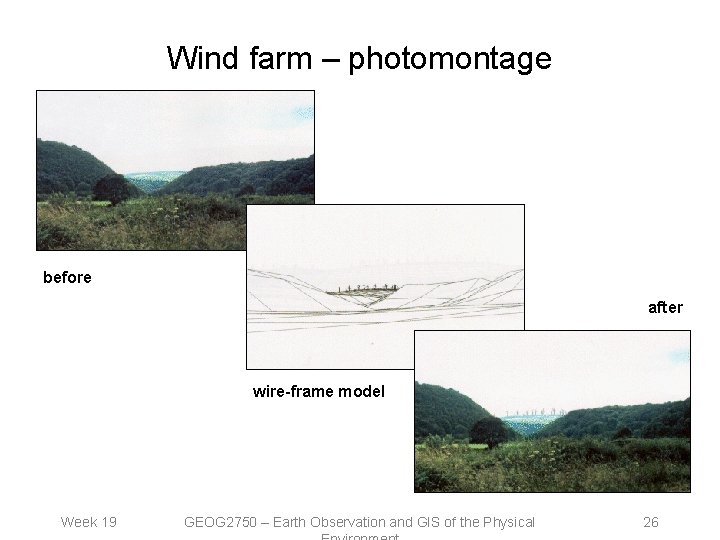
Wind farm – photomontage before after wire-frame model Week 19 GEOG 2750 – Earth Observation and GIS of the Physical 26
Conclusions • Need for third dimensional GIS – especially in environmental applications – new data models/structures – new opportunities for analysis • Basic uses and derived variables • Application areas – visualisation – visibility analysis – etc. Week 19 GEOG 2750 – Earth Observation and GIS of the Physical 27
Practical • Using DEMs for hillslope geomorphology • Task: Derive key variables from DEM and relate to slope profiles • Data: The following datasets are provided for the Hohe Tauern Alps, Austria… – 25 m resolution DEM – 10 m interval contour data (derived from 25 m resolution DEM) Week 19 GEOG 2750 – Earth Observation and GIS of the Physical 28
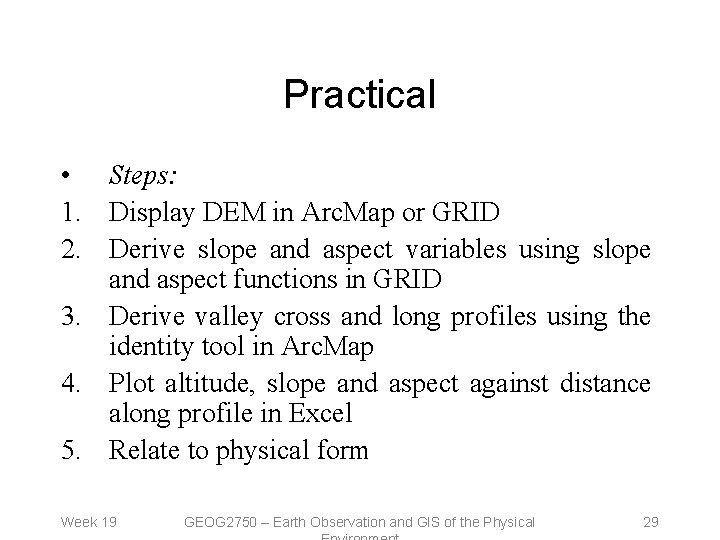
Practical • Steps: 1. Display DEM in Arc. Map or GRID 2. Derive slope and aspect variables using slope and aspect functions in GRID 3. Derive valley cross and long profiles using the identity tool in Arc. Map 4. Plot altitude, slope and aspect against distance along profile in Excel 5. Relate to physical form Week 19 GEOG 2750 – Earth Observation and GIS of the Physical 29
Learning outcomes • Familiarity with TIN/DEM construction in Arc/Info • Experience with deriving surface variables • Experience with displaying surfaces in Arcplot Week 19 GEOG 2750 – Earth Observation and GIS of the Physical 30
Useful web links • View global DEMs – http: //www. ngdc. noaa. gov/mgg/images. html#relief • DEM derived operations – http: //www. powerdata. com. au/derive. htm Week 19 GEOG 2750 – Earth Observation and GIS of the Physical 31
After reading week… • Terrain modelling: applications – Access modelling – Landscape evaluation – Hazard mapping • Practical: Visibility assessment Week 19 GEOG 2750 – Earth Observation and GIS of the Physical 32
- Slides: 32