
Lecture 16 Pattern Sensitive and Electrical Memory Test
- Slides: 33
Lecture 16 Pattern Sensitive and Electrical Memory Test § § § Notation Neighborhood pattern sensitive fault algorithms Cache DRAM and ROM tests Memory Electrical Parametric Tests Summary Copyright 2001, Agrawal & Bushnell VLSI Test: Lecture 16 1
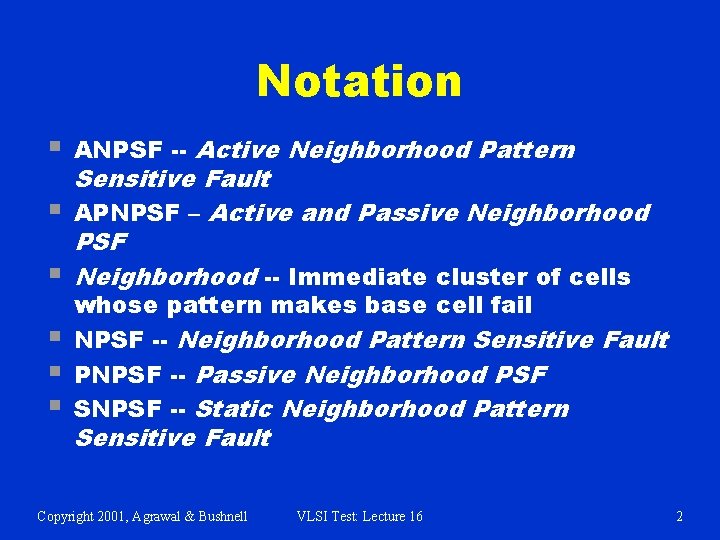
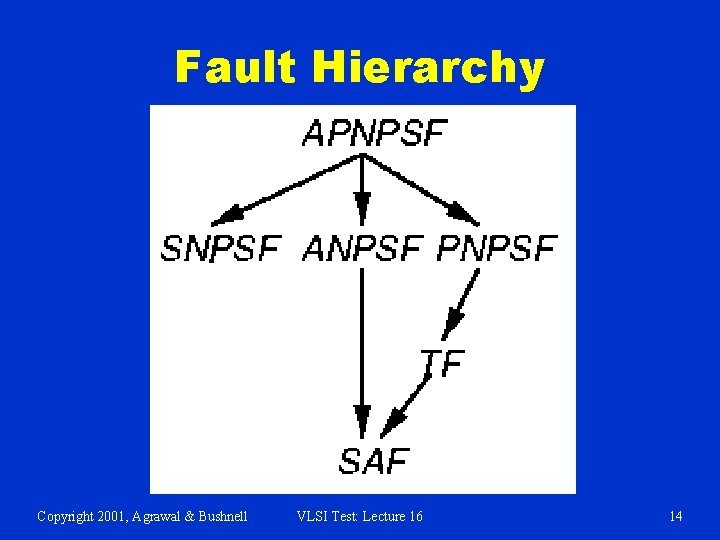
Notation § § § ANPSF -- Active Neighborhood Pattern Sensitive Fault APNPSF – Active and Passive Neighborhood PSF Neighborhood -- Immediate cluster of cells whose pattern makes base cell fail NPSF -- Neighborhood Pattern Sensitive Fault PNPSF -- Passive Neighborhood PSF SNPSF -- Static Neighborhood Pattern Sensitive Fault Copyright 2001, Agrawal & Bushnell VLSI Test: Lecture 16 2
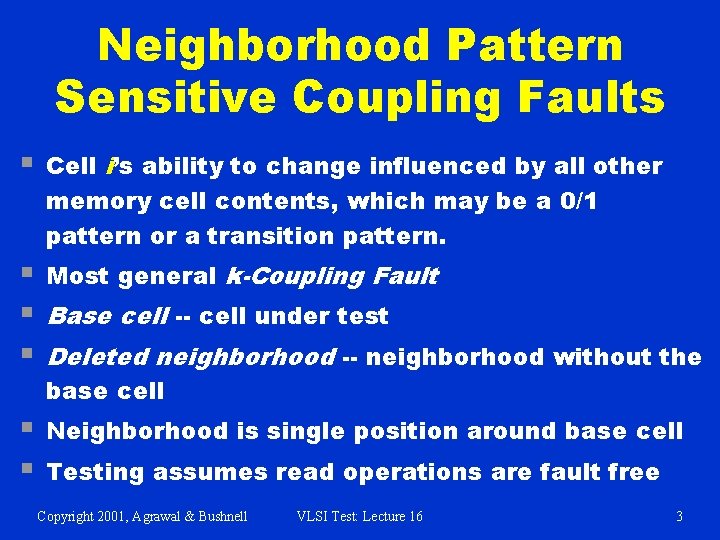
Neighborhood Pattern Sensitive Coupling Faults § Cell i’s ability to change influenced by all other memory cell contents, which may be a 0/1 pattern or a transition pattern. § § § Most general k-Coupling Fault Base cell -- cell under test Deleted neighborhood -- neighborhood without the base cell § § Neighborhood is single position around base cell Testing assumes read operations are fault free Copyright 2001, Agrawal & Bushnell VLSI Test: Lecture 16 3
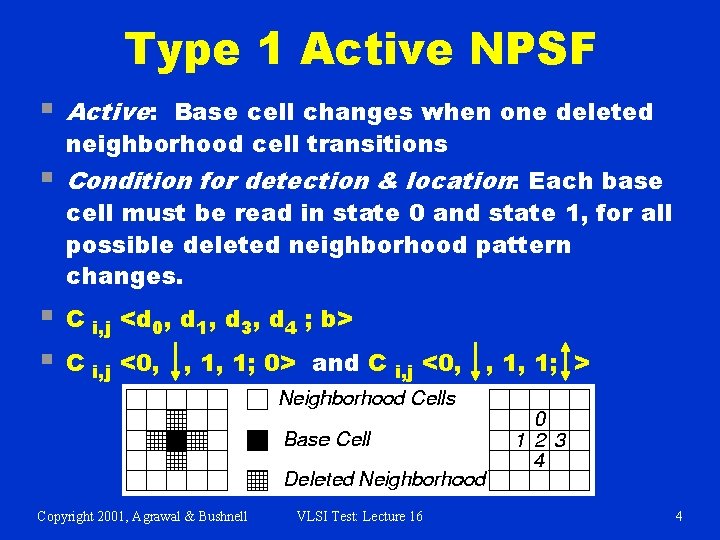
Type 1 Active NPSF § Active: Base cell changes when one deleted § Condition for detection & location: Each base § § neighborhood cell transitions cell must be read in state 0 and state 1, for all possible deleted neighborhood pattern changes. C i, j <d 0, d 1, d 3, d 4 ; b> C i, j <0, , 1, 1; 0> and C Copyright 2001, Agrawal & Bushnell i, j <0, , 1, 1; > VLSI Test: Lecture 16 4
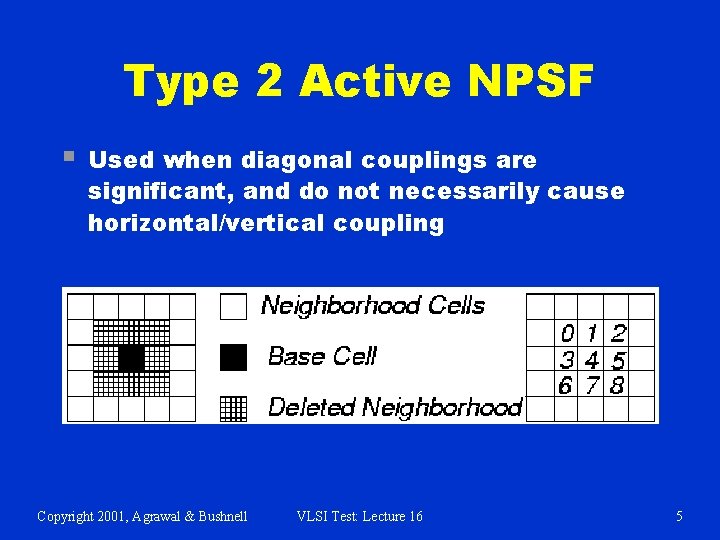
Type 2 Active NPSF § Used when diagonal couplings are significant, and do not necessarily cause horizontal/vertical coupling Copyright 2001, Agrawal & Bushnell VLSI Test: Lecture 16 5
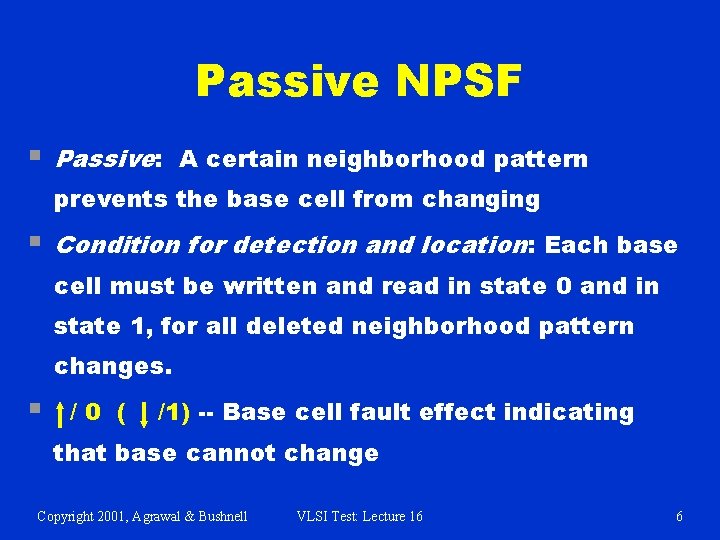
Passive NPSF § Passive: A certain neighborhood pattern prevents the base cell from changing § Condition for detection and location: Each base cell must be written and read in state 0 and in state 1, for all deleted neighborhood pattern changes. § /0 ( /1) -- Base cell fault effect indicating that base cannot change Copyright 2001, Agrawal & Bushnell VLSI Test: Lecture 16 6
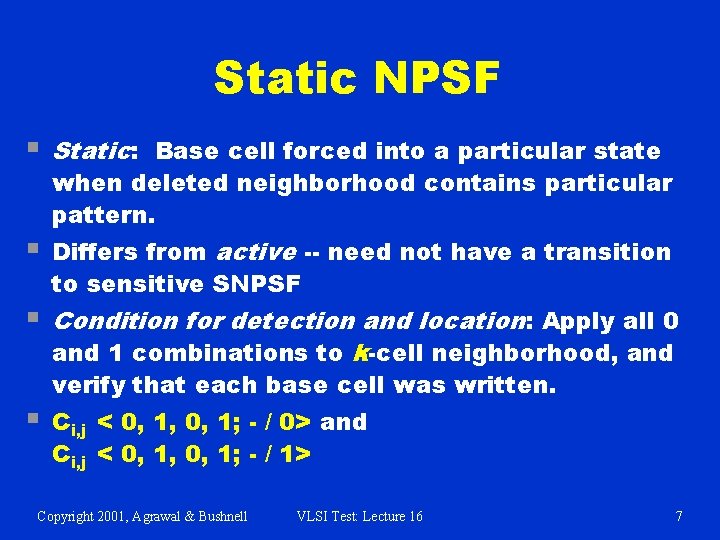
Static NPSF § Static: Base cell forced into a particular state § Differs from active -- need not have a transition to sensitive SNPSF § § when deleted neighborhood contains particular pattern. Condition for detection and location: Apply all 0 and 1 combinations to k-cell neighborhood, and verify that each base cell was written. Ci, j < 0, 1, 0, 1; - / 0> and Ci, j < 0, 1, 0, 1; - / 1> Copyright 2001, Agrawal & Bushnell VLSI Test: Lecture 16 7
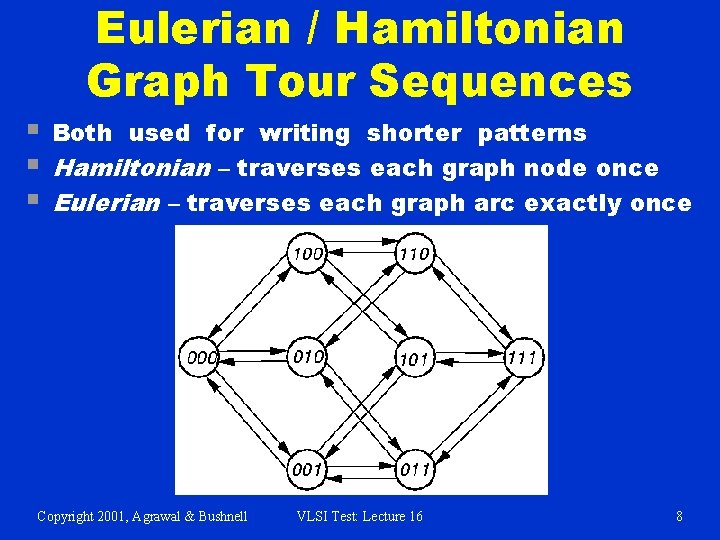
Eulerian / Hamiltonian Graph Tour Sequences § § § Both used for writing shorter patterns Hamiltonian – traverses each graph node once Eulerian – traverses each graph arc exactly once Copyright 2001, Agrawal & Bushnell VLSI Test: Lecture 16 8
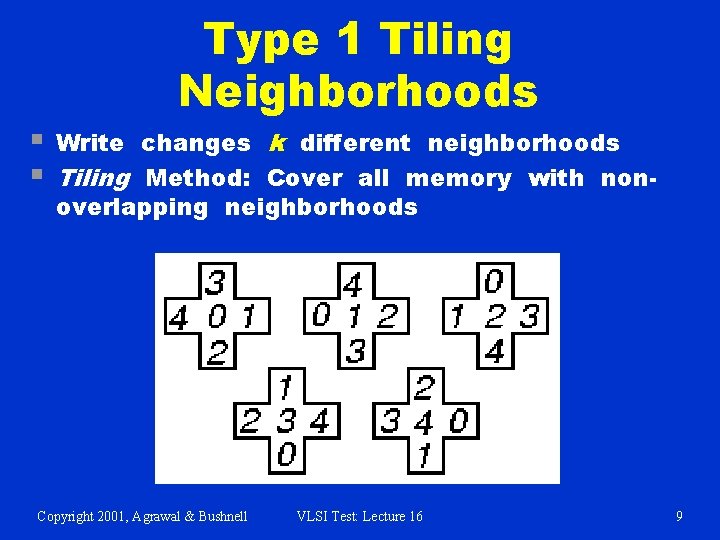
Type 1 Tiling Neighborhoods § § Write changes k different neighborhoods Tiling Method: Cover all memory with nonoverlapping neighborhoods Copyright 2001, Agrawal & Bushnell VLSI Test: Lecture 16 9
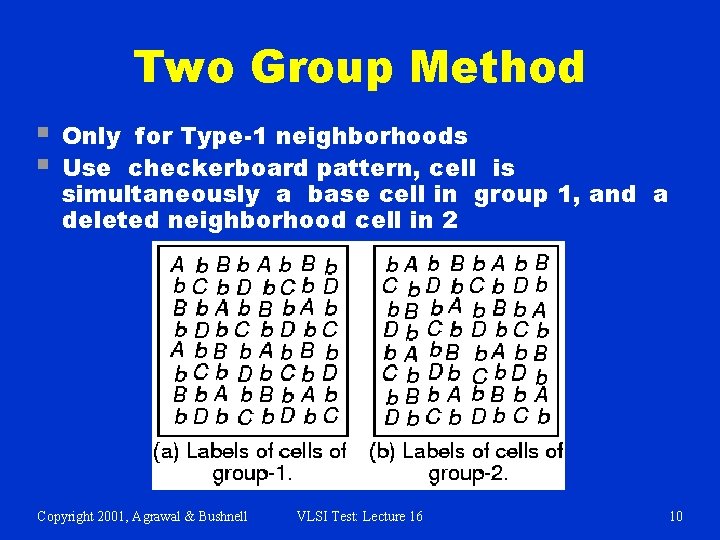
Two Group Method § § Only for Type-1 neighborhoods Use checkerboard pattern, cell is simultaneously a base cell in group 1, and a deleted neighborhood cell in 2 Copyright 2001, Agrawal & Bushnell VLSI Test: Lecture 16 10
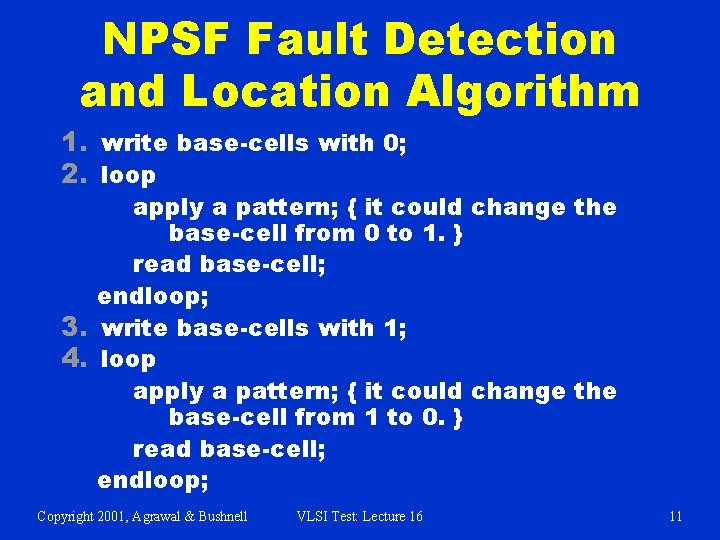
NPSF Fault Detection and Location Algorithm 1. write base-cells with 0; 2. loop apply a pattern; { it could change the base-cell from 0 to 1. } read base-cell; endloop; 3. write base-cells with 1; 4. loop apply a pattern; { it could change the base-cell from 1 to 0. } read base-cell; endloop; Copyright 2001, Agrawal & Bushnell VLSI Test: Lecture 16 11
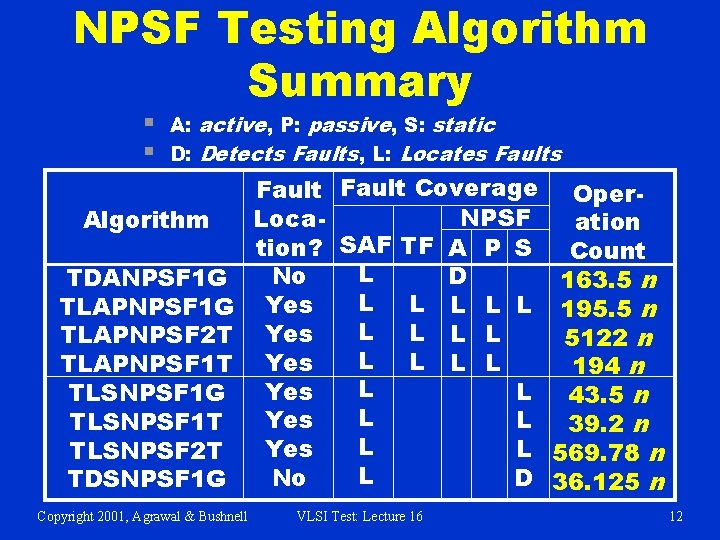
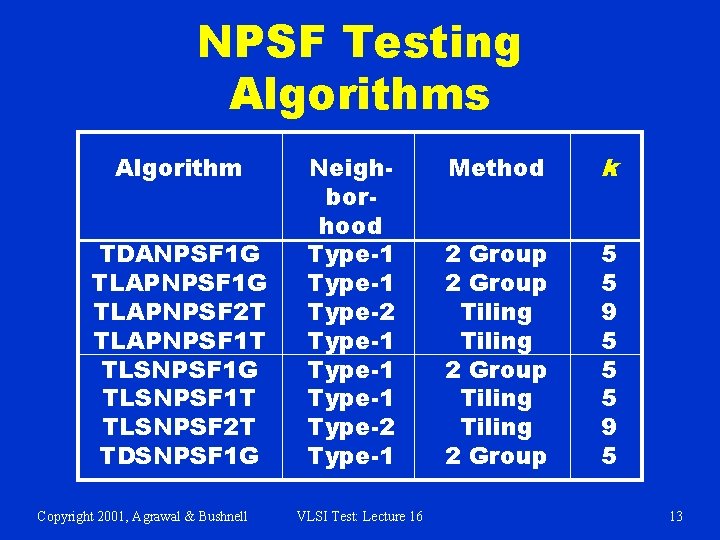
NPSF Testing Algorithm Summary § § A: active, P: passive, S: static D: Detects Faults, L: Locates Fault Coverage NPSF Loca. Algorithm tion? SAF TF A P S L No D TDANPSF 1 G L L L TLAPNPSF 1 G Yes L L TLAPNPSF 2 T Yes L L TLAPNPSF 1 T Yes L TLSNPSF 1 G L Yes L TLSNPSF 1 T L Yes L TLSNPSF 2 T L No D TDSNPSF 1 G Copyright 2001, Agrawal & Bushnell VLSI Test: Lecture 16 Operation Count 163. 5 n 195. 5 n 5122 n 194 n 43. 5 n 39. 2 n 569. 78 n 36. 125 n 12
NPSF Testing Algorithms Algorithm TDANPSF 1 G TLAPNPSF 2 T TLAPNPSF 1 T TLSNPSF 1 G TLSNPSF 1 T TLSNPSF 2 T TDSNPSF 1 G Copyright 2001, Agrawal & Bushnell Neighborhood Type-1 Type-2 Type-1 VLSI Test: Lecture 16 Method k 2 Group Tiling 2 Group 5 5 9 5 13
Fault Hierarchy Copyright 2001, Agrawal & Bushnell VLSI Test: Lecture 16 14
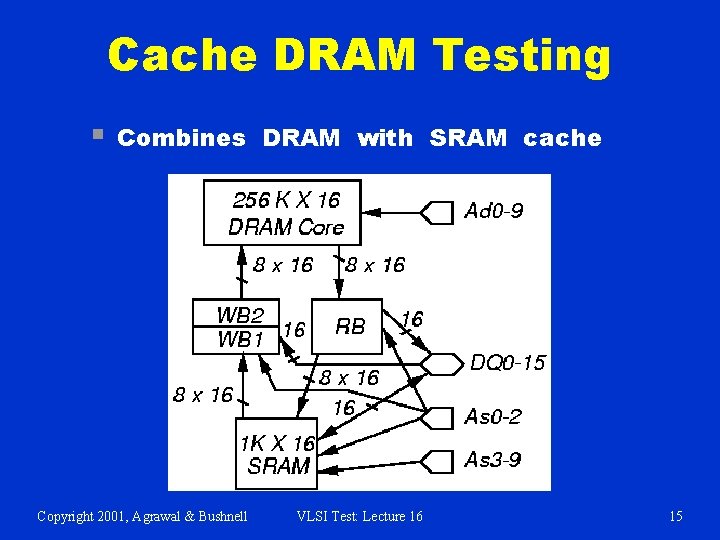
Cache DRAM Testing § Combines DRAM with SRAM cache Copyright 2001, Agrawal & Bushnell VLSI Test: Lecture 16 15
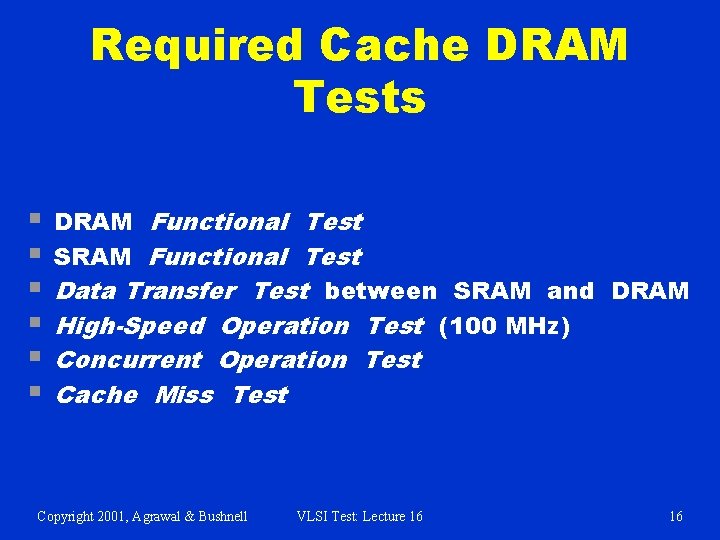
Required Cache DRAM Tests § § § DRAM Functional Test SRAM Functional Test Data Transfer Test between SRAM and DRAM High-Speed Operation Test (100 MHz) Concurrent Operation Test Cache Miss Test Copyright 2001, Agrawal & Bushnell VLSI Test: Lecture 16 16
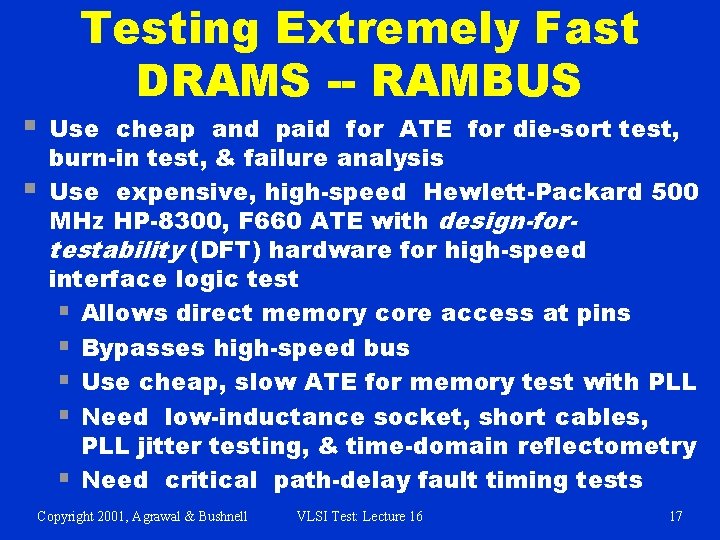
§ § Testing Extremely Fast DRAMS -- RAMBUS Use cheap and paid for ATE for die-sort test, burn-in test, & failure analysis Use expensive, high-speed Hewlett-Packard 500 MHz HP-8300, F 660 ATE with design-fortestability (DFT) hardware for high-speed interface logic test § Allows direct memory core access at pins § Bypasses high-speed bus § Use cheap, slow ATE for memory test with PLL § Need low-inductance socket, short cables, PLL jitter testing, & time-domain reflectometry § Need critical path-delay fault timing tests Copyright 2001, Agrawal & Bushnell VLSI Test: Lecture 16 17
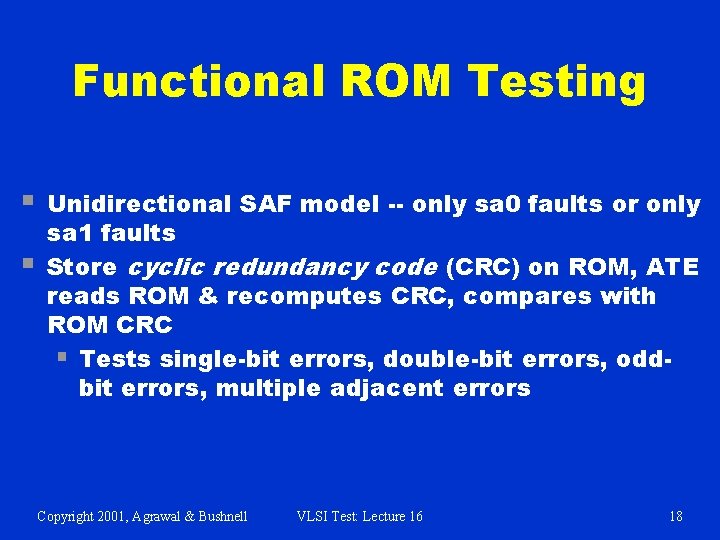
Functional ROM Testing § § Unidirectional SAF model -- only sa 0 faults or only sa 1 faults Store cyclic redundancy code (CRC) on ROM, ATE reads ROM & recomputes CRC, compares with ROM CRC § Tests single-bit errors, double-bit errors, oddbit errors, multiple adjacent errors Copyright 2001, Agrawal & Bushnell VLSI Test: Lecture 16 18
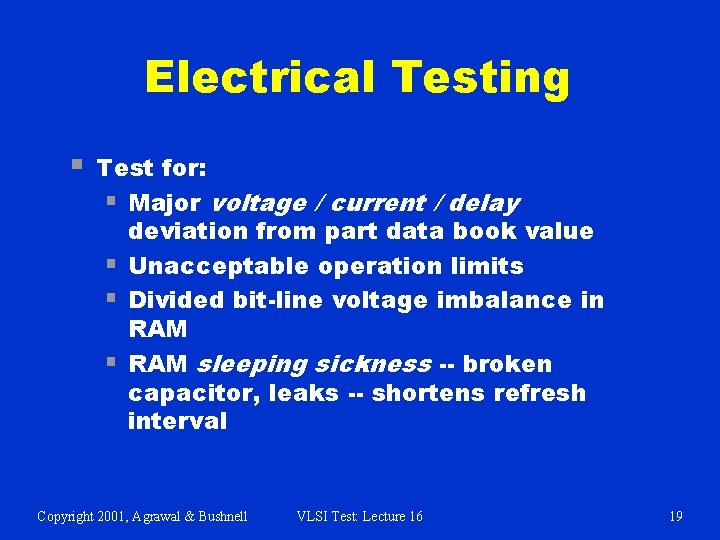
Electrical Testing § Test for: § Major voltage / current / delay deviation from part data book value § Unacceptable operation limits § Divided bit-line voltage imbalance in RAM § RAM sleeping sickness -- broken capacitor, leaks -- shortens refresh interval Copyright 2001, Agrawal & Bushnell VLSI Test: Lecture 16 19
RAM Organization Copyright 2001, Agrawal & Bushnell VLSI Test: Lecture 16 20
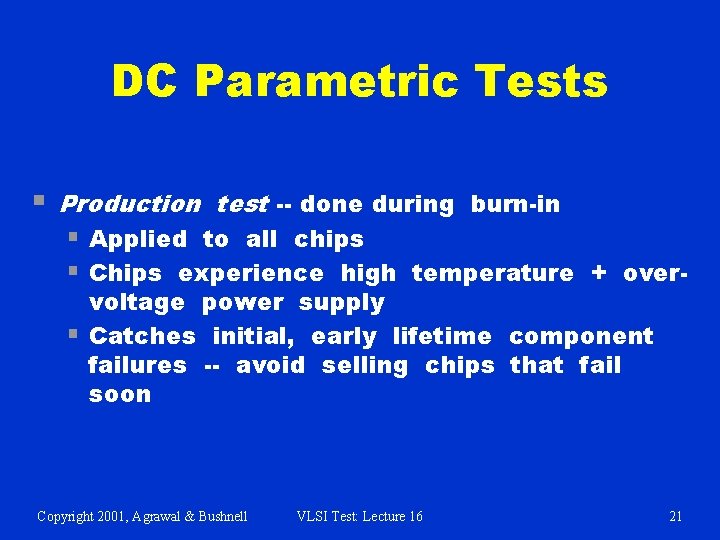
DC Parametric Tests § Production test -- done during burn-in § Applied to all chips § Chips experience high temperature + over§ voltage power supply Catches initial, early lifetime component failures -- avoid selling chips that fail soon Copyright 2001, Agrawal & Bushnell VLSI Test: Lecture 16 21
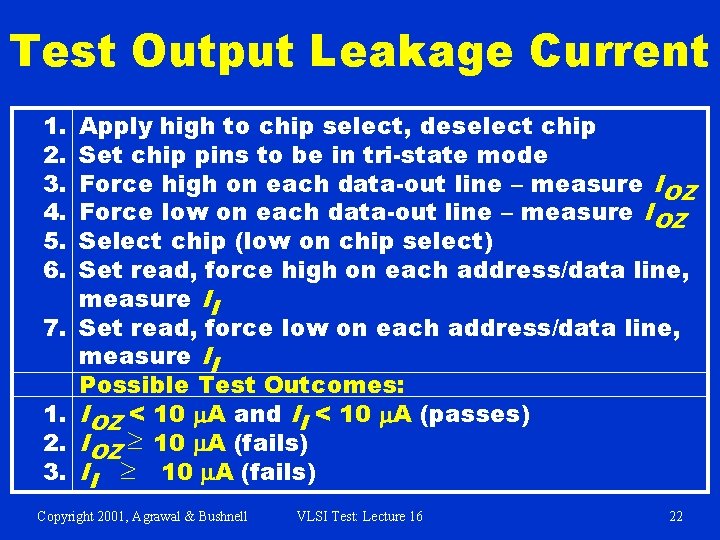
Test Output Leakage Current 1. 2. 3. 4. 5. 6. 7. 1. 2. 3. Apply high to chip select, deselect chip Set chip pins to be in tri-state mode Force high on each data-out line – measure IOZ Force low on each data-out line – measure IOZ Select chip (low on chip select) Set read, force high on each address/data line, measure II Set read, force low on each address/data line, measure II Possible Test Outcomes: IOZ < 10 m. A and II < 10 m. A (passes) IOZ ³ 10 m. A (fails) II ³ 10 m. A (fails) Copyright 2001, Agrawal & Bushnell VLSI Test: Lecture 16 22
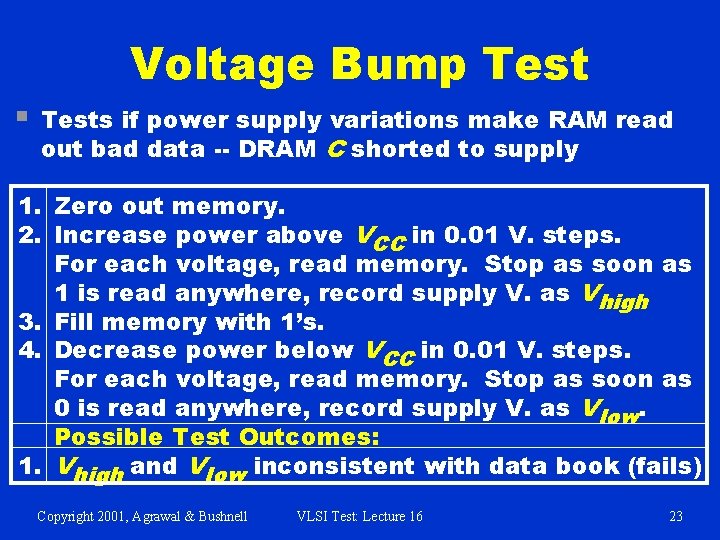
Voltage Bump Test § Tests if power supply variations make RAM read out bad data -- DRAM C shorted to supply 1. Zero out memory. 2. Increase power above VCC in 0. 01 V. steps. For each voltage, read memory. Stop as soon as 1 is read anywhere, record supply V. as Vhigh 3. Fill memory with 1’s. 4. Decrease power below VCC in 0. 01 V. steps. For each voltage, read memory. Stop as soon as 0 is read anywhere, record supply V. as Vlow. Possible Test Outcomes: 1. Vhigh and Vlow inconsistent with data book (fails) Copyright 2001, Agrawal & Bushnell VLSI Test: Lecture 16 23
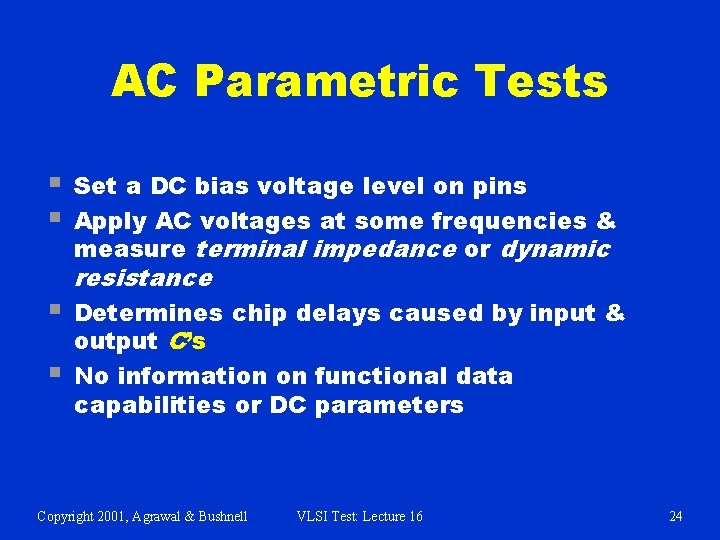
AC Parametric Tests § § Set a DC bias voltage level on pins Apply AC voltages at some frequencies & measure terminal impedance or dynamic resistance Determines chip delays caused by input & output C’s No information on functional data capabilities or DC parameters Copyright 2001, Agrawal & Bushnell VLSI Test: Lecture 16 24
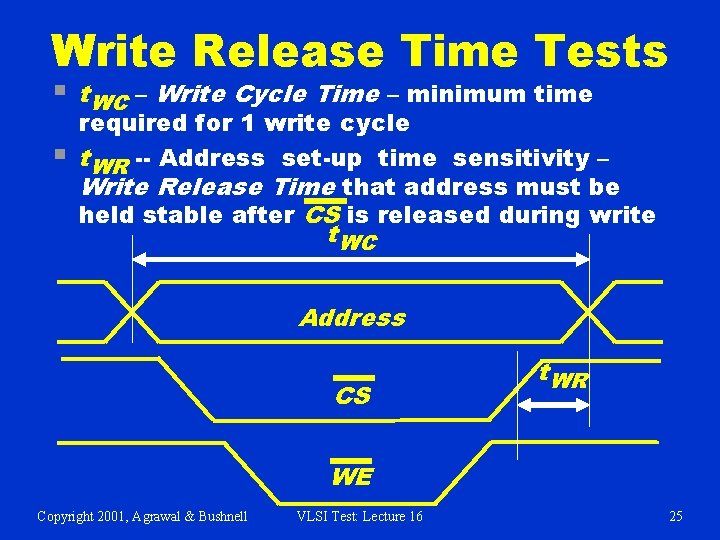
Write Release Time Tests § § t. WC – Write Cycle Time – minimum time required for 1 write cycle t. WR -- Address set-up time sensitivity – Write Release Time that address must be held stable after CS is released during write t. WC Address CS t. WR WE Copyright 2001, Agrawal & Bushnell VLSI Test: Lecture 16 25
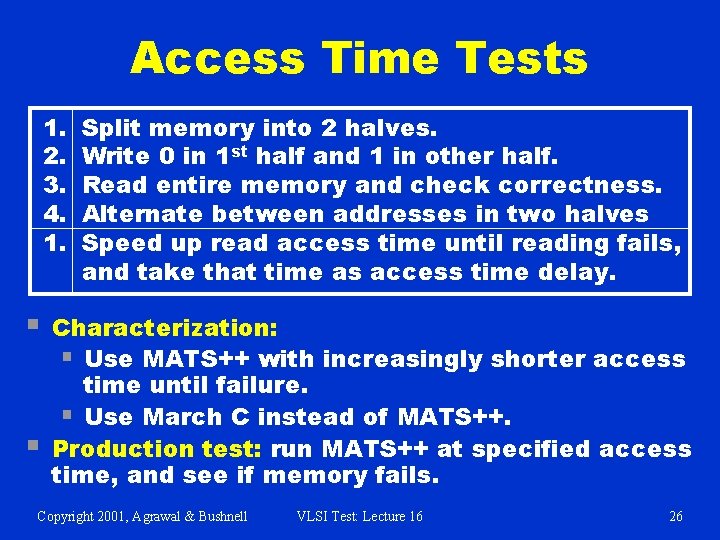
Access Time Tests 1. 2. 3. 4. 1. § § Split memory into 2 halves. Write 0 in 1 st half and 1 in other half. Read entire memory and check correctness. Alternate between addresses in two halves Speed up read access time until reading fails, and take that time as access time delay. Characterization: § Use MATS++ with increasingly shorter access time until failure. § Use March C instead of MATS++. Production test: run MATS++ at specified access time, and see if memory fails. Copyright 2001, Agrawal & Bushnell VLSI Test: Lecture 16 26
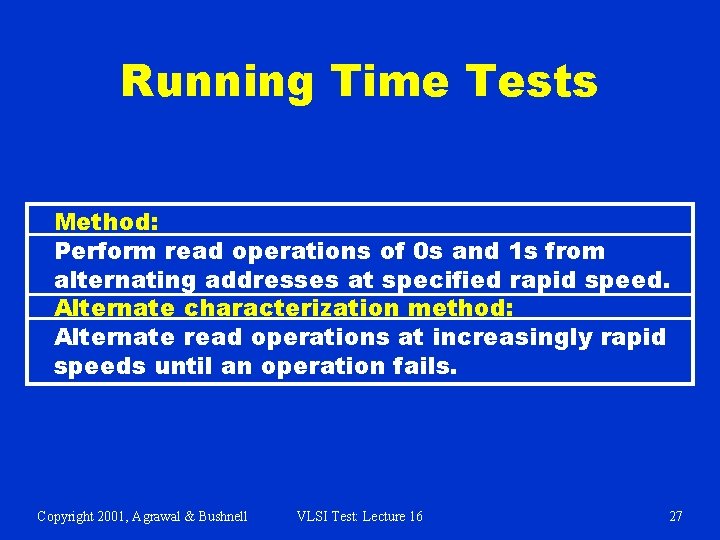
Running Time Tests Method: Perform read operations of 0 s and 1 s from alternating addresses at specified rapid speed. Alternate characterization method: Alternate read operations at increasingly rapid speeds until an operation fails. Copyright 2001, Agrawal & Bushnell VLSI Test: Lecture 16 27
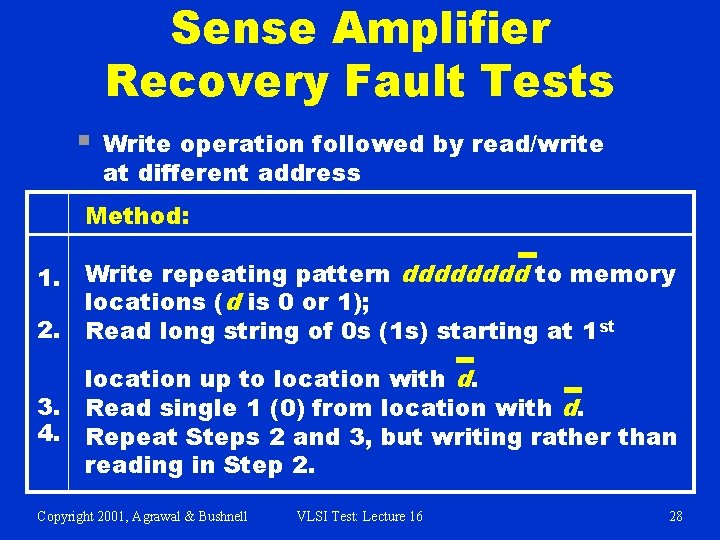
Sense Amplifier Recovery Fault Tests § Write operation followed by read/write at different address Method: 1. 2. 3. 4. Write repeating pattern dddd to memory locations (d is 0 or 1); Read long string of 0 s (1 s) starting at 1 st location up to location with d. Read single 1 (0) from location with d. Repeat Steps 2 and 3, but writing rather than reading in Step 2. Copyright 2001, Agrawal & Bushnell VLSI Test: Lecture 16 28
Dual-Port SRAM Tests Copyright 2001, Agrawal & Bushnell VLSI Test: Lecture 16 29
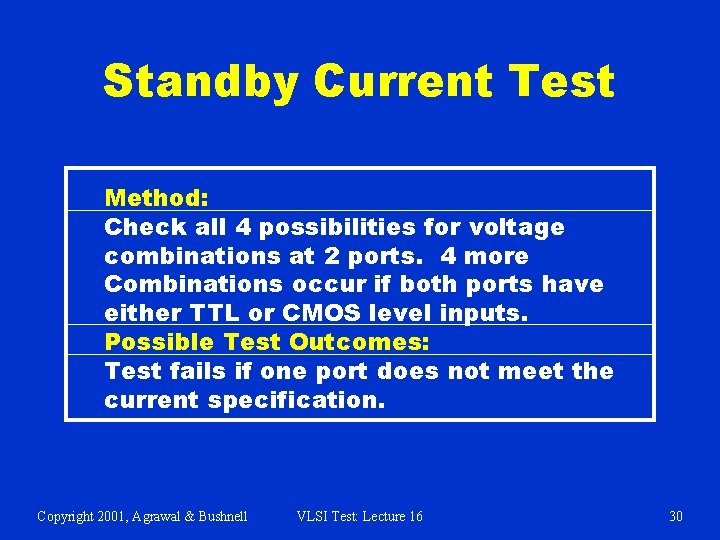
Standby Current Test Method: Check all 4 possibilities for voltage combinations at 2 ports. 4 more Combinations occur if both ports have either TTL or CMOS level inputs. Possible Test Outcomes: Test fails if one port does not meet the current specification. Copyright 2001, Agrawal & Bushnell VLSI Test: Lecture 16 30
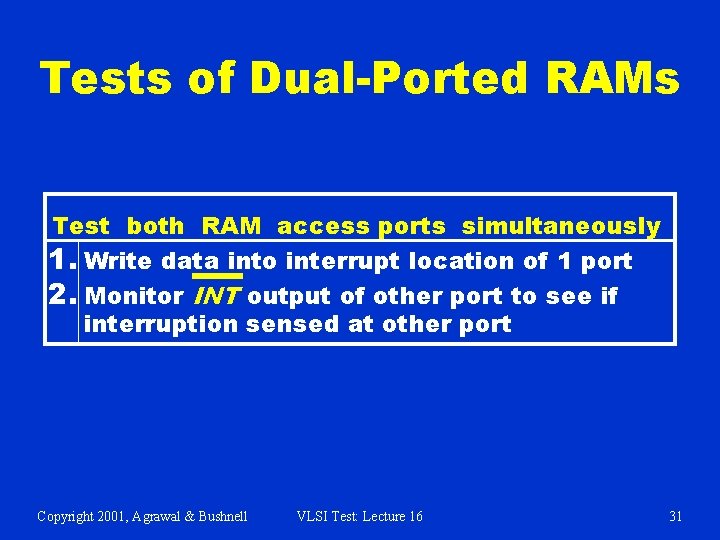
Tests of Dual-Ported RAMs Test both RAM access ports simultaneously 1. Write data into interrupt location of 1 port 2. Monitor INT output of other port to see if interruption sensed at other port Copyright 2001, Agrawal & Bushnell VLSI Test: Lecture 16 31
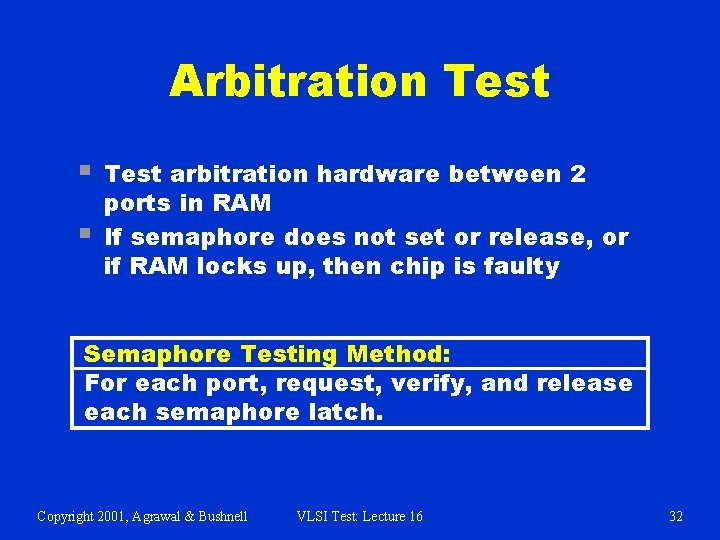
Arbitration Test § § Test arbitration hardware between 2 ports in RAM If semaphore does not set or release, or if RAM locks up, then chip is faulty Semaphore Testing Method: For each port, request, verify, and release each semaphore latch. Copyright 2001, Agrawal & Bushnell VLSI Test: Lecture 16 32
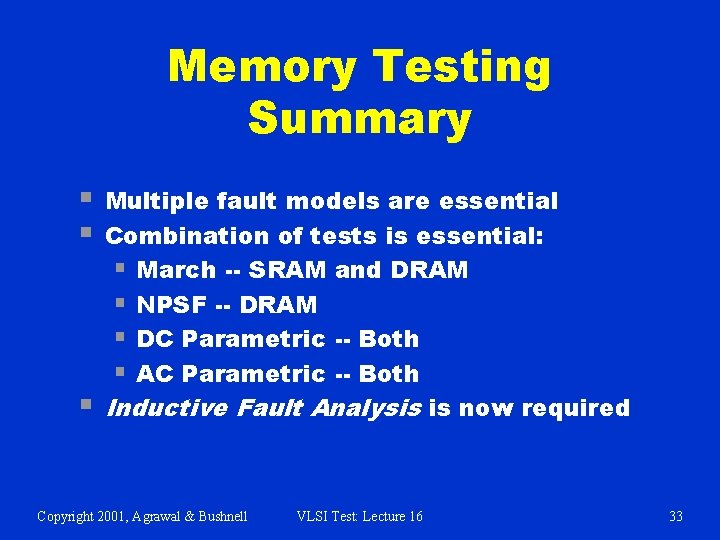
Memory Testing Summary § § § Multiple fault models are essential Combination of tests is essential: § March -- SRAM and DRAM § NPSF -- DRAM § DC Parametric -- Both § AC Parametric -- Both Inductive Fault Analysis is now required Copyright 2001, Agrawal & Bushnell VLSI Test: Lecture 16 33