
Lecture 16 Paging and Segmentation Operating System Concepts
- Slides: 64
Lecture 16 Paging and Segmentation Operating System Concepts – 10 th Edition Silberschatz, Galvin and Gagne © 2018
Outline 1. Paging • • The Scheme, Address Translation Hardware support Shared Pages Advanced Topics 2. Swapping 3. Segmentation • The Scheme, Address Translation • Segmentation with Paging in Intel Pentium Operating System Concepts – 10 th Edition 2. 2 Silberschatz, Galvin and Gagne © 2018
Outline KEYWORDS: Paging, Frames, Page Table, Shared Pages, Segmentation table, Offset, swapping. § HOMEWORK: 1) Reading : Chapter 9, especially the summary. 2) Make sure to understand be able to explain every keyword from the list here and the ones which are printed bold in the text book. 3) Important Questions: • Describe the page-to-frame translation. List advantages of paging. • How does fragmentation for segmentation differ from that in paging? • Consider a logical address space of eight pages of 1024 words each, mapped onto a physical memory of 32 frames. 4 a. How many bits are there in the logical address? 4 b. How many bits are there in the physical address? Operating System Concepts – 10 th Edition 2. 3 Silberschatz, Galvin and Gagne © 2018
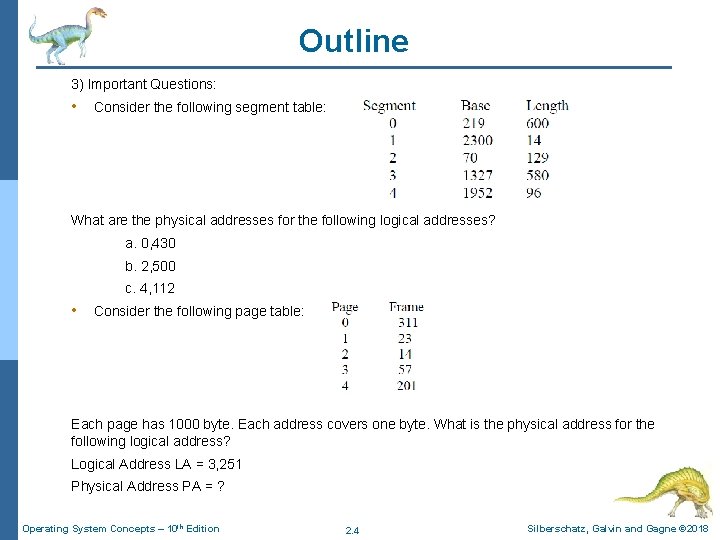
Outline 3) Important Questions: • Consider the following segment table: What are the physical addresses for the following logical addresses? a. 0, 430 b. 2, 500 c. 4, 112 • Consider the following page table: Each page has 1000 byte. Each address covers one byte. What is the physical address for the following logical address? Logical Address LA = 3, 251 Physical Address PA = ? Operating System Concepts – 10 th Edition 2. 4 Silberschatz, Galvin and Gagne © 2018
Outline 1. Paging • • The Scheme, Address Translation Hardware support Shared Pages Advanced Topics 2. Swapping 3. Segmentation • The Scheme, Address Translation • Segmentation with Paging in Intel Pentium Operating System Concepts – 10 th Edition 2. 5 Silberschatz, Galvin and Gagne © 2018
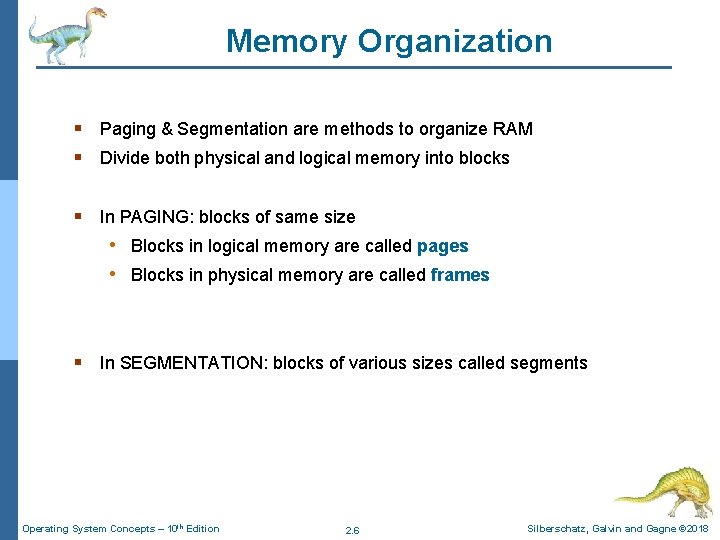
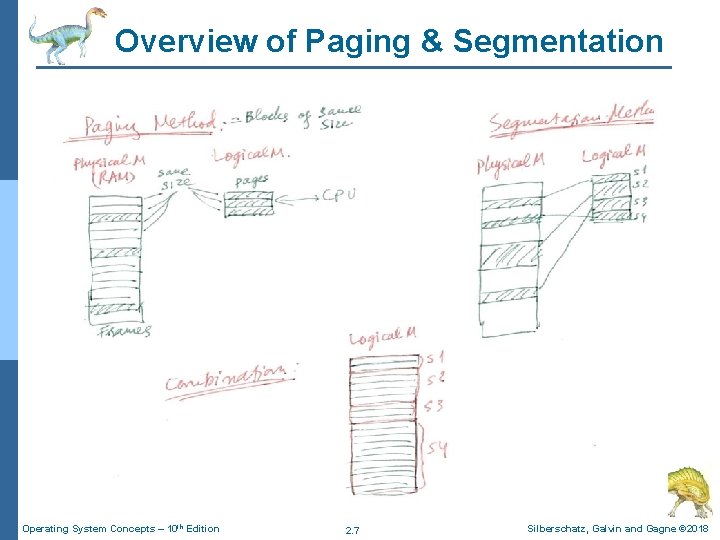
Memory Organization § Paging & Segmentation are methods to organize RAM § Divide both physical and logical memory into blocks § In PAGING: blocks of same size • Blocks in logical memory are called pages • Blocks in physical memory are called frames § In SEGMENTATION: blocks of various sizes called segments Operating System Concepts – 10 th Edition 2. 6 Silberschatz, Galvin and Gagne © 2018
Overview of Paging & Segmentation Operating System Concepts – 10 th Edition 2. 7 Silberschatz, Galvin and Gagne © 2018
Outline 1. Paging • • The Scheme, Address Translation Hardware support Shared Pages Advanced Topics 2. Swapping 3. Segmentation • The Scheme, Address Translation • Segmentation with Paging in Intel Pentium Operating System Concepts – 10 th Edition 2. 8 Silberschatz, Galvin and Gagne © 2018
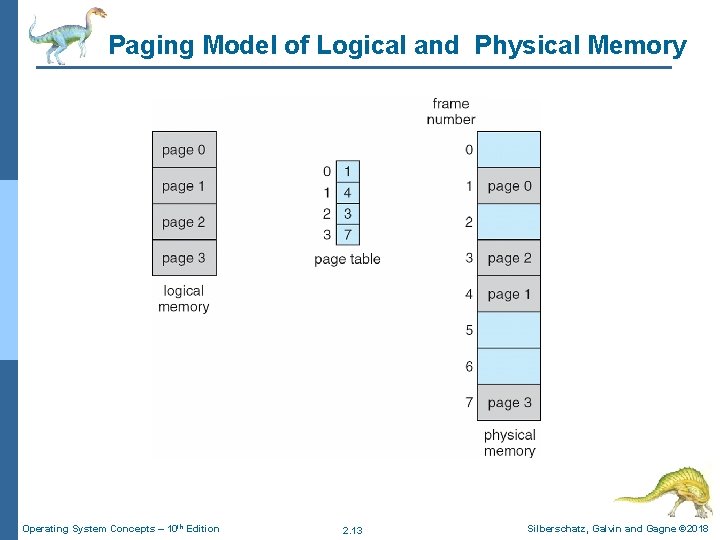
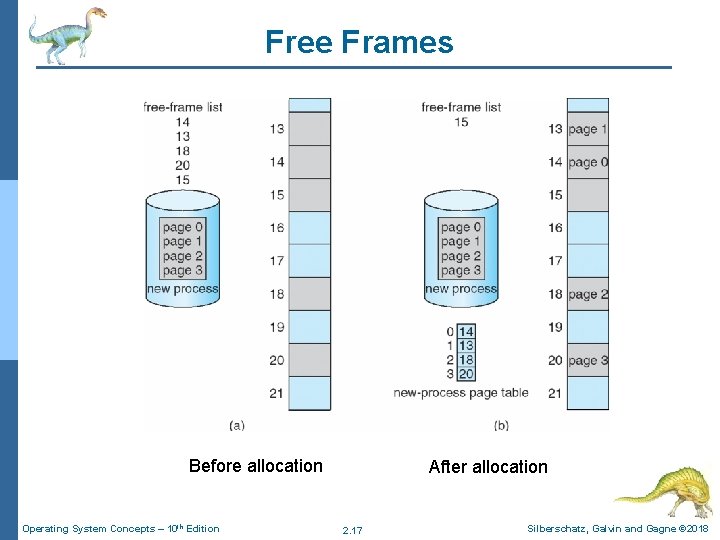
Paging § Physical address space of a process can be noncontiguous; process is allocated physical memory whenever the latter is available • Avoids external fragmentation • Avoids problem of varying sized memory chunks § Divide physical memory into fixed-sized blocks called frames • Size is power of 2, between 512 bytes and 16 Mbytes § Divide logical memory into blocks of same size called pages § Keep track of all free frames § To run a program of size N pages, need to find N free frames and load program § Set up a page table to translate logical to physical addresses § Backing store likewise split into pages § Still have Internal fragmentation Operating System Concepts – 10 th Edition 2. 9 Silberschatz, Galvin and Gagne © 2018
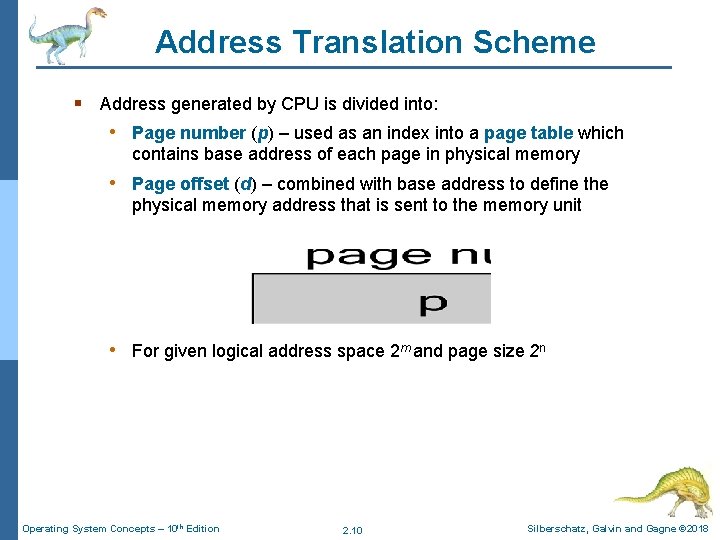
Address Translation Scheme § Address generated by CPU is divided into: • Page number (p) – used as an index into a page table which contains base address of each page in physical memory • Page offset (d) – combined with base address to define the physical memory address that is sent to the memory unit • For given logical address space 2 m and page size 2 n Operating System Concepts – 10 th Edition 2. 10 Silberschatz, Galvin and Gagne © 2018
Outline 1. Paging • • The Scheme, Address Translation Hardware support Shared Pages Advanced Topics 2. Swapping 3. Segmentation • The Scheme, Address Translation • Segmentation with Paging in Intel Pentium Operating System Concepts – 10 th Edition 2. 11 Silberschatz, Galvin and Gagne © 2018
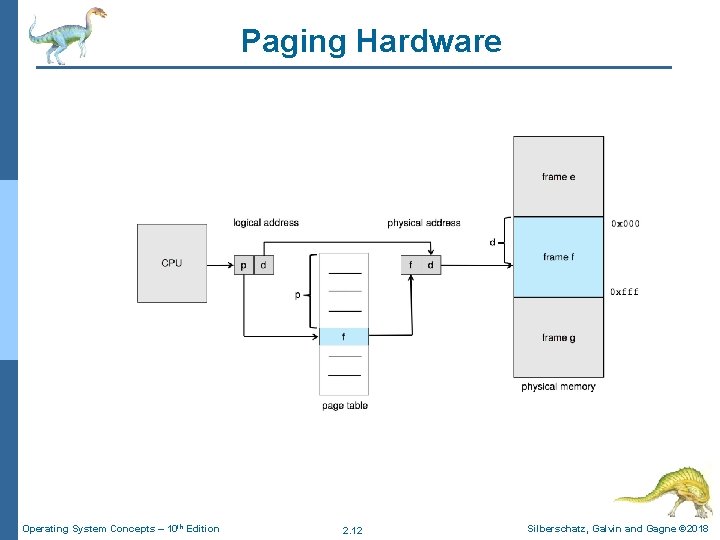
Paging Hardware Operating System Concepts – 10 th Edition 2. 12 Silberschatz, Galvin and Gagne © 2018
Paging Model of Logical and Physical Memory Operating System Concepts – 10 th Edition 2. 13 Silberschatz, Galvin and Gagne © 2018
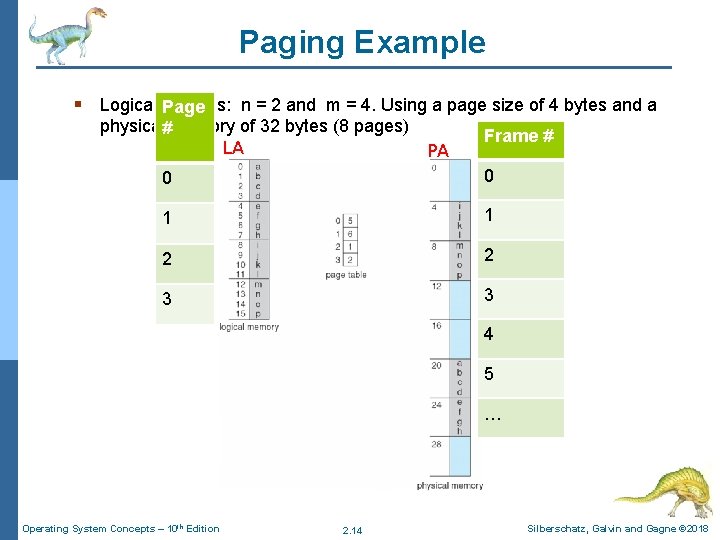
Paging Example § Logical address: n = 2 and m = 4. Using a page size of 4 bytes and a Page physical#memory of 32 bytes (8 pages) LA PA Frame # 0 0 1 1 2 2 3 3 4 5 … Operating System Concepts – 10 th Edition 2. 14 Silberschatz, Galvin and Gagne © 2018
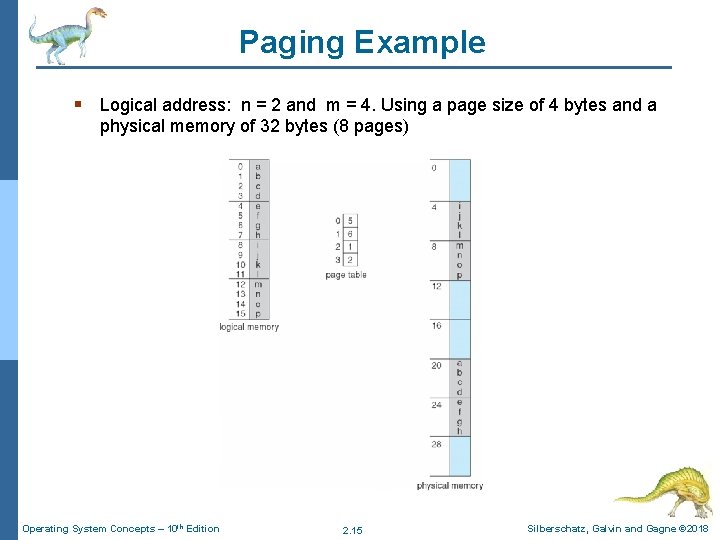
Paging Example § Logical address: n = 2 and m = 4. Using a page size of 4 bytes and a physical memory of 32 bytes (8 pages) Operating System Concepts – 10 th Edition 2. 15 Silberschatz, Galvin and Gagne © 2018
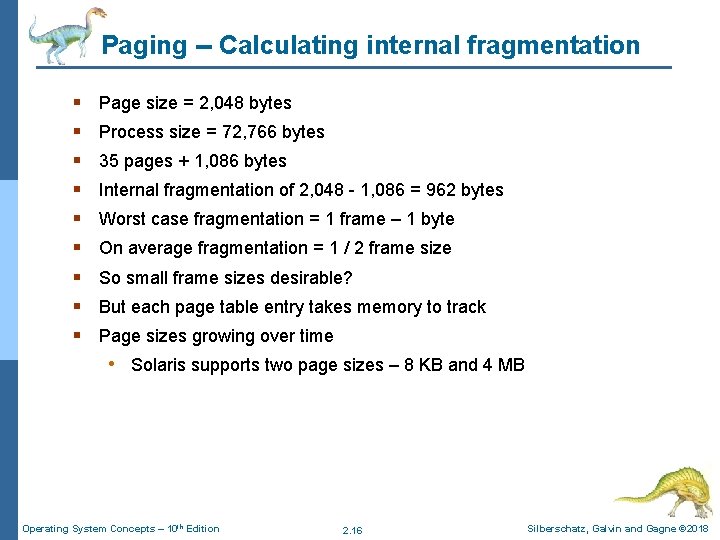
Paging -- Calculating internal fragmentation § § § § § Page size = 2, 048 bytes Process size = 72, 766 bytes 35 pages + 1, 086 bytes Internal fragmentation of 2, 048 - 1, 086 = 962 bytes Worst case fragmentation = 1 frame – 1 byte On average fragmentation = 1 / 2 frame size So small frame sizes desirable? But each page table entry takes memory to track Page sizes growing over time • Solaris supports two page sizes – 8 KB and 4 MB Operating System Concepts – 10 th Edition 2. 16 Silberschatz, Galvin and Gagne © 2018
Free Frames Before allocation Operating System Concepts – 10 th Edition After allocation 2. 17 Silberschatz, Galvin and Gagne © 2018
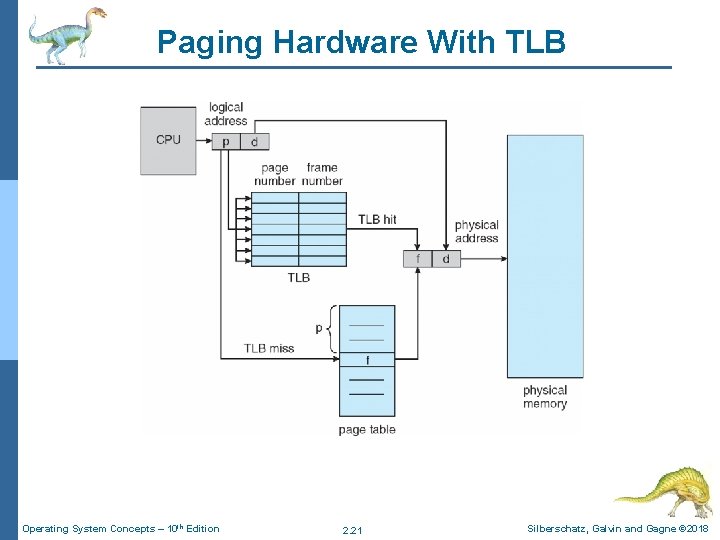
Implementation of Page Table § Page table is kept in main memory • Page-table base register (PTBR) points to the page table • Page-table length register (PTLR) indicates size of the page table § In this scheme every data/instruction access requires two memory accesses • One for the page table and one for the data / instruction § The two-memory access problem can be solved by the use of a special fast-lookup hardware cache called translation look-aside buffers (TLBs) (also called associative memory). Operating System Concepts – 10 th Edition 2. 18 Silberschatz, Galvin and Gagne © 2018
Translation Look-Aside Buffer § Some TLBs store address-space identifiers (ASIDs) in each TLB entry – uniquely identifies each process to provide addressspace protection for that process • Otherwise need to flush at every context switch § TLBs typically small (64 to 1, 024 entries) § On a TLB miss, value is loaded into the TLB for faster access next time • Replacement policies must be considered • Some entries can be wired down for permanent fast access Operating System Concepts – 10 th Edition 2. 19 Silberschatz, Galvin and Gagne © 2018
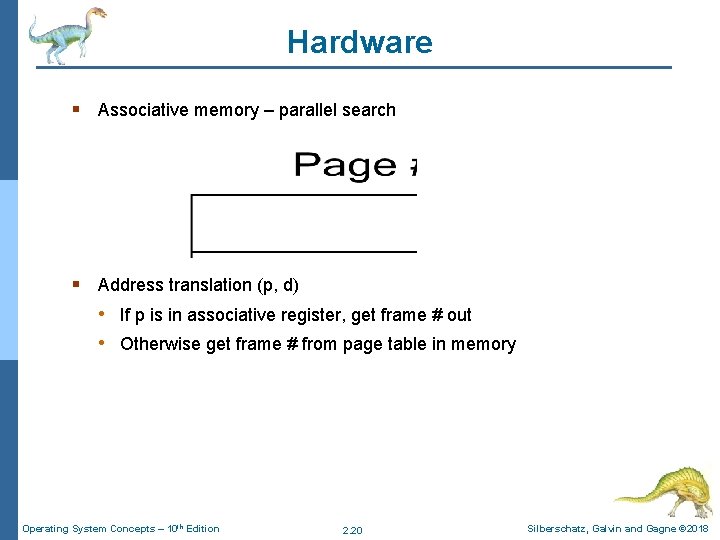
Hardware § Associative memory – parallel search § Address translation (p, d) • If p is in associative register, get frame # out • Otherwise get frame # from page table in memory Operating System Concepts – 10 th Edition 2. 20 Silberschatz, Galvin and Gagne © 2018
Paging Hardware With TLB Operating System Concepts – 10 th Edition 2. 21 Silberschatz, Galvin and Gagne © 2018
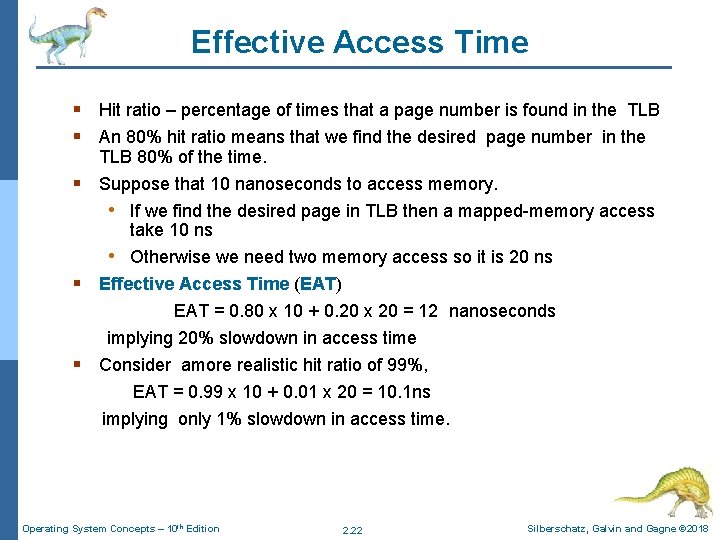
Effective Access Time § Hit ratio – percentage of times that a page number is found in the TLB § An 80% hit ratio means that we find the desired page number in the TLB 80% of the time. § Suppose that 10 nanoseconds to access memory. • If we find the desired page in TLB then a mapped-memory access take 10 ns • Otherwise we need two memory access so it is 20 ns § Effective Access Time (EAT) EAT = 0. 80 x 10 + 0. 20 x 20 = 12 nanoseconds implying 20% slowdown in access time § Consider amore realistic hit ratio of 99%, EAT = 0. 99 x 10 + 0. 01 x 20 = 10. 1 ns implying only 1% slowdown in access time. Operating System Concepts – 10 th Edition 2. 22 Silberschatz, Galvin and Gagne © 2018
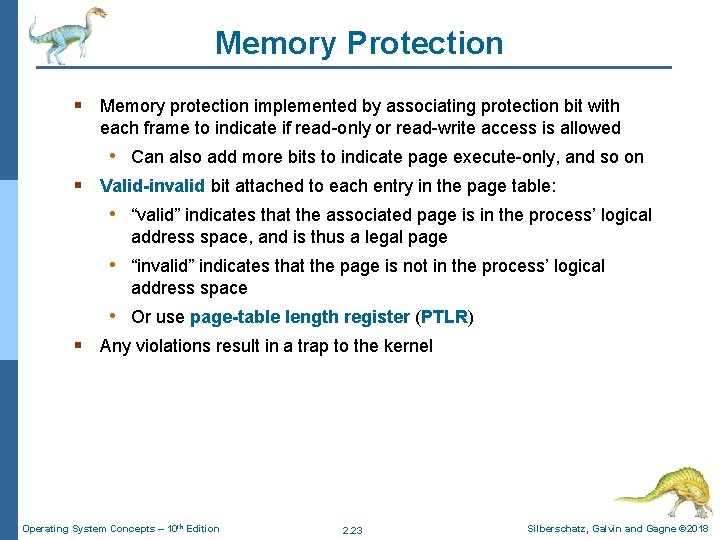
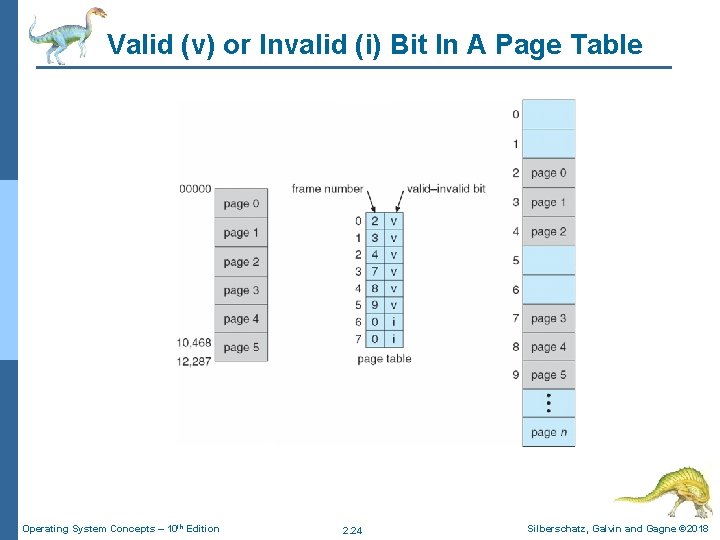
Memory Protection § Memory protection implemented by associating protection bit with each frame to indicate if read-only or read-write access is allowed • Can also add more bits to indicate page execute-only, and so on § Valid-invalid bit attached to each entry in the page table: • “valid” indicates that the associated page is in the process’ logical address space, and is thus a legal page • “invalid” indicates that the page is not in the process’ logical address space • Or use page-table length register (PTLR) § Any violations result in a trap to the kernel Operating System Concepts – 10 th Edition 2. 23 Silberschatz, Galvin and Gagne © 2018
Valid (v) or Invalid (i) Bit In A Page Table Operating System Concepts – 10 th Edition 2. 24 Silberschatz, Galvin and Gagne © 2018
Outline 1. Paging • • The Scheme, Address Translation Hardware support Shared Pages Advanced Topics 2. Swapping 3. Segmentation • The Scheme, Address Translation • Segmentation with Paging in Intel Pentium Operating System Concepts – 10 th Edition 2. 25 Silberschatz, Galvin and Gagne © 2018
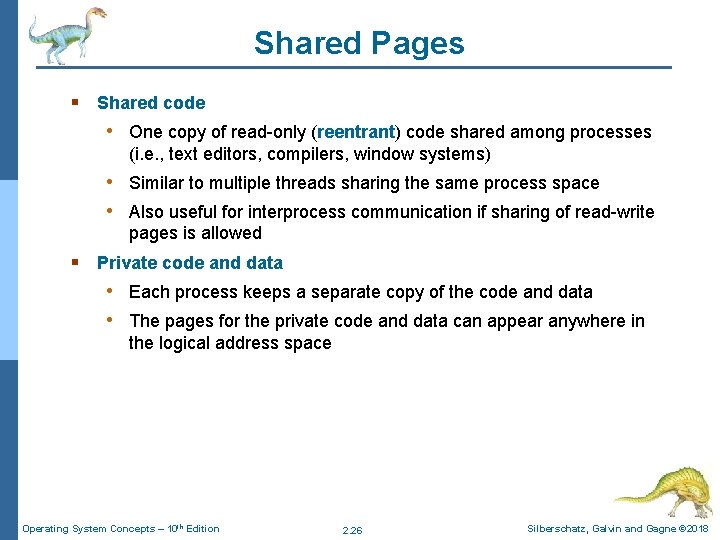
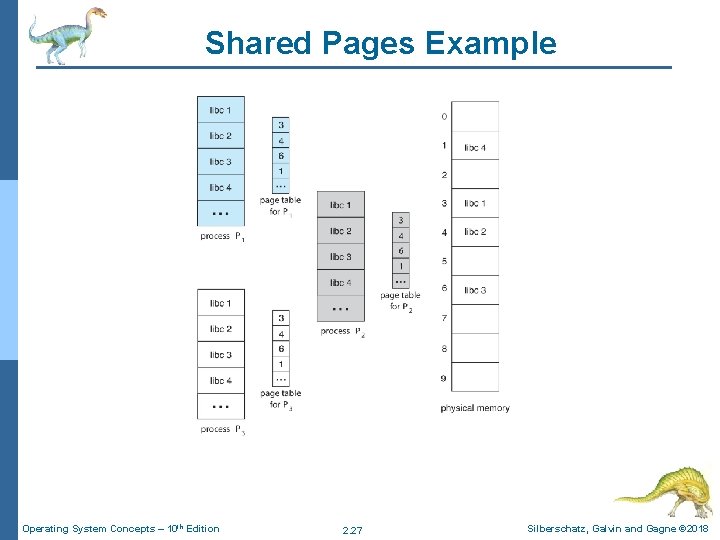
Shared Pages § Shared code • One copy of read-only (reentrant) code shared among processes (i. e. , text editors, compilers, window systems) • Similar to multiple threads sharing the same process space • Also useful for interprocess communication if sharing of read-write pages is allowed § Private code and data • Each process keeps a separate copy of the code and data • The pages for the private code and data can appear anywhere in the logical address space Operating System Concepts – 10 th Edition 2. 26 Silberschatz, Galvin and Gagne © 2018
Shared Pages Example Operating System Concepts – 10 th Edition 2. 27 Silberschatz, Galvin and Gagne © 2018
Outline 1. Paging • • The Scheme, Address Translation Hardware support Shared Pages Advanced Topics 2. Swapping 3. Segmentation • The Scheme, Address Translation • Segmentation with Paging in Intel Pentium Operating System Concepts – 10 th Edition 2. 28 Silberschatz, Galvin and Gagne © 2018
Structure of the Page Table § Memory structures for paging can get huge using straight-forward methods • • Consider a 32 -bit logical address space as on modern computers Page size of 4 KB (212) Page table would have 1 million entries (232 / 212) If each entry is 4 bytes each process 4 MB of physical address space for the page table alone 4 Don’t want to allocate that contiguously in main memory • One simple solution is to divide the page table into smaller units 4 Hierarchical Paging 4 Hashed Page Tables 4 Inverted Page Tables Operating System Concepts – 10 th Edition 2. 29 Silberschatz, Galvin and Gagne © 2018
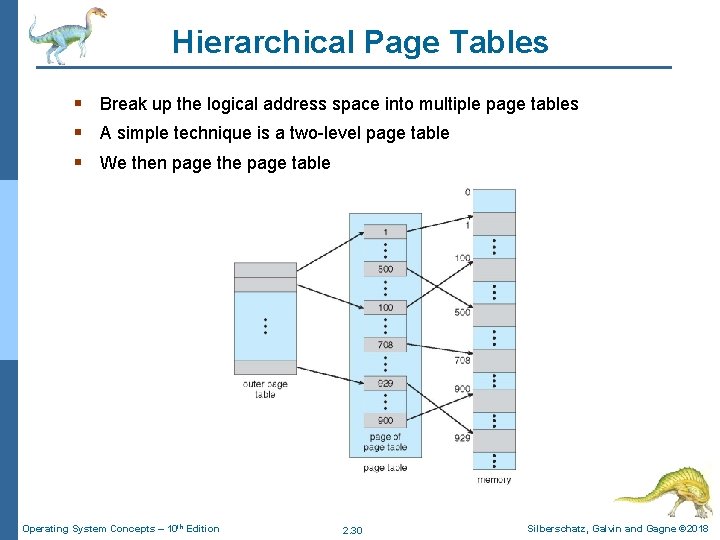
Hierarchical Page Tables § Break up the logical address space into multiple page tables § A simple technique is a two-level page table § We then page the page table Operating System Concepts – 10 th Edition 2. 30 Silberschatz, Galvin and Gagne © 2018
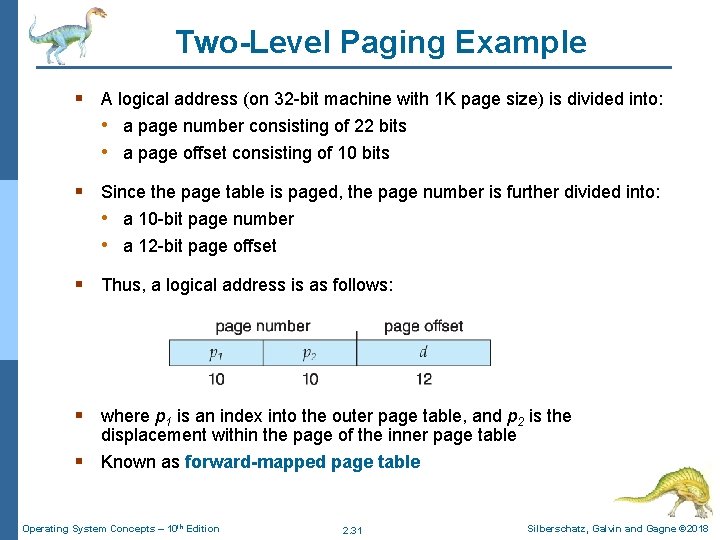
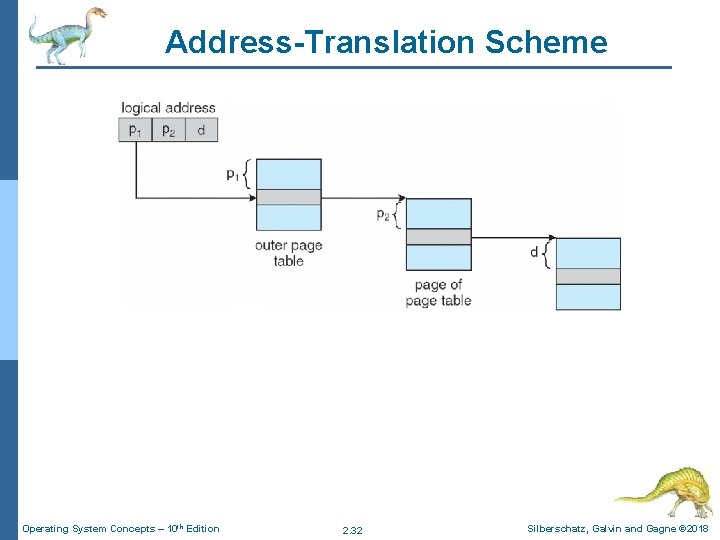
Two-Level Paging Example § A logical address (on 32 -bit machine with 1 K page size) is divided into: • a page number consisting of 22 bits • a page offset consisting of 10 bits § Since the page table is paged, the page number is further divided into: • a 10 -bit page number • a 12 -bit page offset § Thus, a logical address is as follows: § where p 1 is an index into the outer page table, and p 2 is the displacement within the page of the inner page table § Known as forward-mapped page table Operating System Concepts – 10 th Edition 2. 31 Silberschatz, Galvin and Gagne © 2018
Address-Translation Scheme Operating System Concepts – 10 th Edition 2. 32 Silberschatz, Galvin and Gagne © 2018
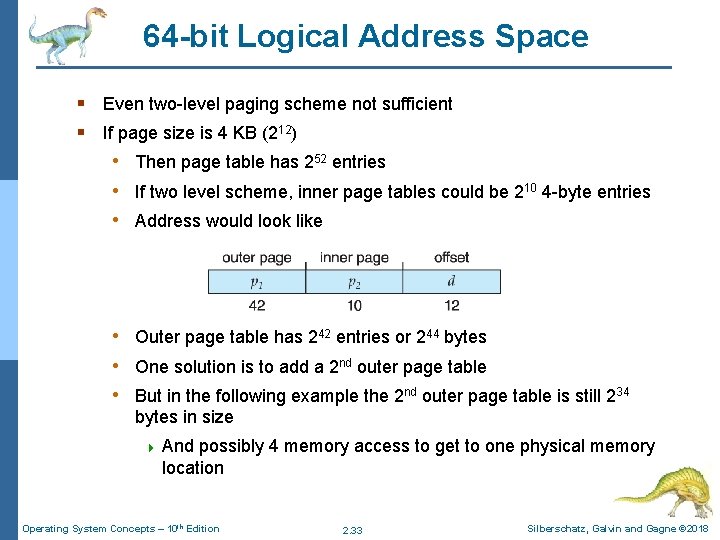
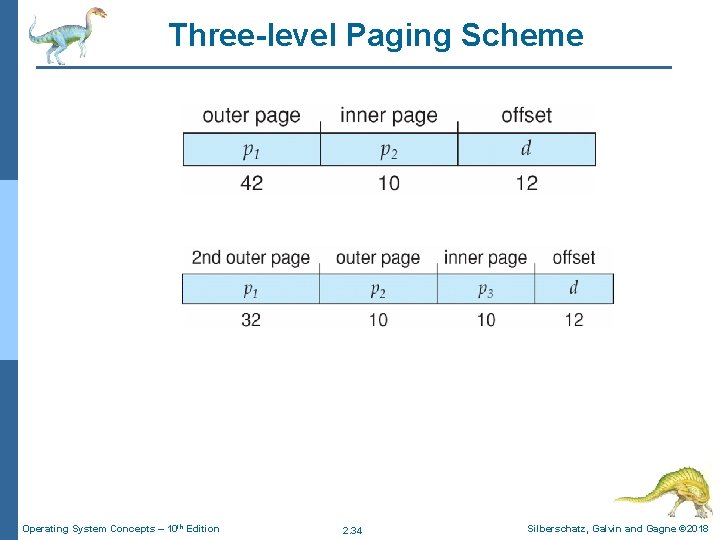
64 -bit Logical Address Space § Even two-level paging scheme not sufficient § If page size is 4 KB (212) • Then page table has 252 entries • If two level scheme, inner page tables could be 210 4 -byte entries • Address would look like • Outer page table has 242 entries or 244 bytes • One solution is to add a 2 nd outer page table • But in the following example the 2 nd outer page table is still 234 bytes in size 4 And possibly 4 memory access to get to one physical memory location Operating System Concepts – 10 th Edition 2. 33 Silberschatz, Galvin and Gagne © 2018
Three-level Paging Scheme Operating System Concepts – 10 th Edition 2. 34 Silberschatz, Galvin and Gagne © 2018
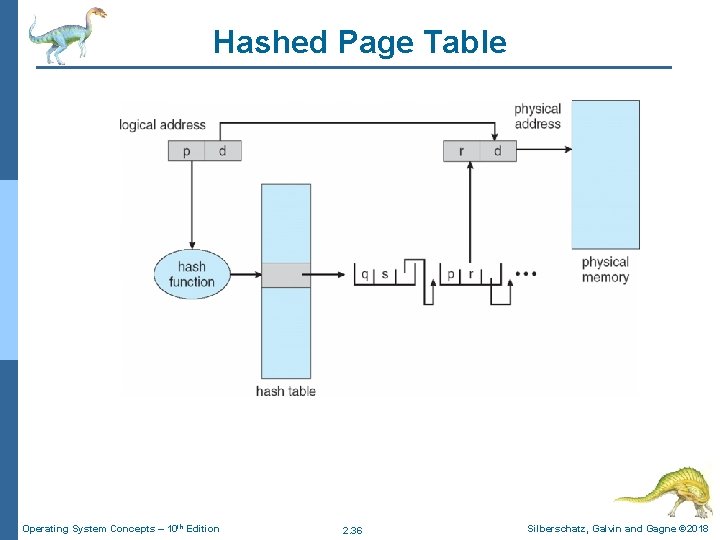
Hashed Page Tables § Common in address spaces > 32 bits § The virtual page number is hashed into a page table • This page table contains a chain of elements hashing to the same location § Each element contains (1) the virtual page number (2) the value of the mapped page frame (3) a pointer to the next element § Virtual page numbers are compared in this chain searching for a match • If a match is found, the corresponding physical frame is extracted § Variation for 64 -bit addresses is clustered page tables • Similar to hashed but each entry refers to several pages (such as 16) rather than 1 • Especially useful for sparse address spaces (where memory references are non-contiguous and scattered) Operating System Concepts – 10 th Edition 2. 35 Silberschatz, Galvin and Gagne © 2018
Hashed Page Table Operating System Concepts – 10 th Edition 2. 36 Silberschatz, Galvin and Gagne © 2018
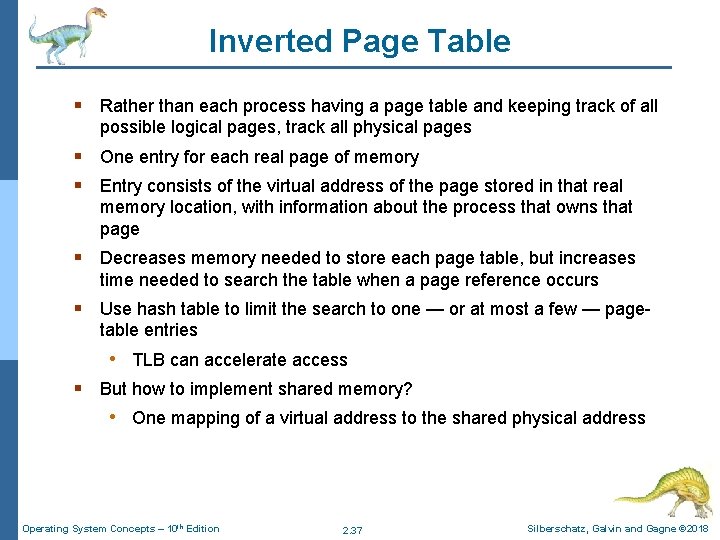
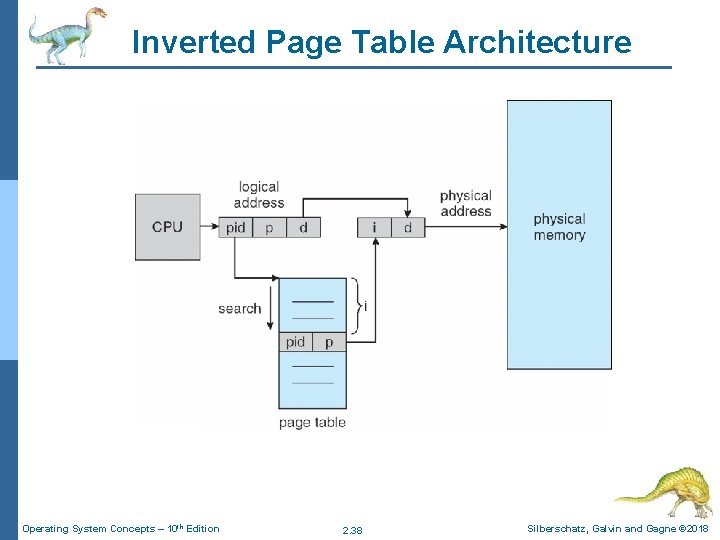
Inverted Page Table § Rather than each process having a page table and keeping track of all possible logical pages, track all physical pages § One entry for each real page of memory § Entry consists of the virtual address of the page stored in that real memory location, with information about the process that owns that page § Decreases memory needed to store each page table, but increases time needed to search the table when a page reference occurs § Use hash table to limit the search to one — or at most a few — pagetable entries • TLB can accelerate access § But how to implement shared memory? • One mapping of a virtual address to the shared physical address Operating System Concepts – 10 th Edition 2. 37 Silberschatz, Galvin and Gagne © 2018
Inverted Page Table Architecture Operating System Concepts – 10 th Edition 2. 38 Silberschatz, Galvin and Gagne © 2018
Outline 1. Paging • • The Scheme, Address Translation Hardware support Shared Pages Advanced Topics 2. Swapping 3. Segmentation • The Scheme, Address Translation • Segmentation with Paging in Intel Pentium Operating System Concepts – 10 th Edition 2. 39 Silberschatz, Galvin and Gagne © 2018
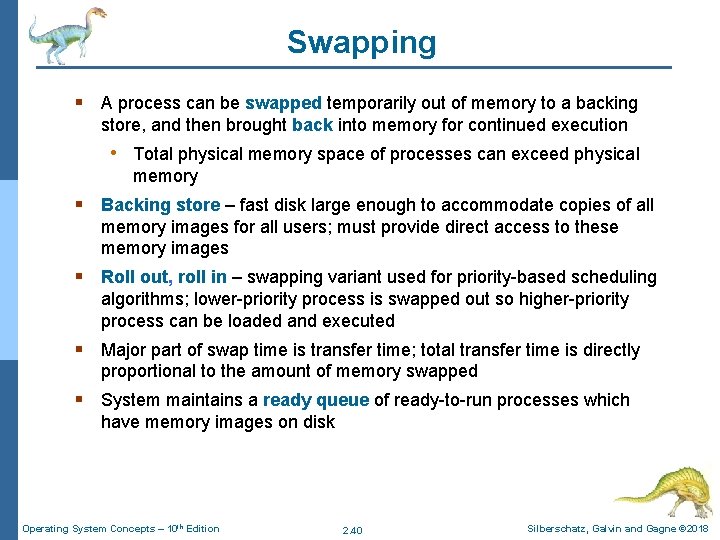
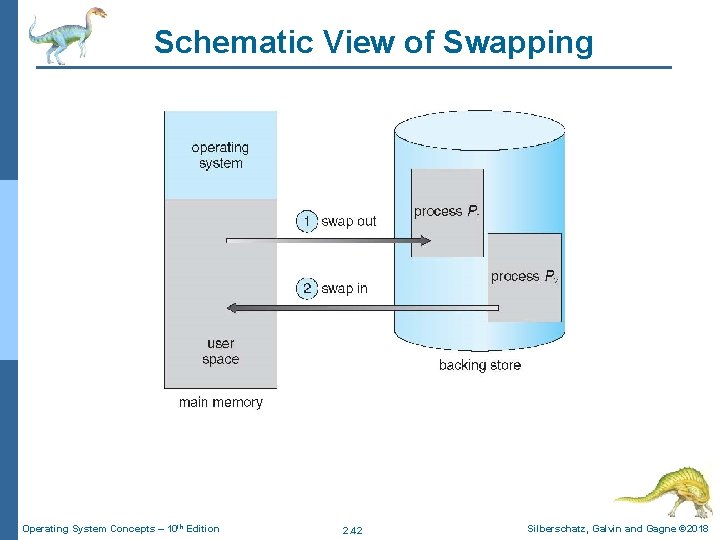
Swapping § A process can be swapped temporarily out of memory to a backing store, and then brought back into memory for continued execution • Total physical memory space of processes can exceed physical memory § Backing store – fast disk large enough to accommodate copies of all memory images for all users; must provide direct access to these memory images § Roll out, roll in – swapping variant used for priority-based scheduling algorithms; lower-priority process is swapped out so higher-priority process can be loaded and executed § Major part of swap time is transfer time; total transfer time is directly proportional to the amount of memory swapped § System maintains a ready queue of ready-to-run processes which have memory images on disk Operating System Concepts – 10 th Edition 2. 40 Silberschatz, Galvin and Gagne © 2018
Swapping (Cont. ) § Does the swapped out process need to swap back in to same physical addresses? § Depends on address binding method • Plus consider pending I/O to / from process memory space § Modified versions of swapping are found on many systems (i. e. , UNIX, Linux, and Windows) • Swapping normally disabled • Started if more than threshold amount of memory allocated • Disabled again once memory demand reduced below threshold Operating System Concepts – 10 th Edition 2. 41 Silberschatz, Galvin and Gagne © 2018
Schematic View of Swapping Operating System Concepts – 10 th Edition 2. 42 Silberschatz, Galvin and Gagne © 2018
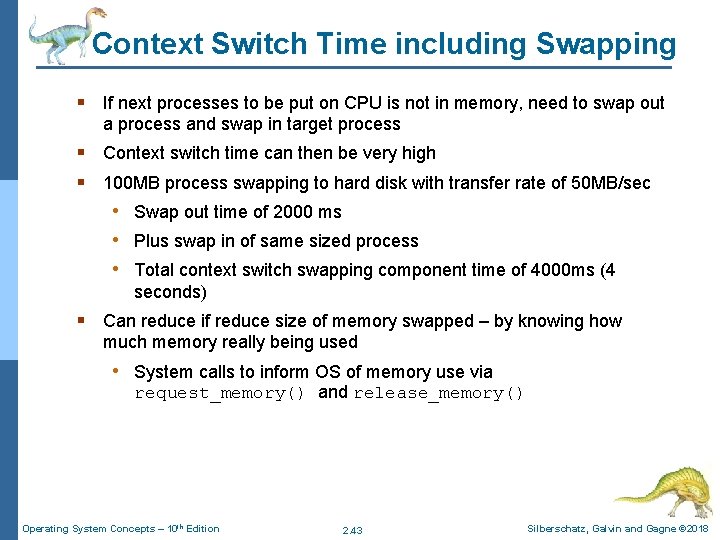
Context Switch Time including Swapping § If next processes to be put on CPU is not in memory, need to swap out a process and swap in target process § Context switch time can then be very high § 100 MB process swapping to hard disk with transfer rate of 50 MB/sec • Swap out time of 2000 ms • Plus swap in of same sized process • Total context switch swapping component time of 4000 ms (4 seconds) § Can reduce if reduce size of memory swapped – by knowing how much memory really being used • System calls to inform OS of memory use via request_memory() and release_memory() Operating System Concepts – 10 th Edition 2. 43 Silberschatz, Galvin and Gagne © 2018
Context Switch Time and Swapping (Cont. ) § Other constraints as well on swapping • Pending I/O – can’t swap out as I/O would occur to wrong process • Or always transfer I/O to kernel space, then to I/O device 4 Known as double buffering, adds overhead § Standard swapping not used in modern operating systems • But modified version common 4 Swap only when free memory extremely low Operating System Concepts – 10 th Edition 2. 44 Silberschatz, Galvin and Gagne © 2018
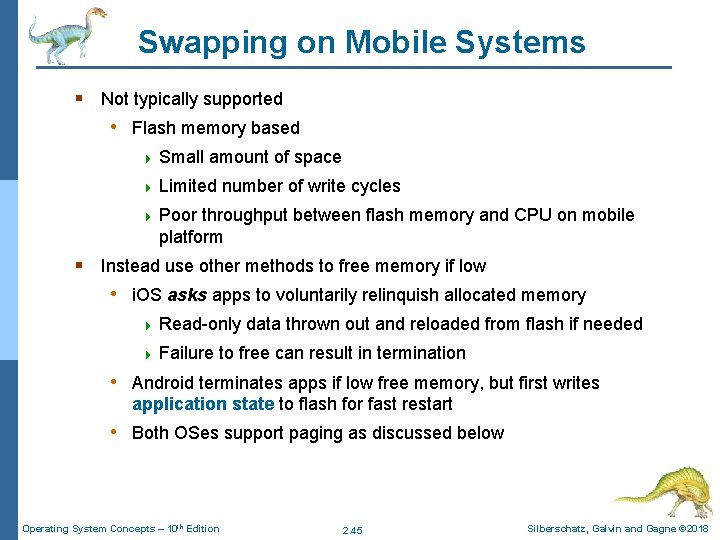
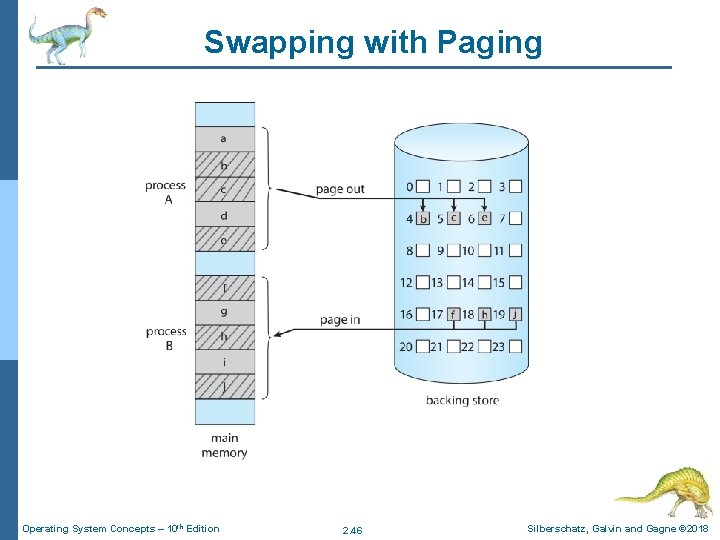
Swapping on Mobile Systems § Not typically supported • Flash memory based 4 Small amount of space 4 Limited number of write cycles 4 Poor throughput between flash memory and CPU on mobile platform § Instead use other methods to free memory if low • i. OS asks apps to voluntarily relinquish allocated memory 4 Read-only 4 Failure data thrown out and reloaded from flash if needed to free can result in termination • Android terminates apps if low free memory, but first writes application state to flash for fast restart • Both OSes support paging as discussed below Operating System Concepts – 10 th Edition 2. 45 Silberschatz, Galvin and Gagne © 2018
Swapping with Paging Operating System Concepts – 10 th Edition 2. 46 Silberschatz, Galvin and Gagne © 2018
Outline 1. Paging • • The Scheme, Address Translation Hardware support Shared Pages Advanced Topics 2. Swapping 3. Segmentation • The Scheme, Address Translation • Segmentation with Paging in Intel Pentium Operating System Concepts – 10 th Edition 2. 47 Silberschatz, Galvin and Gagne © 2018
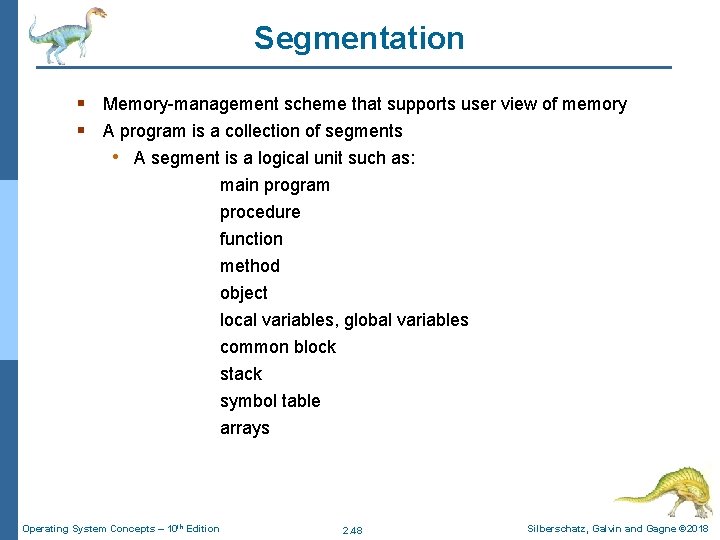
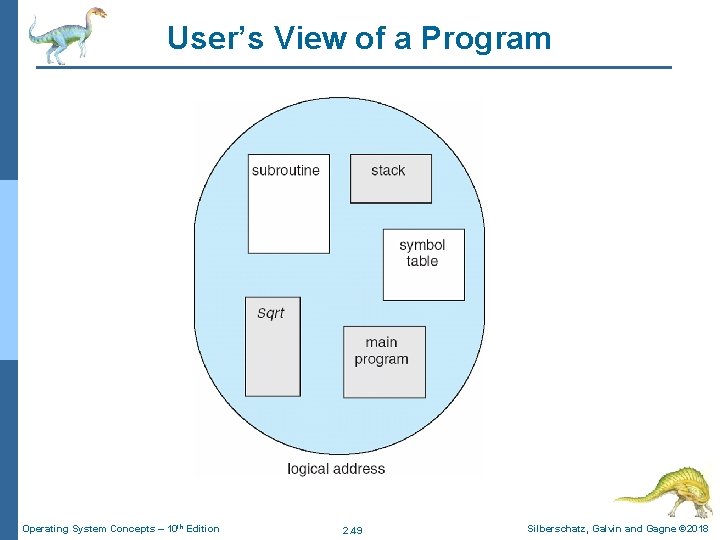
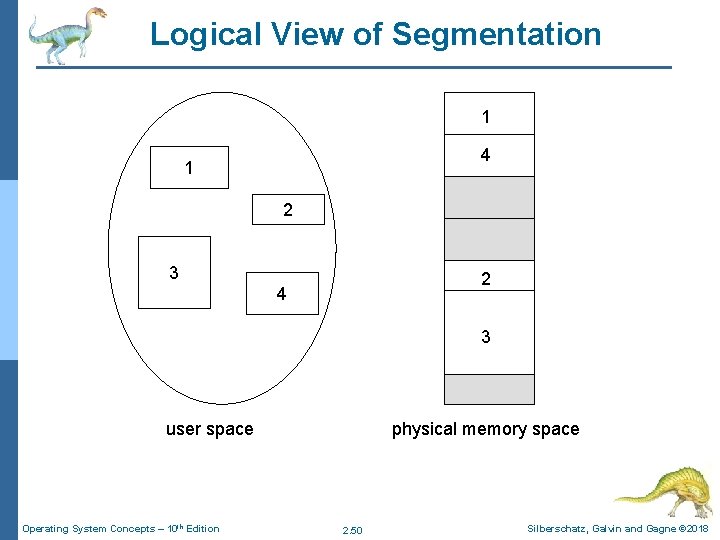
Segmentation § Memory-management scheme that supports user view of memory § A program is a collection of segments • A segment is a logical unit such as: main program procedure function method object local variables, global variables common block stack symbol table arrays Operating System Concepts – 10 th Edition 2. 48 Silberschatz, Galvin and Gagne © 2018
User’s View of a Program Operating System Concepts – 10 th Edition 2. 49 Silberschatz, Galvin and Gagne © 2018
Logical View of Segmentation 1 4 1 2 3 2 4 3 user space Operating System Concepts – 10 th Edition physical memory space 2. 50 Silberschatz, Galvin and Gagne © 2018
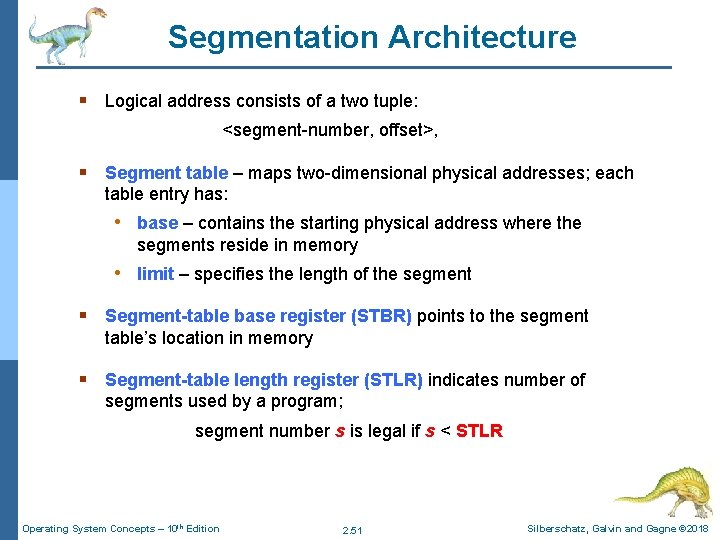
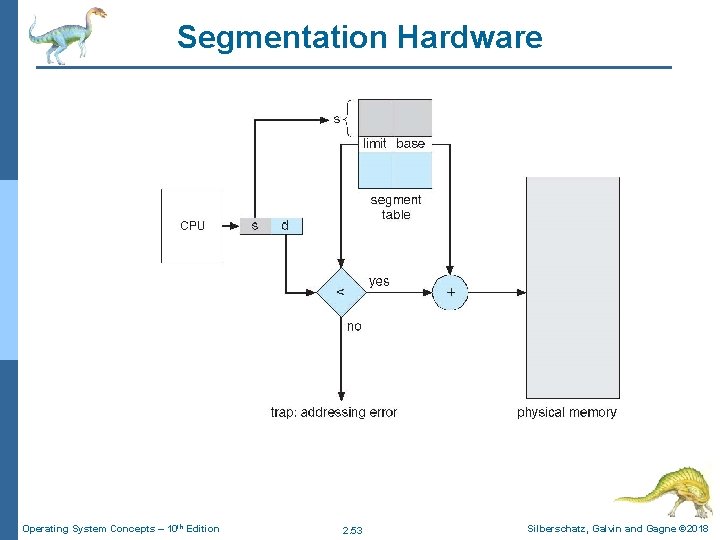
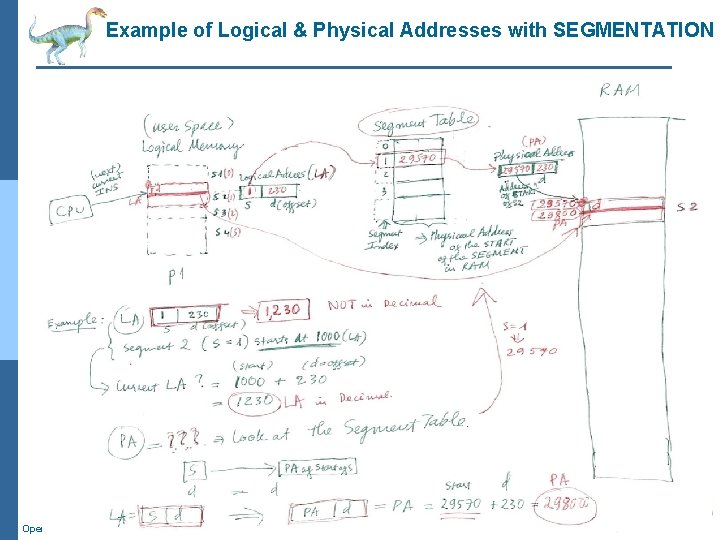
Segmentation Architecture § Logical address consists of a two tuple: <segment-number, offset>, § Segment table – maps two-dimensional physical addresses; each table entry has: • base – contains the starting physical address where the segments reside in memory • limit – specifies the length of the segment § Segment-table base register (STBR) points to the segment table’s location in memory § Segment-table length register (STLR) indicates number of segments used by a program; segment number s is legal if s < STLR Operating System Concepts – 10 th Edition 2. 51 Silberschatz, Galvin and Gagne © 2018
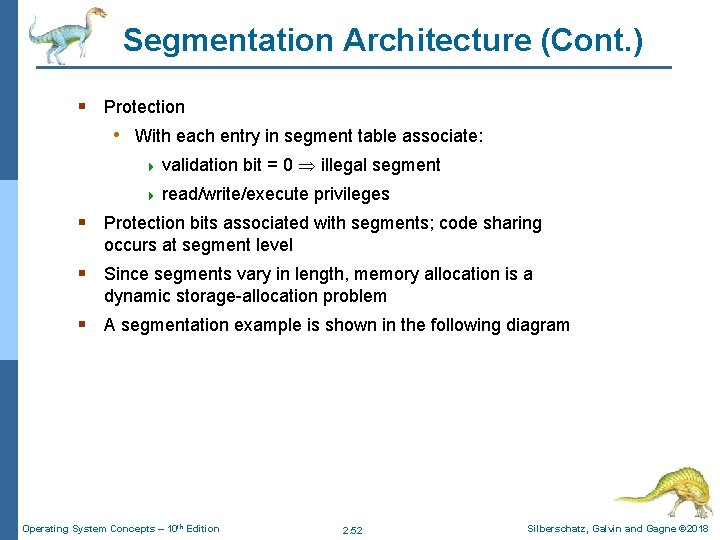
Segmentation Architecture (Cont. ) § Protection • With each entry in segment table associate: 4 validation bit = 0 illegal segment 4 read/write/execute privileges § Protection bits associated with segments; code sharing occurs at segment level § Since segments vary in length, memory allocation is a dynamic storage-allocation problem § A segmentation example is shown in the following diagram Operating System Concepts – 10 th Edition 2. 52 Silberschatz, Galvin and Gagne © 2018
Segmentation Hardware Operating System Concepts – 10 th Edition 2. 53 Silberschatz, Galvin and Gagne © 2018
Example of Logical & Physical Addresses with SEGMENTATION Operating System Concepts – 10 th Edition 2. 54 Silberschatz, Galvin and Gagne © 2018
Outline 1. Paging • • The Scheme, Address Translation Hardware support Shared Pages Advanced Topics 2. Swapping 3. Segmentation • The Scheme, Address Translation • Segmentation with Paging in Intel Pentium Operating System Concepts – 10 th Edition 2. 55 Silberschatz, Galvin and Gagne © 2018
Example: The Intel 32 and 64 -bit Architectures § § Dominant industry chips Pentium CPUs are 32 -bit and called IA-32 architecture Current Intel CPUs are 64 -bit and called IA-64 architecture Many variations in the chips, cover the main ideas here Operating System Concepts – 10 th Edition 2. 56 Silberschatz, Galvin and Gagne © 2018
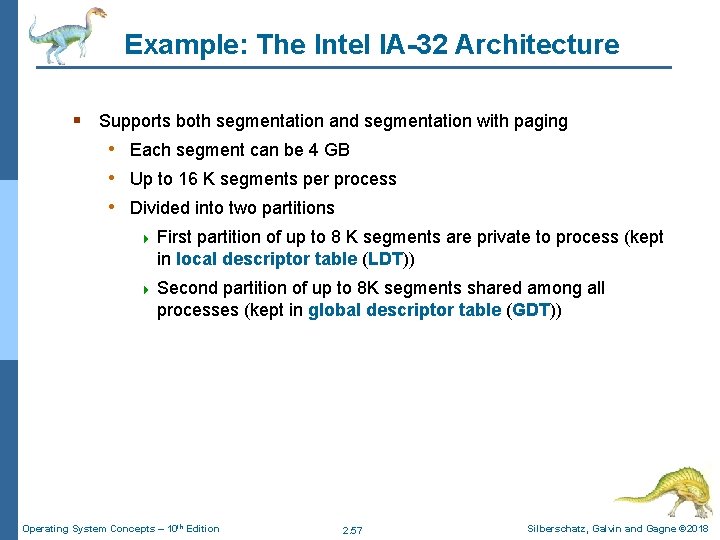
Example: The Intel IA-32 Architecture § Supports both segmentation and segmentation with paging • Each segment can be 4 GB • Up to 16 K segments per process • Divided into two partitions 4 First partition of up to 8 K segments are private to process (kept in local descriptor table (LDT)) 4 Second partition of up to 8 K segments shared among all processes (kept in global descriptor table (GDT)) Operating System Concepts – 10 th Edition 2. 57 Silberschatz, Galvin and Gagne © 2018
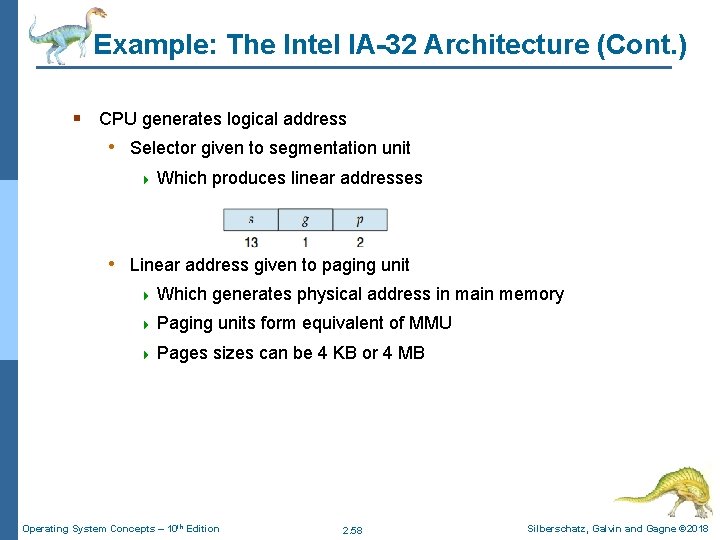
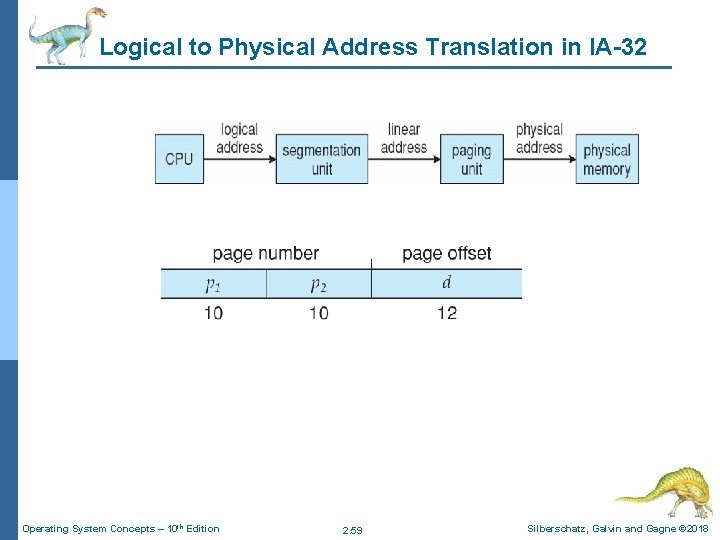
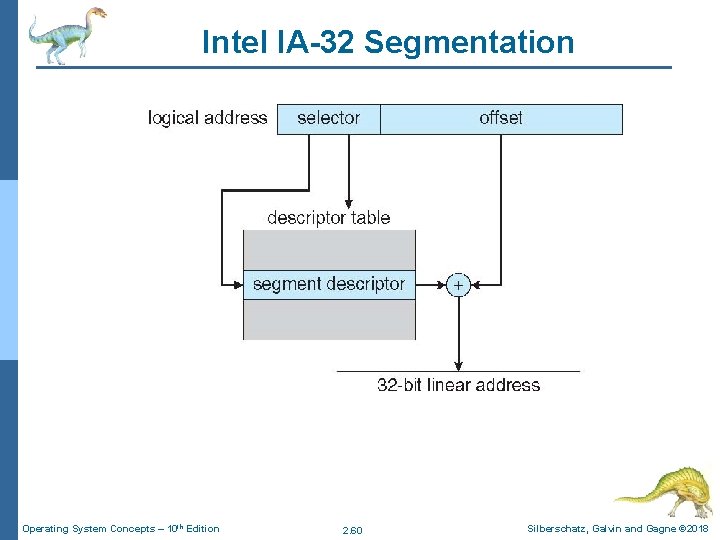
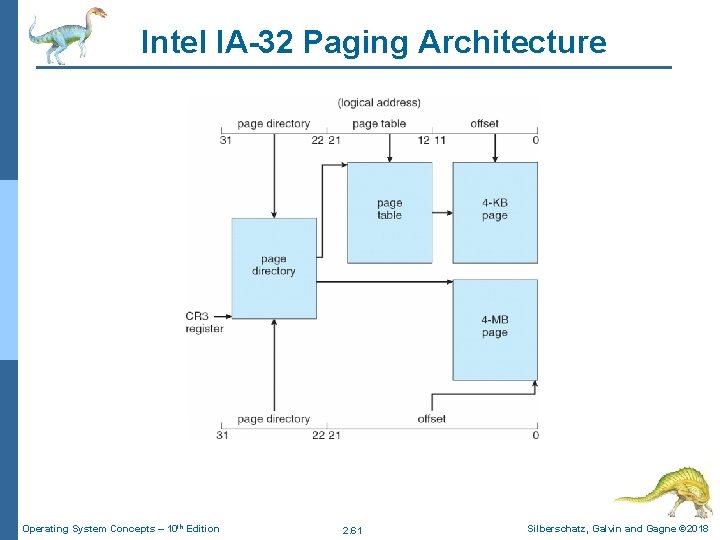
Example: The Intel IA-32 Architecture (Cont. ) § CPU generates logical address • Selector given to segmentation unit 4 Which produces linear addresses • Linear address given to paging unit 4 Which generates physical address in main memory 4 Paging 4 Pages units form equivalent of MMU sizes can be 4 KB or 4 MB Operating System Concepts – 10 th Edition 2. 58 Silberschatz, Galvin and Gagne © 2018
Logical to Physical Address Translation in IA-32 Operating System Concepts – 10 th Edition 2. 59 Silberschatz, Galvin and Gagne © 2018
Intel IA-32 Segmentation Operating System Concepts – 10 th Edition 2. 60 Silberschatz, Galvin and Gagne © 2018
Intel IA-32 Paging Architecture Operating System Concepts – 10 th Edition 2. 61 Silberschatz, Galvin and Gagne © 2018
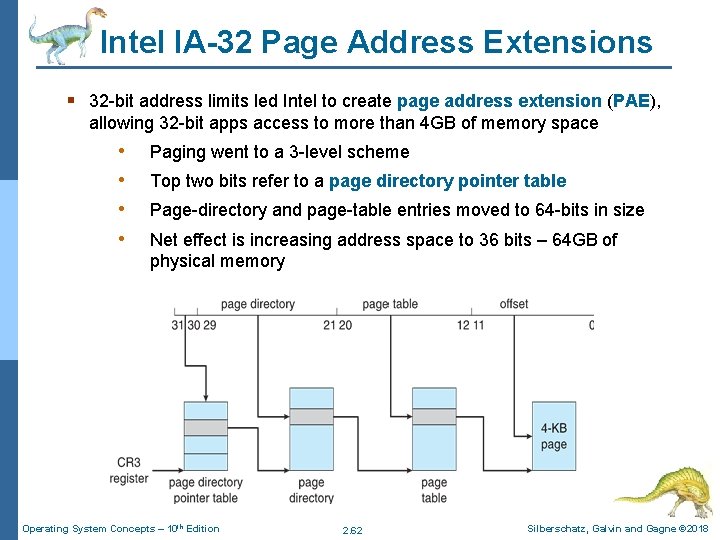
Intel IA-32 Page Address Extensions § 32 -bit address limits led Intel to create page address extension (PAE), allowing 32 -bit apps access to more than 4 GB of memory space • • Paging went to a 3 -level scheme Top two bits refer to a page directory pointer table Page-directory and page-table entries moved to 64 -bits in size Net effect is increasing address space to 36 bits – 64 GB of physical memory Operating System Concepts – 10 th Edition 2. 62 Silberschatz, Galvin and Gagne © 2018
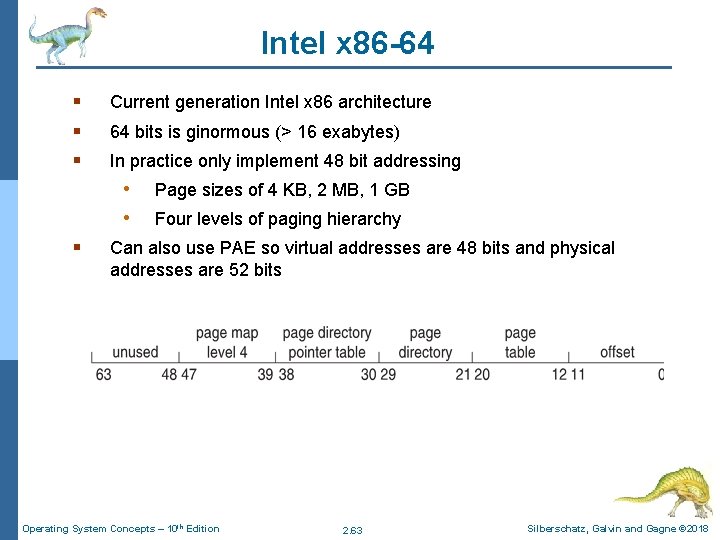
Intel x 86 -64 § § § Current generation Intel x 86 architecture 64 bits is ginormous (> 16 exabytes) In practice only implement 48 bit addressing • • § Page sizes of 4 KB, 2 MB, 1 GB Four levels of paging hierarchy Can also use PAE so virtual addresses are 48 bits and physical addresses are 52 bits Operating System Concepts – 10 th Edition 2. 63 Silberschatz, Galvin and Gagne © 2018
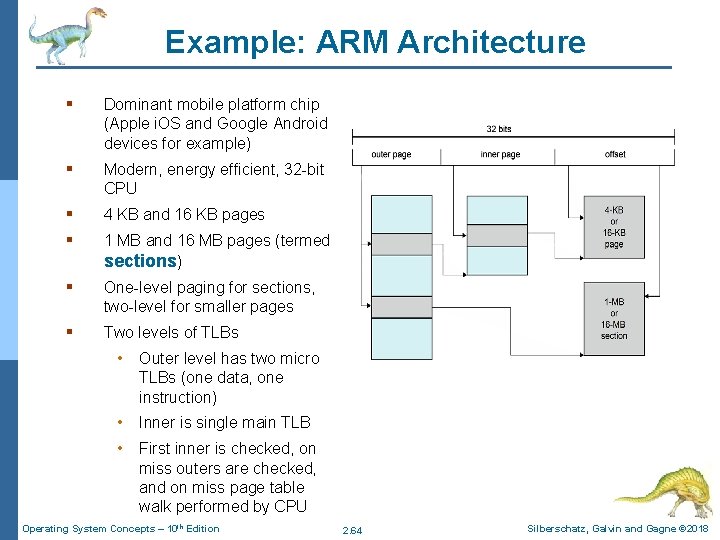
Example: ARM Architecture § Dominant mobile platform chip (Apple i. OS and Google Android devices for example) § Modern, energy efficient, 32 -bit CPU § § 4 KB and 16 KB pages § One-level paging for sections, two-level for smaller pages § Two levels of TLBs 1 MB and 16 MB pages (termed sections) • Outer level has two micro TLBs (one data, one instruction) • Inner is single main TLB • First inner is checked, on miss outers are checked, and on miss page table walk performed by CPU Operating System Concepts – 10 th Edition 2. 64 Silberschatz, Galvin and Gagne © 2018