
Lecture 16 Maximize Learning TrainTheTrainer Unit Objectives At

Lecture 16
Maximize Learning Train-The-Trainer
Unit Objectives • At the conclusion of this unit, the participants will be able to: – Describe the ways in which people learn – Explain how to create a positive learning environment – Demonstrate how to maximize learning in a given scenario
Unit Objectives (contd. ) – State why trainers need to evaluate – List formal and informal ways of evaluating – Provide some guidelines for asking and answering questions – Provide some guidelines for giving feedback
Exercise: Positive Learning Experiences
What Do You Think? • When you get a new gadget, how do you learn how to use it?
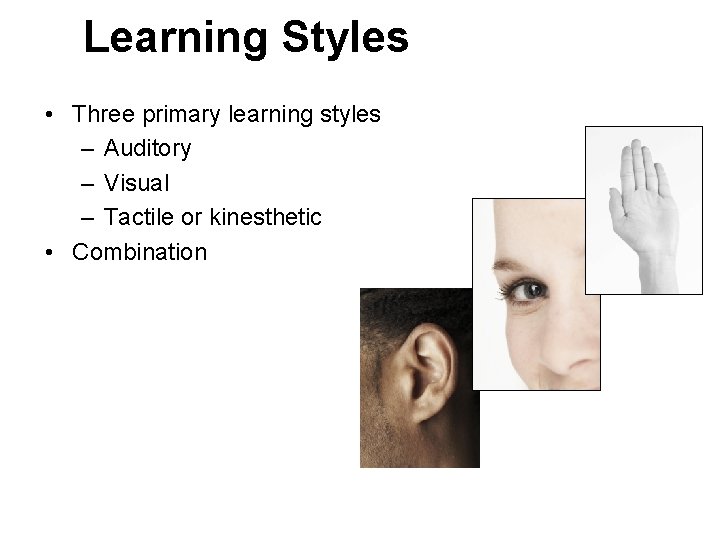
Learning Styles • Three primary learning styles – Auditory – Visual – Tactile or kinesthetic • Combination
Auditory Learners • Learn through listening – Lectures – Discussions – Talking things through – Listening to what others have to say • Written information has little meaning – Prefer to read text aloud – Like to use tape recorder
Visual Learners • Learn through seeing: – – – – Pictures Demonstrations Diagrams Illustrated text books Power. Point slides Videos Flipcharts Handouts
Visual Learners (contd. ) • Instructor’s body language and facial expressions help them understand • Sit at front of room • Remember by seeing • Like to take detailed notes to absorb information
Tactile Learners • Learn by doing, moving, touching – Hands-on activities • Find it hard to sit still for very long • Want to actively explore physical world around them
Learning Styles and Teaching • Good instruction should combine auditory, visual, and tactile • Retention increases dramatically when learning involves more senses and is more active
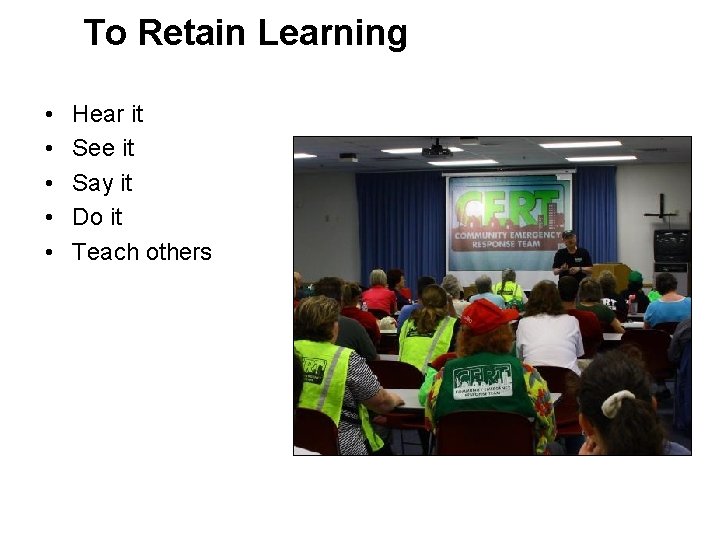
To Retain Learning • • • Hear it See it Say it Do it Teach others
Learning Styles and Instructors • Instructors have a preferred learning style that may affect how they like to teach • Instructors need to incorporate elements that are less comfortable • CERT Basic Training Instructor Guide includes elements for all learning styles • Addressing all learning styles will help increase learners’ retention
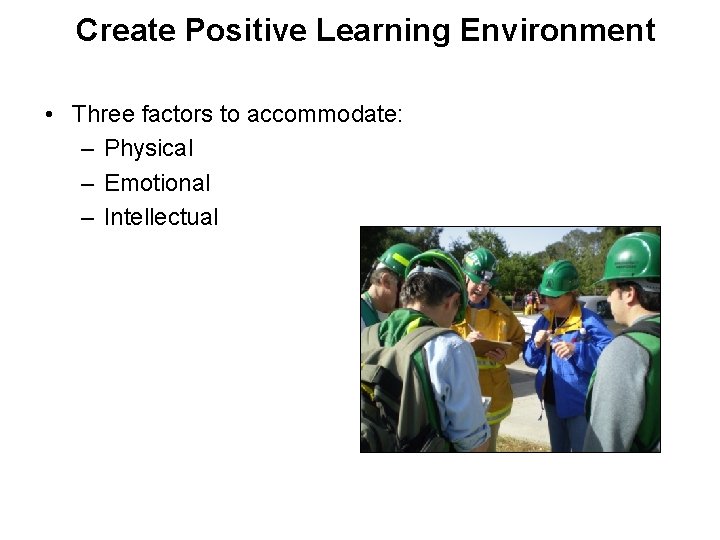
Create Positive Learning Environment • Three factors to accommodate: – Physical – Emotional – Intellectual
What Do You Think? • What is a physically comfortable learning environment?
Physical Factors • What is a physically comfortable learning environment? – Room not too hot or too cold – People can see and hear instructor – Lighting and amplification for people with reduced vision and hearing – Don’t have to sit too long; take regular breaks – Expectations account for reduced flexibility, reaction times, time of day
Emotional Factors • To be treated like adults (peers) • To direct their own learning whenever possible (selfmotivated) • To know they are doing it right or at least that they are trying hard • To feel accepted as they are • To see a reason for the training
What Do You Think? • How could instructors respond to these emotional needs?
Provide Emotional Factors • How could instructors respond to these emotional needs? – Be a learning resource – Explain benefits; then let participants discover benefits themselves – Respect them – Teach to their level – Don’t embarrass them – Provide reinforcement and peer feedback – Make learning non-threatening – Make learning realistic and problem-centered
Intellectual Factors • • To share their experiences To connect new information to what they already know To be involved in the learning To learn the way they like to learn
What Do You Think? • How could instructors respond to these intellectual needs?
Provide Intellectual Factors • How could instructors respond to these intellectual needs? – Use learners’ experiences to introduce concepts – Build bridges between old and new information – Make learning active – Use variety of methods to reach all the learning styles
Differentiate Factors • Review the list generated in the first question of the unit and choose: – “P” for Physical Factors – “E” for Emotional Factors – “I” for Intellectual Factors
Techniques to Maximize Learning • Motivation – Especially at beginning of training – What’s in it for me (WIIFM) • Reinforcement – Frequently and positively • Repetition – At least 3 times for learning retention
Motivation • Motivation is critical, especially at beginning of training • Adults need to know how it will benefit them • To motivate, instructors need to: – Establish rapport – Create open, friendly training atmosphere – Keep stress low – Challenge but don’t frustrate participants
Reinforcement • Instructors need to encourage and reinforce throughout training • Reward good behavior positively and frequently
Repetition • People need to hear something at least three times – #1: Explain – #2: Demonstrate – #3: Have learners practice • For optimal learning, have learners also practice while explaining what they are doing

Exercise: Power Outage
What Do You Think? • What is your job as a trainer?
Your Job as Trainer • What is your job as a trainer? – To transfer knowledge – Effective instructors use variety of training methods • Interactive lecture • Demonstrations • Roleplays • Exercises
What Do You Think? • Why do we use a variety of methods?
Training Methods • Why do we use a variety of methods? – To appeal to all learning styles • Auditory • Visual • Tactile
Assess Learning • Effective instructors assess learning to see that: – The learners have understood what’s been said – The learners “got it”
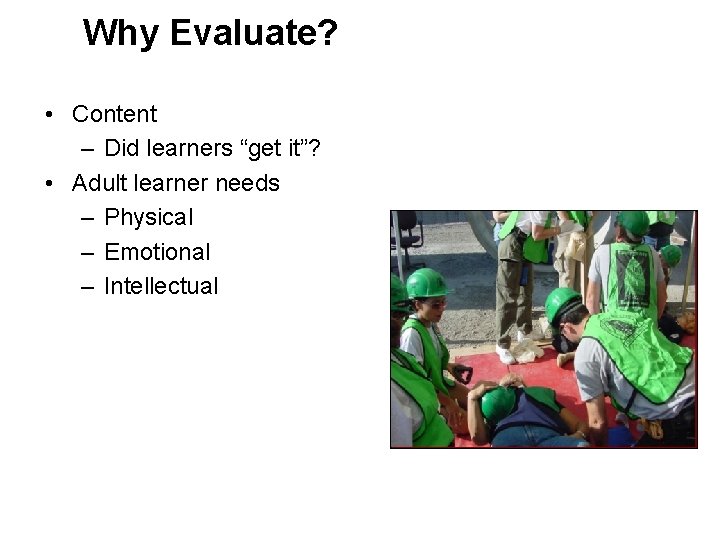
Why Evaluate? • Content – Did learners “get it”? • Adult learner needs – Physical – Emotional – Intellectual
What Do You Think? • How can instructors find out if people have learned?
How To Assess Learning • How can instructors find out if people have learned? – Instructors can find out if people have learned by: • Asking questions • Listening to questions • Testing • Observing hands-on exercises • Observing body language
Types of Evaluation • Formal – Tests – Performance demonstrations • Informal – Watching body language – Questions – Observation of hands-on activities

What Do You Think? • What are some other reasons for asking questions?
Why We Ask Questions • What are some other reasons for asking questions? – Ask questions to: • Get people involved/interested • Stimulate discussion • Channel thinking
Kinds of Questions to Ask 1. 2. Open and closed To different audiences – Direct question to one person – Direct question to whole group – Ask rhetorical question 3. Recall and apply
What Do You Think? • What is the difference between an open question and a closed question?
Closed Questions • What is the difference between an open question and a closed question? – Closed questions: • Answered by yes or no, true or false, or limited response • Used to: – Test knowledge – Receive quick answers – Maintain control of class – End topic before a break – Force a choice between correct and incorrect response
Open Questions • What is the difference between an open question and a closed question? – Open questions: • Start with what, why, how, or describe • Ask respondents to think and reflect • Typically require a longer answer • Often not one correct answer • Used to: – Generate discussion – Find out how class is feeling – Get people to open up – Get class to think
To Different Audiences • Instructor can direct a question to different audiences – To one person – To the whole group – Rhetorical questions
Recall and Apply • There are two kinds of evaluation questions: – Recall question: Learners repeat what they learned – Apply question: Learners think about what they learned and apply it to new situation
How to Ask a Question • Be brief, clear, friendly • To group: – Ask – Plant – Call • To individual: – Call – Ask – Plant
How to Answer a Question • • You can ask someone else to answer question Repeat question before answering it Paraphrase any lengthy questions Acknowledge questions that you cannot answer; get back to group as soon as possible
Too Many Questions • If one learner asks too many questions, you can: – Encourage others by recognizing their questions first – As a last resort, take the individual aside
What Do You Think? • What are some opportunities for giving feedback in CERT Basic Training?
Feedback Opportunities • What are some opportunities for giving feedback in CERT Basic Training? – During hands-on activities and skills training – Tell how well CERT requirements are met • Correct attire • PPE • CERT kits – During class discussion
Give Feedback • When to give feedback: – To correct information – For behavior that can be changed – To acknowledge correct answers or performance of a technique • How to give feedback – Compliment whenever possible, even when feedback is corrective – Be specific • Describe what needs to be corrected • Describe how it needs to be corrected
What Do You Think? • What if you ask a question and someone gives you a wrong answer? What would you do?
Exercise: Develop “What If” Questions
Unit Summary • This unit has examined: – How people learn • Three learning styles: auditory, visual, and tactile • Best teaching approach combines all three: hear it, see it, do it, teach it (say and do it) – How to create positive learning environment • Address physical, emotional, and intellectual needs – Techniques that maximize learning • Motivation • Reinforcement • Repetition (at least 3 times)
Unit Summary (contd. ) – – Why instructors need to evaluate Formal and informal ways to evaluate Guidelines for asking and answering questions Guidelines for when and how to give feedback
- Slides: 56