
Lecture 16 Knee Joint Basic Projections AP Lateral
Lecture (16 )

Knee Joint • • • Basic Projections AP Lateral Oblique Tunnel AP Knee Joint Exposure Factors Kv m. As FFD (cm) Grid Focus Cassette 65 5 100 No Fine 18 x 24 cm

• Patient Position • Supine with leg extended • • • Part position Adjust knee to cassette Slightly rotate leg medially to centralize patella Central Ray 5 -7 degrees cephalic • Center Point ½ inch inferior to patellar apex Structure shown Femorotibial joint Distal femur and proximal tibia & fibul • • •
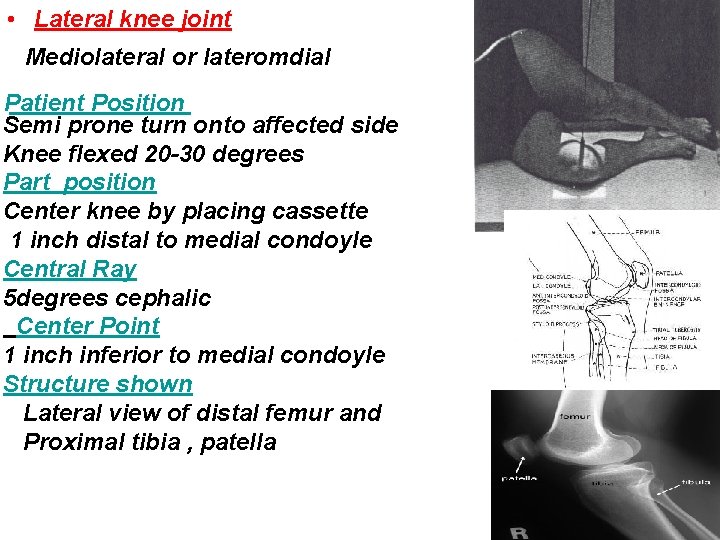
• Lateral knee joint Mediolateral or lateromdial Patient Position Semi prone turn onto affected side Knee flexed 20 -30 degrees Part position Center knee by placing cassette 1 inch distal to medial condoyle Central Ray 5 degrees cephalic Center Point 1 inch inferior to medial condoyle Structure shown Lateral view of distal femur and Proximal tibia , patella

• AP Oblique knee joint ( Lateral or external rotation ) Patient Position Supine extend affected knee Part position Adjust knee to cassette Rotate affected knee with entire leg 45 degrees laterally Central Ray Perpendicular Center Point At level of patella apex Structure shown Oblique view of distal femur and Proximal tibia and fibula , patella

• Medial Oblique knee joint Patient Position Supine extend affected knee Part position Adjust knee to cassette Rotate affected knee with entire leg 45 degrees medially Central Ray Perpendicular Center Point At level of patella apex Structure shown Oblique view of distal femur and Proximal tibia and fibula, patella
- Slides: 6