
Lecture 16 Introduction to Control Part II 2
- Slides: 13
Lecture 16: Introduction to Control (Part II) 2. Control requirements 3. Design by pole placement ME 431, Lecture 16 1. Illustrative cruise control example 1
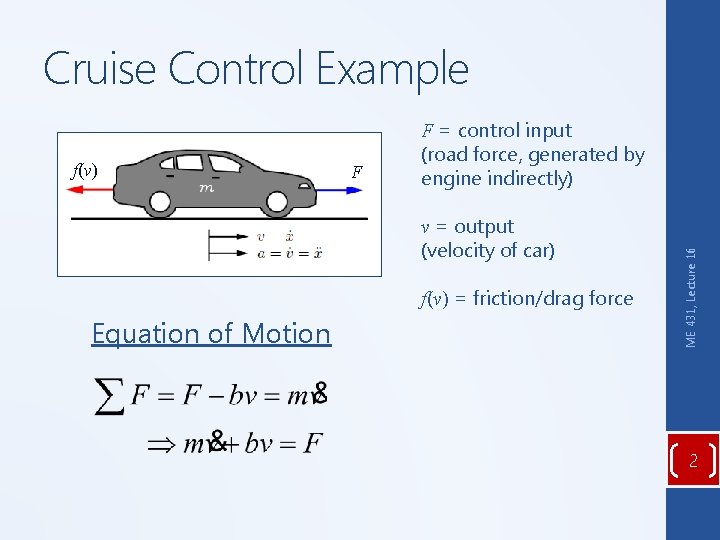
Cruise Control Example F v = output (velocity of car) f(v) = friction/drag force Equation of Motion ME 431, Lecture 16 f(v) F = control input (road force, generated by engine indirectly) 2
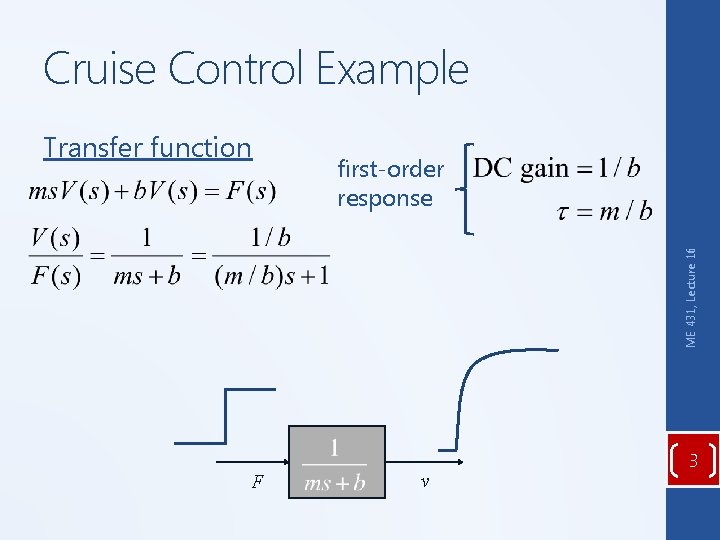
Cruise Control Example first-order response ME 431, Lecture 16 Transfer function F v 3
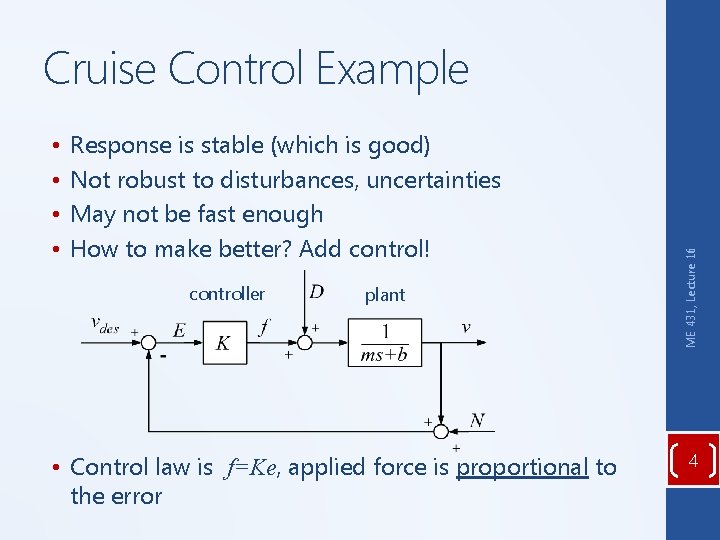
• • Response is stable (which is good) Not robust to disturbances, uncertainties May not be fast enough How to make better? Add control! controller plant • Control law is f=Ke, applied force is proportional to the error ME 431, Lecture 16 Cruise Control Example 4
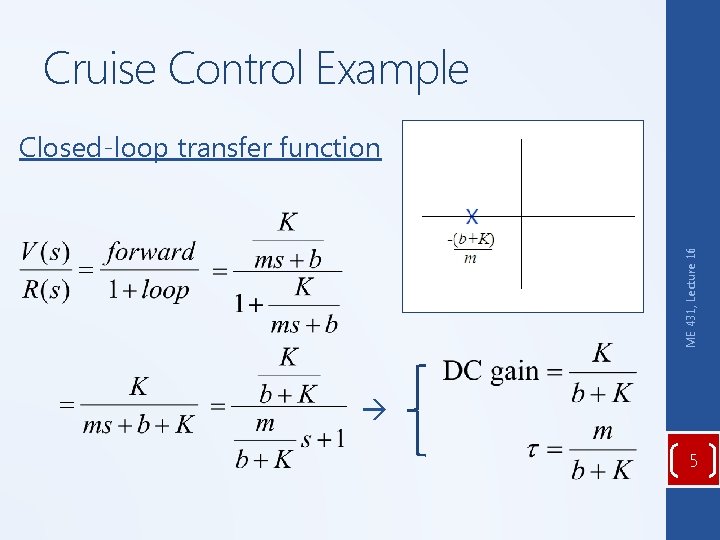
Cruise Control Example ME 431, Lecture 16 Closed-loop transfer function 5
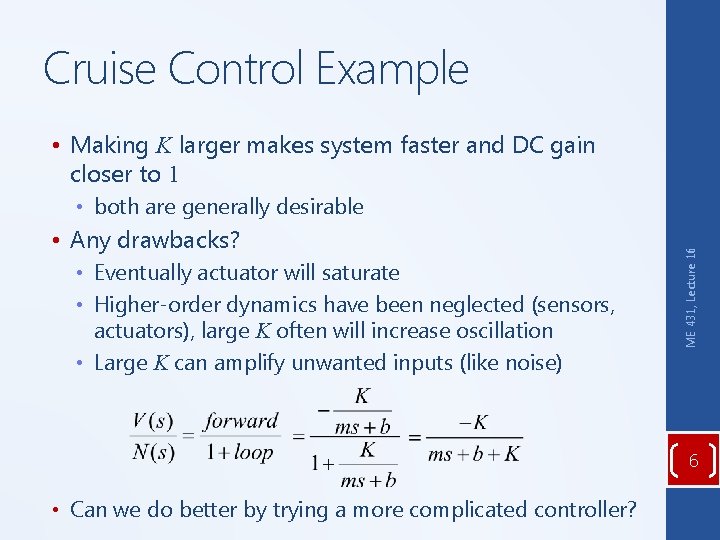
Cruise Control Example • Making K larger makes system faster and DC gain closer to 1 • Any drawbacks? • Eventually actuator will saturate • Higher-order dynamics have been neglected (sensors, actuators), large K often will increase oscillation • Large K can amplify unwanted inputs (like noise) ME 431, Lecture 16 • both are generally desirable 6 • Can we do better by trying a more complicated controller?
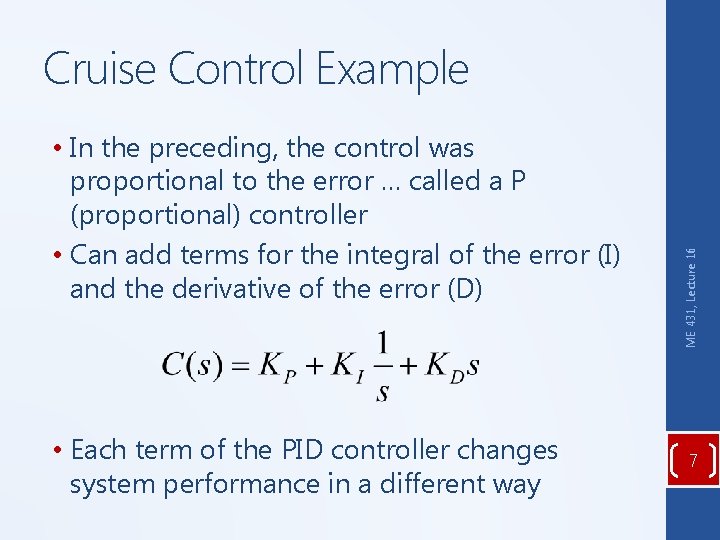
• In the preceding, the control was proportional to the error … called a P (proportional) controller • Can add terms for the integral of the error (I) and the derivative of the error (D) • Each term of the PID controller changes system performance in a different way ME 431, Lecture 16 Cruise Control Example 7
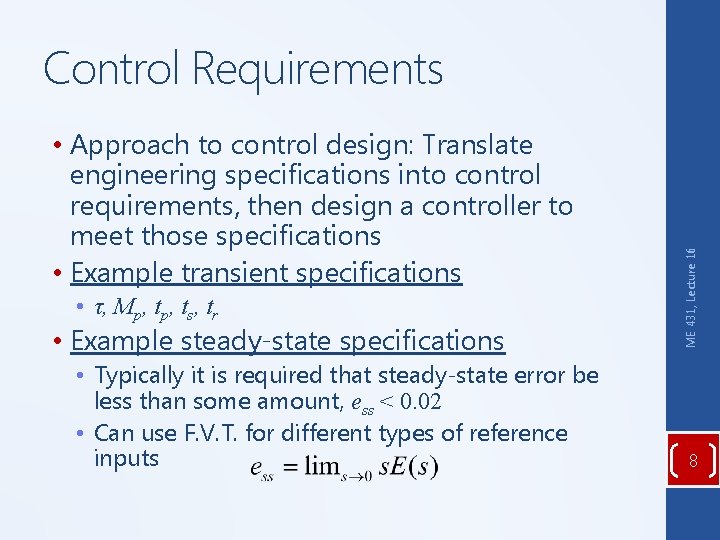
• Approach to control design: Translate engineering specifications into control requirements, then design a controller to meet those specifications • Example transient specifications • τ, Mp, ts, tr • Example steady-state specifications • Typically it is required that steady-state error be less than some amount, ess < 0. 02 • Can use F. V. T. for different types of reference inputs ME 431, Lecture 16 Control Requirements 8
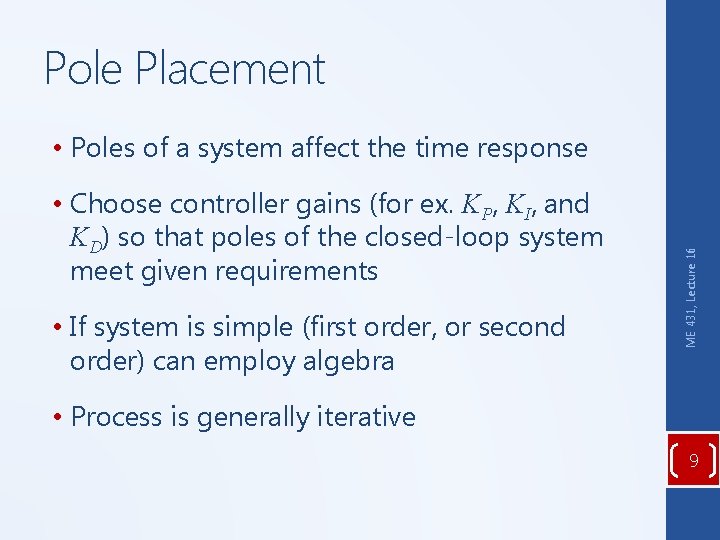
Pole Placement • Choose controller gains (for ex. KP, KI, and KD) so that poles of the closed-loop system meet given requirements • If system is simple (first order, or second order) can employ algebra ME 431, Lecture 16 • Poles of a system affect the time response • Process is generally iterative 9
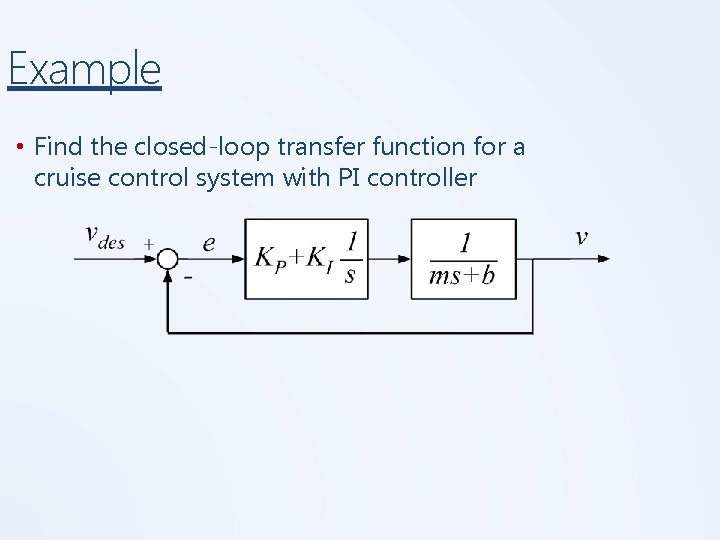
Example • Find the closed-loop transfer function for a cruise control system with PI controller
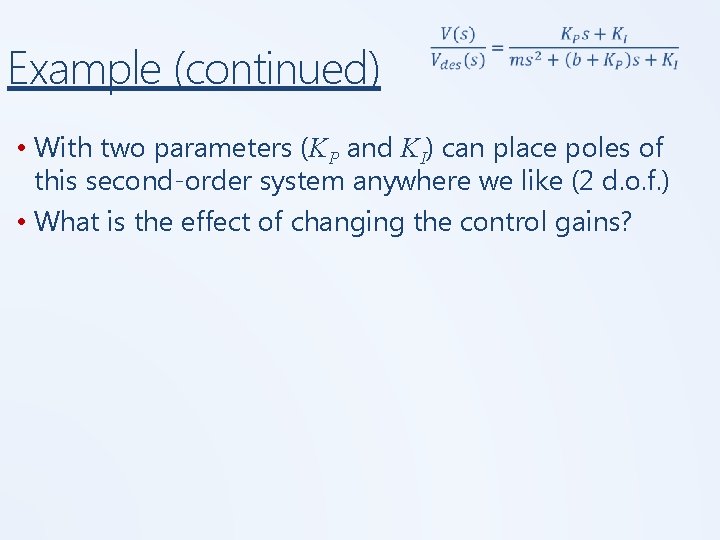
Example (continued) • With two parameters (KP and KI) can place poles of this second-order system anywhere we like (2 d. o. f. ) • What is the effect of changing the control gains?
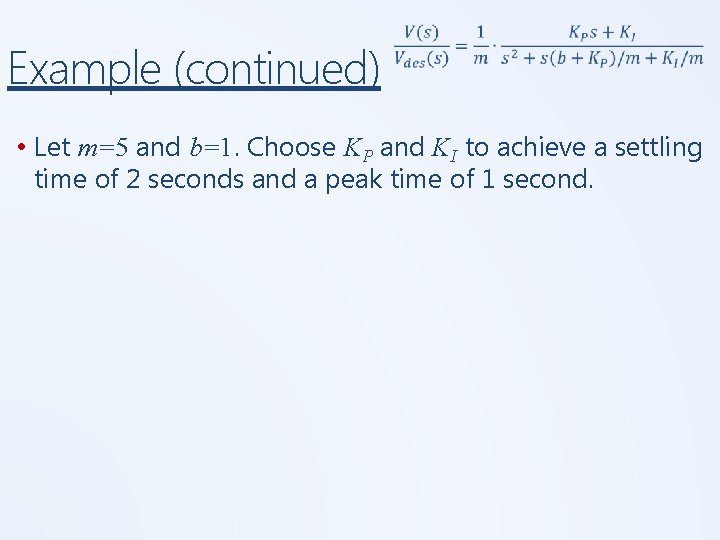
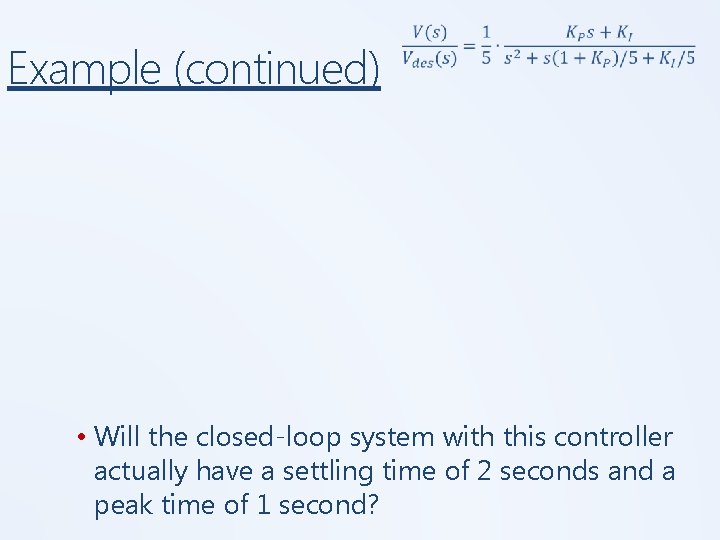
Example (continued) • Let m=5 and b=1. Choose KP and KI to achieve a settling time of 2 seconds and a peak time of 1 second.
Example (continued) • Will the closed-loop system with this controller actually have a settling time of 2 seconds and a peak time of 1 second?