
Lecture 16 Gregory of Nazianzus and Gregory of
- Slides: 22
Lecture 16: Gregory of Nazianzus and Gregory of Nyssa 24 October 2019 1
Gregory Nazianzus, 329 -389 n n n Knew Athanasius as a young man; wrote a funeral oration for Athanasius Very close friend of Basil; studied in Athens with him Great rhetorician Sermons on Christology and Trinity very influential q St. Jerome was his disciple in Constantinople Took up residence in a monastery in Constantinople so he could pray and study Known as ‘The Theologian’ 2
De Fuga n n n His father tried to ordain him a priest, and Basil encouraged him to be ordained, but fled because Gregory felt himself unworthy Wrote De Fuga; trying to defend his flight to Basil q Wanted to lead a Christian philosophical life of study q Described responsibilities of priesthood and bishops Very influential on St. John Chrysostom and Pope St. Gregory the Great 3
Gregory of Nazianzus and Theodosius n Recall that several of Constantine’s successors had been Arians q n n n Constantinople had an Arian Patriarch during this time Theodosius made Gregory Nazianzus Patriarch after orthodox Christians proclaimed Gregory In 381 Theodosius called Council of Constantinople, over which Gregory presided Reaffirmed Orthodox (Nicene) creed; expanded statements on Holy Spirit q Basically what we have now 4
Heretical Reaction to Arius n n n Recall that Arius believed the Word was created In reaction to this Apollinarius, bishop of Laodicea, proposed notion that Jesus had a physically human body, but mind and will were not human but divine. Gregory rejects this completely; q Supports “what is not assumed is not saved” 5
Works of Gregory Nazianzus n n n De Fuga Poems Homilies and Orations q q q Oration in praise of Athanasius and Basil Funeral Oration for his sister Georgina Theological Orations 6
Theological Orations n n Delivered in Constantinople in 390 in support of theology of Trinity Series of 5 Orations q q q First is an Introduction Second on God the Father Third and Fourth on Son n n q Third is philosophical arguments about Son Fourth analyzes difficult Scriptural passages on Son Fifth on Holy Spirit 7
First Theological Oration n n n Note that Gregory is preaching in a hostile environment Setting stage for future discussions and argument with Arians on one hand Appolinarians on the other Must be purified in soul and spirit to philosophize about God (3) Importance of reason and rules of conduct in philosophy discussions (5) Seems to support notion of multiple ways to philosophize about God (8) But some ways are clearly wrong (9) 8
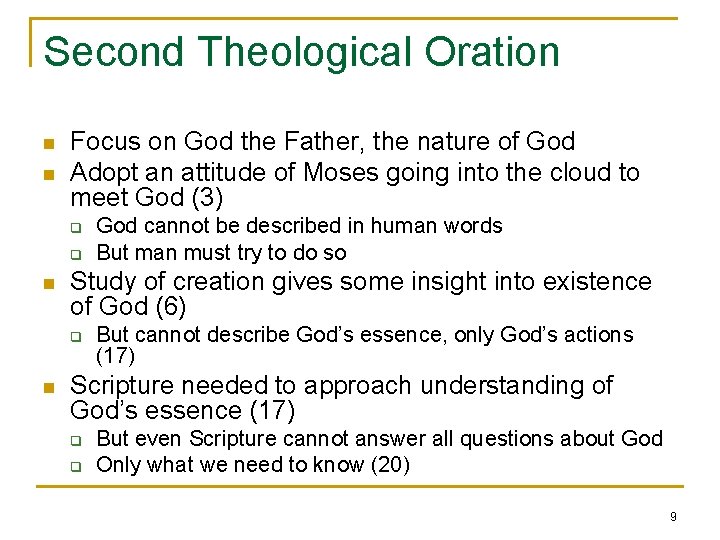
Second Theological Oration n n Focus on God the Father, the nature of God Adopt an attitude of Moses going into the cloud to meet God (3) q q n Study of creation gives some insight into existence of God (6) q n God cannot be described in human words But man must try to do so But cannot describe God’s essence, only God’s actions (17) Scripture needed to approach understanding of God’s essence (17) q q But even Scripture cannot answer all questions about God Only what we need to know (20) 9
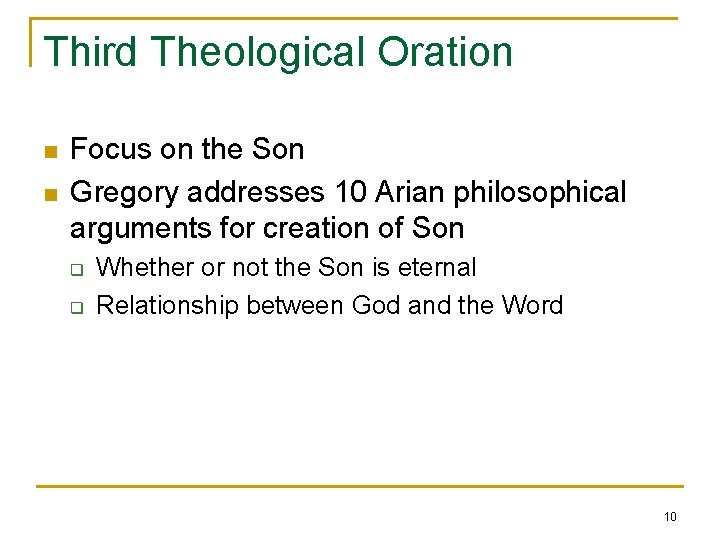
Third Theological Oration n n Focus on the Son Gregory addresses 10 Arian philosophical arguments for creation of Son q q Whether or not the Son is eternal Relationship between God and the Word 10
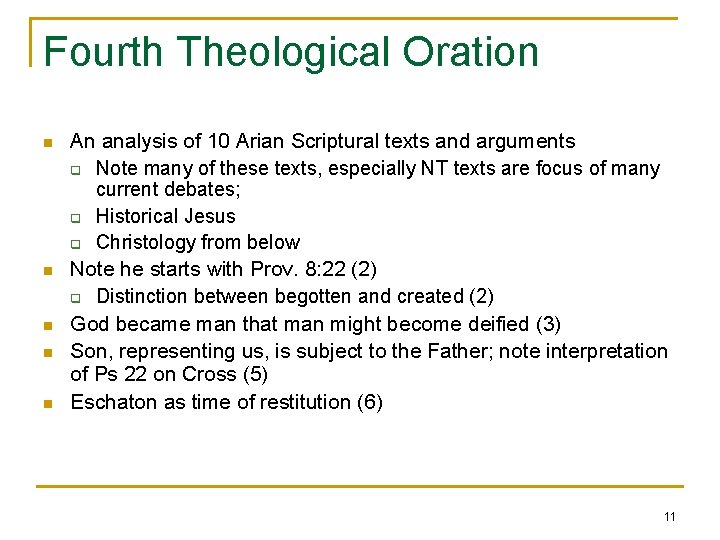
Fourth Theological Oration n n An analysis of 10 Arian Scriptural texts and arguments q Note many of these texts, especially NT texts are focus of many current debates; q Historical Jesus q Christology from below Note he starts with Prov. 8: 22 (2) q Distinction between begotten and created (2) God became man that man might become deified (3) Son, representing us, is subject to the Father; note interpretation of Ps 22 on Cross (5) Eschaton as time of restitution (6) 11
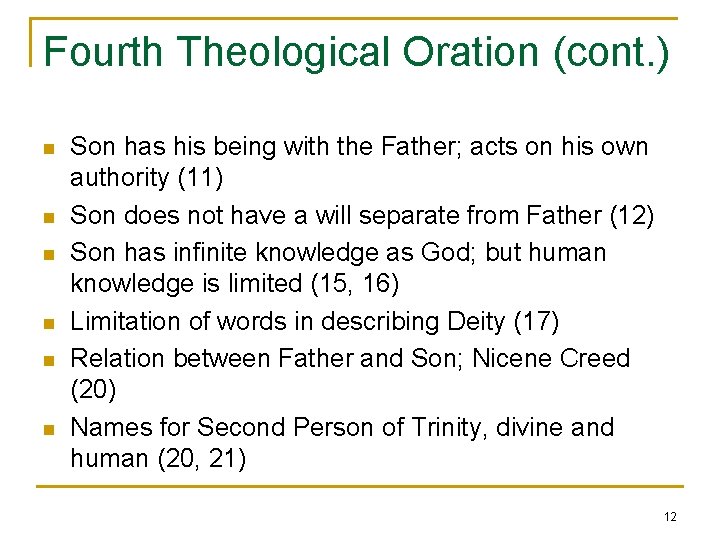
Fourth Theological Oration (cont. ) n n n Son has his being with the Father; acts on his own authority (11) Son does not have a will separate from Father (12) Son has infinite knowledge as God; but human knowledge is limited (15, 16) Limitation of words in describing Deity (17) Relation between Father and Son; Nicene Creed (20) Names for Second Person of Trinity, divine and human (20, 21) 12
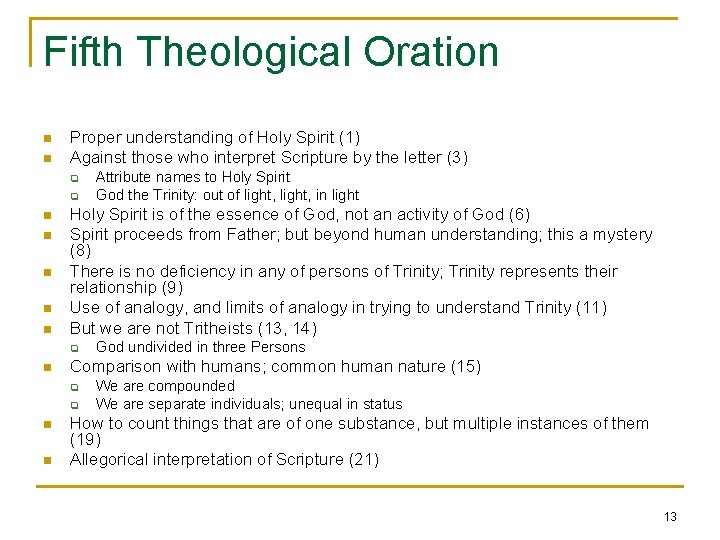
Fifth Theological Oration n n Proper understanding of Holy Spirit (1) Against those who interpret Scripture by the letter (3) q q n n n Holy Spirit is of the essence of God, not an activity of God (6) Spirit proceeds from Father; but beyond human understanding; this a mystery (8) There is no deficiency in any of persons of Trinity; Trinity represents their relationship (9) Use of analogy, and limits of analogy in trying to understand Trinity (11) But we are not Tritheists (13, 14) q n God undivided in three Persons Comparison with humans; common human nature (15) q n Attribute names to Holy Spirit God the Trinity: out of light, in light We are compounded We are separate individuals; unequal in status How to count things that are of one substance, but multiple instances of them (19) Allegorical interpretation of Scripture (21) 13
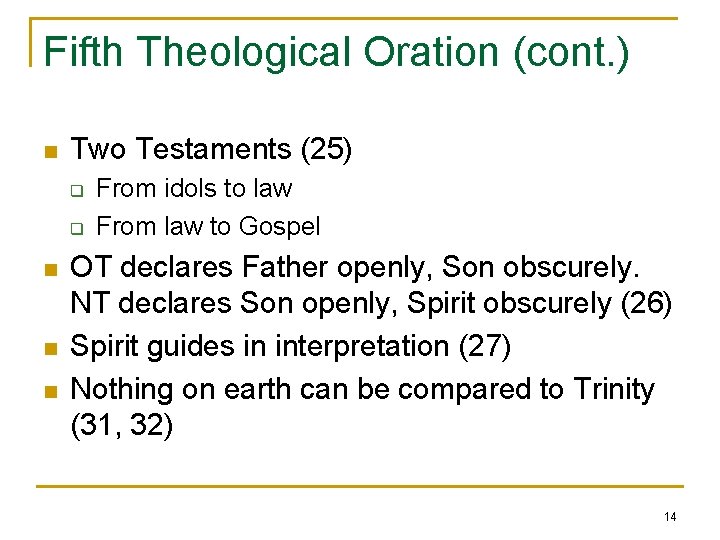
Fifth Theological Oration (cont. ) n Two Testaments (25) q q n n n From idols to law From law to Gospel OT declares Father openly, Son obscurely. NT declares Son openly, Spirit obscurely (26) Spirit guides in interpretation (27) Nothing on earth can be compared to Trinity (31, 32) 14
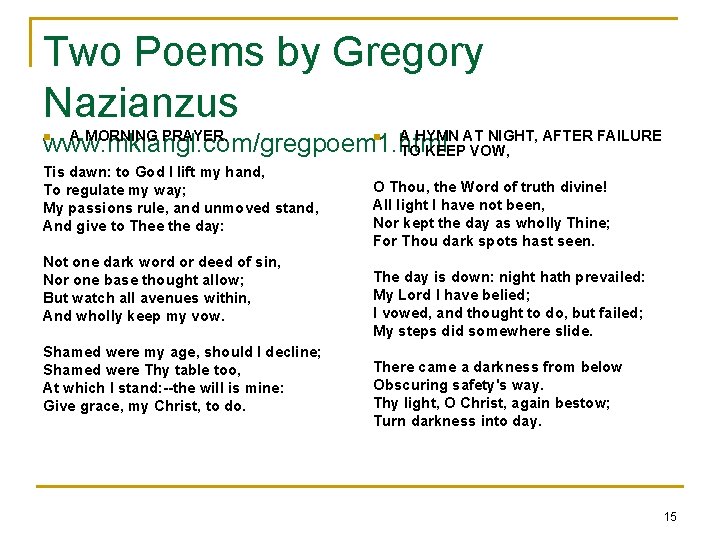
Two Poems by Gregory Nazianzus A MORNING PRAYER. A HYMN AT NIGHT, AFTER FAILURE www. mklangl. com/gregpoem 1. html TO KEEP VOW, n Tis dawn: to God I lift my hand, To regulate my way; My passions rule, and unmoved stand, And give to Thee the day: Not one dark word or deed of sin, Nor one base thought allow; But watch all avenues within, And wholly keep my vow. Shamed were my age, should I decline; Shamed were Thy table too, At which I stand: --the will is mine: Give grace, my Christ, to do. n O Thou, the Word of truth divine! All light I have not been, Nor kept the day as wholly Thine; For Thou dark spots hast seen. The day is down: night hath prevailed: My Lord I have belied; I vowed, and thought to do, but failed; My steps did somewhere slide. There came a darkness from below Obscuring safety's way. Thy light, O Christ, again bestow; Turn darkness into day. 15
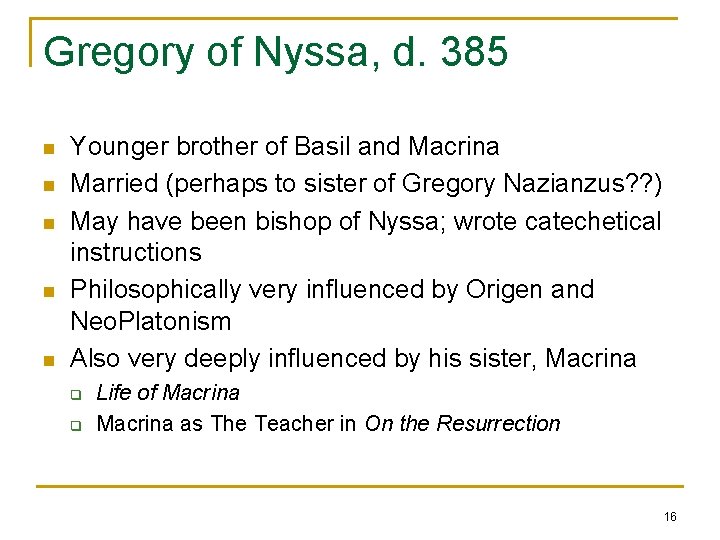
Gregory of Nyssa, d. 385 n n n Younger brother of Basil and Macrina Married (perhaps to sister of Gregory Nazianzus? ? ) May have been bishop of Nyssa; wrote catechetical instructions Philosophically very influenced by Origen and Neo. Platonism Also very deeply influenced by his sister, Macrina q q Life of Macrina as The Teacher in On the Resurrection 16
Neo. Platonism n Philosophy developed by Plotinus (204 -270) q q q n n n Alexandrian philosopher; contemporary of Origen Extended aspects of Plato Work is preserved in the Enneads Emphasis on God as One, q The One as self-caused and cause of everything in universe q The One is exquisitely, beautifully simple (i. e. , without complexity); the One is completely Good Matter, as caused by One is good; therefore, evil must be what is limited or absence of being Man as a rational creature finds his true happiness in unity with the One; moving from the limiting material to the unbounded simple, beautiful good One 17
Influence of Neo. Platonism n n Cannot be over-stated The development of both Greek and Latin Christianity through the Middle Ages q q q n Group of learned Christian converts in Italy, including Augustine Questions about Aquinas: he seemed to abandon neo. Platonism as a philosophical method for Aristotle; Aquinas’ contemporary, Bonaventure, relied very much on neo. Platonism After the Third Century, when subsequent philosophers and theologians refer to the “Platonists”, almost always referring to what we now refer to as Neo. Platonists 18
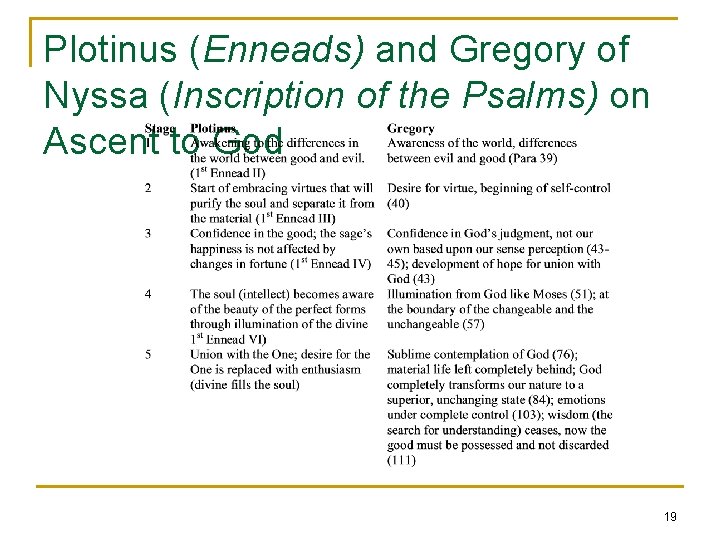
Plotinus (Enneads) and Gregory of Nyssa (Inscription of the Psalms) on Ascent to God 19
Gregory of Nyssa Commentary on Song of Songs n Prolog q q q n Written to a group of religious women Need to consider the allegorical meaning of Scripture Based on Origen Homily 1 q Christ used Solomon, wisest of all kings, to speak to us in Proverbs, Ecclesiastes, and Song of Songs n n q q n Proverbs for young Ecclesiastes for those ready to embrace virtue and leave behind material world (vanities) Song of Songs teaches us mystery of mysteries Become passionless using words of passion After resurrection, passions of flesh will no longer disturb the soul Allegorical understanding of first line See www. bhsu. edu/artssciences/asfaculty/dsalomon/nyssa/songcompar. html for a comparison of Origen, Gregory of Nyssa and Bernard of Clairvaux on Song of Songs 20
Another rising ‘philosophy’ of the period: Manicheaism n n Founded by Mani, Persian contemporary of Plotinus Many gnostic elements q q q n n Secret knowledge ‘solves’ theodicy problem with two gods Synchristic: mixture of Christianity, Hinduism, Zoroastrianism Becomes very popular in fourth century; most famous hearer (catechumen) : Augustine Still viable in 11 th Century: St. Dominic founds Order of Preachers to preach against theirs (Cathars) 21
Assignments n n n Gregory Nazianzus, Theological Orations 1, 4, 5 p 128 -135; 177 -214. Gregory of Nyssa, Commentary on the Song of Songs Prolog and First Homily p. 35 -56 CCC 2670 -2685, Holy Spirit and Prayer Benedict XVI, General Audiences, Gregory Nazianzus, 8 August 2007, 22 August 2007 Benedict XVI, General Audiences, Gregory of Nyssa, 29 August 2007, 5 September 2007 Write short paper on one of the Cappadocian readings 22