
Lecture 15 The National Security State Dynamics of
- Slides: 24
Lecture 15. The National Security State Dynamics of Democracy, Ch. 18, cont’d Hudson, Ch. 8
Congress and Foreign Policy • The Constitution assigns Congress considerable influence in foreign policy, including the power to declare war • During the 1950 s and 1960 s Congress typically deferred to the Executive Branch • During 1970 s and 1980 s Congressional activism in foreign policy grew • Congressional deference to President increased after 9/11 attacks
War Powers Act of 1973 • Attempt by Congress to restrain Presidential activism in foreign policy • Reaction to problems of the war in Viet Nam: the Tonkin Gulf resolution, Nixon’s secret bombing of Laos and Cambodia • Requires Congress to approve any American use of troops abroad within 60 -90 days • Requires detailed reporting to Congress of foreign policy actions by the President • Passed over Nixon’s veto; opposed by every president since Jimmy Carter (1977 -) regardless of political party
Limits on Foreign Policy Role of Congress • Unable to act swiftly in an emergency • Lack of access to current intelligence (the president’s daily intelligence briefing is highly classified) • Partisan conflicts over foreign policy goals • Both parties tend to support the president after military action is initiated • Politically, it is difficult to withhold funds from the military in order to stop presidential foreign actions
Future Challenges to U. S. Foreign Policy • Disagreements about the goals and strategies of American foreign policy • A changing foreign policy agenda • Unilateral versus multilateral action: Role of the United Nations, European Union, G-8, etc. • Bush’s doctrine of preemptive war: attacking first to eliminate a potential threat
The preemptive war debate • Attacking first would violate the traditional American “no first strike” principle of defense • It requires accurate intelligence as to enemy capabilities and intentions Intelligence failures: Clinton bombing of the factory in Sudan. No WMDs found in Iraq • It would require unilateral action by the US • It could prevent a terrorist or nuclear attack • It would greatly expand presidential power
Potential Problems in U. S. Foreign Policy The United States will face problems in: • Nuclear proliferation • Military interventions • Economic policy • Globalization • Human rights • High cost of defense • Multilateral versus unilateral action • Homeland security
Globalization is the process by which growing economic relations and technological change make countries increasingly interdependent. New problems brought on by globalization: • The drug trade • Biodiversity • Acid rain • Global warming • Labor • Use of resources
18 -4 c Unilateralism v. Multilateralism Unilateralism The tendency of the United States to act alone in foreign affairs without consulting other countries. Multilateralism An approach in which two or more countries cooperate for the purpose of solving some common problem.
Benefits of Multilateralism • Cost of military actions or sanctions are shared • Sharing of intelligence • US is less likely to become the focus of opposition • Aggressive actions by any one country are likely to be constrained or delayed • Examples: Korea 1950 -1953, Iraq 1990 -91
Costs of Multilateralism • Policies and outcomes may not serve the US national interest • Delay in negotiating policy actions • US troops could be subject to foreign or UN commanders • US military secrets could be exposed
Problems with the Iraq War • Faulty intelligence; no WMDs found • Congressional resolution of October 2002 based on faulty intelligence or deception • Other options were not considered during prewar planning. Only war hawks consulted. • Insufficient troop commitment to maintain public order and services after Baghdad fell • No long-term planning for reconstruction of Iraq • No exit strategy • Minimal involvement by allies or the UN • Financed by borrowing rather than budgeting
Hudson: Origins of the National Security State • The Cold War; fear of Communism • Ties to American economic imperialism • Efforts by the military-industrial complex to increase its influence and profits • Weakness of opposition groups favoring peace, less defense spending
Hudson: Critique of the National Security State Problems it poses for democracy: 1. Secrecy 2. Centralization 3. Repression of civil liberties (to be discussed Friday) 4. Distortion by vested interests: Military-industrial complex Professional military
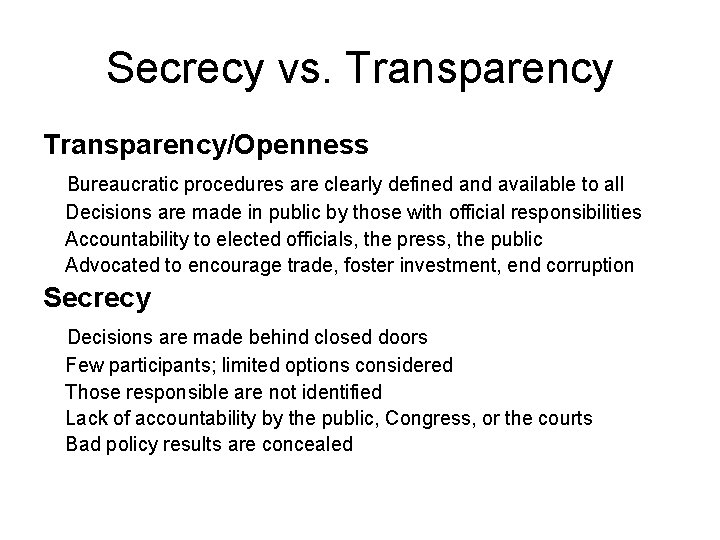
Secrecy vs. Transparency/Openness Bureaucratic procedures are clearly defined and available to all Decisions are made in public by those with official responsibilities Accountability to elected officials, the press, the public Advocated to encourage trade, foster investment, end corruption Secrecy Decisions are made behind closed doors Few participants; limited options considered Those responsible are not identified Lack of accountability by the public, Congress, or the courts Bad policy results are concealed
Hudson: Problems with Centralization of Foreign Policy • Too much power to the President and his advisers • Limited role for Congress • Weakness of War Powers Act of 1973 • The public is largely excluded (except to ratify previous decisions) • Better decisions are made when more people are involved; prevent policy errors such as Bay of Pigs, Iran/Contra
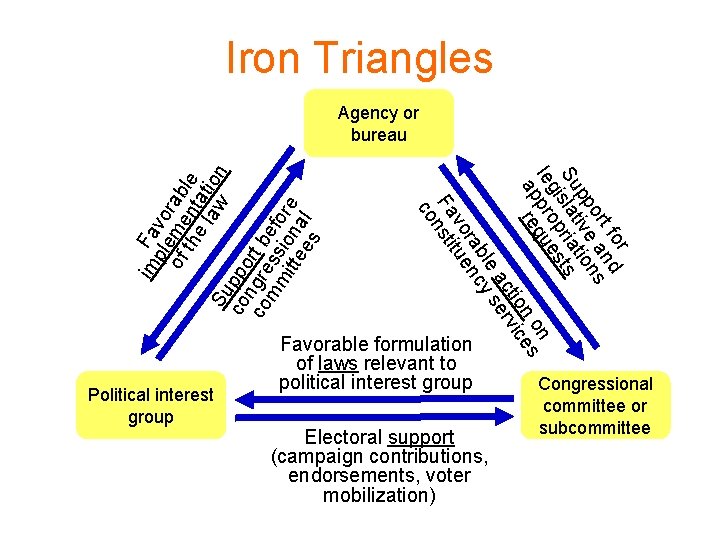
Distortion • Too much influence by the MIC: militaryindustrial complex “Iron Triangle” 1. National security bureaucracies 2. Defense contractors 3. Congressional defense committees • Economic impact of defense spending, arms sales abroad • MIC exaggerates threats of the Cold War or terrorism to build its profits • Too little countervailing power
Iron Triangles Political interest group or t f nd or a s pp tive tion Su isla pria sts leg pro ue q on ap re n es tio vic ac ser ble y ra nc vo tue Fa nsti co im Fa ple vo of me rab the nt le ati l a w on Su co ppo co ngre rt b mm ss efo itte iona re es l Agency or bureau Favorable formulation of laws relevant to political interest group Electoral support (campaign contributions, endorsements, voter mobilization) Congressional committee or subcommittee
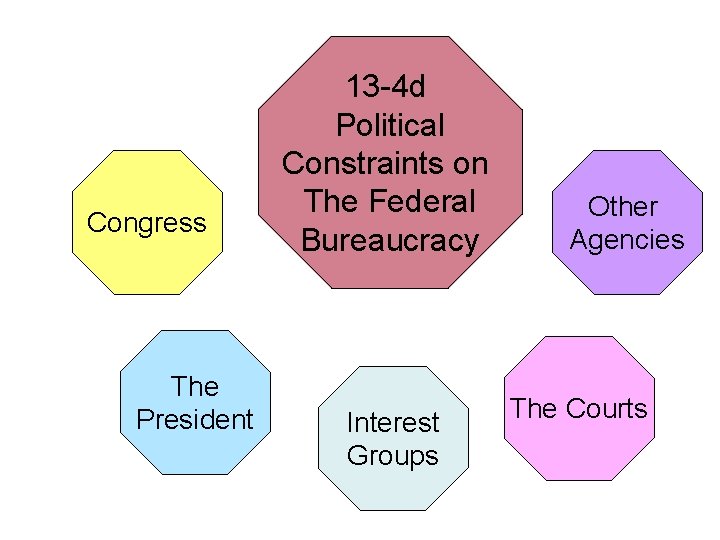
Congress The President 13 -4 d Political Constraints on The Federal Bureaucracy Interest Groups Other Agencies The Courts
Constraints by Congress • • Hold hearings to assess performance Cut or increase budget Oversight of rules and spending Can reorganize, cut out, merge departments or agencies
Constraints by the President • Can recommend budget cuts or downsizing • Can appoint cabinet secretaries or SES officials on the basis of ideology or loyalty, not competence • Can fire senior civil servants
Other Constraints on Bureaucracy • Interest groups may challenge regulations, urge budget cuts, demand hiring of sympathetic officials • Courts may disallow certain regulations • Courts may permit lawsuits against agencies or rules (such as class-action lawsuits on environmental restrictions) • The media may expose corruption or poor performance • Other agencies compete for authority, budgets, office space, presidential support, influence in Congress
Lack of Constraints on Military. Industrial Complex • • Strength of “iron triangle” Growing influence of professional military Large share of the federal budget Military spending sought by state/local governments • Courts seldom intervene • Fear and secrecy deceive the public
Hudson: Reforms of the National Security State • • • Restore the role of Congress Dismantle the Military-Industrial Complex Reassert civilian control of the military Renounce preventive war Support multilateralism Promote democratic values abroad and at home • More effective policies to combat terrorism