
Lecture 15 OUTLINE pn junction IV characteristics Reading
- Slides: 22
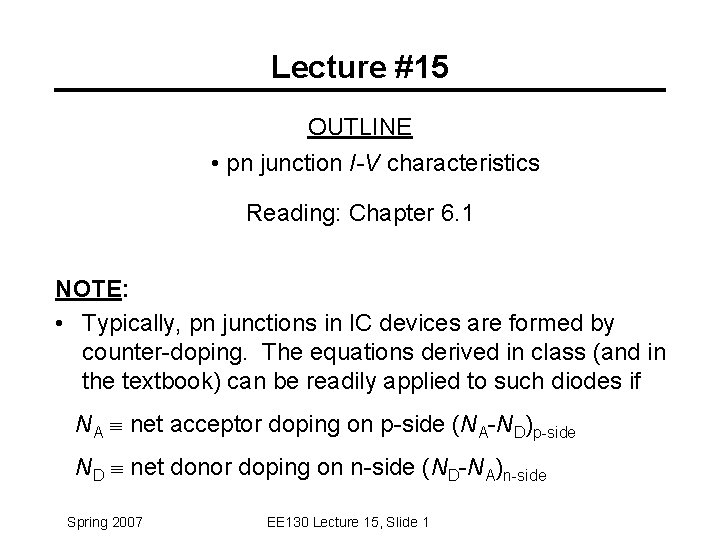
Lecture #15 OUTLINE • pn junction I-V characteristics Reading: Chapter 6. 1 NOTE: • Typically, pn junctions in IC devices are formed by counter-doping. The equations derived in class (and in the textbook) can be readily applied to such diodes if NA net acceptor doping on p-side (NA-ND)p-side ND net donor doping on n-side (ND-NA)n-side Spring 2007 EE 130 Lecture 15, Slide 1
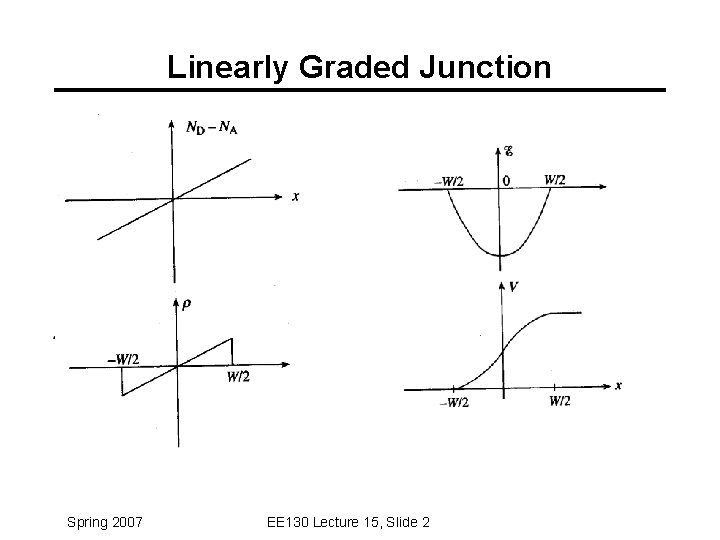
Linearly Graded Junction Spring 2007 EE 130 Lecture 15, Slide 2
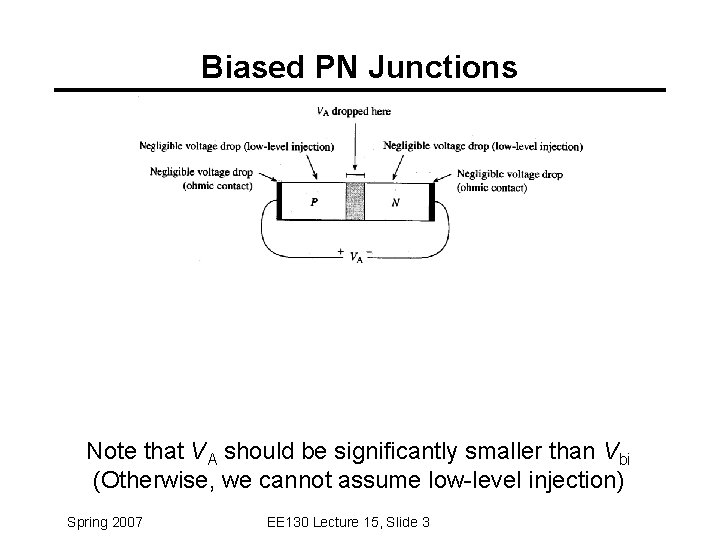
Biased PN Junctions Note that VA should be significantly smaller than Vbi (Otherwise, we cannot assume low-level injection) Spring 2007 EE 130 Lecture 15, Slide 3
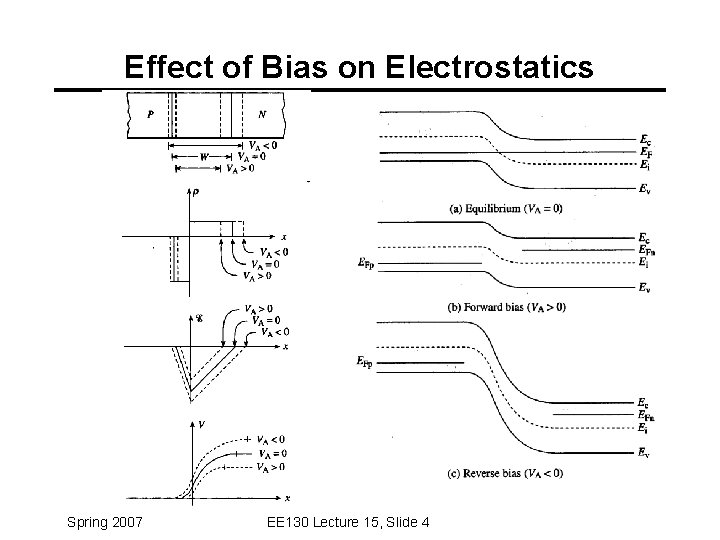
Effect of Bias on Electrostatics Spring 2007 EE 130 Lecture 15, Slide 4
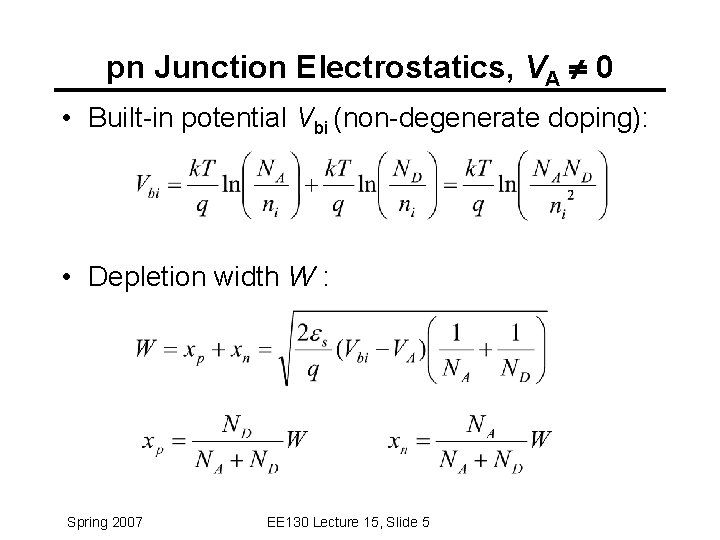
pn Junction Electrostatics, VA 0 • Built-in potential Vbi (non-degenerate doping): • Depletion width W : Spring 2007 EE 130 Lecture 15, Slide 5
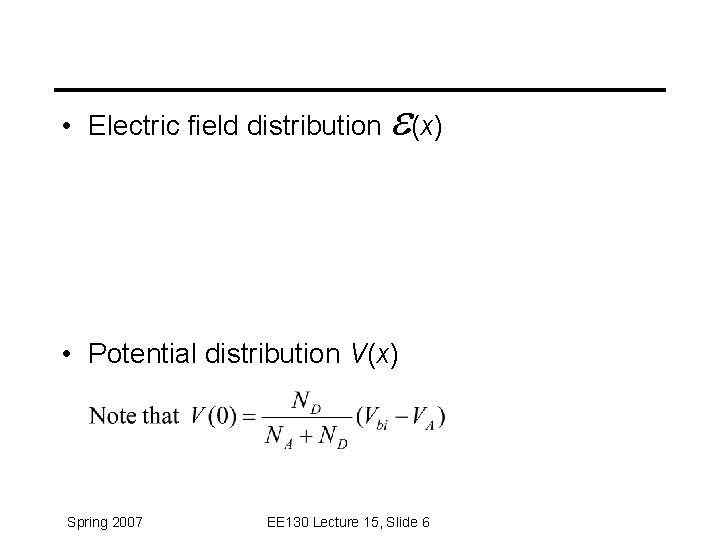
• Electric field distribution e(x) • Potential distribution V(x) Spring 2007 EE 130 Lecture 15, Slide 6
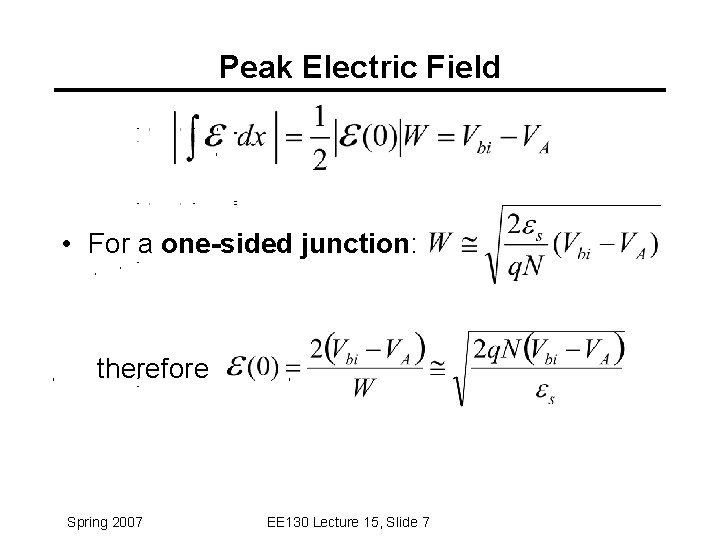
Peak Electric Field • For a one-sided junction: therefore Spring 2007 EE 130 Lecture 15, Slide 7
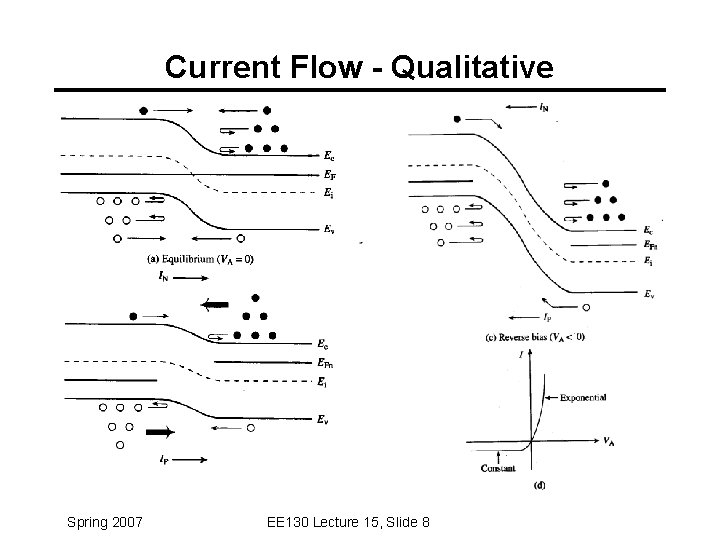
Current Flow - Qualitative Spring 2007 EE 130 Lecture 15, Slide 8
Current Flow in a pn Junction Diode • When a forward bias (VA>0) is applied, the potential barrier to diffusion across the junction is reduced – Minority carriers are “injected” into the quasineutral regions => Dnp > 0, Dpn > 0 • Minority carriers diffuse in the quasi-neutral regions, recombining with majority carriers Spring 2007 EE 130 Lecture 15, Slide 9
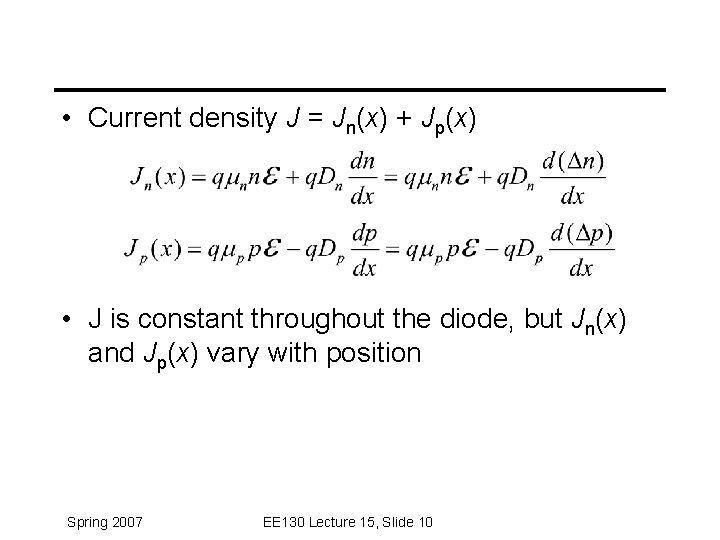
• Current density J = Jn(x) + Jp(x) • J is constant throughout the diode, but Jn(x) and Jp(x) vary with position Spring 2007 EE 130 Lecture 15, Slide 10
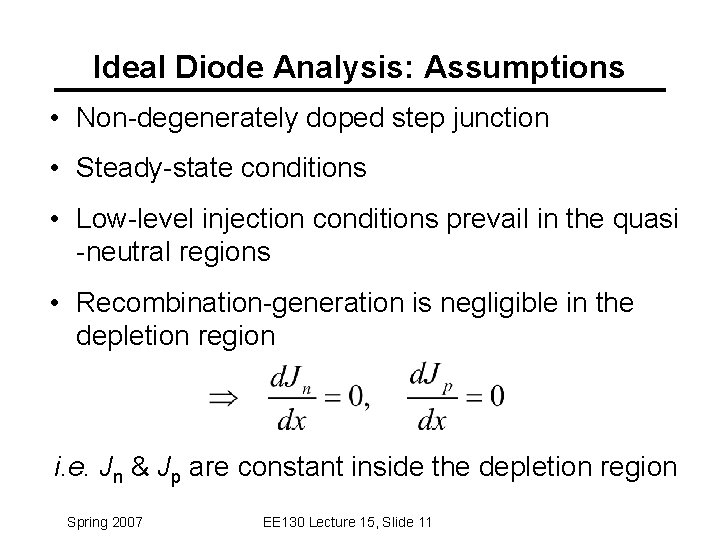
Ideal Diode Analysis: Assumptions • Non-degenerately doped step junction • Steady-state conditions • Low-level injection conditions prevail in the quasi -neutral regions • Recombination-generation is negligible in the depletion region i. e. Jn & Jp are constant inside the depletion region Spring 2007 EE 130 Lecture 15, Slide 11
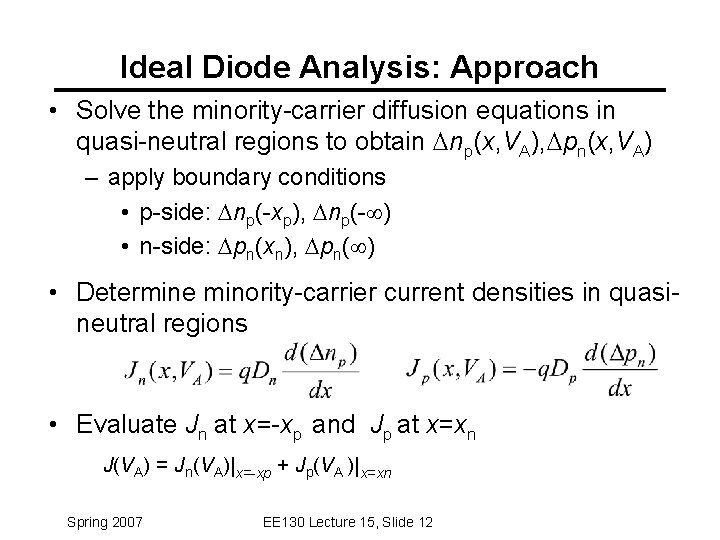
Ideal Diode Analysis: Approach • Solve the minority-carrier diffusion equations in quasi-neutral regions to obtain Dnp(x, VA), Dpn(x, VA) – apply boundary conditions • p-side: Dnp(-xp), Dnp(- ) • n-side: Dpn(xn), Dpn( ) • Determine minority-carrier current densities in quasineutral regions • Evaluate Jn at x=-xp and Jp at x=xn J(VA) = Jn(VA)|x=-xp + Jp(VA )|x=xn Spring 2007 EE 130 Lecture 15, Slide 12
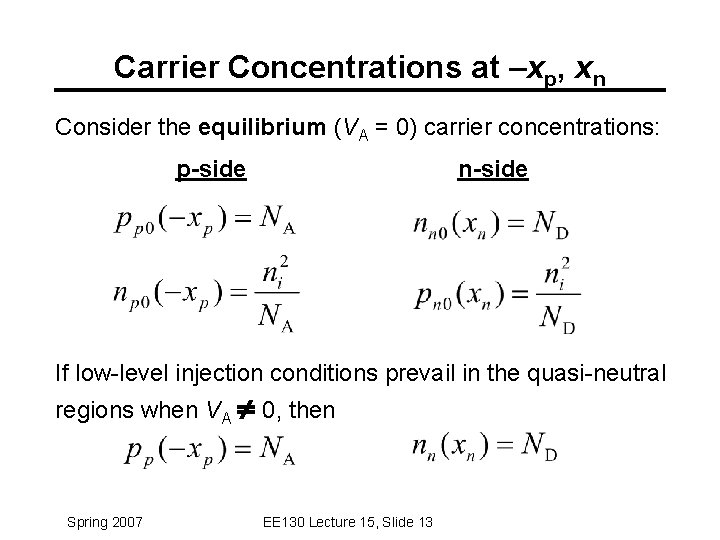
Carrier Concentrations at –xp, xn Consider the equilibrium (VA = 0) carrier concentrations: p-side n-side If low-level injection conditions prevail in the quasi-neutral regions when VA 0, then Spring 2007 EE 130 Lecture 15, Slide 13
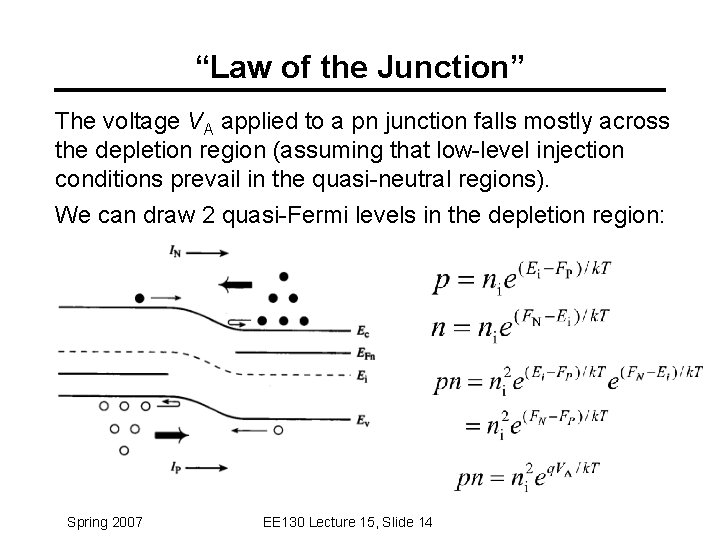
“Law of the Junction” The voltage VA applied to a pn junction falls mostly across the depletion region (assuming that low-level injection conditions prevail in the quasi-neutral regions). We can draw 2 quasi-Fermi levels in the depletion region: Spring 2007 EE 130 Lecture 15, Slide 14
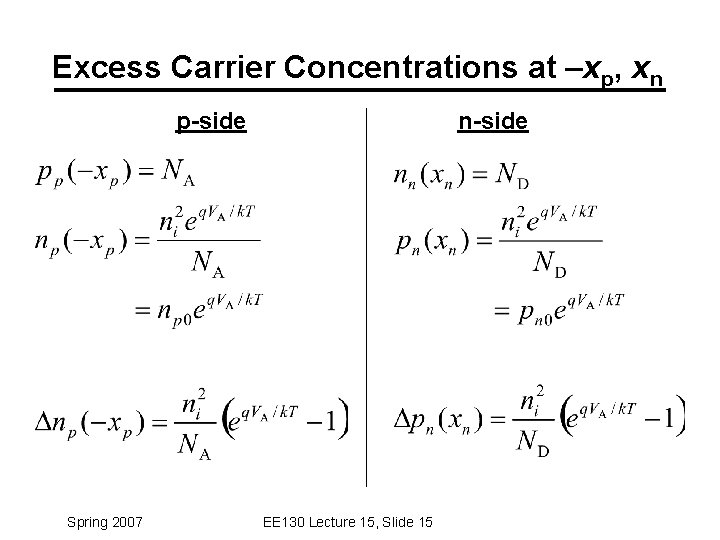
Excess Carrier Concentrations at –xp, xn p-side Spring 2007 n-side EE 130 Lecture 15, Slide 15
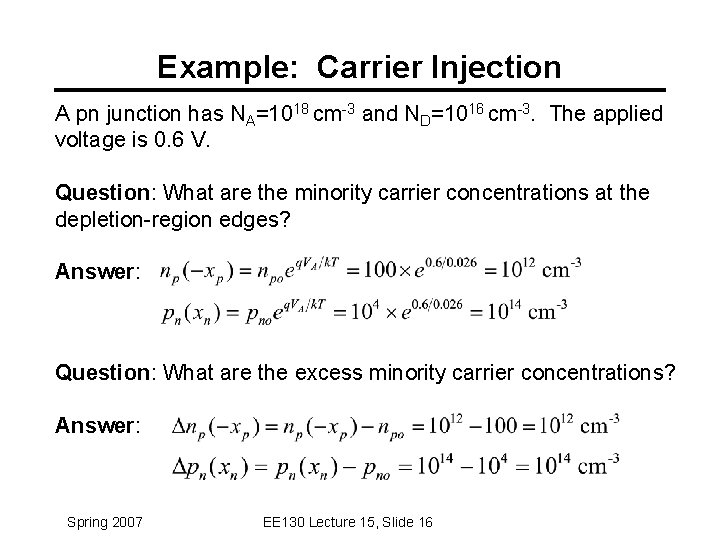
Example: Carrier Injection A pn junction has NA=1018 cm-3 and ND=1016 cm-3. The applied voltage is 0. 6 V. Question: What are the minority carrier concentrations at the depletion-region edges? Answer: Question: What are the excess minority carrier concentrations? Answer: Spring 2007 EE 130 Lecture 15, Slide 16
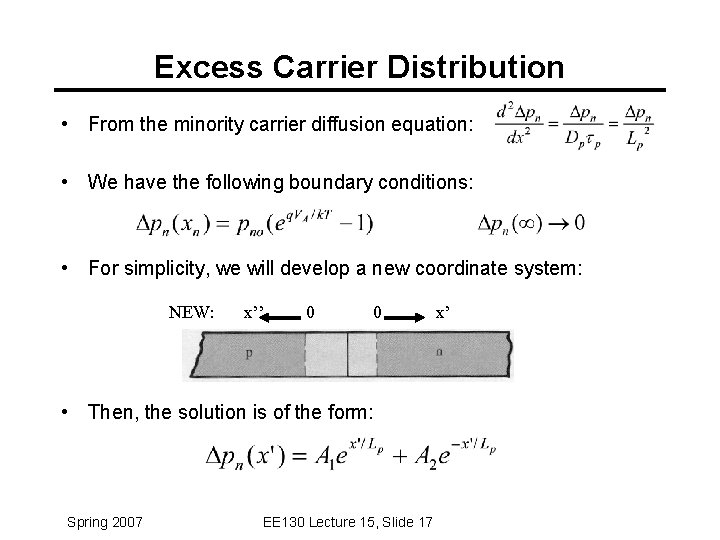
Excess Carrier Distribution • From the minority carrier diffusion equation: • We have the following boundary conditions: • For simplicity, we will develop a new coordinate system: NEW: x’’ 0 0 • Then, the solution is of the form: Spring 2007 EE 130 Lecture 15, Slide 17 x’
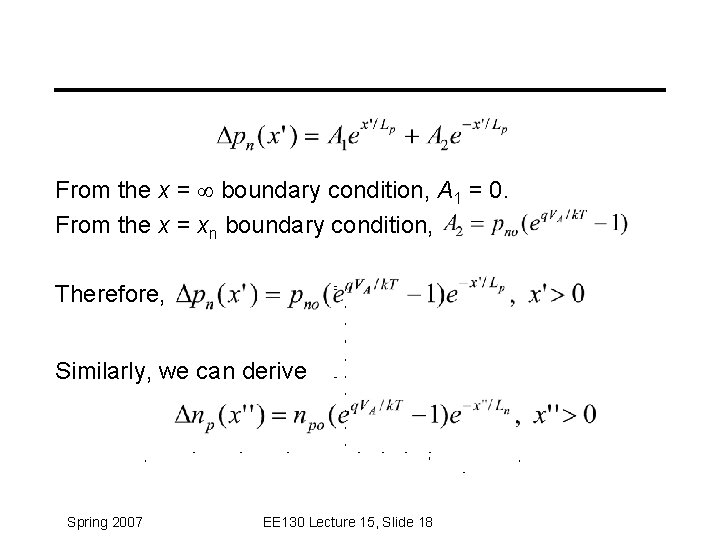
From the x = boundary condition, A 1 = 0. From the x = xn boundary condition, Therefore, Similarly, we can derive Spring 2007 EE 130 Lecture 15, Slide 18
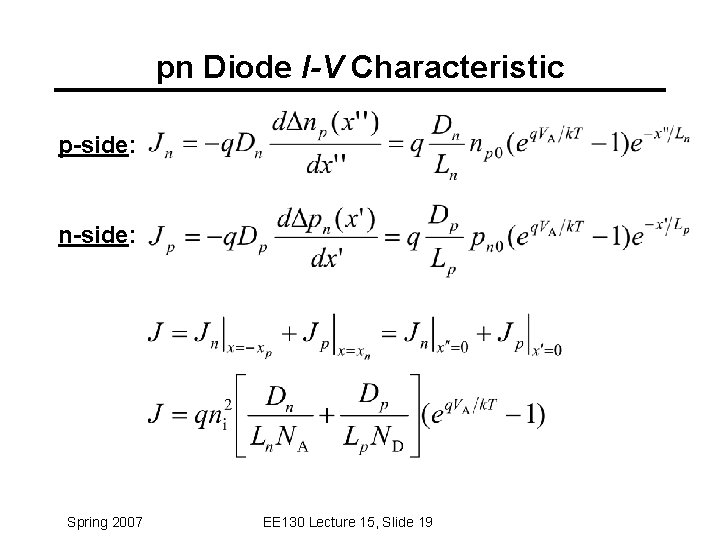
pn Diode I-V Characteristic p-side: n-side: Spring 2007 EE 130 Lecture 15, Slide 19
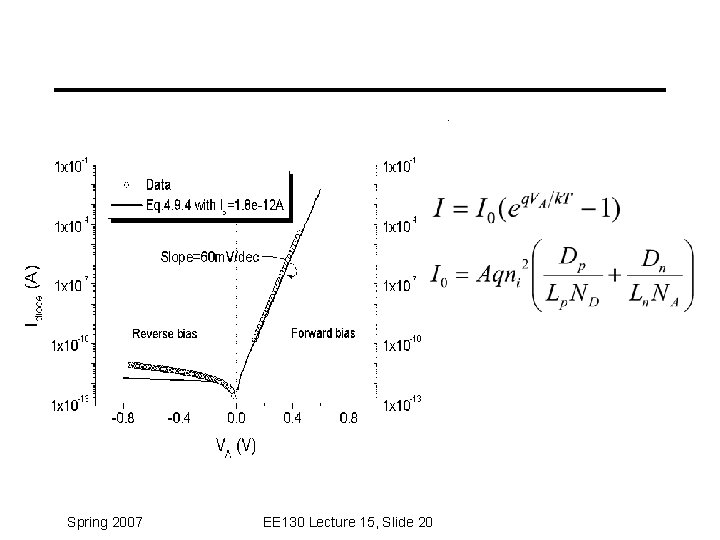
Spring 2007 EE 130 Lecture 15, Slide 20
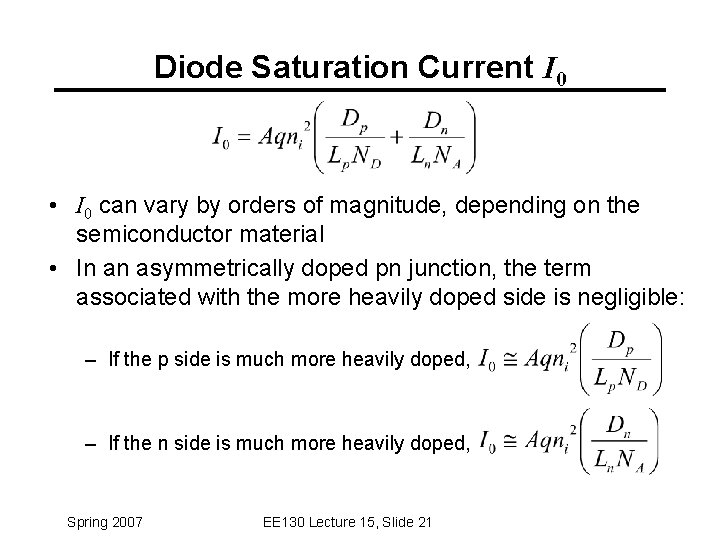
Diode Saturation Current I 0 • I 0 can vary by orders of magnitude, depending on the semiconductor material • In an asymmetrically doped pn junction, the term associated with the more heavily doped side is negligible: – If the p side is much more heavily doped, – If the n side is much more heavily doped, Spring 2007 EE 130 Lecture 15, Slide 21
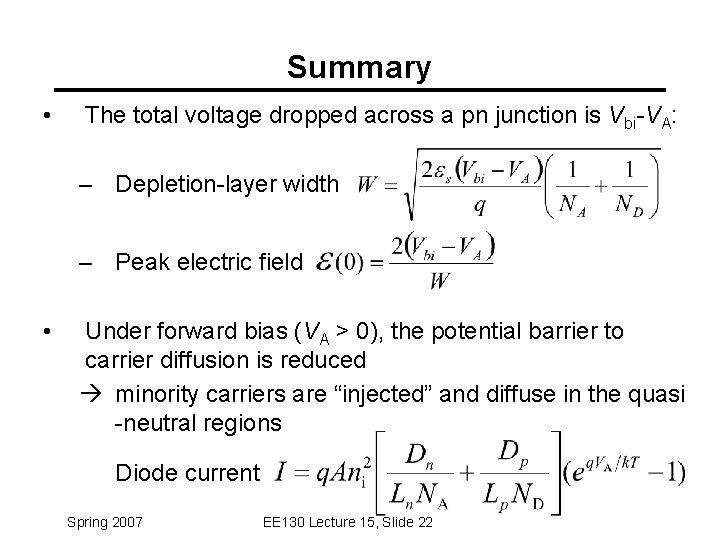
Summary • The total voltage dropped across a pn junction is Vbi-VA: – Depletion-layer width – Peak electric field • Under forward bias (VA > 0), the potential barrier to carrier diffusion is reduced à minority carriers are “injected” and diffuse in the quasi -neutral regions Diode current Spring 2007 EE 130 Lecture 15, Slide 22