
Lecture 15 Large Cache Design III Topics Replacement



- Slides: 19
Lecture 15: Large Cache Design III • Topics: Replacement policies, prefetch, dead blocks, associativity, cache networks 1
LIN Qureshi et al. , ISCA’ 06 • Memory level parallelism (MLP): number of misses that simultaneously access memory; high MLP miss is less expensive • Replacement decision is a linear combination of recency and MLP experienced when fetching that block • MLP is estimated by tracking the number of outstanding requests in the MSHR while waiting in the MSHR • Can also use set dueling to decide between LRU and LIN 2
Pseudo-LIFO Chaudhuri, MICRO’ 09 • A fill stack is a FIFO that tracks the order in which blocks entered the set • Most hits are serviced while a block is near the top of the stack; there is usually a knee-point beyond which blocks stop yielding hits • Evict the highest block above the knee that has not yet serviced a hit in its current fill stack position • Allows some blocks to probabilistically escape past the knee and get retained for distant reuse 3
Scavenger Basu et al. , MICRO’ 07 • Half the cache is used as a victim cache to retain blocks that will likely be used in the distant future • Counting bloom filters to track a block’s potential for reuse and make replacement decisions in the victim cache • Complex indexing and search in the victim cache • Another recent paper (Nu. Cache, HPCA’ 11) places blocks in a large FIFO victim file if they were fetched by delinquent PCs and the block has a short re-use distance 4
V-Way Cache Qureshi et al. , ISCA’ 05 • Meant to reduce load imbalance among sets and compute a better global replacement decision • Tag store: every set has twice as many ways • Data store: no correspondence with tag store; need forward and reverse pointers • In most cases, can replace any block; every block has a 2 b saturating counter that is incremented on every access; scan blocks (and decrement) until a zero counter is found; continue scan on next replacement 5
ZCache Sanchez and Kozyrakis, MICRO’ 10 • Skewed associative cache: each way has a different indexing function (in essence, W direct-mapped caches) • When block A is brought in, it could replace one of four (say) blocks B, C, D, E; but B could be made to reside in one of three other locations (currently occupied by F, G, H); and F could be moved to one of three other locations • We thus get a tree of replacement options and we can pick LRU among these options • Every replacement requires multiple tag look-ups and data block copies; worthwhile if you’re reducing off-chip accesses 6
Temporal Memory Streaming Wenisch et al. , ISCA’ 05 • When a thread incurs a series of misses to blocks (PQRS, not necessarily contiguous), other threads are likely to incur a similar series of misses • Each thread maintains its miss log in a circular buffer in memory; the directory for P also keeps track of a pointer to multiple log entries of P • When a thread has a miss on P, it contacts the directory and the directory provides the log pointers; the thread receives multiple streams and starts prefetching • Log access and prefetches are off the critical path 7
Spatial Memory Streaming Somogyi et al. , ISCA’ 06 • Threads often enter a new region (page) and touch a few arbitrary blocks in that region • A predictor is indexed with the PC of the first access to that region and the offset of the first access; the predictor returns a bit vector indicating the blocks accessed within that region • Can even prefetch for regions that have not been touched before! 8
Feedback Directed Prefetching Srinath et al. , HPCA’ 07 • A stream prefetcher has two parameters: P: prefetch distance: how far ahead of the start do we prefetch N: prefetch degree: how much do we advance the start when there is a hit in the stream • Can vary these two parameters based on pref effectiveness • Accuracy: a bit tracks if a prefetched block was touched • Timeliness: was the block touched while in the MSHR? • Pollution: track recent evictions (Bloom filter) and see if 9 they are re-touched; also guides insertion policy
Dead Block Prediction • Can keep track of the number of accesses to a line during its previous residence; the block is deemed to be dead after that many accesses Kharbutli, Solihin, IEEE TOC’ 08 • To reduce noise, an access can be considered as a block’s move to the MRU position Liu et al. , MICRO 2008 • Earlier DBPs used a trace of PCs to capture when a block has completed its use • DBP is used for energy savings, replacement policies, and cache bypassing 10
Distill Cache Qureshi, HPCA 2007 • Half the ways are traditional (LOC); when a block is evicted from the LOC, only the touched words are stored in a word-organized cache that has many narrow ways • Incurs a fair bit of complexity (more tags for the WOC, collection of word touches in L 1 s, blocks with holes, etc. ) • Does not need a predictor; actions are based on the block’s behavior during current residence • Useless word identification is orthogonal to cache compression 11
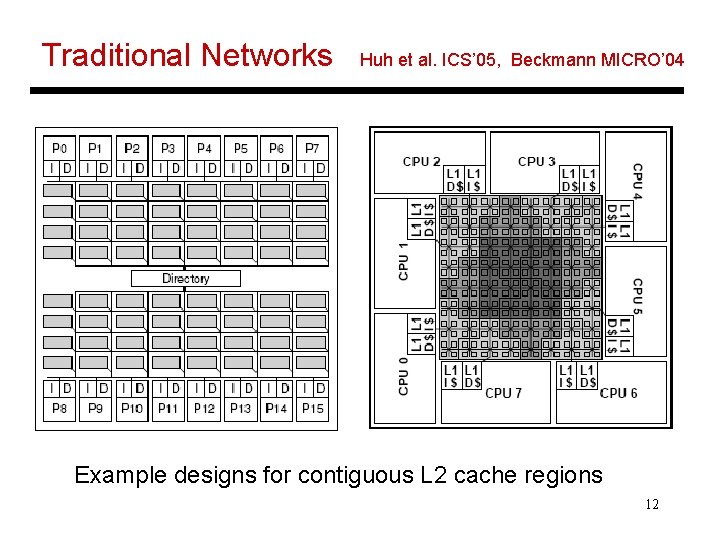
Traditional Networks Huh et al. ICS’ 05, Beckmann MICRO’ 04 Example designs for contiguous L 2 cache regions 12
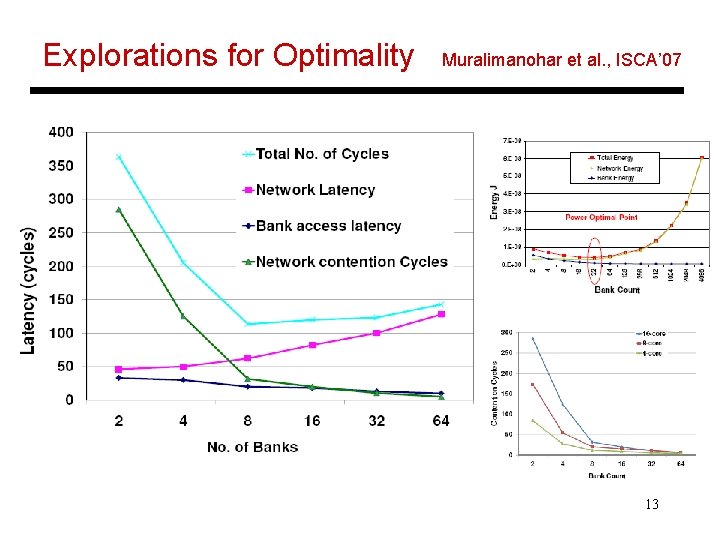
Explorations for Optimality Muralimanohar et al. , ISCA’ 07 13
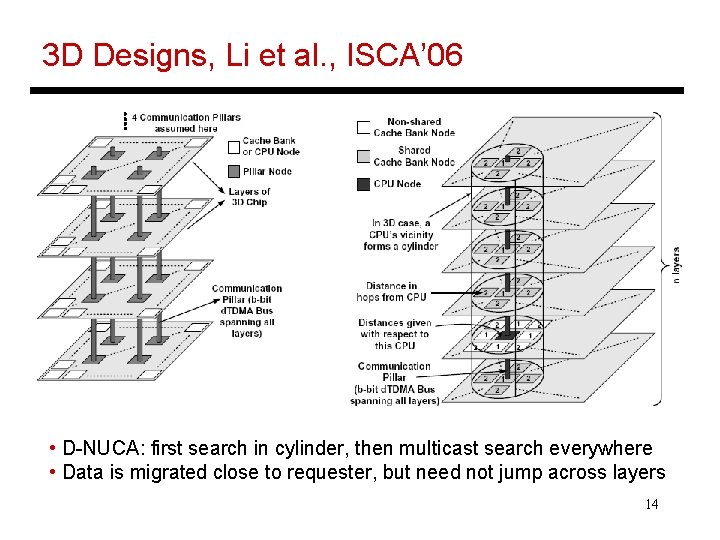
3 D Designs, Li et al. , ISCA’ 06 • D-NUCA: first search in cylinder, then multicast search everywhere • Data is migrated close to requester, but need not jump across layers 14
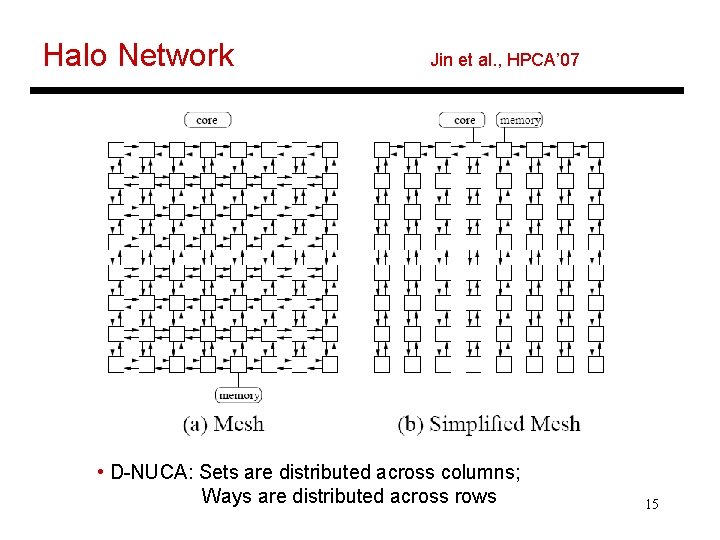
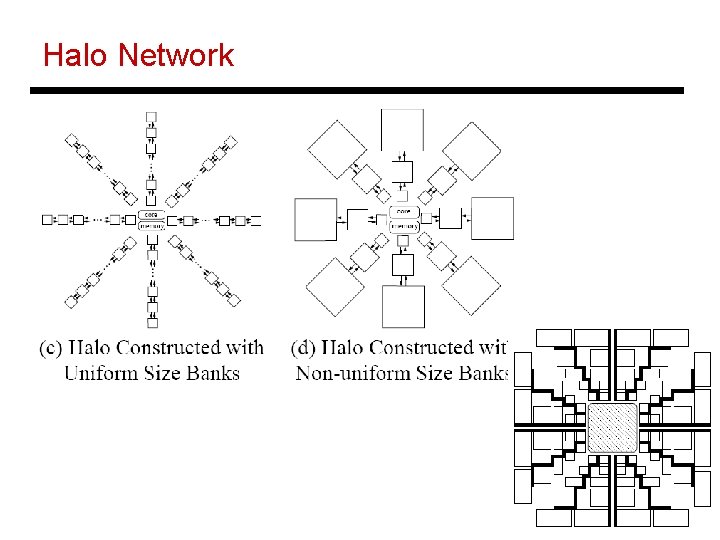
Halo Network Jin et al. , HPCA’ 07 • D-NUCA: Sets are distributed across columns; Ways are distributed across rows 15
Halo Network 16
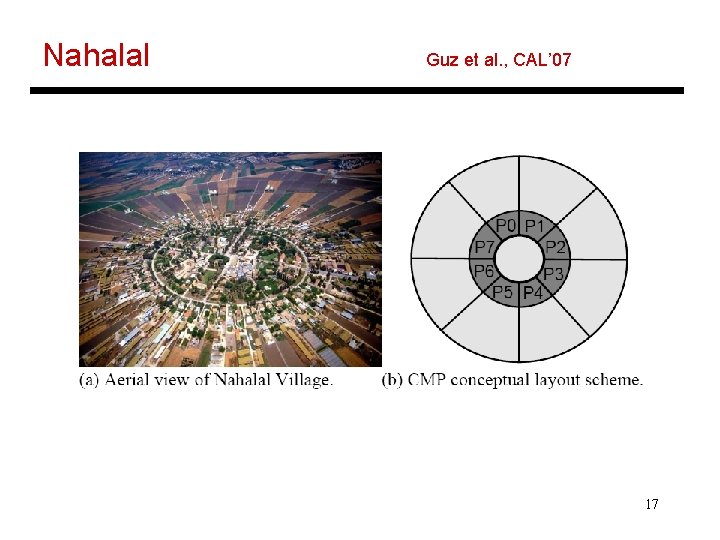
Nahalal Guz et al. , CAL’ 07 17
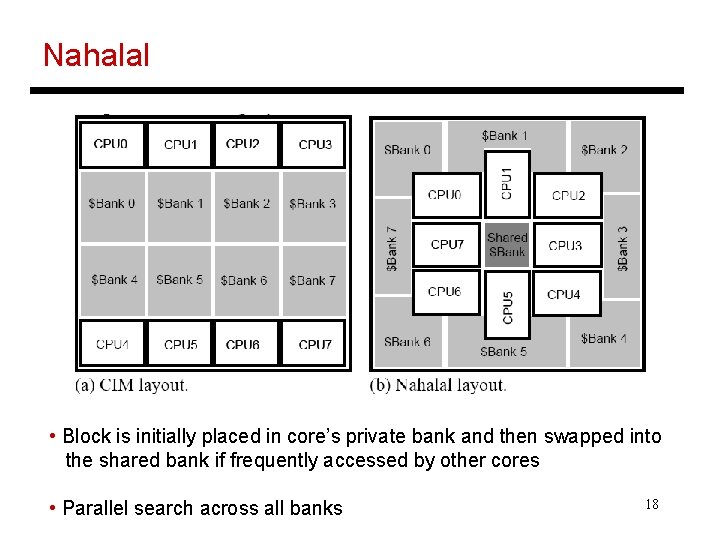
Nahalal • Block is initially placed in core’s private bank and then swapped into the shared bank if frequently accessed by other cores • Parallel search across all banks 18
Title • Bullet 19