
Lecture 15 How to be a Savvy User
Lecture 15 How to be a Savvy User and Consumer of AO Claire Max Astro 289, UC Santa Cruz Februrary 27, 2020 Page 1

How to be a savvy user and consumer of AO systems? Topics • What kinds of astronomy are helped by AO? • For users of astronomical AO: – How to plan your observations – What questions to ask when you get to the telescope – Observing procedures • For critical readers of AO papers in journals: – How to assess the reality of AO results reported in the literature – Which data should you take seriously? – What are “danger signs” that should make you doubtful? Page 2
What kinds of observations will be helped by AO? (Part 1) • See details that were not previously present – Qualitative: can make new morphological statements » Examples: this galaxy has a double nucleus, Titan’s clouds have reformed in southern hemisphere, … – Quantitative: need to know Point Spread Function; need to understand PSF error bars » New methods called “PSF Reconstruction” do a pretty good job » Based on wavefront sensor measurements and commands sent to DM (AO Telemetry stream) Page 3
What kinds of observations will be helped by AO? (Part 2) • Detect fainter objects/features – Works for point sources – But: IR AO systems may inject more thermal background, because of many mirror surfaces (unless you use an adaptive secondary!) – In astronomy, faint extended objects can actually be harder to see with AO. Limiting factor is sky background or thermal background, and AO doesn’t improve this for extended objects. – For a point source with a diffraction limited core, integration time to reach a given SNR scales as D-4 where D is telescope diameter – If fully seeing limited, integration time scales as D-2 Page 4
What kinds of observations will be helped by AO? (2) • AO increases image contrast: – Increased Strehl ratio ⇒ sharper edges, brighter features (if they are close to diffraction limit) – Detecting faint things close to bright things: » companions to bright stars » host galaxies of quasars » stellar and protoplanetary disks – Caution: Contrast improvement may not be helped by AO for extended features, unless they have structure at λ / D • AO permits more precise astrometry – Can measure position of a point source more accurately if a) it is smaller, and b) it is brighter – But need other stars in the field to create a reference frame Page 5
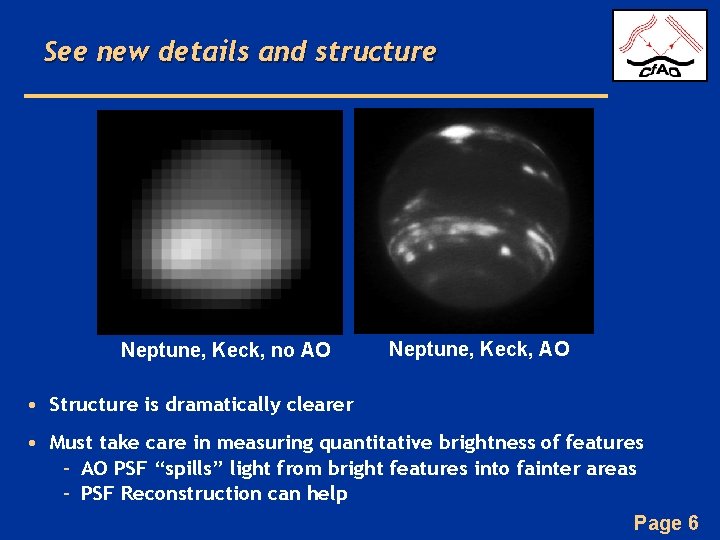
See new details and structure Neptune, Keck, no AO Neptune, Keck, AO • Structure is dramatically clearer • Must take care in measuring quantitative brightness of features – AO PSF “spills” light from bright features into fainter areas – PSF Reconstruction can help Page 6
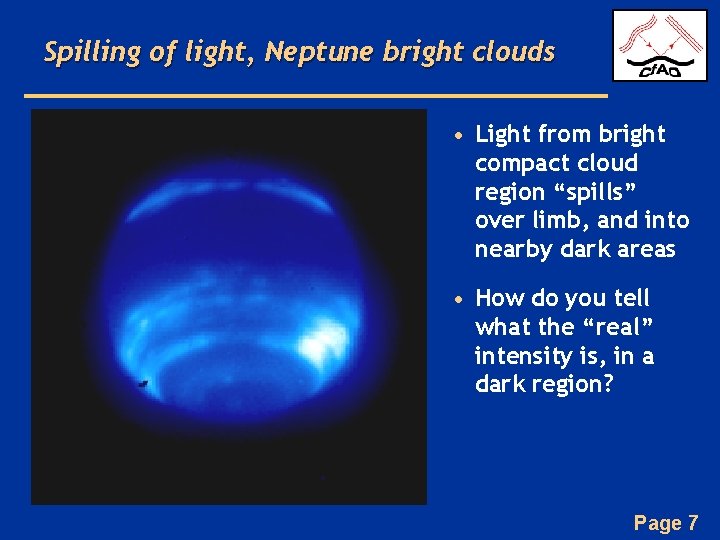
Spilling of light, Neptune bright clouds • Light from bright compact cloud region “spills” over limb, and into nearby dark areas • How do you tell what the “real” intensity is, in a dark region? Page 7
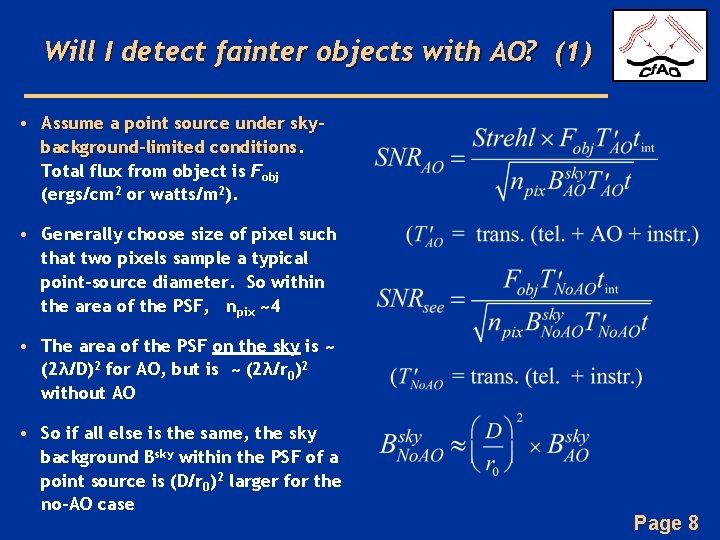
Will I detect fainter objects with AO? (1) • Assume a point source under skybackground-limited conditions Total flux from object is Fobj (ergs/cm 2 or watts/m 2). • Generally choose size of pixel such that two pixels sample a typical point-source diameter. So within the area of the PSF, npix ~4 • The area of the PSF on the sky is ~ (2λ/D)2 for AO, but is ~ (2λ/r 0)2 without AO • So if all else is the same, the sky background Bsky within the PSF of a point source is (D/r 0)2 larger for the no-AO case Page 8
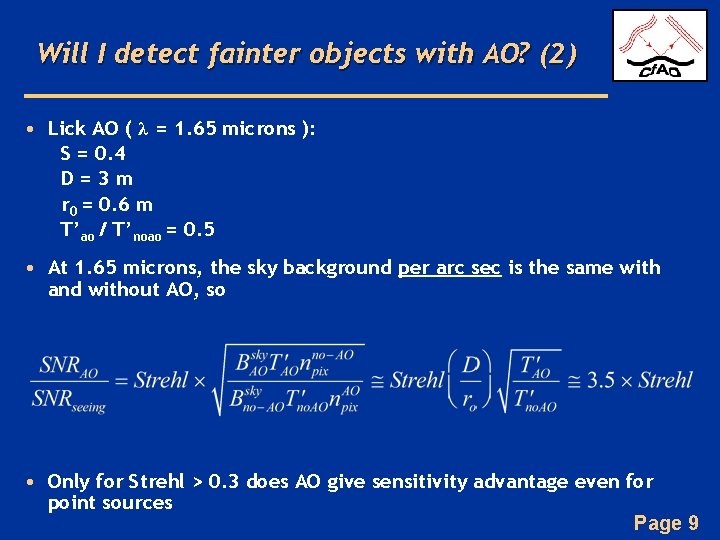
Will I detect fainter objects with AO? (2) • Lick AO ( λ = 1. 65 microns ): S = 0. 4 D=3 m r 0 = 0. 6 m T’ao / T’noao = 0. 5 • At 1. 65 microns, the sky background per arc sec is the same with and without AO, so • Only for Strehl > 0. 3 does AO give sensitivity advantage even for point sources Page 9
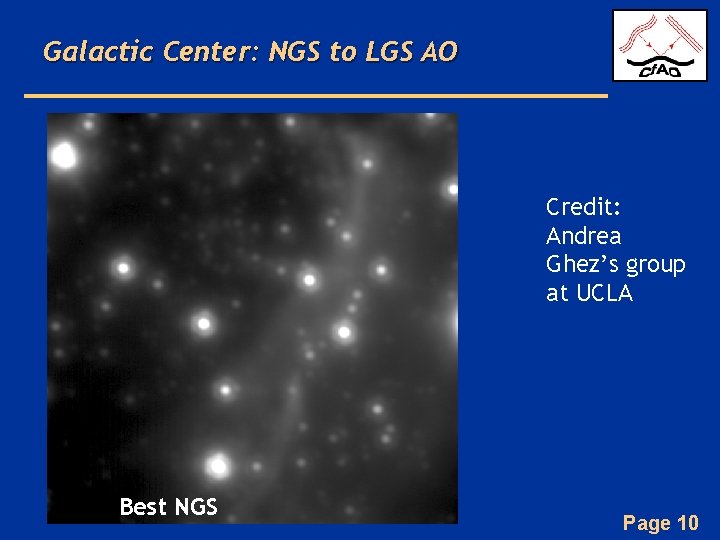
Galactic Center: NGS to LGS AO Credit: Andrea Ghez’s group at UCLA Best NGS Page 10
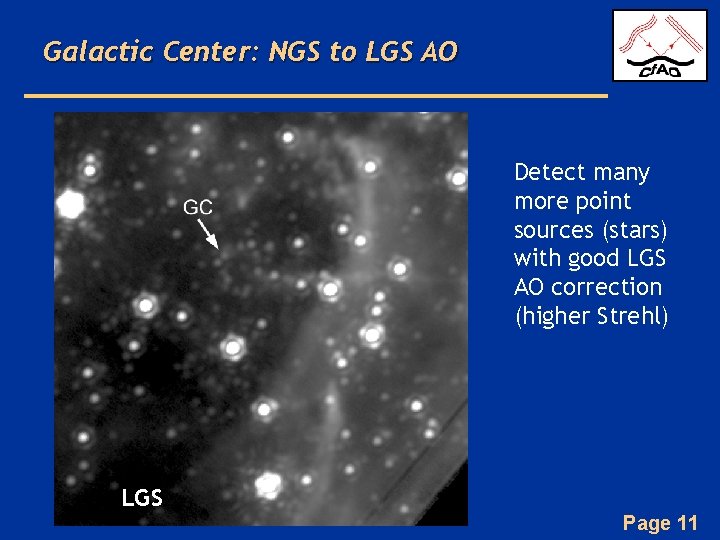
Galactic Center: NGS to LGS AO Detect many more point sources (stars) with good LGS AO correction (higher Strehl) LGS Page 11
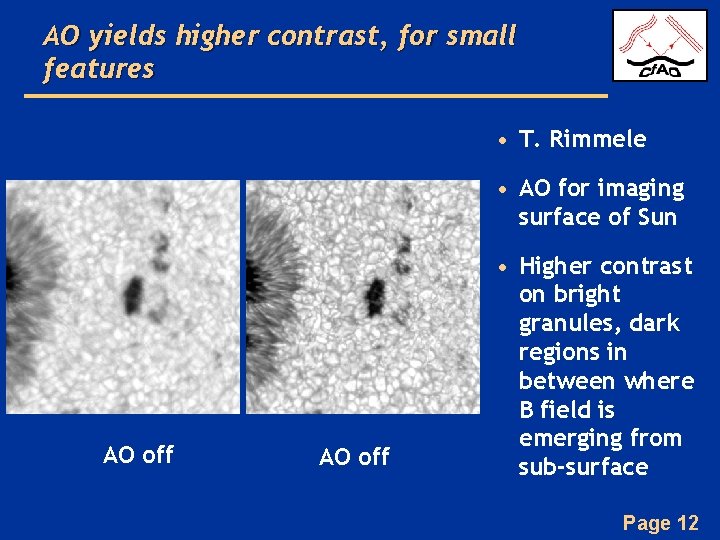
AO yields higher contrast, for small features • T. Rimmele • AO for imaging surface of Sun AO off • Higher contrast on bright granules, dark regions in between where B field is emerging from sub-surface Page 12
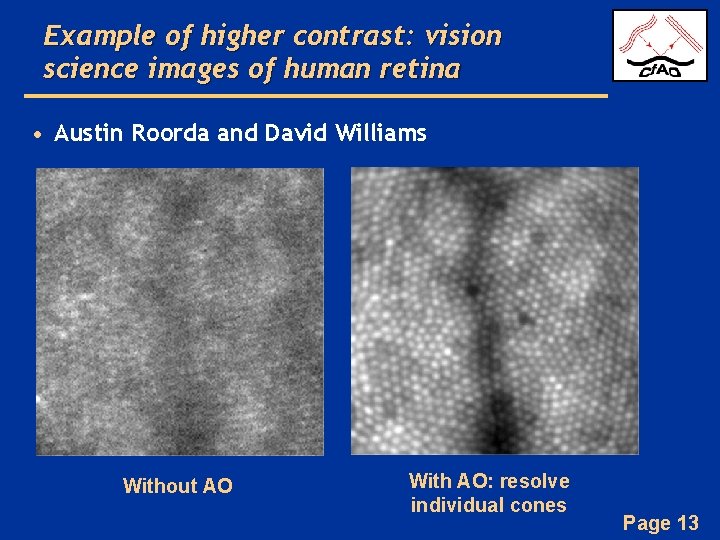
Example of higher contrast: vision science images of human retina • Austin Roorda and David Williams Without AO With AO: resolve individual cones Page 13
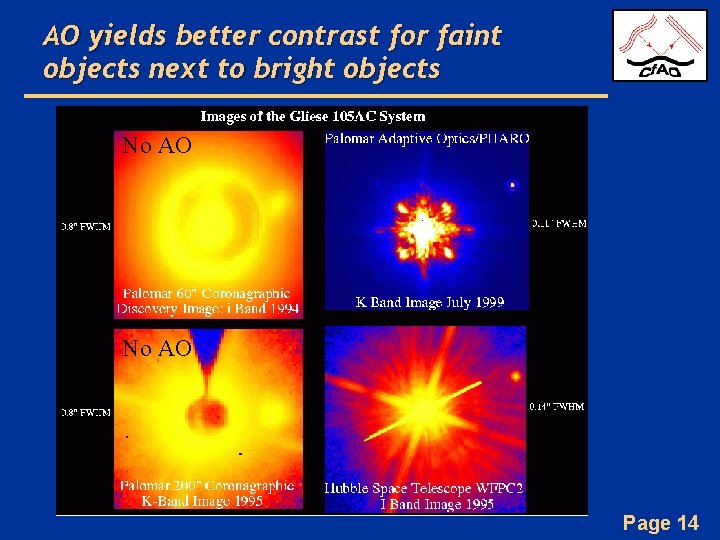
AO yields better contrast for faint objects next to bright objects No AO Page 14
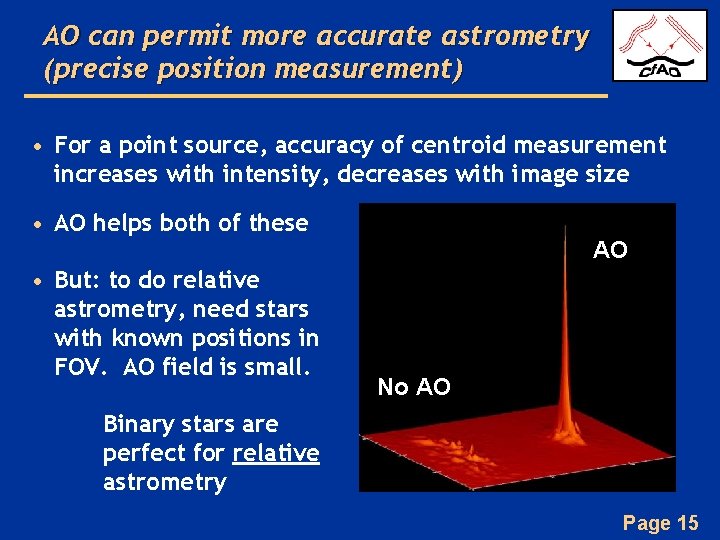
AO can permit more accurate astrometry (precise position measurement) • For a point source, accuracy of centroid measurement increases with intensity, decreases with image size • AO helps both of these AO • But: to do relative astrometry, need stars with known positions in FOV. AO field is small. No AO Binary stars are perfect for relative astrometry Page 15

Questions? Discussion? Page 16
How to plan observations ahead of time • First requirement: understand what Strehl ratio you will need for your science project to succeed • Estimate exposure time needed to achieve good SNR – Some AO systems have exposure time calculators – Or check with folks who have observed in the past • Refer to web pages to see what brightness guide star, at what distance, at what zenith angle, you will need • Check AO system web page for maximum offset between science target and guide star • Search star catalogues to find guide stars Page 17
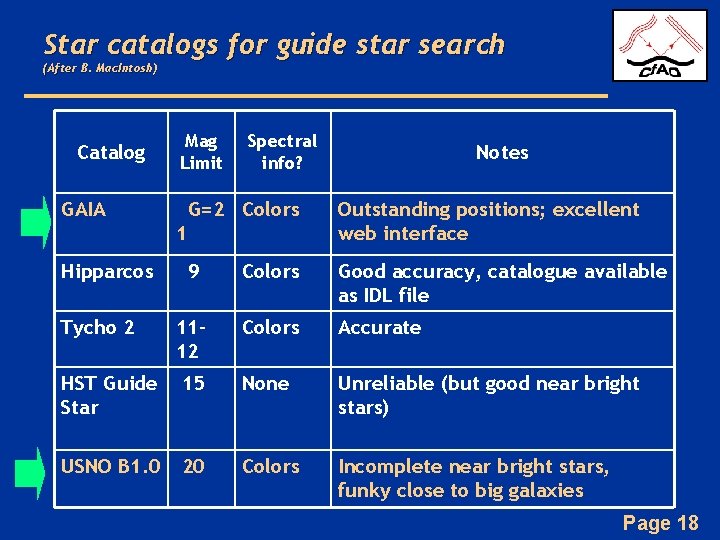
Star catalogs for guide star search (After B. Mac. Intosh) Catalog Mag Limit GAIA Spectral info? Notes G=2 Colors Outstanding positions; excellent web interface 9 Colors Good accuracy, catalogue available as IDL file 1112 Colors Accurate HST Guide Star 15 None Unreliable (but good near bright stars) USNO B 1. 0 20 Colors Incomplete near bright stars, funky close to big galaxies 1 Hipparcos Tycho 2 Page 18
Finding a guide star: Tools • Vizie. R http: //vizier. u-strasbg. fr/viz-bin/Vizie. R – Has the ability to do constrained searches – limited in position, magnitude, etc. – from a list of input targets • Aladin (one of Vizier’s capabilities) – https: //aladin. u-strasbg. fr/ – Can overplot a Digital Sky Survey image of your target with all the stars it can find from the catalogue of choice. Very useful for finding guide stars. Page 19
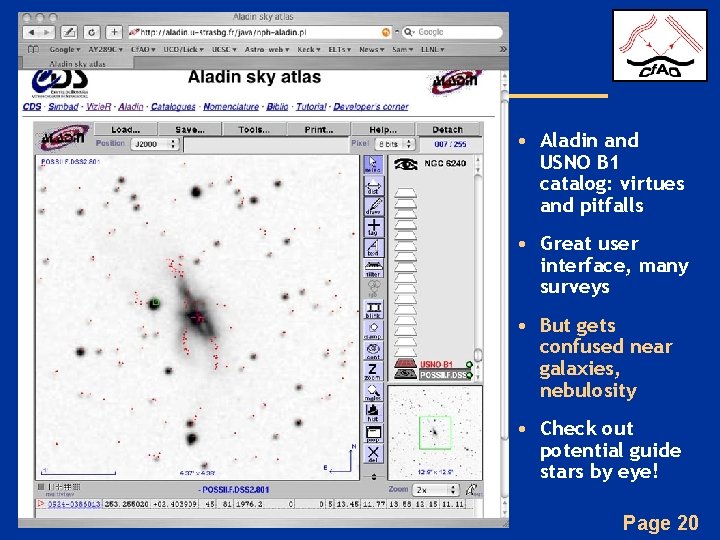
• Aladin and USNO B 1 catalog: virtues and pitfalls • Great user interface, many surveys • But gets confused near galaxies, nebulosity • Check out potential guide stars by eye! Page 20
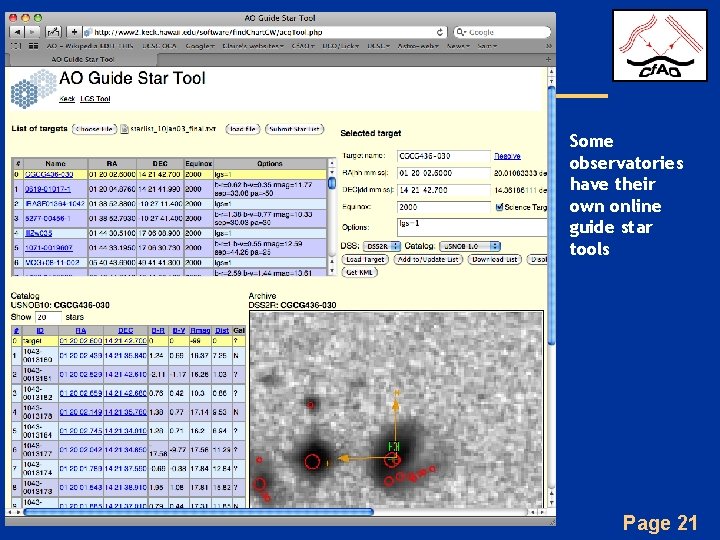
Some observatories have their own online guide star tools Page 21
Other questions to address prior to observing with AO system • PSF calibrations – What is my PSF star calibration strategy? – Can I do PSF reconstruction? – What is the impact of anisoplanatism? • Observing time – Calculate exposure times needed for good SNR – Have I accurately estimated AO’s overhead (wasted time)? • Calibration and flat-fielding issues – How will I calibrate the sky fluxes (offset skies, dithering, other? ) – How will I calibrate detector response variations? – How will I calibrate photometry (brightness measurement)? » Usually observe photometric standard stars » How often? In what sequence? Page 22
“PSF stars” • Before, after, and sometimes intermingled with observing science target, observe “PSF star” • Constraints: – If science target is offset in angle from guide star, can find PSF star pair with similar relative offset – Should be at ~ same zenith angle as science target (but typically an hour or two earlier or later) – PSF star should produce same number of wavefront sensor counts as guide star for your science target. • In practice it’s hard to meet all these conditions • With LGS, I typically end up using the tip-tilt star as PSF Page 23
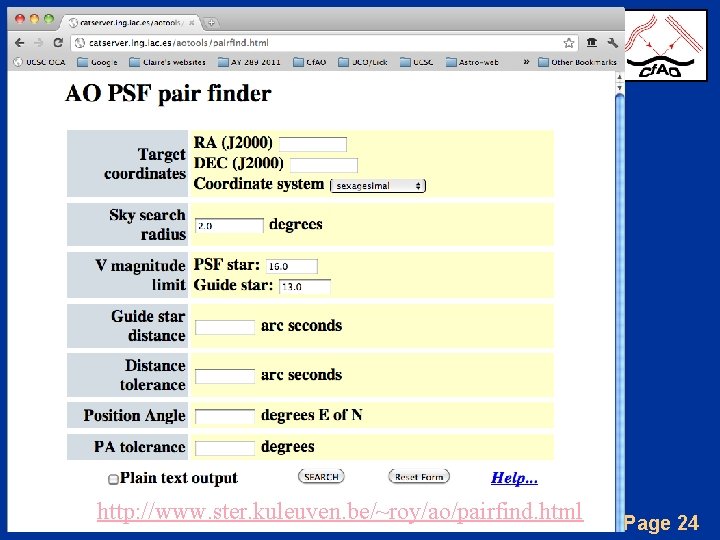
http: //www. ster. kuleuven. be/~roy/ao/pairfind. html Page 24
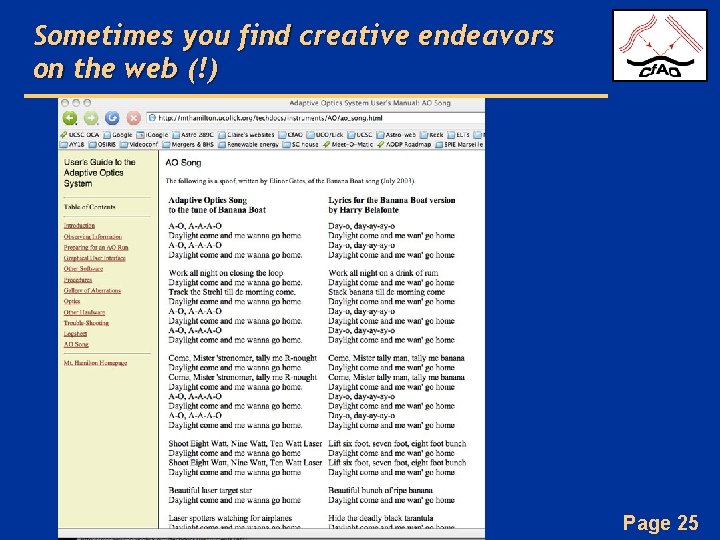
Sometimes you find creative endeavors on the web (!) Page 25
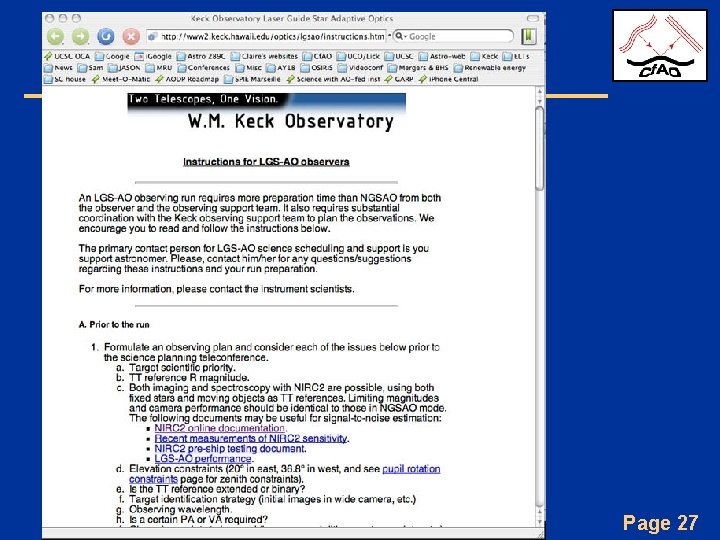
Laser guide star observing requires more preparation • US observatories have to submit target list to US Space Command (satellite avoidance) in advance – Not good form to destroy the detector on a billion dollar satellite • Specific formats required • Check web pages for instructions Page 26
Page 27
Questions to ask when you get to the telescope • If possible, come a day early and watch the previous night’s observers use the AO system • Ask for a “lesson” in how to control the AO system from the instrument interface • Typically the AO system is calibrated each afternoon – Observatory staff will use an internal light source to measure non-common-path errors every day (before observing) – Instructive to watch this process if you’ve never seen it before Page 28
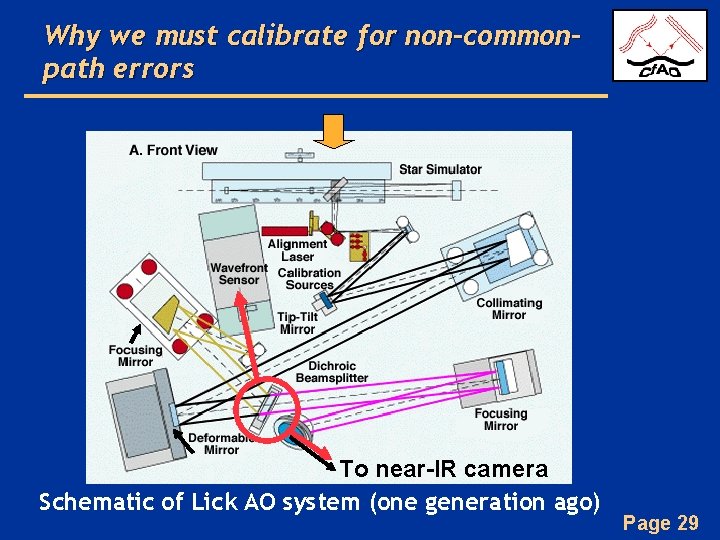
Why we must calibrate for non-commonpath errors To near-IR camera Schematic of Lick AO system (one generation ago) Page 29
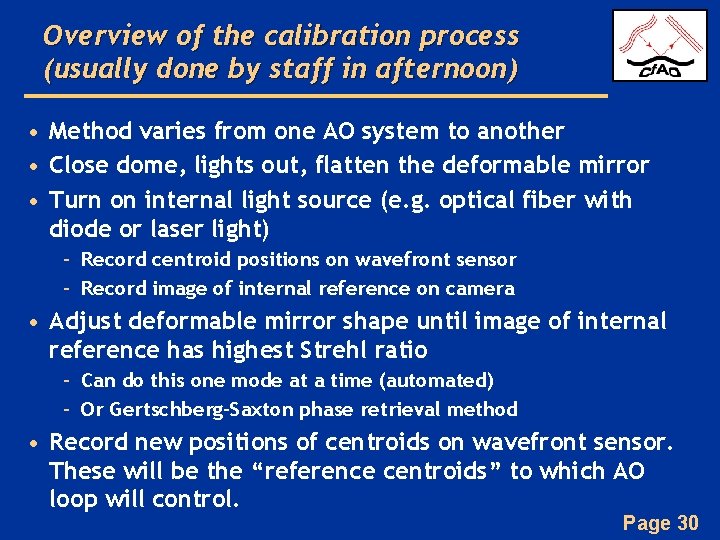
Overview of the calibration process (usually done by staff in afternoon) • Method varies from one AO system to another • Close dome, lights out, flatten the deformable mirror • Turn on internal light source (e. g. optical fiber with diode or laser light) – Record centroid positions on wavefront sensor – Record image of internal reference on camera • Adjust deformable mirror shape until image of internal reference has highest Strehl ratio – Can do this one mode at a time (automated) – Or Gertschberg-Saxton phase retrieval method • Record new positions of centroids on wavefront sensor. These will be the “reference centroids” to which AO loop will control. Page 30
AO tuning for your guide star • Wavefront sensor camera frame-rate and AO control loop gain optimized for your guide star – For fainter guide stars, want slower frame rate – With Shack-Hartmann WFS, typically need 100 -200 counts per subaperture per wavefront sensor frame, for good performance – For fainter stars, use lower control loop gain (lower bandwidth) • AO operator will take a sky background measurement for the wavefront sensor – Subtracted from each wavefront sensor frame • Based on number of wavefront sensor counts, AO operator will run a program to optimize the AO system performance (trade frame rate against counts on wavefront sensor) • Then offset from PSF star’s guide star to the real guide star, turn on AO system, take images or spectra Page 31
Re-tuning the AO system during the night • When does operator re-tune AO system? – – At each new telescope pointing When background changes (clouds, moon) When flexure changes (after slew, long integrations) Whenever observer requests an updated tune-up • I usually keep an eye on the number of wavefront sensor counts per subaperture – When it drops considerably below its original value, ask for a re-tuning Page 32
Other observing procedures are same as for any infra-red observations (1) • Take sky backgrounds – Necessary in IR: science target can be dimmer than the sky background! – Can nod to sky so that your science target is entirely off the detector, or – If your science target is small enough, can get sky bkgnd just from dithering target on detector • Observe photometric standard stars several times during the night (if needed) Page 33
Other observing procedures are same as for any infra-red observations (2) • Dithering and nodding: 1 2 • IR array non-uniformity requires sky measurement and subtraction • To obtain a sky subtraction, usually need a multiposition dither (1 -2 -3 -4 etc. ) – If your science target is big, good to get a separate sky frame too 3 4 5 (sky) Page 34

Questions? Discussion? Page 35
How to assess the reality of AO results reported in the literature • Which data should you take seriously? • What are “danger signs” that should make you doubtful? Page 36
Taking data seriously: Three big issues 1. Strehl ratio and variability 2. Effect of using a non-point-source as a guide star or tip -tilt star 3. Signal to noise ratio Page 37
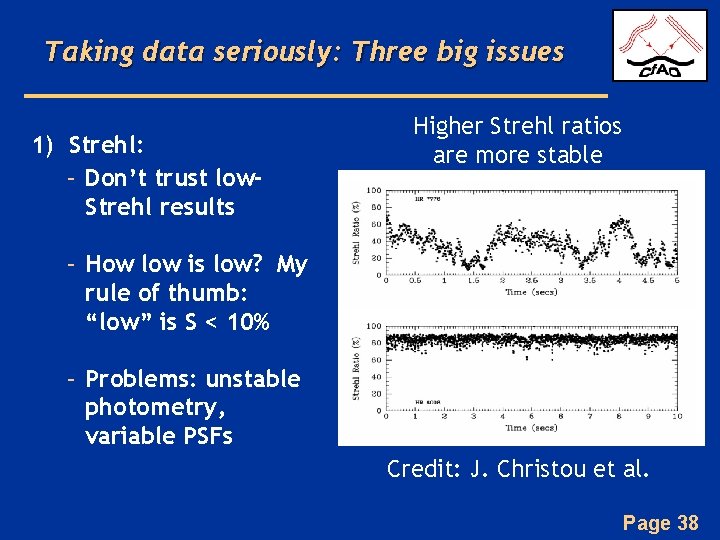
Taking data seriously: Three big issues 1) Strehl: – Don’t trust low. Strehl results Higher Strehl ratios are more stable – How low is low? My rule of thumb: “low” is S < 10% – Problems: unstable photometry, variable PSFs Credit: J. Christou et al. Page 38
Big issues, continued 2) Finite-size object used as “guide star” – Frequently produces artifacts on point spread function – Sometimes get “double-star” PSF – Look for independent measurement of PSF if possible – Also there can be issues with using finite-sized object as tip-tilt star » Most important example: using bright nucleus of a galaxy as the tip-tilt reference » The more point-like it is, the better » No firm rules here about what to do – try it! Page 39
Big issues, continued 3) Signal to noise ratio of AO image or spectrum – Rules of thumb (Hardy): » SNR needed to recognize an object in a noisy background: SNR > 5 » SNR needed for spectroscopy is much larger: people use numbers like 20, 50, 100 per resolution element (depends on the application) Be sure to look carefully at section of published paper where SNR is discussed. – If it isn’t discussed, try to estimate it yourself. Page 40
“Journal of Irreproducible Results” • Danger signs: • Low Strehl ratios (e. g. 5% - 15%) • Use of an extended source as a “natural guide star” – Can give PSFs that are double, or that have several lumps • Use of a “guide star” that IS a point source, but that is embedded in a fuzzy region – Also can give odd PSFs • Look for repeatable independent measurements of PSF Page 41
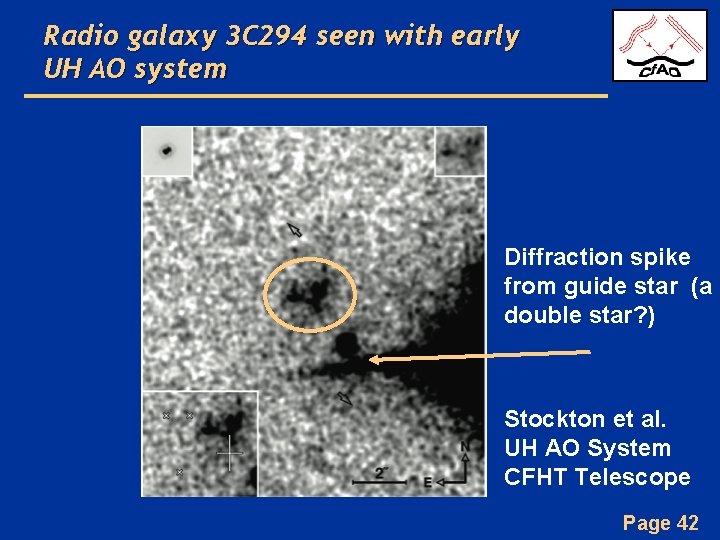
Radio galaxy 3 C 294 seen with early UH AO system Diffraction spike from guide star (a double star? ) Stockton et al. UH AO System CFHT Telescope Page 42
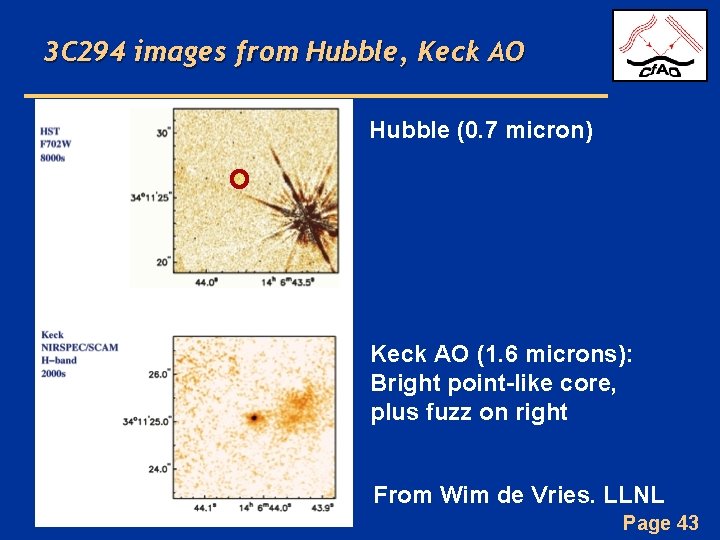
3 C 294 images from Hubble, Keck AO Hubble (0. 7 micron) Keck AO (1. 6 microns): Bright point-like core, plus fuzz on right From Wim de Vries. LLNL Page 43
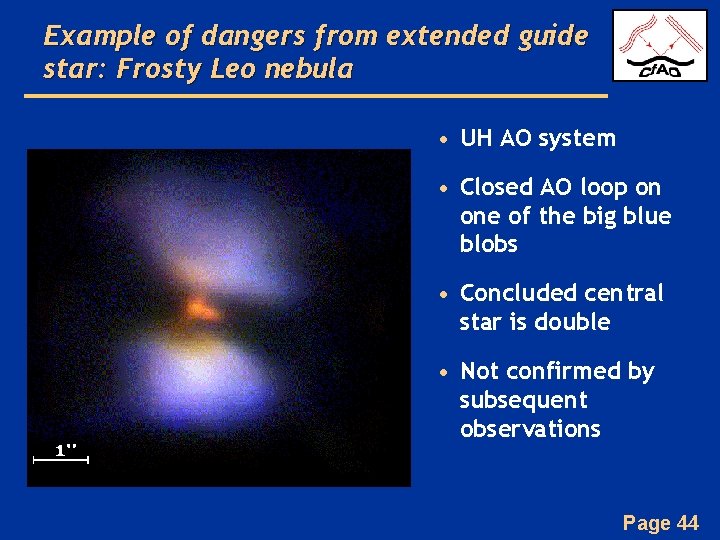
Example of dangers from extended guide star: Frosty Leo nebula • UH AO system • Closed AO loop on one of the big blue blobs • Concluded central star is double • Not confirmed by subsequent observations Page 44
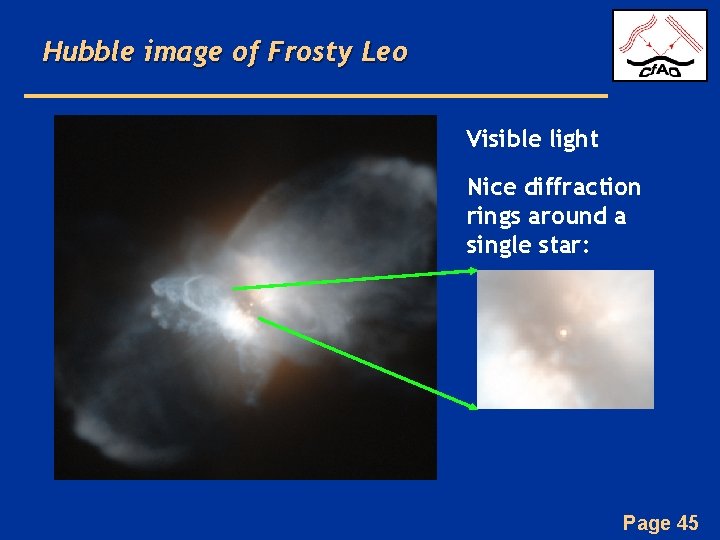
Hubble image of Frosty Leo Visible light Nice diffraction rings around a single star: Page 45
Conclusions • AO systems can yield flakey results if: – Guide star is extended, or too faint – Strehl is too low or too variable • Need good signal to noise (but that is no different from “regular” observations) • Need thoughtful preparation before an observing run • But…. RESULT CAN BE WORTH THE TROUBLE! Page 46
- Slides: 46