
Lecture 15 Decision making definition Decision making occurs
- Slides: 17
Lecture 15 – Decision making - definition Decision making occurs when you have several alternatives and you choose among them. There are two characteristics of good decision making: 1. You make the best (most valuable) choice. 2. You are consistent in the choice you make in a given situation. 1
Lecture 15 – Decision making 2 Decision making – how well do we do it? The best choice: There are two reasons humans do not always make the best choice: A. We don't always pick the outcome with the highest value. B. We don't always evaluate all possible outcomes before choosing.
Lecture 15 – Decision making Picking the outcome with the highest value Economists offer several schemes for measuring value. The most famous is theory of expected value. E. V. = outcome measured in dollars X probability Thus a 1/10 th chance of winning $200 is worth 1/10 X $200 = $20 3
Lecture 15 – Decision making The problem with expected value theory Which would you prefer - a 1/10 th chance of winning $100, or a 9/10 th chance of winning $8? A. 1/10 th X $100 = $10 B. 9/10 th X $8 = $7. 20 But suppose you are hungry - really hungry. Then, higher probability may be more attractive, so you choose B. 4
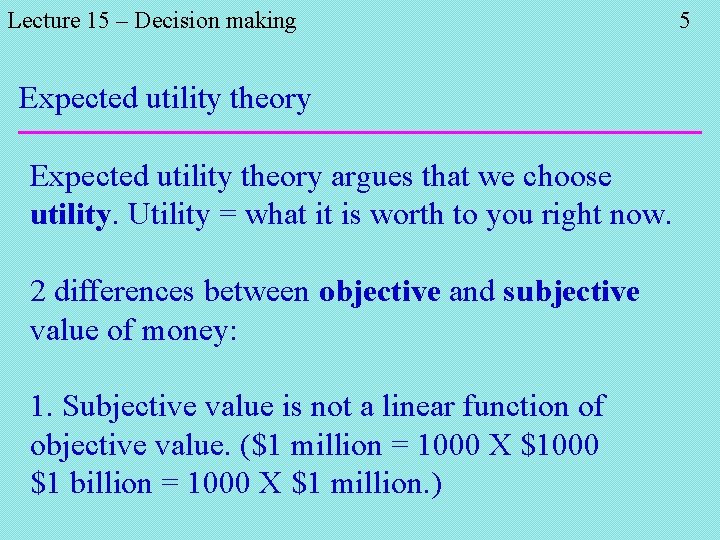
Lecture 15 – Decision making Expected utility theory argues that we choose utility. Utility = what it is worth to you right now. 2 differences between objective and subjective value of money: 1. Subjective value is not a linear function of objective value. ($1 million = 1000 X $1000 $1 billion = 1000 X $1 million. ) 5
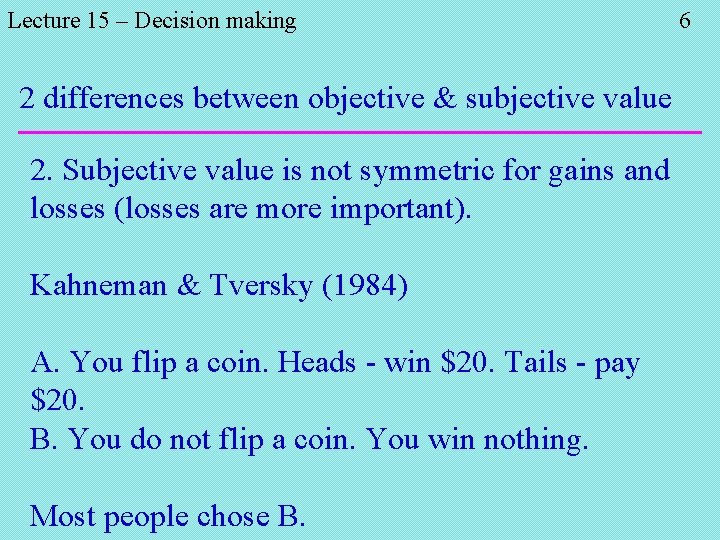
Lecture 15 – Decision making 2 differences between objective & subjective value 2. Subjective value is not symmetric for gains and losses (losses are more important). Kahneman & Tversky (1984) A. You flip a coin. Heads - win $20. Tails - pay $20. B. You do not flip a coin. You win nothing. Most people chose B. 6
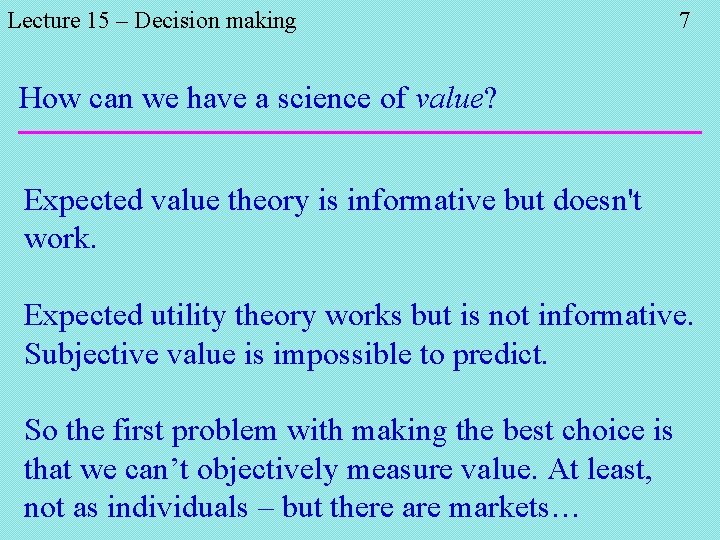
Lecture 15 – Decision making 7 How can we have a science of value? Expected value theory is informative but doesn't work. Expected utility theory works but is not informative. Subjective value is impossible to predict. So the first problem with making the best choice is that we can’t objectively measure value. At least, not as individuals – but there are markets…
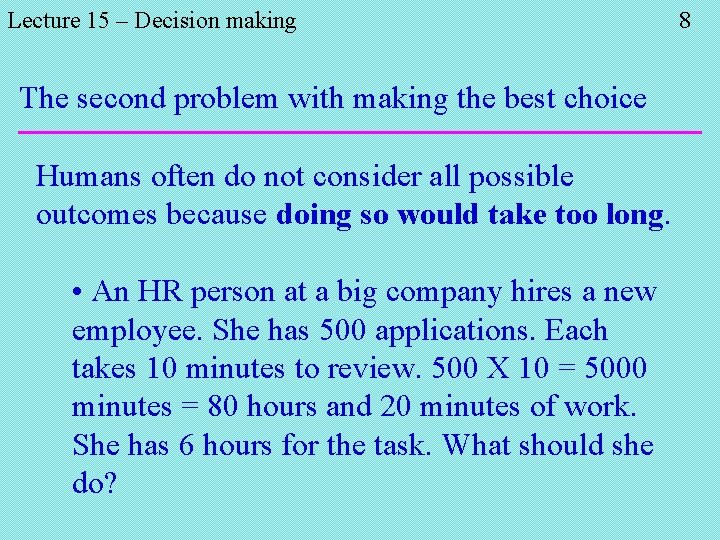
Lecture 15 – Decision making The second problem with making the best choice Humans often do not consider all possible outcomes because doing so would take too long. • An HR person at a big company hires a new employee. She has 500 applications. Each takes 10 minutes to review. 500 X 10 = 5000 minutes = 80 hours and 20 minutes of work. She has 6 hours for the task. What should she do? 8
Lecture 15 – Decision making Heuristics In 6 hours, she can review 36 applications. She reads 36 at random and hires the best person among those 36 candidates. This is called satisficing (doing well enough). Sometimes we don't choose the most valuable outcome because discovering it takes too much time. In such cases, we use sensible strategies called heuristics. Heuristics let us satisfice. 9
Lecture 15 – Decision making 10 Heuristics A heuristic is a 'rule of thumb, ' a procedure which is easy to use, though it may not work. In contrast, an algorithm is a step-by-step procedure guaranteed to produce the correct result. We do not always have an algorithm, and sometimes when we do have one, it cannot be used (as in the case of the HR person). Then, we use heuristics.
Lecture 15 – Decision making Important heuristics in decision making 1. Availability – judgment that the more easily an event comes to mind, the more likely it is. Often works - e. g. , when was the last time you met a professor who liked to be yelled at? Sometimes doesn’t work – as in cases of illusory correlation. 11
Lecture 15 – Decision making 12 Illusory correlations IC is found in cases of rare events that happen to cooccur. • E. g. , sports announcer says "X hasn't dropped the ball for 100 plays, " and X drops the ball on the next play. • You only notice this when the rare, newsworthy event happens - not when X doesn't then drop the ball.
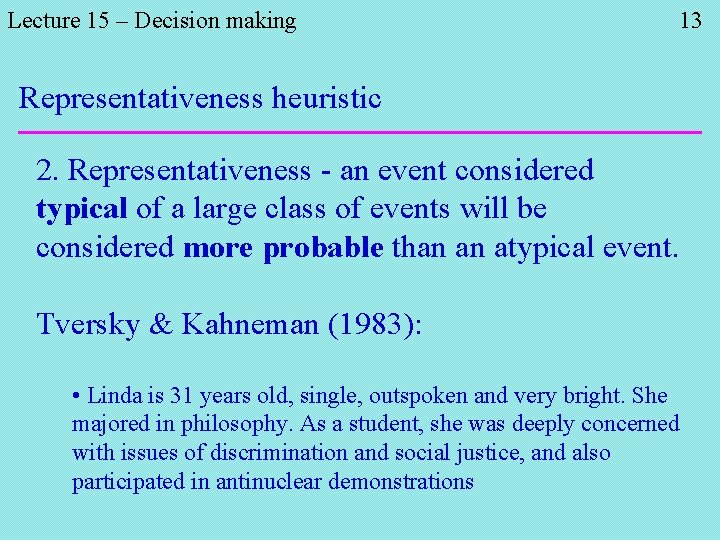
Lecture 15 – Decision making 13 Representativeness heuristic 2. Representativeness - an event considered typical of a large class of events will be considered more probable than an atypical event. Tversky & Kahneman (1983): • Linda is 31 years old, single, outspoken and very bright. She majored in philosophy. As a student, she was deeply concerned with issues of discrimination and social justice, and also participated in antinuclear demonstrations
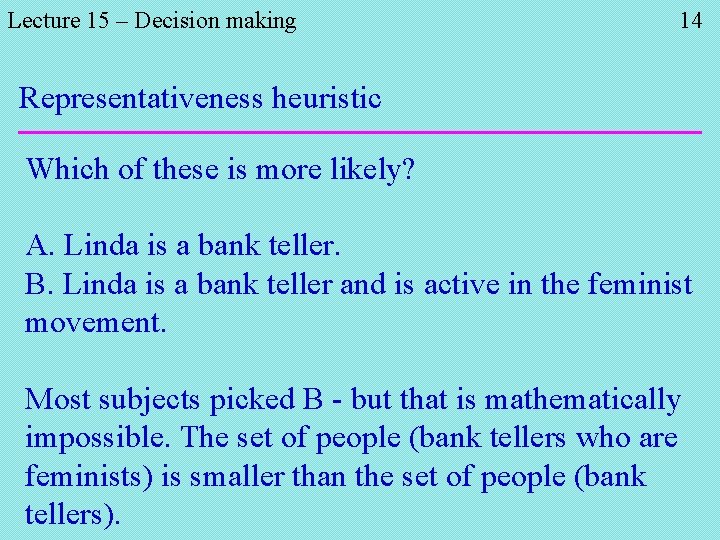
Lecture 15 – Decision making 14 Representativeness heuristic Which of these is more likely? A. Linda is a bank teller. B. Linda is a bank teller and is active in the feminist movement. Most subjects picked B - but that is mathematically impossible. The set of people (bank tellers who are feminists) is smaller than the set of people (bank tellers).
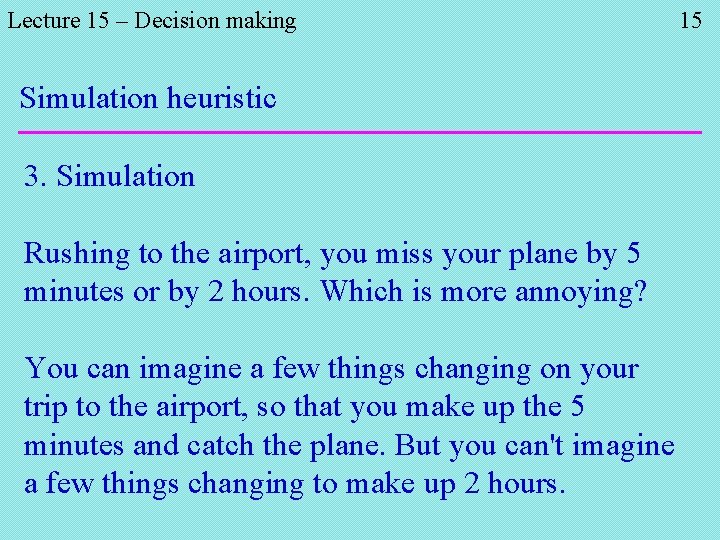
Lecture 15 – Decision making Simulation heuristic 3. Simulation Rushing to the airport, you miss your plane by 5 minutes or by 2 hours. Which is more annoying? You can imagine a few things changing on your trip to the airport, so that you make up the 5 minutes and catch the plane. But you can't imagine a few things changing to make up 2 hours. 15
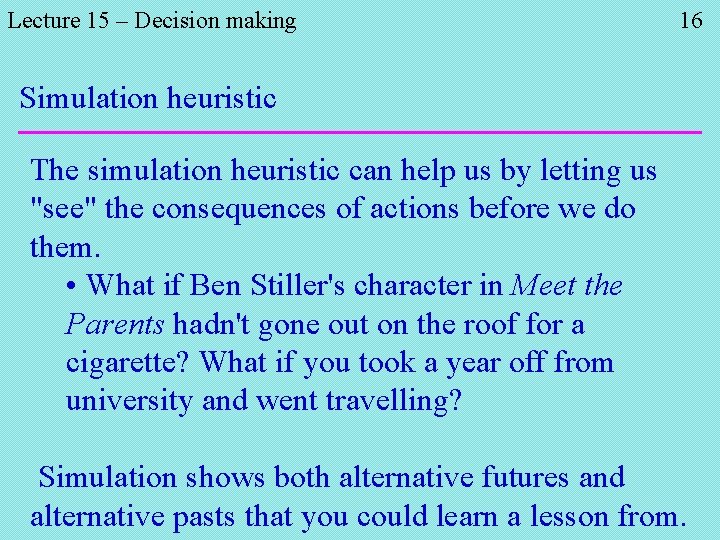
Lecture 15 – Decision making 16 Simulation heuristic The simulation heuristic can help us by letting us "see" the consequences of actions before we do them. • What if Ben Stiller's character in Meet the Parents hadn't gone out on the roof for a cigarette? What if you took a year off from university and went travelling? Simulation shows both alternative futures and alternative pasts that you could learn a lesson from.
Lecture 15 – Decision making 17 Review There are three things we lack as decision makers: An objective way of evaluating outcomes Unlimited cognitive processing capacity Unlimited time to make our decisions That’s alright. What we have to do to survive as a species is make good decisions more often than not. Heuristics help us to do that.