
Lecture 15 a Metallocenes Synthesis I Alkali metal
- Slides: 15
Lecture 15 a Metallocenes
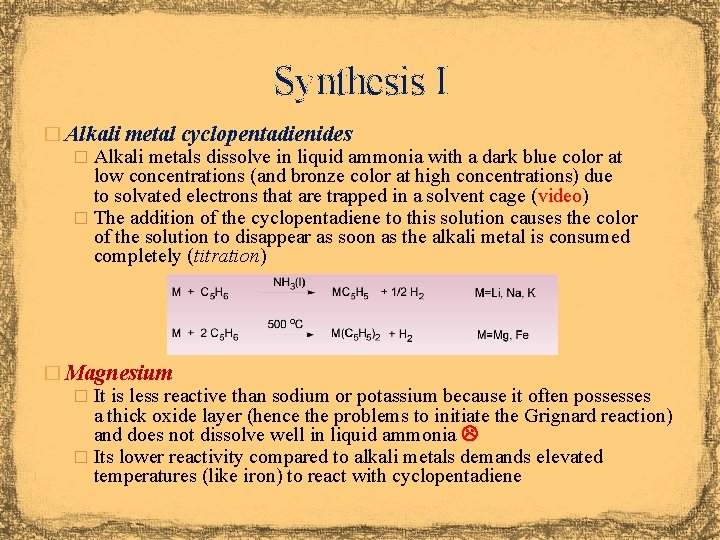
Synthesis I � Alkali metal cyclopentadienides � Alkali metals dissolve in liquid ammonia with a dark blue color at low concentrations (and bronze color at high concentrations) due to solvated electrons that are trapped in a solvent cage (video) � The addition of the cyclopentadiene to this solution causes the color of the solution to disappear as soon as the alkali metal is consumed completely (titration) � Magnesium � It is less reactive than sodium or potassium because it often possesses a thick oxide layer (hence the problems to initiate the Grignard reaction) and does not dissolve well in liquid ammonia � Its lower reactivity compared to alkali metals demands elevated temperatures (like iron) to react with cyclopentadiene
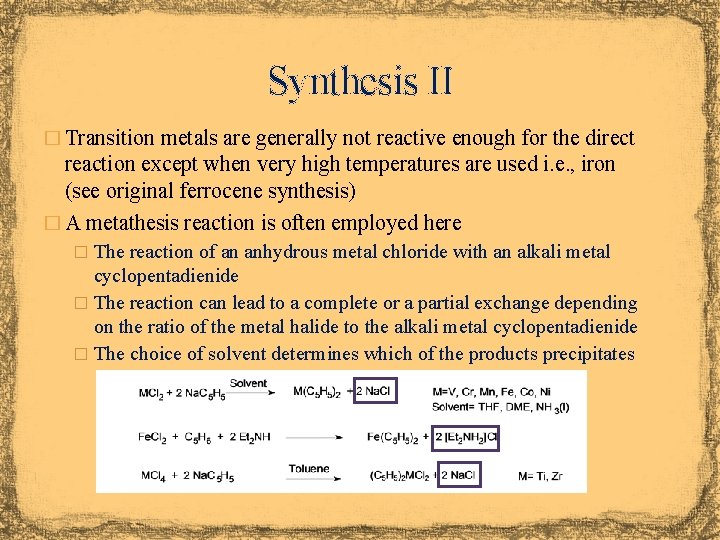
Synthesis II � Transition metals are generally not reactive enough for the direct reaction except when very high temperatures are used i. e. , iron (see original ferrocene synthesis) � A metathesis reaction is often employed here � The reaction of an anhydrous metal chloride with an alkali metal cyclopentadienide � The reaction can lead to a complete or a partial exchange depending on the ratio of the metal halide to the alkali metal cyclopentadienide � The choice of solvent determines which of the products precipitates
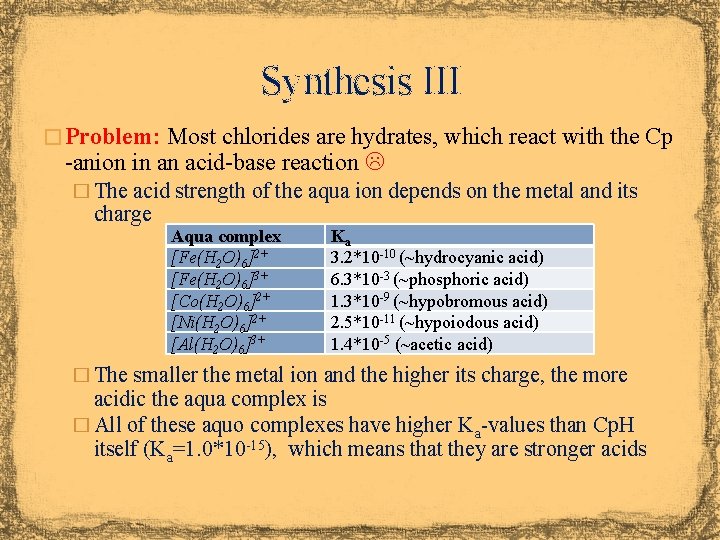
Synthesis III � Problem: Most chlorides are hydrates, which react with the Cp -anion in an acid-base reaction � The acid strength of the aqua ion depends on the metal and its charge Aqua complex [Fe(H 2 O)6]2+ [Fe(H 2 O)6]3+ [Co(H 2 O)6]2+ [Ni(H 2 O)6]2+ [Al(H 2 O)6]3+ Ka 3. 2*10 -10 (~hydrocyanic acid) 6. 3*10 -3 (~phosphoric acid) 1. 3*10 -9 (~hypobromous acid) 2. 5*10 -11 (~hypoiodous acid) 1. 4*10 -5 (~acetic acid) � The smaller the metal ion and the higher its charge, the more acidic the aqua complex is � All of these aquo complexes have higher Ka-values than Cp. H itself (Ka=1. 0*10 -15), which means that they are stronger acids
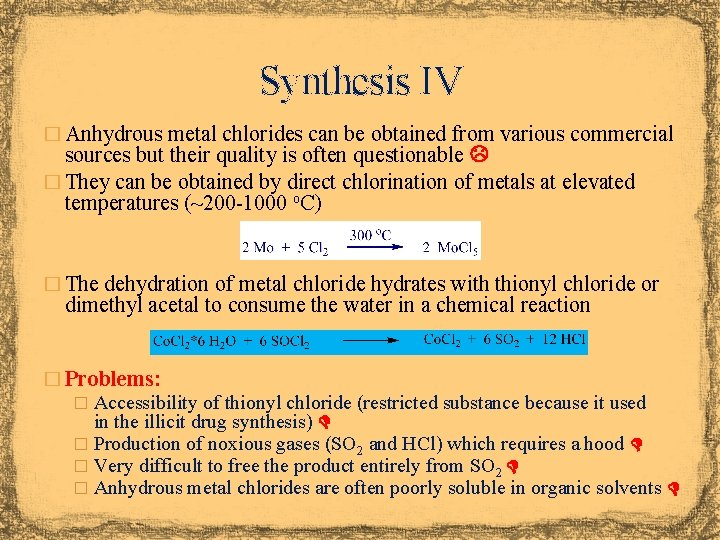
Synthesis IV � Anhydrous metal chlorides can be obtained from various commercial sources but their quality is often questionable � They can be obtained by direct chlorination of metals at elevated temperatures (~200 -1000 o. C) � The dehydration of metal chloride hydrates with thionyl chloride or dimethyl acetal to consume the water in a chemical reaction � Problems: � Accessibility of thionyl chloride (restricted substance because it used in the illicit drug synthesis) � Production of noxious gases (SO 2 and HCl) which requires a hood � Very difficult to free the product entirely from SO 2 � Anhydrous metal chlorides are often poorly soluble in organic solvents
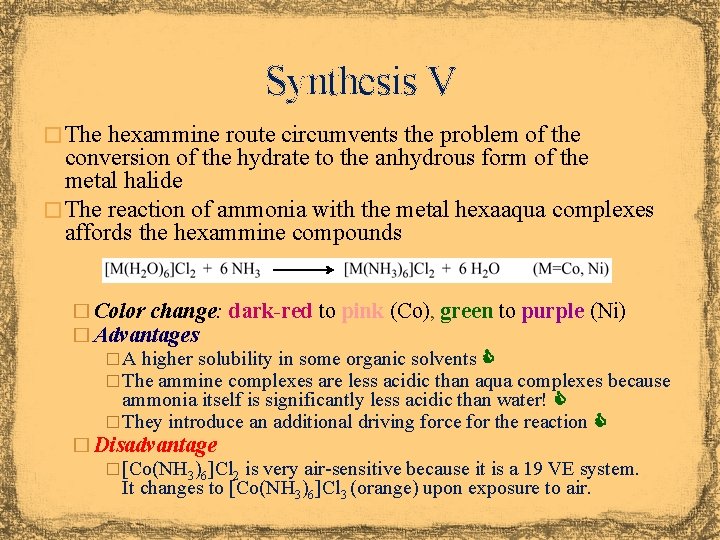
Synthesis V � The hexammine route circumvents the problem of the conversion of the hydrate to the anhydrous form of the metal halide � The reaction of ammonia with the metal hexaaqua complexes affords the hexammine compounds � Color change: dark-red to pink (Co), green to purple (Ni) � Advantages �A higher solubility in some organic solvents �The ammine complexes are less acidic than aqua complexes because ammonia itself is significantly less acidic than water! �They introduce an additional driving force for the reaction � Disadvantage �[Co(NH 3)6]Cl 2 is very air-sensitive because it is a 19 VE system. It changes to [Co(NH 3)6]Cl 3 (orange) upon exposure to air.
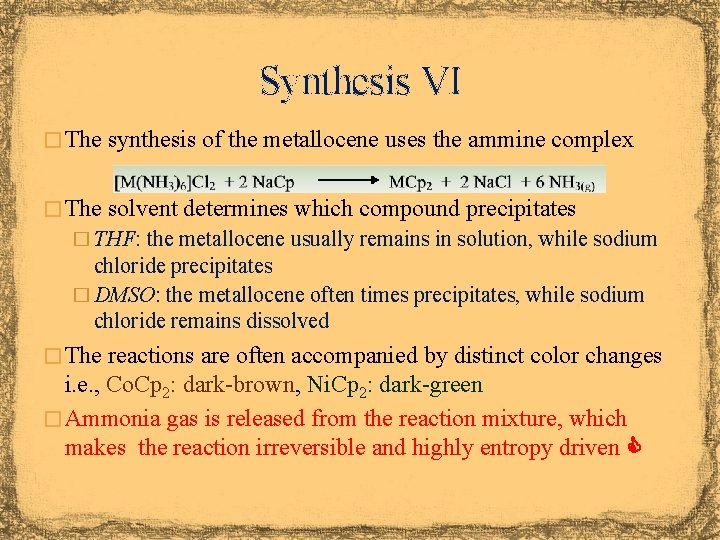
Synthesis VI � The synthesis of the metallocene uses the ammine complex � The solvent determines which compound precipitates � THF: the metallocene usually remains in solution, while sodium chloride precipitates � DMSO: the metallocene often times precipitates, while sodium chloride remains dissolved � The reactions are often accompanied by distinct color changes i. e. , Co. Cp 2: dark-brown, Ni. Cp 2: dark-green � Ammonia gas is released from the reaction mixture, which makes the reaction irreversible and highly entropy driven
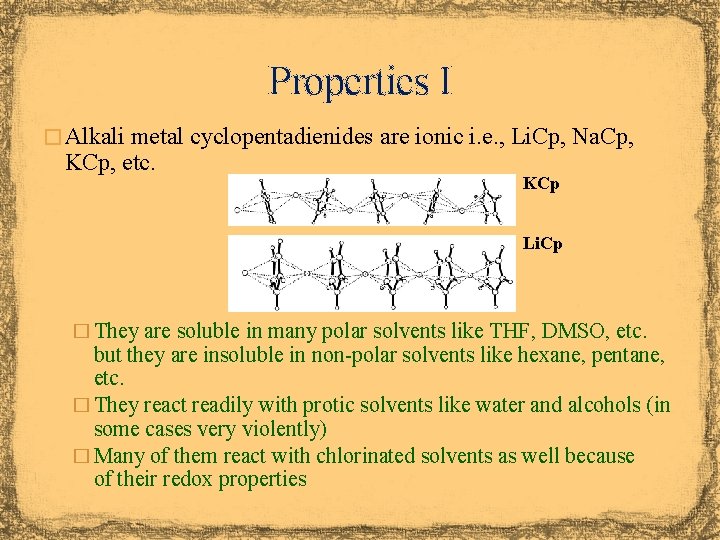
Properties I � Alkali metal cyclopentadienides are ionic i. e. , Li. Cp, Na. Cp, KCp, etc. KCp Li. Cp � They are soluble in many polar solvents like THF, DMSO, etc. but they are insoluble in non-polar solvents like hexane, pentane, etc. � They react readily with protic solvents like water and alcohols (in some cases very violently) � Many of them react with chlorinated solvents as well because of their redox properties
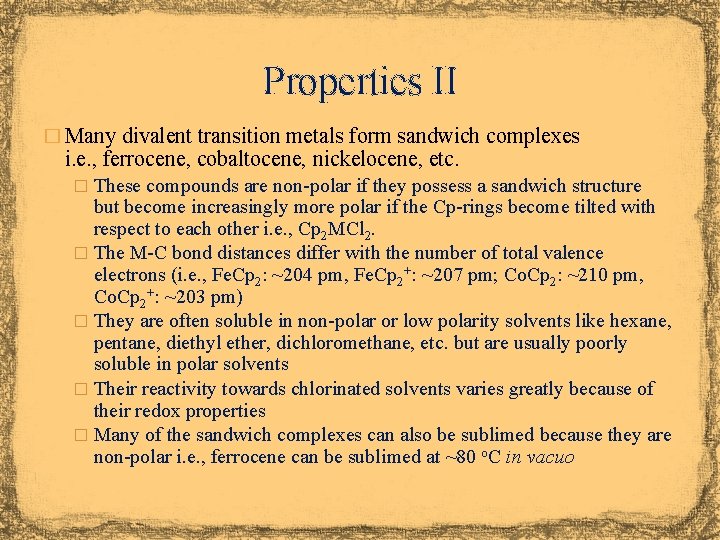
Properties II � Many divalent transition metals form sandwich complexes i. e. , ferrocene, cobaltocene, nickelocene, etc. � These compounds are non-polar if they possess a sandwich structure but become increasingly more polar if the Cp-rings become tilted with respect to each other i. e. , Cp 2 MCl 2. � The M-C bond distances differ with the number of total valence electrons (i. e. , Fe. Cp 2: ~204 pm, Fe. Cp 2+: ~207 pm; Co. Cp 2: ~210 pm, Co. Cp 2+: ~203 pm) � They are often soluble in non-polar or low polarity solvents like hexane, pentane, diethyl ether, dichloromethane, etc. but are usually poorly soluble in polar solvents � Their reactivity towards chlorinated solvents varies greatly because of their redox properties � Many of the sandwich complexes can also be sublimed because they are non-polar i. e. , ferrocene can be sublimed at ~80 o. C in vacuo
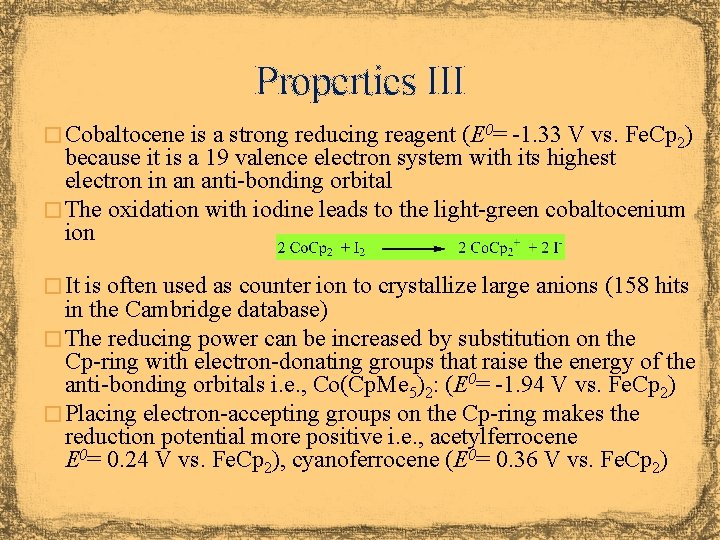
Properties III � Cobaltocene is a strong reducing reagent (E 0= -1. 33 V vs. Fe. Cp 2) because it is a 19 valence electron system with its highest electron in an anti-bonding orbital � The oxidation with iodine leads to the light-green cobaltocenium ion � It is often used as counter ion to crystallize large anions (158 hits in the Cambridge database) � The reducing power can be increased by substitution on the Cp-ring with electron-donating groups that raise the energy of the anti-bonding orbitals i. e. , Co(Cp. Me 5)2: (E 0= -1. 94 V vs. Fe. Cp 2) � Placing electron-accepting groups on the Cp-ring makes the reduction potential more positive i. e. , acetylferrocene E 0= 0. 24 V vs. Fe. Cp 2), cyanoferrocene (E 0= 0. 36 V vs. Fe. Cp 2)
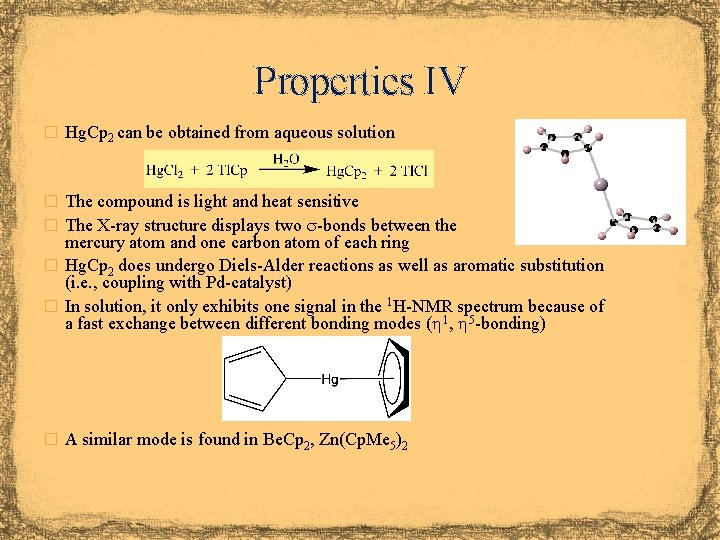
Properties IV � Hg. Cp 2 can be obtained from aqueous solution � The compound is light and heat sensitive � The X-ray structure displays two s-bonds between the mercury atom and one carbon atom of each ring � Hg. Cp 2 does undergo Diels-Alder reactions as well as aromatic substitution (i. e. , coupling with Pd-catalyst) � In solution, it only exhibits one signal in the 1 H-NMR spectrum because of a fast exchange between different bonding modes ( 1, 5 -bonding) � A similar mode is found in Be. Cp 2, Zn(Cp. Me 5)2
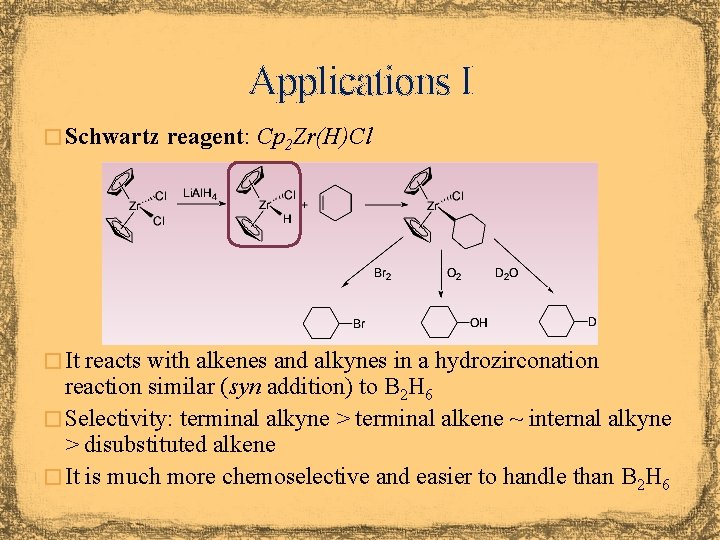
Applications I � Schwartz reagent: Cp 2 Zr(H)Cl � It reacts with alkenes and alkynes in a hydrozirconation reaction similar (syn addition) to B 2 H 6 � Selectivity: terminal alkyne > terminal alkene ~ internal alkyne > disubstituted alkene � It is much more chemoselective and easier to handle than B 2 H 6
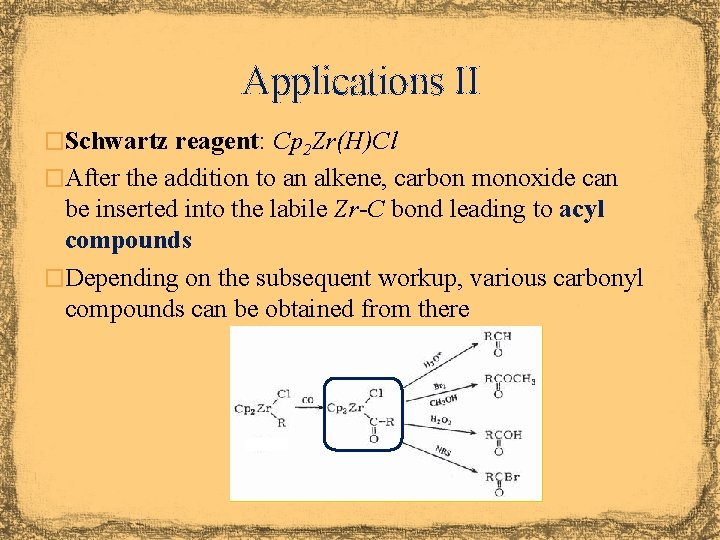
Applications II �Schwartz reagent: Cp 2 Zr(H)Cl �After the addition to an alkene, carbon monoxide can be inserted into the labile Zr-C bond leading to acyl compounds �Depending on the subsequent workup, various carbonyl compounds can be obtained from there
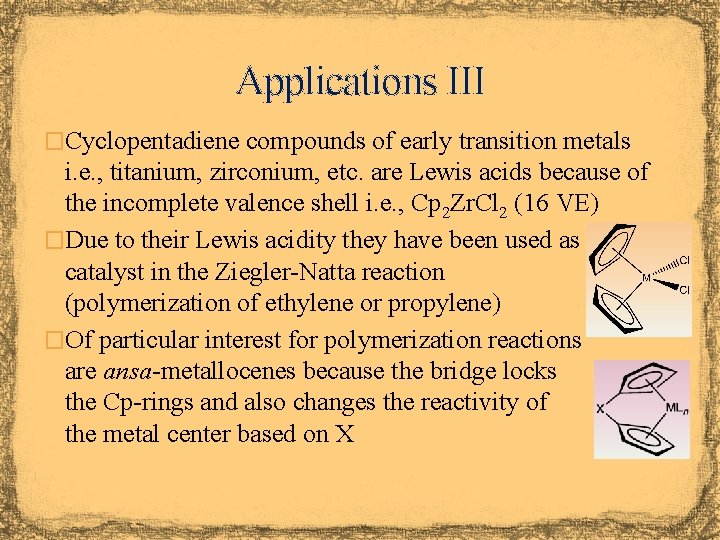
Applications III �Cyclopentadiene compounds of early transition metals i. e. , titanium, zirconium, etc. are Lewis acids because of the incomplete valence shell i. e. , Cp 2 Zr. Cl 2 (16 VE) �Due to their Lewis acidity they have been used as catalyst in the Ziegler-Natta reaction (polymerization of ethylene or propylene) �Of particular interest for polymerization reactions are ansa-metallocenes because the bridge locks the Cp-rings and also changes the reactivity of the metal center based on X
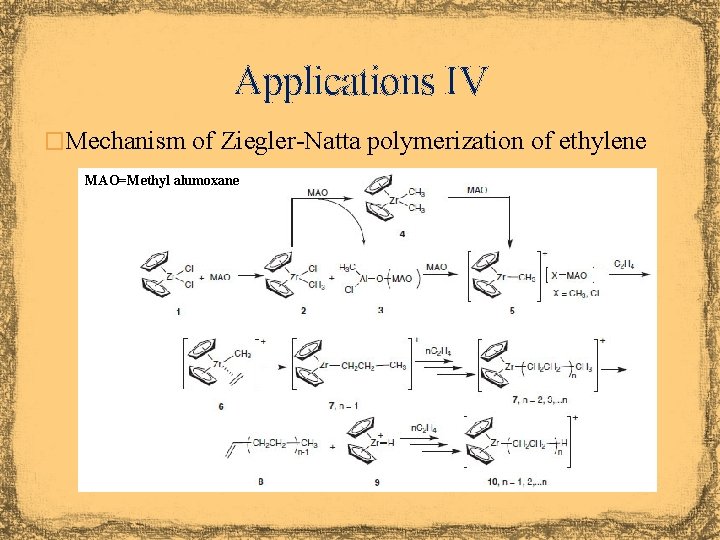
Applications IV �Mechanism of Ziegler-Natta polymerization of ethylene MAO=Methyl alumoxane