
Lecture 14 The Relational Model Lecture 14 Todays
- Slides: 57
Lecture 14: The Relational Model
Lecture 14 Today’s Lecture 1. The Relational Model & Relational Algebra 2. Relational Algebra Pt. II [Optional: may skip] 2
Lecture 14 > Section 1 1. The Relational Model & Relational Algebra 3
Lecture 14 > Section 1 What you will learn about in this section 1. The Relational Model 2. Relational Algebra: Basic Operators 3. Execution 4. ACTIVITY: From SQL to RA & Back 4
Lecture 14 > Section 1 > The Relational Model Motivation The Relational model is precise, implementable, and we can operate on it (query/update, etc. ) Database maps internally into this procedural language.
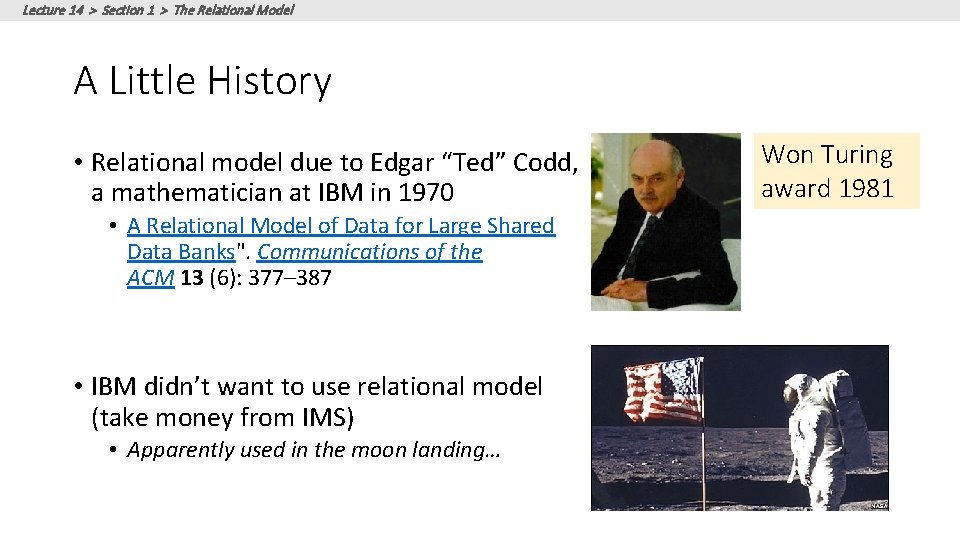
Lecture 14 > Section 1 > The Relational Model A Little History • Relational model due to Edgar “Ted” Codd, a mathematician at IBM in 1970 • A Relational Model of Data for Large Shared Data Banks". Communications of the ACM 13 (6): 377– 387 • IBM didn’t want to use relational model (take money from IMS) • Apparently used in the moon landing… Won Turing award 1981
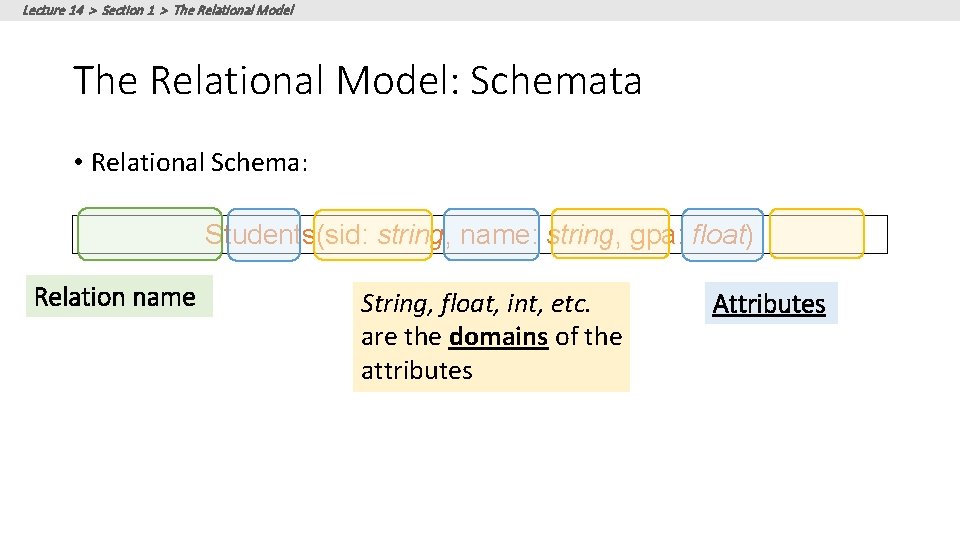
Lecture 14 > Section 1 > The Relational Model: Schemata • Relational Schema: Students(sid: string, name: string, gpa: float) Relation name String, float, int, etc. are the domains of the attributes Attributes
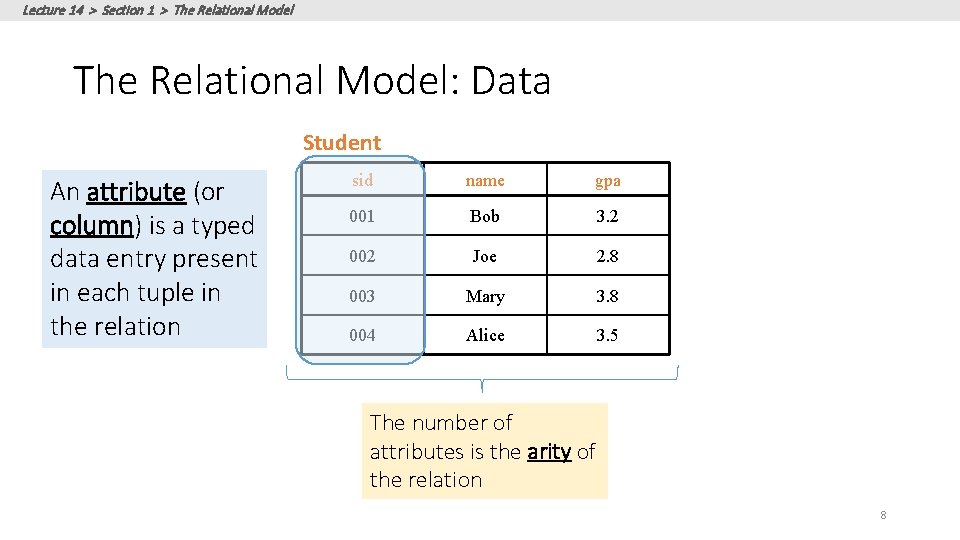
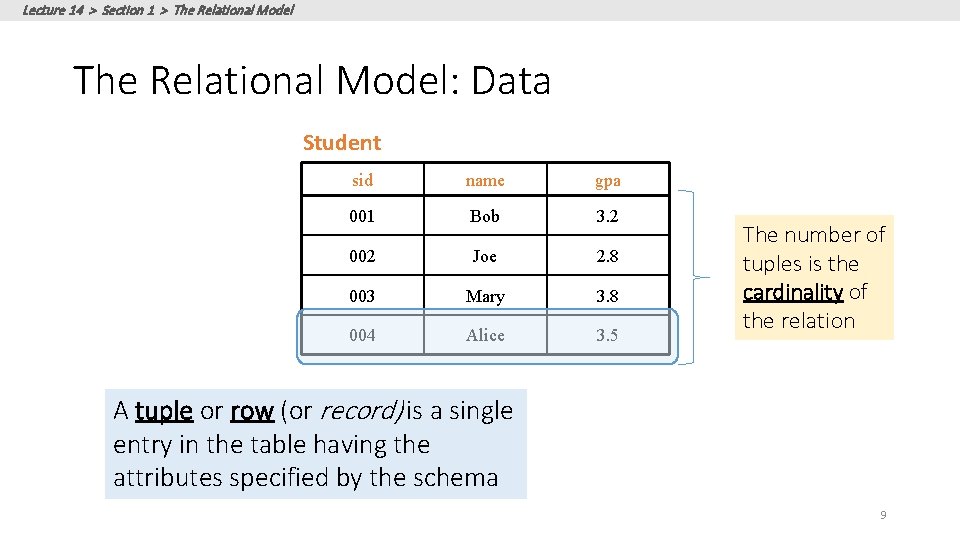
Lecture 14 > Section 1 > The Relational Model: Data Student An attribute (or column) is a typed data entry present in each tuple in the relation sid name gpa 001 Bob 3. 2 002 Joe 2. 8 003 Mary 3. 8 004 Alice 3. 5 The number of attributes is the arity of the relation 8
Lecture 14 > Section 1 > The Relational Model: Data Student sid name gpa 001 Bob 3. 2 002 Joe 2. 8 003 Mary 3. 8 004 Alice 3. 5 The number of tuples is the cardinality of the relation A tuple or row (or record) is a single entry in the table having the attributes specified by the schema 9
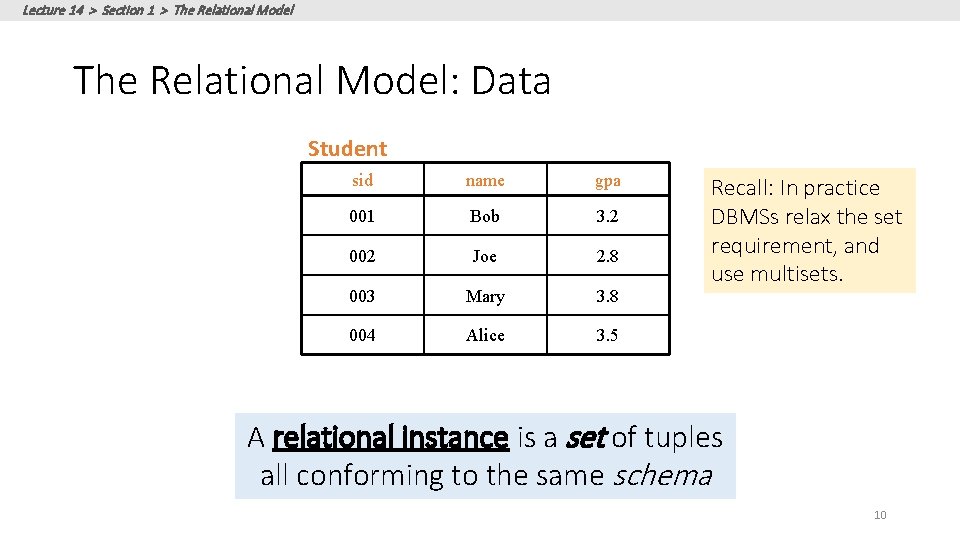
Lecture 14 > Section 1 > The Relational Model: Data Student sid name gpa 001 Bob 3. 2 002 Joe 2. 8 003 Mary 3. 8 004 Alice 3. 5 Recall: In practice DBMSs relax the set requirement, and use multisets. A relational instance is a set of tuples all conforming to the same schema 10
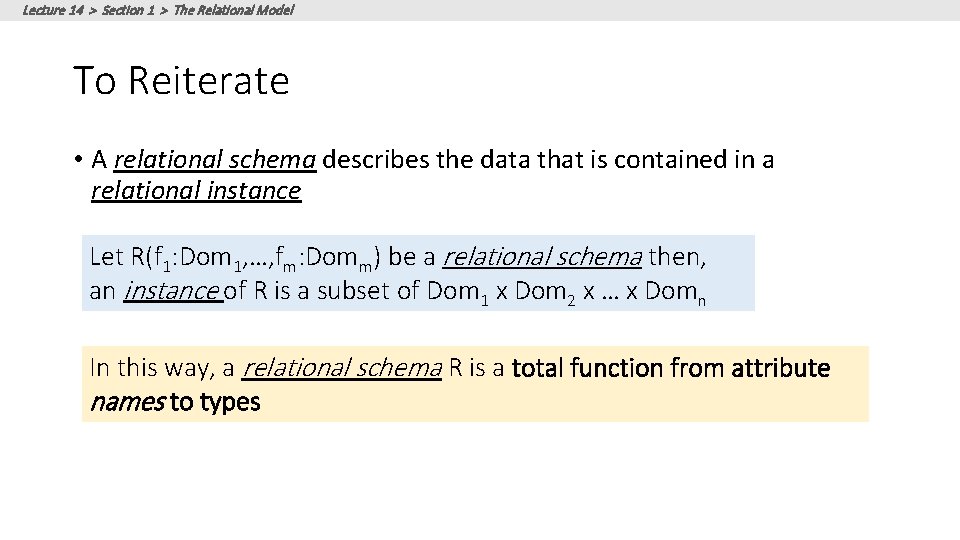
Lecture 14 > Section 1 > The Relational Model To Reiterate • A relational schema describes the data that is contained in a relational instance Let R(f 1: Dom 1, …, fm: Domm) be a relational schema then, an instance of R is a subset of Dom 1 x Dom 2 x … x Domn In this way, a relational schema R is a total function from attribute names to types
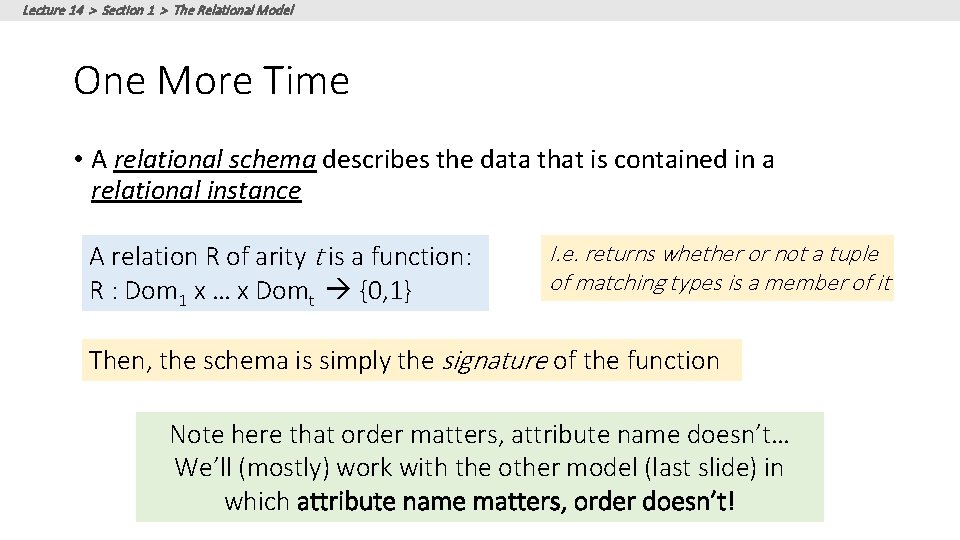
Lecture 14 > Section 1 > The Relational Model One More Time • A relational schema describes the data that is contained in a relational instance A relation R of arity t is a function: R : Dom 1 x … x Domt {0, 1} I. e. returns whether or not a tuple of matching types is a member of it Then, the schema is simply the signature of the function Note here that order matters, attribute name doesn’t… We’ll (mostly) work with the other model (last slide) in which attribute name matters, order doesn’t!
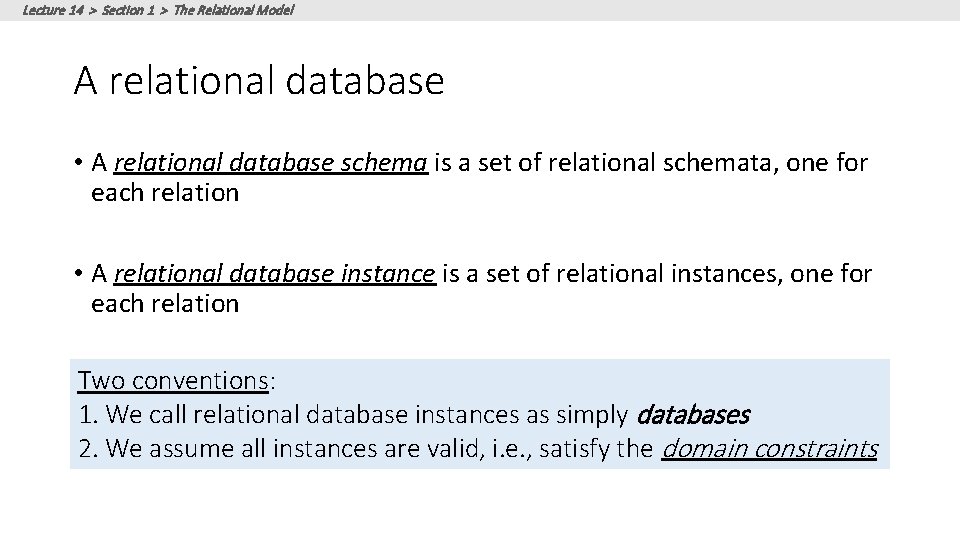
Lecture 14 > Section 1 > The Relational Model A relational database • A relational database schema is a set of relational schemata, one for each relation • A relational database instance is a set of relational instances, one for each relation Two conventions: 1. We call relational database instances as simply databases 2. We assume all instances are valid, i. e. , satisfy the domain constraints
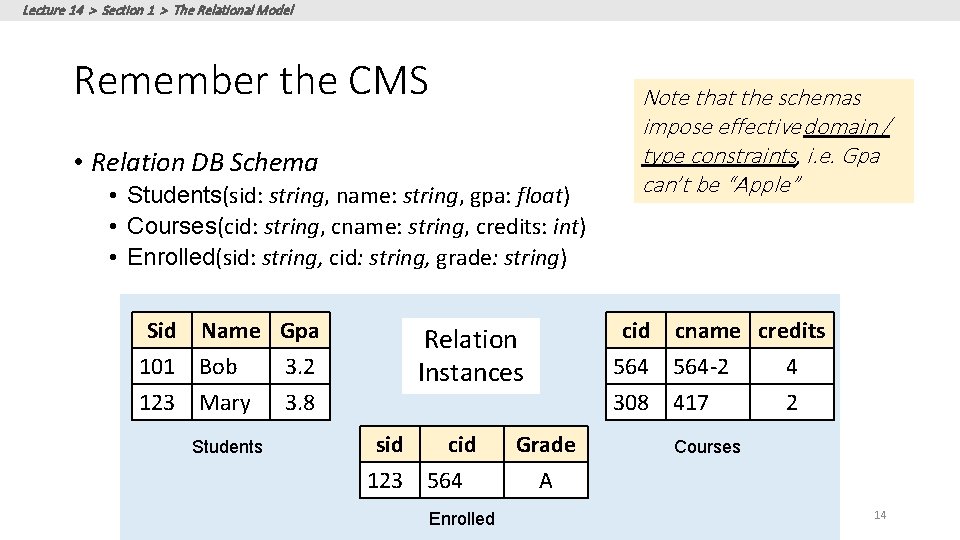
Lecture 14 > Section 1 > The Relational Model Remember the CMS • Relation DB Schema • Students(sid: string, name: string, gpa: float) • Courses(cid: string, cname: string, credits: int) • Enrolled(sid: string, cid: string, grade: string) Sid Name Gpa 101 Bob 3. 2 123 Mary 3. 8 Students Relation Instances sid cid 123 564 Enrolled Grade A Note that the schemas impose effective domain / type constraints, i. e. Gpa can’t be “Apple” cid cname credits 564 -2 4 308 417 2 Courses 14
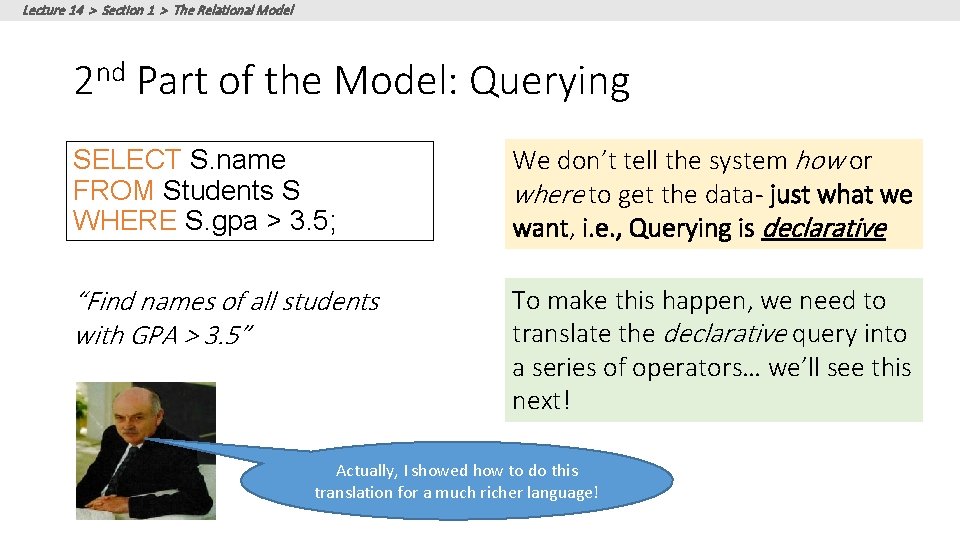
Lecture 14 > Section 1 > The Relational Model 2 nd Part of the Model: Querying SELECT S. name FROM Students S WHERE S. gpa > 3. 5; We don’t tell the system how or where to get the data- just what we want, i. e. , Querying is declarative “Find names of all students with GPA > 3. 5” To make this happen, we need to translate the declarative query into a series of operators… we’ll see this next! Actually, I showed how to do this translation for a much richer language!
Lecture 14 > Section 1 > The Relational Model Virtues of the model • Physical independence (logical too), Declarative • Simple, elegant clean: Everything is a relation • Why did it take multiple years? • Doubted it could be done efficiently.
Lecture 14 > Section 1 > Relational Algebra
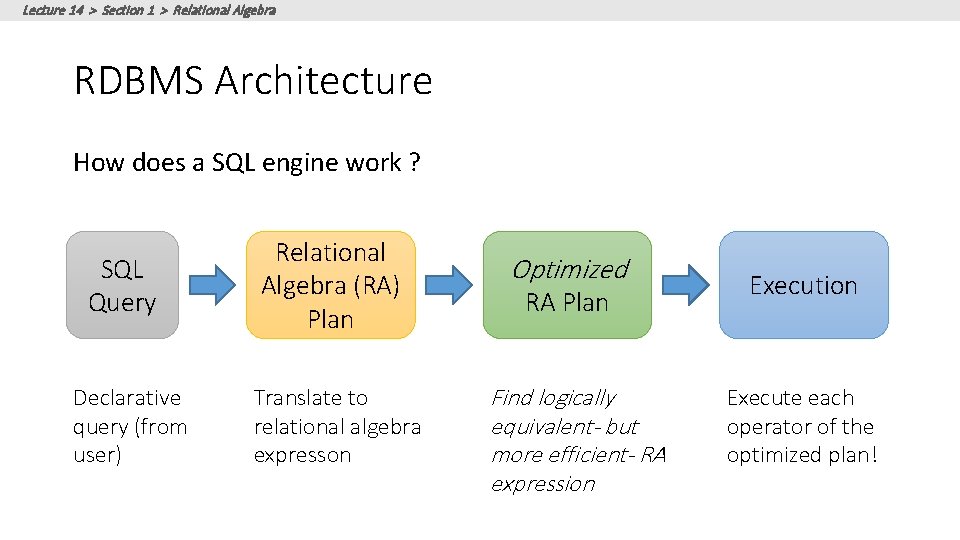
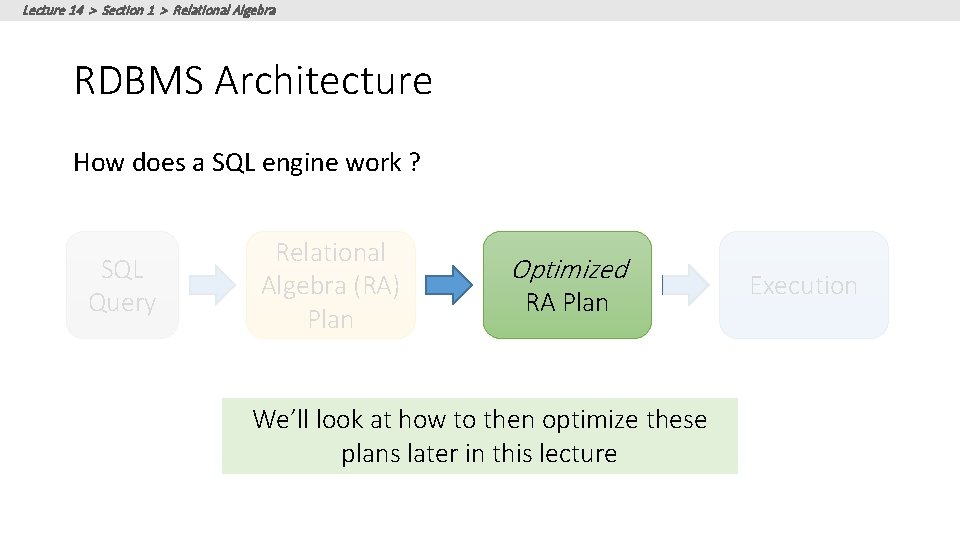
Lecture 14 > Section 1 > Relational Algebra RDBMS Architecture How does a SQL engine work ? SQL Query Declarative query (from user) Relational Algebra (RA) Plan Translate to relational algebra expresson Optimized RA Plan Find logically equivalent- but more efficient- RA expression Execute each operator of the optimized plan!
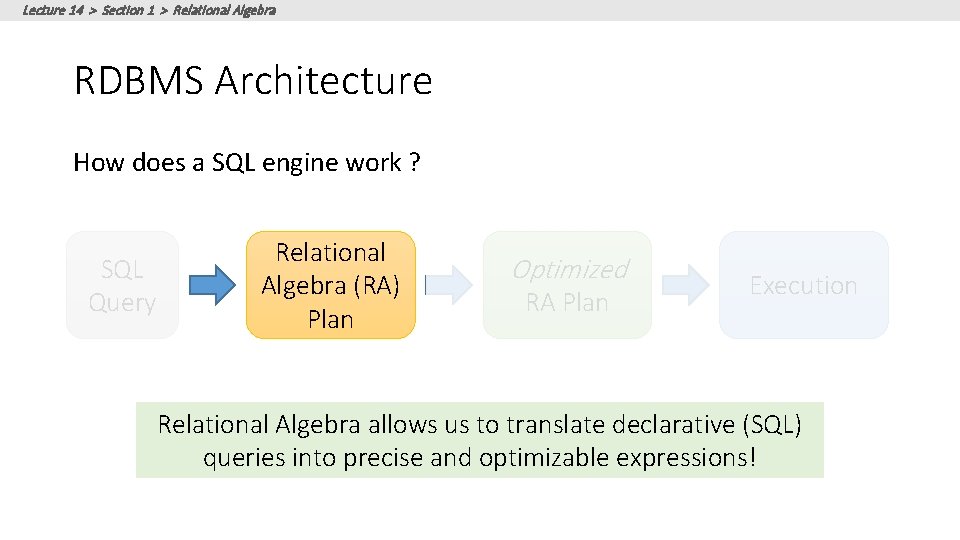
Lecture 14 > Section 1 > Relational Algebra RDBMS Architecture How does a SQL engine work ? SQL Query Relational Algebra (RA) Plan Optimized RA Plan Execution Relational Algebra allows us to translate declarative (SQL) queries into precise and optimizable expressions!
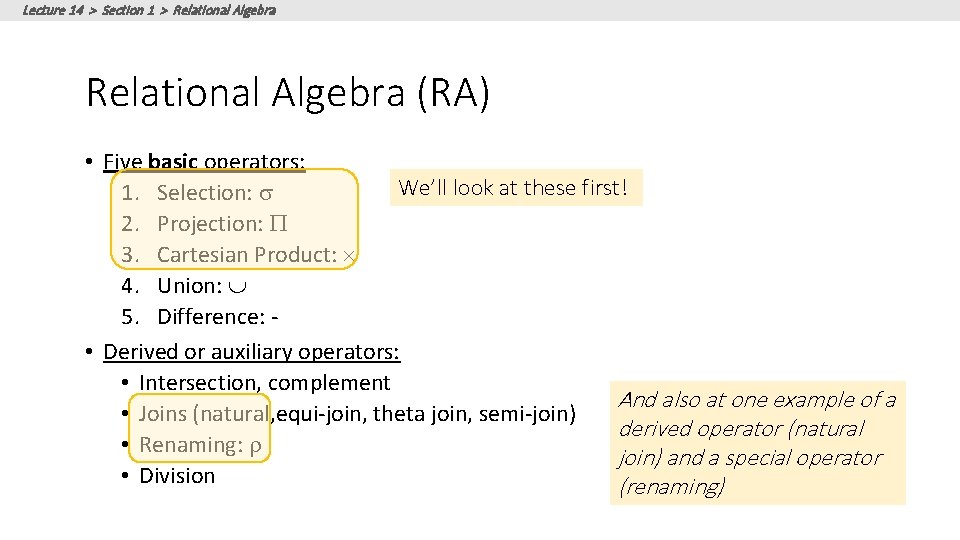
Lecture 14 > Section 1 > Relational Algebra (RA) • Five basic operators: We’ll look at these first! 1. Selection: s 2. Projection: P 3. Cartesian Product: 4. Union: 5. Difference: • Derived or auxiliary operators: • Intersection, complement And also at one example of a • Joins (natural, equi-join, theta join, semi-join) derived operator (natural • Renaming: r join) and a special operator • Division (renaming)
Lecture 14 > Section 1 > Relational Algebra Keep in mind: RA operates on sets! • RDBMSs use multisets, however in relational algebra formalism we will consider sets! • Also: we will consider the named perspective, where every attribute must have a unique name • attribute order does not matter… Now on to the basic RA operators…
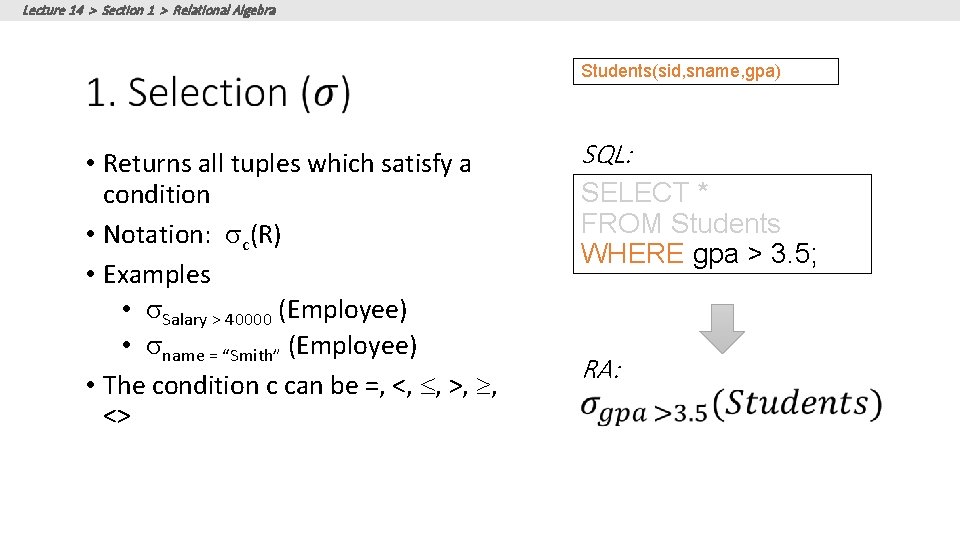
Lecture 14 > Section 1 > Relational Algebra Students(sid, sname, gpa) • Returns all tuples which satisfy a condition • Notation: sc(R) • Examples • s. Salary > 40000 (Employee) • sname = “Smith” (Employee) • The condition c can be =, <, , >, , <> SQL: SELECT * FROM Students WHERE gpa > 3. 5; RA:
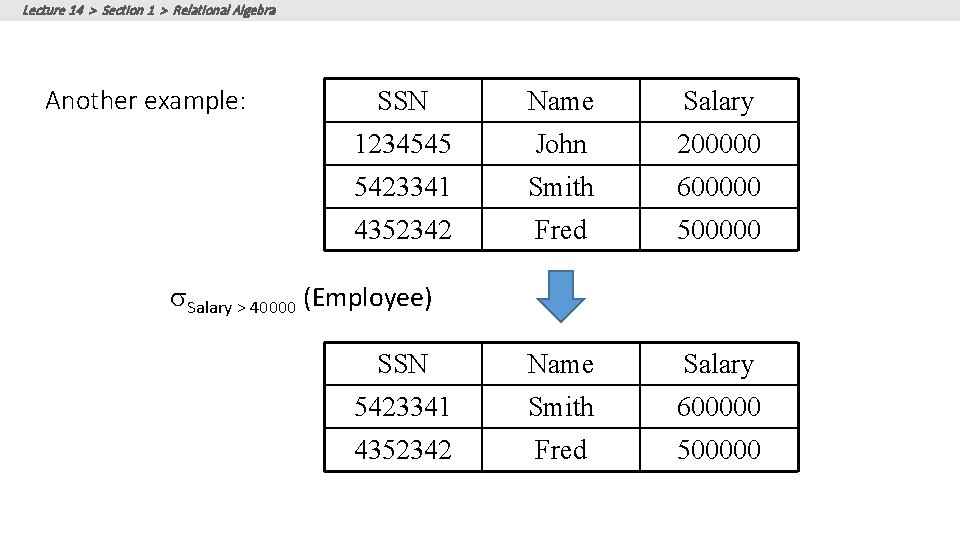
Lecture 14 > Section 1 > Relational Algebra Another example: SSN Name Salary 1234545 John 200000 5423341 Smith 600000 4352342 Fred 500000 SSN Name Salary 5423341 Smith 600000 4352342 Fred 500000 s. Salary > 40000 (Employee)
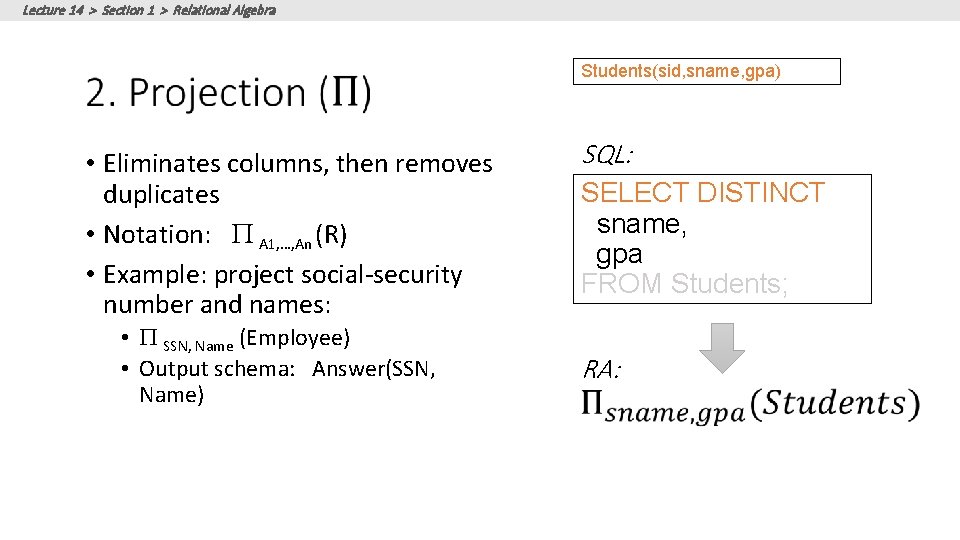
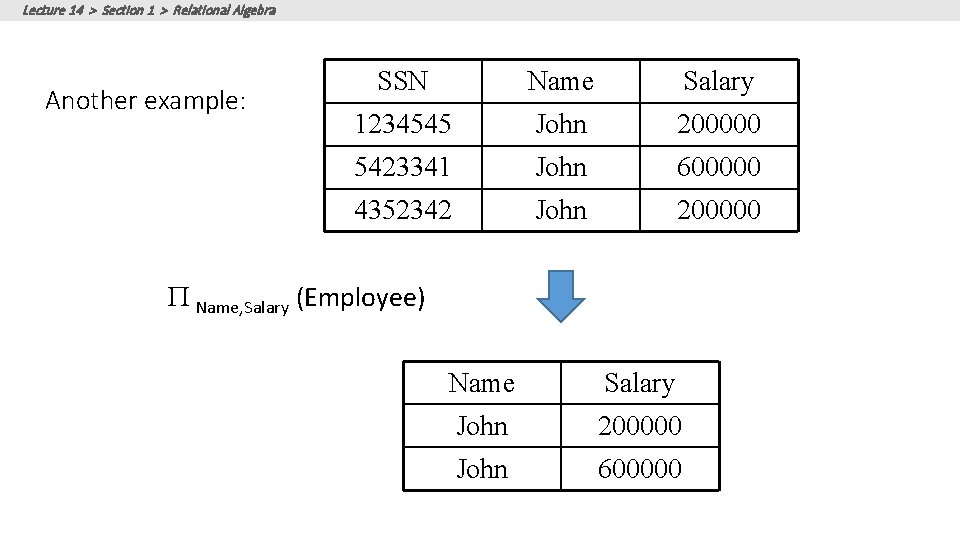
Lecture 14 > Section 1 > Relational Algebra Students(sid, sname, gpa) • Eliminates columns, then removes duplicates • Notation: P A 1, …, An (R) • Example: project social-security number and names: • P SSN, Name (Employee) • Output schema: Answer(SSN, Name) SQL: SELECT DISTINCT sname, gpa FROM Students; RA:
Lecture 14 > Section 1 > Relational Algebra Another example: SSN Name Salary 1234545 John 200000 5423341 John 600000 4352342 John 200000 P Name, Salary (Employee) Name Salary John 200000 John 600000
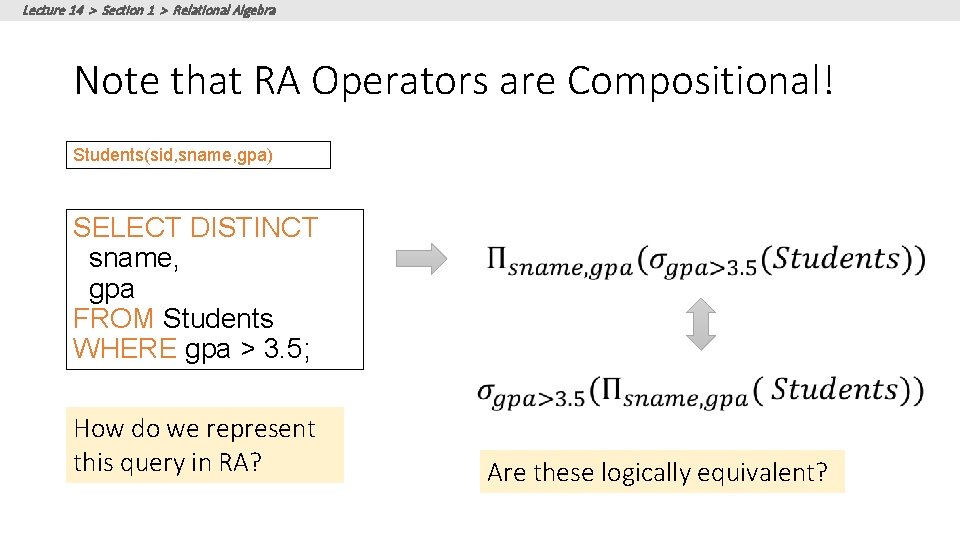
Lecture 14 > Section 1 > Relational Algebra Note that RA Operators are Compositional! Students(sid, sname, gpa) SELECT DISTINCT sname, gpa FROM Students WHERE gpa > 3. 5; How do we represent this query in RA? Are these logically equivalent?
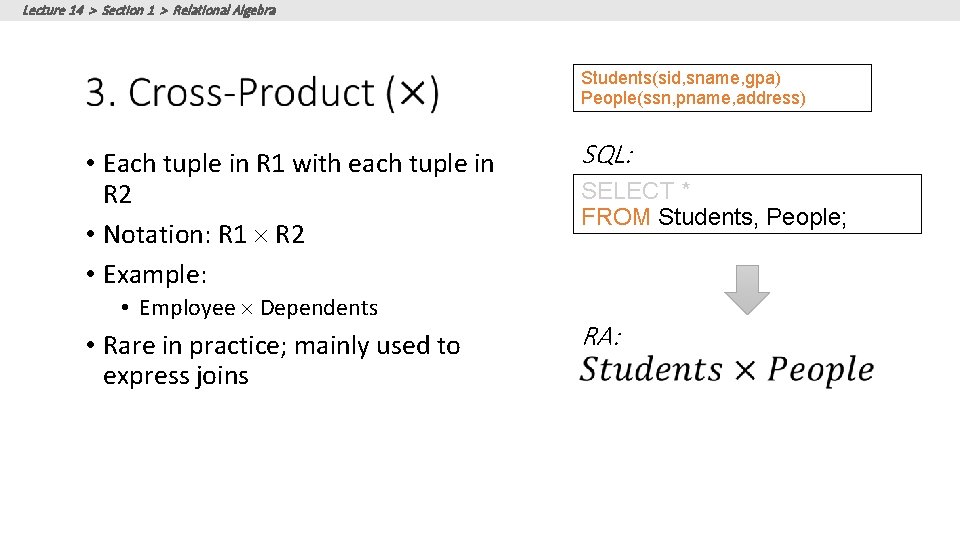
Lecture 14 > Section 1 > Relational Algebra Students(sid, sname, gpa) People(ssn, pname, address) • Each tuple in R 1 with each tuple in R 2 • Notation: R 1 R 2 • Example: • Employee Dependents • Rare in practice; mainly used to express joins SQL: SELECT * FROM Students, People; RA:
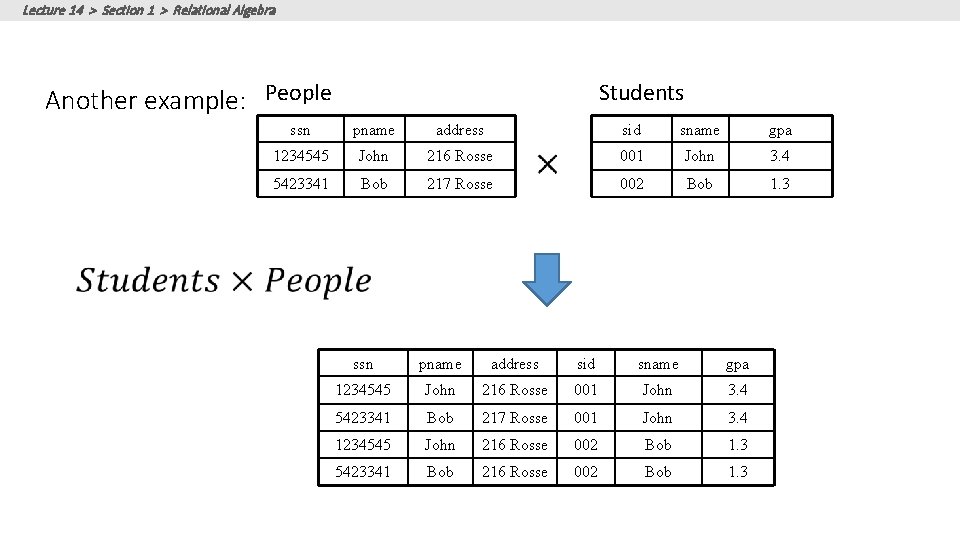
Lecture 14 > Section 1 > Relational Algebra Another example: People Students ssn pname address sid sname gpa 1234545 John 216 Rosse 001 John 3. 4 5423341 Bob 217 Rosse 002 Bob 1. 3 ssn pname address sid sname gpa 1234545 John 216 Rosse 001 John 3. 4 5423341 Bob 217 Rosse 001 John 3. 4 1234545 John 216 Rosse 002 Bob 1. 3 5423341 Bob 216 Rosse 002 Bob 1. 3
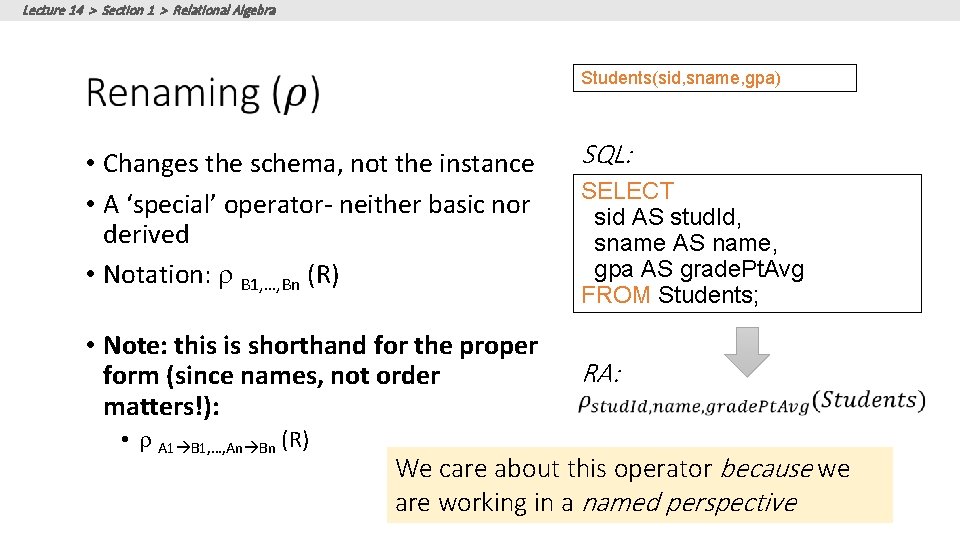
Lecture 14 > Section 1 > Relational Algebra Students(sid, sname, gpa) • Changes the schema, not the instance • A ‘special’ operator- neither basic nor derived • Notation: r B 1, …, Bn (R) • Note: this is shorthand for the proper form (since names, not order matters!): • r A 1 B 1, …, An Bn (R) SQL: SELECT sid AS stud. Id, sname AS name, gpa AS grade. Pt. Avg FROM Students; RA: We care about this operator because we are working in a named perspective
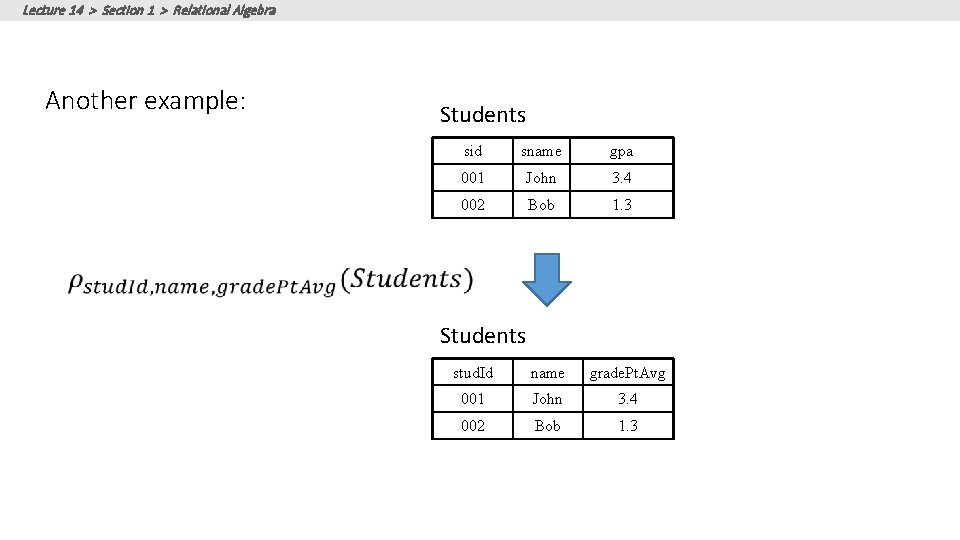
Lecture 14 > Section 1 > Relational Algebra Another example: Students sid sname gpa 001 John 3. 4 002 Bob 1. 3 Students stud. Id name grade. Pt. Avg 001 John 3. 4 002 Bob 1. 3
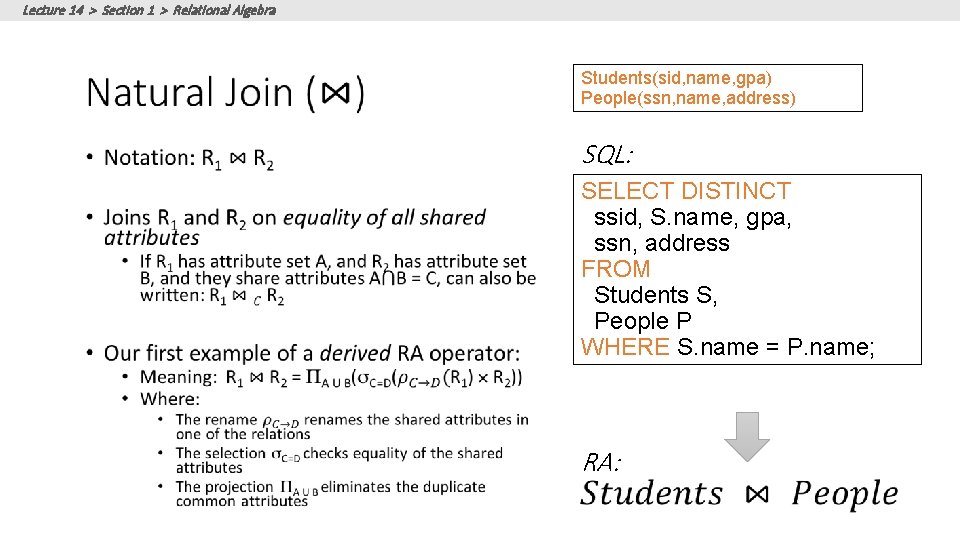
Lecture 14 > Section 1 > Relational Algebra Students(sid, name, gpa) People(ssn, name, address) • SQL: SELECT DISTINCT ssid, S. name, gpa, ssn, address FROM Students S, People P WHERE S. name = P. name; RA:
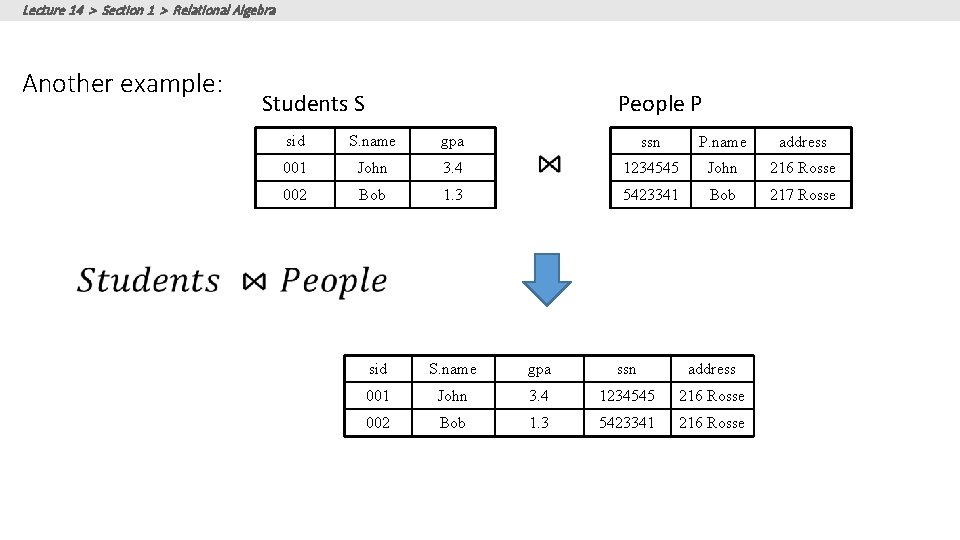
Lecture 14 > Section 1 > Relational Algebra Another example: People P Students S sid S. name gpa ssn P. name address 001 John 3. 4 1234545 John 216 Rosse 002 Bob 1. 3 5423341 Bob 217 Rosse sid S. name gpa ssn address 001 John 3. 4 1234545 216 Rosse 002 Bob 1. 3 5423341 216 Rosse
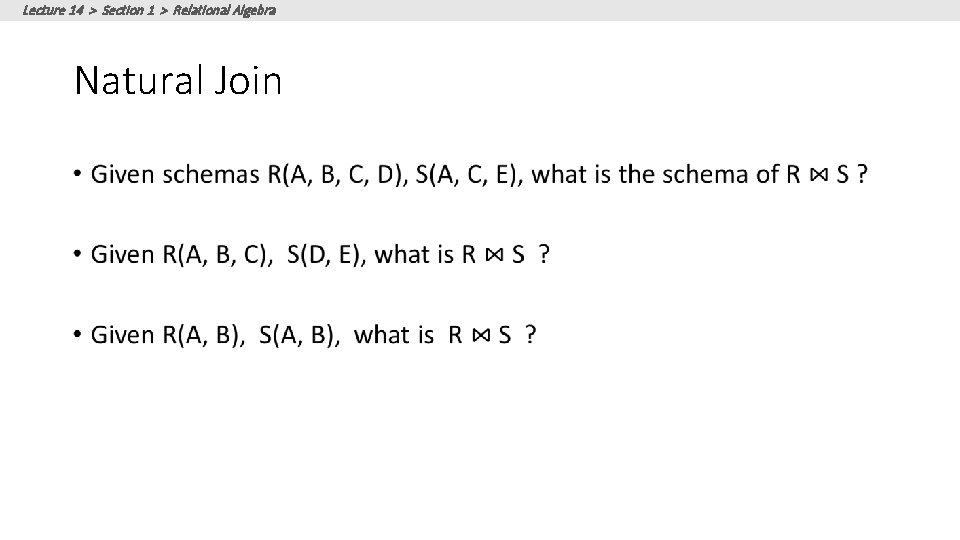
Lecture 14 > Section 1 > Relational Algebra Natural Join •
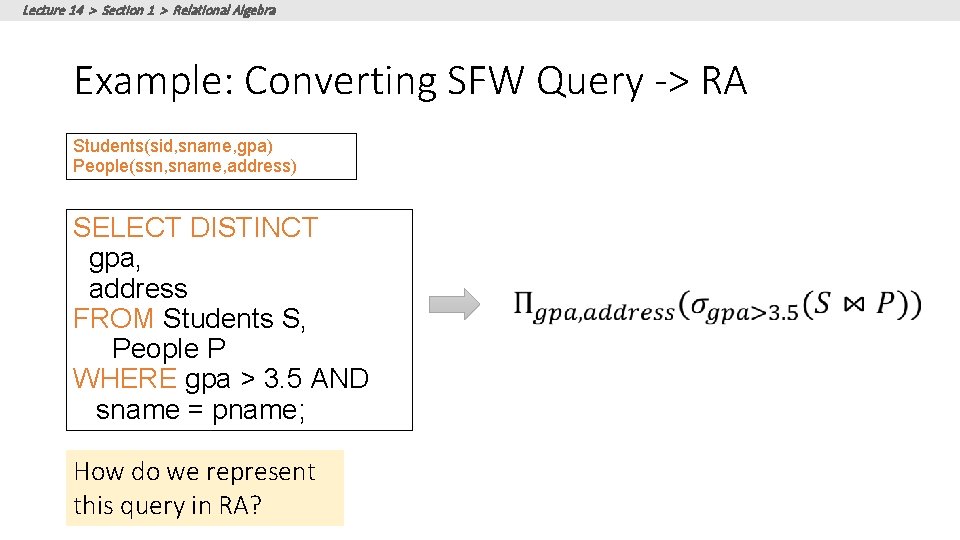
Lecture 14 > Section 1 > Relational Algebra Example: Converting SFW Query -> RA Students(sid, sname, gpa) People(ssn, sname, address) SELECT DISTINCT gpa, address FROM Students S, People P WHERE gpa > 3. 5 AND sname = pname; How do we represent this query in RA?
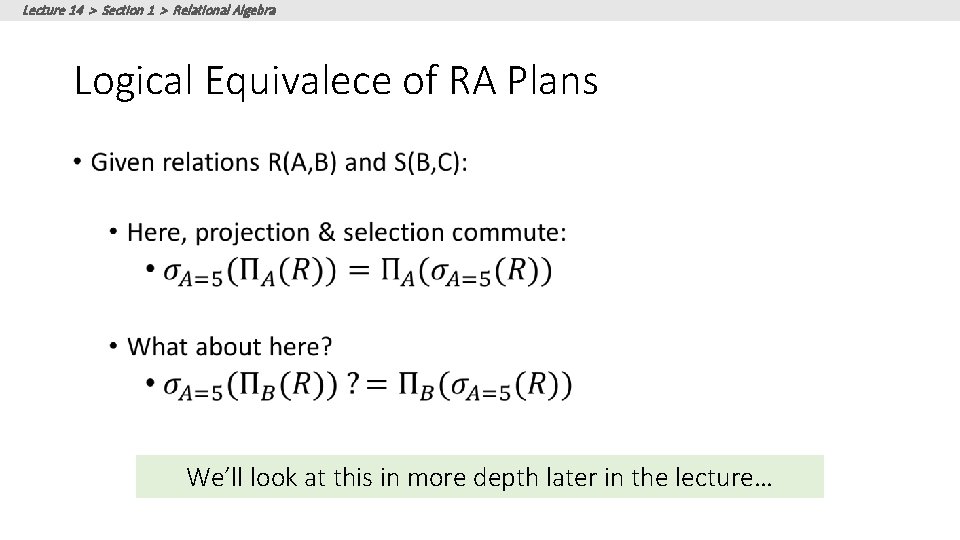
Lecture 14 > Section 1 > Relational Algebra Logical Equivalece of RA Plans • We’ll look at this in more depth later in the lecture…
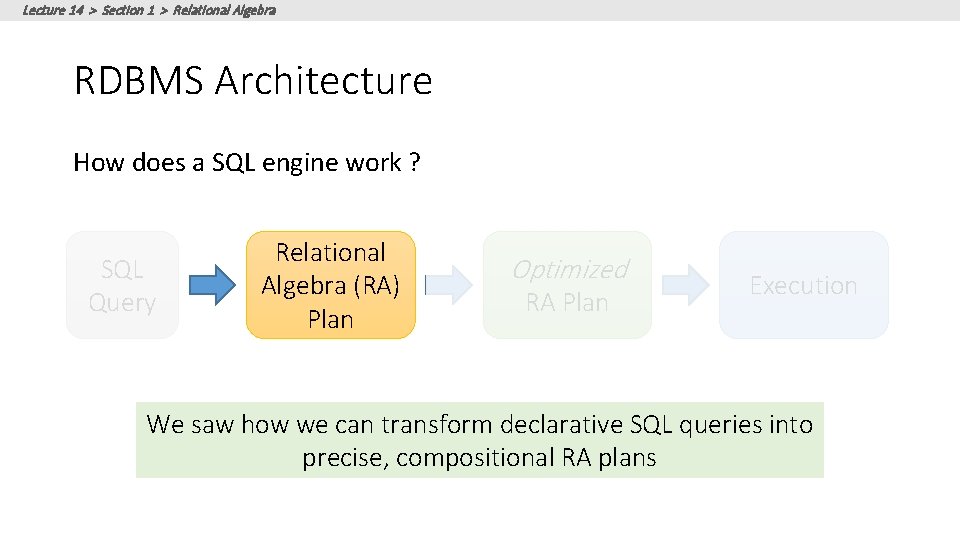
Lecture 14 > Section 1 > Relational Algebra RDBMS Architecture How does a SQL engine work ? SQL Query Relational Algebra (RA) Plan Optimized RA Plan Execution We saw how we can transform declarative SQL queries into precise, compositional RA plans
Lecture 14 > Section 1 > Relational Algebra RDBMS Architecture How does a SQL engine work ? SQL Query Relational Algebra (RA) Plan Optimized RA Plan We’ll look at how to then optimize these plans later in this lecture Execution
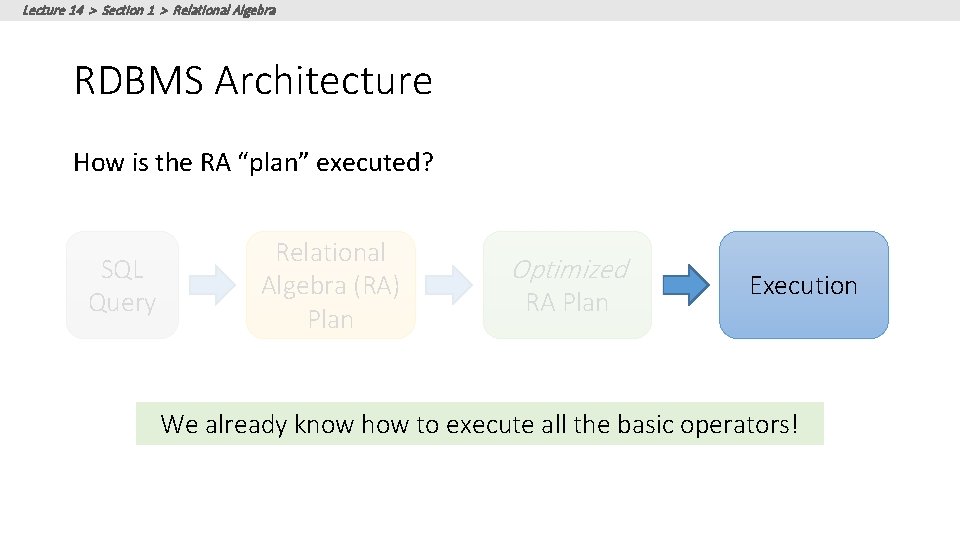
Lecture 14 > Section 1 > Relational Algebra RDBMS Architecture How is the RA “plan” executed? SQL Query Relational Algebra (RA) Plan Optimized RA Plan Execution We already know how to execute all the basic operators!
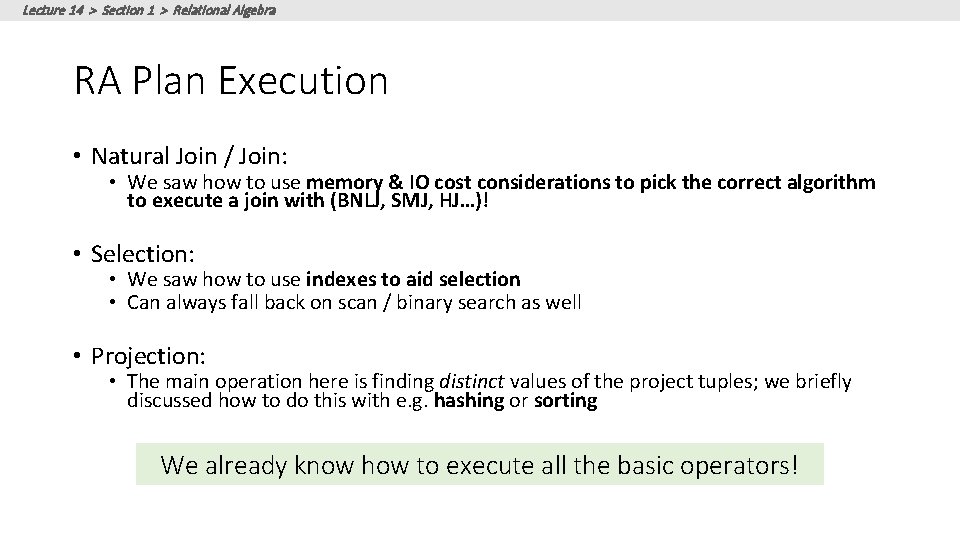
Lecture 14 > Section 1 > Relational Algebra RA Plan Execution • Natural Join / Join: • We saw how to use memory & IO cost considerations to pick the correct algorithm to execute a join with (BNLJ, SMJ, HJ…)! • Selection: • We saw how to use indexes to aid selection • Can always fall back on scan / binary search as well • Projection: • The main operation here is finding distinct values of the project tuples; we briefly discussed how to do this with e. g. hashing or sorting We already know how to execute all the basic operators!
Lecture 14 > Section 1 > ACTIVITY DB-WS 14 a. ipynb 40
Lecture 14 > Section 2 2. Adv. Relational Algebra 41
Lecture 14 > Section 2 What you will learn about in this section 1. Set Operations in RA 2. Fancier RA 3. Extensions & Limitations 42
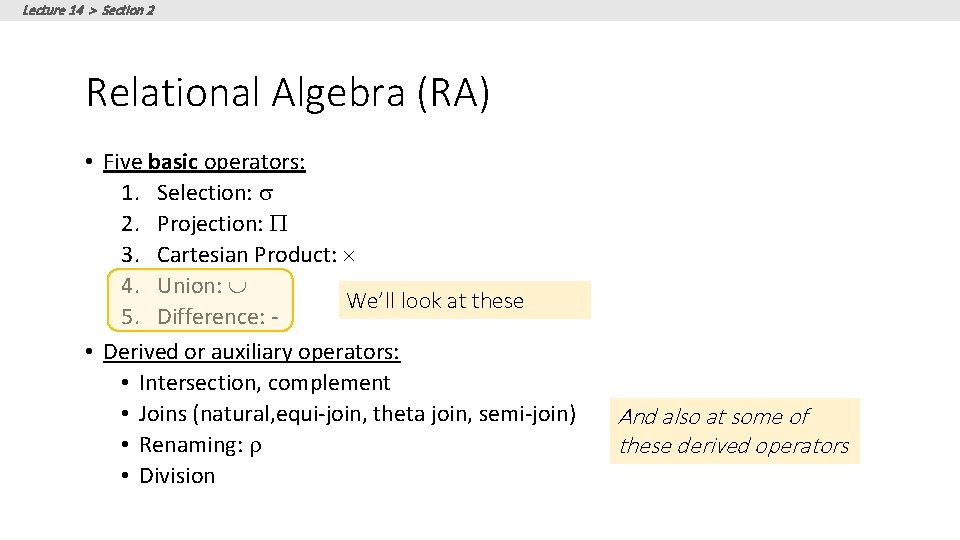
Lecture 14 > Section 2 Relational Algebra (RA) • Five basic operators: 1. Selection: s 2. Projection: P 3. Cartesian Product: 4. Union: We’ll look at these 5. Difference: • Derived or auxiliary operators: • Intersection, complement • Joins (natural, equi-join, theta join, semi-join) • Renaming: r • Division And also at some of these derived operators
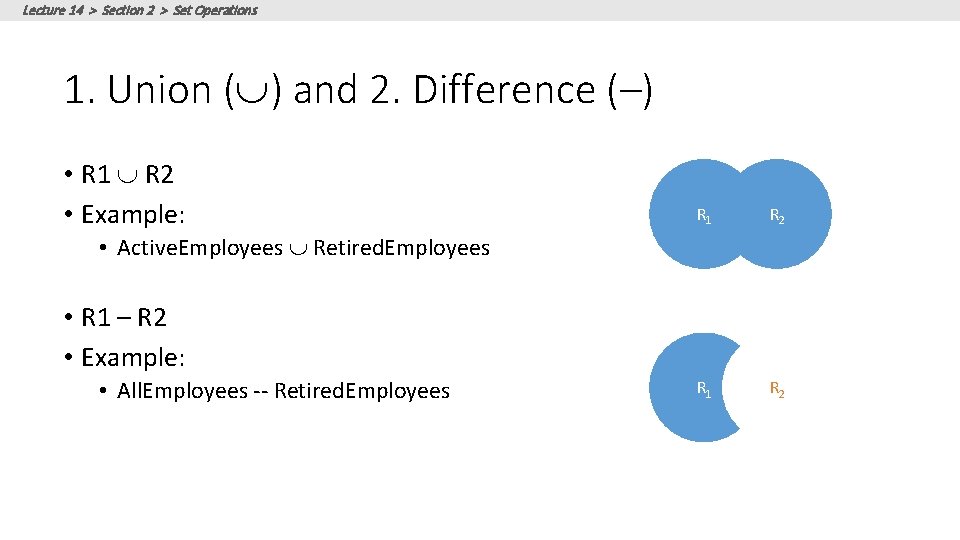
Lecture 14 > Section 2 > Set Operations 1. Union ( ) and 2. Difference (–) • R 1 R 2 • Example: R 1 R 2 • Active. Employees Retired. Employees • R 1 – R 2 • Example: • All. Employees -- Retired. Employees
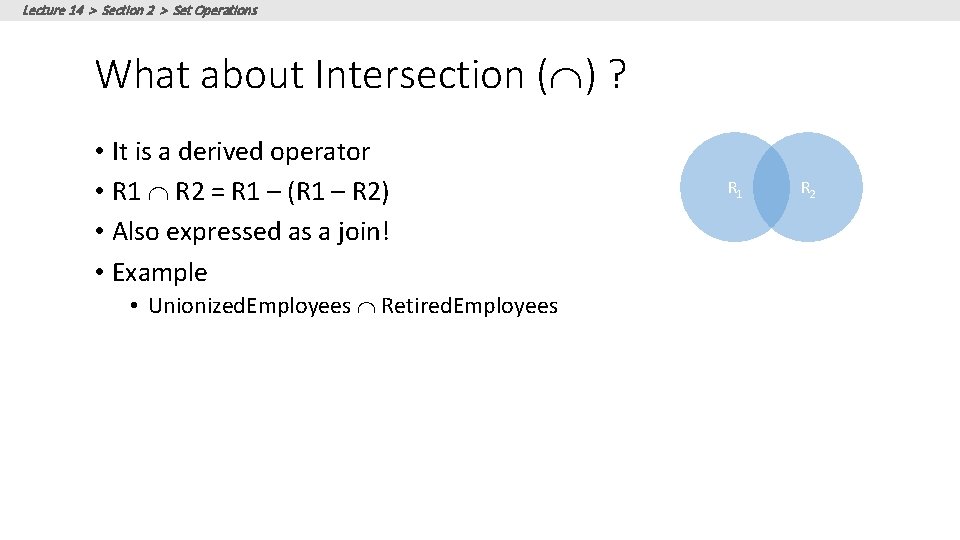
Lecture 14 > Section 2 > Set Operations What about Intersection ( ) ? • It is a derived operator • R 1 R 2 = R 1 – (R 1 – R 2) • Also expressed as a join! • Example • Unionized. Employees Retired. Employees R 1 R 2
Lecture 14 > Section 2 > Fancier RA
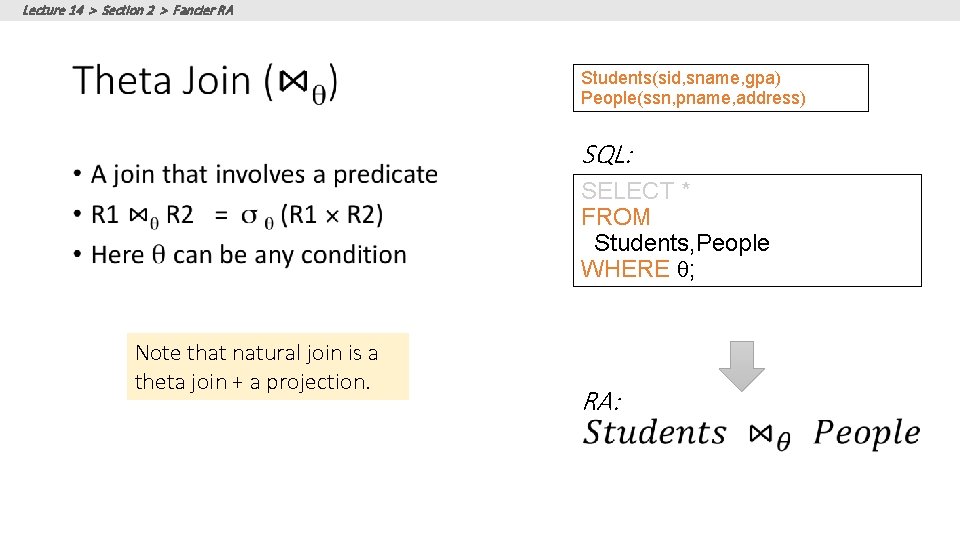
Lecture 14 > Section 2 > Fancier RA Students(sid, sname, gpa) People(ssn, pname, address) SQL: • SELECT * FROM Students, People WHERE q; Note that natural join is a theta join + a projection. RA:
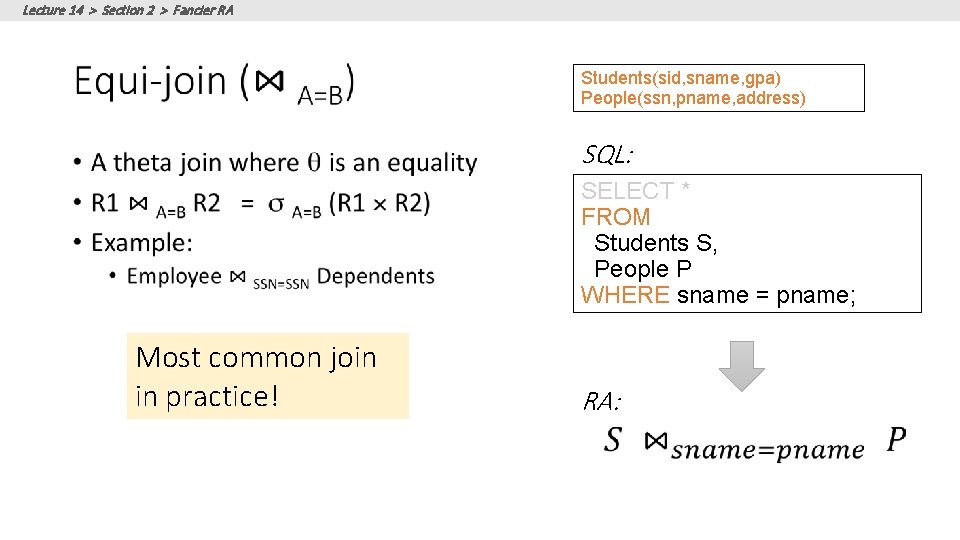
Lecture 14 > Section 2 > Fancier RA Students(sid, sname, gpa) People(ssn, pname, address) SQL: • SELECT * FROM Students S, People P WHERE sname = pname; Most common join in practice! RA:
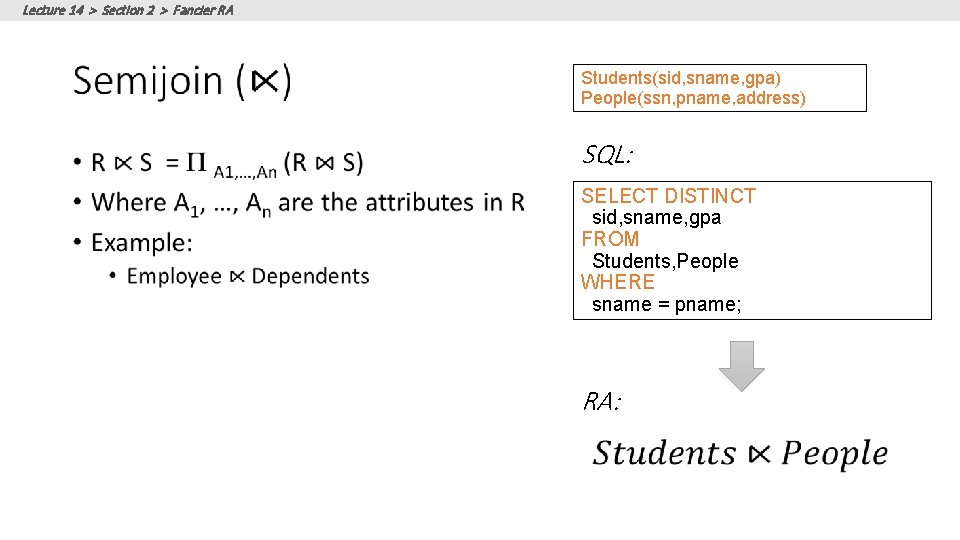
Lecture 14 > Section 2 > Fancier RA Students(sid, sname, gpa) People(ssn, pname, address) • SQL: SELECT DISTINCT sid, sname, gpa FROM Students, People WHERE sname = pname; RA:
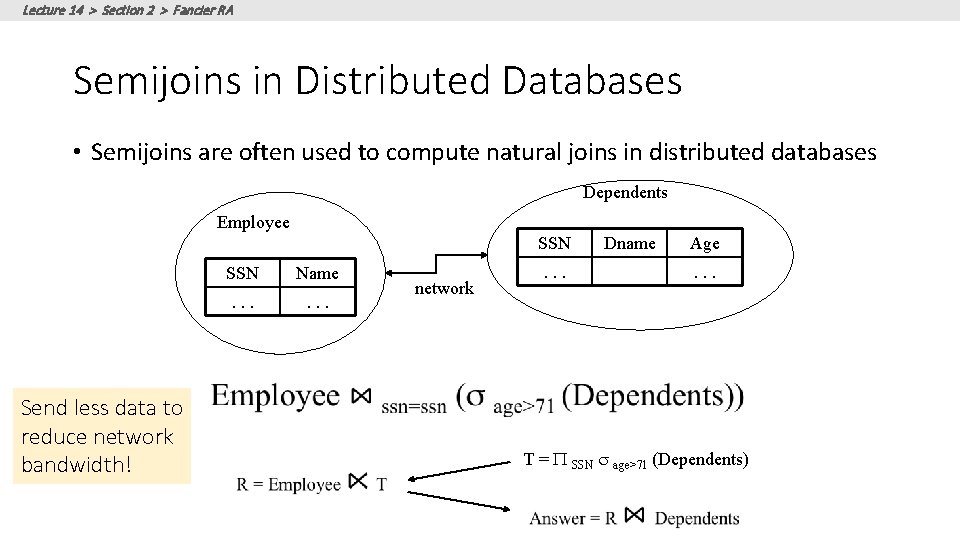
Lecture 14 > Section 2 > Fancier RA Semijoins in Distributed Databases • Semijoins are often used to compute natural joins in distributed databases Dependents Employee SSN Send less data to reduce network bandwidth! SSN Name . . . network . . . Dname Age. . . T = P SSN s age>71 (Dependents)
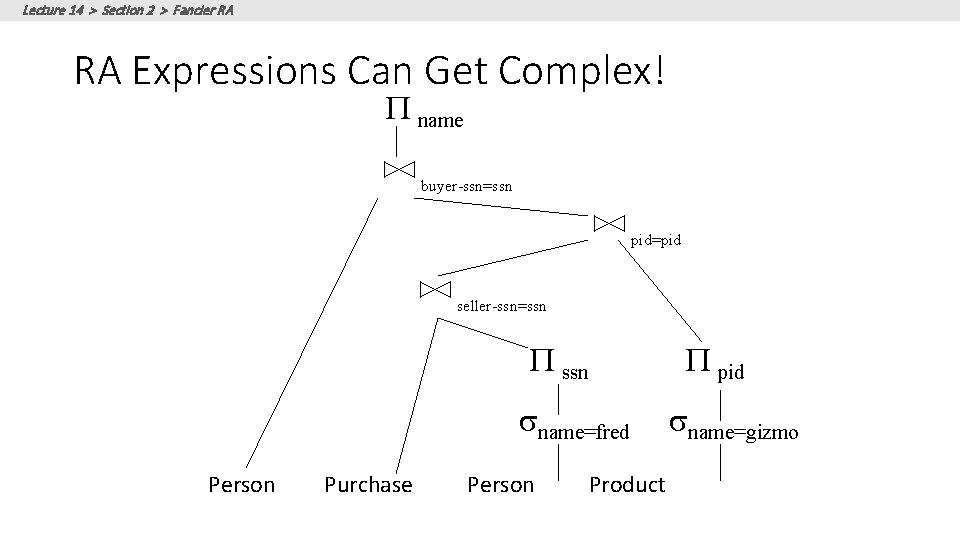
Lecture 14 > Section 2 > Fancier RA RA Expressions Can Get Complex! P name buyer-ssn=ssn pid=pid seller-ssn=ssn P pid sname=fred Person Purchase Person Product sname=gizmo
Lecture 14 > Section 2 > Extensions & Limitations Multisets
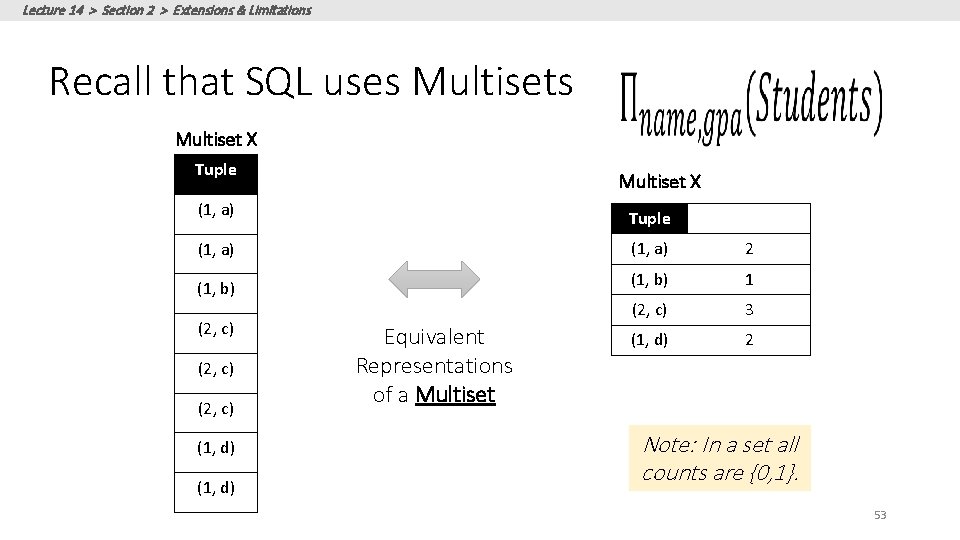
Lecture 14 > Section 2 > Extensions & Limitations Recall that SQL uses Multiset X Tuple Multiset X (1, a) Tuple (1, a) 2 (1, b) 1 (2, c) 3 (1, d) 2 (1, b) (2, c) (1, d) Equivalent Representations of a Multiset Note: In a set all counts are {0, 1}. 53
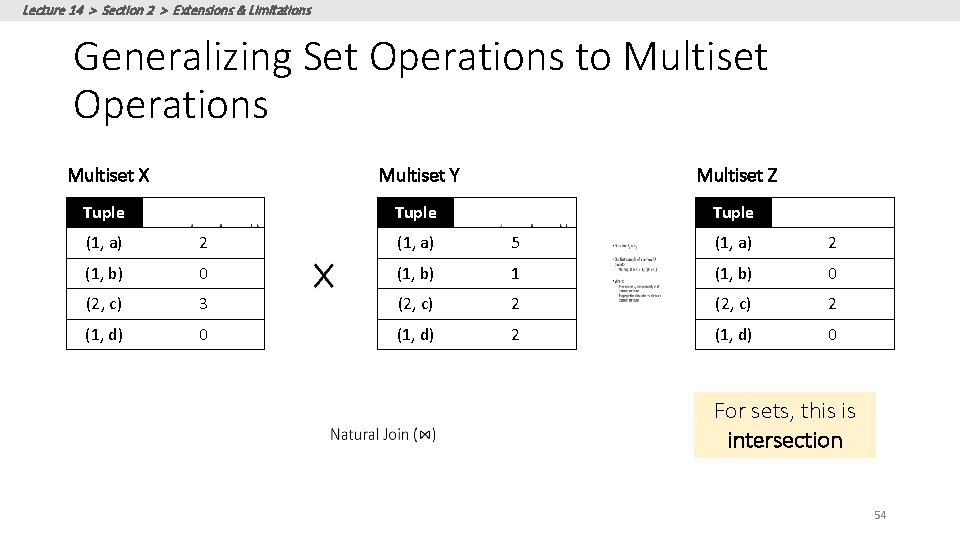
Lecture 14 > Section 2 > Extensions & Limitations Generalizing Set Operations to Multiset Operations Multiset X Multiset Y Multiset Z Tuple (1, a) 2 (1, a) 5 (1, a) 2 (1, b) 0 (1, b) 1 (1, b) 0 (2, c) 3 (2, c) 2 (1, d) 0 (1, d) 2 (1, d) 0 For sets, this is intersection 54
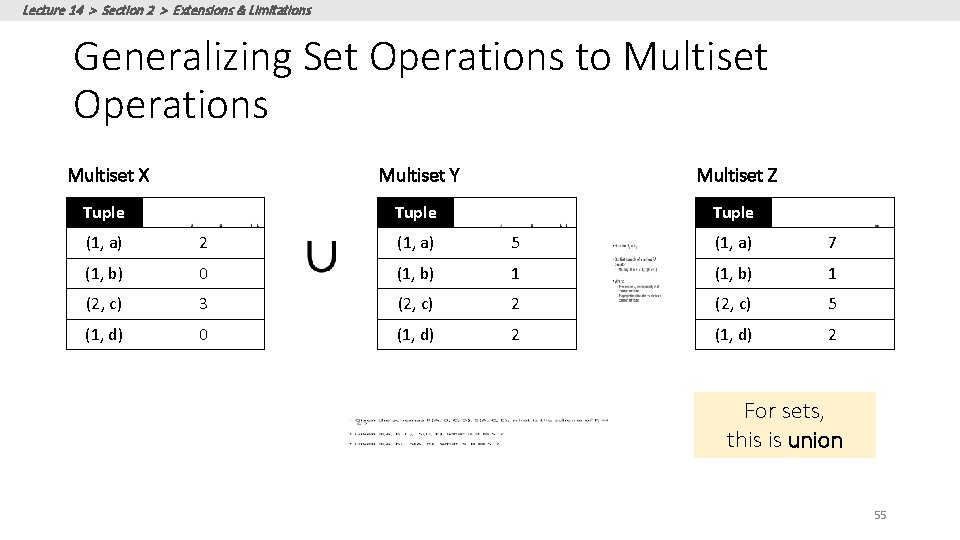
Lecture 14 > Section 2 > Extensions & Limitations Generalizing Set Operations to Multiset Operations Multiset X Multiset Y Multiset Z Tuple (1, a) 2 (1, a) 5 (1, a) 7 (1, b) 0 (1, b) 1 (2, c) 3 (2, c) 2 (2, c) 5 (1, d) 0 (1, d) 2 For sets, this is union 55
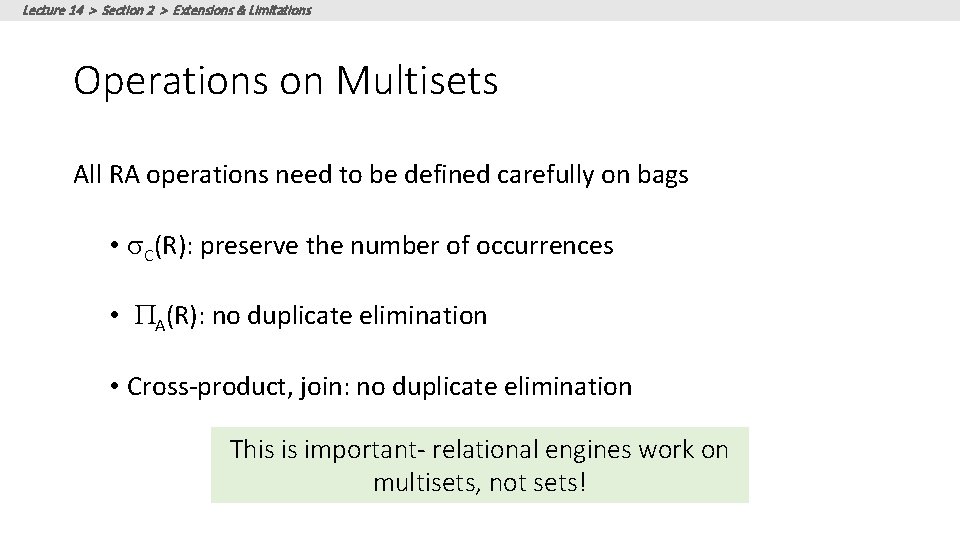
Lecture 14 > Section 2 > Extensions & Limitations Operations on Multisets All RA operations need to be defined carefully on bags • s. C(R): preserve the number of occurrences • PA(R): no duplicate elimination • Cross-product, join: no duplicate elimination This is important- relational engines work on multisets, not sets!
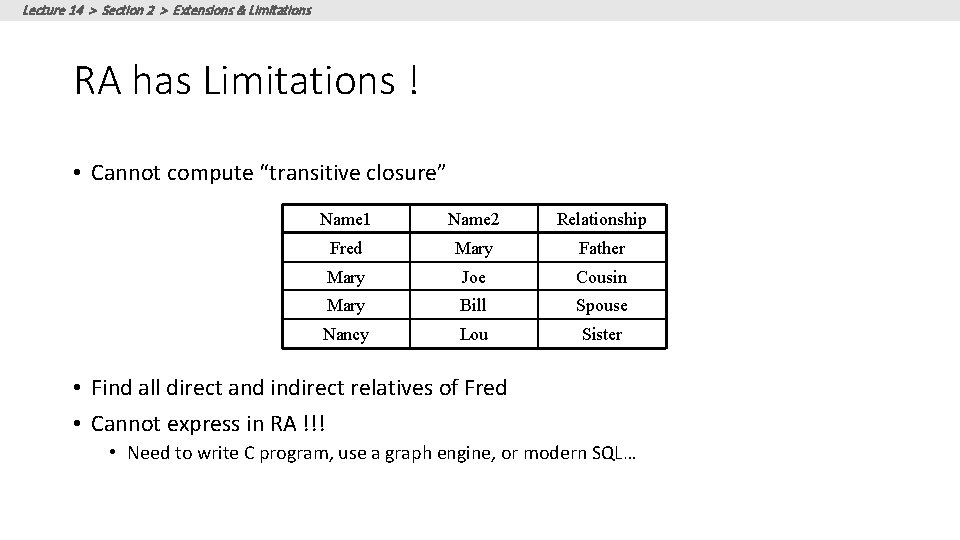
Lecture 14 > Section 2 > Extensions & Limitations RA has Limitations ! • Cannot compute “transitive closure” Name 1 Name 2 Relationship Fred Mary Father Mary Joe Cousin Mary Bill Spouse Nancy Lou Sister • Find all direct and indirect relatives of Fred • Cannot express in RA !!! • Need to write C program, use a graph engine, or modern SQL…