
Lecture 14 Reduction of State Tables Elimination of
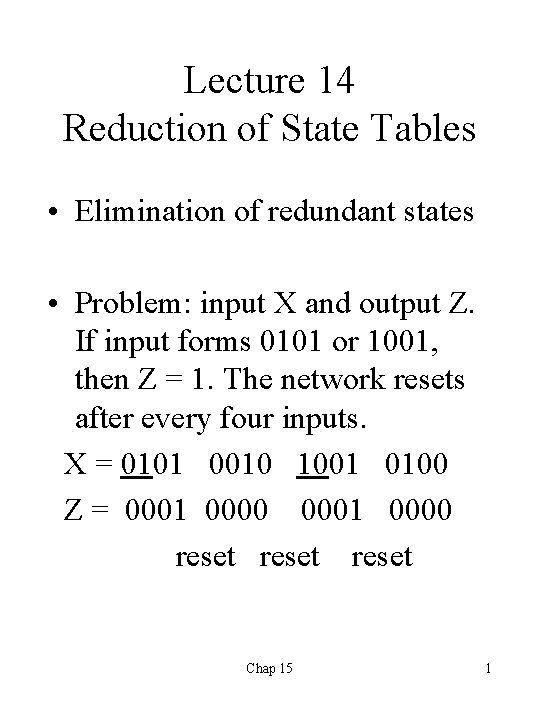
Lecture 14 Reduction of State Tables • Elimination of redundant states • Problem: input X and output Z. If input forms 0101 or 1001, then Z = 1. The network resets after every four inputs. X = 0101 0010 1001 0100 Z = 0001 0000 reset Chap 15 1
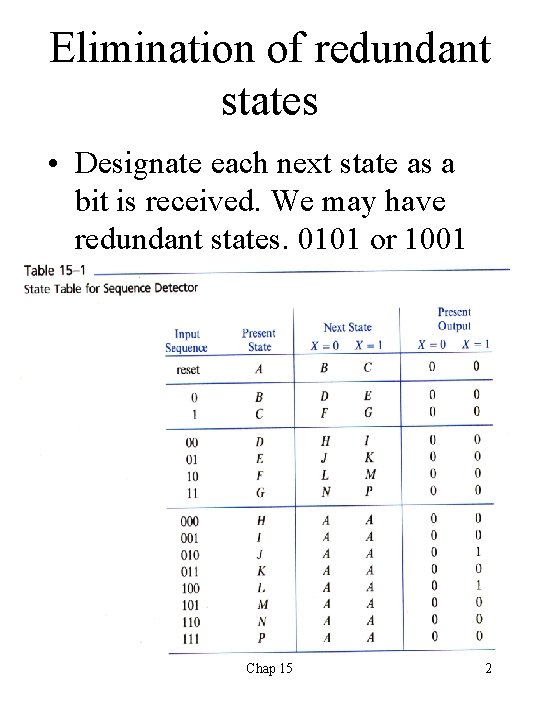
Elimination of redundant states • Designate each next state as a bit is received. We may have redundant states. 0101 or 1001 Chap 15 2
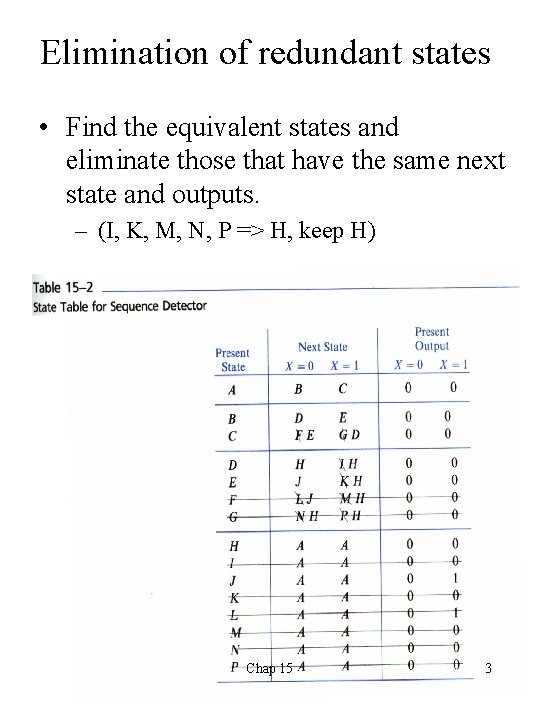
Elimination of redundant states • Find the equivalent states and eliminate those that have the same next state and outputs. – (I, K, M, N, P => H, keep H) Chap 15 3
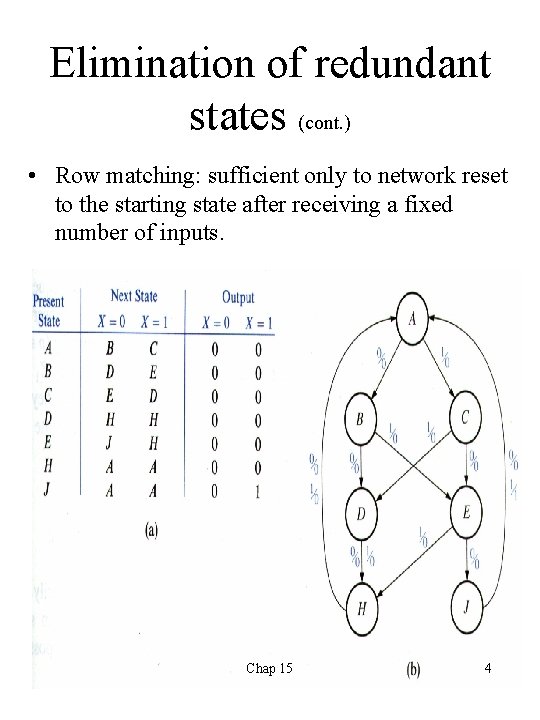
Elimination of redundant states (cont. ) • Row matching: sufficient only to network reset to the starting state after receiving a fixed number of inputs. Chap 15 4
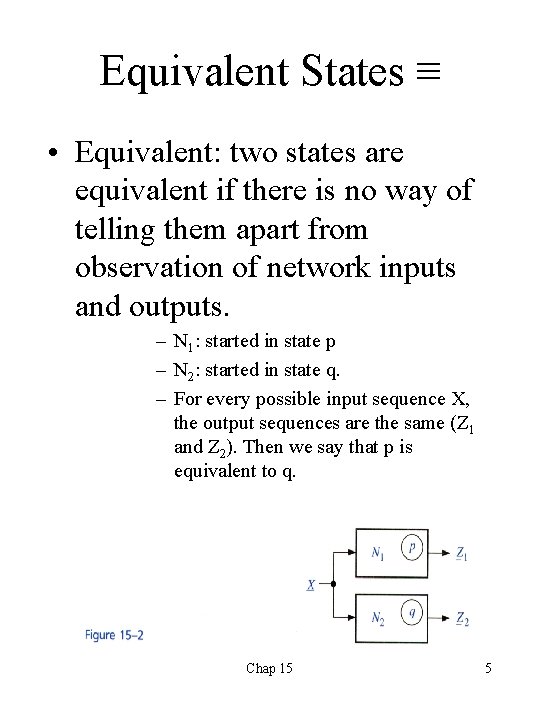
Equivalent States ≡ • Equivalent: two states are equivalent if there is no way of telling them apart from observation of network inputs and outputs. – N 1: started in state p – N 2: started in state q. – For every possible input sequence X, the output sequences are the same (Z 1 and Z 2). Then we say that p is equivalent to q. Chap 15 5
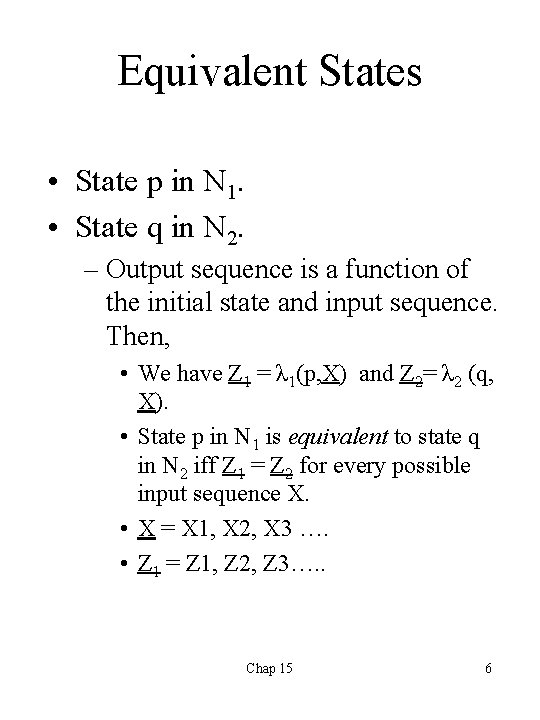
Equivalent States • State p in N 1. • State q in N 2. – Output sequence is a function of the initial state and input sequence. Then, • We have Z 1 = λ 1(p, X) and Z 2= λ 2 (q, X). • State p in N 1 is equivalent to state q in N 2 iff Z 1 = Z 2 for every possible input sequence X. • X = X 1, X 2, X 3 …. • Z 1 = Z 1, Z 2, Z 3…. . Chap 15 6
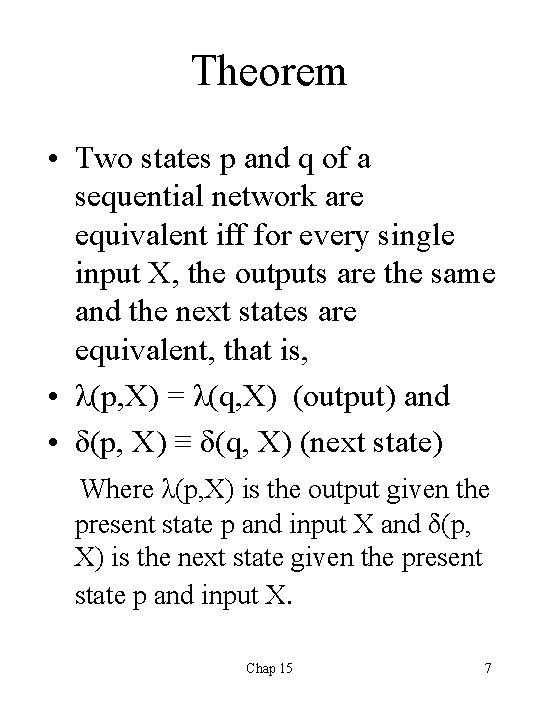
Theorem • Two states p and q of a sequential network are equivalent iff for every single input X, the outputs are the same and the next states are equivalent, that is, • λ(p, X) = λ(q, X) (output) and • δ(p, X) ≡ δ(q, X) (next state) Where λ(p, X) is the output given the present state p and input X and δ(p, X) is the next state given the present state p and input X. Chap 15 7
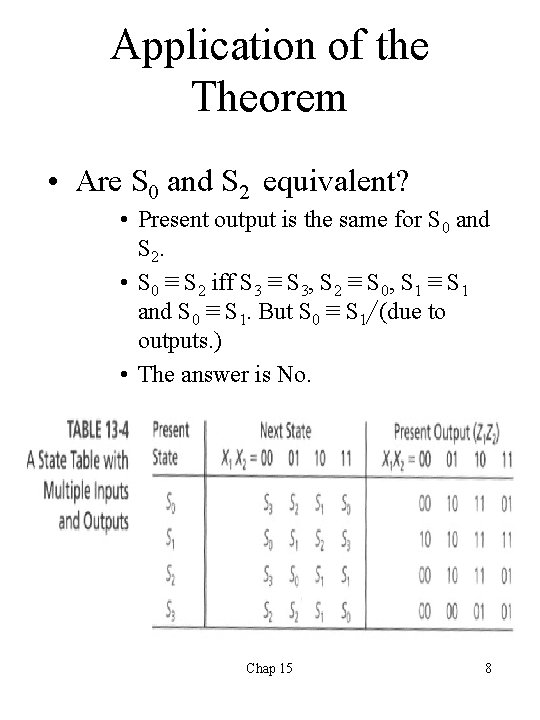
Application of the Theorem • Are S 0 and S 2 equivalent? • Present output is the same for S 0 and S 2. • S 0 ≡ S 2 iff S 3 ≡ S 3, S 2 ≡ S 0, S 1 ≡ S 1 and S 0 ≡ S 1. But S 0 ≡ S 1 (due to outputs. ) • The answer is No. Chap 15 8
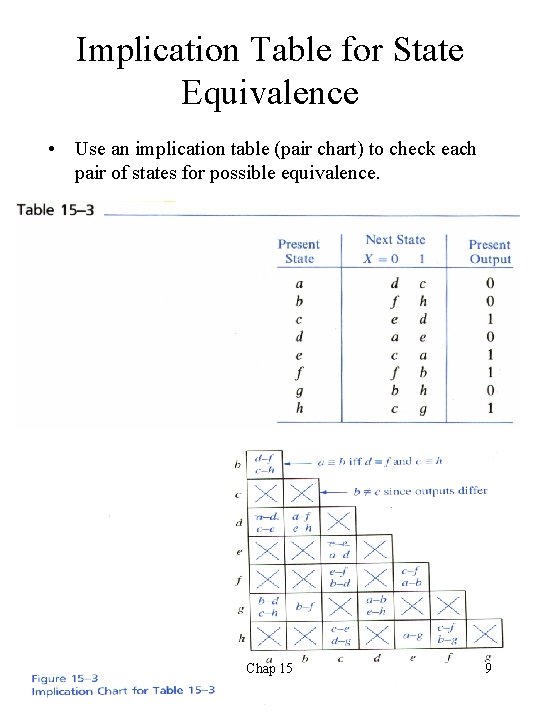
Implication Table for State Equivalence • Use an implication table (pair chart) to check each pair of states for possible equivalence. Chap 15 9
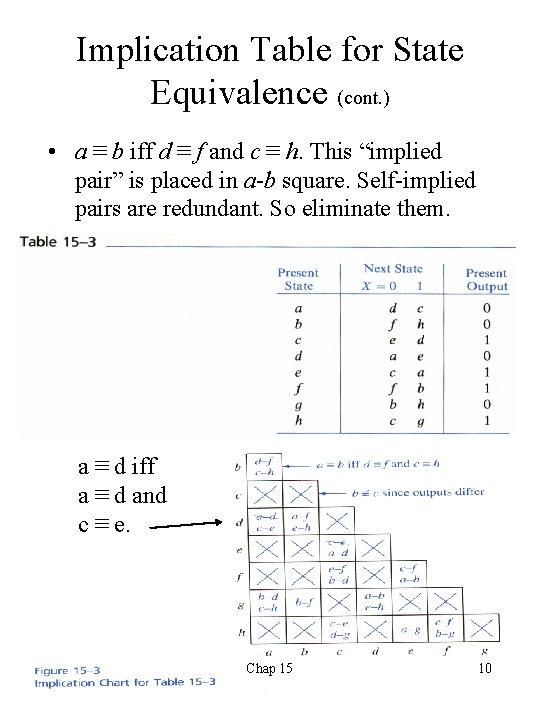
Implication Table for State Equivalence (cont. ) • a ≡ b iff d ≡ f and c ≡ h. This “implied pair” is placed in a-b square. Self-implied pairs are redundant. So eliminate them. a ≡ d iff a ≡ d and c ≡ e. Chap 15 10
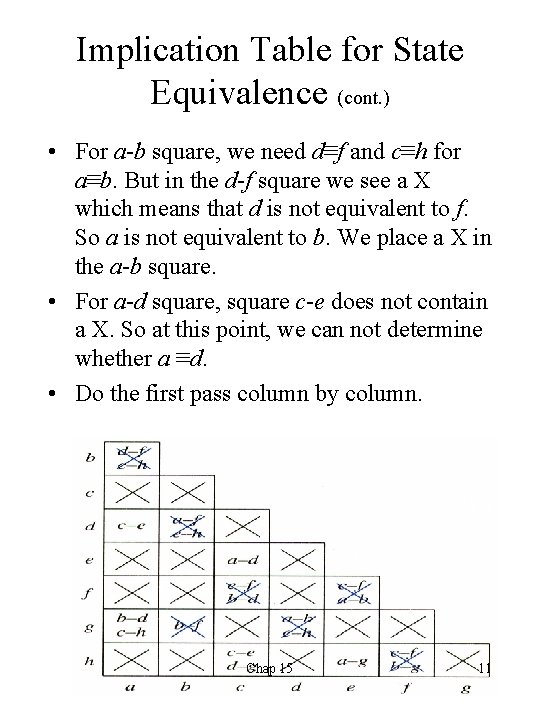
Implication Table for State Equivalence (cont. ) • For a-b square, we need d≡f and c≡h for a≡b. But in the d-f square we see a X which means that d is not equivalent to f. So a is not equivalent to b. We place a X in the a-b square. • For a-d square, square c-e does not contain a X. So at this point, we can not determine whether a ≡d. • Do the first pass column by column. Chap 15 11
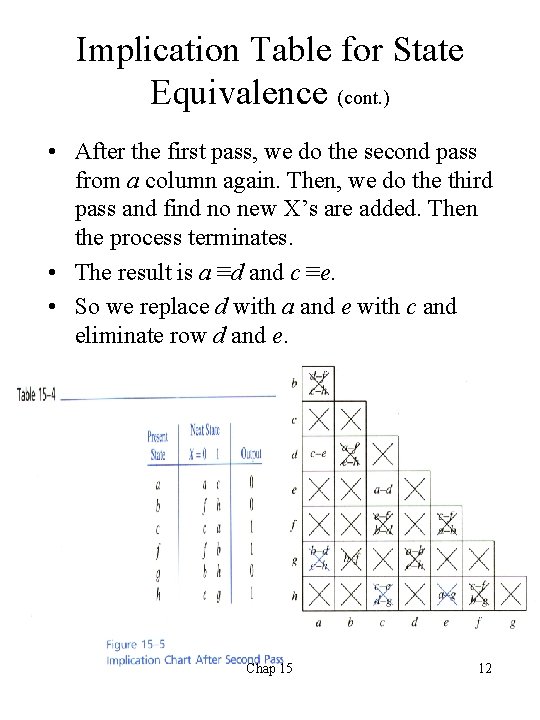
Implication Table for State Equivalence (cont. ) • After the first pass, we do the second pass from a column again. Then, we do the third pass and find no new X’s are added. Then the process terminates. • The result is a ≡d and c ≡e. • So we replace d with a and e with c and eliminate row d and e. Chap 15 12
Equivalent Sequential Networks • Sequential network N 1 is equivalent to sequential network N 2 if for each state p in N 1 there is a state q in N 2 such that p q, and conversely, for each state s in N 2 there is a state t in N 1 such that s t. • That is, for N 1 and N 2, the output sequences are the same for the same input sequences. Chap 15 13
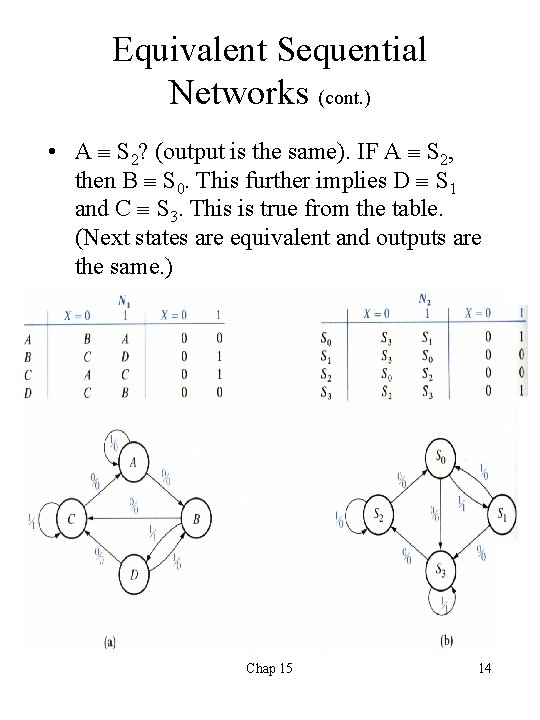
Equivalent Sequential Networks (cont. ) • A S 2? (output is the same). IF A S 2, then B S 0. This further implies D S 1 and C S 3. This is true from the table. (Next states are equivalent and outputs are the same. ) Chap 15 14
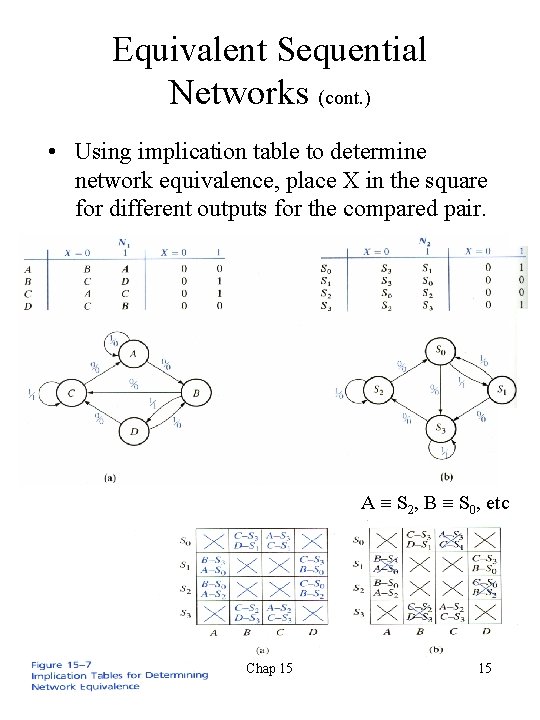
Equivalent Sequential Networks (cont. ) • Using implication table to determine network equivalence, place X in the square for different outputs for the compared pair. A S 2, B S 0, etc Chap 15 15
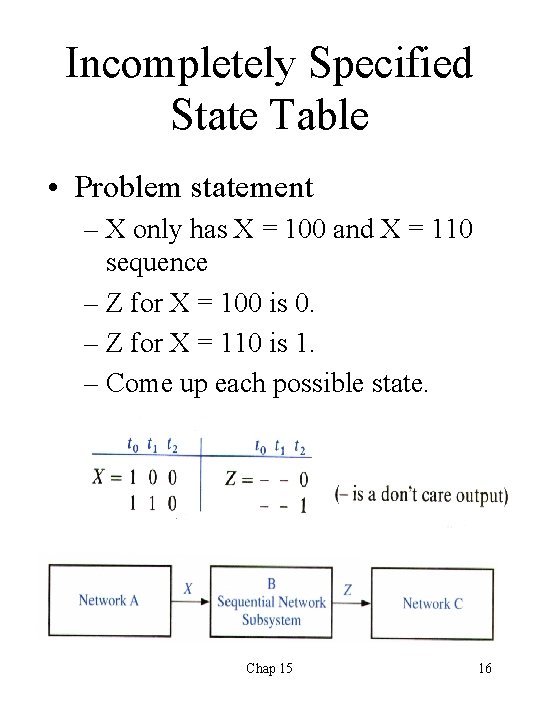
Incompletely Specified State Table • Problem statement – X only has X = 100 and X = 110 sequence – Z for X = 100 is 0. – Z for X = 110 is 1. – Come up each possible state. Chap 15 16
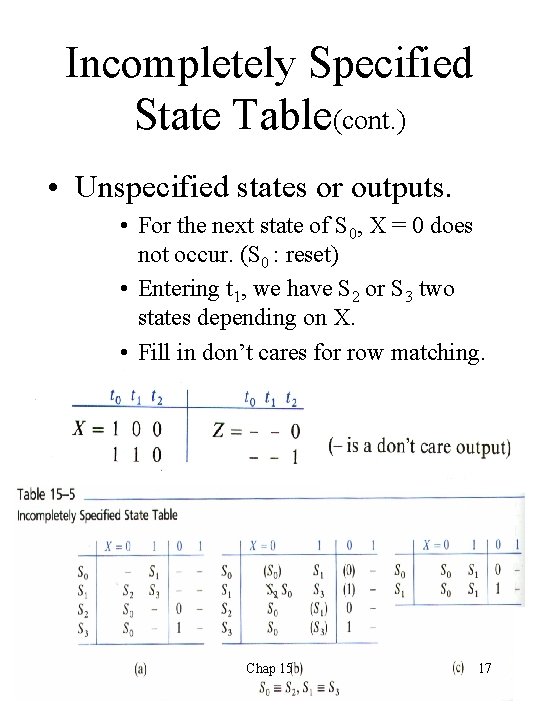
Incompletely Specified State Table(cont. ) • Unspecified states or outputs. • For the next state of S 0, X = 0 does not occur. (S 0 : reset) • Entering t 1, we have S 2 or S 3 two states depending on X. • Fill in don’t cares for row matching. Chap 15 17
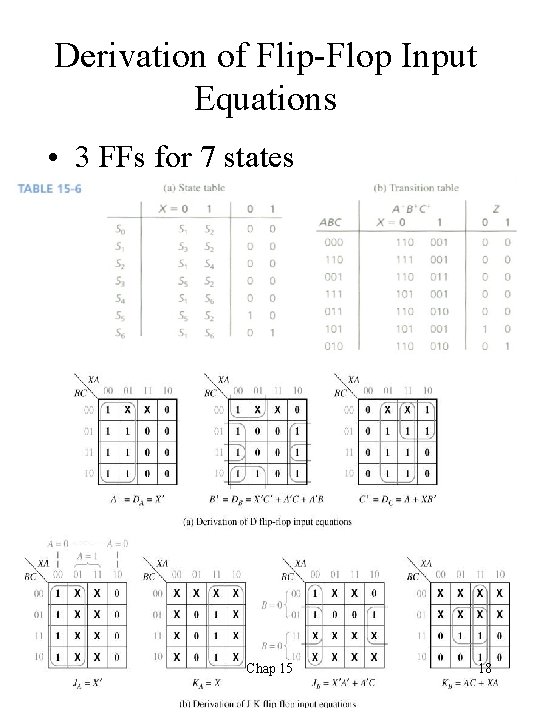
Derivation of Flip-Flop Input Equations • 3 FFs for 7 states Chap 15 18
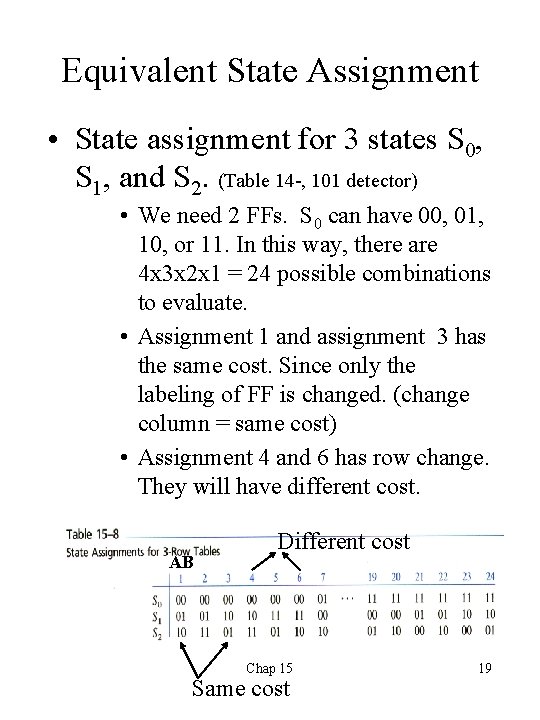
Equivalent State Assignment • State assignment for 3 states S 0, S 1, and S 2. (Table 14 -, 101 detector) • We need 2 FFs. S 0 can have 00, 01, 10, or 11. In this way, there are 4 x 3 x 2 x 1 = 24 possible combinations to evaluate. • Assignment 1 and assignment 3 has the same cost. Since only the labeling of FF is changed. (change column = same cost) • Assignment 4 and 6 has row change. They will have different cost. AB Different cost Chap 15 Same cost 19
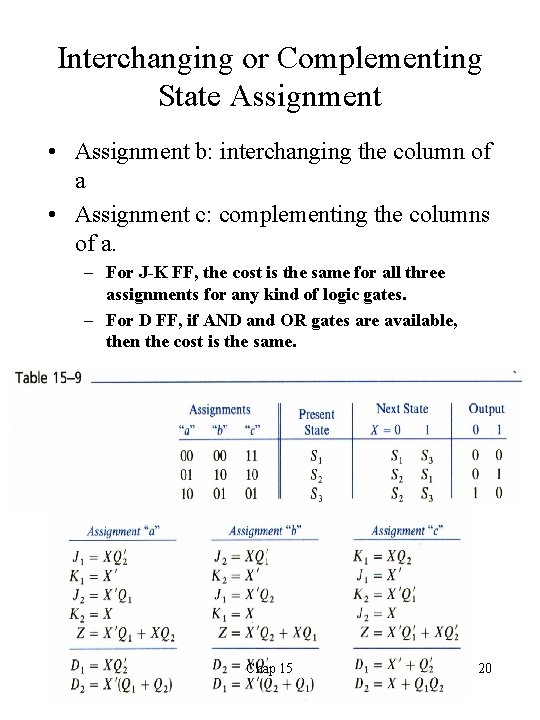
Interchanging or Complementing State Assignment • Assignment b: interchanging the column of a • Assignment c: complementing the columns of a. – For J-K FF, the cost is the same for all three assignments for any kind of logic gates. – For D FF, if AND and OR gates are available, then the cost is the same. Chap 15 20
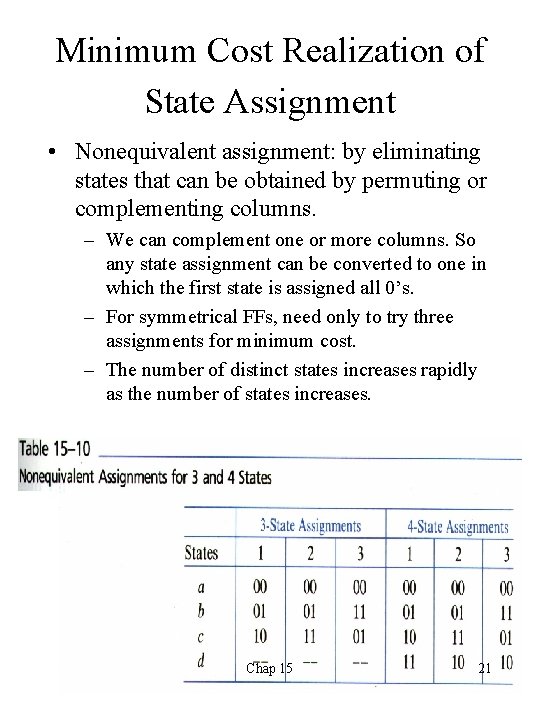
Minimum Cost Realization of State Assignment • Nonequivalent assignment: by eliminating states that can be obtained by permuting or complementing columns. – We can complement one or more columns. So any state assignment can be converted to one in which the first state is assigned all 0’s. – For symmetrical FFs, need only to try three assignments for minimum cost. – The number of distinct states increases rapidly as the number of states increases. Chap 15 21
Guidelines for State Assignment • Try to places 1’s on the FF input maps in adjacent squares. • 1: States which have the same next state for a given input should be given adjacent assignment. • 2: States which are the next states of the same state should be given adjacent assignment. • 3: States which have the same output for a given input should be given adjacent assignment (for output simplification. ) Chap 15 22
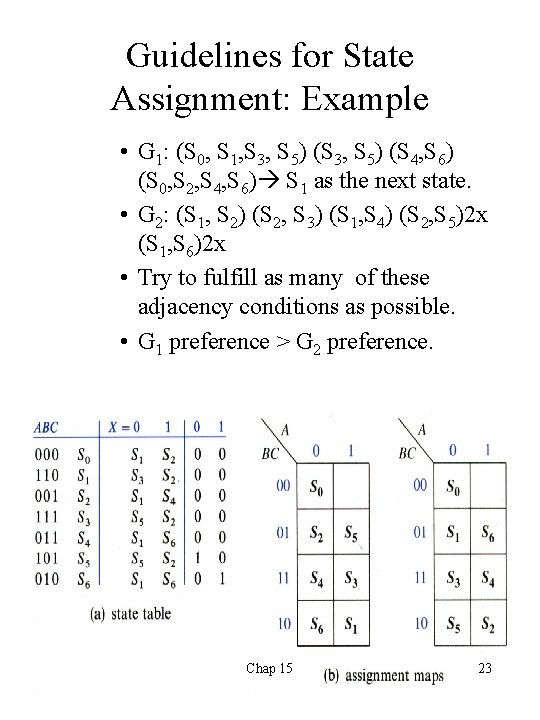
Guidelines for State Assignment: Example • G 1: (S 0, S 1, S 3, S 5) (S 4, S 6) (S 0, S 2, S 4, S 6) S 1 as the next state. • G 2: (S 1, S 2) (S 2, S 3) (S 1, S 4) (S 2, S 5)2 x (S 1, S 6)2 x • Try to fulfill as many of these adjacency conditions as possible. • G 1 preference > G 2 preference. Chap 15 23
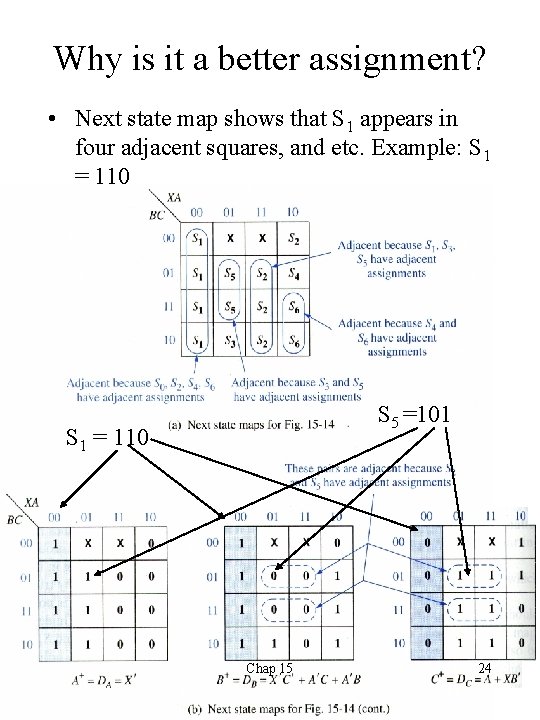
Why is it a better assignment? • Next state map shows that S 1 appears in four adjacent squares, and etc. Example: S 1 = 110 S 5 =101 S 1 = 110 Chap 15 24
On State Assignment • In some cases, the assignment which satisfies the most guidelines is not necessarily the best assignment. Therefore, it is a good idea to try several assignments which satisfy most of the guidelines and choose the one which gives the lowest cost function. • In general, the best assignment for one type of flip-flop is not the best for another type. Chap 15 25
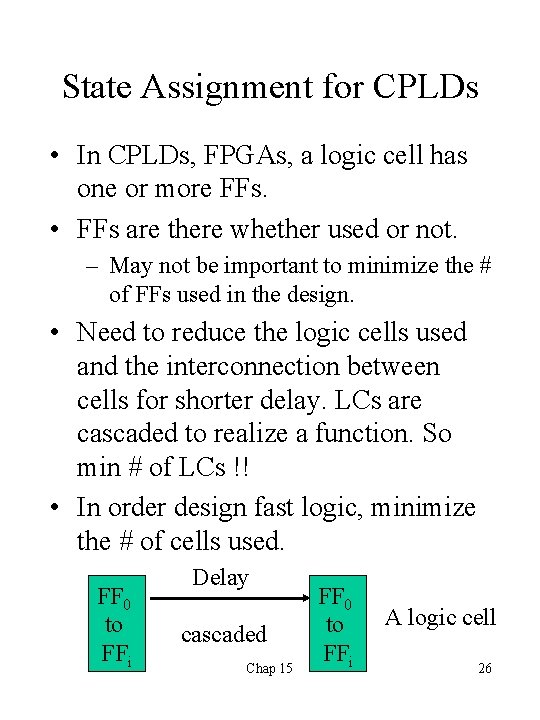
State Assignment for CPLDs • In CPLDs, FPGAs, a logic cell has one or more FFs. • FFs are there whether used or not. – May not be important to minimize the # of FFs used in the design. • Need to reduce the logic cells used and the interconnection between cells for shorter delay. LCs are cascaded to realize a function. So min # of LCs !! • In order design fast logic, minimize the # of cells used. FF 0 to FFi Delay cascaded Chap 15 FF 0 to FFi A logic cell 26
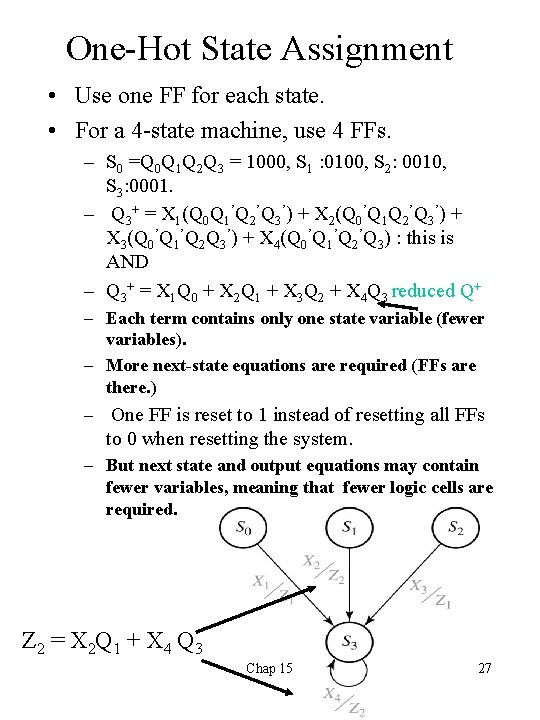
One-Hot State Assignment • Use one FF for each state. • For a 4 -state machine, use 4 FFs. – S 0 =Q 0 Q 1 Q 2 Q 3 = 1000, S 1 : 0100, S 2: 0010, S 3: 0001. – Q 3+ = X 1(Q 0 Q 1’Q 2’Q 3’) + X 2(Q 0’Q 1 Q 2’Q 3’) + X 3(Q 0’Q 1’Q 2 Q 3’) + X 4(Q 0’Q 1’Q 2’Q 3) : this is AND – Q 3+ = X 1 Q 0 + X 2 Q 1 + X 3 Q 2 + X 4 Q 3 reduced Q+ – Each term contains only one state variable (fewer variables). – More next-state equations are required (FFs are there. ) – One FF is reset to 1 instead of resetting all FFs to 0 when resetting the system. – But next state and output equations may contain fewer variables, meaning that fewer logic cells are required. Z 2 = X 2 Q 1 + X 4 Q 3 Chap 15 27
IN CPLD and FPGA • Try both for state assignment – Minimum number of states – One-hot assignment – And see which leads to the use of the smallest number of logic cells. • Less delays, higher speed! Chap 15 28
- Slides: 28