
Lecture 14 Processes CS 105 October 24 2019

Lecture 14: Processes CS 105 October 24, 2019
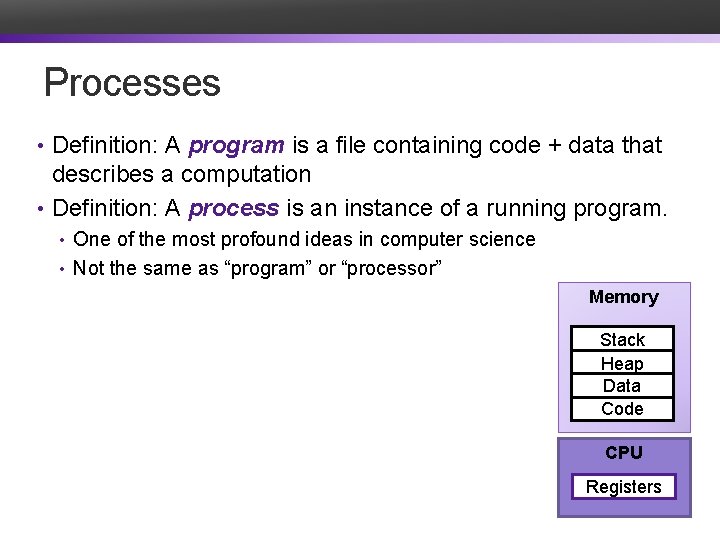
Processes • Definition: A program is a file containing code + data that describes a computation • Definition: A process is an instance of a running program. • One of the most profound ideas in computer science • Not the same as “program” or “processor” Memory Stack Heap Data Code CPU Registers
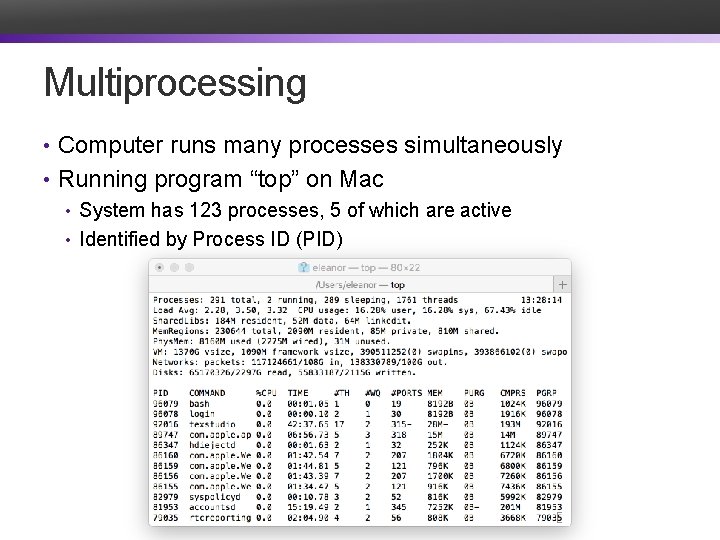
Multiprocessing • Computer runs many processes simultaneously • Running program “top” on Mac • System has 123 processes, 5 of which are active • Identified by Process ID (PID)
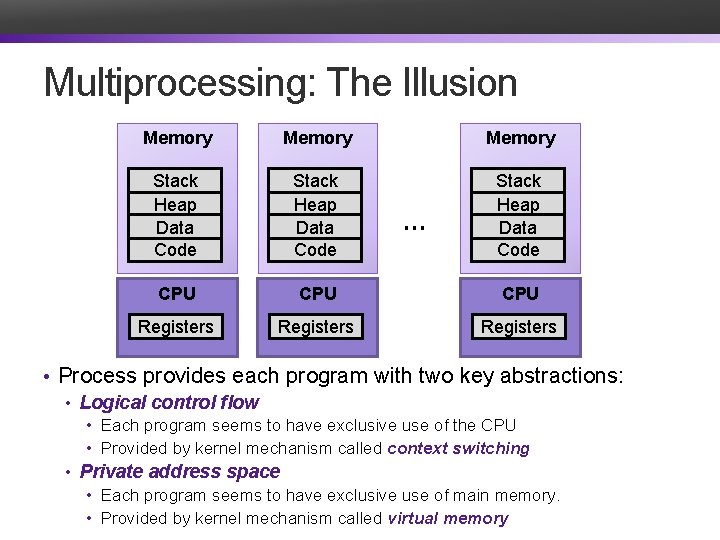
Multiprocessing: The Illusion Memory Stack Heap Data Code CPU CPU Registers … • Process provides each program with two key abstractions: • Logical control flow • Each program seems to have exclusive use of the CPU • Provided by kernel mechanism called context switching • Private address space • Each program seems to have exclusive use of main memory. • Provided by kernel mechanism called virtual memory
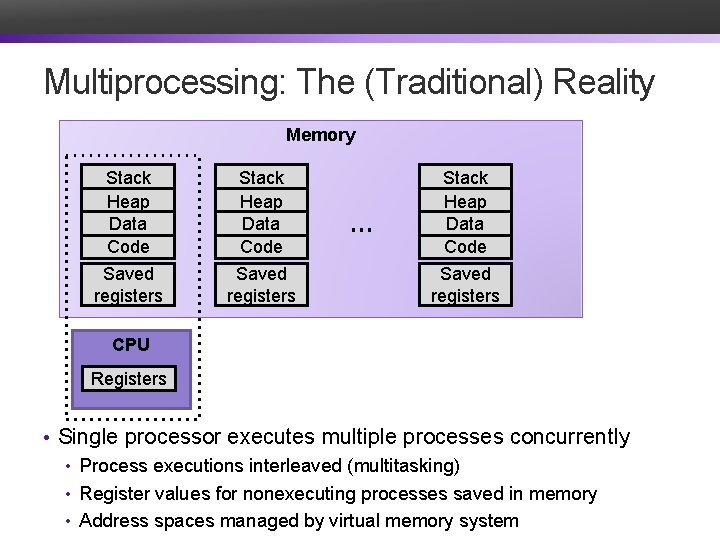
Multiprocessing: The (Traditional) Reality Memory Stack Heap Data Code Saved registers … Stack Heap Data Code Saved registers CPU Registers • Single processor executes multiple processes concurrently • Process executions interleaved (multitasking) • Register values for nonexecuting processes saved in memory • Address spaces managed by virtual memory system

Multiprocessing: The (Traditional) Reality Memory Stack Heap Data Code Saved registers Stack Heap Data Code … Saved registers CPU Registers 1. Save current registers in memory
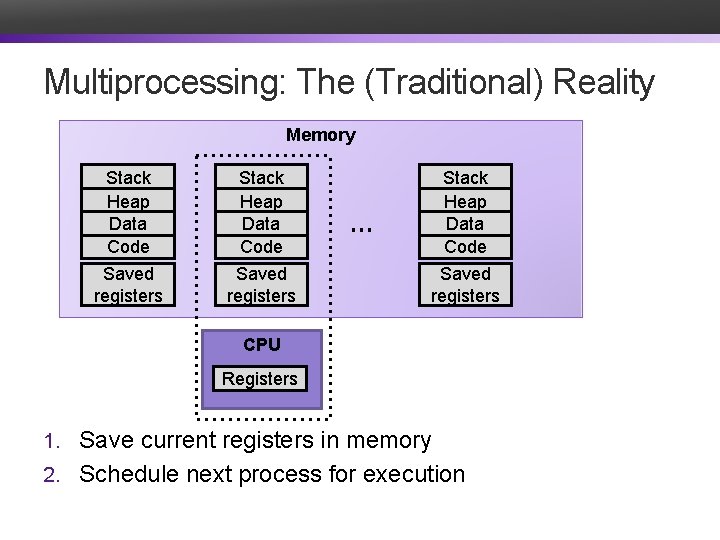
Multiprocessing: The (Traditional) Reality Memory Stack Heap Data Code Saved registers Stack Heap Data Code … Saved registers CPU Registers 1. Save current registers in memory 2. Schedule next process for execution
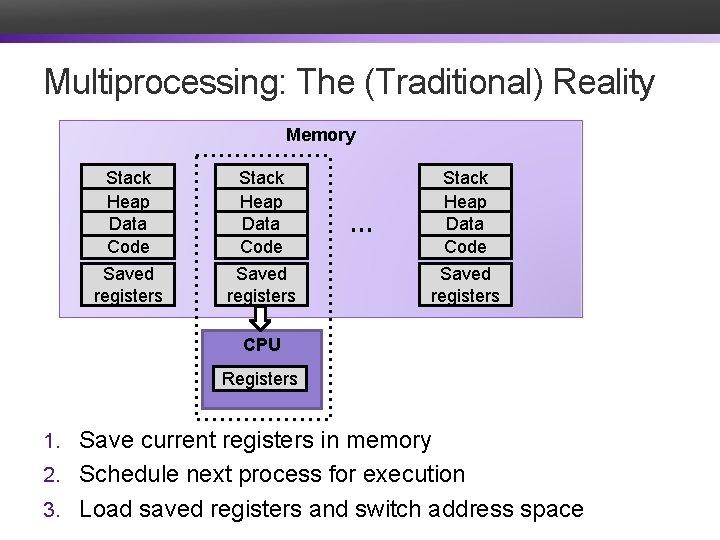
Multiprocessing: The (Traditional) Reality Memory Stack Heap Data Code Saved registers Stack Heap Data Code … Saved registers CPU Registers 1. Save current registers in memory 2. Schedule next process for execution 3. Load saved registers and switch address space
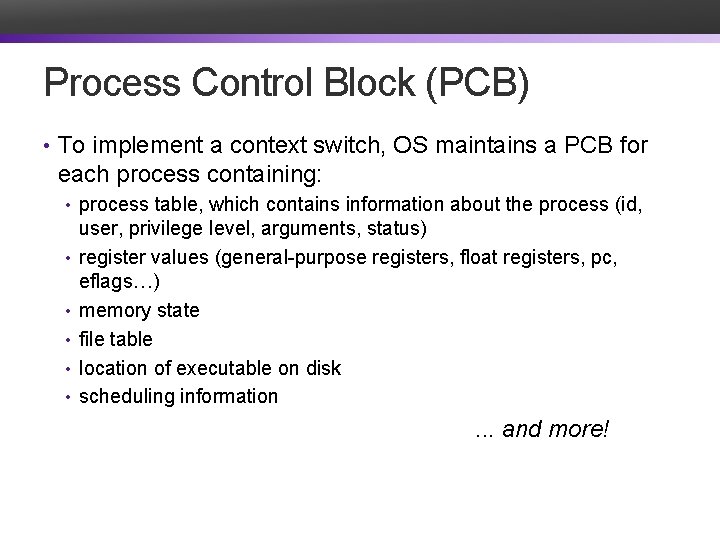
Process Control Block (PCB) • To implement a context switch, OS maintains a PCB for each process containing: • process table, which contains information about the process (id, • • • user, privilege level, arguments, status) register values (general-purpose registers, float registers, pc, eflags…) memory state file table location of executable on disk scheduling information . . . and more!
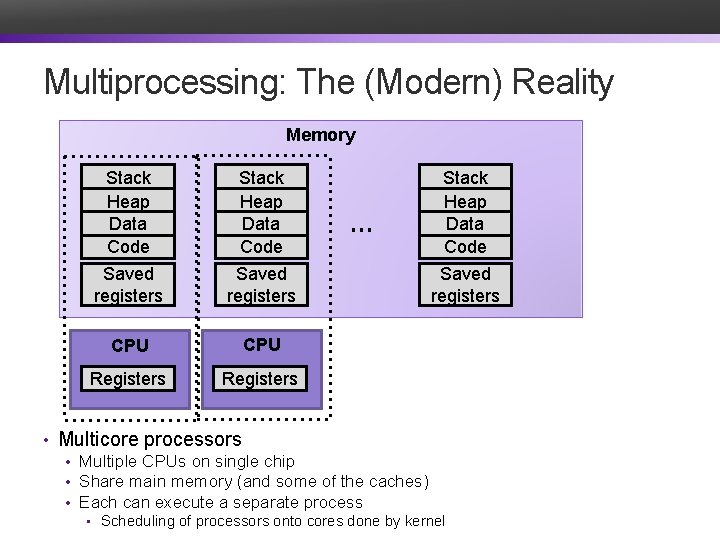
Multiprocessing: The (Modern) Reality Memory Stack Heap Data Code Saved registers CPU Registers … Stack Heap Data Code Saved registers • Multicore processors • Multiple CPUs on single chip • Share main memory (and some of the caches) • Each can execute a separate process • Scheduling of processors onto cores done by kernel
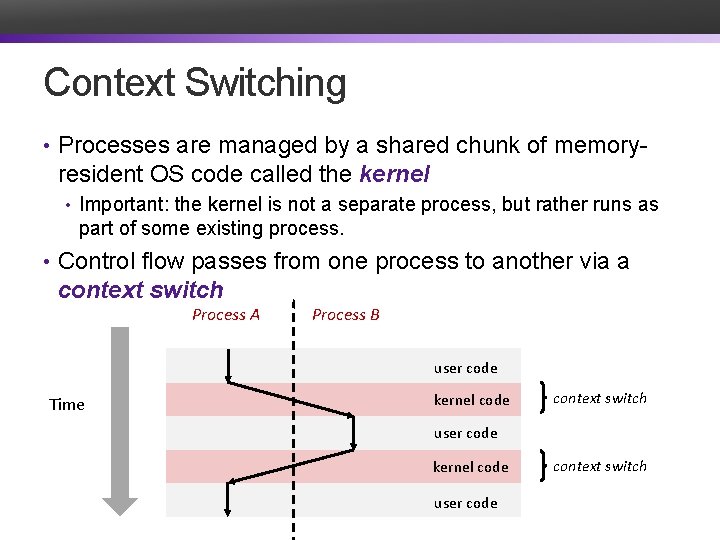
Context Switching • Processes are managed by a shared chunk of memory- resident OS code called the kernel • Important: the kernel is not a separate process, but rather runs as part of some existing process. • Control flow passes from one process to another via a context switch Process A Process B user code Time kernel code context switch user code kernel code user code context switch
Interrupts (Asynchronous Exceptions) • Caused by events external to the processor • Indicated by setting the processor’s interrupt pin • Handler returns to “next” instruction • Examples: • Timer interrupt • Every few ms, an external timer chip triggers an interrupt • Used by the kernel to take back control from user programs • I/O interrupt from external device • Hitting Ctrl-C at the keyboard • Arrival of a packet from a network • Arrival of data from a disk
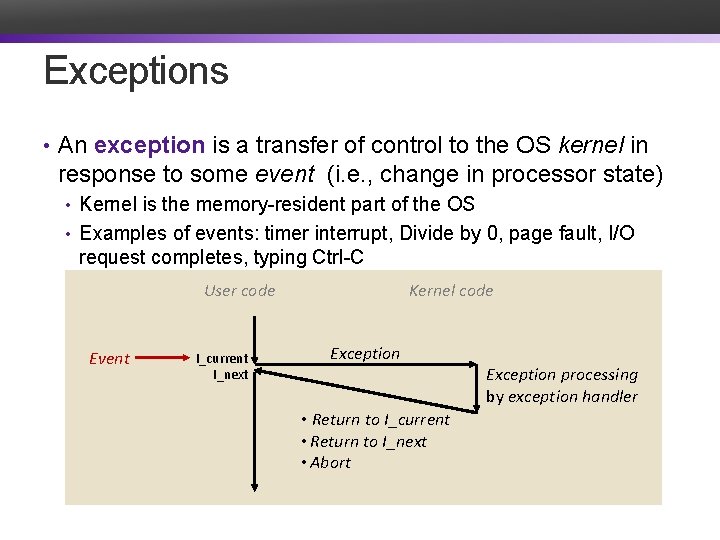
Exceptions • An exception is a transfer of control to the OS kernel in response to some event (i. e. , change in processor state) • Kernel is the memory-resident part of the OS • Examples of events: timer interrupt, Divide by 0, page fault, I/O request completes, typing Ctrl-C User code Event I_current I_next Kernel code Exception • Return to I_current • Return to I_next • Abort Exception processing by exception handler
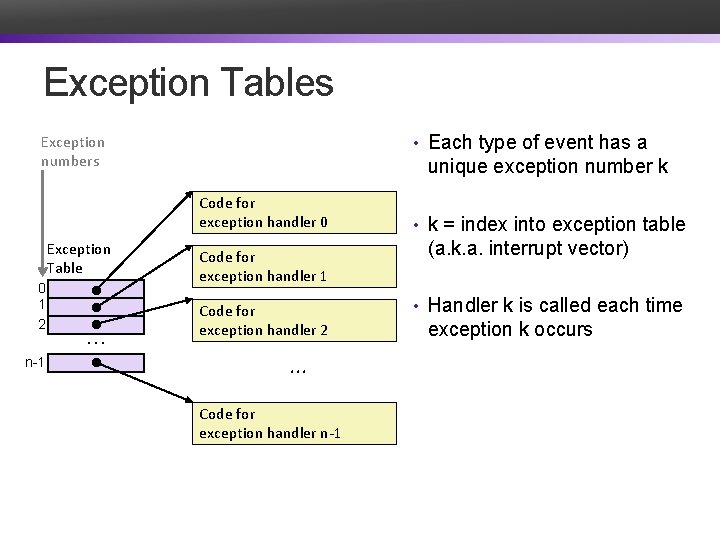
Exception Tables • Each type of event has a Exception numbers unique exception number k Code for exception handler 0 Exception Table 0 1 2 n-1 . . . Code for exception handler 1 Code for exception handler 2 . . . Code for exception handler n-1 • k = index into exception table (a. k. a. interrupt vector) • Handler k is called each time exception k occurs
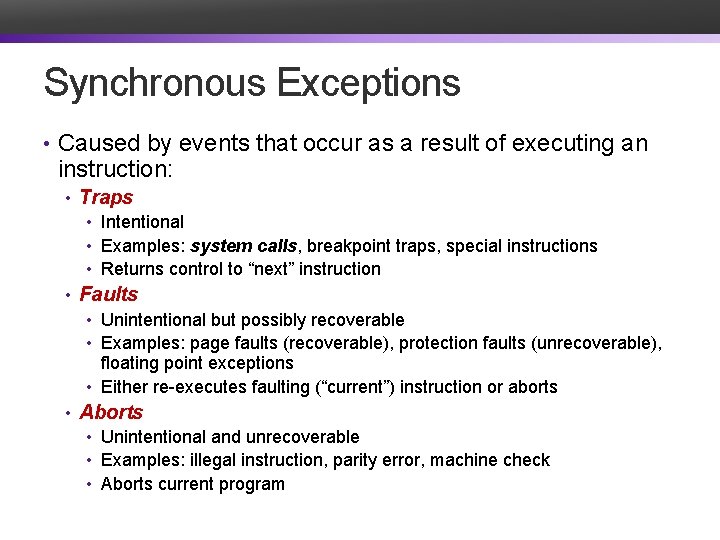
Synchronous Exceptions • Caused by events that occur as a result of executing an instruction: • Traps • Intentional • Examples: system calls, breakpoint traps, special instructions • Returns control to “next” instruction • Faults • Unintentional but possibly recoverable • Examples: page faults (recoverable), protection faults (unrecoverable), floating point exceptions • Either re-executes faulting (“current”) instruction or aborts • Aborts • Unintentional and unrecoverable • Examples: illegal instruction, parity error, machine check • Aborts current program
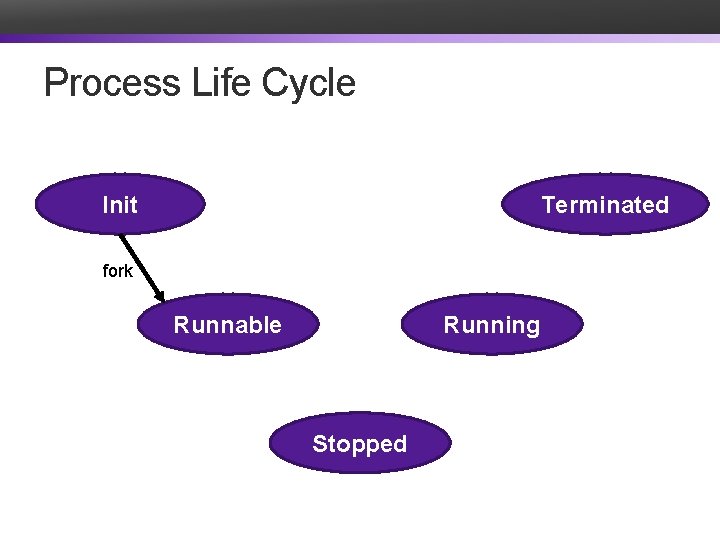
Process Life Cycle Init Terminated fork Runnable Running Stopped
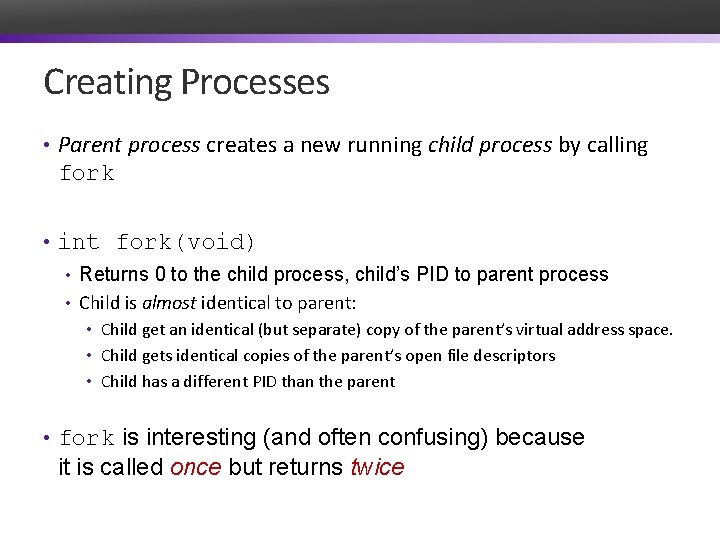
Creating Processes • Parent process creates a new running child process by calling fork • int fork(void) • Returns 0 to the child process, child’s PID to parent process • Child is almost identical to parent: • Child get an identical (but separate) copy of the parent’s virtual address space. • Child gets identical copies of the parent’s open file descriptors • Child has a different PID than the parent • fork is interesting (and often confusing) because it is called once but returns twice
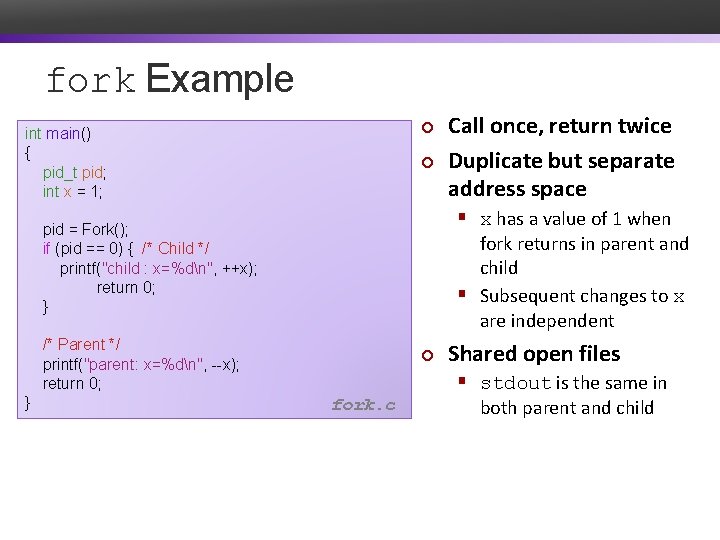
fork Example ¢ int main() { pid_t pid; int x = 1; ¢ § x has a value of 1 when pid = Fork(); if (pid == 0) { /* Child */ printf("child : x=%dn", ++x); return 0; } fork returns in parent and child § Subsequent changes to x are independent /* Parent */ printf("parent: x=%dn", --x); return 0; } Call once, return twice Duplicate but separate address space ¢ Shared open files § stdout is the same in fork. c both parent and child
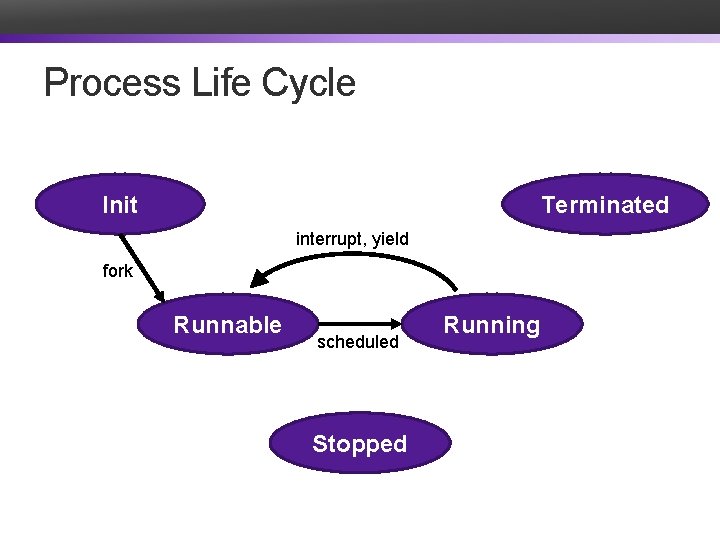
Process Life Cycle Init Terminated interrupt, yield fork Runnable scheduled Stopped Running
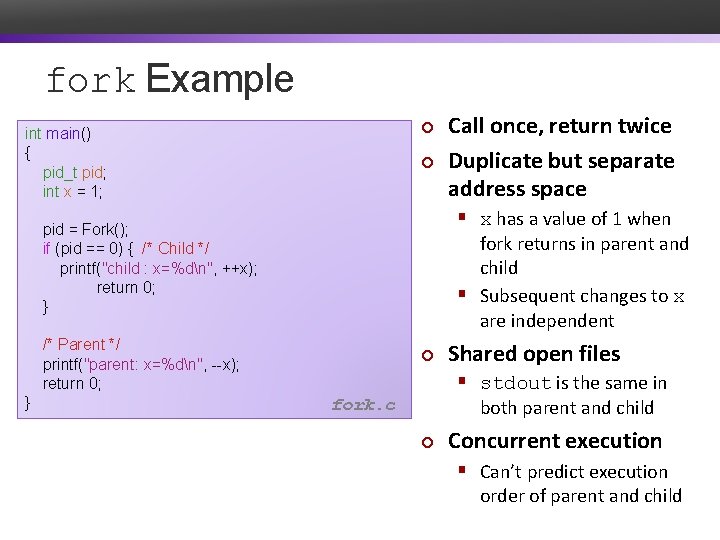
fork Example ¢ int main() { pid_t pid; int x = 1; ¢ § x has a value of 1 when pid = Fork(); if (pid == 0) { /* Child */ printf("child : x=%dn", ++x); return 0; } fork returns in parent and child § Subsequent changes to x are independent /* Parent */ printf("parent: x=%dn", --x); return 0; } Call once, return twice Duplicate but separate address space ¢ Shared open files § stdout is the same in both parent and child fork. c ¢ Concurrent execution § Can’t predict execution order of parent and child
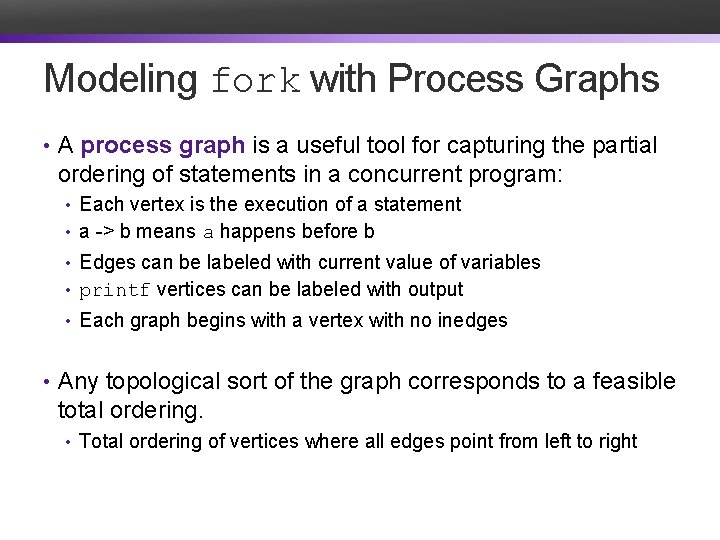
Modeling fork with Process Graphs • A process graph is a useful tool for capturing the partial ordering of statements in a concurrent program: • Each vertex is the execution of a statement • a -> b means a happens before b • Edges can be labeled with current value of variables • printf vertices can be labeled with output • Each graph begins with a vertex with no inedges • Any topological sort of the graph corresponds to a feasible total ordering. • Total ordering of vertices where all edges point from left to right
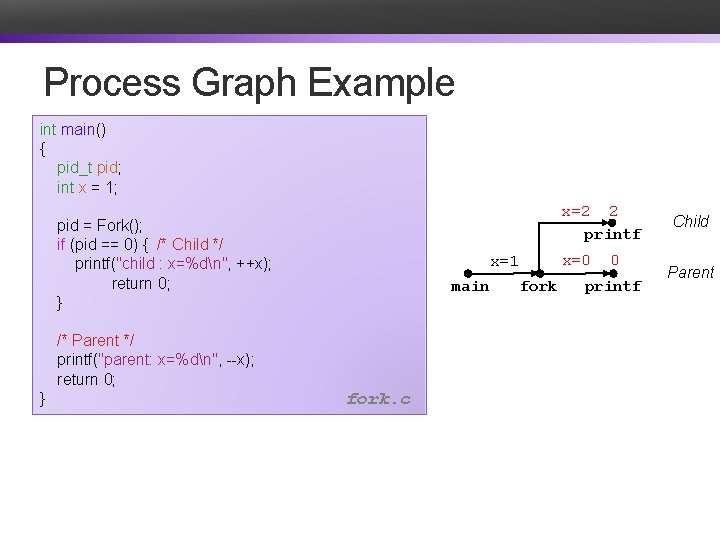
Process Graph Example int main() { pid_t pid; int x = 1; x=2 2 printf pid = Fork(); if (pid == 0) { /* Child */ printf("child : x=%dn", ++x); return 0; } main /* Parent */ printf("parent: x=%dn", --x); return 0; } x=0 x=1 fork. c fork 0 printf Child Parent
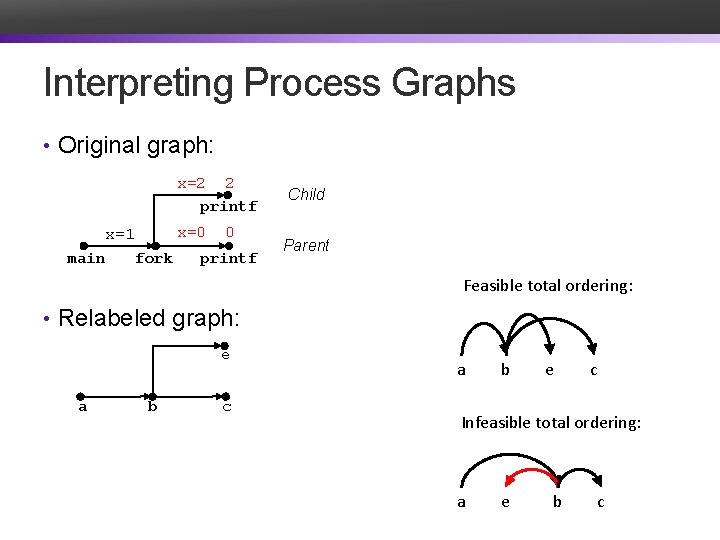
Interpreting Process Graphs • Original graph: x=2 2 printf x=0 x=1 main fork 0 printf Child Parent Feasible total ordering: • Relabeled graph: e a b c a b e c Infeasible total ordering: a e b c
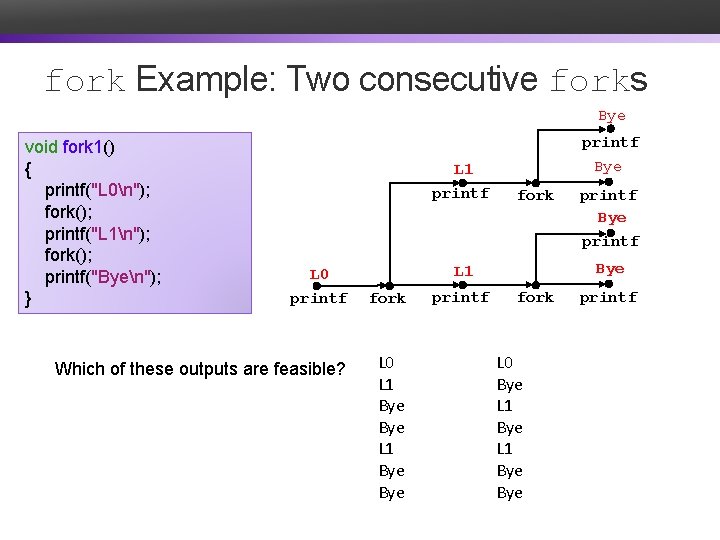
fork Example: Two consecutive forks Bye void fork 1() { printf("L 0n"); fork(); printf("L 1n"); fork(); printf("Byen"); } printf L 1 printf L 0 printf Which of these outputs are feasible? Bye fork Bye L 1 fork L 0 L 1 Bye Bye printf fork L 0 Bye L 1 Bye printf
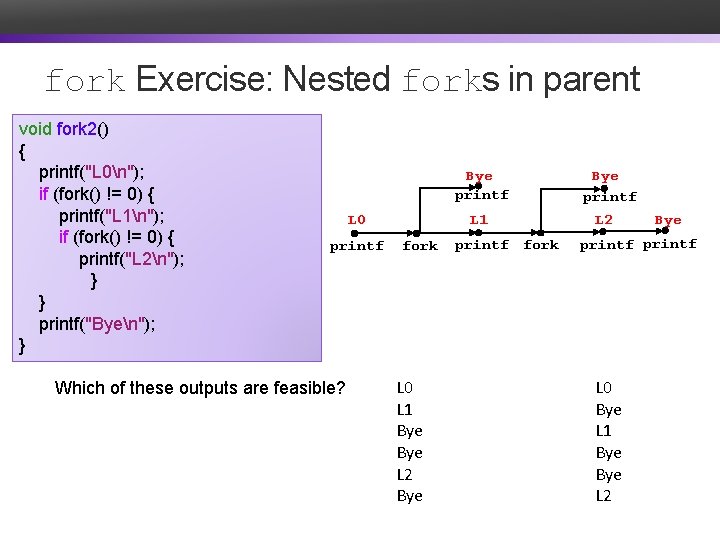
fork Exercise: Nested forks in parent void fork 2() { printf("L 0n"); if (fork() != 0) { printf("L 1n"); if (fork() != 0) { printf("L 2n"); } } printf("Byen"); } Bye printf L 0 printf Which of these outputs are feasible? L 1 fork L 0 L 1 Bye L 2 Bye printf fork Bye printf L 2 Bye printf L 0 Bye L 1 Bye L 2
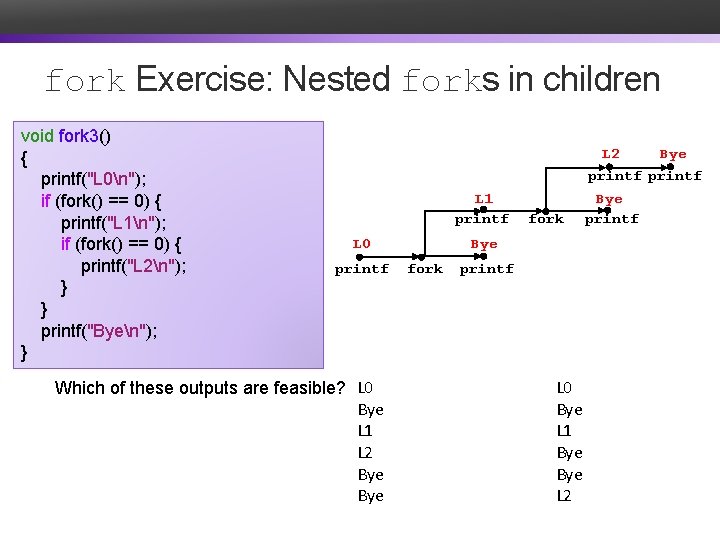
fork Exercise: Nested forks in children void fork 3() { printf("L 0n"); if (fork() == 0) { printf("L 1n"); if (fork() == 0) { printf("L 2n"); } } printf("Byen"); } L 2 Bye printf L 1 printf L 0 printf Which of these outputs are feasible? L 0 Bye L 1 L 2 Bye fork printf L 0 Bye L 1 Bye L 2 Bye printf
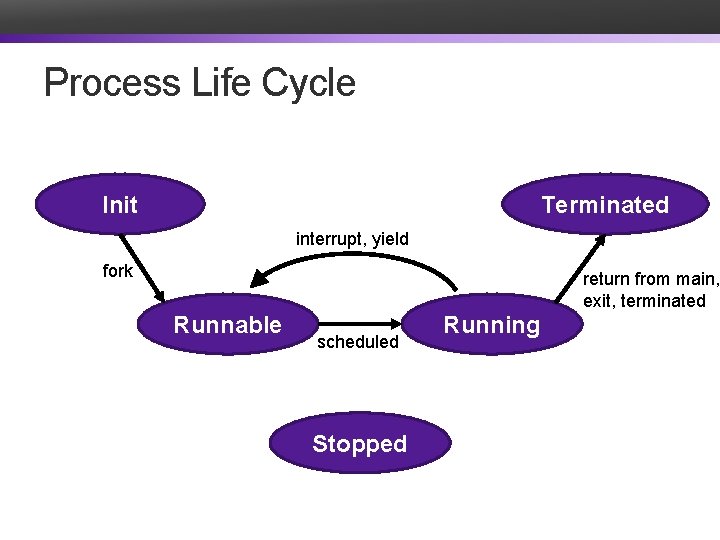
Process Life Cycle Init Terminated interrupt, yield fork return from main, exit, terminated Runnable scheduled Stopped Running
Terminating Processes • Process becomes terminated for one of three reasons: • Returning from the main routine • Calling the exit function • Receiving a signal whose default action is to terminate • void exit(int status) • Terminates with an exit status of status • Convention: normal return status is 0, nonzero on error • Another way to explicitly set the exit status is to return an integer value from the main routine • exit is called once but never returns.
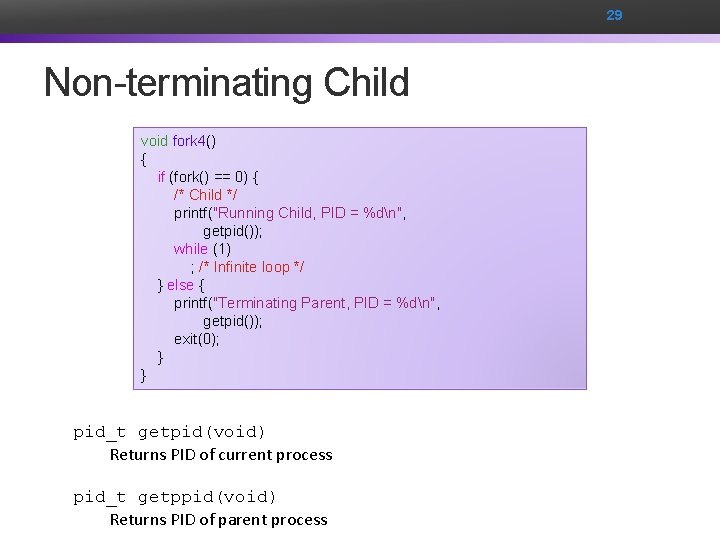
29 Non-terminating Child void fork 4() { if (fork() == 0) { /* Child */ printf("Running Child, PID = %dn", getpid()); while (1) ; /* Infinite loop */ } else { printf("Terminating Parent, PID = %dn", getpid()); exit(0); } } pid_t getpid(void) Returns PID of current process pid_t getppid(void) Returns PID of parent process
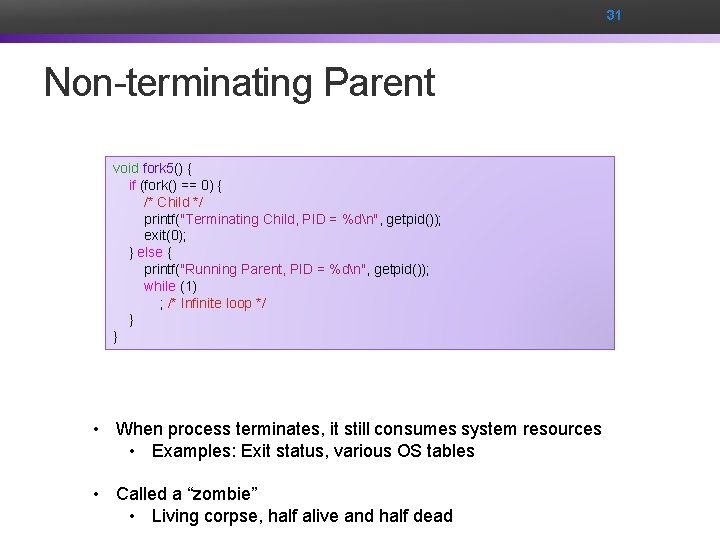
31 Non-terminating Parent void fork 5() { if (fork() == 0) { /* Child */ printf("Terminating Child, PID = %dn", getpid()); exit(0); } else { printf("Running Parent, PID = %dn", getpid()); while (1) ; /* Infinite loop */ } } • When process terminates, it still consumes system resources • Examples: Exit status, various OS tables • Called a “zombie” • Living corpse, half alive and half dead
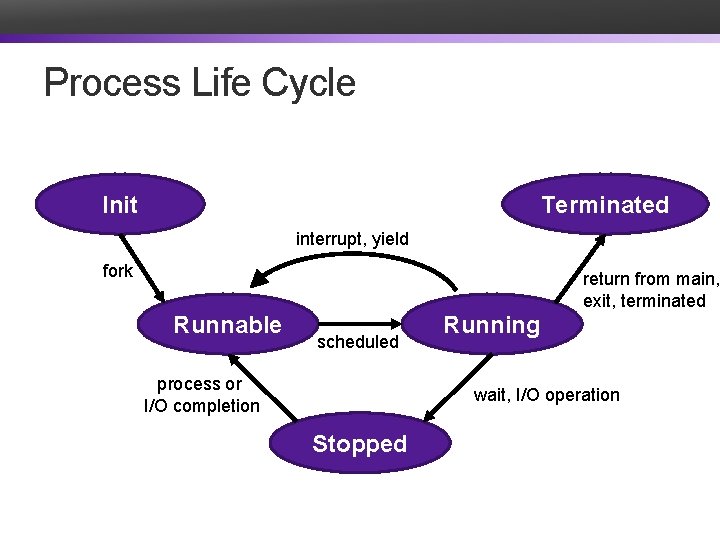
Process Life Cycle Init Terminated interrupt, yield fork return from main, exit, terminated Runnable scheduled process or I/O completion Running wait, I/O operation Stopped
34 Reaping Children • Reaping • Performed by parent on terminated child (using wait or waitpid) • Parent is given exit status information • Kernel then deletes zombie child process • int wait(int *child_status) • Suspends current process until one of its children terminates • Return value is the pid of the child process that terminated • If child_status != NULL, then the integer it points to will be set to a value that indicates reason the child terminated and the exit status: • Checked using macros defined in wait. h • WIFEXITED, WEXITSTATIS, WIFSIGNALED, WTERMSIG, WIFSTOPPED, WSTOPSIG, WIFCONTINUED • See textbook for details
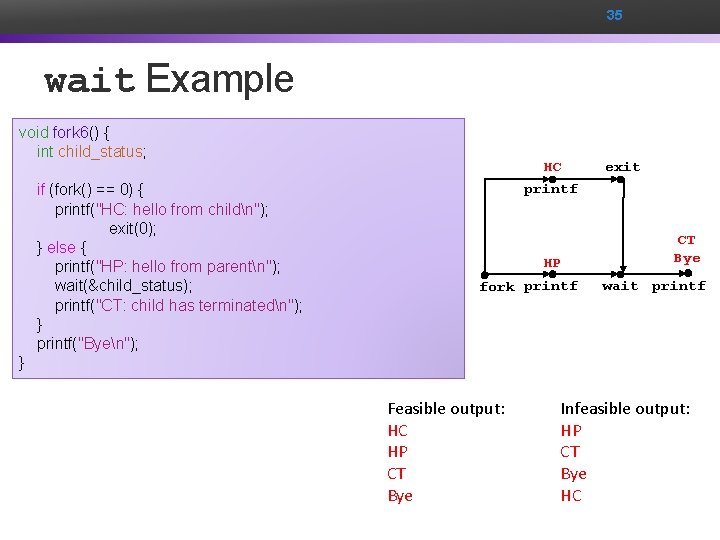
35 wait Example void fork 6() { int child_status; if (fork() == 0) { printf("HC: hello from childn"); exit(0); } else { printf("HP: hello from parentn"); wait(&child_status); printf("CT: child has terminatedn"); } printf("Byen"); HC printf HP fork printf exit CT Bye wait printf } Feasible output: HC HP CT Bye Infeasible output: HP CT Bye HC
36 Reaping Children • What if parent doesn’t reap? • If any parent terminates without reaping a child, then the orphaned child will be reaped by init process (pid == 1) • So, only need explicit reaping in long-running processes • e. g. , shells and servers
![execve: Loading and Running Programs • int execve(char *filename, char *argv[], char *envp[]) •](http://slidetodoc.com/presentation_image_h/18784116a057345893362ef87e0eb330/image-35.jpg "execve: Loading and Running Programs • int execve(char *filename, char *argv[], char *envp[]) •")
execve: Loading and Running Programs • int execve(char *filename, char *argv[], char *envp[]) • Loads and runs in the current process: • Executable filename • Can be object file or script file beginning with #!interpreter (e. g. , #!/bin/bash) • …with argument list argv • By convention argv[0]==filename • …and environment variable list envp • “name=value” strings (e. g. , USER=droh) • getenv, putenv, printenv • Overwrites code, data, and stack • Retains PID, open files and signal context • Called once and never returns • …except if there is an error
![38 Linux Process Heirarchy [0] init [1] … Login shell Child Grandchild … …](http://slidetodoc.com/presentation_image_h/18784116a057345893362ef87e0eb330/image-36.jpg "38 Linux Process Heirarchy [0] init [1] … Login shell Child Grandchild … …")
38 Linux Process Heirarchy [0] init [1] … Login shell Child Grandchild … … Daemon e. g. httpd Child Login shell Child Grandchild Note: you can view the hierarchy using the Linux pstree command
![39 pstree on pom-itb-cs 2 [ebac 2018@pom-itb-cs 2 ~]$ pstree systemd─┬─Network. Manager───2*[{Network. Manager}] …](http://slidetodoc.com/presentation_image_h/18784116a057345893362ef87e0eb330/image-37.jpg "39 pstree on pom-itb-cs 2 [ebac 2018@pom-itb-cs 2 ~]$ pstree systemd─┬─Network. Manager───2*[{Network. Manager}] …")
39 pstree on pom-itb-cs 2 [ebac 2018@pom-itb-cs 2 ~]$ pstree systemd─┬─Network. Manager───2*[{Network. Manager}] … ├─attacklab-repor ├─attacklab-reque ├─attacklab-resul ├─attacklab. pl … ├─crond ├─cupsd … ├─sshd─┬─sshd───bash───pstree │ └─28*[sshd───sftp-server] ├─systemd-journal ├─systemd-logind ├─systemd-udevd … └─xdg-permission-───2*[{xdg-permission-}]
- Slides: 37