
Lecture 14 Malthusian Model Economics Growth Solow model

- Slides: 39
Lecture 14 Malthusian Model
Economics Growth Solow model explains all growth facts for industrialized countries p Why are many poor countries not growing? p Why did all countries stagnate before 1800? p
The Malthus Model 1798: "Essay on Population" p Explains stagnation as resulting from limited supply of land population growth p
Outline Production function uses land labor p People decide on number of children p Population growth offsets productivity growth p
Differences to Solow Model Solow model does not consider land as an input p Solow model takes population growth as constant p
Structure of the Model Consumers work on their own farm (no firms in the model) and decide to consumption and fertility p Each consumer owns an equal share of land p Law of motion for population is determined by fertility decisions p
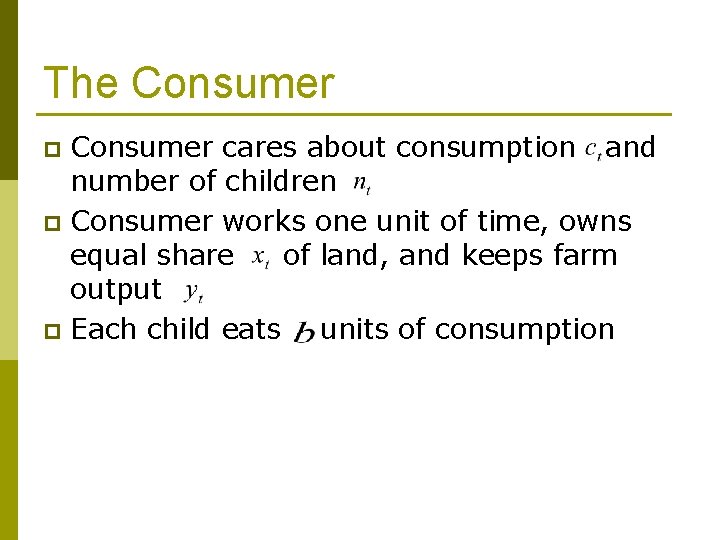
The Consumer cares about consumption and number of children p Consumer works one unit of time, owns equal share of land, and keeps farm output p Each child eats units of consumption p
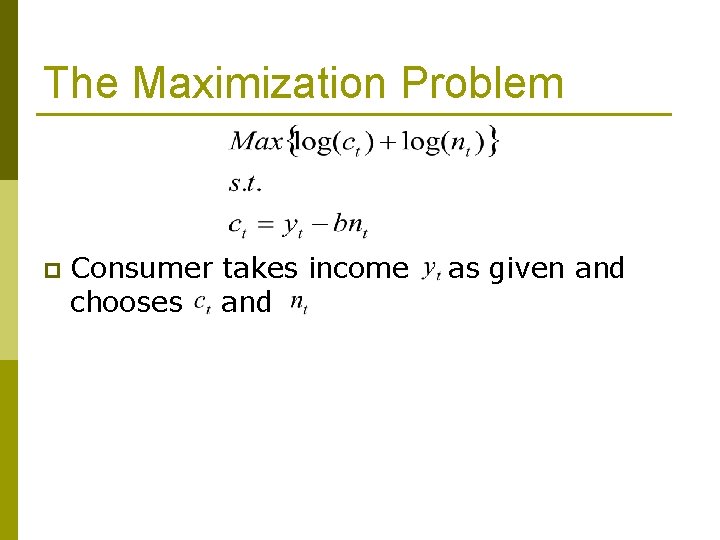
The Maximization Problem p Consumer takes income chooses and as given and
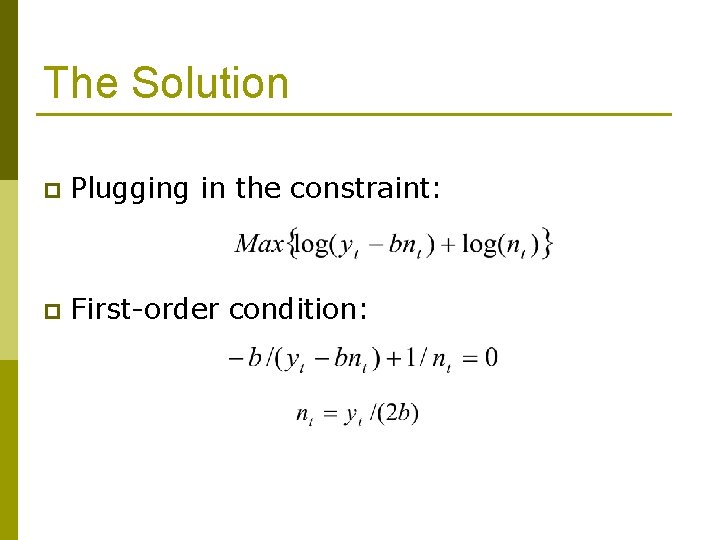
The Solution p Plugging in the constraint: p First-order condition:
Result Number of children depends positively on farm income p The richer the consumer is, the more children she will have p
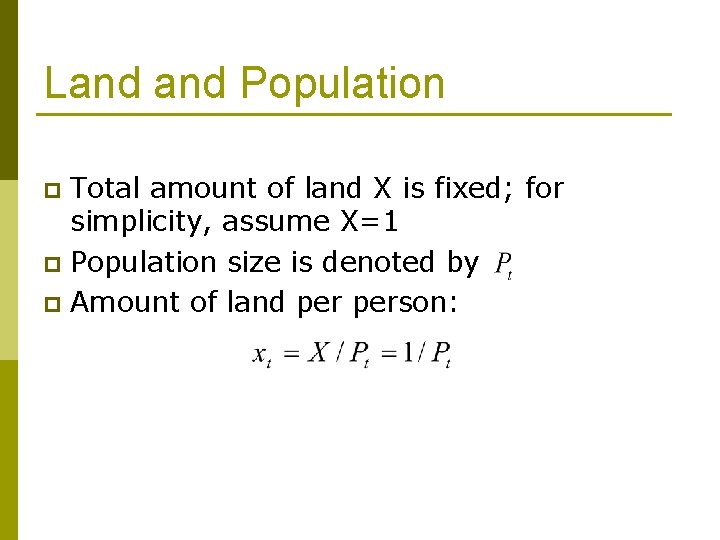
Land Population Total amount of land X is fixed; for simplicity, assume X=1 p Population size is denoted by p Amount of land person: p
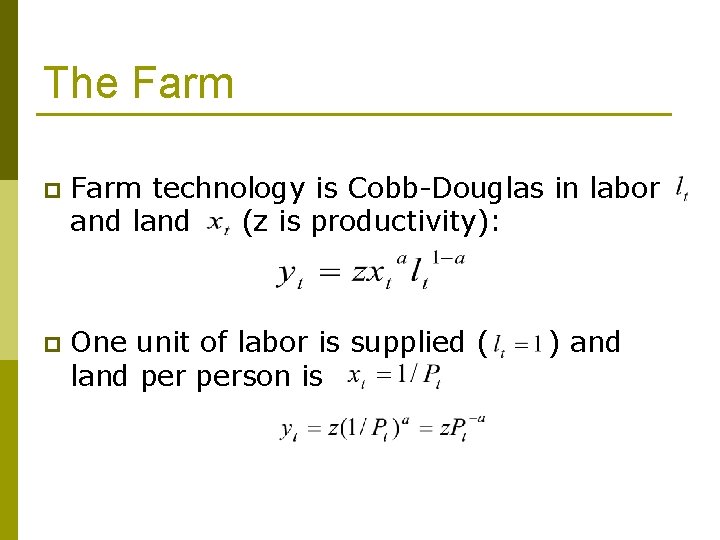
The Farm p Farm technology is Cobb-Douglas in labor and land (z is productivity): p One unit of labor is supplied ( land person is ) and
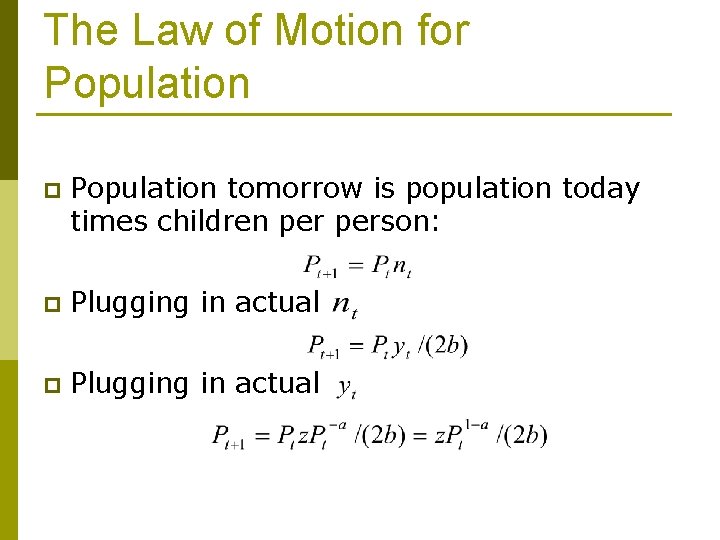
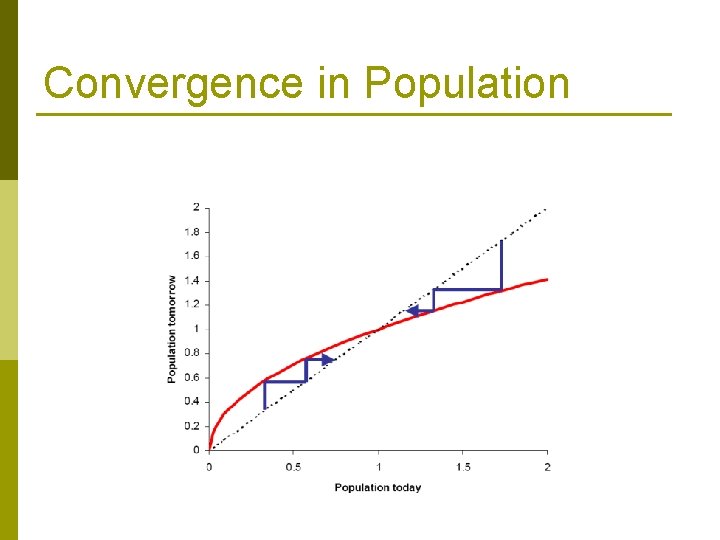
The Law of Motion for Population p Population tomorrow is population today times children person: p Plugging in actual
Convergence in Population
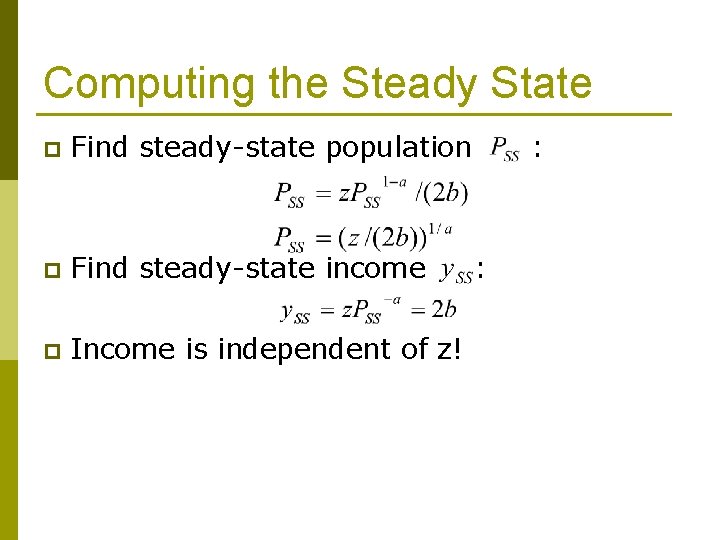
Computing the Steady State p Find steady-state population p Find steady-state income p Income is independent of z! : :
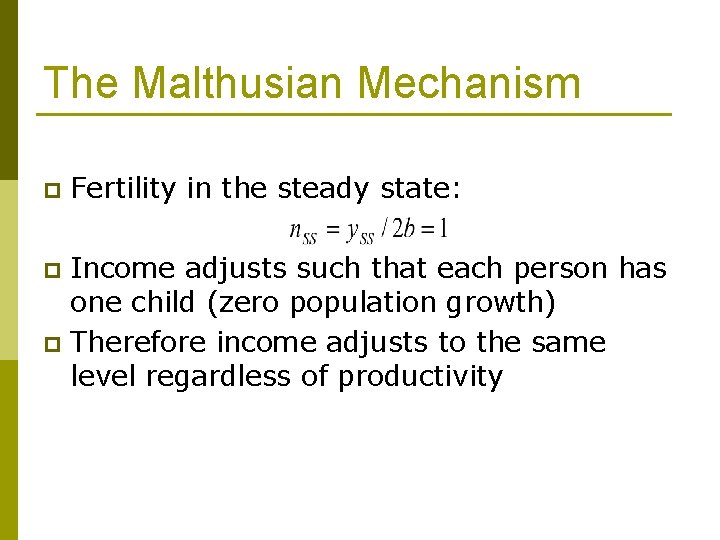
The Malthusian Mechanism p Fertility in the steady state: Income adjusts such that each person has one child (zero population growth) p Therefore income adjusts to the same level regardless of productivity p
Explanation for the Result When income in high, people have many children and population growth is high p High population growth lowers income until each parent has just one child p
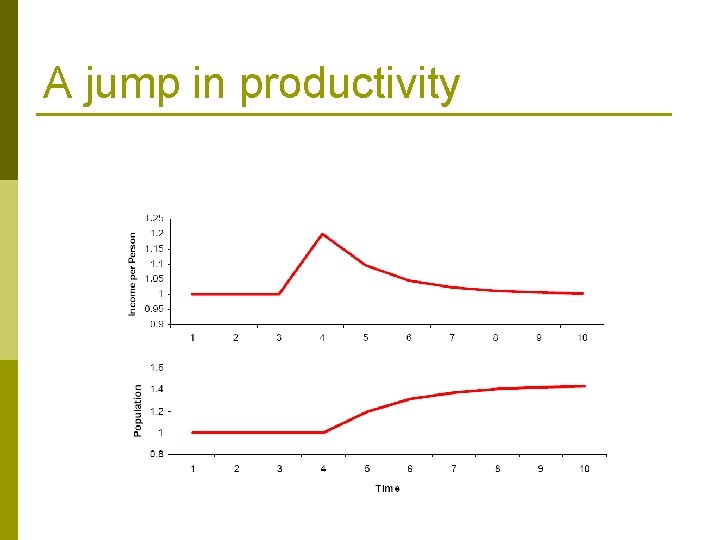
What Happens if Productivity Increases? Increase in z will lead to higher income and higher population growth p Higher population growth pushes incomes down p Ultimately, a new steady state is reached with higher population, but same income person p
A jump in productivity
Long-Run Predictions Income per capita will be roughly constant over time p Increase in productivity will increase world population without raising living standards p Inventive countries and regions will have higher population growth p
Why is the Solow Model Different? The Solow model does not have endogenous fertility-population growth assumed to be constant p The Solow technology does not use landpopulation increases do not lower income per capital p
Why Do We Use Both Models? p p The Malthus model is an accurate description of the world until 1800 --Agriculture and land were important --Income and fertility were positively related The Solow model is an accurate description of industrialized countries --Agriculture is small sector today --Fertility no longer closely related to income
How Did We Get From Malthus to Solow? p Two promising approaches: --Technological change replaced land -based technology by capital-based technology --People started to invest in human capital instead of having many children
Technological Changes and Growth Industrialization replaced land-based technology by capital-based technology p Since the importance of land diminishes, returns to population size no longer decreasing p Growth in income per capita is possible even as population is growing p
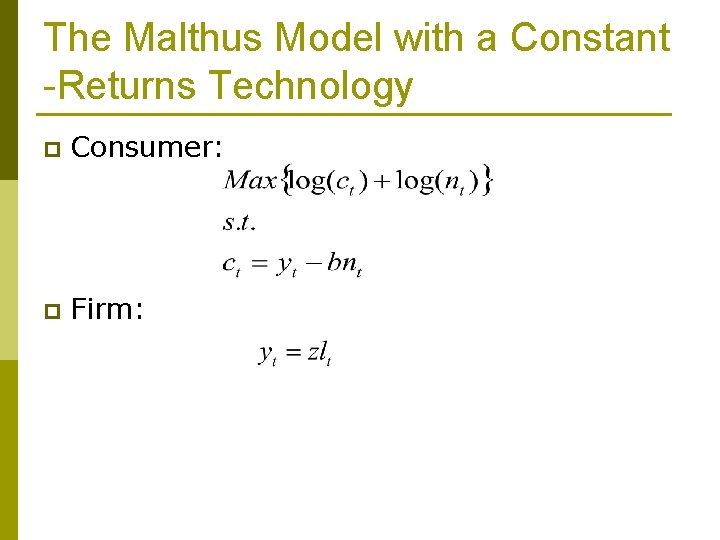
The Malthus Model with a Constant -Returns Technology p Consumer: p Firm:
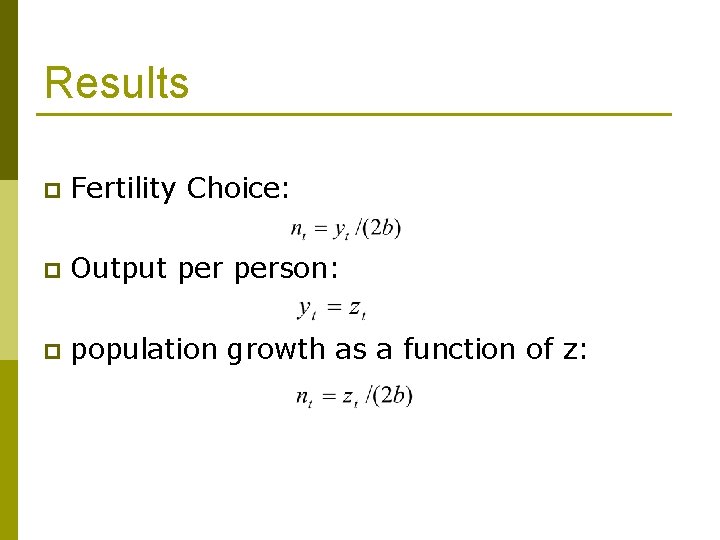
Results p Fertility Choice: p Output person: p population growth as a function of z:
Implication Productivity growth (increase in z) is not offset by population growth p Income per capita increases with z, as in the Solow model p However, population growth ever increasing p Can get transition in theory, not in practice p
The Demographic Transition The income-fertility relationship also changed p In late 19 th century, mortality rates and fertility rates fell steeply in England, U. S. , and Germany p Today richer people have fewer children p All industrialized countries experienced demographic transition p
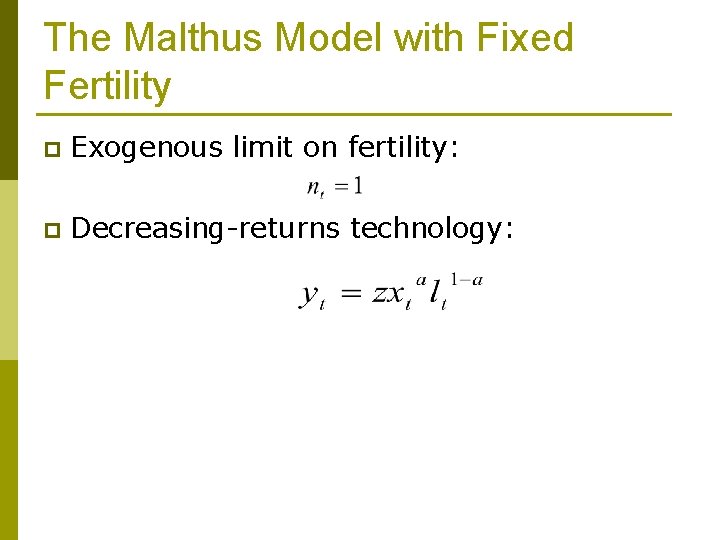
The Malthus Model with Fixed Fertility p Exogenous limit on fertility: p Decreasing-returns technology:
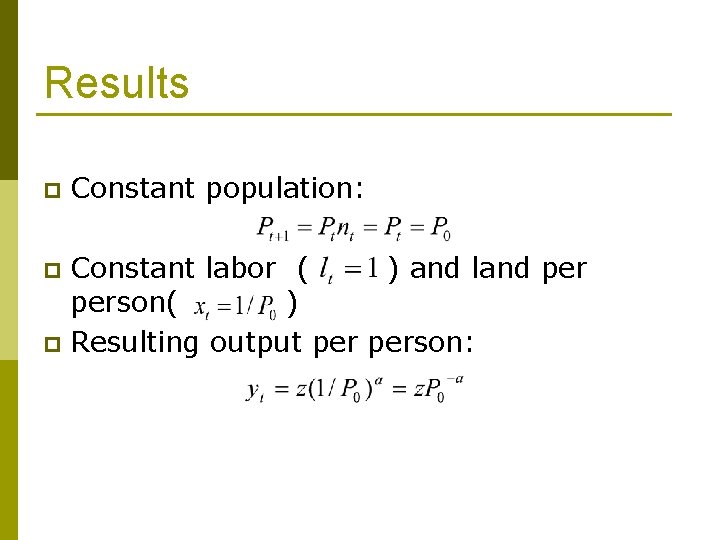
Results p Constant population: Constant labor ( ) and land person( ) p Resulting output person: p
Implication Once again, income per capita increases with z, as in the Solow model p However, share of land stays constant p In data, share of land in output declining over time p True explanation is probably a combination p
Why Did Fertility Fall? Increased cost of children (education, no more child labor) p Low mortality p Social security p Increased female labor-force participation p
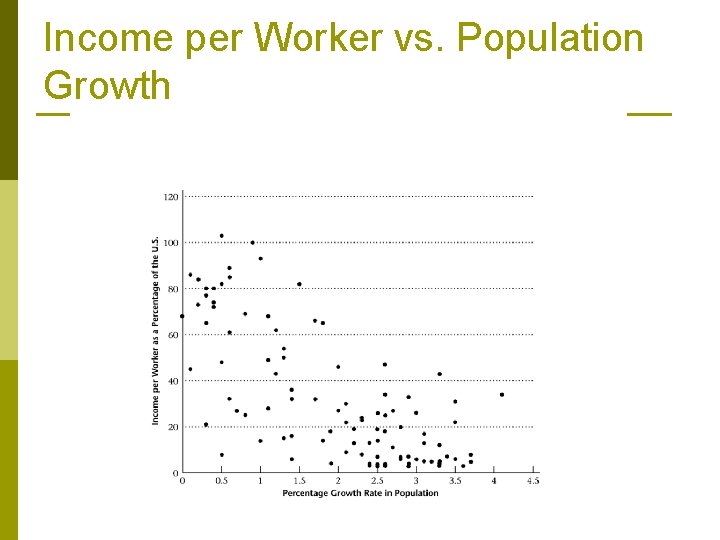
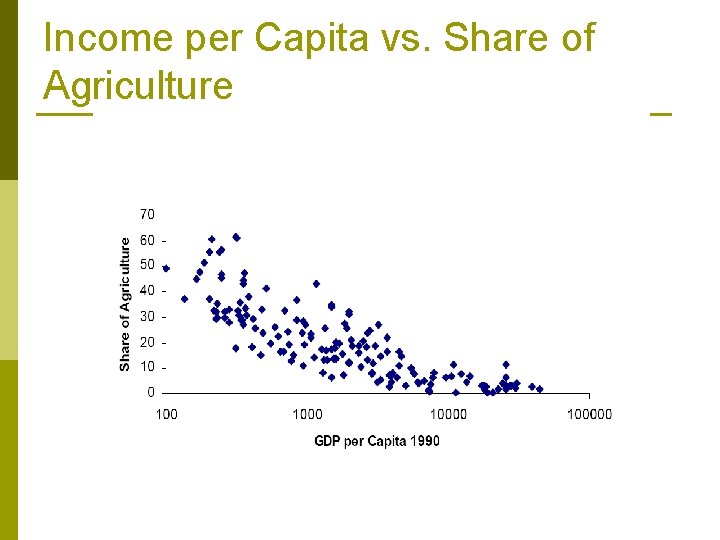
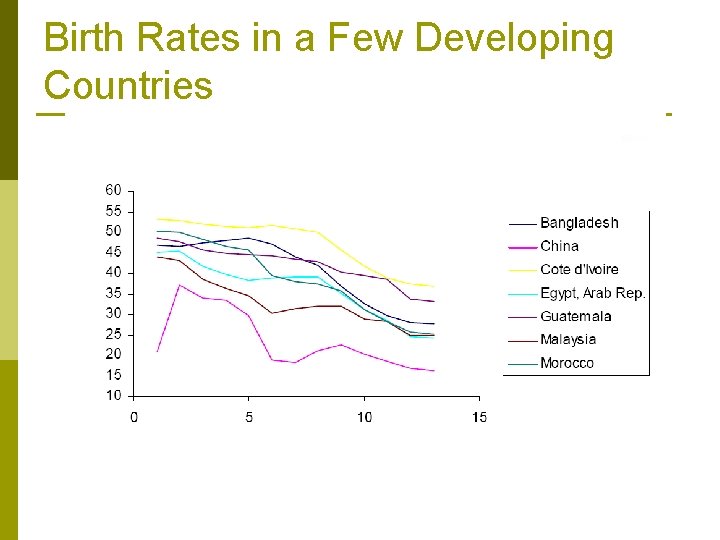
The Current Situation in Developing Countries Many developing countries are still in between Malthus and Solow p Agriculture plays a more important role p Less education, less social security, less female labor force participation, and more child labor result in higher fertility and population growth p
Income per Worker vs. Population Growth
Income per Capita vs. Share of Agriculture
Additional Problems in Developing Countries Lack of protection of property rights p Inefficient government and corruption p Wars and civil conflict p Tropical diseases and AIDS p Lack of human capital p
Economics for the 21 th Century What are the prospects for world economy in the next 100 years? p Key questions: --Are there reasons why growth might stop in developed countries? --Will developing countries start to be more like industrialized countries? p
Educated Guesses No reason why Solow model should cease to work-continued growth in rich countries is likely p Fertility is falling fast, and the role of agriculture is declining-more developing countries should start to grow p Expect convergence around the world p
Birth Rates in a Few Developing Countries