
Lecture 14 Hardware Approaches for Cache Optimizations Cache
- Slides: 21
Lecture 14: Hardware Approaches for Cache Optimizations Cache performance metrics, reduce miss rates, improve hit time, reduce miss penalty Adapted from UCB CS 252 S 01, Revised by Zhao Zhang in IASTATE CPRE 585, 2004 1
Cache Performance Metrics Cache miss rate: number of cache misses divided by number of accesses Cache hit time: the time between sending address and data returning from cache Cache miss latency: the time between sending address and data returning from next-level cache/memory Cache miss penalty: the extra processor stall caused by next-level cache/memory access 2
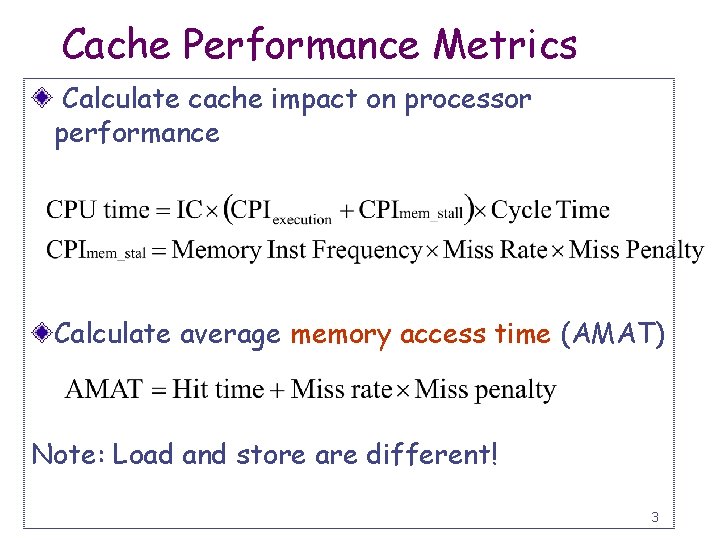
Cache Performance Metrics Calculate cache impact on processor performance Calculate average memory access time (AMAT) Note: Load and store are different! 3
Cache Performance for OOO Processors Very difficult to define miss penalty to fit in this simple model, in the context of OOO processors n n Consider overlapping between computation and memory accesses Consider overlapping among memory accesses for more than one misses We may assume a certain percentage of overlapping n n In practice, the degree of overlapping varies significantly between There are techniques to increase the overlapping, making the cache performance even unpredictable 4
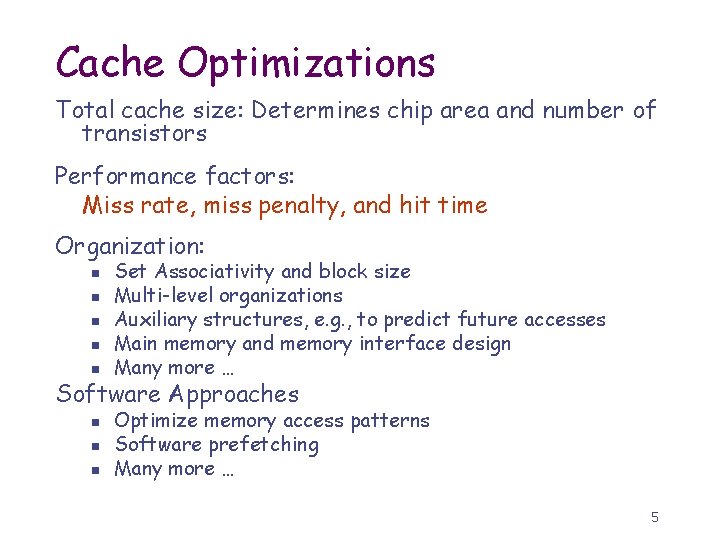
Cache Optimizations Total cache size: Determines chip area and number of transistors Performance factors: Miss rate, miss penalty, and hit time Organization: n n n Set Associativity and block size Multi-level organizations Auxiliary structures, e. g. , to predict future accesses Main memory and memory interface design Many more … Software Approaches n n n Optimize memory access patterns Software prefetching Many more … 5
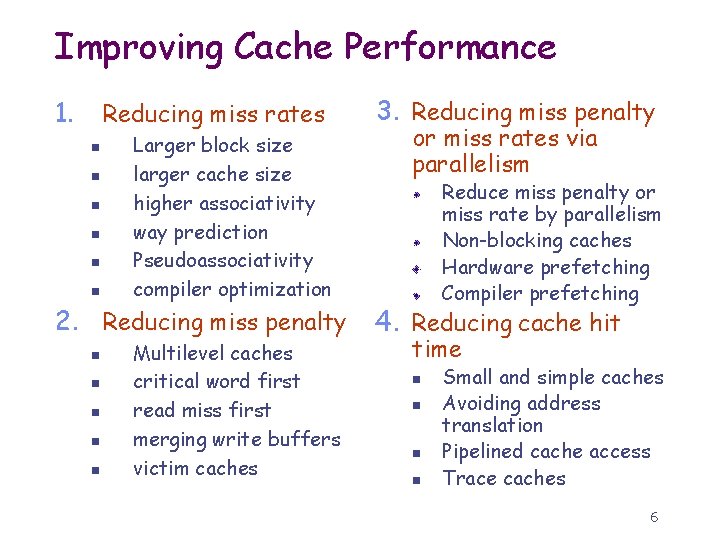
Improving Cache Performance 1. Reducing miss rates n n n Larger block size larger cache size higher associativity way prediction Pseudoassociativity compiler optimization 2. Reducing miss penalty n n n Multilevel caches critical word first read miss first merging write buffers victim caches 3. Reducing miss penalty or miss rates via parallelism Reduce miss penalty or miss rate by parallelism Non-blocking caches Hardware prefetching Compiler prefetching 4. Reducing cache hit time n n Small and simple caches Avoiding address translation Pipelined cache access Trace caches 6
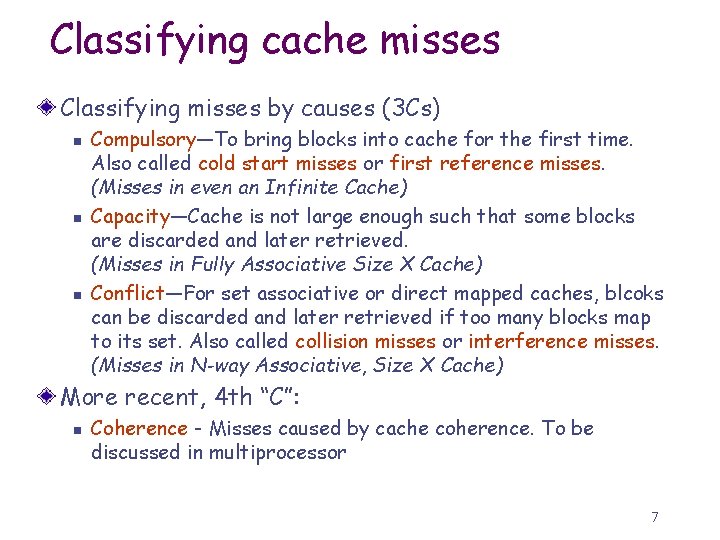
Classifying cache misses Classifying misses by causes (3 Cs) n n n Compulsory—To bring blocks into cache for the first time. Also called cold start misses or first reference misses. (Misses in even an Infinite Cache) Capacity—Cache is not large enough such that some blocks are discarded and later retrieved. (Misses in Fully Associative Size X Cache) Conflict—For set associative or direct mapped caches, blcoks can be discarded and later retrieved if too many blocks map to its set. Also called collision misses or interference misses. (Misses in N-way Associative, Size X Cache) More recent, 4 th “C”: n Coherence - Misses caused by cache coherence. To be discussed in multiprocessor 7
Cache Organization Cache size, block size, and set associativity Other terms: cache set number, cache blocks per set, and cache block size How do they affect miss rate? n Recall 3 Cs: Compulsory, Capacity, Conflict cache misses? How about miss penalty? How about cache hit time? 8
3 Cs Absolute Miss Rate (SPEC 92) Conflict Compulsory vanishingly small 9
2: 1 Cache Rule miss rate 1 -way associative cache size X = miss rate 2 -way associative cache size X/2 Conflict 10
3 Cs Relative Miss Rate Conflict Flaws: for fixed block size Good: insight => invention 11
Larger Block Size? 12
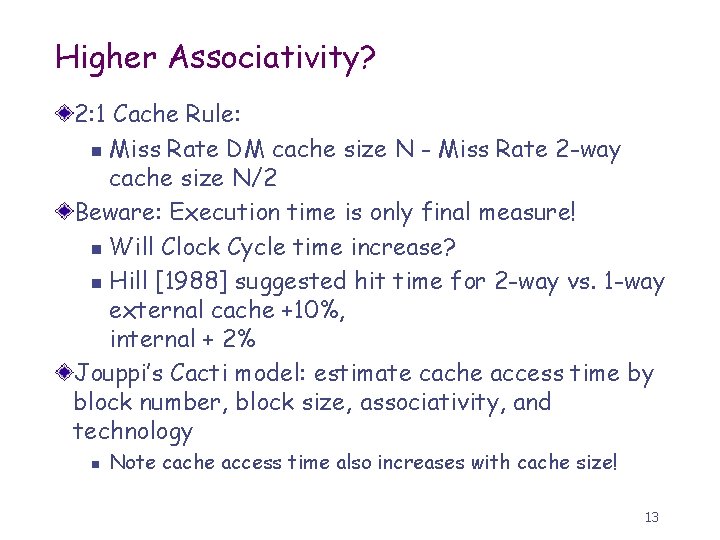
Higher Associativity? 2: 1 Cache Rule: n Miss Rate DM cache size N Miss Rate 2 -way cache size N/2 Beware: Execution time is only final measure! n Will Clock Cycle time increase? n Hill [1988] suggested hit time for 2 -way vs. 1 -way external cache +10%, internal + 2% Jouppi’s Cacti model: estimate cache access time by block number, block size, associativity, and technology n Note cache access time also increases with cache size! 13
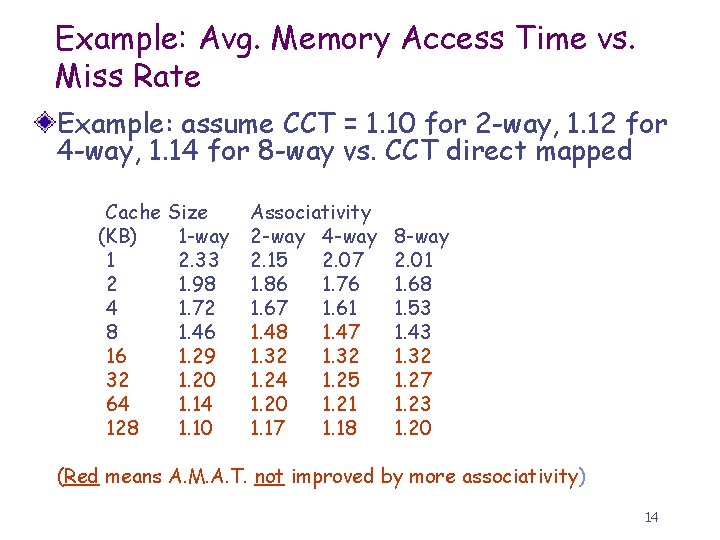
Example: Avg. Memory Access Time vs. Miss Rate Example: assume CCT = 1. 10 for 2 -way, 1. 12 for 4 -way, 1. 14 for 8 -way vs. CCT direct mapped Cache Size (KB) 1 -way 1 2. 33 2 1. 98 4 1. 72 8 1. 46 16 1. 29 32 1. 20 64 1. 14 128 1. 10 Associativity 2 -way 4 -way 2. 15 2. 07 1. 86 1. 76 1. 67 1. 61 1. 48 1. 47 1. 32 1. 24 1. 25 1. 20 1. 21 1. 17 1. 18 8 -way 2. 01 1. 68 1. 53 1. 43 1. 32 1. 27 1. 23 1. 20 (Red means A. M. A. T. not improved by more associativity) 14
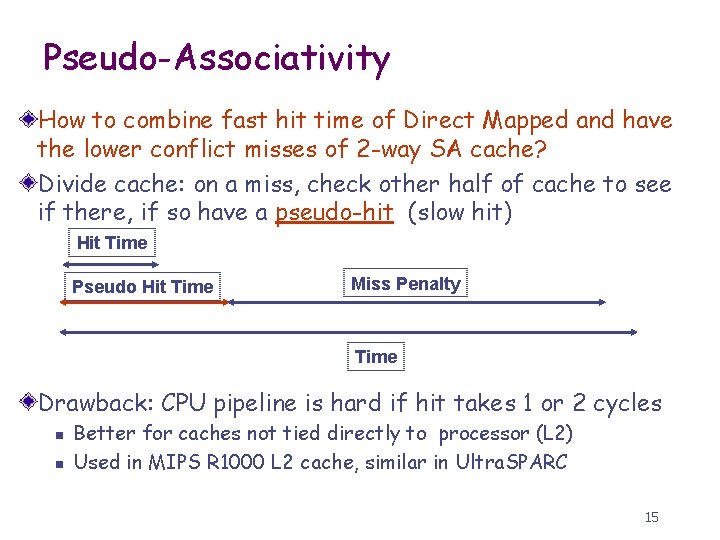
Pseudo-Associativity How to combine fast hit time of Direct Mapped and have the lower conflict misses of 2 -way SA cache? Divide cache: on a miss, check other half of cache to see if there, if so have a pseudo-hit (slow hit) Hit Time Pseudo Hit Time Miss Penalty Time Drawback: CPU pipeline is hard if hit takes 1 or 2 cycles n n Better for caches not tied directly to processor (L 2) Used in MIPS R 1000 L 2 cache, similar in Ultra. SPARC 15
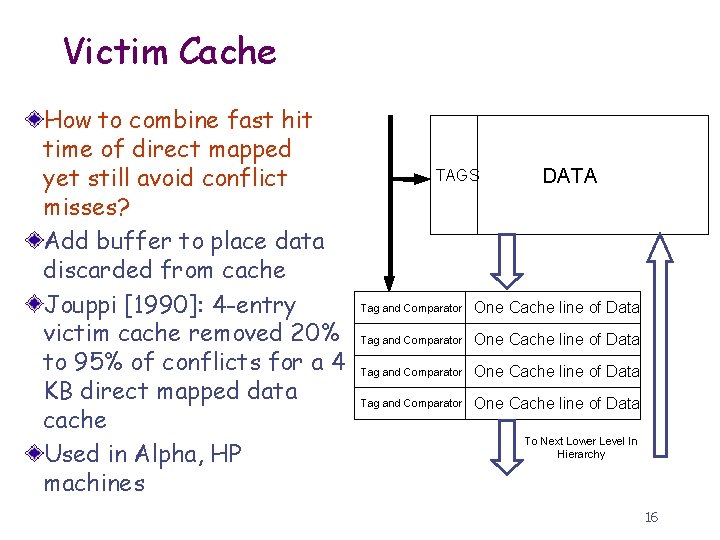
Victim Cache How to combine fast hit time of direct mapped yet still avoid conflict misses? Add buffer to place data discarded from cache Jouppi [1990]: 4 -entry victim cache removed 20% to 95% of conflicts for a 4 KB direct mapped data cache Used in Alpha, HP machines TAGS DATA Tag and Comparator One Cache line of Data To Next Lower Level In Hierarchy 16
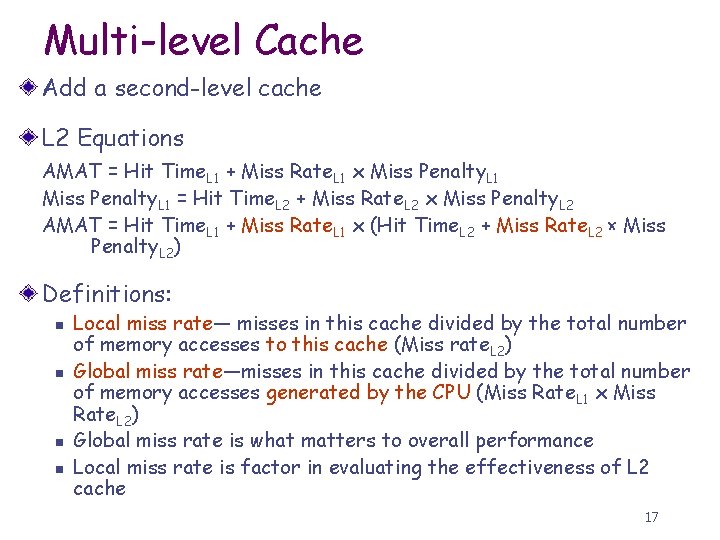
Multi-level Cache Add a second-level cache L 2 Equations AMAT = Hit Time. L 1 + Miss Rate. L 1 x Miss Penalty. L 1 = Hit Time. L 2 + Miss Rate. L 2 x Miss Penalty. L 2 AMAT = Hit Time. L 1 + Miss Rate. L 1 x (Hit Time. L 2 + Miss Rate. L 2 × Miss Penalty. L 2) Definitions: n n Local miss rate— misses in this cache divided by the total number of memory accesses to this cache (Miss rate. L 2) Global miss rate—misses in this cache divided by the total number of memory accesses generated by the CPU (Miss Rate. L 1 x Miss Rate. L 2) Global miss rate is what matters to overall performance Local miss rate is factor in evaluating the effectiveness of L 2 cache 17
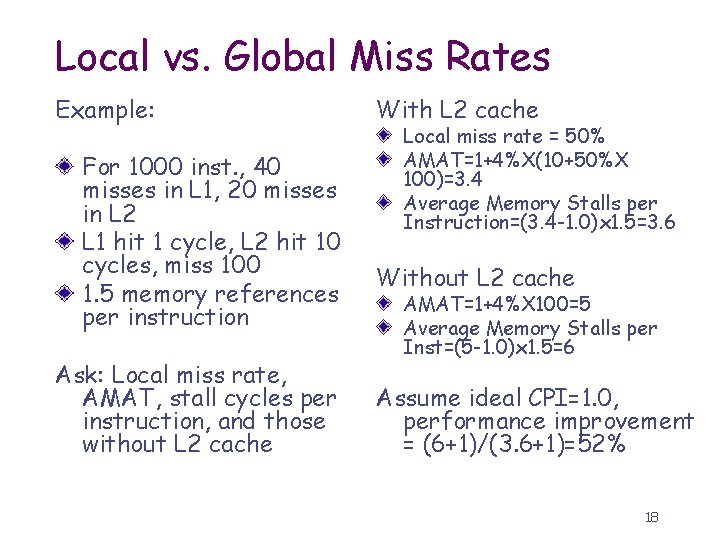
Local vs. Global Miss Rates Example: For 1000 inst. , 40 misses in L 1, 20 misses in L 2 L 1 hit 1 cycle, L 2 hit 10 cycles, miss 100 1. 5 memory references per instruction Ask: Local miss rate, AMAT, stall cycles per instruction, and those without L 2 cache With L 2 cache Local miss rate = 50% AMAT=1+4%X(10+50%X 100)=3. 4 Average Memory Stalls per Instruction=(3. 4 -1. 0)x 1. 5=3. 6 Without L 2 cache AMAT=1+4%X 100=5 Average Memory Stalls per Inst=(5 -1. 0)x 1. 5=6 Assume ideal CPI=1. 0, performance improvement = (6+1)/(3. 6+1)=52% 18
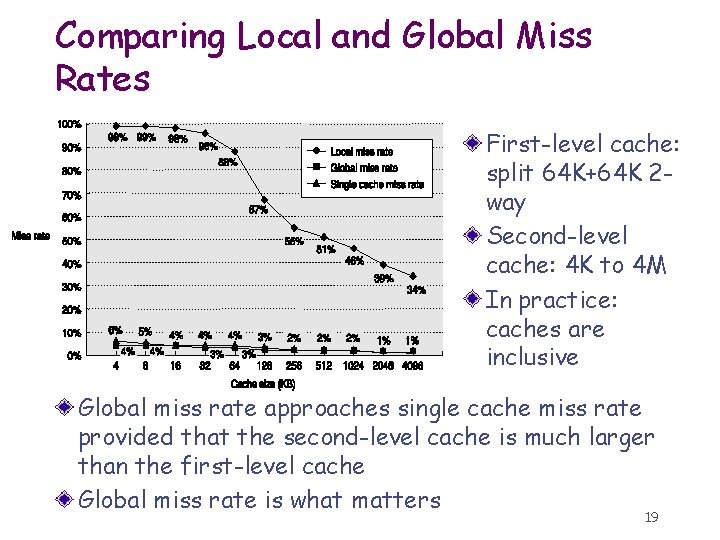
Comparing Local and Global Miss Rates First-level cache: split 64 K+64 K 2 way Second-level cache: 4 K to 4 M In practice: caches are inclusive Global miss rate approaches single cache miss rate provided that the second-level cache is much larger than the first-level cache Global miss rate is what matters 19
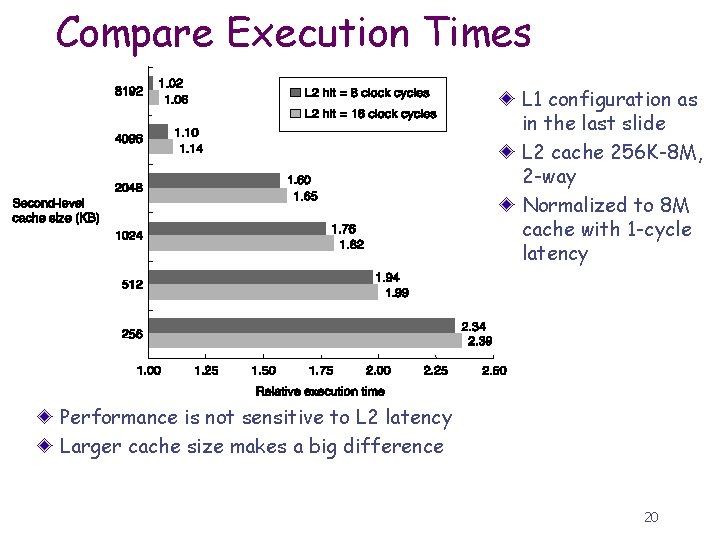
Compare Execution Times L 1 configuration as in the last slide L 2 cache 256 K-8 M, 2 -way Normalized to 8 M cache with 1 -cycle latency Performance is not sensitive to L 2 latency Larger cache size makes a big difference 20
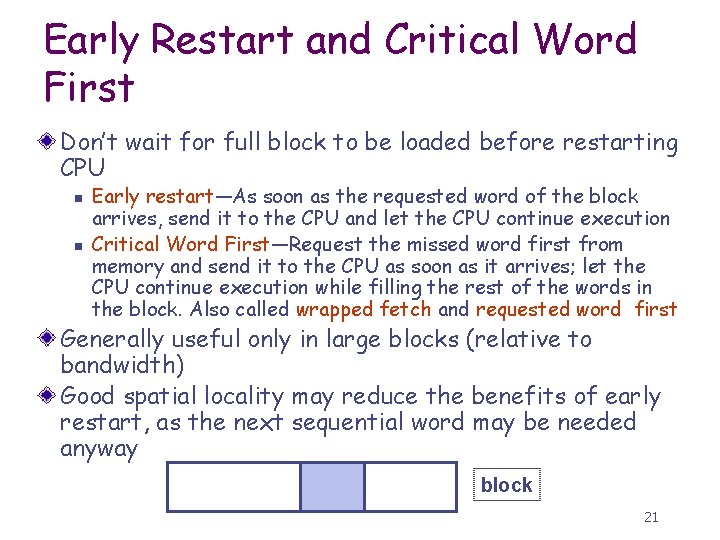
Early Restart and Critical Word First Don’t wait for full block to be loaded before restarting CPU n n Early restart—As soon as the requested word of the block arrives, send it to the CPU and let the CPU continue execution Critical Word First—Request the missed word first from memory and send it to the CPU as soon as it arrives; let the CPU continue execution while filling the rest of the words in the block. Also called wrapped fetch and requested word first Generally useful only in large blocks (relative to bandwidth) Good spatial locality may reduce the benefits of early restart, as the next sequential word may be needed anyway block 21