
LECTURE 14 CONDUCTOR PROPERTIES UNDER STATIC CONDITIONS OBJECTIVES

LECTURE # 14 CONDUCTOR PROPERTIES UNDER STATIC CONDITIONS
OBJECTIVES l To understand what happens to excess free charge in a conductor when exposed to external electric field. l To list down various conductor properties that under static conditions.
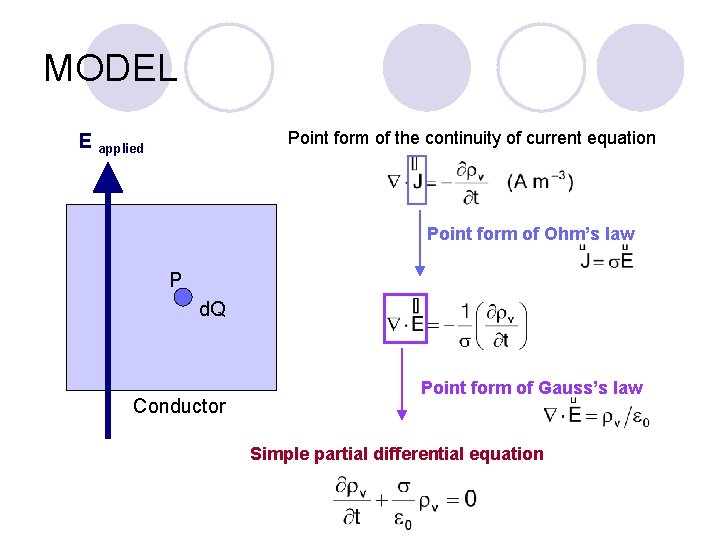
MODEL Point form of the continuity of current equation E applied Point form of Ohm’s law P d. Q Conductor Point form of Gauss’s law Simple partial differential equation
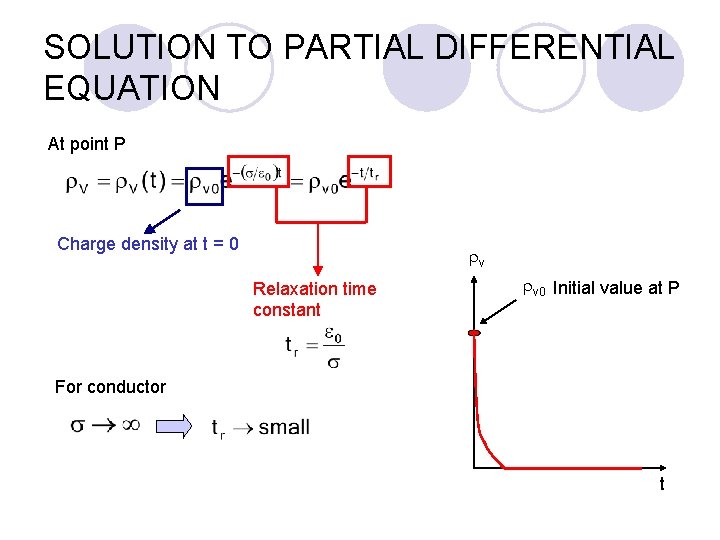
SOLUTION TO PARTIAL DIFFERENTIAL EQUATION At point P Charge density at t = 0 rv Relaxation time constant rv 0 Initial value at P For conductor t
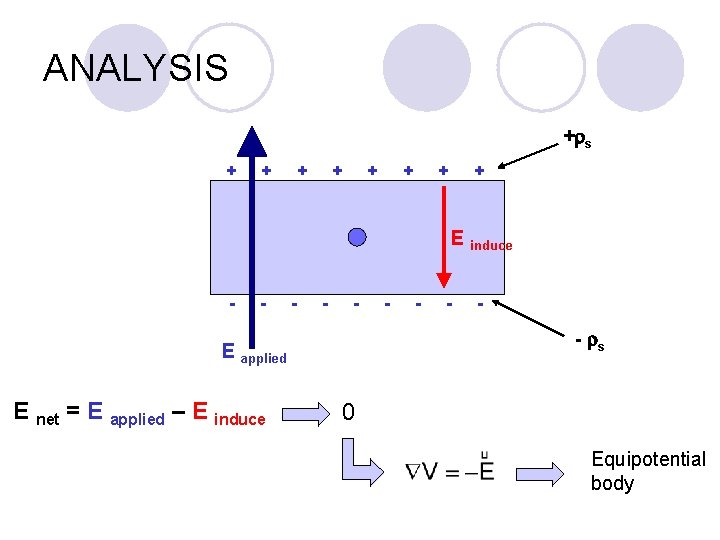
ANALYSIS +rs + + + + E induce - - - - - rs E applied E net = E applied – E induce - 0 Equipotential body
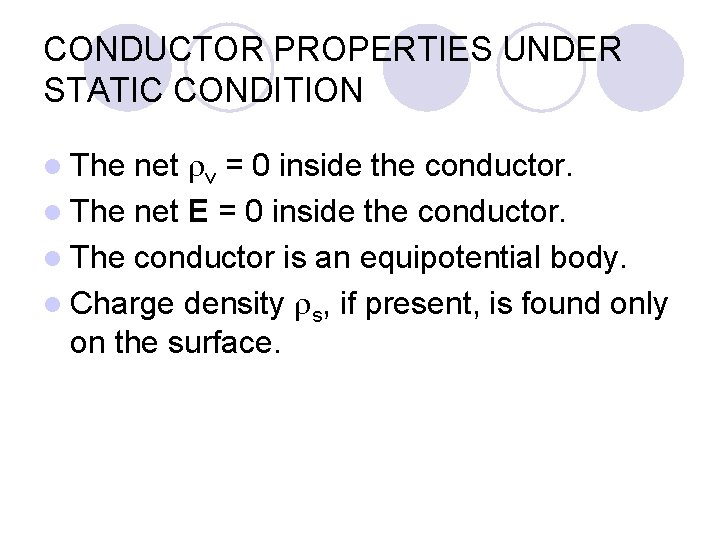
CONDUCTOR PROPERTIES UNDER STATIC CONDITION net rv = 0 inside the conductor. l The net E = 0 inside the conductor. l The conductor is an equipotential body. l Charge density rs, if present, is found only on the surface. l The
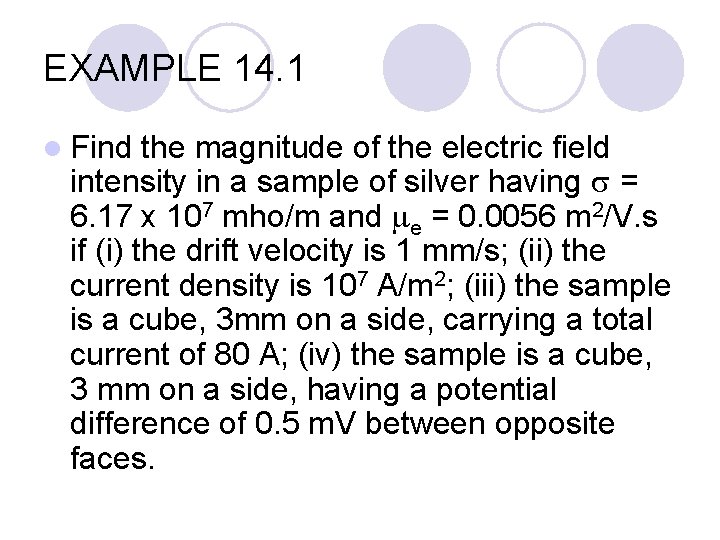
EXAMPLE 14. 1 l Find the magnitude of the electric field intensity in a sample of silver having s = 6. 17 x 107 mho/m and me = 0. 0056 m 2/V. s if (i) the drift velocity is 1 mm/s; (ii) the current density is 107 A/m 2; (iii) the sample is a cube, 3 mm on a side, carrying a total current of 80 A; (iv) the sample is a cube, 3 mm on a side, having a potential difference of 0. 5 m. V between opposite faces.
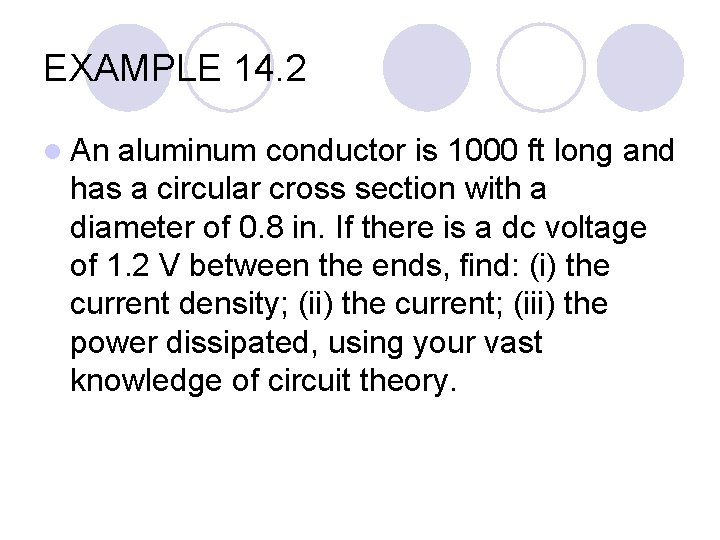
EXAMPLE 14. 2 l An aluminum conductor is 1000 ft long and has a circular cross section with a diameter of 0. 8 in. If there is a dc voltage of 1. 2 V between the ends, find: (i) the current density; (ii) the current; (iii) the power dissipated, using your vast knowledge of circuit theory.

THANK YOU QUESTIONS AND ANSWERS
- Slides: 9