
Lecture 14 Chemical Reaction Engineering CRE is the


- Slides: 21
Lecture 14 Chemical Reaction Engineering (CRE) is the field that studies the rates and mechanisms of chemical reactions and the design of the reactors in which they take place.
Lecture 14 – Thursday 2/24/2011 �Pseudo Steady State Hypothesis (PSSH) �Net Rate of Reaction of Active Intermediates is Zero �Hall of Fame Reaction: 2 NO +O 2 2 NO 2 �Introduction to Enzyme Kinetics �Begin Non-Isothermal Reactor Design 2
An active intermediate is a molecule that is in a highly energetic and reactive state It is short lived as it disappears virtually as fast as it is formed. That is, the net rate of reaction of an active intermediate, A*, is zero. The assumption that the net rate of reaction is zero is called the Pseudo Steady State Hypothesis (PSSH) 3
4
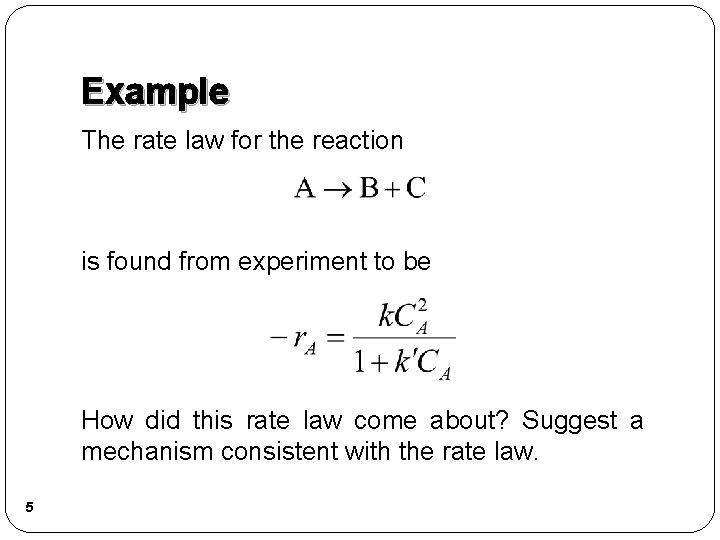
Example The rate law for the reaction is found from experiment to be How did this rate law come about? Suggest a mechanism consistent with the rate law. 5
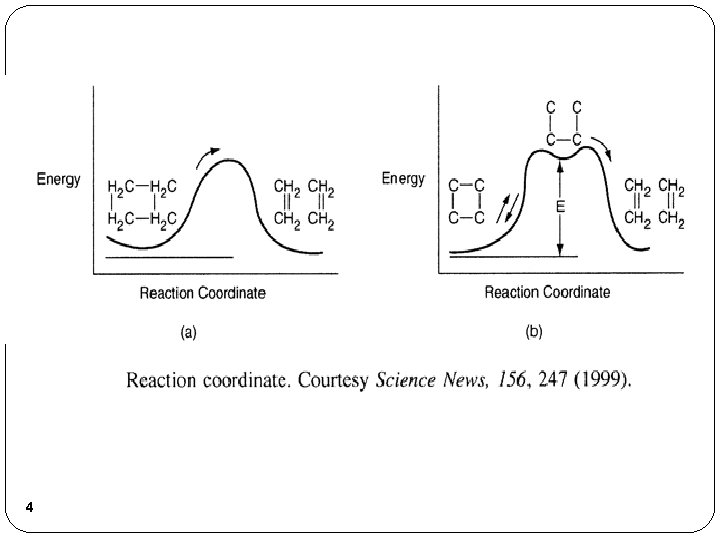
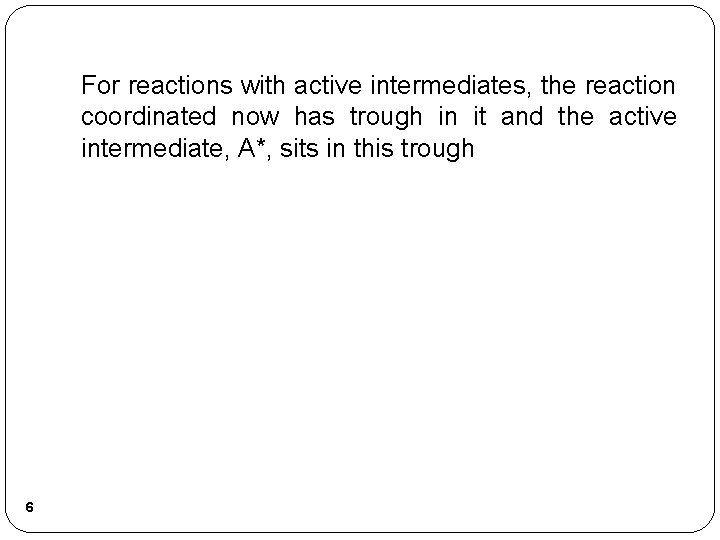
For reactions with active intermediates, the reaction coordinated now has trough in it and the active intermediate, A*, sits in this trough 6
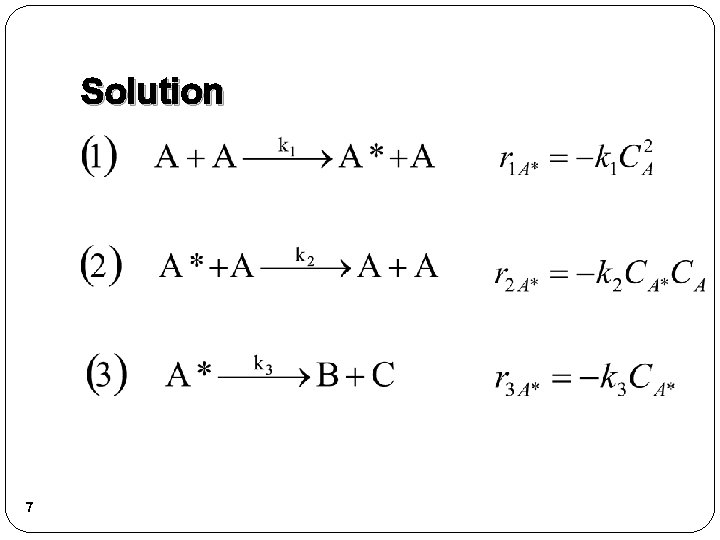
Solution 7
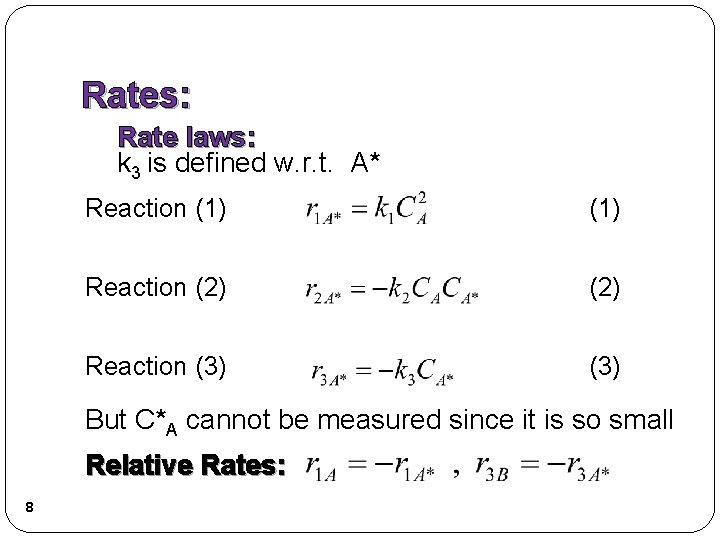
Rates: Rate laws: k 3 is defined w. r. t. A* Reaction (1) Reaction (2) Reaction (3) But C*A cannot be measured since it is so small Relative Rates: 8
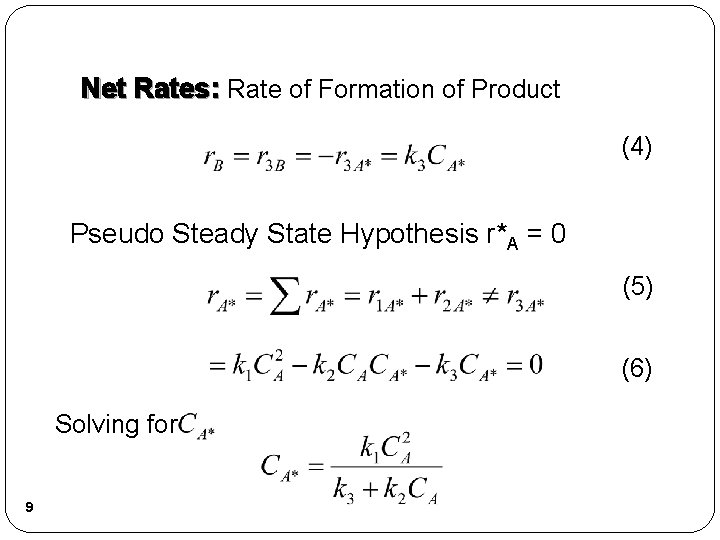
Net Rates: Rate of Formation of Product (4) Pseudo Steady State Hypothesis r*A = 0 (5) (6) Solving for 9
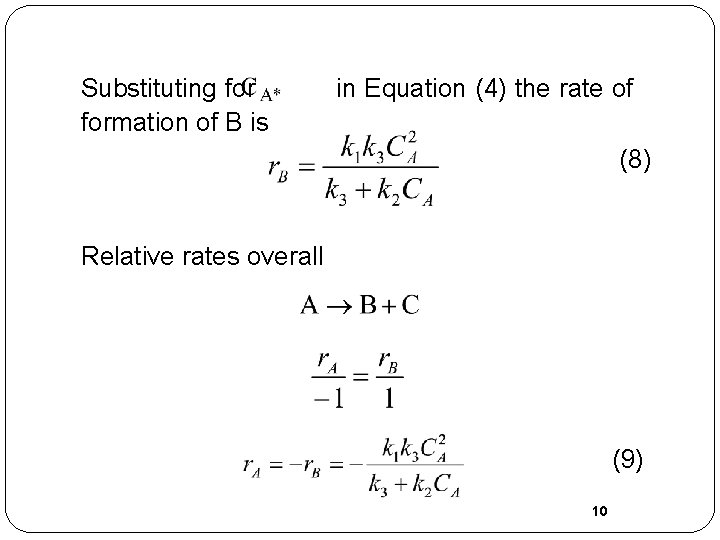
Substituting formation of B is in Equation (4) the rate of (8) Relative rates overall (9) 10
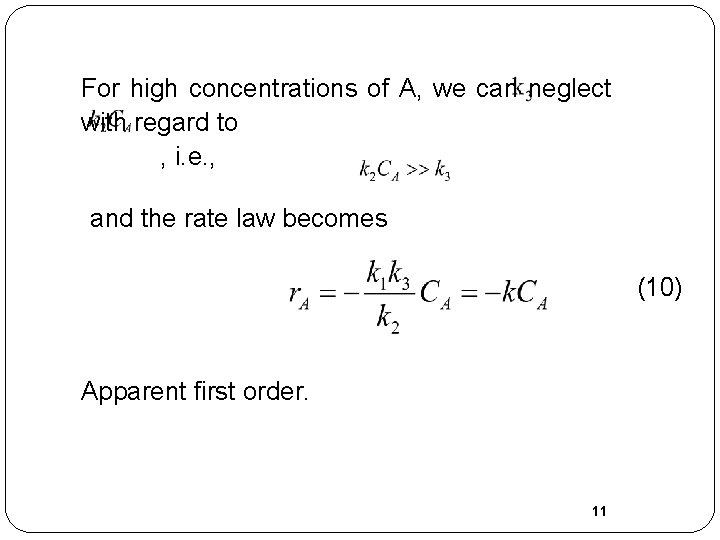
For high concentrations of A, we can neglect with regard to , i. e. , and the rate law becomes (10) Apparent first order. 11
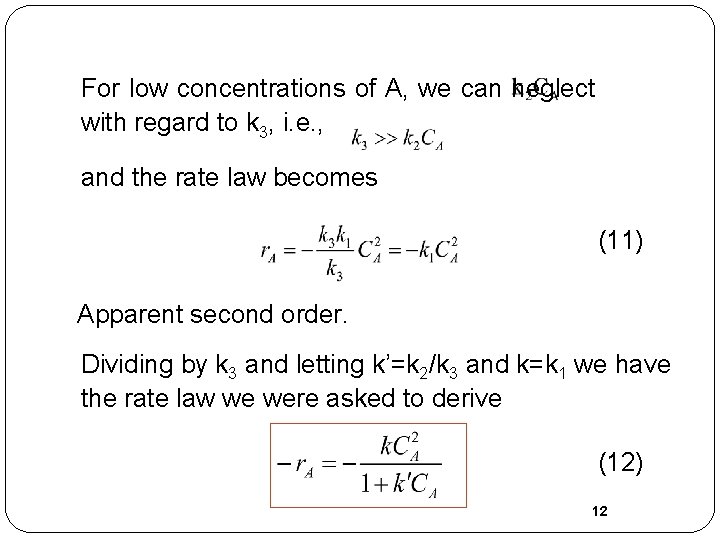
For low concentrations of A, we can neglect with regard to k 3, i. e. , and the rate law becomes (11) Apparent second order. Dividing by k 3 and letting k’=k 2/k 3 and k=k 1 we have the rate law we were asked to derive (12) 12
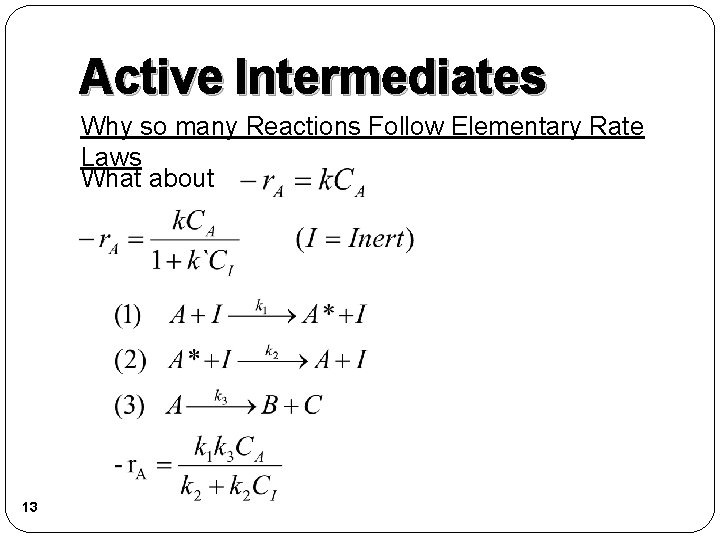
Active Intermediates Why so many Reactions Follow Elementary Rate Laws What about 13
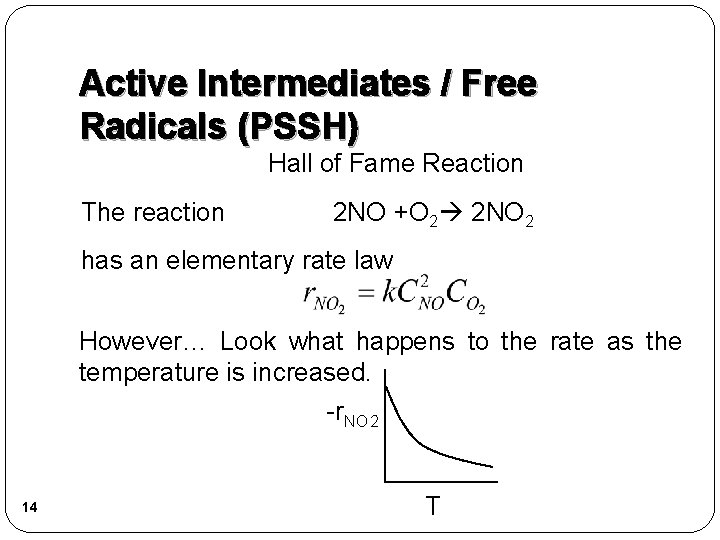
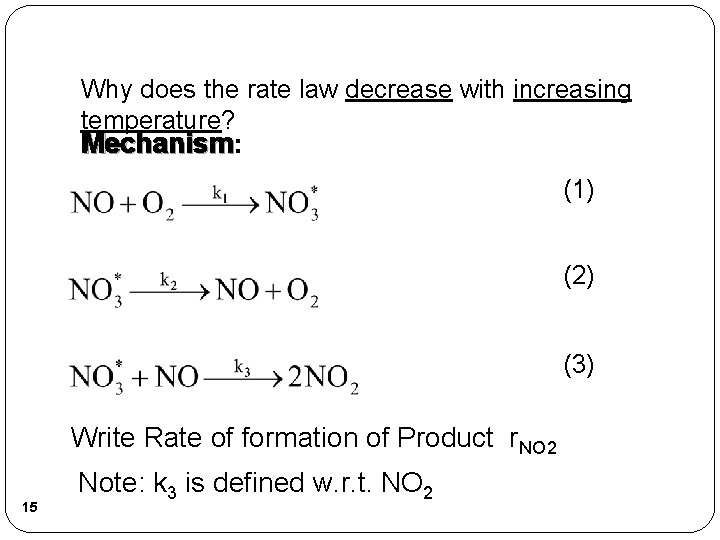
Active Intermediates / Free Radicals (PSSH) Hall of Fame Reaction The reaction 2 NO +O 2 2 NO 2 has an elementary rate law However… Look what happens to the rate as the temperature is increased. -r. NO 2 14 T
Why does the rate law decrease with increasing temperature? Mechanism: (1) (2) (3) Write Rate of formation of Product r. NO 2 15 Note: k 3 is defined w. r. t. NO 2
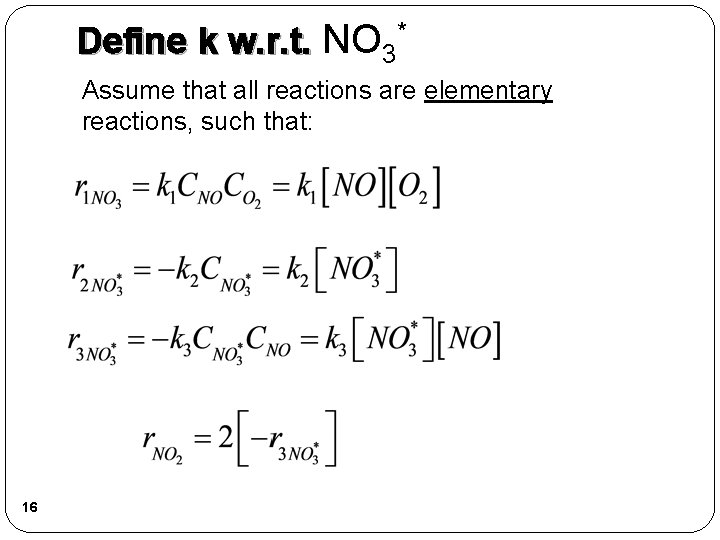
Define k w. r. t. NO 3* Assume that all reactions are elementary reactions, such that: 16
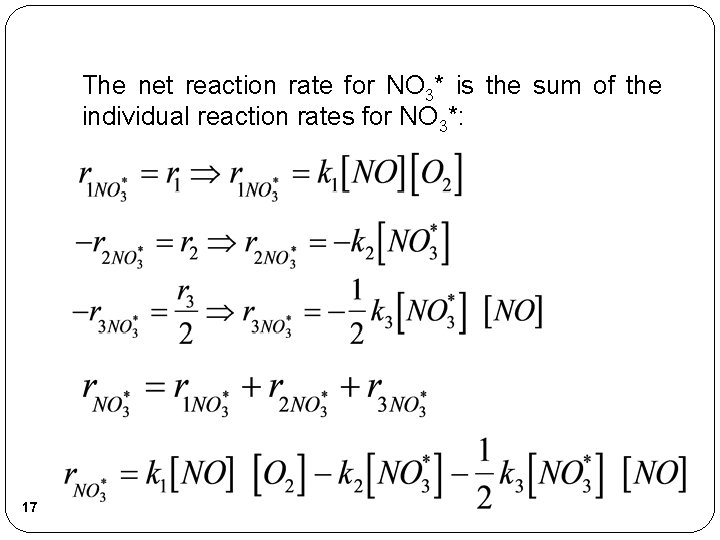
The net reaction rate for NO 3* is the sum of the individual reaction rates for NO 3*: 17
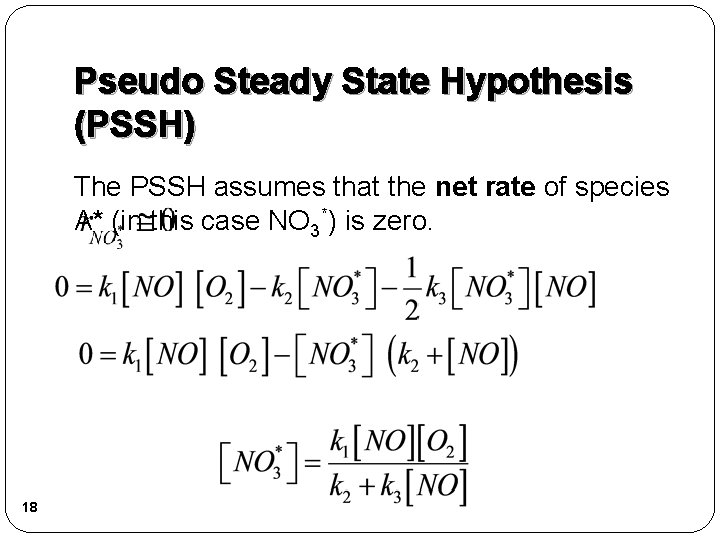
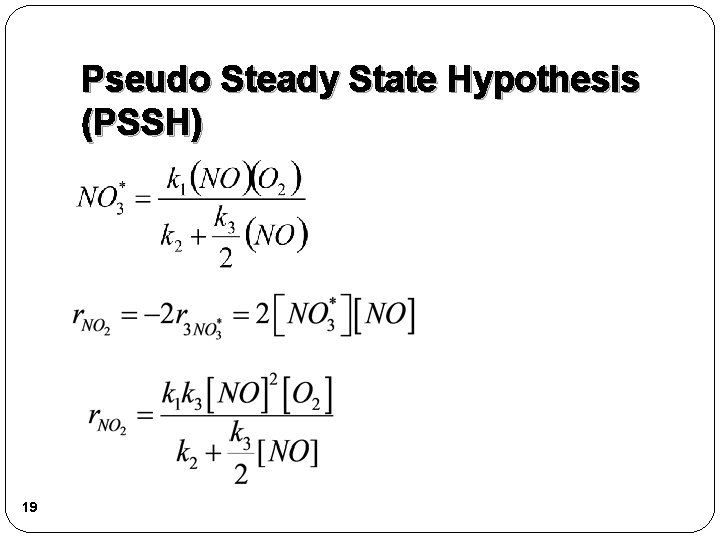
Pseudo Steady State Hypothesis (PSSH) The PSSH assumes that the net rate of species A* (in this case NO 3*) is zero. 18
Pseudo Steady State Hypothesis (PSSH) 19
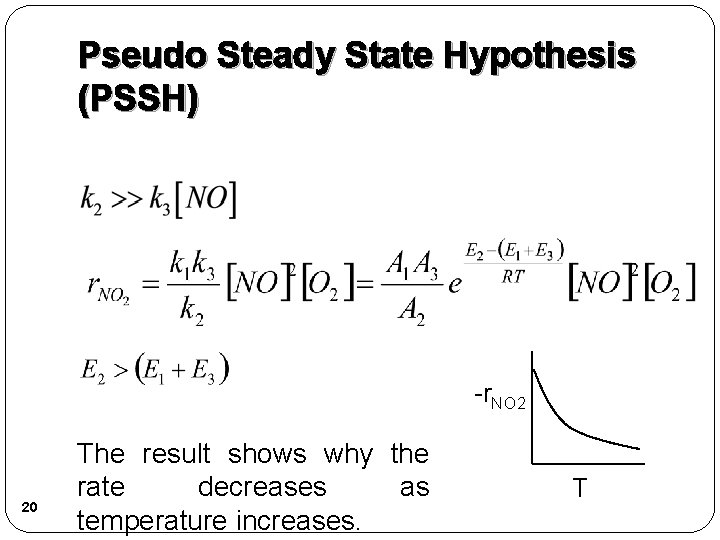
Pseudo Steady State Hypothesis (PSSH) -r. NO 2 20 The result shows why the rate decreases as temperature increases. T
End of Lecture 14 21